
5 B2B Marketing Channels That Still Deliver ROI in 2026
In 2026, the B2B marketing channels generating the highest return on investment are search engine optimization (SEO), email marketing, LinkedIn advertising, account-based marketing (ABM), and webinars. As budgets flatline against rising expectations, success depends on shifting away from high-volume, low-intent tactics toward precise, data-driven channels that demonstrably accelerate the sales pipeline.
The 2026 B2B Budget Reality: Doing More With Less
Marketing leaders are currently navigating a challenging paradox. The mandate for revenue growth is higher than ever, yet corporate marketing budgets have effectively stalled. According to large-scale industry surveys from Gartner and Forrester, the average B2B marketing budget currently sits between 7.7% and 9.4% of total company revenue, representing a stabilization from previous years but a sharp decline from the 9.5% highs seen earlier in the decade 1234.
For the second consecutive year, nearly 59% of Chief Marketing Officers (CMOs) report that their current budget is insufficient to fully execute their strategy, while 48% face pressure regarding headcount cuts 1678. This constrained fiscal environment is forcing a ruthless prioritization of capital and a fundamental shift in how performance is measured. Digital channels now absorb roughly 58% to 61% of total marketing spend, while offline, traditional, and highly experimental channels face an increasingly steep burden of proof 39. Paid media continues to command the largest single share of the budget, accounting for roughly 30.6% of spending, but rising media costs and digital inflation mean marketers are securing less reach for every dollar deployed 131011.
To survive this squeeze, B2B teams are reallocating funds away from broad brand-awareness campaigns and into highly measurable, high-ROI digital engines. The focus has decisively shifted toward channels that capture active intent, nurture long-term relationships, and align directly with sales revenue. Let's explore the five marketing channels delivering the most reliable returns in 2026, the underlying mechanisms driving their success, and the execution strategies required to scale them.
1. Search Engine Optimization (SEO) and the Rise of GEO
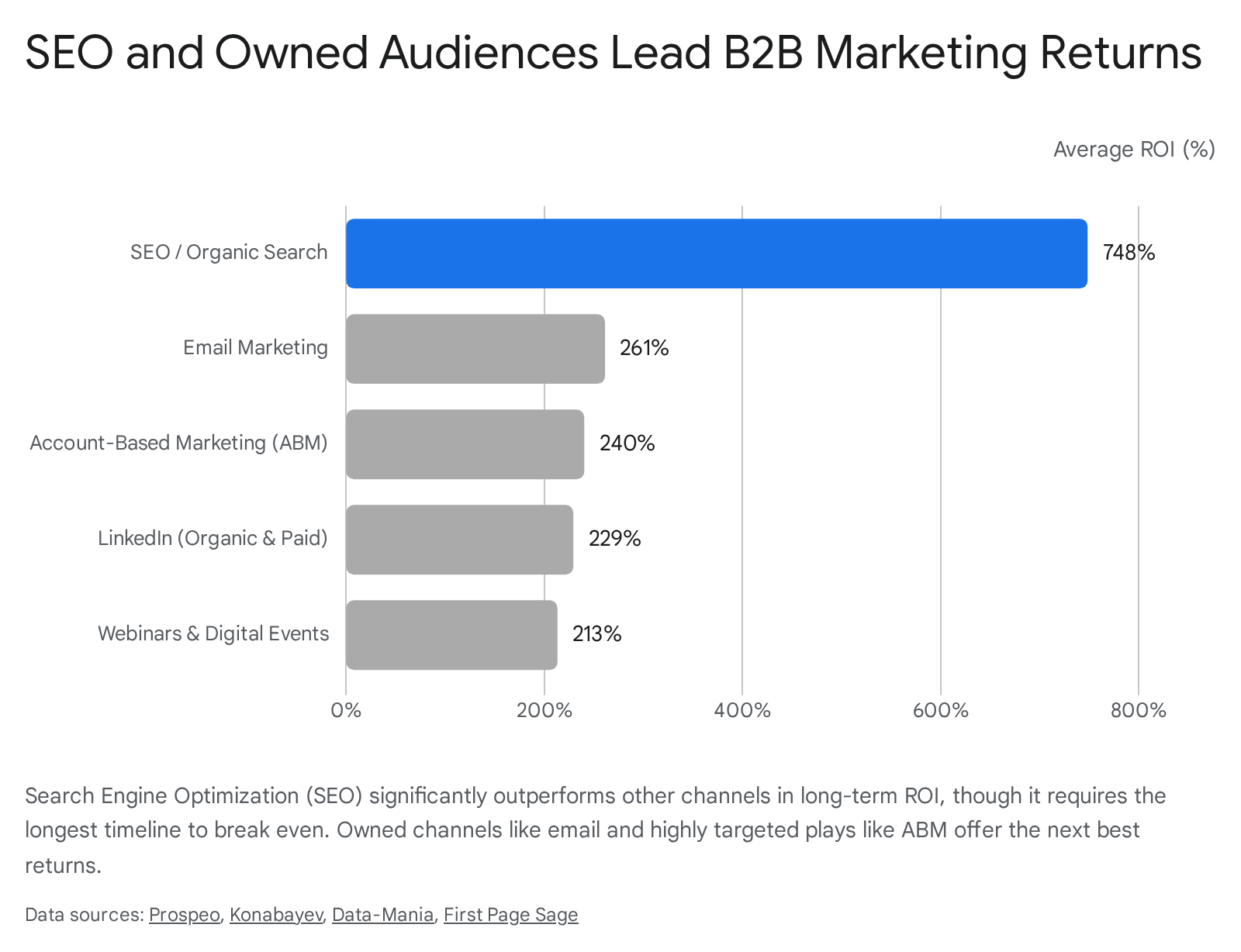
Search Engine Optimization (SEO) consistently ranks as the absolute highest-ROI channel for B2B marketers. When executed correctly, SEO generates an average return of 748% over a three-year period, representing roughly a 9.10 Return on Ad Spend (ROAS) equivalent 12314. Furthermore, SEO boasts the lowest average Cost Per Lead (CPL) in the B2B space, typically hovering around $33, compared to paid search or event leads that can cost hundreds of dollars 9.
The primary driver of this exceptional return is fundamental buyer behavior. Approximately 71% of B2B researchers initiate their vendor evaluation with a generic search query, and organic search remains the largest single traffic source for B2B websites, accounting for roughly 29% to 76% of all incoming traffic depending on the industry 121415.
Unlike paid advertising - which acts like a faucet that stops generating leads the moment the budget runs dry - SEO acts as a compounding financial asset. Content published today continues to attract high-intent buyers months and years into the future. The gap between average and top-performing B2B SEO programs is dramatic: top performers grow organic traffic by 50% or more year-over-year, while average programs hover between 10% and 20% 3. However, marketing leaders must manage expectations regarding velocity; SEO is a long-term play, with the average breakeven point for organic search investments ranging between 4 and 9 months 3144.
The Shift to Generative Engine Optimization (GEO)
While the returns are staggering, the actual mechanics of search are fundamentally changing. In 2026, the rise of AI-powered search overviews and conversational interfaces (such as ChatGPT, Perplexity, and Google's AI Overviews) has forced marketers to adapt to a new discipline: Generative Engine Optimization (GEO) 1245.
Gartner projects that traditional search volume will drop by 25% by 2026 as buyers increasingly shift to AI-powered conversational tools for their research 15. These AI search overviews now appear in over 70% of buyer research experiences 12. Consequently, traditional SEO tactics like keyword stuffing or publishing generic, high-volume blog posts are entirely obsolete. Buyers increasingly discover information through "zero-click" search experiences, where the AI synthesizes an answer directly on the results page without requiring the user to click a blue link 6.
To secure visibility in this new paradigm, content must be structured in a way that Large Language Models (LLMs) can easily parse, validate, and cite. This means prioritizing: * Deep topic clusters: Building interconnected hubs of information rather than isolated pages. * Structured formatting: Utilizing clear schema markup, conversational Q&A formats, and concise explanations 12619. * Original data and human perspective: AI engines prioritize citing primary sources, original research, and recognizable brand authorities 1278. Content that lacks a distinct human point of view is easily replaced by AI-generated summaries.
Comparing Search Channels: Organic vs. Paid
While SEO delivers the highest long-term efficiency, it lacks the immediacy of paid search (SEM). For companies needing to test new messaging, enter new geographic markets, or capture active demand immediately, Google Ads remains a critical, albeit expensive, counterpart to organic strategy.
The table below outlines the core economic differences between organic and paid search in 2026:
| Search Channel Metric | Organic Search (SEO) | Paid Search (Google Ads) | Strategic Implication |
|---|---|---|---|
| Average ROI | 748% | 36% to 200% | SEO is for long-term equity; Paid is for immediate velocity. |
| Average Cost Per Lead (CPL) | ~$33 | $75 - $200 | Paid costs scale linearly with lead volume; SEO costs compound efficiently. |
| Average Conversion Rate | 2.6% - 14.6% | 1.5% - 3.0% | Organic leads generally show higher trust and readiness to buy. |
| Breakeven Timeline | 4 to 9 Months | Immediate to 1 Month | Paid search solves immediate pipeline gaps while SEO matures. |
| Cost Per Click (CPC) | N/A (Fixed investment) | $3.50 - $5.50 | Paid search requires ongoing, escalating budget to maintain visibility. |
Data aggregated from multiple 2026 B2B benchmarks 93144.
2. Email Marketing and Lifecycle Automation
Despite constant industry predictions regarding its demise in the face of social media and instant messaging, email marketing remains the most efficient customer acquisition and nurturing engine in B2B marketing. Broad benchmarks place the average B2B email ROI at 261%, while absolute revenue metrics show astounding returns of roughly $36 to $45 for every single dollar spent 931415923.
Email's dominance stems from its fundamental distribution economics. Because a company fully owns its email subscriber list, the marginal cost of reaching an additional prospect is near zero. Furthermore, the channel is entirely immune to the algorithmic throttling and unannounced policy changes that plague social media platforms 2310. While social media is highly effective for top-of-funnel discovery, email is the digital closer. Research indicates that email drives conversion rates of roughly 4.24% to 8%, which is up to seven times higher than the 0.59% to 3% conversion rates typically seen across social media channels 2310.
The 2014 Myth vs. The 2026 Reality
For years, marketers relied on a famous 2014 McKinsey study claiming that email was 40 times more effective at acquiring customers than Facebook and Twitter combined 925. While email remains highly effective, holding onto this static comparison is dangerous in 2026. The digital ecosystem has completely transformed, and executing successful email marketing today requires significantly more sophistication than sending out a weekly "batch-and-blast" newsletter.
The most significant hurdle in 2026 is the rise of the AI Inbox Agent. Technologies like Apple Intelligence and Google's Gemini now operate within user inboxes, automatically summarizing, filtering, or archiving generic promotional emails before a human decision-maker ever sees them 25. In this environment, generic messaging has no chance of survival; un-targeted emails simply train AI assistants to filter your brand out of the primary inbox.
Zero-Party Data and Hyper-Personalization
To bypass these algorithmic gatekeepers, top B2B brands are shifting away from sheer volume and moving toward extreme precision. This shift relies heavily on the collection of "zero-party data" - information that a customer intentionally and proactively shares with a brand, such as their specific role, current business challenges, or budget timeline 1025. With the total phase-out of third-party cookies, this direct relationship data is more valuable than ever.
Marketing teams are deploying advanced lifecycle automation platforms to trigger emails based on specific behavioral cues. For example, if a prospect views a highly technical pricing page, downloads a specific whitepaper, or attends a niche webinar, the system automatically triggers a tailored sequence of short, text-based emails addressing that specific pain point 19102526.
This behavioral, human-sounding approach yields impressive engagement. Across B2B industries, average open rates range between 18% and 43.5%, with click-through rates hovering between 2% and 4% 8315. However, advanced marketers are increasingly abandoning open rates as a primary metric - due to privacy protections inflating the numbers - and instead focusing on Click-to-Open Rates (CTOR), Revenue Per Email (RPE), and downstream pipeline generation 810.
3. LinkedIn Advertising and the Era of Employee Advocacy
When it comes to B2B social media, LinkedIn is not just the leader; it is effectively the entire market. The platform now hosts over 1.2 billion registered members globally, including over 61 million senior-level influencers and 40 million active decision-makers 27. Consequently, LinkedIn generates an astounding 80% of all B2B leads sourced from social media - no other platform comes close 272829.
Financially, LinkedIn is the only major social network that consistently delivers a positive Return on Ad Spend (ROAS) for complex B2B sales cycles, currently averaging a 121% ROAS 8. When looking at comprehensive ROI, organic LinkedIn content delivers roughly 192% ROI, while paid campaigns average 229% 314430.
The Cost of Precision
LinkedIn's core advantage lies in the precision of its professional graph. Advertisers can target buyers surgically by job title, seniority, company size, skills, and even specific firmographic clustering 2629. This allows marketers to place their message exactly in front of the buying committee of a target account.
However, this precision comes at a steep premium. LinkedIn is a highly competitive, "pay-to-play" environment for B2B brands. Cost Per Click (CPC) averages $5 to $9, and Cost Per Lead (CPL) for sponsored content typically ranges from $75 to $150, easily exceeding $200 for niche enterprise audiences 4331. Despite these high upfront costs, the downstream economics justify the investment; LinkedIn's visitor-to-lead conversion rate sits at 2.74%, which is nearly three times higher than the rates seen on Twitter or Facebook 1427.
The "Power of Two" and the "Drip Effect"
To combat rising ad costs and algorithmic changes, smart marketers are rethinking how they use the platform. In 2025 and 2026, LinkedIn implemented significant algorithm updates (often referred to as the "360Brew" engine) that heavily prioritize authentic human connection over corporate broadcasting 31. B2B buyers have become highly skeptical of polished corporate jargon; they prefer learning from individual subject matter experts and peers.
As a result, personal profiles now consistently outperform corporate Company Pages in organic reach. Employee-generated posts achieve double the engagement of company posts, and content authored by a CEO or founder can generate up to four times the average engagement 2729.
The LinkedIn B2B Institute identifies this phenomenon as the "Drip Effect" - a strategy where a steady, strategic drip of real employee stories and insights builds lasting brand impact far more effectively than massive corporate ad bursts 1133. The most successful B2B organizations are now employing the "Power of Two" framework: they equip their internal subject matter experts to post authentic, educational content organically, and then use the corporate marketing budget to amplify those specific high-performing posts as "Thought Leader Ads" to a targeted audience 30313334. This hybrid approach humanizes the brand, builds trust earlier in the buying cycle, and significantly lowers the overall cost of acquisition.
4. Account-Based Experience (ABX) and Buyer Intent
As B2B sales cycles lengthen and economic scrutiny tightens, traditional broad-net "demand generation" is losing its efficacy. B2B buying committees have expanded significantly; the average deal now involves 6.8 people, and complex enterprise Software-as-a-Service (SaaS) deals often require consensus from 7 to 13 different decision-makers 935. Furthermore, these buyers require an average of 31 distinct marketing touchpoints spread across 84 days before they are ready to convert 35.
In this environment, casting a wide net to capture low-level leads is highly inefficient. Instead, high-performing revenue teams utilize Account-Based Marketing (ABM), a strategy that flips the traditional funnel upside down. Rather than trying to attract thousands of random leads, marketing and sales teams collaborate to identify a specific "Dream 100" list of high-value accounts, and then direct all resources toward penetrating those specific companies 3612.
The financial case for ABM is robust. It delivers an estimated 240% ROI, and 87% of B2B marketers state that their ABM initiatives outperform all other marketing investments 94. Organizations utilizing ABM report that their Annual Contract Values (ACV) are up to 171% higher than those generated by traditional methods, and their sales cycles close 28% faster 9.
The Evolution from ABM to ABX
By 2026, the standard practice of ABM has evolved into a more sophisticated methodology known as Account-Based Experience (ABX) 38. Traditional ABM often devolved into sales teams aggressively cold-calling a target list, regardless of whether the account was actually in the market to buy. ABX, conversely, focuses on delivering synchronized, personalized content to the entire buying committee only when they show active interest, prioritizing the buyer's experience over the seller's timeline 38.
The Role of Buyer Intent Data
The engine powering this ABX revolution is buyer intent data. According to Gartner, 75% of B2B buyers now prefer a "rep-free" sales experience, choosing to conduct deep, independent research online before ever speaking to a vendor 39. By the time a prospect fills out a "Contact Sales" form, the decision is often already heavily skewed toward a preferred vendor.
Intent data platforms track this anonymous digital footprint across the web. They monitor when employees at a specific target account are reading industry analyst reports, comparing software solutions on third-party review sites, or surging in search activity for specific technical keywords 939.
By identifying these real-time research behaviors, marketers can deploy advertising and personalized outreach to accounts that are actively exploring solutions. This precise timing drastically reduces wasted ad spend and allows sales reps to intervene early in the decision-making process. While launching a robust ABX program carries significant setup and software costs (often $25,000 to $35,000+), the resulting pipeline efficiency makes it a non-negotiable strategy for enterprise deals exceeding $50,000 in value 34.
5. Webinars, Video Content, and the "Bottle Episode"
Rounding out the top five channels are interactive digital formats: webinars, digital events, and video marketing. These formats deliver an average ROI of 213%, with specialized B2B SaaS companies frequently pushing that return to 430% or higher 3144.
The medium of video has become absolutely non-negotiable in B2B marketing. In 2026, 91% of businesses utilize video as a primary marketing tool, and 72% of B2B buyers actively consume video content during their purchasing journey 928. The engagement metrics justify the investment: video content achieves engagement rates 1,200% higher than text and static images combined, and placing a video on a landing page can increase conversion rates by up to 34% 28.
The "Bottle Episode" Concept
While video is ubiquitous, the format of digital events is shifting. For years, B2B marketers measured the success of a webinar simply by the volume of registrants. Today, however, massive, generic webinars suffer from low attendance and poor engagement.
A fascinating trend emerging in 2026 is the B2B "Bottle Episode," a concept identified by researchers at the LinkedIn B2B Institute 1133. In television production, a "bottle episode" is an episode shot entirely in one location with a limited cast, designed to save money but often resulting in the most intense, character-driven storytelling of the season.
B2B marketers are adapting this concept to digital events. Rather than hosting sprawling, public broadcasts, brands are producing highly focused, intimate digital roundtables, invite-only workshops, or exclusive community Q&A sessions 30113340.
These "bottle episodes" serve to isolate the audience from the overwhelming noise of the internet. By creating a private, enclosed environment, marketers foster deeper trust. B2B buyers - exhausted by public social media posturing - increasingly prefer these safe, community-driven spaces to validate vendors, compare solutions, and ask candid questions 3011.
While webinars and digital events lack the immediate speed-to-lead of paid search - typically requiring 7 to 9 months to show their full ROI as attendees move through complex sales cycles - they serve as unparalleled mid-funnel accelerators. Hearing the voice of a brand's leadership, seeing a live product walkthrough, and interacting with peers creates an emotional connection that static text simply cannot replicate 3430.
The True Cost of Scaling and Budget Allocation
Understanding channel ROI is only half the battle; marketing leaders must also know how to allocate their overall budget to scale these channels effectively. The "right" budget allocation depends heavily on a company's growth stage and go-to-market motion.
Marketing Spend by Company Stage
Data from 2025 and 2026 reveals stark differences in how companies fund their marketing operations based on their maturity:
- Pre-Product-Market Fit (Pre-PMF): Early-stage startups in aggressive growth mode allocate a massive 30% to 60%+ of their revenue to marketing. The goal here is rapid experimentation and pipeline creation, even if it results in high Customer Acquisition Costs (CAC) 2.
- Scaling Stage ($10M - $50M ARR): Companies transitioning into scaleups reduce their relative spend to 15% to 25% of revenue. At this stage, the focus shifts to balancing aggressive market expansion with improving the efficiency of proven channels 235.
- Mature / Established Stage ($50M+ ARR): Highly mature, enterprise companies drop their marketing spend to 5% to 7% of revenue. Their budgets prioritize defending market share, optimizing the CAC payback period, and brand maintenance rather than aggressive new customer acquisition 2.
The 70/20/10 Rule for Channel Investment
Regardless of stage, B2B leaders are advised to avoid putting all their budget into a single channel. A widely recommended framework for 2026 is the 70/20/10 rule: * 70% on Proven Strategies: Invest the bulk of the budget into core, high-ROI channels that reliably generate pipeline (e.g., SEO, Email, targeted LinkedIn Ads). * 20% on Emerging Channels: Allocate funds to scaling channels that show promise but require optimization (e.g., new intent-data ABX plays, podcast sponsorships). * 10% on Experiments: Reserve a small fraction for high-risk, high-reward tests (e.g., experimental AI platforms, new event formats) to stay ahead of market shifts 2.
The Measurement Crisis: The Death of the MQL
The most significant barrier to proving marketing ROI in 2026 is an outdated measurement framework. Only 36% of marketers report that they can accurately measure their ROI, and 47% struggle significantly with cross-channel attribution 41.
For over a decade, B2B marketing success was measured by the volume of Marketing Qualified Leads (MQLs) generated. However, the MQL model is fundamentally broken in 2026. Data shows that across B2B SaaS, an abysmal 13% of MQLs actually convert into Sales Qualified Leads (SQLs) 35. Focusing on sheer lead volume incentivizes marketing teams to gate every piece of content and chase cheap, low-intent clicks on platforms like Facebook, resulting in bloated CRMs and frustrated sales teams.
Shifting to Revenue-Centric Metrics
To bridge the gap between marketing activity and actual business growth, top brands and CFOs are demanding a shift to revenue-centric metrics. Instead of counting raw leads, modern marketing organizations track:
- Sourced Pipeline: The total dollar value of sales opportunities that were directly generated by a marketing campaign 42.
- Influenced Pipeline: The total dollar value of deals where marketing touchpoints accelerated the sales timeline or increased the deal size, even if sales initiated the first contact 42.
- Customer Acquisition Cost (CAC): The total cost of marketing and sales divided by the number of new customers acquired. The median B2B SaaS CAC in 2026 sits around $702 73.
- LTV:CAC Ratio: The ratio of a customer's Lifetime Value compared to the cost to acquire them. A healthy, sustainable B2B target is a ratio of 3:1 or higher 43.
Furthermore, because buyers touch an average of 31 marketing assets across 84 days before converting, simplistic "last-click" attribution models are deeply misleading 35. Attributing a closed enterprise deal entirely to the Google Ad a prospect clicked the day before signing ignores the months of podcasts, SEO articles, and LinkedIn posts that actually built the trust. To combat this "dark funnel" of untracked activity, sophisticated marketers are moving toward Machine Learning Attribution models, Media Mix Modeling (MMM), and hybrid setups that balance digital tracking with qualitative "How did you hear about us?" surveys 42.
Bottom line
In a macroeconomic climate defined by flatlined budgets, rising media costs, and increasingly complex buyer journeys, B2B marketers can no longer afford the "spray and pray" approach of previous eras. Search Engine Optimization, Email Marketing, LinkedIn Advertising, Account-Based Experience (ABX), and intimate digital events represent the highest-ROI investments because they allow brands to capture specific intent, bypass algorithmic noise, and engage directly with entire buying committees. Moving forward, sustainable growth requires abandoning vanity metrics and lead volume in favor of rigorous pipeline efficiency, authentic employee-led thought leadership, and deep, data-driven alignment with sales revenue.