
Digital marketing ROI by channel and region in 2026
The digital marketing landscape in 2026 represents a critical inflection point where the era of growth-at-all-costs has been permanently replaced by a mandate for rigorous, verifiable unit economics. Driven by privacy regulations, the proliferation of generative artificial intelligence in search environments, and heightened macroeconomic scrutiny, marketing leaders and Chief Financial Officers (CFOs) have fundamentally altered how return on investment (ROI) is defined, measured, and funded. Organizations have shifted their focus from generating digital activity to architecting causal relationships between media capital and enterprise value.
This comprehensive analysis examines the structural shifts defining the 2026 marketing ecosystem. It relies heavily on institutional research from authoritative marketing journals such as eMarketer and Marketing Dive, alongside institutional reports from Forrester, Nielsen, Gartner, and HubSpot. By explicitly addressing the limitations of current data availability, decoupling vanity engagement metrics from true financial performance, exploring the maturation of complex channels like Retail Media Networks (RMNs) and Connected TV (CTV), and dissecting the divergent mechanics of B2B and B2C commerce across global regions, this report provides an authoritative blueprint for navigating the contemporary digital economy.
1. The Epistemology of Marketing Data in 2026
1.1 Data Availability, Source Quality, and Benchmarking Limitations
Establishing definitive ROI benchmarks in 2026 requires navigating an environment defined by data fragmentation and signal loss. The transition from third-party tracking ecosystems to privacy-first architectures has fundamentally altered the reliability of digital measurement. Consequently, evaluating 2026 performance requires synthesizing institutional benchmark forecasts published in late 2025 with early-2026 quarterly actuals to establish a realistic range of expected outcomes. Absolute precision in cross-channel tracking is no longer technologically feasible.
Forecasts generated in late 2025 projected linear trajectories that early-2026 actuals have frequently contradicted 11. Historically, the gap between budgeted marketing spend and actual execution averages approximately 23%, often due to intra-year volatility in channel costs, unexpected algorithmic shifts, and unspent experimental budgets 1. Furthermore, privacy regulations and technology shifts have eliminated 30% to 40% of the conversion signals that marketers historically relied upon to build multi-touch attribution models 1. The cumulative impact of the European Union's General Data Protection Regulation (GDPR), state-level privacy laws in the United States, Apple's App Tracking Transparency (ATT) framework, and the deprecation of third-party cookies in major browsers has created an inherently opaque measurement environment 124.
To overcome these blind spots, this report prioritizes data sourced from robust institutional frameworks. Organizations like Gartner and Forrester provide macroeconomic context, while platforms like HubSpot and eMarketer offer granular, channel-specific metrics that reflect the realities of the early 2026 operating environment 1534.
2. The CFO's Mandate: Eradicating Engagement Misconceptions
For over a decade, marketing organizations conflated engagement metrics - such as open rates, impressions, follower growth, and click-through rates (CTR) - with actual financial ROI. In 2026, executive boards and finance departments have aggressively debunked this misconception, forcing marketing teams to justify their existence in the language of corporate finance 8510.
2.1 The Breakdown of Vanity Metrics
Marketing budgets have generally flattened at approximately 7.7% of overall company revenue, intensifying the pressure to prove direct financial impact 811. In this environment, engagement metrics serve only as directional indicators for algorithmic optimization, not as proxies for revenue. For example, email open rates have become highly unreliable due to privacy features like Apple's Mail Privacy Protection (MPP), which artificially inflates open rates by an estimated 4.5 percentage points by pre-fetching email content 126. Similarly, raw impression counts on search engines have lost their correlation with business value, as users increasingly view information on the search engine results page without clicking through to the host website 14.
2.2 Realigning with True Financial ROI
Modern marketing reporting is oriented entirely around causal financial outcomes. The metrics that dictate budget allocation in 2026 are separated entirely from surface-level engagement. The table below illustrates the critical shift from vanity metrics to the financial metrics demanded by modern executives.
| Legacy Engagement Metric (Pre-2025) | 2026 Financial Equivalent | Definition and Executive Relevance |
|---|---|---|
| Email Open Rate | Net Revenue Retention (NRR) | NRR measures expansion revenue minus churn. Best-in-class SaaS organizations operate at 116% to 120% NRR, meaning the value of an existing customer cohort grows without any new acquisition spend 716. |
| Cost Per Click (CPC) | Customer Acquisition Cost (CAC) Payback Period | Measures the time required to recoup the cost of acquiring a customer. Fast payback periods allow for aggressive reinvestment of working capital 717. |
| Total Lead Volume | Pipeline Velocity & Sourced Revenue | High-performing marketing teams are expected to source 40% to 55% of the total sales pipeline, operating as co-equal revenue drivers rather than top-of-funnel cost centers 18. |
| Return on Ad Spend (ROAS) | Incremental ROAS (iROAS) | iROAS isolates the net-new revenue caused directly by the marketing intervention, discounting sales that would have happened organically without the ad exposure 19821. |
| Social Follower Growth | Customer Lifetime Value (LTV) to CAC Ratio | The cross-industry median sits at 3.4x, with top-quartile operators achieving a 5.6x ratio. This ratio dictates whether unit economics support sustainable scaling 71617. |
CFOs are prioritizing flexibility, measurable pipeline contribution, and programs that demonstrate a clear timeline for returns 10. Initiatives that rely on long feedback loops without intermediate financial milestones are the first to be divested during quarterly budget reviews 10.
3. The Mechanics of Measurement: Multi-Touch Attribution Versus Marketing Mix Modeling
The shift toward absolute financial accountability has triggered a structural overhaul of measurement mechanics. The industry has reached a consensus that no single platform can provide a perfect view of the customer journey, leading to the deployment of multi-layered measurement architectures.
3.1 The Diminishing Efficacy of Multi-Touch Attribution (MTA)
By 2026, while 41% of enterprises still attempt to use MTA models, only 18% rate their implementations as highly accurate 1. MTA fundamentally relies on user-level tracking to stitch together fragmented digital journeys across devices and platforms. As device identifiers, IP tracking, and third-party cookies vanish, MTA models develop massive blind spots 92310.
This signal loss systematically over-credits lower-funnel, direct-response tactics (such as branded search or retargeting) because they are typically the last measurable touchpoint before a conversion 91011. Conversely, MTA chronically under-values upper-funnel brand building channels like digital video, connected TV, and organic content 1011. In 2026, MTA has not disappeared, but its role has been drastically narrowed. It is now largely relegated to tactical optimization within isolated "walled gardens" (such as Meta Ads Manager) or strictly owned ecosystems (logged-in app environments), where deterministic tracking remains intact 1011.
3.2 The Renaissance of Marketing Mix Modeling (MMM)
To answer strategic questions about portfolio-level budget allocation, the industry has experienced a massive resurgence in Marketing Mix Modeling (MMM) 49. Enterprise adoption of MMM has surged to 27%, up from 14% in 2023, largely driven by open-source frameworks and the integration of artificial intelligence 1.
Traditional MMM was a slow, expensive, and backward-looking exercise requiring months of econometric modeling by specialized data scientists. In 2026, MMM has evolved into an agile, AI-powered framework capable of generating actionable insights in one to two weeks 1426. Modern MMM platforms ingest daily or hourly aggregated data, utilizing Bayesian hierarchical models and machine learning to rapidly simulate thousands of budget permutations and diminishing returns curves 426.
Because MMM analyzes aggregated time-series data rather than individual user paths, it is inherently privacy-compliant and immune to browser-level tracking preventions 92310. It enables marketing leaders to mathematically measure the interplay between offline channels (linear TV, out-of-home), external economic factors (seasonality, inflation), and digital spend 923.
3.3 The Unified Measurement Architecture
The state-of-the-art measurement architecture in 2026 abandons the false dichotomy of "MMM versus MTA" in favor of a "Unified Marketing Measurement" (UMM) stack. This tri-layered approach functions as follows: 1. Strategic Allocation (MMM): Top-down econometric modeling dictates the overarching budget envelopes across channels, regions, and business units based on historical aggregate trends 91011. 2. Tactical Optimization (MTA): Bottom-up attribution manages daily bid optimization and creative rotation strictly within the allocated channel budgets 1011. 3. Causal Validation (Incrementality Testing): Continuous geo-holdout experiments and causal AI tests serve as the objective ground truth, continuously calibrating the outputs of both the MMM and MTA systems to ensure budget is driving purely incremental revenue 191011.
4. Expanding the Channel Scope: AI, RMNs, and CTV
The channels driving the highest marginal returns in 2026 operate in either highly closed-loop ecosystems (where purchase intent and conversion data are owned by a single platform) or AI-mediated environments that bypass traditional web navigation entirely.
4.1 AI-Overviews (SGE) and Zero-Click Platforms
The most profound structural shift in organic marketing in 2026 is the mainstream dominance of generative AI in search. Features such as Google's AI Overviews and native AI search engines like Perplexity and ChatGPT Search have fundamentally altered global traffic patterns.
Data from early 2026 indicates that 64.82% of all Google searches now end without a user clicking on a traditional blue link 1213. The prevalence of AI Overviews continues to climb, triggering on 25.11% to 48% of all queries depending on the specific industry and measurement methodology 14. When an AI Overview is triggered, organic click-through rates (CTR) plummet by an average of 18% to 34.5%, with some broad informational queries experiencing CTR drops as steep as 61% 1213141531. ChatGPT's search functionality exhibits an even more extreme zero-click nature; despite handling massive query volumes, it sends approximately 190 times less referral traffic to external websites than traditional Google search 14.
This phenomenon necessitates a paradigm shift from traditional Search Engine Optimization (SEO) to Answer Engine Optimization (AEO) or Generative Engine Optimization (GEO) 32333435. The strategic objective is no longer to route traffic to a domain, but to be cited as the authoritative source inside the AI summary itself 323335. While overall traffic volume falls precipitously, the quality of the surviving traffic is exceptionally high. Users who click through an AI Overview citation convert at a 23% higher rate because their basic informational intent has already been satisfied; they arrive at the website seeking deep, transactional engagement 1215.
To prove ROI in a zero-click environment, marketers have adopted the "Enterprise AI Visibility KPI Stack," which replaces session-based reporting with three distinct metrics 13: * AI Inclusion Rate (AIR): The mathematical frequency with which a brand's domain is cited in AI summaries across priority prompts 13. * Recommendation Share (RS): The brand's proportional presence against competitors within AI-generated product comparisons 13. * Assisted Revenue Influence (ARI): A modeled metric that connects AI citations to downstream financial outcomes by quantifying revenue generated in subsequent sessions influenced by prior AI brand exposure 1333.
4.2 Retail Media Networks (RMNs): Maturation and Margin Pressures
Retail Media Networks - where retailers package their digital properties and first-party shopper data as advertising inventory - have evolved from experimental budgets into a primary digital pillar. In 2026, US retail media ad spend is projected to approach $70 billion, while globally, RMNs command approximately 22% of total media budgets, representing the definitive "third wave" of digital advertising 83616.
The primary appeal of RMNs is their inherent closed-loop attribution. Because platforms like Amazon, Walmart Connect, and Target Roundel control both the advertising surface and the digital point of sale, they can definitively link an ad impression to a finalized purchase without relying on vulnerable third-party cookies 1617.
However, by 2026, the honeymoon phase of RMNs has definitively ended 8. As consumer packaged goods (CPG) brands and endemic advertisers flood these networks, cost-per-click (CPC) and CPM inflation have severely compressed product margins 18. Advertising is increasingly viewed not as a discretionary growth lever, but as a mandatory operational tax required simply to maintain digital shelf space against aggressive competitors 18.
To combat diminishing returns on crowded lower-funnel search placements, retail media investment is rapidly shifting "offsite" 82117. Retailers are utilizing their rich first-party purchase data to target their shoppers across the open web, social media platforms, and connected TV ecosystems. While onsite media margins for retailers are incredibly lucrative (frequently ranging between 70% and 90%), offsite margins compress significantly to 20% to 40% 2117. The operational challenge in 2026 lies in managing the fragmentation of dozens of different RMNs, each utilizing distinct workflows and definitions of "incremental" sales 174041. Brands are heavily scrutinizing these investments, demanding standard incrementality tests and integrating data clean rooms to ensure RMN spend isn't merely cannibalizing sales that would have occurred organically 171840.
4.3 Connected TV (CTV): The Convergence of Brand and Performance
By 2026, Connected TV ad spend is forecasted to reach $38.8 billion, functioning as the primary growth engine for video advertising as linear television viewership continues its structural decline 194344. Linear TV ad spend now accounts for just 12.4% of global media spend - a staggering 70% drop in market share since 2013 44.
Historically, television was treated exclusively as an upper-funnel awareness vehicle measured by broad demographic reach. Today, CTV combines the high-impact visual storytelling of the living room screen with the precision targeting and programmatic bidding architecture of digital display advertising 4344. Performance metrics demonstrate that CTV campaigns generate up to 10 times more conversions than traditional linear TV, despite utilizing only 60% of the comparative budget 20. Furthermore, CTV advertising ROI averages 4.5 times higher than linear TV, with an estimated return on media investment of $0.81 on the dollar (rapidly approaching the $0.90 digital baseline) 4621.
A defining trend in 2026 is the deep integration of CTV with Retail Media Networks. Through data clean rooms, brands can overlay deterministic retail purchase data directly onto CTV ad buys, enabling highly targeted household delivery 1617. This convergence has given rise to "shoppable CTV," featuring interactive formats that allow viewers to add items directly to an online cart via their remote control or a generated QR code. These shoppable CTV formats are reported to convert at a rate five times higher than standard digital video ads, firmly establishing CTV as a full-funnel channel capable of driving both brand salience and immediate financial performance 4648.
5. Global Structural Asymmetries: EMEA and APAC Divergence
Global digital marketing in 2026 is far from homogeneous. Regional data privacy laws, distinct cultural relationships with technology, and divergent consumer behaviors require strictly localized ROI expectations and go-to-market mechanics.
5.1 EMEA: Privacy Frameworks and the Economics of Trust
In Europe, the Middle East, and Africa (EMEA), marketing ROI is heavily dictated by the strictures of aggressive data privacy legislation. Five years post-implementation, the GDPR, augmented by the ePrivacy Regulation, has forced a maturation in how digital businesses operate across the continent 2495022.
The financial stakes for non-compliance are severe; cumulative GDPR fines have surpassed €4.5 billion, with a remarkable 72% of that total levied in the past three years alone as regulatory bodies accelerate enforcement 2. Consequently, compliance is no longer viewed merely as an operational risk, but as a core component of brand equity and long-term marketing performance.
The average opt-in rate for marketing cookies across the European Union has dropped to 46% in 2026, leading to a systemic average data loss of 25% to 40% for platforms like Google Ads 2. Furthermore, research indicates that 27% of European visitors instinctively click "reject all" on Consent Management Platform (CMP) banners without reading the terms 2. The traditional programmatic advertising playbook, reliant on pervasive third-party tracking, is fundamentally broken in this region.
To maintain high ROI in EMEA, marketing organizations have pivoted aggressively to zero-party and first-party data strategies 4952. Instead of relying on passive surveillance tracking, brands are actively engineering "value exchanges" - offering premium content, exclusive discounts, or highly personalized digital experiences in explicit exchange for user data 49. Marketers who adapt early to contextual signals, hybrid predictive attribution systems, and transparent data ecosystems are capturing significant market share from competitors who remain paralyzed by signal loss 249.
5.2 APAC: The Social Commerce Phenomenon
Conversely, the Asia-Pacific (APAC) region is characterized by an unprecedented explosion in social commerce and mobile-first consumer behavior, juxtaposed against highly fragmented digital maturity across different sovereign nations.
APAC currently accounts for a staggering 71.6% of global social commerce revenue, driven predominantly by mobile devices which capture 92.2% of transactions 23. In Southeast Asia specifically, social platforms have achieved a permanent behavioral shift, capturing one in four e-commerce dollars. This momentum is propelling the regional social commerce market from an estimated $47.6 billion in 2025 toward a projected $186.5 billion by 2030, representing a compound annual growth rate (CAGR) of 31.4% 23.
The ROI mechanics in APAC are entirely distinct from Western markets. While traditional e-commerce conversion rates globally sit between 1% and 2%, live commerce platforms in APAC radically outperform these baselines. Platforms like Shopee Live and TikTok Live boast conversion rates ranging from 4.3% to 7.2%, with theoretical peak scenarios approaching 30% under optimal conditions 23. Influencer marketing in APAC relies heavily on highly engaged "micro-influencers" (accounts with 2,000 to 10,000 followers) operating in tight-knit community channels. When a micro-influencer recommends a product in Southeast Asia, data indicates that 82% of consumers follow through with a purchase, yielding an influencer-to-purchase conversion impact up to 40 times higher than traditional display advertising 23. Chat commerce via platforms like WhatsApp and Line is also ubiquitous, accounting for 40% of purchases in markets like Thailand 23.
Despite this highly lucrative environment, APAC presents complex operational challenges. Stricter data protection laws (such as Singapore's PDPA) are increasing compliance costs, with potential regional fines for violations exceeding $1.5 billion collectively 5224. Moreover, the region is highly culturally and linguistically fragmented. A significant 68% of B2B marketers in the region report struggling to identify the correct buying groups due to inconsistent multi-market data and diverse research behaviors 55. Success in APAC requires hyper-localized intent models and deep platform integration rather than broad, generic regional assumptions.
6. Analytical Separation of Commerce: B2B vs. B2C Modalities
To evaluate channel effectiveness accurately, a strict analytical separation between Business-to-Business (B2B) and Business-to-Consumer (B2C) operations must be maintained. The unit economics, sales cycle lengths, and optimal marketing channel mixes differ profoundly, rendering aggregate cross-industry benchmarks largely useless.
6.1 B2C Dynamics: Algorithmic Commerce and Immediate Gratification
B2C marketing in 2026 is defined by rapid transaction velocity, algorithmic product discovery, and the absolute imperative to maximize early-stage customer retention to offset rising acquisition costs.
- Email Marketing: Email remains the undisputed ROI champion for B2C organizations, particularly in the retail and e-commerce sectors. It returns an average of $36 to $45 for every $1 spent 5116. Advanced AI-driven segmentation and send-time optimization have preserved email's profitability despite massive inbox clutter. Highly targeted micro-segments (audiences of 500-2,000) generated by AI predictive intent scores outperform broad broadcast sends by a factor of 3.4x in conversion 6.
- Paid Social (TikTok and Instagram): B2C brands continue to allocate massive budgets to short-form video platforms. Influencer and affiliate marketing on these platforms yield robust returns, averaging $5.78 to $6.50 per $1 spent 56. Social commerce integrations allow brands to capitalize on impulse buying directly within the content feed, minimizing friction.
- Customer Lifetime Value (LTV): Customer retention in B2C e-commerce is highly fragile. The average repeat-purchase rate falls to 28% by Month 12, as the underlying behavior is non-contractual 717. However, a major breakthrough in 2026 is that subscription-based direct-to-consumer (DTC) brands (e.g., consumables, beauty refills, pet food) have achieved positive Net Revenue Retention (102%) at scale for the first time, fundamentally improving their LTV:CAC ratios and altering how these consumer businesses are valued 7.
6.2 B2B Dynamics: Pipeline Velocity and Multi-Touch Complexity
B2B marketing operates under drastically different constraints. The average B2B deal in 2026 takes an agonizing 272 days to close, involves approximately 10 different channels, 11+ unique digital touchpoints, and requires consensus from 7 to 10 stakeholders within a complex buying committee 2558. Consequently, single-channel or last-click attribution in B2B is deeply flawed and misleading.
- Organic Search (SEO/AEO) & Content: SEO delivers the highest compounding ROI in B2B marketing, averaging 748% over a 12-to-24-month horizon 355859. It produces the lowest Cost Per Lead (CPL) at roughly $33, with leads closing at a 14.6% rate - vastly outperforming the 1-2% close rates of traditional outbound tactics like cold calling 5625. Content marketing generates 3.4x more leads per dollar spent compared to outbound methods 25.
- LinkedIn Ads: LinkedIn has completely solidified its dominance in the B2B paid social sector. While expensive - with CPLs ranging from $80 in APAC to $120 in EMEA and $230 in North America - it boasts a 121% Return on Ad Spend (ROAS) and captures 41% of all B2B paid social budgets 360. It remains the only platform capable of precisely targeting high-value decision-makers by seniority, industry, and firmographics at scale 58.
- B2B Unit Economics: The B2B Software-as-a-Service (SaaS) sector highlights a growing decoupling in Customer Lifetime Value. Mid-market SaaS CLV ($43,200) is now 4.4 times higher than Small and Medium Business (SMB) SaaS ($9,850) 7. This disparity is driven not by initial pricing, but by Net Revenue Retention. Mid-market accounts retained on multi-product contracts achieve 116% NRR, demonstrating that post-sale expansion economics - fueled by continuous marketing engagement and customer success alignment - is the primary driver of B2B profitability 7.
6.3 Synthesized Findings: Comparative Channel Performance
The table below synthesizes the definitive 2026 performance benchmarks, explicitly highlighting the distinct strategic roles and expected returns channels play depending on the underlying business model.
| Marketing Channel | Primary B2B Metric & 2026 Benchmark | Primary B2C Metric & 2026 Benchmark | Current Strategic Shift |
|---|---|---|---|
| Email Marketing | Pipeline Nurture: $36 ROI per $1 spent; 2.4% conversion rate; CPL averages $57 565625. | Direct Revenue: $45 ROI per $1 spent; 2.8% conversion rate 5656. | Hyper-segmentation via AI predictive modeling; basic broadcast blasts are obsolete 6. |
| Organic Search (SEO/AEO) | Demand Capture (Long-term): 748% ROI; Lowest CPL ($33); 14.6% close rate 562559. | Brand Discovery: High traffic, variable ROI depending on Average Order Value 115961. | Shift from traditional blue-link optimization to Answer Engine Optimization (AEO) due to 64.8% zero-click rates 123335. |
| Paid Social Media | Targeted Lead Gen: LinkedIn dominates (121% ROAS; ~$124-$230 CPL) 32560. | Impulse Commerce: Meta/TikTok ($2.80 ROI); high creator/influencer ROI ($5.78) 656. | B2B focuses on firmographic precision; B2C focuses on native, short-form video formats and social commerce integration 586026. |
| Retail Media Networks (RMNs) | N/A (Limited B2B application outside of specific industrial distributors) | Incremental Sales: High onsite ROAS; Offsite CPMs benchmark at $25-$60 2140. | Widespread shift to offsite programmatic extensions to combat severe onsite margin compression 211718. |
| Connected TV (CTV) | Brand Salience/Awareness: Emerging use for enterprise brand building and complex product storytelling 27. | Full-Funnel Performance: 4.5x higher ROI than linear; 1.8-3.5% engagement 2046. | Transition from reach-based metrics to shoppable formats, directly tying living room screens to online carts 432046. |
The empirical data across all regions and business models confirms that success in 2026 demands a complete rejection of superficial marketing metrics in favor of rigorous, mathematically sound unit economics.
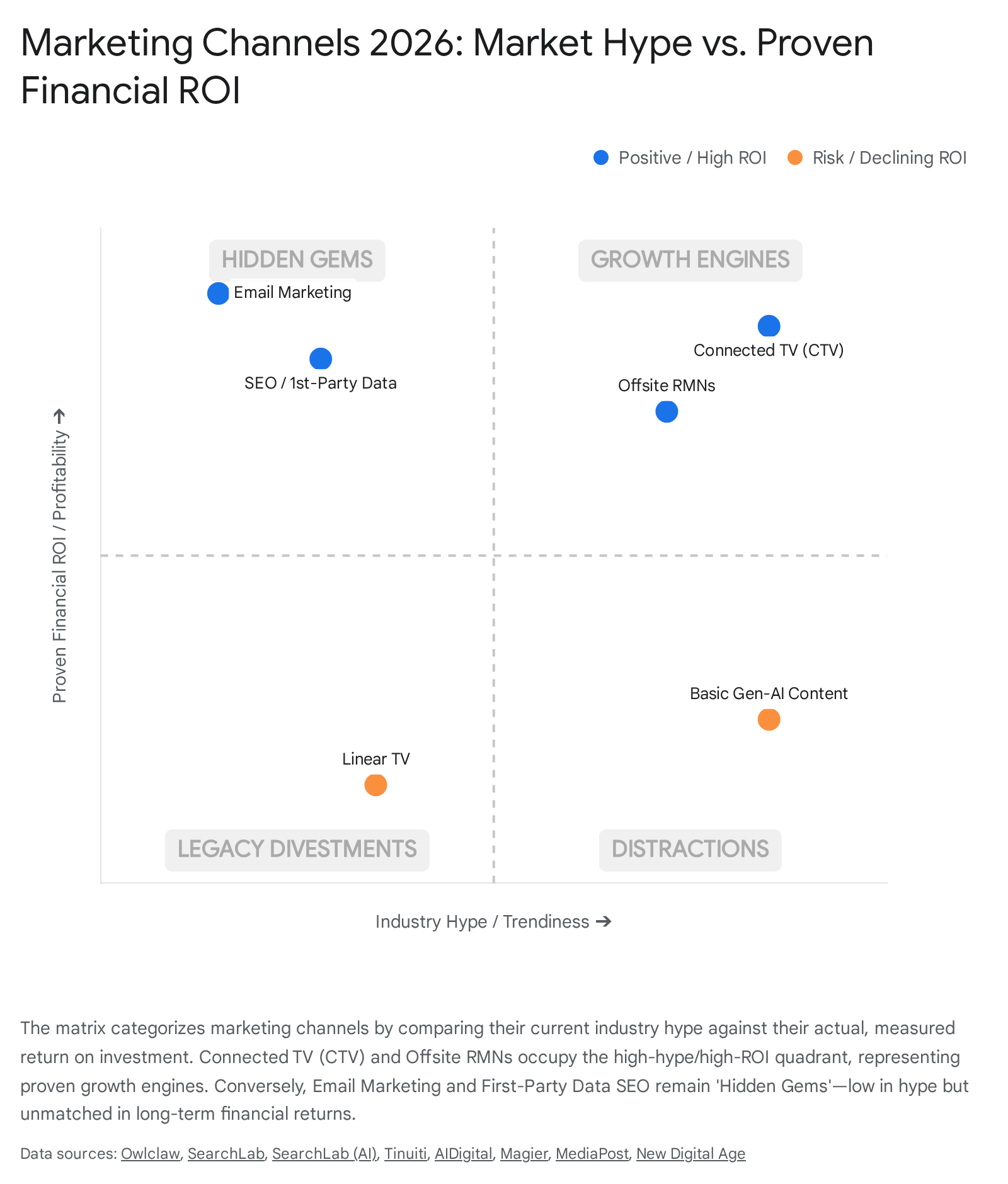
Marketing organizations can no longer afford to operate in silos, optimizing for channel-specific dashboards that fail to reconcile with the CFO's ledger. To achieve superior ROI, brands must leverage privacy-compliant methodologies like Marketing Mix Modeling, ruthlessly reallocate capital based on empirical performance, and engineer channel strategies that specifically respect the distinct buying cycles of their target audience.