
B2B lead generation content formats for 2026
The landscape of business-to-business (B2B) lead generation in 2026 reflects a fundamental transformation in buyer behavior, economic pressures, and technological capabilities. As purchasing committees rely heavily on autonomous, digital-first research before engaging with sales representatives, the strategic deployment of content formats has become the primary mechanism for pipeline generation.
Recent data indicates that traditional volume-based content strategies are failing to produce qualified pipeline, forcing organizations to prioritize formats that capture high-intent signals, leverage real-time artificial intelligence (AI) personalization, and respect the asynchronous consumption preferences of the modern B2B buyer. Furthermore, the integration of autonomous AI agents is fundamentally altering lead qualification, shifting the industry focus from the traditional Marketing Qualified Lead (MQL) to the Agent-Qualified Lead (AQL).
This report provides an exhaustive analysis of the data surrounding B2B content formats in 2026. It examines acquisition cost benchmarks, regional engagement nuances, funnel conversion rates, academic perspectives on digital mediation, and the structural efficiency of various content types. By synthesizing cross-industry benchmarks, this analysis identifies the content formats that yield the highest return on investment (ROI) and pipeline velocity for B2B enterprises.
Macroeconomic Environment and Acquisition Costs
To evaluate the effectiveness of any content format, it is necessary to establish the baseline economic realities of B2B marketing. The data demonstrates that while overall marketing budgets remain relatively stable, the cost of acquiring buyer attention has inflated significantly, necessitating highly optimized content strategies.
B2B Marketing Budget Allocations
Marketing budgets currently hover between 7.7% and 9.1% of total company revenue across most B2B sectors 123. However, this allocation varies substantially by industry maturity and go-to-market motion. Software and technology companies frequently allocate between 11.4% and 15% of revenue to marketing, reflecting the higher customer lifetime value and the competitive nature of recurring revenue models 123. Conversely, industrial and manufacturing firms typically allocate a more conservative 3% to 5.7% of their revenue 12.
Within these budgets, digital channels command approximately 58% to 61.1% of total marketing spend 23. Content creation and distribution represent a massive financial commitment; a 2025 survey of senior marketing executives revealed that the average annual spend on content sits at approximately $1.2 million, with 91% of marketers increasing their content output 4. Despite this investment, numerous organizations report a growing confidence gap between content activity and measurable pipeline outcomes, indicating that sheer volume no longer correlates with revenue growth 6.
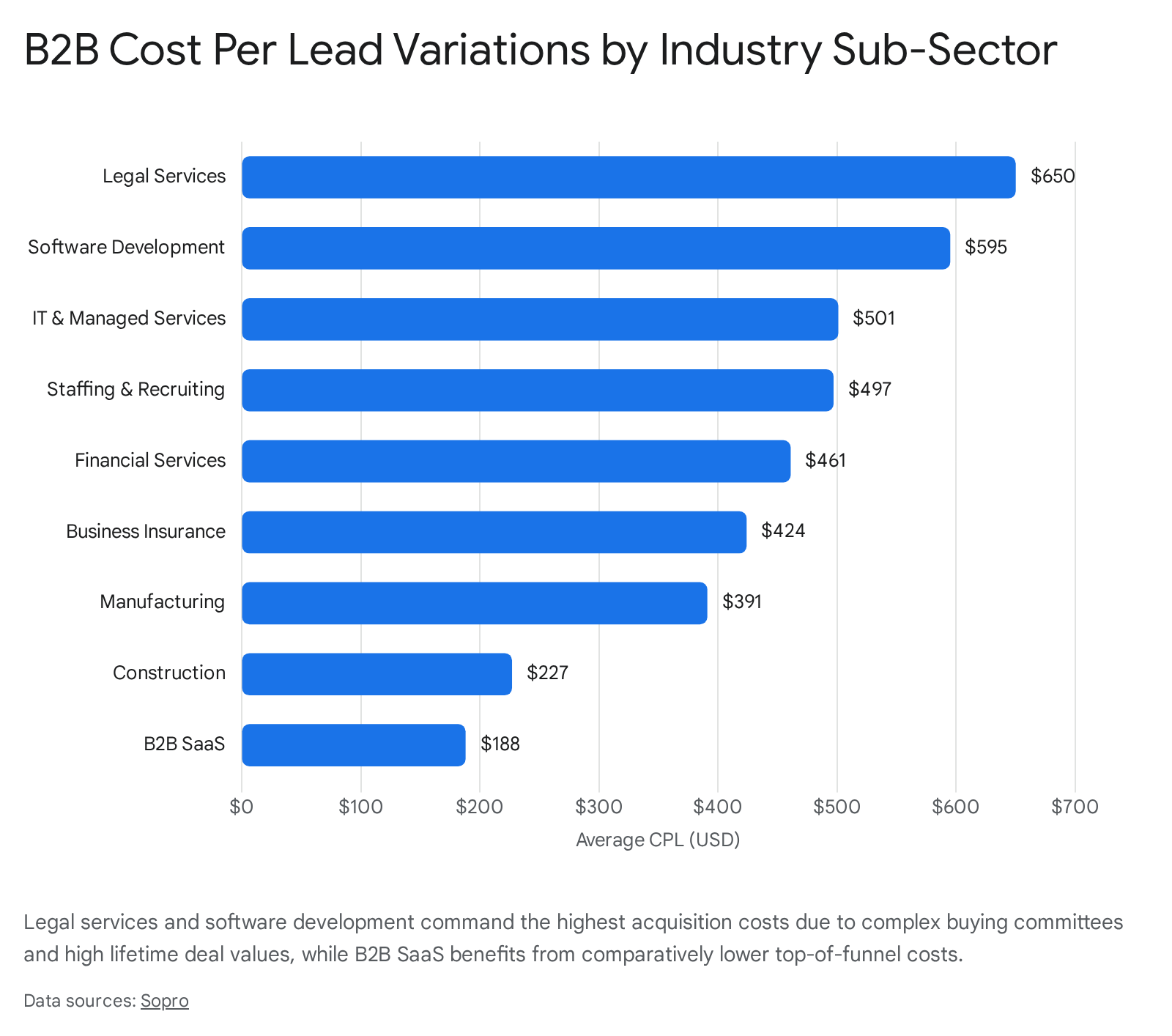
Cost Per Lead Variances Across Industries
The inflation in lead costs is a critical driver of content format strategy. In 2026, the median B2B cost per lead (CPL) experienced an 11% year-over-year increase, driven heavily by paid-search rate inflation and platform competition 7.
While blended averages that combine organic and paid efforts occasionally cite a generalized $84 CPL, isolated paid channels and highly complex industries present much steeper acquisition economics 45.
The disparity in CPL is fundamentally linked to the complexity of the solution and the expected contract value. In sectors like software development and IT managed services, a lead represents early consensus among a technical buying committee, justifying acquisition costs exceeding $500 1011.
Platform-Specific Acquisition Costs
Platform specialization further fragments acquisition costs. LinkedIn remains the premium network for B2B targeting, yielding an average CPL of $110 globally 4. Within enterprise software targeting, LinkedIn CPLs can easily range from $150 to $300 for top-of-funnel content downloads, scaling to over $800 for bottom-funnel requests 5.
In contrast, the Google Search Network averages a $70.11 CPL, while Meta (Facebook/Instagram) averages $27.66 4. The premium paid on LinkedIn and Google Search is widely justified by the higher commercial intent and superior qualification rates of the resulting pipeline 45. Content formats designed for high-cost platforms must inherently carry higher conversion potential to maintain positive unit economics.
The Decline of the Traditional Funnel and MQL
The inflation in lead costs coincides with a structural shift in buyer behavior and purchasing committee dynamics. The traditional linear sales funnel, heavily reliant on the Marketing Qualified Lead (MQL), is proving inadequate for modern B2B transactions.
Expansion of the Buying Committee
In 2026, the median B2B buying group has expanded to an average of 11.2 stakeholders for deals exceeding $50,000 1. This represents a significant increase from 9.7 stakeholders in 2024. The inclusion of diverse perspectives - ranging from end-users and technical evaluators to financial procurement officers and executive sponsors - has dramatically lengthened sales cycles.
Currently, mid-market B2B sales cycles average 121 days, while enterprise deals stretch to 218 days 1. The data indicates that 67% of the buyer journey is entirely self-directed, with purchasing committees consuming an average of 13.4 pieces of content before ever initiating contact with a vendor 1.
Funnel Conversion Attrition Rates
To understand the necessity of high-intent content formats, one must analyze the severe attrition rates within the traditional B2B sales funnel. Because legacy MQL definitions are often based on superficial metrics - such as a single whitepaper download or an email open - they frequently result in sales teams pursuing prospects with zero actual buying intent.
The cross-industry median conversion data for 2026 highlights the mathematical difficulty of volume-based lead generation.
| Pipeline Stage Transition | Cross-Industry B2B Median | SaaS Specific Median | Manufacturing Specific Median |
|---|---|---|---|
| Visitor to Lead | 2.1% | 2.8% | 1.4% |
| Lead to MQL | 31.0% | 34.0% | 24.0% |
| MQL to SQL | 17.0% | 19.0% | 13.0% |
| SQL to Opportunity | 58.0% | 61.0% | 52.0% |
| Opportunity to Closed-Won | 24.0% | 24.0% | 21.0% |
| Compound (Lead to Closed-Won) | 0.78% | 0.95% | 0.43% |
Table 1: B2B Funnel Conversion Benchmarks (2026 Data). 1
The historical data demonstrates a consistent compounding attrition effect. Across B2B industries, the compound conversion rate from an initial lead to a closed-won deal sits below 1%. For every 100,000 website visitors, the average B2B organization generates approximately 2,100 leads, which filter down to roughly 650 MQLs, 110 SQLs, and ultimately result in merely 15 closed-won deals 1. This attrition emphasizes the necessity of content formats that qualify buyers deeply and early in the cycle, rather than those optimized merely for top-of-funnel volume.
The Shift to Agent-Qualified Leads (AQL)
The inefficiencies of the MQL are driving the rapid adoption of agentic AI. Industry analysis highlights a definitive move toward the Agent-Qualified Lead (AQL), a framework where autonomous AI agents facilitate self-qualification via natural-language conversations 613.
In this paradigm, rather than a prospect downloading a static asset and receiving a generic email sequence, a conversational agent dynamically engages the buyer. The agent answers technical questions, queries the prospect's specific use case, and programmatically determines intent before routing the engagement to a human representative 613. Analysts forecast that by 2028, 60% of brands will utilize agentic AI for these one-to-one interactions, fundamentally rewriting the mechanics of lead qualification 6. Content formats must now be designed to serve as the foundational knowledge base for these conversational agents.
Text-Based Content and Original Research
Despite the proliferation of multimedia and the push toward brief, easily digestible content, deep-dive textual formats remain the cornerstone of high-converting B2B lead generation. The data reveals a pronounced preference among B2B buyers for asynchronous, highly detailed resources that can be distributed and analyzed across a complex buying committee.
Whitepapers and Long-Form Guides
An extensive analysis of over 750 B2B campaigns revealed a counterintuitive trend regarding content consumption. Text-based whitepapers and documents averaged a 38% engagement rate, nearly doubling the 20.7% average engagement rate of synchronous webinars 14. Furthermore, well-structured eBooks and comprehensive industry guides achieved engagement rates of 66.24% and 35.90%, respectively 14.
This data suggests that in an era characterized by digital fatigue and overbooked schedules, the autonomy to consume complex, technical information on the buyer's own timeline is a massive competitive advantage. Senior decision-makers, particularly in highly technical fields like software development and financial services, require detailed specifications and architectural overviews that cannot be adequately conveyed in a two-minute video 15.
The Trust Deficit and Proprietary Data
The widespread integration of generative AI into daily marketing workflows has drastically lowered the barrier to content creation. By the beginning of 2026, 95% of B2B marketers reported utilizing AI, with large percentages using it directly for drafting and content generation 7818. This influx of synthesized commodity content has created a severe trust deficit among B2B buyers.
Consumers of B2B content have become highly adept at recognizing generic, AI-generated prose. Consequently, there is a distinct premium placed on authenticity, lived experience, and proprietary insight 1920. Original research reports - featuring benchmark data, survey results, and analysis unavailable elsewhere - currently generate the highest-quality leads of any text-based format 9.
This is particularly critical because 73% of B2B buyers now actively avoid gated content by default, preferring to self-educate through ungated resources 9. The perceived value of an asset must be exceptionally high to warrant a form submission. Original benchmark data, practical operational frameworks, and executive-level thought leadership are among the few formats that consistently overcome this gating friction 9.
Search Engine Optimization and Compounding Returns
From a financial perspective, long-form content optimized for search engines delivers the highest compounding return of any B2B format. Search Engine Optimization (SEO) and thought leadership content generate an average ROI of 702% to 748% for B2B enterprises 101124.
The economics of organic content reveal a break-even period typically occurring between seven and nine months after publication 1011. Beyond the first year, the compounding effect accelerates, with successful organic content pipelines returning up to $22.24 for every $1 invested 1124. Furthermore, organic traffic converts at a rate 2.8 times higher than paid traffic, underscoring the trust inherent in algorithmic discovery 7.
However, the nature of search is evolving. With 94% of B2B buyers utilizing Large Language Models (LLMs) to synthesize research during their purchase process, organizations must optimize for "Answer Engine Optimization" (AEO) 711. Visitors arriving via AI referral traffic exhibit significantly higher intent than traditional search traffic. They spend up to three times longer on-page, and their search queries average 15 to 23 words, indicating highly specific, mid-funnel technical requirements 712. Text-based content must therefore be structured with clear entity relationships and definitive answers to complex industry questions to ensure citation by AI models.
Video Marketing and Algorithmic Distribution
While long-form text dominates the mid-funnel and complex technical evaluations, video is definitively the most leveraged format for top-of-funnel awareness and initial engagement. In 2026, 78% of B2B marketers integrate video into their strategies, with short-form video identified as the fastest-growing investment area and the highest ROI channel for initial reach 12.
Short-Form Vertical Dominance
The dominance of vertical, mobile-first video formats has reshaped B2B content distribution. Platforms such as LinkedIn, YouTube Shorts, and specialized B2B syndication networks prioritize videos under 60 seconds that deliver rapid insights, highlight case studies, or showcase executive thought leadership 13.
The performance data indicates a shift in production aesthetics. Unscripted, authentic video significantly outperforms highly polished, traditional corporate promotions 13. Human stories, behind-the-scenes content, and genuine subject-matter expertise cut through the noise generated by automated marketing sequences 1213. This format aligns seamlessly with the shrinking attention spans of decision-makers while simultaneously humanizing complex B2B brands.
Real-Time AI Video Personalization
The most disruptive advancement in 2026 video marketing is AI-driven personalization at scale. Historically, personalized video was economically unviable for anything other than high-value, one-to-one Account-Based Marketing (ABM) targets. However, modern AI platforms now allow organizations to generate unique videos dynamically. These systems pull CRM data to greet prospects by name, reference their specific company, and tailor the value proposition to their industry vertical 1314.
The performance metrics for AI-personalized video are striking. Early adopters report click-through rates that are 200% to 300% higher than generic video alternatives, accompanied by an 80% increase in watch-through rates 14. Furthermore, AI tools have reduced the production costs associated with video by 60% to 80%, fundamentally altering the cost-benefit analysis of multimedia outreach 14.
Sales teams utilizing personalized video report response rates up to three times higher than text-only emails, and customer success metrics show a 25% increase in Net Promoter Scores when personalized video is used for client onboarding 14. Overall, AI personalization in B2B content delivers a measurable 10% to 15% revenue lift and a 10% to 30% improvement in total marketing ROI 728.
Interactive Diagnostic Tools and ROI Calculators
As B2B buyers conduct more autonomous research, static content is increasingly supplemented by interactive experiences that provide immediate, tailored utility. Interactive tools - such as ROI calculators, readiness assessments, pricing simulators, and maturity scorecards - have emerged as premier lead generation mechanisms.
Conversion Rates and Zero-Party Data
Data indicates that interactive content generates twice as many conversions and five times more pageviews than static content 29. While the visitor-to-lead conversion rate for standard B2B web pages typically ranges from 1.5% to 2.3%, well-designed interactive tools and dedicated capture pages convert traffic at rates between 6.6% and 10% 911. Companies that embed interactive tools into their buyer journey report growing 80% faster than competitors relying exclusively on static resources 10.
The primary advantage of interactive formats is the depth of intent data they capture. When a prospect inputs their company size, current software spend, operational volume, or specific pain points into an ROI calculator, they provide the sales team with a highly qualified, contextualized profile 30. This zero-party data - information the buyer voluntarily provides - is critical in an environment constrained by tightening global privacy regulations and the deprecation of third-party tracking cookies 7.
Production Investment and Unit Economics
Developing interactive tools requires a higher initial capital expenditure than writing a whitepaper. Building custom digital infrastructure, ensuring secure data handling, and maintaining platform integrations represents a moderate technical investment. However, the business case for these tools is supported by robust unit economics.
Internal product and marketing benchmarks indicate that core interactive tools deliver ROI ranging from 150% to 300%, with a payback period typically falling between 8 and 12 months 31. Because these tools automate a portion of the consultative sales process - allowing the buyer to self-qualify the financial viability of the solution before ever speaking to a representative - they actively reduce the length of the sales cycle. This acceleration of pipeline velocity directly lowers the overall Customer Acquisition Cost 3032.
Synchronous Digital Events and Webinars
Webinars remain a vital component of the B2B marketing mix, particularly for mid-funnel education, product demonstrations, and community building. In 2026, 91% of B2B professionals cite webinars as a preferred content format, and 73% of marketers state that webinars generate their highest-quality leads 2915.
Financial and Resource Commitments
Producing a professional-grade B2B webinar requires significant logistical and financial orchestration. The average total cost to host a high-quality webinar ranges from $3,000 to $5,000 per event 1635. This budget comprises platform licensing, paid promotional spend, external speaker fees, and technical production 1516.
Beyond hard costs, webinars demand roughly 30 to 60 hours of cross-functional internal labor per event for asset creation, audience acquisition, slide design, and post-event follow-up 15. Consequently, the true fully-loaded cost of synchronous events necessitates a high volume of qualified registrations to achieve positive unit economics.
Performance Benchmarks and Optimal Formats
The data strictly defines the parameters of a successful webinar program. The median registration-to-live-attendance rate stands at 41.6% 15. Therefore, a marketing team targeting 1,000 live attendees must generate approximately 2,400 registrations. Email remains the dominant acquisition channel, driving 73% of all webinar registrations, though targeted LinkedIn advertising is highly effective for capturing net-new senior decision-makers 15.
Content format within the webinar heavily influences retention. Educational, framework-driven sessions generate 53% more ROI than product-centric demonstrations 15. Furthermore, audience retention data indicates that the optimal length for a B2B webinar is between 35 and 45 minutes, outperforming both shorter 30-minute formats and longer 60-to-90-minute broadcasts 15.
To maximize the initial financial investment, top-performing organizations rely heavily on post-event content repurposing. AI companions are routinely utilized to automatically slice 45-minute webinars into multiple short-form videos, transcripts, and blog posts, dramatically extending the lifespan and ROI of the initial asset 1635.
Regional Nuances in Content Consumption
B2B lead generation strategies cannot be applied uniformly across the globe. Audience preferences, cultural business norms, and data privacy regulations dictate distinct content format strategies across North America, Europe, and the Asia-Pacific regions. Global engagement rates on professional networks like LinkedIn have surged - reaching an average of 3.85% in 2024 - but the drivers of that engagement vary widely by geography 15.
North American Market Preferences
North America operates as a highly video-centric ecosystem. Video content in this region leads all formats with a 29.67% view rate, particularly among professionals aged 35 to 54 15. In the technology sector specifically, video content drives five times more engagement than static imagery 15. Consequently, marketing budgets in North America are heavily weighted toward multimedia production, short-form social cuts, and rapid, high-impact visual storytelling designed to capture attention in a saturated market.
European and EMEA Market Preferences
The EMEA region exhibits a strong preference for intellectual depth, rigorous validation, and localization. European audiences favor long-form articles, whitepapers, and detailed case studies, which earn 30% more shares than other formats in the region 15.
Bilingual and localized content is critical for penetration; for example, posts in the DACH region (Germany, Austria, Switzerland) utilizing both German and English achieve a 41% broader reach 15. Furthermore, stringent data privacy regulations compel European marketers to rely heavily on first-party data capture through high-value, opted-in content ecosystems 36. Employee advocacy and thought leadership from technical experts also yield exceptional results in Europe, driving up to eight times higher engagement than standard corporate brand messaging 15.
Asia-Pacific Market Preferences
The APAC market represents a highly cost-effective digital landscape characterized by visual storytelling and mobile-first consumption. Multi-image document posts and carousels generate twice the impression rates of single-image content 15.
Furthermore, the APAC region relies extensively on outsourced programmatic advertising to scale campaigns 36. The cost dynamics are highly favorable for digital formats; for instance, the average LinkedIn CPL in APAC is approximately $80, compared to $120 in EMEA and $230 in North America 12. This allows organizations to test high volumes of visual content formats at a lower financial risk than in Western markets.
Academic Perspectives on B2B Content Efficacy
The evolution of B2B content formats is actively monitored within peer-reviewed literature, providing a theoretical foundation for the empirical benchmarks observed in the industry. Academic analyses emphasize the role of content formats in reducing information asymmetry and managing complex inter-organizational relationships.
Information Asymmetry and Digital Mediation
Research published in Industrial Marketing Management and the Journal of Business-to-Business Marketing highlights that digital tools are not merely distribution mechanisms, but active actors that rearrange the relationships among buying and selling centers 1718. Content formats such as livestreaming and immersive digital exhibitions have been proven to effectively reduce information asymmetry in complex industrial purchases 17. By providing real-time, interactive demonstrations, these formats allow B2B enterprises to efficiently convey technical specifications, boosting brand influence and customer loyalty 17.
Furthermore, academic studies on AI integration into B2B marketing emphasize that while AI improves forecasting accuracy, lead scoring, and content personalization, it also introduces risks related to algorithmic gatekeeping and decreased transparency 18. Therefore, the literature suggests that successful B2B content must balance automated efficiency with explainability and human-machine collaboration to foster trust in high-stakes procurement scenarios 18. Strategic content on platforms like LinkedIn requires advanced targeting and technically robust narratives tailored specifically to decision-makers, balancing higher upfront production costs with the long-term value of engaged, high-intent leads 19.
Conclusion
The data surrounding B2B lead generation in 2026 presents a definitive mandate: organizations must abandon volume-centric content production in favor of formats that capture explicit intent, provide immediate utility, and facilitate autonomous buyer research.
While written content remains the highest-ROI channel over the long term, it must evolve from generic blog posts into data-backed original research to overcome widespread buyer skepticism fueled by generative AI. Video has cemented its place at the top of the funnel, but its true economic potential is unlocked only when coupled with AI-driven personalization at scale, yielding massive CTR improvements and cost reductions. Furthermore, interactive diagnostic tools and ROI calculators have proven to be the most efficient mechanisms for capturing zero-party data and accelerating pipeline velocity.
As the industry shifts away from the outdated Marketing Qualified Lead toward the conversational, AI-vetted Agent-Qualified Lead, marketers must architect content not just for human consumption, but for ingestion by the complex AI models that modern B2B buyers rely upon to navigate the market.