
4 Scenarios for the Commercialization of Low Earth Orbit
Low Earth orbit is rapidly transitioning from a government-funded scientific frontier into a dynamic commercial marketplace driven by collapsing launch costs. Over the next decade, the economic development of this domain will be defined by four potential scenarios: the proliferation of mega-constellations for global connectivity, the rise of in-space manufacturing fueled by microgravity, the expansion of sovereign-commercial hybrid space stations, and the looming threat of a regulatory crisis triggered by unmanageable space debris.
The Dawn of the Low Earth Orbit Economy
For the past quarter-century, humanity's presence in low Earth orbit (LEO) has been anchored by the International Space Station (ISS), a collaborative triumph of international diplomacy and government-funded science. However, the ISS is aging, with its retirement and de-orbit planned for the early 2030s 113. Anticipating this end-of-life, the United States, through NASA, has made a deliberate strategic pivot. Rather than building a direct, government-owned successor to the ISS, the agency intends to become just one of many tenants renting space and services on commercially owned and operated orbital platforms 132.
This transition represents a complex exercise in market creation. It is effectively a supply-side push where government seed funding attempts to catalyze a self-sustaining in-space economy before sufficient non-government demand fully exists 33. The success of this transition hinges on unlocking new markets that can only exist in the unique environment of space, shifting the paradigm from government exploration to commercial exploitation.
The Rocket Equation Broken
The foundational enabler for all future LEO commercialization is the plummeting cost of access to space, driven almost entirely by advancements in reusable launch architecture 67. During the Space Shuttle era, delivering a payload to LEO cost approximately $54,500 per kilogram. Today, SpaceX's partially reusable Falcon 9 has compressed that marginal cost to roughly $2,700 per kilogram for high-cadence operators 68.
However, the industry is currently bracing for an even more dramatic macroeconomic disruption: the maturation of fully reusable super-heavy lift vehicles, most notably SpaceX's Starship. Representing an estimated $10 billion in total research and development capital expenditure, Starship is designed to act less as a traditional rocket and more as a high-cadence logistics platform 8.
If Starship achieves its targeted unit economics of roughly $10 million per launch, the cost to deliver mass to LEO could drop to below $50 to $100 per kilogram 678. This represents a near 99.8% cost reduction from the Space Shuttle era. At these rates, the economic barriers that have historically kept heavy manufacturing, large-scale orbital habitats, and bulk material processing grounded will evaporate 78. Other next-generation heavy-lift vehicles, such as Blue Origin's New Glenn and Rocket Lab's Neutron, are entering the market to provide competitive supply, ensuring that launch cost deflation becomes a structural permanence in the space economy 6.
| Launch Vehicle | Reusability Status | Payload Capacity to LEO (Tons) | Est. Marginal Cost per Launch | Est. Cost per Kg to LEO |
|---|---|---|---|---|
| Space Shuttle (Historical) | None (Refurbished) | ~27 | ~$1.5 Billion | ~$54,500 |
| SpaceX Falcon 9 | Partial (First Stage) | ~22 | ~$67 Million | ~$2,700 |
| Blue Origin New Glenn | Partial (First Stage) | ~45 | Proprietary / TBD | Market Competitive |
| SpaceX Starship (Target) | Full (Both Stages) | 100 - 250 | ~$10 Million | <$50 - $100 |
Table 1: The structural deflation of launch costs to Low Earth Orbit. Future cost estimates for Starship represent mature scale targets. Data compiled from aerospace industry estimates 68.
Scenario 1: The Mega-Constellation Paradigm and Ubiquitous Connectivity
The most mature and immediately profitable scenario for LEO commercialization is the deployment of mega-constellations designed to provide global broadband and direct-to-device connectivity. In this scenario, LEO is treated primarily as high-value real estate for telecommunications infrastructure, serving as an orbital extension of the terrestrial internet.
The Industrialization of Satellite Manufacturing
To support these mega-constellations, the satellite manufacturing industry has undergone a profound paradigm shift. It is transitioning from the bespoke, artisanal crafting of multi-billion-dollar geostationary (GEO) satellites to the high-volume, serial production of small satellites 4. The global satellite manufacturing market, valued at $19 billion in 2024, is projected to surge to over $72.5 billion by 2034, compounding at nearly 15% annually 10.
This boom is characterized by "Proliferated LEO" architectures. Instead of relying on a single, vulnerable node in high orbit, modern telecommunications and defense networks rely on swarms of hundreds or thousands of smaller, cheaper, interconnected assets 4. This shift requires automotive-style production techniques, modular designs, and automated testing 4. SpaceX leads this industrialization, operating roughly 65% of all active satellites in orbit through its Starlink program, which alone accounted for over 7,800 active satellites as of mid-2025 512.
Direct-to-Cellular Technology
The new commercial frontier of the mega-constellation paradigm is "direct-to-cell" service. Until recently, satellite phones required bulky, specialized hardware and expensive legacy network plans. Today, satellites equipped with massive advanced phased-array antennas act as cell towers in space, communicating directly with standard, unmodified smartphones 13.
This market accelerated rapidly in 2025. In July 2025, T-Mobile officially launched its "T-Satellite" service in partnership with SpaceX, utilizing over 600 specialized Starlink direct-to-cell satellites to eradicate coverage dead zones across 500,000 square miles of previously unreachable United States territory 1314. Operating on standard LTE radios and 3GPP Release 17 standards, the service began with SMS and MMS messaging, expanding to limited data applications for apps like WhatsApp, Apple, and Google by late 2025 1315.
The Market Battle for the Unconnected
Competitors are aggressively pursuing this emerging direct-to-device market. AST SpaceMobile, utilizing significantly larger satellites with roughly 100 times the bandwidth of early Starlink direct-to-cell units, has partnered with AT&T and Verizon to build a rival 3GPP-compliant network 1516. AST SpaceMobile's strategy leverages existing agreements with global mobile network operators that collectively serve over 2.8 billion subscribers, establishing a massive built-in distribution base globally 16.
Simultaneously, alternative infrastructure models are emerging. Providers like Skylo do not launch their own satellites but operate as wholesale providers, routing smartphone SOS and text data through existing satellite networks operated by Viasat and Echostar 15. The commercial viability of routing daily consumer text messages and data through LEO definitively proves that space commercialization is no longer an abstract future concept; it is actively embedded in the everyday functionality of consumer electronics.
Scenario 2: Orbital Industrial Parks and Microgravity Manufacturing
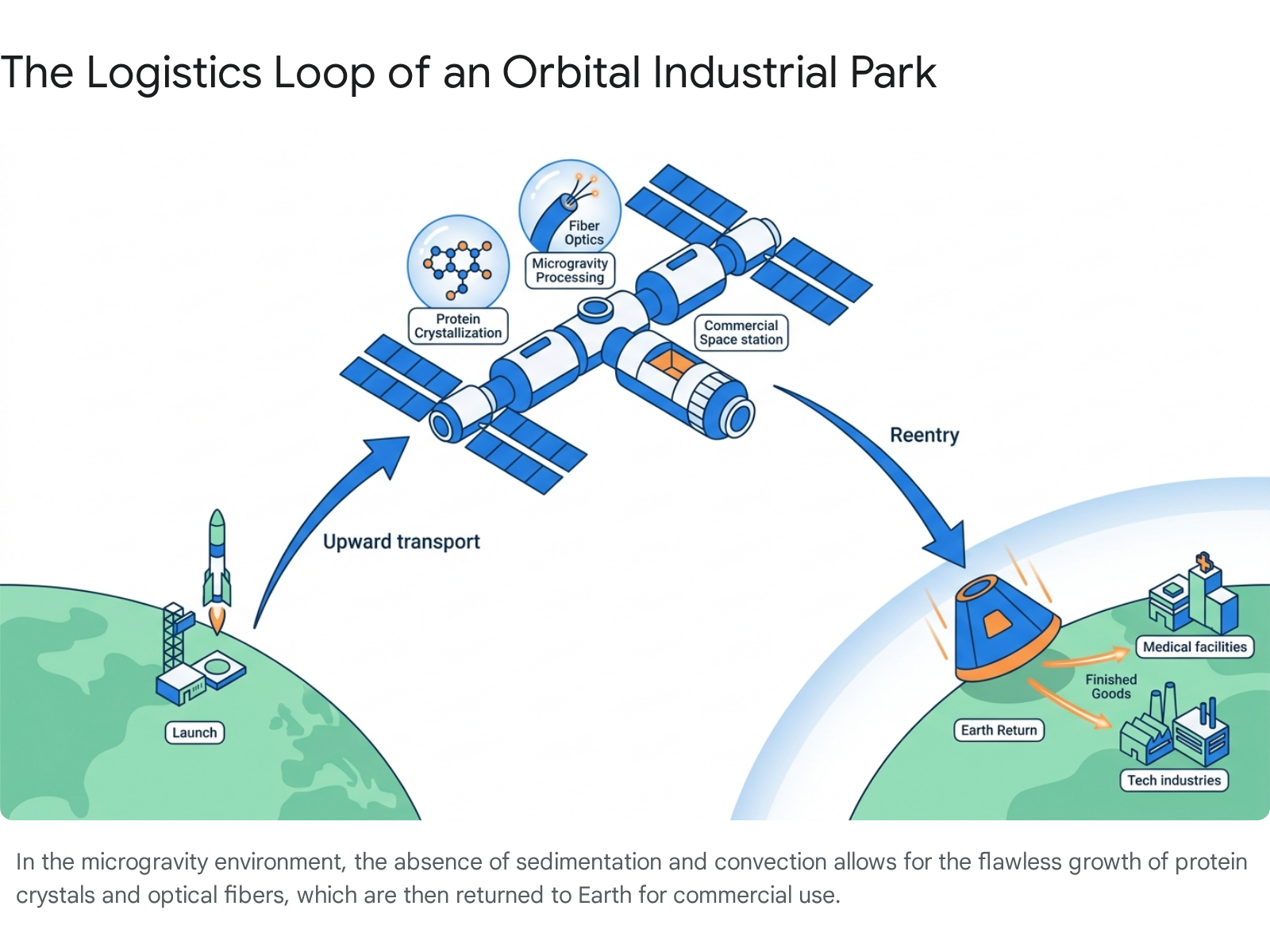
While telecommunications rely on the unique vantage point of LEO, the second scenario capitalizes on its physical environment - specifically, sustained microgravity. Here, LEO transitions from being a shipping lane for data into an industrial park for high-value manufacturing and biopharmaceutical research 76.
Why Manufacture in Space?
On Earth, gravity drives convection currents, buoyancy, and sedimentation. These physical forces complicate the manufacturing of delicate materials, from optical fibers to complex proteins. In the near-weightless environment of LEO, these forces are effectively neutralized 78. Fluids mix flawlessly, and crystals grow without the structural defects induced by their own weight.
NASA and independent research firms have proven that materials like ZBLAN optical fiber, semiconductor crystals, and artificial retinas can be manufactured in space with significantly higher quality and uniformity than on Earth 720. As launch costs compress via vehicles like Starship, the business case for launching raw materials, processing them autonomously in orbit, and returning high-value finished goods to Earth is rapidly closing 7.
The Pharmaceutical Gold Rush
The most lucrative near-term application for in-space manufacturing lies in the pharmaceutical sector. Developing biological drugs, particularly monoclonal antibodies, is notoriously difficult because these large, complex molecules are highly sensitive to their manufacturing environment 78.
A landmark proof-of-concept occurred aboard the ISS when Merck Research Laboratories conducted crystallization experiments on pembrolizumab, the active ingredient in its blockbuster cancer immunotherapy drug, Keytruda. Keytruda generated nearly $29.5 billion in sales in 2024, making it one of the most vital oncology treatments globally 21.
On Earth, crystallizing pembrolizumab yields a bimodal population of particles ranging from 10 to 100 microns, making the resulting suspension viscous and difficult to inject 7. By leveraging microgravity on the ISS to eliminate sedimentation and reduce molecular diffusion rates, Merck produced highly uniform 30-micron crystalline suspensions 78. The space-grown crystals resulted in a less viscous, highly uniform fluid that sedimented faster than terrestrial controls 89.
The clinical implications are staggering. Currently, Keytruda is administered via a time-consuming intravenous (IV) infusion in a clinical setting. The uniform crystals developed from microgravity research pave the way for formulating the drug as a simple subcutaneous injection that could be administered quickly in a doctor's office, drastically reducing healthcare costs and improving patient quality of life 89. With other pharmaceutical giants like Bristol Myers Squibb also exploring microgravity R&D, and startups like Varda Space successfully crystallizing the HIV drug Ritonavir in orbit, LEO is poised to become an essential layer of the global biotech pipeline 209.
Building the Successor Stations
To house this new industrial activity, a suite of private companies is racing to build commercial space stations. NASA's Commercial LEO Destinations (CLD) program is heavily subsidizing these efforts, providing over $415 million in seed funding to de-risk private investment 136.
The primary contenders reflect a mix of legacy aerospace contractors and agile "New Space" entrants: * Axiom Space: Taking an iterative approach, Axiom was awarded a $140 million contract to initially attach its commercial modules directly to the existing ISS 123. Before the ISS is retired, the Axiom segment is designed to detach and form its own free-flying commercial station 2310. * Orbital Reef: Led by Blue Origin and Sierra Space, with backing from Boeing, this concept is marketed as an orbital "mixed-use business park." It aims to provide transportation, logistics, and habitation services to open new markets in space 123. * Starlab: Developed by Voyager Space (in a global joint venture with Airbus, Mitsubishi, and others), Starlab represents a highly international commercial effort aimed at capturing both government and corporate research contracts once the ISS goes offline 1.
These platforms represent a fundamental shift in space economics. By acting as landlords in space, these companies will provide the power, life support, and orbital maintenance required for pharmaceutical companies, sovereign nations, and research universities to conduct business without having to build their own spacecraft 323.
Scenario 3: Sovereign-Commercial Hybrids and Geopolitics
While much of the commercial narrative is dominated by American firms, LEO is rapidly becoming a multi-polar domain. The third scenario envisions an orbit where national space stations, operated by sovereign governments, act as anchors for regional commercial ecosystems and tools of geopolitical soft power.
China's Tiangong as an Open Market
China's Tiangong space station, fully operational and permanently crewed since 2022, is aggressively positioning itself as an alternative to US-led commercial platforms 11. While Tiangong is a state-owned asset operated by the China Manned Space Agency (CMSA), it has fully opened its doors to international and commercial payloads, viewing space infrastructure as a profound extension of soft power and economic diplomacy 2627.
China is actively soliciting partnerships from developing nations and international organizations. During the Shijian-19 mission in 2024, China provided Thailand with a commercial payload opportunity to send high-quality rice seeds into space for mutation breeding, aimed at enhancing regional crop resilience and food security 27. Furthermore, CMSA is integrating foreign astronauts into its program, selecting payload specialists from nations like Pakistan to train in Beijing and eventually fly to Tiangong 27.
To support this massive logistics effort, China is advancing its own heavy-lift and reusable launch capabilities. State-backed commercial space companies are intensifying efforts, with the LandSpace Zhuque-3 reusable rocket scheduled for flight testing, and the Qingzhou cargo spacecraft - capable of delivering 2 tonnes of payload - slated for deployment to support the station 28.
India's Bharatiya Antariksha Station
India is also cementing its status as an orbital superpower. Following the success of its domestic launch programs and lunar probes, the Indian Space Research Organisation (ISRO) is developing the Bharatiya Antariksha Station (BAS) 12. Planned as a 52-tonne modular outpost orbiting at 400 to 450 kilometers, the BAS is scheduled to launch its first module (BAS-01) in 2028 and reach full operational capacity by 2035 1230.
Crucially, the BAS is not merely a scientific endeavor; it is deeply intertwined with India's commercial ambitions. NewSpace India Limited (NSIL), the commercial arm of ISRO formed in 2019, is tasked with commercializing space products, launching foreign satellites, and transferring technology to private Indian industries 3113. The BAS will feature automated hatch systems, platforms for microgravity research, and eventually provisions for space tourism, allowing India to capture a slice of the global orbital economy while maintaining sovereign independence 1415.
| Space Station Project | Lead Operator / Nation | Primary Nature | Target First Module | Estimated Mass / Scale |
|---|---|---|---|---|
| Axiom Station | Axiom Space (USA) | Pure Commercial | Mid-2020s (via ISS) | Multi-module |
| Orbital Reef | Blue Origin / Sierra Space | Pure Commercial | Late 2020s | Large Mixed-Use |
| Tiangong | CMSA (China) | Sovereign (Commercial Open) | 2021 (Operational) | ~100 Tonnes |
| Bharatiya Antariksha Station | ISRO (India) | Sovereign (Commercial Open) | 2028 | 52 Tonnes |
Table 2: The diverse landscape of next-generation Low Earth Orbit space stations, highlighting the split between pure commercial US ventures and sovereign-led platforms 1231112.
Europe's Push for Autonomy
The European Space Agency (ESA) faces a distinct challenge: cultivating commercialization without a dedicated, wholly European crewed space station. ESA is instead focusing on commercializing specialized LEO infrastructure and regaining sovereign launch capabilities, aiming to capture 30% of commercial satellite manufacturing revenues and foster independent space logistics .
Through the Flight Ticket Initiative, ESA is subsidizing commercial launch startups like Isar Aerospace (with its Spectrum rocket) and Rocket Factory Augsburg to compete directly with American commercial launch dominance 16. To achieve the reusability required for modern economics, ESA has launched the PROTEIN initiative for heavy-lift feasibility, the THRUST! program developing 200-tonne methane engines, and the BEST! initiative focused on reusable first stages 37.
Simultaneously, ESA is pushing commercial boundaries with the "Celeste" LEO-PNT (Positioning, Navigation, and Timing) demonstrator mission. By deploying a constellation of navigation satellites in LEO, ESA aims to provide resilient, highly accurate GPS-like services that can penetrate deep urban canyons and indoor environments - a massive commercial boon for autonomous vehicles and the Internet of Things that traditional medium Earth orbit (MEO) satellites cannot reach 17.
Scenario 4: The Kessler Constriction and the Orbital Commons
The final scenario is the darkest, yet increasingly plausible: the commercialization of LEO is strangled by its own success. As thousands of satellites are launched by competing megacorporations and sovereign states, the orbital environment is rapidly approaching a critical density threshold known as the Kessler Syndrome 3940.
Envisioned by US astrophysicist Donald Kessler in 1978, the syndrome describes a runaway chain reaction where colliding satellites generate hypervelocity space debris, which in turn causes more collisions 3918. Because a 100-gram piece of debris traveling at orbital speeds of 28,000 km/h possesses the kinetic energy of a 1-ton car moving at 280 km/h, even tiny fragments can cause catastrophic damage 39. Academic modeling by space debris experts at the University of Southampton suggests that the orbital bands between 600 km and 1,000 km may already be above the instability threshold, meaning the debris population will grow regardless of whether new satellites are launched 40.
The Escalating Reality of Collision Avoidance
This is no longer a theoretical concern; it is a daily operational hazard. The sheer volume of traffic in LEO has forced operators into a continuous state of evasion. Satellite collisions remain relatively rare, but the frequency of close approaches has skyrocketed alongside the introduction of mega-constellations 1218.
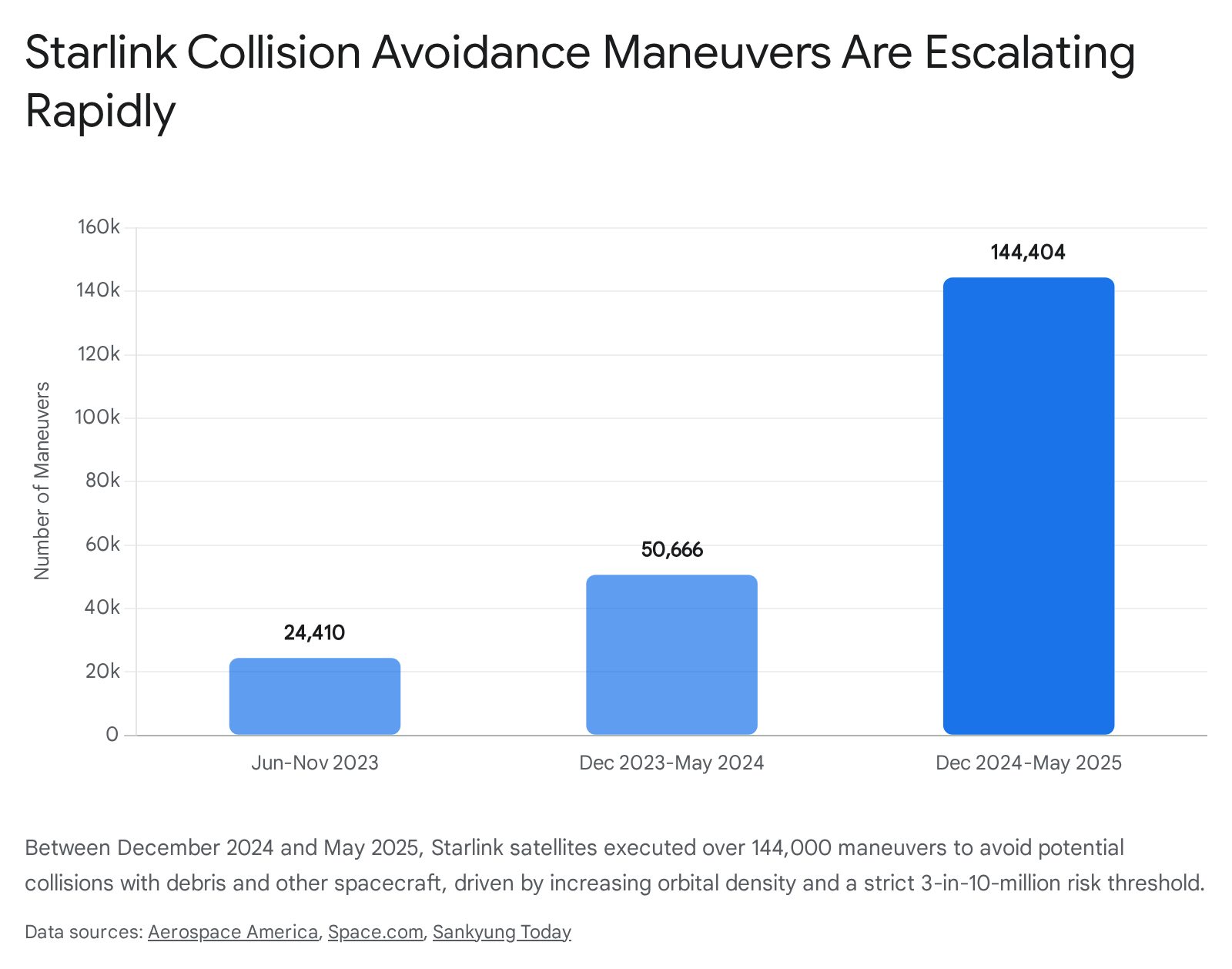
SpaceX's Starlink constellation provides the most stark evidence of this congestion. Because SpaceX employs a highly conservative automated collision avoidance system - triggering a maneuver if the probability of a collision exceeds 3 in 10 million (far stricter than the historical industry standard of 1 in 10,000) - their satellites are constantly firing thrusters 121920.
The data illustrates a severe operational strain. Between December 2023 and May 2024, Starlink performed approximately 50,000 collision avoidance maneuvers 20. Just one year later, between December 2024 and May 2025, that number erupted to 144,404 maneuvers 121944.
In March 2026 alone, Starlink recorded a cluster of nine conjunction threats over a four-day window, including one high-risk pass where a Starlink satellite came within a predicted range of just nine meters from a Chinese operational satellite 12. Projections suggest that as Chinese mega-constellations like Guowang and Amazon's Project Kuiper come online in massive numbers, total annual avoidance maneuvers across LEO could surpass one million by 2027 1221.
Corporate Sovereignty vs. Space Law
The congestion crisis is exacerbated by a severe lag in international space law. The governing legal framework remains the 1967 Outer Space Treaty (OST), drafted during the Cold War to prevent the placement of nuclear weapons in orbit and to declare space the "province of all mankind" 4647.
The OST was built for a world of state actors launching a handful of assets, not for commercial mega-constellations. Article II of the OST explicitly forbids "national appropriation" by claims of sovereignty 4648. However, the treaty is dangerously ambiguous regarding what international legal scholars now term "corporate sovereignty." When a single private corporation, such as SpaceX, files to deploy upwards of 42,000 satellites, it effectively occupies prime orbital altitudes and finite radio frequency spectrum. This creates a de facto appropriation of the commons that complicates market entry for competitors and undermines the OST's ideals of equitable access 47.
Navigating the Regulatory Void
Furthermore, the treaty lacks comprehensive guidelines for space traffic management or binding "rules of the road" 4648. Currently, there is no legal duty to share conjunction data in a common format, no internationally agreed right-of-way standard for close approaches, and no unified mechanism to force non-maneuverable dead satellites to be de-orbited 48. Article VI of the OST dictates that states are internationally responsible for the actions of private entities under their jurisdiction, meaning the US government bears ultimate liability for the actions of American commercial operators, yet domestic licensing is struggling to keep pace with the launch cadence 4722.
To adapt, the industry is witnessing a fragmented push for governance adaptation 23. Mitigation strategies, such as the European Space Agency's "Zero Debris Approach" (mandating rapid de-orbiting post-mission) and the nascent Active Debris Removal (ADR) industry - projected to generate nearly $980 million in revenue by 2030 - are critical steps forward 3924. However, these solutions face steep technical and financial hurdles, and a lack of binding regulation makes commercial players reluctant to invest heavily in cleanup services 24. Without binding international traffic management and potential reform to the International Telecommunication Union (ITU) to limit spectrum hoarding, the tragedy of the orbital commons remains a potent threat to the long-term viability of the LEO economy 47.
Bottom line
The commercialization of low Earth orbit is actively shifting from a speculative future into an operational industrial reality, fueled by reusable rockets that are driving launch costs toward an unprecedented sub-$100 per kilogram. While the mega-constellation market is already generating billions by linking consumer smartphones directly to space, the coming years will test the economic viability of in-space pharmaceutical manufacturing and the resilience of sovereign-commercial hybrid space stations. However, what remains highly uncertain is whether antiquated international regulatory frameworks can evolve fast enough to manage the explosive growth of orbital traffic before cascading space debris renders this new economic frontier impassable.