
4 Scenarios for the Future of Remote and Hybrid Work
The daily commute, once an unquestioned ritual of modern professional life, has morphed from a mandatory grind into a highly contested negotiation over autonomy, economics, and human well-being. To directly answer the prevailing question regarding the trajectory of the modern workplace, the future of work is fracturing into four distinct scenarios: strict full return-to-office (RTO) mandates, a stabilized hybrid default, the persistence of remote-first dominance, and the disruptive emergence of the AI-collapsed office. These models reflect a fundamental renegotiation of the geographic, technological, and psychological contracts between employers and employees, deeply influenced by regional cultures and algorithmic advancements.
What is the Actual State of Remote Work in 2026?
Despite high-profile corporate announcements demanding a return to the physical office, the statistical reality of remote and hybrid work has demonstrated remarkable resilience across the global economy. Following the massive, involuntary spike in 2020 - where nearly 60 percent of workdays in the United States were performed from home - the rate of remote work steadily declined through 2021 and 2022 before stabilizing at approximately 25 percent of all paid workdays by 2024, a level that has held completely firm into 2026 123. To place this structural shift in its proper historical context, this rate remains more than triple the pre-pandemic baseline of roughly 5 to 7 percent 134.
By the end of 2025, approximately 32.6 million Americans - representing roughly 22 percent of the national workforce - were working remotely to some degree 55. Across the global landscape of college-educated employees, the average number of work-from-home (WFH) days has settled at roughly one full day per week when aggregated across all work types, though this masks deep concentrations in hybrid knowledge-work sectors 2. The empirical data definitively indicates that the shift to remote work is not a temporary pandemic-era anomaly but a permanent structural alteration to the modern labor market. As researchers from Stanford University and the National Bureau of Economic Research (NBER) have noted, headline-grabbing RTO mandates from corporate giants will barely move the macro-level needle on remote work 6. In fact, among executives whose companies currently utilize hybrid or remote models, a mere 12 percent report any plans to enforce stricter in-office mandates in the coming year, and of those, the vast majority are merely formalizing hybrid expectations rather than demanding five days on-site 6.
The apparent disconnect between the media narrative of a massive RTO wave and the statistical reality of stabilized remote work can be explained by what Stanford economist Nick Bloom identifies as the "composition effect" 1. Media coverage inherently amplifies stories that trigger strong reactions; a multinational conglomerate calling tens of thousands of employees back to headquarters generates massive attention 1. Conversely, when thousands of mid-sized, fast-growing firms quietly extend their flexible hybrid arrangements, the event goes entirely unnoticed by the press. Furthermore, larger, slower-growing legacy firms are statistically more likely to reduce remote options, while smaller, high-growth companies enthusiastically embrace hybrid models to attract talent and control real estate overhead. As these smaller, agile firms increase their total share of the workforce, the aggregate macroeconomic numbers remain perfectly balanced 17.
This stabilization sets the stage for four diverging operational scenarios that organizations are currently adopting to navigate the future of work.
Scenario 1: Will Strict RTO Mandates Eliminate Flexible Work?
The first and most aggressively publicized scenario is the push for a full Return to Office (RTO). In recent years, a highly visible cohort of multinational corporations has instituted strict policies requiring employees to return to their corporate desks five days a week. Amazon famously transitioned from a manager-discretion model in 2021 to a three-day mandate in 2023, before ultimately demanding a full five-day return starting in early 2025, effectively ending remote flexibility for its massive corporate workforce 78. Similar sweeping five-day mandates have been enacted by major institutions including JPMorgan Chase, Dell, AT&T, and Boeing 678.
This uncompromising trend is not isolated to North America. In Europe, the Danish pharmaceutical giant Novo Nordisk announced a global policy requiring five days on-site for office roles starting in 2026, pivoting sharply away from its previous regional flexibilities 1011. Major media conglomerates like NBCUniversal and Paramount, alongside financial titans such as Truist, HSBC, and UBS, have similarly summoned employees back for four to five days a week, explicitly targeting senior leadership first to "lead by example" before trickling the mandate down to junior staff 10119.
The justification for these rigid mandates generally centers on perceived operational deficits in the remote environment. Executives argue that an erosion of corporate culture, a lack of spontaneous innovation, and reduced opportunities for the organic mentorship of junior staff require a physical remedy 910. Leaders driving these policies operate under the assumption that physical proximity is the indispensable catalyst for strategic alignment and long-term productivity. Furthermore, substantial sunk costs in commercial real estate portfolios often exert unseen, yet immense, financial pressure on corporate boards to justify expensive, long-term urban leases that were signed prior to the 2020 disruption.
However, the enforcement of these mandates has proven exceptionally perilous and fraught with internal friction. The data indicates that companies employing strict five-day mandates often face severe employee backlash and operational resistance. When companies like Disney and WPP announced strict mandates, they were met with immediate, organized pushback, including thousands of signatures on employee petitions and highly publicized internal dissent 89. The friction between management's desire for control and the workforce's demand for autonomy has given rise to the phenomenon of "coffee badging" - a practice where employees swipe their access badges, grab a coffee, socialize briefly to ensure visibility, and then leave the office shortly after to actually complete their deep work at home 711. While companies have increasingly utilized surveillance tools to crack down on this practice, it underscores a fundamental, potentially toxic disconnect between managerial directives and genuine employee engagement.
Most significantly, empirical research suggests that strict RTO mandates carry a catastrophic retention penalty. Surveys consistently indicate that a massive portion of the workforce - up to 44 percent in recent Stanford studies - state they would refuse to comply, choosing instead to quit or immediately begin looking for new employment if subjected to a full five-day RTO mandate 6. The enforcement mechanisms required to maintain these mandates - such as tracking badge swipes, utilizing sophisticated desktop surveillance software, tying office attendance directly to performance reviews, and issuing termination threats - often erode the very corporate culture and psychological safety that executives claim the physical office is meant to protect and nurture 7.
Scenario 2: Has the "Hybrid Default" Won the Workplace War?
The second, and by far the most statistically dominant scenario, is the "Hybrid Default." Rather than viewing remote work as a temporary concession to be slowly clawed back, approximately 67 to 70 percent of firms globally - ranging from agile startups to massive multinationals like Apple, Google, and Citi - have accepted structured hybrid work as the permanent optimal equilibrium 710. In this model, employees deliberately divide their time, typically spending two to three days in the office for collaborative work, strategic planning, large meetings, and socialization, and reserving the remaining days at home for focused, heads-down individual tasks 3710.
This paradigm has radically reshaped urban rhythms, birthing the "Tuesday-Thursday economy," a phenomenon acutely visible in major European and North American metropolitan centers. Office occupancy data from access control systems like Kastle Systems consistently demonstrates that physical attendance clusters heavily mid-week, peaking on Tuesdays and Wednesdays, while Mondays and particularly Fridays remain virtual ghost towns 15121718. In France, for example, the hybrid model of two to three remote days has become the absolute standard across the service sector, with 38 percent of French workers regularly working from home in 2026, causing a massive shift in how public transit and downtown retail operate 18.
The empirical foundation for the hybrid default scenario is incredibly robust, anchored by landmark randomized control trials conducted by leading economists. The most prominent of these, led by Stanford researchers at Trip.com - a $50 billion global travel agency - provides definitive proof of the model's efficacy. The researchers rigorously randomized 1,600 graduate-level employees into two distinct groups: one working a traditional five days in the office, and another working three days in the office and two at home 313.
The results of this two-year study systematically dismantled the core executive arguments against hybrid work. First, there was absolutely zero negative impact on performance, productivity, or rates of promotion for the hybrid group; the quality and volume of their output, which included highly measurable metrics like computer code written by software engineers, matched their fully in-office peers exactly 1314.
Second, and most critically for corporate bottom lines, the hybrid model functioned as a massive retention engine. Quit rates among the hybrid workers fell by a staggering 35 percent, with particularly strong retention gains among female employees and caregivers 11314.
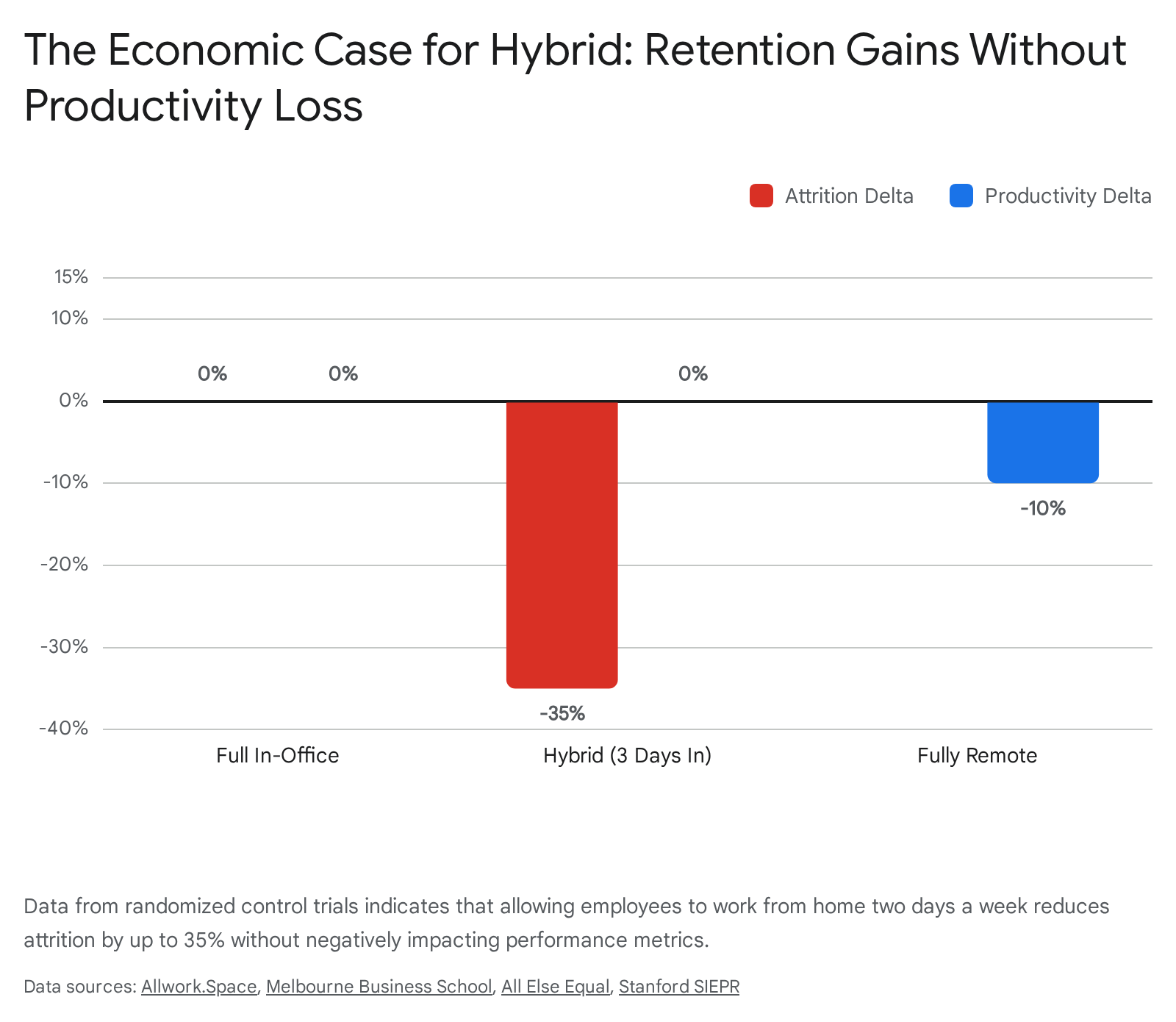
Given that Trip.com meticulously calculated the cost of replacing a single departed professional employee at roughly $30,000 to $50,000 in lost productivity and recruitment fees, the implementation of the hybrid policy resulted in tens of millions of dollars in direct annual savings 13. Stanford researchers concluded that employees value the flexibility and reduced commute time of a hybrid schedule as much as an 8 percent pay raise. This unique economic dynamic allows companies to essentially increase total compensation value, boost morale, and drive loyalty without actually raising top-line labor costs 115.
The success of the hybrid default relies heavily on intentionality. When companies fail to coordinate, allowing employees to choose their own days in the office, the system quickly breaks down into isolation and logistical chaos, severely damaging productivity and cross-functional visibility. However, when managed deliberately, with mandated team-level anchor days, the hybrid default offers a win-win-win for productivity, real estate optimization, and talent retention.
Scenario 3: Can Remote-First Dominance Survive Post-Pandemic Scrutiny?
The third scenario represents the absolute vanguard of geographic decoupling: the "Remote-First" organization. While accounting for a smaller subset of the overall global market - roughly 10 to 16 percent of companies operate fully remotely without maintaining physical corporate offices - these organizations are heavily concentrated in the technology, software, digital services, and decentralized finance sectors 5515. Companies such as Zillow, Dropbox, Coinbase, Atlassian, and Shopify operate proudly under this paradigm, prioritizing asynchronous workflows, rigorous digital documentation, and global connectivity over any form of physical co-location 178.
The primary advantage of the remote-first model lies in ultimate agility and the democratization of talent acquisition. Unbound by the geographic constraints of a 30-mile commuting radius around a headquarters, remote-first companies can source the absolute best talent globally, often capitalizing on geographic arbitrage to secure elite engineering or creative talent in lower-cost markets 1. Furthermore, as artificial intelligence and automation rapidly force corporate reorganizations, fully remote companies are significantly better positioned to shuffle teams, reallocate resources, and pivot strategies without the friction of moving human bodies across physical office floors 1. To mitigate the inherent loss of human connection, the most successful remote-first organizations heavily reinvest the capital saved on commercial real estate into intentional, high-value gatherings, flying teams out for quarterly off-sites that focus purely on socialization, strategic alignment, and culture building, rather than daily execution 112.
The Macroeconomic Ripple: The "Donut Effect" and Real Estate Upheaval
The persistence of the remote-first and highly flexible hybrid models has triggered a massive macroeconomic ripple effect across global real estate and urban planning, documented extensively by economists and geographers as the "Donut Effect" 4.
Because remote-first and hybrid employees no longer need to endure a grinding daily commute, the massive premium historically placed on housing immediately adjacent to central business districts (CBDs) has plummeted. Rigorous research analyzing high-frequency datasets on credit card spending, commuting patterns, postal migration data, and housing prices shows a profound global dispersion of economic activity away from dense city centers and outward toward the suburbs and exurbs 416. In the United States, an analysis of microdata reveals that three-fifths of households that fled big city centers during the pandemic permanently relocated to the surrounding suburbs of that same city, explicitly seeking larger homes capable of accommodating dedicated, quiet home offices 416.
This structural shift in housing demand is not merely anecdotal; it is deeply measurable. Advanced economic models indicate that a single percentage point increase in remote work within a metropolitan area causes a 0.92 percent increase in local real house prices, even after strictly controlling for out-of-state migration spillovers 23. The shift to remote work is calculated to explain over one-half of the staggering 18.9 percent increase in U.S. real house prices observed between 2019 and 2023 23.
Remote households consistently spend over 7 percent more on housing than comparable non-remote households within the exact same commuting zone, driving up demand for larger dwellings with more square footage 16. As a direct consequence, commercial real estate in city centers faces an existential crisis. Office occupancy rates and foot traffic to commercial offices across major U.S. cities remain depressed at around 30 to 50 percent below pre-pandemic levels, starving downtown retail and hospitality sectors of their foundational customer base 412. The remote-first model essentially takes the massive capital previously locked in corporate real estate overhead and redistributes it directly into the suburban residential housing market, fundamentally redrawing the economic map of the modern city.
Scenario 4: Will the AI-Collapsed Office Erase the Need for Proximity?
The fourth, most disruptive, and rapidly accelerating scenario looks beyond geographic policies toward the structural redesign of the firm itself: the AI-collapsed office. To understand the magnitude of this shift, one must understand its origin. Historically, the traditional corporate organizational chart - a wide, heavy pyramid featuring a broad base of junior staff, thick layers of middle management, and a narrow executive peak - was not an inherent law of nature, but a design created in the 19th century by the railroad industry to solve complex logistical communication problems across vast distances 241726.
In 2026, artificial intelligence is aggressively and systematically dismantling this 170-year-old architecture. The primary victim of this technological shift is what organizational theorists term the "coordination tax" - the estimated 30 to 50 percent of total operational expenditures spent on middle management layers whose primary, and sometimes sole, function is to aggregate data from the bottom, translate strategic directives from the top, and validate frontline execution 1819.
How is Agentic AI Redefining Management and Structure?
Agentic AI - autonomous, goal-seeking systems capable of executing complex multi-step workflows, managing data streams, and generating predictive modeling with minimal human oversight - is instantaneously collapsing the distance between the executive decision-maker and the operational data 1819. A landmark Harvard Business School study analyzing over 50,000 global software developers utilizing generative AI (specifically GitHub Copilot) provided startling empirical evidence of this shift. The study found that the technology effectively allowed individual frontline contributors to completely absorb traditional managerial tasks. The data noted that core coding activity as a share of total work rose by 5 percent, while time spent on project management, coordination, and status updating dropped by 10 percent 2920. AI essentially enables employees to work vastly more independently, directly flattening corporate hierarchies and drastically reducing the need for constant supervisory oversight and status meetings 2920.
Gartner and other premier industry analysts predict that by the end of 2026, 20 percent of all enterprise companies will use AI to fundamentally flatten their organizational structures, actively cutting over half of their mid-tier managerial roles 2418. The traditional pyramid is rapidly shifting into a "barbell" or "pentagon" shape.
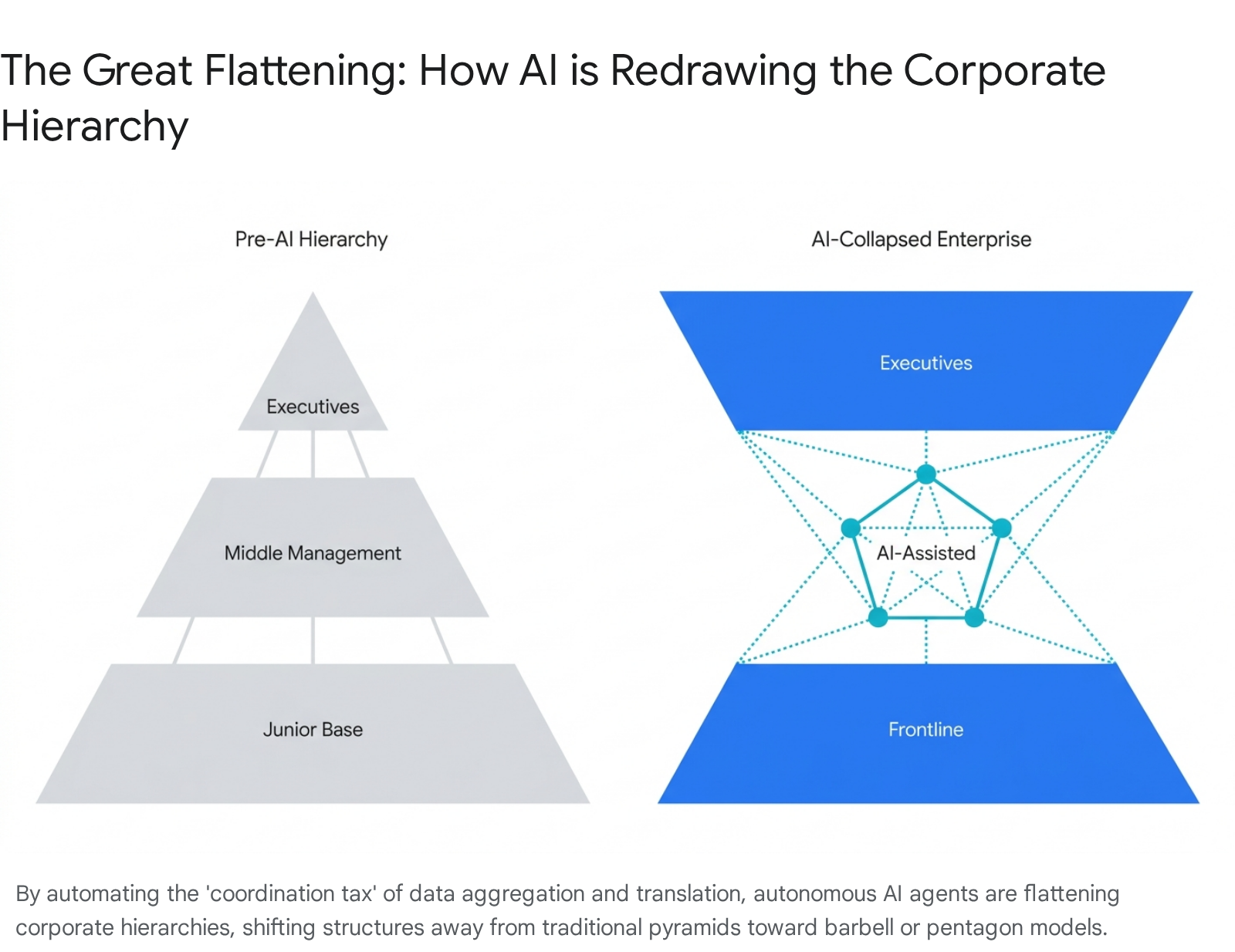
At the top of this new structure, a significantly smaller group of high-leverage strategic architects focuses on vision, intent, and risk allocation. At the bottom, high-fidelity execution teams act as "AI orchestrators," utilizing highly personalized AI co-pilots to autonomously handle the analysis, coding, and drafting that previously required an entire department of junior analysts and middle managers 241921.
In this AI-collapsed scenario, the bitter debate over physical office space and RTO mandates becomes entirely secondary, if not obsolete. When intelligent agents process information at the speed of intent - and when machines begin negotiating directly with other machines to autonomously optimize enterprise workflows - the physical proximity of human workers becomes vastly less critical to the firm's operational velocity 1932. The coordination overhead that once required a manager to corral ten people into a physical conference room is replaced by a single lead worker operating twenty-five persistent AI agents from their living room 17.
However, this transition is not without severe systemic risks. Organizational psychologists and workforce strategists warn that indiscriminately stripping away the human middle-management layer risks losing vital qualitative context. While AI excels at data aggregation, it lacks the human intuition required to interpret frontline nuances, mediate complex interpersonal conflicts, and push back against operationally impractical top-down mandates 2418. Furthermore, eliminating the junior and middle tiers threatens to completely hollow out the leadership pipeline; companies dismantling their middle management in 2026 are simultaneously destroying the apparatus required to train and produce the senior leaders of 2030 17. To mitigate this, forward-thinking enterprises are establishing new roles, such as the Chief AI Agent Officer, tasked explicitly with governing the ethical and operational intersections between human workers and autonomous systems, ensuring that organizational knowledge is codified rather than lost in the flattening process 32.
How Do Remote Work and Labor Laws Differ Across Global Regions?
The successful execution of any of these four scenarios is heavily dependent on the surrounding regional geography, deeply entrenched cultural norms, and localized legislative frameworks. An analysis of harmonized data covering tens of thousands of global workers reveals stark and enduring contrasts between North America, Europe, and Asia 2234.
Stanford researchers utilizing the 2025 Global Survey of Working Arrangements (G-SWA) found that one single sociological factor - cultural individualism, as defined by the Hofstede index - accounts for roughly 29 percent of the cross-country variation in work-from-home rates. This cultural variable outpaces measurable structural factors like industry composition, population density, and baseline economic development 1522.
North America: The At-Will Frontier and the Commute Burden
In the United States and Canada, remote work adoption remains the highest globally, stabilizing at roughly 25 percent of all paid days 151215. The U.S. labor market is largely defined by the legal principle of "employment-at-will," meaning employers possess significant flexibility to terminate employees without establishing legally defined "just cause," and federal mandates for paid leave or severance are minimal to non-existent compared to global peers 34. This lack of centralized labor rigidity has allowed American technology and finance sectors to experiment wildly and unilaterally with both fully remote paradigms and highly aggressive, punitive RTO mandates.
Furthermore, the physical infrastructure and commute burden heavily influence American attitudes toward hybrid work. The national average one-way commute rose to 27.2 minutes in 2024, with nearly 10 percent of the workforce enduring commutes of 60 minutes or more each way 3523. In major coastal hubs like New York City, the average one-way commute exceeds 40 minutes 35. The sheer mathematical reality of reclaiming nearly two hours of unpaid transit time per day makes North American workers fiercely protective of hybrid models, willingly trading potential compensation for the preservation of flexibility.
Europe: Institutionalized Flexibility and the Right to Disconnect
Europe presents a highly regulated, institutionally structured approach to the dispersed workforce. WFH adoption in Europe is slightly lower than in North America but remains significantly higher than in Asia, with about 22 percent of employed individuals in the EU working from home regularly 1515. The labor philosophy here is grounded in "just cause" employment, strong collective bargaining through works councils, strict Working Time Directives (capping the maximum workweek at 48 hours), and profound data privacy protections under the General Data Protection Regulation (GDPR) 3437. Because of GDPR, European companies face immense legal hurdles if they attempt to implement the invasive desktop surveillance and badge-tracking mechanisms currently favored by American executives forcing RTO 3738.
In the UK, France, and Germany (the DACH region), hybrid work is formally supported by evolving legislation. The UK's Flexible Working Regulations allow employees to officially request hybrid arrangements from day one of employment 39. Interestingly, geopolitical factors have also heavily influenced European remote work. The 2026 Middle East energy crisis prompted the European Commission and the International Energy Agency to actively encourage mandatory remote work days as a macroeconomic tool to rapidly reduce commercial energy consumption in office buildings, putting direct governmental pressure on companies attempting to force an office return 18. Despite this, in major European capitals, the cultural value of the office remains strong; Paris shows a high average of 3.5 in-office days per week among city center workers, compared to London's 2.7 days, reflecting subtle continental variations in management culture 40.
Asia: Collectivism, Demographic Crisis, and the Productivity Paradox
Asia exhibits the lowest rates of remote work adoption globally, averaging just 0.5 to 1 day per week of work-from-home 2151541. Researchers attribute this directly to deep-seated cultural frameworks that heavily prioritize group collectivism over individualism. In these corporate cultures, physical presence, extreme dedication of time, and hierarchical visibility are critical, non-negotiable components of professional standing and promotion 2242.
However, severe demographic collapse and intense labor crises are forcing rapid, unprecedented legislative intervention. South Korea currently suffers from the longest average commute in the world - an agonizing 1 hour and 48 minutes per day - which the Korean Medical Association and international journals explicitly link to rising rates of clinical depression, severe stress, and anxiety 24. Korean workers also endure incredibly high annual working hours, logging 1,859 hours in 2024 compared to the OECD average of 1,682 2526.
To combat this exhaustion and its ripple effects on the national birthrate, the South Korean government launched heavy legislative initiatives for 2026. The Ministry of Employment and Labor earmarked a 27.6 billion won budget to actively subsidize small and medium-sized enterprises (SMEs) that adopt a 4.5-day workweek 252728. Furthermore, South Korea is formalizing legislation to guarantee workers the "right to disconnect" from late-night work messages, directly attacking the pervasive culture of unending availability 26.
Similarly, Japan's historically rigid, overtime-heavy office culture is shifting under the immense weight of an aging population and shrinking workforce. The Japanese government's 2024 amendments to the Child Care and Family Care Leave Act - fully active by late 2025 - now legally obligate employers to make earnest efforts to allow remote work and highly flexible hours specifically for employees with children under the age of three, a direct attempt to keep women in the workforce while boosting fertility 48. Concurrently, developing economies in the region like Singapore, Thailand, and the Philippines have recognized the economic potential of the remote class, pivoting rapidly to capture the global talent pool by introducing formal digital nomad visas and mandating that local employers formally consider flexible work requests 41.
Global Workforce Models and Regional Policy Trends (2025-2026)
| Scenario/Region | Core Adoption Level | Dominant Labor Philosophy | Key 2026 Regulatory & Macro Trends | Real Estate & Demographic Impact |
|---|---|---|---|---|
| North America | High (~25% of paid days are WFH) | "Employment-at-Will"; high employer unilateral flexibility. | Decentralized labor laws; high friction between RTO mandates and remote holdouts. | Extreme "Donut Effect"; suburban home prices surging while dense CBD office values plummet. |
| Europe | Medium-High (~22% WFH overall) | "Just Cause"; strong union and works council influence. | Strict GDPR constraints on employee surveillance; energy crisis prompting state-encouraged remote work. | "Tuesday-Thursday" economy dominates; Paris (3.5 days) leads London (2.7 days) in office attendance. |
| Asia | Low (0.5 to 1 day per week) | Collectivist culture; extreme emphasis on group visibility. | South Korea subsidizing 4.5-day weeks; Japan legislating remote childcare options to fight demographic collapse. | South Korea holds longest global commute (1h 48m); SE Asia aggressively utilizing Digital Nomad Visas. |
What Are the Common Misconceptions Hindering Workplace Strategy?
As global organizations attempt to navigate these four highly complex scenarios, several pervasive, deeply entrenched misconceptions continue to misguide executive strategy, leading to disastrous talent and operational outcomes.
Misconception 1: Remote Work Inherently Destroys Productivity. The most stubborn, heavily cited myth is that employees are inherently less productive when unmonitored by physical management. While it is true that fully remote entry-level roles involving highly repetitive tasks (such as offshore call center operations or basic data entry) have occasionally shown slight productivity dips, rigorous, high-quality NBER studies consistently demonstrate that hybrid knowledge workers maintain flat or slightly elevated productivity levels 31429. A comprehensive global study revealed that WFH saves an average of 72 minutes per day in commute time, a significant portion of which workers frequently reinvest directly back into primary work tasks rather than leisure 15. The real issue disguised as a productivity drop is almost universally a failure of management: legacy leaders mistake physical presence for actual performance because they lack the modern Key Performance Indicators (KPIs) necessary to measure genuine output 13.
Misconception 2: Cybersecurity Risks are Inherent to Remote Work. Many executives aggressively enforce RTO out of an acute fear of data breaches, believing the office to be a digital fortress. However, the surge in cyber vulnerabilities observed during the 2020 pandemic was due entirely to rushed, unprepared IT transitions and a lack of VPN infrastructure, not the geographic location of the worker. Data from 2024 and 2025 indicates that as workers returned to the office, cyber incidents actually increased in several sectors 50. This proves that enterprise security is a product of robust hybrid-cloud infrastructure, strict endpoint management, and zero-trust protocols, not the physical walls of a commercial office building 50.
Misconception 3: Employees Will Happily Accept Compensation Cuts for Flexibility. While an overwhelming 74 percent of professionals state they deeply value flexibility, the notion that they will happily accept reduced pay for the privilege of working from home is fraying rapidly 5. Severe inflationary pressures, combined with the quiet shifting of operational costs - such as daytime electricity, high-speed internet upgrades, and ergonomic furniture - from the corporate balance sheet to the employee's personal budget, have made workers hypersensitive to wage stagnation 18. The legal landscape is also shifting to protect workers from this cost burden. In France, the Cour de cassation ruled that utilizing a private home for professional purposes constitutes an intrusion into private life, making financial compensation from the employer nearly automatic, completely upending the math for companies attempting to use remote work simply as a cost-cutting measure 18.
What Are the Practical Takeaways for Managers and Employees?
Whether an organization adopts a structured hybrid default or aggressively integrates AI-driven workflows to flatten its hierarchy, managing and thriving within a dispersed, multi-generational workforce requires a fundamental evolution in psychology and daily habits. Research from organizational psychology, particularly the application of the Job Demands-Resources (JD-R) framework to virtual teams, indicates that team-level well-being in hybrid contexts requires deliberate, intentional structural support 30.
Strategic Imperatives for Leadership
1. Eradicate "Visibility Bias" Through Coordinated Scheduling. The single greatest threat to a hybrid organization is the accidental creation of a two-tier workforce: an "in-office in-group" that receives organic mentorship, prime assignments, and rapid promotions, and a "home out-group" that becomes isolated and organizationally stagnant 10. Stanford studies have shown that WFH employees can face a staggering 50 percent lower promotion rate if their peers are consistently in the office 10. To combat this insidious proximity bias, managers must absolutely abandon the concept of "employee-chosen" hybrid days. Instead, leaders must mandate team-level coordination (e.g., the entire marketing department is physically required on-site on Tuesdays and Wednesdays). This ensures that when people endure a commute, they are guaranteed face-to-face collaboration, and critically, no employee is ever penalized for being virtual while the boss is physically present 31013.
2. Build Psychological Safety Through Micro-Signals. Trust erodes rapidly when collaboration occurs purely through the sterile medium of screens. In 2026, psychological safety - the foundation of high-performing teams - is not built through grand corporate gestures or annual retreats, but through consistent, highly intentional micro-signals from leadership 31. Managers must proactively make their decision-making processes visible, over-communicate strategic context, and deliberately dedicate specific time in virtual meetings for unstructured, unplanned personal interactions. Checking in on an employee's well-being before diving into the agenda is essential to replicate the organic "water cooler" dynamics completely lost in the remote shift 3153.
3. Transition from Surveillance to Outcome-Based Measurement. Organizations utilizing invasive "bossware" to track keystrokes, monitor active screen time, or count badge swipes universally suffer from destroyed morale, elevated stress, and the immediate departure of top-tier talent 713. True hybrid leadership requires defining explicit, highly measurable outcomes and allowing teams the absolute autonomy to execute them on their own schedules. As AI continues to automate the rote administrative tasks of middle management, the role of the human leader must pivot away from overseeing execution toward interpreting context, mediating complex human conflict, and fostering the emotional intelligence that algorithms cannot currently replicate 2418.
Tactical Advice for Employees
1. Master "Microshifting" and Aggressive Calendar Blocking. To survive the blurred boundaries of the modern workplace, employees must take absolute ownership of their time. The 2025 Owl Labs data shows a massive rise in "microshifting" - the practice of working in short, non-linear blocks matched to personal energy levels rather than a rigid 9-to-5 schedule 54. Employees must aggressively utilize calendar blocking to protect deep work time. Full-time office workers are currently twice as likely to block their calendars as remote workers, a dangerous dynamic that leads to remote burnout 11.
2. Establish Ruthless Digital Boundaries. With 39 percent of workers reporting increased work-related stress over the past year, establishing a "right to disconnect" on a personal level is vital for mental health 54. Employees must clearly communicate their availability to their managers and peers, recognizing that responsiveness does not equate to value. Currently, one in five remote workers are actively instilling greater boundaries by refusing to answer company communications outside of clearly defined work hours, a trend that is essential for long-term career sustainability in a geographically dispersed environment 11.
Bottom Line
The global labor market of 2026 has irrevocably moved past the simplistic, binary debate of "office versus home." The massive weight of empirical data overwhelmingly supports the "Hybrid Default" as the optimal economic and operational equilibrium, perfectly balancing the deep collaborative, culture-building benefits of physical proximity with the massive retention and flexibility advantages of remote work. Strict, punitive five-day Return-to-Office mandates function primarily as blunt, outdated instruments that artificially inflate attrition rates without delivering any corresponding, measurable productivity gains.
Meanwhile, the rapid integration of Agentic AI is quietly executing the most profound structural shift to the corporate firm since the Industrial Revolution, actively threatening to collapse the traditional middle-management pyramid and render proximity-based oversight entirely obsolete. Organizations that succeed in this volatile new era will not be those that aggressively police physical attendance or attempt to resurrect 2019. The winners will be the enterprises that adapt their leadership models to manage outcomes rather than presence, seamlessly leverage human-AI collaboration, and deeply respect the profound cultural, psychological, and legislative nuances of an increasingly borderless, empowered global workforce.