
Will Apple Release an LLM-Based Siri 2.0 at WWDC 2026
Apple is widely expected to unveil a massive, Large Language Model-powered overhaul of Siri - dubbed "Siri 2.0" - at the Worldwide Developers Conference on June 8, 2026, serving as the centerpiece of the iOS 27 operating system. While the update promises true chatbot capabilities, deep cross-app integration, and a completely redesigned interface, strict hardware requirements mean these advanced AI features will likely remain exclusive to the iPhone 15 Pro, the iPhone 16 lineup, and newer Apple silicon devices.
The Unprecedented Stakes for WWDC 2026
Every summer, the global technology industry turns its collective attention to Apple Park in Cupertino, California, for the company's annual Worldwide Developers Conference. Historically, WWDC has served as a reliable, highly choreographed stage for Apple to preview its upcoming software ecosystems. However, the event scheduled for the week of June 8 through June 12, 2026, carries a dramatically different weight 12. After years of incremental updates and a notoriously fragmented rollout of its first-generation "Apple Intelligence" features, Apple is facing immense pressure from investors, developers, and consumers to prove it can genuinely compete with the relentless pace of artificial intelligence leaders like OpenAI, Google, and Anthropic 22.
The opening keynote, which is slated to kick off at 10:00 a.m. Pacific Time on Monday, June 8, is expected to introduce iOS 27, iPadOS 27, macOS 27, watchOS 27, tvOS 27, and visionOS 27 13. While the previous year's WWDC focused heavily on "Liquid Glass" - Apple's sweeping aesthetic and material redesign of its user interfaces - this year's focus is almost exclusively dedicated to artificial intelligence. Apple's official promotional materials and the WWDC 2026 logo explicitly hint at major AI advancements, demonstrating an unusual degree of candor for a company that typically prefers to let its product demonstrations speak for themselves 124.
For consumers and developers, the rollout timeline for these new operating systems will likely follow Apple's highly established playbook. The first developer beta of iOS 27 is expected to launch just hours after the June 8 keynote concludes 1. This initial release will allow developers to begin testing the new frameworks, followed by a more stable public beta typically released in late June or early July 1. Finally, the completed, stable version of iOS 27 will see a public release in September, perfectly timed to align with the highly anticipated launch of the iPhone 18 hardware lineup 15.
To understand why WWDC 2026 is viewed as a make-or-break moment, one must look at the context of Apple's recent history with artificial intelligence. When Apple initially announced "Apple Intelligence" at WWDC 2024, the features were significantly delayed, failing to make the initial September launch of iOS 18 678. Instead, the company opted for a slow, phased rollout. Basic writing tools and notification summaries arrived in October 2024 with iOS 18.1, while image generation and initial ChatGPT integrations were pushed to iOS 18.2 in December 91012. The more advanced Siri features, including on-screen awareness and deeper personal context, did not arrive until iOS 18.4 in March 2025 910. Consequently, iOS 27 is not just another annual update; it represents the arrival of "Apple Intelligence 2.0" and the debut of the fully realized, LLM-powered virtual assistant that users have been anticipating for years 511.
Siri 2.0: The Evolution from Voice Assistant to Agentic AI
Since its groundbreaking but ultimately limited debut in 2011, Siri has functioned primarily as a rigid command-and-control interface. Users issue a specific vocal prompt, and Siri attempts to match that prompt to a hard-coded response or basic web search. According to extensive supply chain leaks and reporting by Bloomberg's Mark Gurman, iOS 27 will introduce "Siri 2.0" - referred to internally at Apple as "LLM Siri" - which completely abandons this legacy architecture in favor of advanced large language models 1213.
This is not merely a backend server upgrade; it represents a fundamental paradigm shift in human-computer interaction. The new assistant is designed to be an "agentic AI," meaning it can understand natural, conversational language, recall context from previous interactions, and take autonomous actions across multiple applications on the user's behalf 1314.
A Complete Interface Redesign and the Standalone Chatbot
Perhaps the most visible and consequential change coming to iOS 27 is the "chatbot-ification" of the Siri experience. Since the explosive rise of conversational AI, users have been conditioned to interact with software through continuous text threads. To meet this expectation, Apple is expected to introduce a standalone Siri application that functions similarly to ChatGPT, Google Gemini, or Anthropic's Claude 121516. This dedicated app will maintain a persistent conversation history, allowing users to scroll back through previous queries, reference past answers, and upload photos or documents directly into the chat interface for the AI to analyze 1617.
For quicker interactions that do not require opening a full application, the traditional glowing orb that previously dominated the bottom of the iPhone screen is reportedly being retired. In its place, Siri will integrate directly into the iPhone's Dynamic Island at the top of the display 218. Furthermore, users will be able to swipe down from the top center of their screen from anywhere within the iOS environment to reveal a new "Search or Ask" interface 1516.
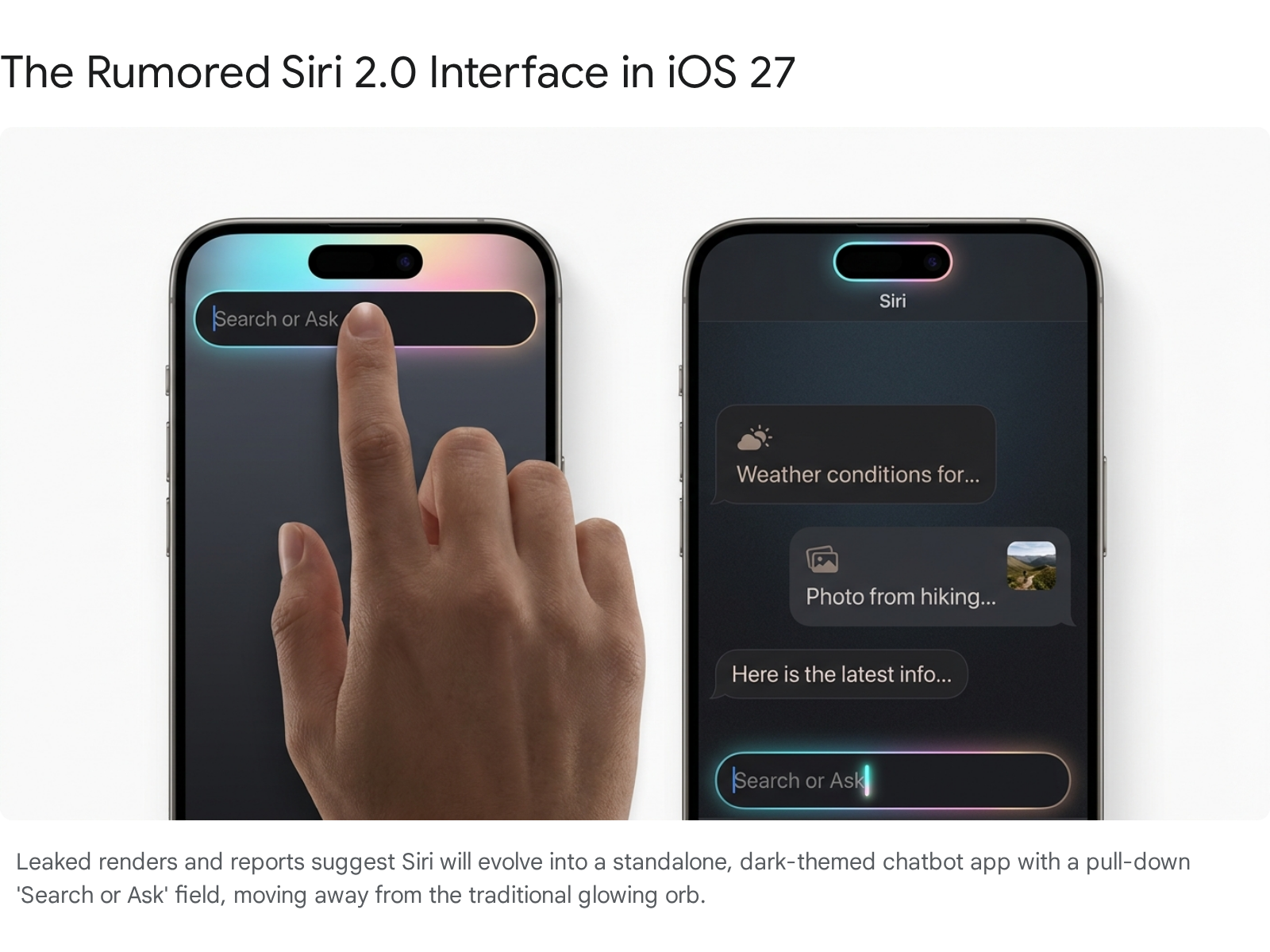
This universal text input field will allow users to silently type complex commands, perform deep web searches, and instruct the operating system to execute background tasks without interrupting their current workflow.
On-Screen Awareness and Deep Semantic Indexing
What promises to separate Siri 2.0 from standalone, third-party applications like ChatGPT is its deep, system-level integration into the Apple operating system. The new Siri is expected to feature advanced "on-screen awareness," allowing the artificial intelligence to seamlessly "see" and understand whatever text, image, or video is currently displayed on the user's screen 311.
This capability is combined with a massive on-device semantic index that continuously catalogs a user's digital footprint. By securely processing a user's emails, text messages, photo libraries, and calendar events, Siri 2.0 will be uniquely positioned to handle complex, highly contextual multi-step requests. For example, a user could theoretically look at a photograph from a recent vacation and say, "Send this to my wife and add a reminder to book this exact hotel again for next summer." Because of the semantic index, the AI will instantly understand who the user's wife is, parse the geolocation data of the image to identify the hotel, draft the message, and set the appropriate calendar event - all without requiring the user to manually open three separate applications 3519.
The "Dark Siri" Aesthetic
Apple is also utilizing the release of iOS 27 to signal Siri's evolution visually. According to design leaks, the new "Search or Ask" bar and the standalone Siri conversational interface will lack a traditional "light mode" option. Instead, Apple is reportedly leaning heavily into a dark color scheme utilizing deep blacks, charcoal hues, and glowing cursor animations. These design choices purposefully match the dark, neon-tinged branding of the WWDC 2026 promotional artwork, giving the new AI agent a distinct, premium visual identity that separates it from the rest of the standard iOS interface 4.
Comparing the Eras of Apple's Virtual Assistant
To truly understand the magnitude of the upcoming iOS 27 update, it is highly informative to compare how Siri 2.0 diverges from both the legacy assistant users have had for the past decade, and the initial iteration of Apple Intelligence introduced in 2024.
| Feature Category | Legacy Siri (Pre-iOS 18) | Early Apple Intelligence (iOS 18) | Siri 2.0 / LLM Siri (iOS 27) |
|---|---|---|---|
| Primary Interaction Model | Voice-first; limited type-to-Siri hidden deep in Accessibility settings. | Voice-first with improved visual glowing edges; basic text input. | Multimodal: Voice, system-wide "Search or Ask" text bar, and a dedicated standalone chatbot app. |
| Underlying Technology | Hard-coded intent recognition and basic, rudimentary machine learning. | Hybrid model: Limited on-device LLMs and initial Private Cloud Compute routing. | Advanced Large Language Models (LLMs) with deep semantic indexing and third-party extensions. |
| Contextual Memory | Extremely limited; routinely struggles with basic follow-up questions. | Moderate; can maintain context for a single conversational thread. | Persistent conversational history and long-term memory of user preferences and past interactions. |
| App Integration | Can open apps and perform basic, pre-programmed shortcuts. | Can summarize content and perform limited actions in native apps. | Agentic control: Can take hundreds of specific, unscripted actions inside and across third-party apps. |
| Screen Awareness | None. | Basic text awareness in supported applications. | High: Can analyze, interpret, and act upon whatever text or image is currently visible on the display. |
Under the Hood: Apple's Bifurcated AI Architecture
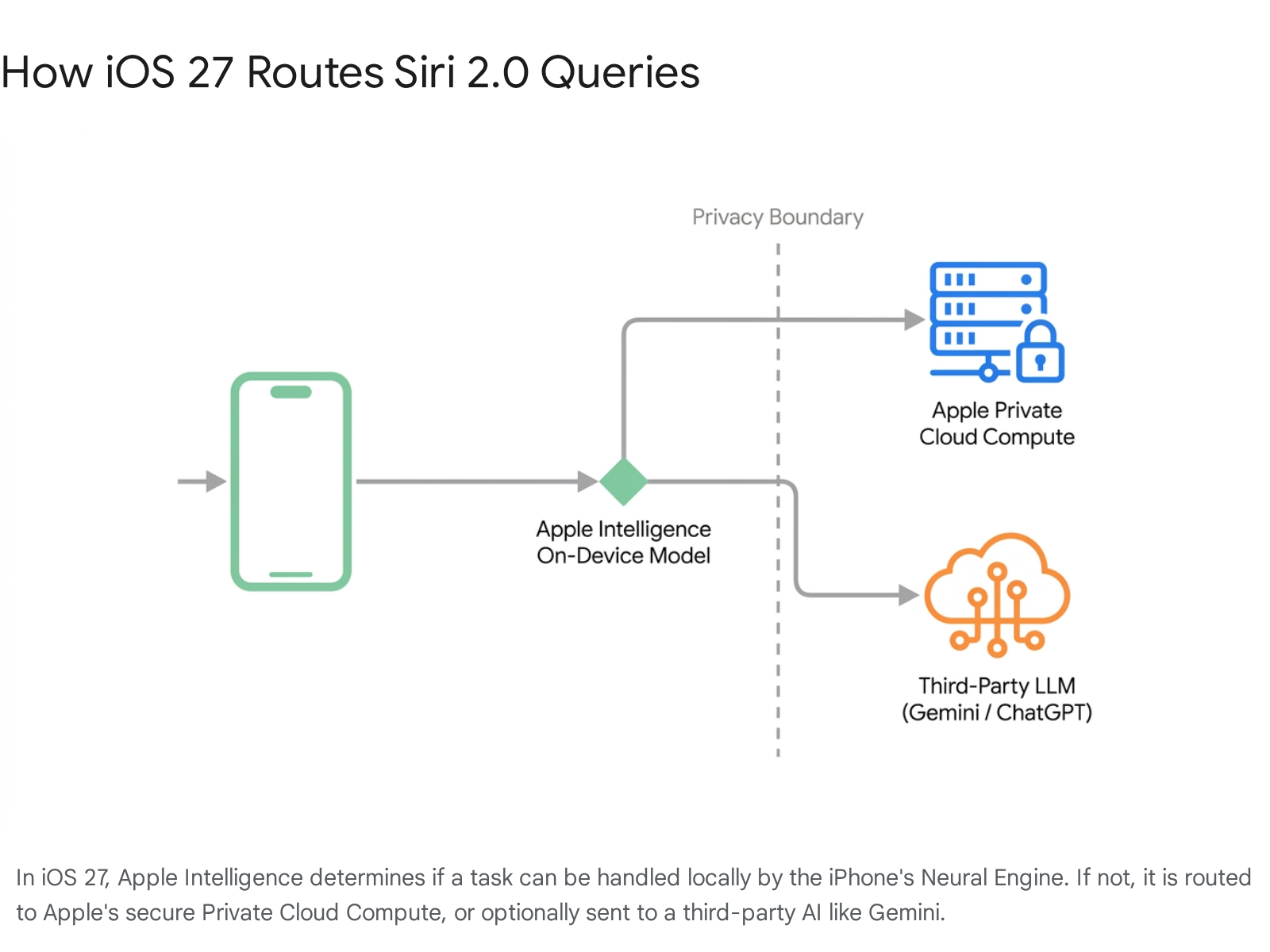
Processing generative artificial intelligence requires a massive amount of computational power. This reality presents a unique, existential challenge for a company like Apple, which has spent the better part of a decade building its brand identity around processing data locally to protect user privacy. To solve this inherent contradiction, Apple's software engineering teams have reportedly engineered a bifurcated approach to artificial intelligence, strictly separating local device tasks from intensive cloud computing tasks 2021.
On-Device Processing vs. Private Cloud Compute
The vast majority of Siri 2.0's everyday features - such as text summarization, grammar proofreading, notification sorting, and basic system control - will be powered by Apple's proprietary Foundation Models running entirely on-device 220. By leveraging the neural engine built into Apple silicon, the company ensures that highly sensitive personal data, such as private text messages, health information, and calendar events, never physically leaves the hardware of the iPhone.
However, natural language processing often results in complex queries that simply exceed the thermal and processing limits of a mobile smartphone. When a user asks a question that requires broader world knowledge or heavy generative capabilities, the iOS 27 architecture will securely route the request to Apple's "Private Cloud Compute" infrastructure. These are dedicated, highly secure servers designed by Apple and powered by custom Apple silicon. According to the company's technical whitepapers, this system uses advanced cryptographic protocols to ensure that even Apple's own engineers cannot access, read, or retain the data sent to these servers for processing 2022.
The Google Gemini Partnership and Third-Party Extensions
Despite Apple's massive financial investments in building out private server farms, industry insiders consistently note that Siri's overarching "chatbot" intelligence may still rely heavily on external corporate partners. Reports strongly indicate that Apple will continue to allow users to optionally route highly complex web searches, coding queries, and generative text requests to third-party AI models. While ChatGPT was the primary partner during the iOS 18 cycle, rumors suggest iOS 27 will heavily feature Anthropic's Claude and, most notably, Google's Gemini 131416.
According to recent analysis from Bloomberg's Mark Gurman, Apple may actually be quietly separating the underlying infrastructure of "Apple Intelligence" from the conversational, external-facing elements of "Siri" to protect its brand messaging 21. While personal context, photo editing, and system tasks will remain strictly on Apple's secure servers, the broad world-knowledge capabilities of the standalone Siri 2.0 app might be powered largely by Google Cloud and Gemini models 1521. This complex technical arrangement allows Apple to offer a cutting-edge, highly capable chatbot experience without shouldering the entirety of the astronomical cloud computing costs. Simultaneously, by treating the chatbot as a slightly separate entity, Apple can maintain its strict "privacy-first" marketing for its core operating system features 21.
The Hardware Divide: Who Gets Left Behind in the AI Era
The most controversial and widely debated aspect of the Siri 2.0 launch will undeniably be its strict hardware compatibility requirements. Running multi-billion-parameter language models natively on a mobile device is an extraordinary feat of engineering that requires an immense amount of memory bandwidth, thermal headroom, and raw processing power. Consequently, Apple has drawn a hard, unforgiving line in the sand regarding which devices will support Apple Intelligence and the new Siri, leaving millions of consumers behind 2324.
The Strict 8GB RAM Bottleneck
To run the on-device inference required by Siri 2.0 fast enough to be practically useful to a consumer, a device must possess a highly capable Neural Engine and a minimum of 8 gigabytes of RAM 2325. During the WWDC 2024 rollout of the initial Apple Intelligence features, Apple's software engineering chief Craig Federighi and AI head John Giannandrea explicitly addressed this limitation. Giannandrea noted that the "inference of large language models is incredibly computationally expensive," relying heavily on the device's internal bandwidth and the size of the Apple Neural Engine 23. Federighi added that while older devices could theoretically run the models, the processing times would be so agonizingly slow that the features would be entirely useless 23.
Because Apple historically equipped its base-model iPhones with significantly less RAM than its premium "Pro" counterparts to maintain profit margins, millions of relatively new, highly capable devices will be entirely excluded from the AI revolution. If a consumer currently owns an iPhone 14 Pro, a standard iPhone 15, or an iPhone 15 Plus, they will likely be able to install the base iOS 27 operating system to receive security updates, but they will absolutely not receive Siri 2.0, the new chatbot interface, or any advanced Apple Intelligence features 2425.
The strict cutoff for the full artificial intelligence experience requires an A17 Pro chip or newer for smartphones, and an M1 chip or newer for iPads and Mac computers 2223.
The End of the Line for Older Hardware
Beyond the AI cutoff, the core architecture of iOS 27 is also expected to leave older devices behind entirely. Supply chain leaks suggest that Apple is using the iOS 27 development cycle to rebuild foundational parts of the operating system, stripping out years of legacy code to improve battery life and overall efficiency 18. As a direct result of this architectural rebuild, Apple is widely expected to officially drop software support for the entire iPhone 11 series, as well as the second-generation iPhone SE 528. Devices older than the iPhone 12 will no longer receive major software updates, officially ending their lifecycle.
Comprehensive iOS 27 Hardware Compatibility Matrix
To clarify the complex tiers of support, the following table breaks down which devices will receive the base iOS 27 update, and which will possess the hardware required for Siri 2.0.
| Device Generation | Base iOS 27 Support | Apple Intelligence & Siri 2.0 Support | Required Internal Chipset |
|---|---|---|---|
| iPhone 11 Series & SE (2nd Gen) | Likely Dropped | No | A13 Bionic |
| iPhone 12, 13, & 14 Series | Yes | No | A14, A15, A16 Bionic |
| iPhone 15 & 15 Plus | Yes | No | A16 Bionic |
| iPhone 15 Pro & Pro Max | Yes | Yes | A17 Pro |
| iPhone 16 Series (All models) | Yes | Yes | A18 / A18 Pro |
| iPhone 17 Series (All models) | Yes | Yes | A19 / A19 Pro |
| iPad & Mac (Intel / Pre-M1) | Varies by year | No | Intel / A-Series |
| iPad & Mac (M1, M2, M3, M4, M5) | Yes | Yes | M-Series Silicon |
Beyond Siri: The Expanding Apple Intelligence Ecosystem
While the revamped virtual assistant is the unquestioned headliner of WWDC 2026, iOS 27 is slated to bring several other highly anticipated, AI-driven features and quality-of-life improvements to the broader Apple ecosystem. Apple is clearly intent on weaving generative capabilities into the foundational applications that users rely on daily.
Next-Generation Image Playground and Genmoji
The Image Playground application, which debuted in late 2024 to allow users to generate playful AI images, will reportedly receive a massive boost in capability. According to Bloomberg, the image generating models in iOS 27 will be significantly upgraded to close the quality gap with industry leaders like Midjourney and DALL-E 426. Furthermore, Apple is expected to open the platform to allow users to select third-party AI models to power their image generation, rather than relying solely on Apple's proprietary diffusion models 4.
Genmoji, the popular feature that allows users to generate custom emojis on the fly, will also see visual refinements. The operating system will reportedly begin proactively suggesting premade Genmoji options based on a user's frequently typed phrases, personal relationships, and recurring image themes, making the feature far more predictive and seamless during messaging 4.
Photographic Evolution: Extend and DSLR Controls
Building on the Visual Intelligence features introduced via the physical Camera Control button in recent hardware generations, Apple is expected to inject heavy AI processing directly into the native Camera and Photos applications 1827. Reports indicate the Camera app will finally cater to professional users by gaining advanced, DSLR-style manual controls for exposure, focus peering, and artificial depth mapping 18.
Additionally, the Photos app is rumored to receive a powerful new "Extend" feature. Powered by the new Gemini-backed Apple Foundation Models, this tool will allow users to seamlessly generate additional image content beyond the original frame of a photograph. If a user takes a tightly cropped photo of a landscape, the AI can analyze the existing pixels and hallucinate the surrounding scenery, expanding the image into a wider aspect ratio 11.
Natural Language Automations in Shortcuts
For years, the Apple Shortcuts app has been a powerful but intimidating tool, requiring users to possess a basic understanding of programming logic and "If/Then" statements to build custom workflows. iOS 27 is expected to democratize this feature by introducing natural language prompting. Users will reportedly be able to simply type a description of what they want to achieve - such as "Every time I connect to my car's Bluetooth, open Spotify and text my partner my ETA" - and the Apple Intelligence agent will automatically code and build the complex automation in the background 41118.
Operating System Refinements and New Hardware
Beyond artificial intelligence, WWDC 2026 will serve as the launchpad for broader operating system refinements and, potentially, new professional-grade hardware designed to support the computing demands of developers.
Liquid Glass and Audio Redesigns
While the visual overhaul will not be as dramatic as the previous year, Apple is expected to continue refining its "Liquid Glass" design language. Leaks point to a new system-wide slider interface and deeper customization options for text legibility, allowing users to tweak how light interacts with the translucent menus across the operating system 114.
On the audio front, iOS 27 will reportedly revamp the AirPods user experience. While the popular earbuds are not receiving a dedicated standalone application, their settings dashboard buried within the iOS settings menu will be completely redesigned. This overhaul will make executing firmware updates, checking detailed battery statistics, and toggling noise cancellation features far more intuitive 1826. Furthermore, in a significant nod to increasing regulatory pressure - particularly from antitrust directives within the European Union - iOS 27 may finally allow users to set alternative wireless streaming protocols, such as Google Cast, as the default system standard over Apple's native AirPlay 1826.
Hardware Murmurs: M5 Silicon, Camera Tech, and Foldables
WWDC is historically a software-centric event, and major consumer hardware announcements are generally reserved for the autumn. However, supply chain analysts widely anticipate that Apple may use the developer focus of the June 8 event to unveil the M5 Ultra chip. This next-generation processor would likely debut inside an updated Mac Studio or Mac Pro, providing developers with the extreme computational horsepower required to train and run local AI models 28. There are also consistent murmurs within the supply chain of a new OLED-equipped MacBook Pro featuring touch input capabilities, though major form-factor redesigns often slip past the WWDC window 28.
Looking further ahead, renowned Apple analyst Ming-Chi Kuo has detailed significant changes coming to the iPhone's camera hardware in the coming years that developers will need to prepare for. Apple is reportedly testing a transition from "Flip-Chip" manufacturing to "Chip-On-Board" (COB) technology for its ultrawide camera sensors 32. This shift drastically improves thermal dissipation, opening the door for massive 200-megapixel sensors and 8K video recording capabilities in future iPhones, potentially by 2028 32.
Finally, the technology sector remains captivated by the open question of the "iPhone Fold." While Apple's first foldable device is highly unlikely to be announced at WWDC 2026, software developers and data miners will be intensely analyzing the beta code of iOS 27. Any inclusion of enhanced multitasking frameworks, dynamic screen-resizing APIs, or a Samsung-style "Flex mode" equivalent would provide the definitive proof that Apple is laying the software foundation for a foldable device launching later in the decade 514. The urgency for Apple is palpable, as analysts note that competitors like OpenAI are already exploring the development of dedicated "AI agent phones" targeted for 2027, threatening to disrupt the traditional smartphone market entirely 29.
Bottom line
WWDC 2026 represents Apple's most critical software event in years, with the unveiling of iOS 27 and Siri 2.0 poised to determine whether the company can successfully transition into the generative AI era. By completely rebuilding Siri from a rigid voice assistant into a conversational, screen-aware AI agent - powered by a complex hybrid of secure local processing and third-party models like Google Gemini - Apple is promising a transformational leap in how users interact with their devices. However, because these advanced capabilities demand top-tier silicon and a minimum of 8GB of RAM, millions of consumers will be required to purchase brand new hardware to actually experience the features being showcased on June 8.