
How Gemini on iPhone Will Change Apple AI in 2026
In 2026, Apple's integration of Google's Gemini 3 model transforms the iPhone into a highly capable, context-aware digital assistant capable of complex, cross-app actions. This partnership relies on a novel hybrid architecture where basic tasks remain on-device for privacy, while complex reasoning is securely offloaded to Google's massive cloud infrastructure. Ultimately, this shift turns the iOS ecosystem into an open marketplace for third-party AI models, while simultaneously raising new challenges around battery consumption, regulatory fragmentation, and premium subscriptions.
The Billion-Dollar Bridge Strategy
For over a decade, Apple has operated under a strict and highly successful philosophy of vertical integration. The modern smartphone era was largely defined by Apple's "walled garden," an ecosystem where internally designed silicon seamlessly dictated the software user experience. However, as the generative artificial intelligence boom accelerated throughout the mid-2020s, the raw computational requirements necessary to run state-of-the-art Large Language Models (LLMs) vastly outpaced what a mobile device could physically support.
In early 2026, the technology industry witnessed a monumental strategic realignment. Apple and Alphabet, the parent company of Google, formally initiated a multi-year, multi-billion-dollar partnership to embed Google's Gemini 3 artificial intelligence architecture directly into Apple's ecosystem 122. Under the terms of this sweeping agreement, which market analysts estimate costs Apple roughly US$1 billion annually, Apple licenses a customized version of Google's 1.2-trillion-parameter Gemini 3 model 123. This model serves as the foundational logic for the most complex tasks within Apple Intelligence, fundamentally reshaping the competitive landscape of mobile computing 12.
This collaboration represents a pragmatic shift for the Cupertino-based company. Following a period where Apple appeared to remain on the sidelines of the generative AI sector while rivals like Meta, Microsoft, and Amazon invested hundreds of billions of dollars into server infrastructure, Apple leadership recognized a critical vulnerability 1. The company determined that Google's cloud scalability was the only viable, immediate way to power the sophisticated, "agentic" reasoning tasks required for the next generation of its digital assistant 14. Google offered a unique proposition: risk-free scale. In 2025 alone, Google committed $85 billion to AI compute, ensuring the capacity required to support queries from over two billion active Apple devices without buckling under the load 25.
However, industry experts and financial analysts view this alliance as a calculated "bridge strategy" rather than a permanent surrender of Apple's autonomy. By licensing Google's state-of-the-art technology today, Apple buys itself critical time to develop and refine its own next-generation foundation models 2. Codenamed Ferret-3, Apple's proprietary long-term project aims for a 2026-2027 rollout 2. The Ferret-3 architecture is designed around a "refer-and-ground" approach, enabling multimodal LLMs to understand spatial relationships and fine-grained details within images and on-device contexts 2. Until those models can match the sheer reasoning power of the broader industry, Google's Gemini provides the essential horsepower to keep the iPhone competitive.
Unpacking the Gemini 3 Pro Engine
To understand why Apple was willing to pay a billion dollars a year to one of its fiercest rivals, it is necessary to examine the technological breakthroughs inherent in Google's Gemini 3 Pro model. Released in late 2025, Gemini 3 Pro represents a re-architecture of machine intelligence that moves away from incremental benchmark chasing and toward genuine, multi-step autonomous reasoning 68.
At the core of Gemini 3 Pro is a Sparse Mixture-of-Experts (MoE) Transformer design 6. Historically, LLMs were "dense," meaning every single parameter in the model was activated for every single query, requiring immense computational power and driving up electricity costs. The MoE architecture solves this inefficiency by delivering massive model capacity without the proportional compute costs. Rather than firing all 1.2 trillion parameters at every prompt, the model intelligently routes each specific token to a small subset of specialized "experts" or subnetworks 6. For example, a math-related prompt is routed only to the neural pathways trained on mathematics, bypassing the language translation experts. This routing intelligence allows Gemini 3 Pro to operate like a massive swarm of highly specialized models fused into a unified brain, enabling faster reasoning despite its enormous capacity 69.
Furthermore, most AI systems operating prior to 2026 treated multimodality as an afterthought, bolting image recognition or audio processing modules on top of a foundational text model. Gemini 3 Pro flipped this script by being fundamentally multimodal from its inception 6. A single prompt fed into Gemini can simultaneously contain text, PDF documents, high-resolution images, audio files, long videos, and code snippets 6. The model blends these inputs naturally into a single cohesive reasoning loop, allowing users to point their iPhone camera at a complex technical diagram and ask highly abstract questions via voice 6.
Google also introduced a revolutionary "Deep Think" mode with Gemini 3 68. This feature grants the AI additional time, extended computational resources, and internal reflection loops to ponder a query before generating an answer. Rather than spitting out the most statistically likely next word in milliseconds, Deep Think allows the model to pause, analyze, and map out a structured response to complex problems 67. This long-horizon planning capability is precisely what Apple required to transform Siri from a basic voice-command trigger into a proactive digital agent.
The iOS 27 Siri Transformation
The most visible and consequential result of the Apple-Google integration is the complete reinvention of Siri, a massive software overhaul known internally within Apple as project "Campos" 11. For fifteen years, Siri functioned primarily as a glorified search bar and a rudimentary command executor - capable of setting a timer or checking the weather, but entirely incapable of maintaining conversational context or understanding complex instructions 118. With the launch of iOS 27, iPadOS 27, and macOS 27, Siri graduates into a fully integrated, system-level generative AI experience 119.
The aesthetic transformation is immediate. Apple has officially retired the familiar glowing orb at the bottom of the screen. In iOS 27, when a user activates the assistant via voice, Siri pops out dynamically from the Dynamic Island - the pill-shaped status bar at the top of modern iPhones 81011. This subtle design choice ensures that the AI maintains visual context without hijacking the user's screen or interrupting their workflow 11.
For more intensive interactions, users can utilize a new gesture - swiping down from the top left of the home screen - to open a dedicated, full-screen Siri application 81011. This new hub functions much like a traditional chatbot, featuring a continuous conversational history and allowing users to seamlessly return to previous chats 10. The interface provides rich text cards for queries regarding news, weather forecasts, and sports scores, but crucially, it also displays dynamic results based on the user's deeply personal data, pulling from text messages, emails, and calendar appointments 1011.
The true paradigm shift, however, is the introduction of "agentic AI." Because iOS 27 embeds this intelligence at the system level rather than restricting it to a siloed application, Apple has effectively solved the "context switching" limitation that previously hobbled mobile AI 11. Siri now possesses on-screen awareness, meaning it possesses a semantic understanding of whatever application the user currently has open 111612.
This allows for unprecedented, cross-app automation. A user can open an email containing a complex project proposal, activate Siri, and issue a natural language command such as, "Check my calendar for open slots next week, draft a polite decline to this sender based on my schedule, and text a summary of this project to my manager." The Gemini-powered foundational logic acts as an autonomous orchestrator, parsing the email, referencing the local calendar, generating the text, and queuing the message, entirely bridging the gap between disparate applications 11111319.
The Physical Toll: Hardware Limits and Battery Drain
Integrating autonomous, agentic AI into the core of a mobile operating system fundamentally alters how a smartphone consumes energy. The computational burden of constantly parsing on-screen text, indexing personal data, and maintaining active connections to cloud inference servers places unprecedented stress on mobile hardware.
Early beta testers and developers using iOS 26 and early iOS 27 builds discovered that the dynamic visual elements of the new AI interface - internally referred to as "Liquid Glass" - caused severe energy drain 20. Performing basic user interface interactions, such as swiping down to summon the new Siri chatbot, initiating a screen recording, or utilizing AI grammar checks, caused the device's power consumption to spike dramatically to 10 - 14 watts 20. To put this figure into perspective, continuously engaging the new AI tools can drain an iPhone's battery as rapidly as playing a graphically intense 3D video game at maximum brightness 20. In practical terms, some users reported their screen-on time dropping to roughly five and a half hours, prompting many to manually disable Apple Intelligence entirely just to make it through the workday without their devices overheating 2021.
Recognizing this physical bottleneck, Apple drastically increased the hardware baseline for its 2026 product cycle. The integration of Gemini 3 into the Siri workflow required significantly higher memory throughput, leading Apple to standardize 12GB of RAM across the entire iPhone 17 Pro lineup, a major leap from the 8GB baseline of the previous generation 2. Furthermore, the custom A19 chip architecture features entirely redesigned neural accelerators in every core, delivering a reported 40% increase in AI processing throughput 2.
To further combat battery anxiety, Apple engineers developed a software intervention called "Adaptive Power," which debuted as an AI-driven battery optimization feature enabled by default on the iPhone 17 series 1423. Unlike the traditional Low Power Mode - which permanently throttles refresh rates and disables 5G connectivity until manually turned off - Adaptive Power uses on-device machine learning to monitor user behavior and predict energy needs in real time 14.
If the system calculates that a user is draining power too quickly based on their historical usage patterns, Adaptive Power dynamically intervenes 14. It aggressively caps the 10-14W power spikes generated by the AI interface down to a much more manageable 5-6W 20. It also slightly lowers screen brightness by roughly three percent and intelligently halts non-essential background activities like iCloud syncing 14. Real-world testing indicates that this dynamic throttling can extend screen-on time from six hours to nearly ten hours, preserving the utility of the agentic AI without leaving users stranded with a dead device 20.
On-Device vs. Cloud: The Split-Routing Architecture
The central conflict of Apple's 2026 strategy is the tension between high-powered artificial intelligence and stringent data privacy. Apple has spent a decade marketing privacy as a fundamental human right, making a core infrastructure partnership with Google - a company whose primary business model relies on aggregating user data for targeted advertising - a massive public relations and security risk 415.
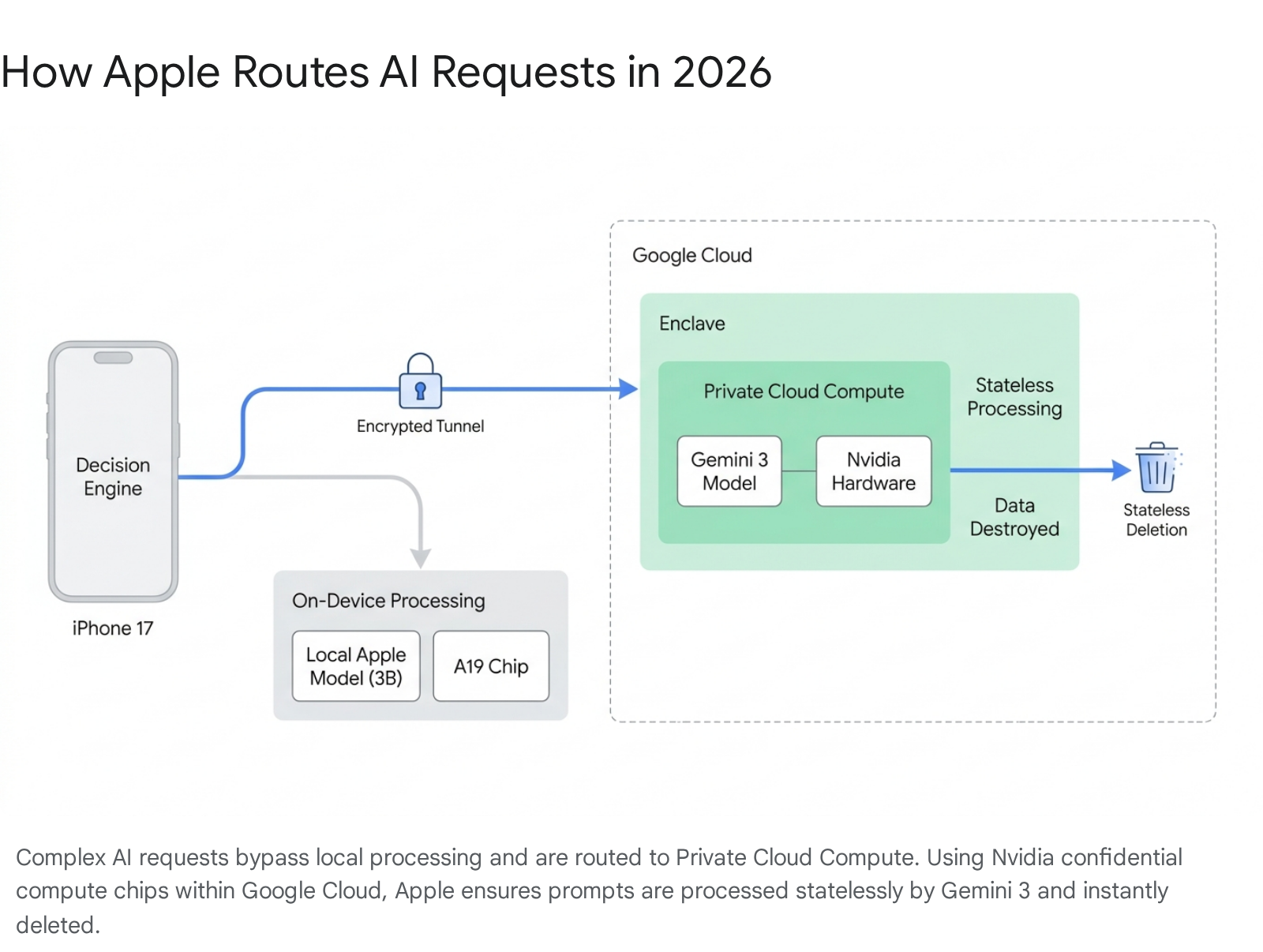
To reconcile this contradiction, Apple engineered a highly sophisticated split-routing system. The logic dictating exactly where and how a user's prompt is processed is determined instantaneously by the iPhone's operating system, based on the complexity of the request.
| Category | On-Device Processing (Apple) | Cloud Processing (Google Gemini / Apple PCC) |
|---|---|---|
| Model Size | Distilled ~3 billion parameter Apple model. | Google's 1.2 trillion parameter Gemini 3 model; future Apple 1T models (Ferret-3). |
| Task Priority | Latency-sensitive, highly private, everyday tasks. | Tasks requiring complex reasoning, world knowledge, and broad cross-app agentic planning. |
| Infrastructure Required | Apple A19 chip featuring redesigned neural accelerators and 12GB of RAM. | Private Cloud Compute (PCC) infrastructure utilizing Nvidia confidential compute hardware within Google Cloud. |
| Privacy Mechanism | Data never leaves the physical device; processed offline. | "Stateless computation" - data is encrypted in transit, processed, and immediately destroyed without logging. |
| Specific Capabilities | Basic UI navigation, text proofreading, prioritization of notifications, and local App Actions. | Orchestrating multi-step workflows, parsing live screen data, and synthesizing web knowledge. |
For routine tasks - such as summarizing a text message, proofreading an email, or setting an alarm - the iPhone relies entirely on its local hardware 1916. To achieve this, Apple utilizes a machine learning technique known as "distillation." Apple uses the massive outputs of Google's large Gemini model to train a much smaller, highly efficient, 3-billion-parameter model that can run natively and entirely offline on the iPhone's A19 chip 216. Because this data never leaves the device, it poses zero risk to user privacy 1926.
The Private Cloud Compute (PCC) Paradigm
When an iPhone determines that a user's prompt - such as researching a complex topic across the web while cross-referencing a lengthy PDF - exceeds the capabilities of the local 3-billion-parameter model, the device must seek external help. However, Apple does not simply transmit the user's personal data to a standard Google server. Instead, it routes the data through a groundbreaking architectural hybrid known as Private Cloud Compute (PCC) 272817.
Because the full Gemini 3 model contains trillions of parameters, Apple lacked the internal server infrastructure to run it efficiently at a global scale 16. The solution involved deploying Apple's privacy framework directly inside Google Cloud 16. Apple licenses the Gemini 3 model from Google, but the processing occurs on servers equipped with Nvidia's advanced AI chips, which utilize a privacy technology called "confidential compute" 16.
Confidential computing relies on hardware-based Trusted Execution Environments (TEEs). This security feature encrypts the user's data and the AI models themselves while they are actively being processed in the cloud 1618. Apple layers its own draconian security mandates on top of this hardware, enforcing what it calls "stateless computation" 271719.
Under the rules of stateless computation, the personal data sent from the iPhone to the PCC node is used for the sole, exclusive purpose of fulfilling the immediate inference request 1719. The millisecond the Gemini 3 model generates a response, the user's data is permanently destroyed 17. The data is never logged, it is never written to persistent storage, and it is strictly cryptographically shielded so that Google cannot retain it or use it to train future AI models 26171932.
Crucially, Apple architected the PCC nodes to guarantee "no privileged runtime access" 1719. This means that the system is entirely locked down; there are no backdoor administrative interfaces. Even if Apple or Google's own site reliability engineers are responding to a severe server outage, they physically and cryptographically cannot bypass the system to view user data 271719. To build public trust in this unprecedented system, Apple established "verifiable transparency," releasing binary artifacts of the PCC code to independent cybersecurity researchers, allowing third-party experts to confirm that the cloud infrastructure genuinely operates as safely as the physical iPhone 271719.
The "Extensions" Framework: An Open AI Marketplace
Despite the massive financial commitment to Google, Apple made a highly strategic decision not to lock its users exclusively into the Gemini ecosystem. In a surprising pivot toward platform openness, iOS 27 introduces a system-level capability known as "Extensions" 920.
Extensions effectively transform the iPhone into a comprehensive, agnostic AI platform. The feature allows users to access generative AI capabilities from various installed applications on demand, directly through native Apple features like Siri, Writing Tools, and Image Playground 920. While Gemini serves as the default fallback for complex Siri queries, users have the freedom to dive into their settings and select rival AI models - such as Anthropic's Claude or OpenAI's ChatGPT - as their primary AI service 91020.
If a user prefers ChatGPT's benchmark-leading logical reasoning for coding tasks, or Claude's nuanced tone for drafting professional documents, they simply download the respective App Store app and grant it Extension privileges 91020. Siri will then route requests to the user's chosen provider. To ensure that users are never confused about who is actively processing their data, Apple implemented an ingenious auditory cue: Siri utilizes custom voices depending on which external model is responding. Siri will speak in its native voice for local Apple tasks, but switch to a distinctly different voice when reading a response generated by Gemini or Claude, making the handover of data explicitly clear 920.
To police this new open marketplace, Apple significantly tightened its App Store Review Guidelines in late 2025. The updated policies mandate that developers must directly notify users and obtain explicit, opt-in consent before transferring any personal data or screen context to third-party AI companies 3221. This prevents predatory apps from silently harvesting user interactions to train external LLMs, ensuring that the openness of the Extensions framework does not compromise Apple's baseline privacy promises 21.
The Splinternet of AI: Navigating Geopolitics and Regulation
While the seamless integration of Gemini and third-party extensions covers the majority of the North American and Asian markets, shifting geopolitical and regulatory realities mean that hundreds of millions of global iPhone users will receive a fundamentally different - and often inferior - AI experience in 2026. The ideal of a unified, global iPhone feature set has fractured, giving rise to what tech analysts dub the "splinternet of AI."
Navigating China's Great Firewall
In mainland China, the challenges are strictly geopolitical. The Chinese government explicitly bans Google's services, making the integration of Gemini impossible 35. Furthermore, the Cyberspace Administration of China (CAC) mandates that all AI models must pass rigorous government testing, actively filter specific content, and route all data processing through domestically approved companies on local servers 3522.
To salvage its market share in a region where local competitors like Huawei and Xiaomi already offer robust AI smartphones, Apple established localized partnerships with Chinese tech titans Alibaba and Baidu 233824. In this bespoke architecture, Alibaba provides the foundational on-device platform. Alibaba engineers developed an intermediary software layer designed to filter, modify, and censor Apple's on-device AI outputs to strictly comply with Beijing's regulatory standards 233824. Because the Chinese government can demand immediate modifications to AI behaviors, Apple designed the system so that specific features can be remotely disabled until Alibaba updates the models to appease regulators 38.
Baidu, serving as a secondary partner, fills the void left by Google and OpenAI by powering cloud-based features 2440. Specifically, Baidu handles "Visual Intelligence" - the capability that allows users to point their iPhone camera at real-world objects to pull up contextual web information 234041. To ensure total compliance, this Chinese-specific AI installation is hardcoded geographically. Devices purchased outside of China will not utilize the Baidu or Alibaba models, even if a tourist physically brings their American iPhone into Beijing 3824.
The European Union's Regulatory Gridlock
In Europe, Apple faces an entirely different obstacle: antitrust regulation. Under the European Union's Digital Markets Act (DMA), Apple is heavily scrutinized as a "gatekeeper" platform 25. The DMA was enacted to foster competition by enforcing strict interoperability requirements, mandating that tech giants cannot favor their own proprietary services over third-party alternatives, nor can they arbitrarily restrict competitor access to core operating system APIs 2526.
When Apple first announced its deep, system-level AI integration, the European Commission immediately launched investigations 2627. Regulators questioned whether deeply integrating an AI assistant into the operating system unfairly disadvantaged rival apps, and whether the Private Cloud Compute infrastructure gave Apple's services preferred access to system data that rivals were denied 26.
Apple argued aggressively that opening up the highly sensitive, deep-system access required for Apple Intelligence to any third-party developer would fatally compromise user privacy and data security 2526. EU officials rejected this premise, arguing that gatekeepers cannot use privacy as a blanket excuse to throttle fair competition 26.
The result of this regulatory standoff was significant delays. Apple withheld the launch of Apple Intelligence features in the EU throughout late 2024 and 2025, warning that regulatory uncertainty made compliance impossible 2528. While negotiations continue into 2026, the strategic risk for Apple is deep fragmentation. European users are increasingly likely to receive a restricted, less capable version of Siri to satisfy antitrust monitors, breaking Apple's long-standing promise of a consistent, premium product experience regardless of geography 26.
The Economics of Intelligence: Costs and Subscriptions
With the infrastructure required to train and run massive LLMs costing tens of billions of dollars, the obvious question for consumers is how the industry plans to recoup these expenses. For the average iPhone user in 2026, the baseline answer is highly favorable: the core Apple Intelligence experience carries no distinct subscription fee 29.
Consumers do not need to purchase an iCloud+ storage upgrade or subscribe to the Apple One bundle to unlock the upgraded Siri, the integrated Writing Tools, or the seamless on-device execution 29. The billion-dollar annual check written to Google is absorbed by Apple as a necessary operational cost to keep the iPhone hardware competitive and justify its premium retail price 2529.
However, as the AI landscape matures, monetization is aggressively shifting toward power-user subscriptions. While the standard Gemini requests routed quietly through Siri are free, Google maintains a tiered approach for users who directly utilize its dedicated apps and developer platforms. In 2026, Google introduced a $100-per-month "AI Ultra" subscription plan 30.
Tailored specifically for software developers, technical leads, and advanced knowledge workers, the AI Ultra tier offers extreme utility. Subscribers receive a 5X higher usage limit than standard Pro users, access to the lightning-fast Gemini 3.5 Flash model for rapid code iteration, priority access to the "Google Antigravity" agent-first development platform, and a massive 20-terabyte cloud storage allowance to house massive datasets 30.
This creates a distinct two-tiered ecosystem. The vast majority of iPhone users will comfortably rely on Apple's free, seamlessly integrated intelligence for daily tasks and basic productivity. However, professionals whose livelihoods depend on unrestricted, massive-scale cloud computing will inevitably find the most transformative tools locked behind hefty subscription paywalls erected by third-party model providers like Google and OpenAI 83031.
Bottom line
Apple's 2026 integration of Google's Gemini 3 model fundamentally reshapes the iPhone, ending the era of Siri as a passive search tool and ushering in a new paradigm of autonomous, cross-app digital agency. By routing the most complex computational queries to Google Cloud through encrypted Nvidia hardware, Apple has managed to scale its AI ambitions rapidly without sacrificing its core promises of user privacy. However, this massive leap in capability introduces significant friction; the immense processing demands require new hardware baselines and strict battery optimization, while geopolitical censorship in China and antitrust regulations in Europe guarantee that the global iPhone experience is now deeply and permanently fragmented.