
Why Writing Things Down Helps You Think and Remember
Writing things down by hand forces your brain to mentally summarize and process information in real-time, engaging a widespread network of neural pathways linked to memory, learning, and motor skills. While digital typing and artificial intelligence tools act as incredibly efficient external storage systems, they bypass this physical and cognitive friction, resulting in shallower neurological engagement and comprehension. Ultimately, the physical act of forming letters builds deeper internal memory traces, ensuring that information is not just recorded, but actively digested and retained.
In an era where a smartphone can flawlessly record a two-hour lecture and a large language model can summarize it in seconds, the physical act of putting pen to paper is increasingly viewed as an archaic inefficiency. For decades, the dominant trend in educational pedagogy and corporate environments has been a relentless drive toward digital optimization. Keyboards allow users to capture words significantly faster, cloud servers store them permanently, and search engines retrieve them instantly.
Yet, a rapidly growing body of cognitive science, neuroscience, and psychological research suggests that this frictionless digital environment comes with a profound, often overlooked biological cost. By consistently outsourcing our memory and analytical processing to digital devices, we are fundamentally altering how our brains encode, process, and retrieve information. To understand why the analog act of handwriting remains one of the most powerful tools for human cognition, it is necessary to look closely at the neuroanatomical mechanics of the brain, the historical psychology of note-taking, the nuanced data of modern replication studies, and the double-edged sword of a phenomenon known as cognitive offloading.
The Neuroscience of Pen and Paper
For centuries, educators and philosophers intuitively understood that handwriting was a foundational pillar of learning. Today, high-density brain imaging techniques, such as functional magnetic resonance imaging (fMRI) and electroencephalography (EEG), are providing the empirical biological evidence to support these historical assumptions. Handwriting is not merely a mechanical method of transcribing words; it is an immensely complex psychomotor task that demands intense cross-talk between disparate regions of the brain 12.
Widespread Brain Connectivity
When an individual writes by hand, they are not just executing a repetitive motor command. They are continuously integrating visual feedback, tactile resistance, and fine motor control to produce unique geometric shapes.
A landmark 2024 high-density EEG study conducted at the Norwegian University of Science and Technology measured the electrical brain activity of 36 university students as they either handwrote words using a digital pen or typed them on a standard keyboard 23. The researchers found that the act of handwriting produced far more elaborate and interconnected brain connectivity patterns 4. Specifically, the researchers observed widespread connectivity coherence between network hubs and nodes located in the parietal and central brain regions 34.
This synchronized neurological activity was notably concentrated in the theta (3.5 - 7.5 Hz) and alpha (8 - 12.5 Hz) frequency bands 4. In the realm of cognitive neuroscience, activity in these specific lower-frequency bands, particularly within the central and parietal cortices, is intrinsically linked to robust sensorimotor integration, memory formation, and sustained attention 13. The study identified a concentration of 32 significant activity clusters representing 16 distinct connections between brain regions that were highly active during handwriting but entirely absent during typing 4.
Furthermore, this heightened connectivity was not a brief spike; the increased activity appeared between 1,000 to 2,000 milliseconds into the trial and lasted throughout the duration of the writing task 4. The sensory feedback obtained through the precisely controlled hand movements of drawing letters essentially primes the brain for learning by forcing it into a highly receptive, interconnected state. Typing, which involves identical, repetitive button presses regardless of the specific letter being formed, completely failed to generate these widespread connectivity patterns 12.
The Anatomical Journey of a Handwritten Word
To truly appreciate the cognitive weight of handwriting, one must look at the specific anatomical regions recruited during the task. A comprehensive 2025 neuroimaging review synthesized decades of data to map the neural correlates of different writing modalities, determining that handwriting actively recruits 13 distinct brain regions or regional groups, whereas typing engages only 10 25.
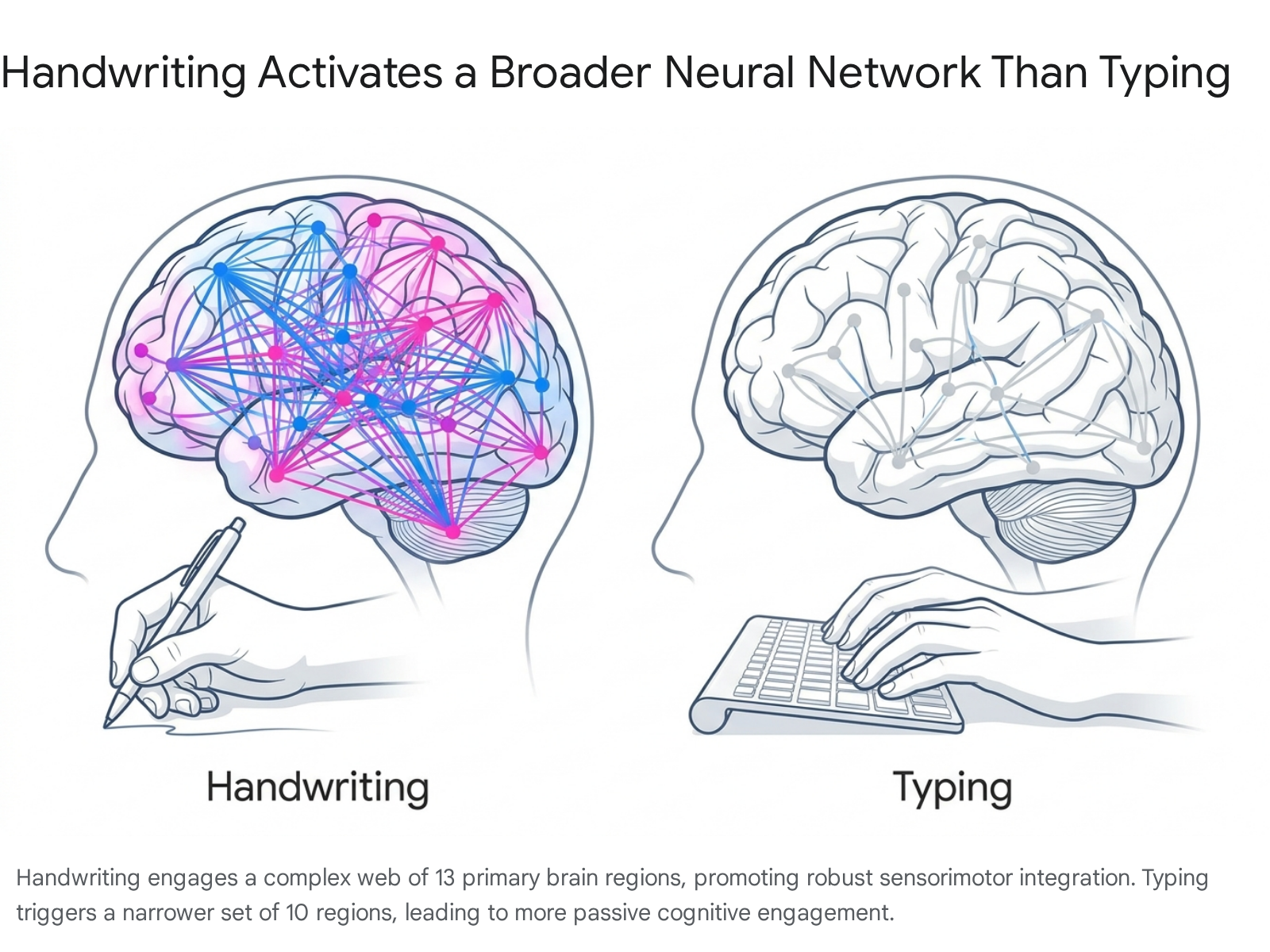
The anatomical journey of a handwritten word begins with the visual processing and memory centers. The brain activates the Visual Word Form Area (VWFA) to store and retrieve specific letter shapes and orthographic knowledge 5. Simultaneously, the superior parietal lobule and the anterior intraparietal sulcus engage to handle visuospatial integration and motor planning, ensuring the brain understands the spatial constraints of the paper and the specific motor programs required for each letter 5.
These visual and spatial representations are then sent to the dorsolateral prefrontal cortex, specifically a sub-region known as Exner's area, which is tasked with translating these abstract letter representations into concrete motor commands 5. The execution of these commands falls to the primary motor cortex and the supplementary motor area, but they do not act alone. Deep within the brain, the basal ganglia - comprising the striatum, putamen, pallidum, and caudate nucleus - work in tandem with the cerebellum to continuously fine-tune the kinematics, movement precision, timing, and physical pressure of the pen on the page 5. Throughout this process, the cuneus and precuneus maintain visual attention, while language centers like Broca's area, the middle temporal gyrus, and the angular gyrus handle phoneme-to-grapheme conversion and semantic processing 5.
Because forming an "A" feels physically and spatially distinct from forming a "B," the brain is forced to continuously update its multisensory integration, creating richer, more robust neural representations of the information 6.
Typing, conversely, relies heavily on procedural memory and spatial mapping - knowing unconsciously where a key is located on a QWERTY layout. However, the physical sensation of striking the "A" key is identical to striking the "B" key 6. This uniformity severely reduces the cognitive and motor demands placed on the brain. While typing does engage areas like the inferior frontal gyrus for spelling and the basal ganglia for automating keypress sequences, it lacks the deep sensorimotor integration required by the pen, resulting in a significantly more passive state of cognitive engagement 25.
Scientific Scrutiny and Methodological Limitations
While the neuroimaging data presents a compelling narrative, the scientific community emphasizes the need for calibrated interpretations. Critics of the aforementioned 2024 Norwegian EEG study have pointed out methodological limitations that warrant consideration.
Notably, researchers evaluating the study highlighted that while handwriting undeniably creates broader neural connectivity in the exact moment of execution, the EEG experiment itself did not include a subsequent learning or memory recall protocol 7. The participants were young adults simply copying words onto a screen; they were not tested on their comprehension or retention of those words 78. Furthermore, critics noted that the original study focused heavily on the statistical differences between handwriting and typing, rather than isolating the independent connectivity patterns of each condition 7. Therefore, while the leap from "more brain activity" to "better academic learning" is theoretically sound and supported by adjacent behavioral studies, the EEG data alone is a measure of neurological engagement, not a direct measure of educational outcomes 78.
The Psychology of Note-Taking: Encoding vs. External Storage
To understand why this heightened brain activity matters in practical, real-world scenarios - such as attending a university lecture or sitting in a corporate strategy meeting - it is necessary to transition from the anatomy of the brain to the psychology of note-taking.
For decades, educational psychologists have posited that the act of taking notes serves two distinct, yet complementary, functions: the encoding hypothesis and the external storage hypothesis 911.
The external storage hypothesis is the more intuitive of the two. It suggests that the primary value of notes is simply the creation of a permanent, physical (or digital) record that a learner can return to and review at a later date 910. From this perspective, the best note-taking method is the one that captures the most information with the highest degree of accuracy.
The encoding hypothesis, however, proposes that the physical act of taking notes facilitates learning in the present moment, completely independent of future review 1110. When an individual takes notes, they must listen to the input, hold it in their working memory, comprehend the underlying meaning, and then physically translate it onto the page 1112. This process demands active attention and subjective paraphrasing, helping the learner to "make the information their own" by weaving it into their existing cognitive frameworks 11.
The Danger of Verbatim Transcription
The tension between these two hypotheses came to a head in 2014 with the publication of a landmark psychological study titled "The Pen Is Mightier Than the Keyboard." The researchers discovered a fascinating, paradoxical behavioral quirk regarding how humans interact with technology 1213.
Because the average human can type significantly faster than they can write by hand, laptop users in educational settings tend to act like human stenographers. They attempt to blindly transcribe a speaker's words verbatim, capturing massive volumes of text 1213. Handwriters, physically unable to keep up with the natural speed of human speech, are forced into a different cognitive strategy. They must listen critically, mentally digest the core concepts, and summarize the information in their own abbreviated words 1213.
This forced summarization is known as "generative processing," and it is the core engine of the encoding hypothesis 1214. The researchers tested this by having university students watch complex lectures and take notes via either laptop or longhand. When the students were subsequently tested on basic factual recall (e.g., remembering a specific date), both groups performed equally well 12. However, when tested on conceptual application - questions that required synthesizing themes and understanding underlying mechanisms - the longhand note-takers significantly outperformed the laptop users 1213.
By forcing the brain to do the hard work of synthesis in real-time, handwriting builds stronger conceptual memory traces 1112. Even when researchers explicitly warned laptop users to avoid transcribing the lecture verbatim, the urge to type every word was so deeply ingrained that the students failed to alter their behavior, and their conceptual test scores suffered accordingly 11.
The Digestion Analogy
The difference between typing and handwriting can be understood through a philosophical analogy regarding information consumption. Consuming information - whether through reading a book or listening to a lecture - is much like eating 17. It is a necessary intake of raw materials. However, thinking, summarizing, and synthesizing that information is analogous to digesting 17.
Typing verbatim notes is the cognitive equivalent of swallowing a meal whole. The raw material has been transferred into the stomach (the external hard drive), but the body has not extracted any nutritional value from it. Handwriting, by imposing a speed limit on data capture, forces the brain to chew and digest the information. As the philosopher John Locke observed centuries ago, reading merely furnishes the mind with the materials of knowledge; it is the act of thinking that makes what we read truly ours 17.
The Great Replication Debate and Meta-Analyses
As is common in the behavioral sciences, the viral success of the 2014 "Pen is Mightier" study triggered a wave of intense scrutiny and replication attempts. The narrative that "handwriting is always better" has proven to be slightly more nuanced than initial headlines suggested.
In recent years, several direct replication studies have yielded mixed or contradictory results. For instance, a highly publicized 2021 study attempted to replicate the original 2014 experiment but found no statistically significant evidence for a longhand advantage on immediate quiz performance, noting instead that laptop users took more voluminous notes but did not suffer a penalty in conceptual recall 1415.
This led to a flurry of meta-analyses attempting to synthesize the disparate findings across dozens of different academic environments. A 2022 meta-analysis examining 39 experimental studies suggested that when digital distractions (such as the temptation to browse the internet on a laptop) were strictly controlled in laboratory environments, the performance difference between digital and longhand note-taking often diminished or disappeared entirely 131617. This suggested that the primary culprit of poor laptop performance in real-world classrooms might be multitasking and divided attention, rather than the typing mechanism itself 1617.
The Crucial Role of Review
The definitive clarity regarding this debate arrived via an exhaustive 2024 meta-analysis published in the Educational Psychology Review, which aggregated data from 24 independent studies involving thousands of students 2122.
The researchers confirmed that typing indeed produces a massive advantage in note-taking volume (Hedges' g = 0.919, indicating a very large effect size for word count) 1322. However, the meta-analysis found a small but highly statistically significant overall advantage for handwriting regarding long-term academic achievement (Hedges' g = 0.248) 1322.
The critical breakthrough of this meta-analysis was identifying a temporal moderator: the handwritten advantage strongly emerges only when students are allowed to review their notes over time 2122. For immediate testing without the opportunity to study, the advantage of handwriting often vanishes 21.
This finding beautifully marries the encoding and external storage hypotheses. Handwriting produces superior notes for later review precisely because the initial encoding process (the generative summarizing) creates richer memory traces 21. When a student reviews typed verbatim notes, they are essentially re-reading a raw transcript, forcing them to begin the cognitive processing from scratch. When a student reviews handwritten notes, they are reactivating a highly condensed, pre-processed cognitive map 1621.
| Feature / Outcome | Pen and Paper (Longhand) | Laptop / Keyboard (Typing) | Tablet and Stylus (Digital Ink) |
|---|---|---|---|
| Capture Speed & Volume | Low (constrained by motor speed) | High (enables near-verbatim transcripts) | Medium-Low (similar to pen and paper) |
| Cognitive Processing | High (forces generative summarization) | Low (promotes passive transcription) | High (maintains generative processing) |
| Distraction Potential | Very Low (single-purpose tool) | Very High (multitasking, internet access) | Medium (notifications can interrupt focus) |
| Long-Term Utility | High (excellent for review, high conceptual mapping) | Low (dense transcripts require heavy re-processing) | High (combines conceptual mapping with digital archiving) |
Does the Medium Matter? Paper vs. Glass
Accepting that the physical motion of drawing letters is cognitively superior to pressing keys, a modern technological question arises: Does it matter if you use an ink pen on a physical paper notebook, or a digital stylus (like an Apple Pencil) on a glass tablet screen?
From a purely motor-sensory perspective, digital styluses are highly effective. They successfully trigger the complex psychomotor pathways required for letter formation, engaging the brain much more deeply than typing 23. They also offer the immense practical benefits of cloud storage, infinite scrolling, and digital searchability 23.
However, emerging neuroscience suggests that physical paper still holds a unique cognitive edge over glass screens. A fascinating 2021 study conducted at the University of Tokyo explored this exact boundary condition 18. Researchers tasked 48 young adult volunteers with reading a fictional conversation that outlined a complex two-month schedule involving 14 different class times, due dates, and personal appointments 18. The participants were divided into three groups and asked to record this schedule using either a physical paper datebook and pen, a calendar app on a tablet with a stylus, or a smartphone using a touch-screen keyboard 18.
Following a distraction period, the volunteers were placed inside a functional MRI (fMRI) scanner and tested on their memory of the schedule. Surprisingly, the participants using physical paper completed the initial note-taking task approximately 25% faster than those using digital tablets (11 minutes versus 14 minutes) 18.
More importantly, the fMRI brain scans revealed that the paper users exhibited significantly stronger activation in the hippocampus, the brain's primary hub for memory consolidation and spatial navigation, as well as in areas associated with language and imaginary visualization 18.
The researchers theorized that the human brain relies heavily on spatial and tactile cues to anchor memories. Physical paper possesses tangible permanence: it features irregular strokes, physical weight, tactile resistance against the pen, and an absolute, fixed spatial layout (e.g., folded corners, top-left margins) 18. A student might unconsciously remember that a specific scientific definition was written "on the bottom left of the right-hand page."
Digital screens, by contrast, are fundamentally uniform. They offer smooth, frictionless scrolling where words disappear and reappear, stripping away the rich spatial landmarks that the hippocampus relies upon to navigate information in the "mind's eye" 18. While writing on a tablet is vastly superior to typing, writing on physical paper provides an additional, subconscious layer of unique spatial data that further solidifies memory retrieval.
The Double-Edged Sword of Cognitive Offloading
To understand why society is so eager to abandon handwriting despite its profound neurological benefits, one must look at a pervasive psychological phenomenon known as "cognitive offloading."
Cognitive offloading is the practice of reducing internal mental effort by outsourcing our memories, planning, and executive functions to external tools or actions 1920. Whether it involves writing a physical grocery list, setting a digital calendar alert, or asking a smart assistant to remind you to call a relative, the fundamental mechanism is the same: you are hiring a temporary external intern to handle routine working memory tasks 19.
Humans are naturally "cognitive misers" 19. The brain consumes an exorbitant amount of the body's energy and glucose, so it aggressively seeks shortcuts to conserve resources 19. Offloading is an ancient, highly adaptive evolutionary trait. By outsourcing routine facts and schedules to the environment, we free up our limited, biologically expensive working memory for higher-order problem solving, threat detection, and creative thinking 1927.
The Google Effect and the External Hard Drive
However, in the digital age, this evolutionary shortcut has metastasized. Psychologists describe offloading as a value-based decision: individuals constantly weigh the biological cost of holding something in their internal memory against the ease of outsourcing it to an external tool 1921. Because modern digital tools are perfectly reliable and instantly accessible, the cost-benefit analysis almost always favors offloading 19.
This carries a severe biological penalty regarding memory retention. Research demonstrates that when people believe a device will save a piece of information, their brains implicitly assign less importance to encoding the fact itself 2022. In experimental settings, when participants are told that a computer will save a list of trivia facts, their internal memory for those facts plummets. Fascinatingly, however, their memory for exactly which folder the computer saved the facts in improves significantly 2022.
Psychologists refer to this as the "Google effect" or "digital amnesia" 1920. The modern internet and the smartphone operate as an omnipotent "external hard drive" for the human brain 202324. Throughout human history, transactive memory systems relied on communities - you might rely on a spouse to remember birthdays, and they might rely on you to remember financial details 2022. The internet, however, bypasses this reciprocal social transaction. It acts as a single, infallible entity responsible for holding virtually all factual information 23.
Because we know the data is permanently stored and instantly searchable, our brains rapidly clear our short-term memory workspace rather than expending the energy to encode the data permanently 20. We no longer memorize phone numbers, historical dates, or navigational routes because the environmental demand to do so has vanished.
AI and the Atrophy of Critical Thought
While relying on a smartphone for trivia recall is relatively benign, the danger of cognitive offloading accelerates dramatically with the advent of Generative Artificial Intelligence (AI). While a calendar offloads a simple memory, AI systems allow humans to offload complex reasoning, planning, and synthesis 1927.
A large-scale 2025 psychological study involving 666 participants utilized Latent Profile Analysis to investigate how frequent reliance on AI systems impacts human cognition 1925. The study found that frequent, uncalibrated AI use was negatively correlated with critical thinking abilities 19.
The researchers identified distinct user profiles based on dependency. "Dependence-Oriented Users" exhibited two problematic traits: * Instrumental Dependency: A habitual reliance on AI for memory support, task automation, and cognitive simplification, essentially delegating independent thinking to the machine 2533. * Relational Dependency: Treating the conversational AI as an emotional companion, leading to deeper psychological reliance 2533.
The researchers concluded that cognitive offloading mediated the drop in critical thinking 19. The more users allowed the AI to do the heavy lifting of analysis, drafting, and synthesis, the less they engaged their own reflective faculties 1933. The human brain is highly plastic; just like a physical muscle, neural circuits responsible for critical thought, deep reading, and creative synthesis can actively atrophy if they are continuously bypassed 1920.
In a world increasingly dominated by frictionless AI, the deliberate, high-effort act of writing things down by hand is one of the most accessible ways to force those mental muscles back into the gym, ensuring that our internal cognitive architecture remains robust.
Neuro-Linguistic Quirks: Alphabetic vs. Logographic Scripts
It is important to note that the cognitive benefits of handwriting are not universally uniform; they change based on the cultural and linguistic properties of the writing system being utilized. Writing systems are broadly categorized into alphabetic scripts (such as English or Italian, which use a small set of letters to represent phonological sounds) and logographic or hieroglyphic scripts (such as Chinese or Japanese Kanji, which require the retrieval of thousands of complex, visually distinct symbols to represent whole concepts or words) 25.
Neuroimaging reveals that these systems engage the brain in fundamentally different ways. Writing in alphabetic systems predominantly activates the brain's left hemisphere, specifically areas dedicated to phonological processing and phoneme-to-grapheme conversion 25.
Writing logographic characters, however, relies heavily on intricate, non-linear strokes. This causes a massive surge of activation in the right hemisphere, particularly in visuospatial processing areas 25. The cognitive demands of retrieving and drawing a complex Chinese character lead to significantly enhanced visuospatial memory and motor coordination compared to alphabet-based writing 25.
Because logographic handwriting places such intense demands on visuospatial memory rather than purely phonological processing, studies suggest it may offer a unique advantage to populations struggling with traditional reading difficulties 2627. Developmental dyslexia is heavily tied to phonological processing deficits within the left hemisphere 2627. Consequently, dyslexic children from alphabetic backgrounds sometimes demonstrate unimpaired - or even superior - abilities when tasked with learning to write and read logographic characters, as they are able to bypass their phonological deficits and utilize their strong right-hemisphere spatial memory 2627.
Bottom line
Writing things down by hand is far more than an act of analog nostalgia; it is a vital neurological workout. By preventing the brain from capturing information at the speed of speech, a pen forces the writer to actively digest, summarize, and spatially organize concepts in real-time, resulting in widespread neural connectivity that keyboards simply cannot trigger. While digital tools and AI assistants are undeniably invaluable for cognitive offloading and workplace efficiency, abandoning the friction of handwriting entirely carries the profound risk of allowing our internal memory and critical synthesis skills to atrophy from disuse.