
Neurobiology and Clinical Efficacy of Therapeutic Journaling
Introduction to the Written Emotional Disclosure Paradigm
Therapeutic journaling, frequently operationalized in clinical research as expressive writing or written emotional disclosure, represents a profound intersection between cognitive psychology, linguistics, and neurobiology. Unlike traditional diary writing - which typically involves the chronological recording of daily events - therapeutic journaling is an intentional, internal process of using the written word to express the full range of emotions, reactions, and perceptions related to difficult, upsetting, or traumatic life events 12. Originating from the pioneering work of Dr. James Pennebaker in the 1980s, the classic expressive writing paradigm instructs individuals to write continuously for 15 to 20 minutes over three to four consecutive days, exploring their deepest thoughts and feelings regarding a traumatic or highly stressful experience without regard for grammar, spelling, or structure 133.
The early theoretical foundations of this practice rested on "inhibition theory," which posited that the active suppression of traumatic memories and negative emotions exacts a chronic physiological toll on the autonomic nervous system, leading to long-term immune suppression and elevated disease risk 45. According to this early model, the act of writing served as a cathartic release, reducing the physiological work of inhibition 5. However, subsequent decades of research have shifted the theoretical focus from pure catharsis toward cognitive processing, exposure theory, and meaning-making 5. It is now understood that unstructured emotional venting alone is insufficient for sustained psychological healing. Rather, the therapeutic mechanism lies in the translation of chaotic, fragmented emotional experiences into a coherent narrative structure 67. This cognitive restructuring allows individuals to organize memories, integrate conflicting emotions, and ultimately gain cognitive mastery over their trauma, thereby initiating emotional habituation 789.
Extensive meta-analyses and randomized controlled trials spanning several decades have validated the efficacy of expressive writing. Engaging in structured emotional disclosure has been linked to a cascade of physiological and psychological benefits, including enhanced immune system functioning, reduced blood pressure, fewer visits to primary care physicians, and significant reductions in symptoms of generalized anxiety, clinical depression, and post-traumatic stress disorder (PTSD) 167. A recent systematic review of 20 randomized controlled trials encompassing over 3,000 participants found that 68% of journaling interventions demonstrated statistically significant improvements in mental health symptoms, lowering scores on mental health measures by an average of 5% 101211. The data positions journaling as a low-cost, low-risk adjunctive therapy suitable for broad clinical application, particularly when the intervention extends beyond 30 days 1014.
However, as the paradigm has evolved, several critical variables have emerged that dictate the efficacy of the intervention. Recent scholarship has aggressively investigated the neurobiological pathways of emotion regulation, the differential impacts of analog versus digital writing modalities, the stark dividing line between adaptive processing and maladaptive rumination, and the cultural boundary conditions that influence emotional disclosure 7121314. This comprehensive analysis systematically examines these dimensions to provide an expert-level evaluation of the therapeutic journaling landscape.
The Neurobiology of Expressive Writing: Pathways from Raw Emotion to Structured Language
To understand why translating trauma into text generates measurable health benefits, it is necessary to examine the neurobiological architecture of emotion generation and regulation. The process of expressive writing forces a highly specific interaction between the brain's subcortical emotional centers and its cortical linguistic and executive control networks 131516.
The Limbic System and Emotional Generation
The genesis of an emotional response occurs deep within the limbic system, a complex network of subcortical structures responsible for processing memory and emotion 1721. When an individual recalls a traumatic or stressful event, sensory information is routed through the thalamus to the amygdala, an almond-shaped structure central to fear conditioning and the evaluation of emotional valence 1617. The amygdala rapidly triggers sympathetic nervous system arousal via the hypothalamus, initiating a cascade of neuroendocrine responses, including the release of monoamine neurotransmitters, cortisol, and adrenaline, which prepare the body for a "fight or flight" response 1618.
Concurrently, the hippocampus - which is highly sensitive to stress hormones - works to contextualize these emotional memories 17. In cases of severe trauma or PTSD, however, the intense neurochemical flood can impair hippocampal function, leading to reductions in volume and resulting in fragmented, intrusive recall rather than a coherent chronological memory 17. The individual experiences the memory as a present, visceral threat rather than a past event.
The "Affect Labeling" Hypothesis and Corticolimbic Coupling
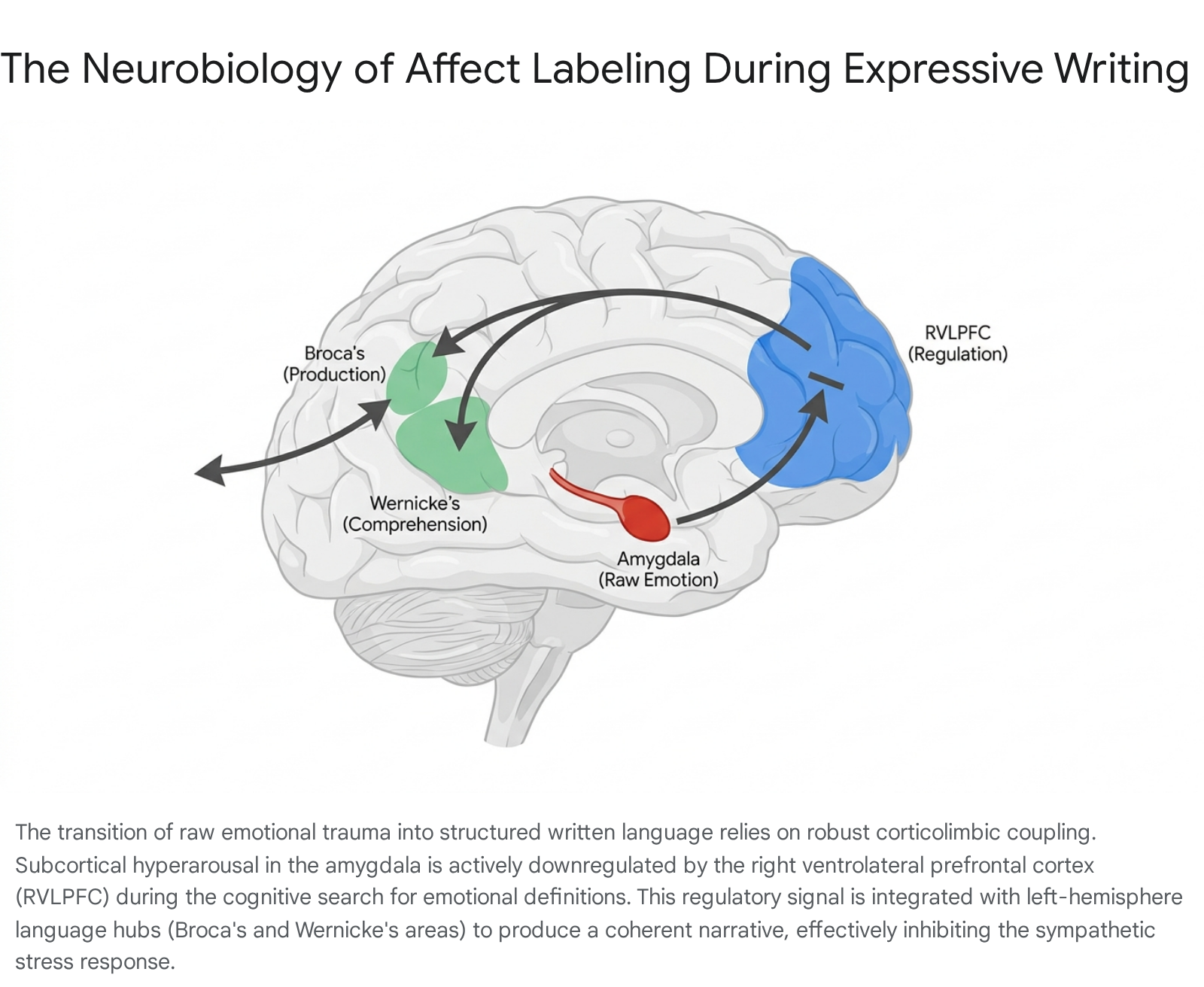
The core neurobiological mechanism underlying therapeutic journaling is grounded in the "affect labeling" hypothesis. Affect labeling is the process of putting feelings into words, which serves as a powerful form of incidental, or implicit, emotion regulation 1319. When an individual engages in expressive writing, they are forced to identify, categorize, and label their diffuse emotional states in order to construct grammatically correct sentences 1520.
Neuroimaging studies utilizing functional magnetic resonance imaging (fMRI) and Dynamic Causal Modeling (DCM) have precisely mapped this pathway. The act of affect labeling reliably recruits the right ventrolateral prefrontal cortex (RVLPFC), an executive region associated with inhibitory control and emotion regulation 1319. Crucially, activation of the RVLPFC exhibits a strong negative functional connectivity with the amygdala. As the individual searches for the correct linguistic terms to describe their distress, the input from the RVLPFC effectively dampens or downregulates the hyperactive amygdala response 1319. This inverse relationship is the neurological manifestation of emotional relief; by activating the prefrontal cortex to construct language, the brain actively suppresses the raw panic and sympathetic arousal generated by the limbic system 1319. Furthermore, robust RVLPFC activity during affect labeling serves as a positive predictor of long-term improvements in depression, anxiety, and physical symptoms up to three months post-intervention 19.
The Linguistic Bridge: Broca's and Wernicke's Areas
The translation of downregulated emotion into the physical act of writing requires profound interhemispheric communication. While the right-lateralized RVLPFC dampens the emotional intensity, the brain must concurrently engage left-lateralized frontoparietal regions associated with language processing 1525. Wernicke's area, situated in the left superior temporal gyrus, is activated for semantic comprehension and the selection of appropriate lexicon, enabling the writer to access the "insight" and "causality" words necessary to construct meaning from the trauma 926. Simultaneously, Broca's area, located in the left frontal operculum (specifically BA 44/45), orchestrates language production, syntax formulation, and motor output for writing 1326.
Advanced fMRI dynamic causal modeling comparing 64 different functional network models across healthy subjects reveals that Broca's area also exerts a direct, negative modulatory influence on the amygdala, operating both independently of and in concert with the RVLPFC 13. The sheer cognitive load of formatting a complete sentence - where syntax demands that one idea logically connects to the next - forces a structural organization upon the memory that inherently slows down the racing, perseverative thought processes characteristic of acute distress 1320. Because the brain cannot simultaneously maintain maximum limbic panic while successfully executing complex syntactic formulation, the biological demand of structured language acts as an active inhibitor of the fear response 1320. Furthermore, higher levels of subjective interoceptive awareness during this process correlate with preserved activation in the anterior cingulate cortex (ACC) and dorsal attention networks, allowing the individual to remain cognitively engaged with their internal states without becoming overwhelmed by them 2527.
The Modality Debate: Analog (Handwriting) versus Digital (Typing) Journaling
In the contemporary era, the ubiquity of smartphones, tablets, and computers has led to a proliferation of digital journaling applications. While these tools offer undeniable convenience, accessibility, and the ability to easily track symptom progression, recent high-density neuroimaging studies indicate that the physical modality of writing - specifically, analog handwriting versus digital typewriting - profoundly alters the brain's functional connectivity and subsequent cognitive outcomes 101221.
A landmark 2024 study by Van der Weel and Van der Meer utilized high-density electroencephalography (HD EEG) with 256-channel sensor arrays to investigate neural activity in young adults tasked with handwriting versus typing identical visually presented words 122223. The findings revealed stark neurocognitive differences between the two modalities, challenging the assumption that all forms of written expression yield identical cognitive benefits 1223.
Frequency Band Dynamics and Sensorimotor Integration
During the handwriting condition, time-frequency analyses demonstrated pronounced neural coherence in the theta (3.5 - 7.5 Hz) and alpha (8 - 12.5 Hz) frequency bands 22. In neurophysiological terms, theta band connectivity is strongly associated with working memory, the temporary holding of information for planning, and the encoding of new conceptual information 2124. Alpha band connectivity, meanwhile, corresponds to task-specific focus, attention, and long-term memory consolidation 2425. The Van der Weel study observed these synchronized, widespread connectivity patterns specifically across the central and parietal regions of the brain during handwriting 1223.
The superior cognitive engagement observed during handwriting is fundamentally attributed to the complex psychomotor requirements of the task. Handwriting demands precise, varied, and continuously controlled fine motor movements of the fingers and wrist to form the unique shape of each individual letter 2124. This intricate movement integrates multiple streams of information simultaneously: visual feedback, proprioceptive awareness of the body's positioning in space, and highly coordinated motor control 24. This robust sensorimotor integration acts as a powerful catalyst for neuroplasticity, memory formation, and the structural encoding of new information 1225.
Conversely, typing is a highly repetitive, uniform motor action. Striking a key requires the exact same physical motion regardless of the letter being produced 24. The HD EEG data demonstrated that typewriting predominantly engaged basic linguistic processing and working memory circuits, but showed significantly weaker and less widespread connectivity patterns in the crucial parietal hubs associated with deep learning and attention 2225. Typing generated a more passive cognitive engagement compared to the active, multi-sensory demand of using a pen 25.
Clinical Implications for Therapeutic Journaling
For therapeutic journaling, the modality chosen may influence the depth of emotional processing and meaning-making. Because handwriting is inherently slower and requires more deliberate psychomotor attention than typing on a keyboard, it acts as a natural pacing mechanism 24. This forced deceleration requires the writer to remain present with their thoughts, carefully select their words, and fully engage the prefrontal cortex in the affect labeling process described earlier 2426. The enhanced functional connectivity and deeper semantic processing associated with handwriting may facilitate a more profound integration of traumatic memories 2526.
Furthermore, some research suggests that the positive mood experienced during deep learning and processing is significantly higher during handwriting than during typing 25. While digital journaling platforms are highly effective for brief interventions, ecological momentary assessment (EMA), daily mood tracking, or generating gratitude lists on the go, analog handwriting appears neurologically superior for intensive therapeutic interventions that require deep cognitive restructuring, meaning-making, and the emotional regulation of complex trauma 102326.
Delineating Therapeutic Processing from Harmful Rumination
A critical misconception in the popular understanding of journaling is the belief that any form of emotional expression or unstructured "venting" is inherently beneficial. In clinical reality, a sharp dividing line exists between adaptive emotional processing and maladaptive rumination. Without proper structure or progression, unstructured venting can actually exacerbate psychological distress, increase clinical anxiety, and entrench pathological neural pathways 6934.
The Physiology of Rumination
Rumination is defined as the repetitive, prolonged, and recurrent negative thinking about past events, one's distress symptoms, or perceived failures, without active problem-solving or meaning-making 142728. While worry is typically future-oriented and characterizes generalized anxiety disorder (GAD), rumination is past-oriented and serves as a central maintenance mechanism for major depressive disorder (MDD) 272930. From a physiological standpoint, rumination acts as a form of chronic internal stress that delays recovery 2831.
When an individual ruminates on paper - simply listing grievances or continually re-living the visceral horror of a trauma without cognitive progression - they trigger and sustain a prolonged stress response. Meta-analyses and psychophysiological studies, such as the comprehensive review by Ottaviani et al., consistently demonstrate that rumination is associated with a distinct, maladaptive physiological profile 28: * Heart Rate Variability (HRV) Withdrawal: HRV - the variation in time between consecutive heartbeats - is a robust biometric marker of autonomic nervous system flexibility and vagal tone. High resting HRV indicates an adaptive capacity for emotion regulation via the parasympathetic nervous system 2829. Rumination, both experimentally induced and naturally occurring, consistently triggers a sharp decline in vagally-mediated HRV, indicating a withdrawal of parasympathetic control and a rigid emotional state 2831. * Sympathetic Dominance: Ruminative thinking is accompanied by elevated heart rate, increased skin conductance, and higher blood pressure, signaling sustained sympathetic nervous system arousal that mimics an ongoing physical threat 2832. * Prolonged Cortisol Secretion: Ruminators exhibit delayed cortisol recovery following a stressor, maintaining the body in a state of neuroendocrine hypervigilance long after the actual stressful event has passed 2832. * Impaired Cognitive Control: Maladaptive rumination decreases the ability to suppress distracting, irrelevant information, locking the individual into a self-referential loop driven by the brain's Default Mode Network (DMN) 2833.
The Mechanism of Therapeutic Processing
In stark contrast, successful therapeutic journaling facilitates emotional processing and eventual habituation. While writing about trauma initially provokes a spike in distress, dysphoria, and physical arousal during the first few sessions, this spike is transient and expected 634. Across consecutive writing sessions, individuals experience emotional habituation; the trauma memory loses its raw affective intensity because the individual learns, through exposure, that the memory itself is not physically dangerous and that the distress is manageable 834.
The linguistic markers of therapeutic processing differ fundamentally from those of rumination. Textual analyses of expressive writing transcripts reveal that long-term health improvements are heavily correlated with an increase in "insight words" (e.g., realize, understand, consider, recognize) and "causal words" (e.g., because, reason, therefore, effect) over the course of the writing sessions 920. This linguistic shift proves that the writer is moving from a passive victim of autonomic hyperarousal to an active constructor of narrative meaning 69. Journaling that merely rehearses negative emotions without achieving this cognitive shift is clinically counterproductive, and individuals who repeatedly dwell on trauma without deriving meaning report poorer health outcomes than those who write about neutral topics 64335.
A Comparative Framework: Processing vs. Rumination
| Feature / Dimension | Therapeutic Journaling (Emotional Processing) | Counterproductive Journaling (Rumination) |
|---|---|---|
| Cognitive Focus | Meaning-making, causal linking, integration of conflicting thoughts, and reappraisal. | Repetitive dwelling on distress symptoms, past failures, or self-victimhood without resolution. |
| Linguistic Markers | High use of insight (understand) and causal (because) words. Gradual shift from first-person to third-person perspective. | High use of negative emotion words without causal linkage. Stuck in absolute, first-person narratives. |
| Autonomic Impact | Initial sympathetic spike, followed by long-term restoration of parasympathetic tone and increased Heart Rate Variability (HRV). | Sustained sympathetic arousal, vagal withdrawal, and chronically blunted Heart Rate Variability (HRV). |
| Endocrine Response | Rapid cortisol recovery post-writing; eventual decrease in baseline stress hormones. | Delayed cortisol recovery; sustained neuroendocrine hyperarousal and elevated baseline cortisol. |
| Clinical Outcome | Emotional habituation; reduced symptoms of depression, anxiety, and PTSD; increased resilience. | Exacerbation of depressive and anxious symptoms; increased emotional distress, avoidance, and impaired mood recovery. |
| Brain Connectivity | RVLPFC successfully dampens amygdala hyperactivity; enhanced connectivity in frontoparietal attention networks. | Failure of prefrontal top-down control; sustained hyperactivation of the amygdala and Default Mode Network (self-referential loops). |
Comparative Intervention Topologies: Expressive, Gratitude, and CBT Structured Journaling
To maximize clinical efficacy and actively mitigate the risks of rumination, mental health professionals employ distinct writing paradigms tailored to specific patient populations, baseline distress levels, and treatment goals 93637.
The Expressive Writing Paradigm (Pennebaker)
The traditional Pennebaker expressive writing paradigm focuses directly on traumatic or deeply stressful events. It is considered a "stand-alone" intervention that can be administered with minimal therapist contact, usually consisting of three to five 15-to-20-minute sessions over consecutive days 19. By forcing the individual to confront avoided stimuli, it operates similarly to an exposure-based therapy, facilitating the emotional processing of fear and the integration of traumatic memories 5934.
However, evidence regarding its universal efficacy is highly nuanced. Large-scale meta-analyses, including Cochrane reviews, indicate that while expressive writing is highly efficient for decreasing PTSD symptoms and reducing generalized anxiety, its effects on long-term depressive symptoms in physically healthy adults are surprisingly modest to negligible 547. Furthermore, expressive writing may be contraindicated for specific populations. Studies indicate that individuals who are highly alexithymic (experiencing a deficit in understanding or expressing emotions), or those who completely lack the psychological resources and social support to process severe trauma independently, may actually experience an exacerbation of physical and psychological symptoms following unstructured expressive writing 638.
Gratitude and Positive Affect Journaling
Originating from the field of positive psychology, gratitude journaling represents a paradigm shift from a deficit-oriented clinical model to a strength-based approach 9. Interventions such as the "Three Good Things" exercise, "Best Possible Self" narratives, and gratitude letters explicitly instruct participants to focus their writing on positive experiences, strengths, and optimism rather than past trauma 3939.
Recent systematic reviews highlight that positive expressive writing yields the most consistent benefits for subjective well-being, positive affect, and optimism across non-clinical populations 4339. In comparative randomized controlled trials between traditional trauma-focused expressive writing and positive writing, the latter was significantly more effective at generating immediate mood improvements and producing cognitive changes in the general population 36. For individuals struggling with severe, acute depression, where the cognitive burden of confronting trauma might trigger uncontrollable rumination, gratitude journaling provides a safer, more accessible entry point into writing therapy that avoids the initial distress spike associated with trauma processing 144336.
Clinically Structured Journaling: CBT Thought Records and CBWT
Cognitive Behavioral Therapy (CBT) employs a highly structured form of journaling known as the thought record or structured diary 940. Unlike free-form expressive writing, which relies on the individual's spontaneous ability to generate insight, CBT diaries provide a rigid, step-by-step framework designed to forcefully interrupt cognitive distortions 9.
In a typical CBT thought record, the patient logs a specific activating event, identifies the automatic negative thoughts triggered by the event, labels the specific emotions felt, grades the intensity of the belief, and then explicitly challenges the rationality of the thought to develop a balanced, alternative perspective 89. This structured approach leaves no room for aimless venting; it explicitly requires cognitive restructuring.
Expanding on this concept, Cognitive-Behavioral Writing Therapy (CBWT) combines the emotional disclosure of expressive writing with the cognitive restructuring protocols of CBT. Patients write narratives of previous traumas, assist the therapist in altering these narratives using cognitive restructuring techniques, and then share the revised narratives 40. Studies have found CBWT to have efficacy comparable to traditional, face-to-face CBT in treating PTSD, offering a highly structured alternative to free-form journaling 40.
Written Exposure Therapy (WET)
Building upon Pennebaker's foundational work and exposure theory, Drs. Denise Sloan and Brian Marx developed Written Exposure Therapy (WET), a manualized, evidence-based treatment specifically designed for PTSD 41. WET distills the mechanism of expressive writing into a highly structured, five-session protocol. In each 50-minute session, the patient writes continuously for 30 minutes about a single index trauma, focusing heavily on the physical sensations and specific emotions experienced at the time of the event 3442. The therapist acts as a guide, delivering precise instructions and briefly checking in regarding the patient's experience of the writing process, but crucially, the therapist does not analyze the text or engage in deep conversational processing of the trauma itself 3443.
Extensive empirical literature, including large non-inferiority trials, has demonstrated that WET is as effective as first-line trauma treatments like Cognitive Processing Therapy (CPT) and Prolonged Exposure (PE), but boasts significantly lower dropout rates (often less than 15%) because it is less burdensome to the patient 3441. The intervention is grounded in an inhibitory learning model, teaching the patient that the trauma memory can be approached without catastrophic consequences 4144. Due to its high efficacy and brief nature, the U.S. Department of Veterans Affairs and Department of Defense (VA/DoD) Clinical Practice Guidelines, along with the American Psychological Association (APA), recognize WET as an essential, evidence-based psychotherapy for the management of PTSD 344142.
Cross-Cultural Dimensions of the Expressive Writing Paradigm
A significant limitation in the early literature on therapeutic journaling was its heavy, almost exclusive reliance on Western, educated, industrialized, rich, and democratic (WEIRD) populations, typically American college students 4546. Western psychology and therapeutic frameworks inherently value individualism, open self-disclosure, and the explicit, direct verbalization of internal emotional states 747. However, as the expressive writing paradigm has expanded globally, rigorous research has uncovered profound cross-cultural dimensions that modulate the efficacy of written emotional disclosure 345.
Asian Cultural Contexts: Collectivism and Emotional Restraint
In many Eastern and collectivist cultures, such as those in China, Japan, and Korea, societal norms strictly prioritize familial harmony, social cohesion, and emotional restraint over individual introspection and self-expression 37. In these contexts, the overt expression of negative emotions may be viewed as culturally disruptive, socially inappropriate, or shameful, leading to a high baseline tendency for emotional suppression 3.
When the expressive writing paradigm was initially applied to Asian populations, researchers hypothesized that individuals who habitually suppress emotions would experience the greatest cathartic benefit from the private disclosure offered by journaling 3. However, extensive meta-analyses of expressive writing interventions in Korean and broader Asian cohorts revealed very small overall effect sizes (e.g., d = 0.05 to 0.16) when compared to Western samples 3. The requirement to violate deeply ingrained cultural norms regarding emotional restraint - even within the confines of a private journal - can induce secondary anxiety and cognitive dissonance 7.
Furthermore, positive psychology interventions, such as gratitude letters, present different cultural challenges. While highly effective in the West for boosting social connection, instructing individuals in collectivist cultures to write and deliver formal gratitude letters can inadvertently trigger feelings of social indebtedness, burden, or embarrassment, thereby nullifying the intended therapeutic benefit 9. Consequently, therapeutic writing in these contexts must be culturally attuned, perhaps utilizing more structured, indirect prompts, or focusing the writing on communal harmony and family resilience rather than strictly individual emotional extraction 747.
Latin American and Hispanic Contexts: Processing Trauma and Grief
Research examining expressive writing in Latin American and Hispanic samples has demonstrated robust efficacy, particularly in the realms of processing grief, acculturative stress, and trauma 484960. Longitudinal randomized controlled trials comparing emotion-focused versus fact-focused online expressive writing among Hispanic university students exposed to trauma found that the emotion-focused group experienced significantly greater reductions in PTSD symptoms over a 3-month follow-up 4449. The efficacy of delivering this intervention online suggests that digital expressive writing can successfully bridge mental health access gaps for minority populations 4449.
Furthermore, within Latinx populations dealing with complicated grief - which is frequently exacerbated by unique systemic issues such as family separation, immigration stress, or deportation - expressive writing has proven to be an effective, highly accessible tool. It allows individuals to navigate complex emotional landscapes without facing the stigma, language barriers, or financial hurdles often associated with seeking formal psychiatric care in marginalized communities 4860.
Middle Eastern and Islamic Adaptations
In the Middle East, acute academic and societal stress is frequently compounded by high parental expectations, rapid cultural shifts, and limited institutional mental health resources 46. Recent peer-reviewed studies conducted in the United Arab Emirates demonstrated that an expressive writing intervention significantly and sustainably reduced perceived stress and improved college adjustment among nursing students, proving its viability as a culturally adaptable and cost-effective intervention in Arab populations 46.
More profoundly, clinical researchers have successfully developed "Islamic Expressive Writing" to cater to the specific spiritual frameworks of Muslim populations. In a 2026 experimental trial involving adolescents in Indonesia, traditional expressive writing protocols were explicitly integrated with Islamic spiritual principles and teachings 61. The study found that while generic expressive writing reduced anxiety in secular state schools, integrating Islamic teachings into the writing prompts significantly enhanced the therapeutic impact within Islamic schools 61. By framing emotional disclosure not merely as a psychological exercise, but within a culturally and spiritually relevant paradigm, the intervention bypassed potential cultural resistance, providing a holistic and highly effective mechanism for anxiety relief 61.
Conclusion
Therapeutic journaling has evolved remarkably from a niche exploratory concept into a robust, neurobiologically validated, and highly structured clinical intervention. The fundamental act of translating raw, limbic-driven emotional trauma into the structured, syntax-bound realm of written language engages precise cortical networks - specifically the right ventrolateral prefrontal cortex and left-hemisphere language hubs - that biologically downregulate the sympathetic stress response through affect labeling 1326.
However, the empirical literature clearly dictates that the efficacy of the practice is highly contingent upon the parameters of its application. The physical modality of the intervention matters; analog handwriting enhances neuroplasticity, working memory, and sensorimotor integration in profound ways that digital typing cannot replicate 2225. The structure of the writing must deliberately guide the individual toward meaning-making, causal linkage, and cognitive restructuring to prevent the physiological deterioration and vagal withdrawal associated with unstructured rumination 928. Depending on the severity of the pathology, clinicians must carefully select between free-form expressive writing, structured CBT diaries, positive affect journaling, or manualized treatments like Written Exposure Therapy 934.
Finally, as the intervention scales globally across diverse populations, practitioners and researchers must remain acutely aware of cross-cultural dimensions. Adapting prompts to respect societal norms regarding emotional suppression, collectivist values, and spiritual frameworks is essential for maintaining efficacy outside of Western contexts 3761. When deployed with clinical precision, cultural sensitivity, and an understanding of its underlying neurobiological mechanisms, therapeutic journaling stands as one of the most accessible, cost-effective, and versatile tools in the modern psychiatric and psychological armamentarium.