
Why Weak Ties Spread Information Better Than Close Friends
Your closest friends share your worldview and social circles, meaning the information they hold is largely redundant to what you already know. Distant acquaintances, however, act as bridges to entirely different social clusters, uniquely positioning them to expose you to novel ideas, lucrative job opportunities, and diverse perspectives that your inner circle cannot reach.
The Counterintuitive Architecture of Human Networks
If you are looking for a new job, searching for an apartment, or trying to understand an emerging macroeconomic trend, your first instinct is likely to ask your closest friends and family members for help. These are the people who care about you the most, who understand your specific needs, and who have the highest motivation to see you succeed. Yet, decades of sociological research reveal a profound paradox at the heart of human relationships: the people closest to us are often the least equipped to bring us entirely new opportunities. The engine of social mobility and information diffusion is not driven by intense, emotional bonds, but by casual acquaintances, distant colleagues, and passing connections.
The breakthrough understanding of this phenomenon began over fifty years ago, when a young Harvard doctoral student named Mark Granovetter began investigating how professionals in a Boston suburb actually navigated the labor market. Granovetter was curious about the mechanics of job hunting and spent his time going door-to-door in Newton, Massachusetts, interviewing 282 men about the specific pathways that led to their current employment 123. He discovered that while 55% of the workers found their jobs through a personal contact, the vast majority of those contacts were not close friends or family members 14. They were acquaintances whom the job-seeker saw only occasionally, or in some cases, very rarely.
Granovetter drew inspiration from a seemingly unrelated field: freshman chemistry. He recalled learning that while atoms within a water molecule are held together by strong covalent bonds, it is the much weaker hydrogen bonds between separate water molecules that hold the liquid together as a cohesive whole 2. Without those weak bonds, the structure would fragment. Granovetter hypothesized that human societies operate on the exact same structural principle. Strong ties cluster us into isolated groups, but weak ties bind those disparate groups into a functioning society.
He formalized these ideas in a paper titled "The Strength of Weak Ties." Initially, the academic establishment was skeptical of this counterintuitive premise, and the American Sociological Review rejected his manuscript in 1969 5. Four years later, Granovetter published a shortened version in the American Journal of Sociology 25. Today, that 1973 publication is universally recognized as one of the most influential and highly cited papers in the history of the social sciences, boasting nearly 70,000 citations and serving as the foundational text for modern social network analysis 35. To understand exactly why information travels more efficiently through an acquaintance than a best friend, it is necessary to examine the underlying mathematical and psychological mechanics of social ties.
The Mechanics of Social Ties and Redundancy
In the discipline of social network analysis, interpersonal connections are not viewed as binary - either you know someone or you do not - but rather as existing along a continuous spectrum of "tie strength" 246. The strength of a tie between two individuals is calculated as a linear combination of four distinct elements: the amount of time invested in the relationship, the emotional intensity, the degree of intimacy or mutual confiding, and the reciprocal services that characterize the connection 247.
The Redundancy of the Inner Circle
Strong ties are relationships characterized by high emotional intensity, deep trust, and frequent interactions 8910. These are your family members, your closest lifelong friends, and the colleagues you interact with on a daily basis. Strong ties serve a vital evolutionary and psychological function; they are the primary source of emotional support, dependable social solidarity, and mental well-being 5911. However, when viewed strictly as conduits for information gathering, strong ties suffer from a severe structural limitation: they are inherently redundant.
This redundancy is driven by a mathematical and sociological concept known as "triadic closure" 45. Rooted in cognitive balance theory, developed by psychologists Fritz Heider and Theodore Newcomb, the principle of triadic closure dictates that if Person A has a strong tie to Person B, and Person A also has a strong tie to Person C, there is an overwhelming probability that Person B and Person C will eventually interact and form their own tie 245. The psychological strain of keeping two close friends separated is immense, and the frequent interactions required to maintain strong ties inevitably force social overlap 4.
Furthermore, human beings are subject to homophily - the tendency to associate and bond with individuals who share similar cultural, demographic, or attitudinal characteristics 9. Because strong ties require significant time and emotional energy to maintain, our close friends inevitably begin moving in the same circles. You all consume the same news, frequent the same establishments, follow the same industry trends, and know the same people. If a close friend hears about a new job opening or a novel technological innovation, chances are you already heard about it from someone else in that same dense, overlapping cluster 28. The information circulating within a strong-tie network loops back on itself continuously.
Local Bridges and the Power of the Acquaintance
Weak ties sit at the opposite end of the spectrum. These are relationships characterized by infrequent interaction, low emotional intensity, and minimal intimacy - a former coworker you message once a year, a neighbor you wave to in the mornings, or an acquaintance you met briefly at a professional conference 8910.
The defining, powerful feature of weak ties is that they do not suffer from the closure-producing pressures of triadic closure 5. Because your acquaintances do not spend all their time with you, they have the freedom to belong to entirely different, tightly knit social clusters of their own 212. They move in different professional circles, read different publications, and associate with individuals you have never met.
Therefore, the weak tie connecting you to your acquaintance acts as a "local bridge." It provides the only path through which information can travel from their dense social cluster into your dense social cluster 4514.
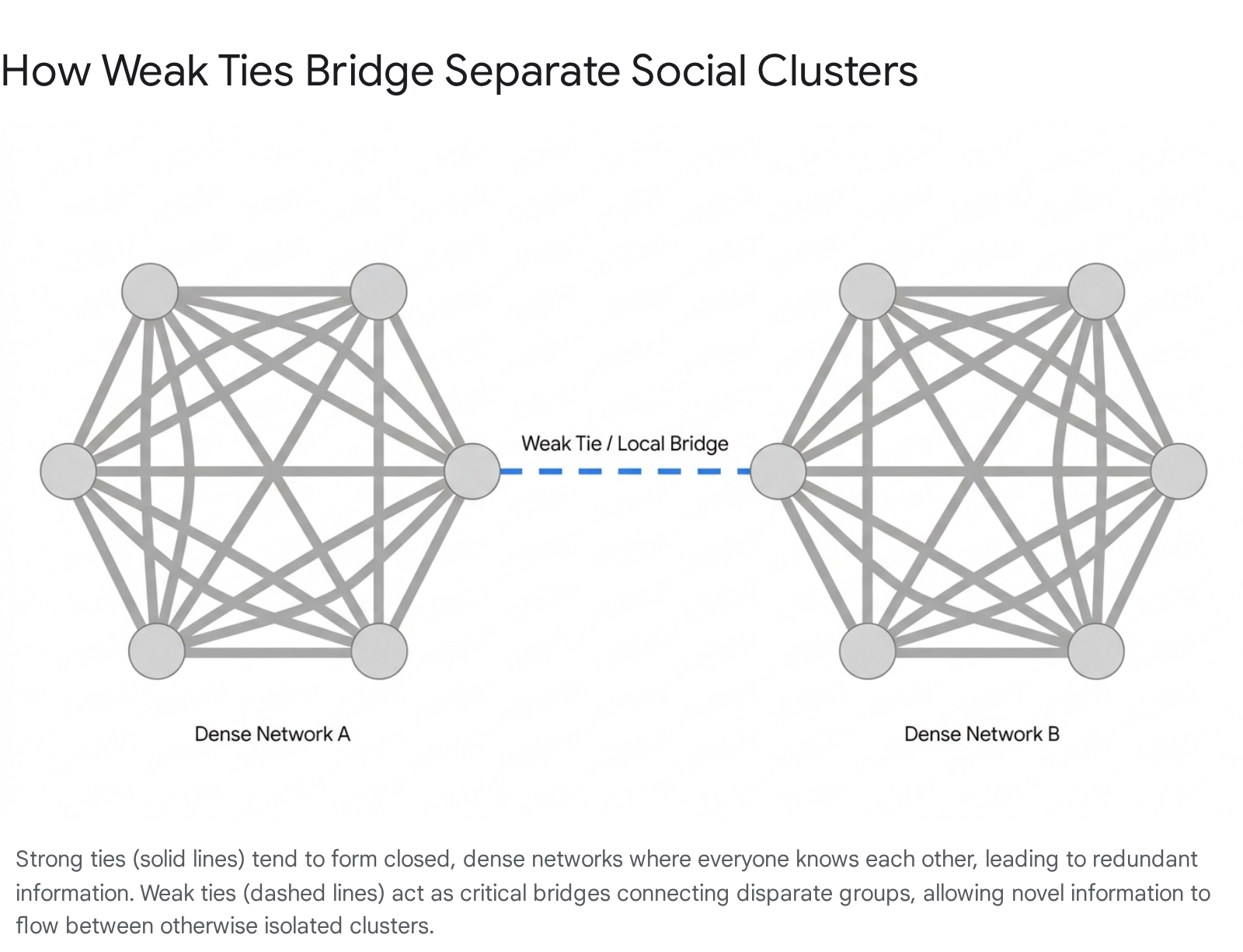
If you want to learn about a job opening in a different company, an investment opportunity in an unfamiliar sector, or a shifting cultural trend, that novel information must traverse a weak tie. As Granovetter posited, while not all weak ties are bridges, virtually all bridges in a social network are weak ties, making them the indispensable arteries of new information 141316.
Structural Holes: The Architecture of Opportunity
Building directly upon the foundational logic of the weak tie theory, sociologist Ronald S. Burt introduced the concept of "structural holes" in the early 1990s, fundamentally expanding how we analyze competitive advantage in networks 61415. While Granovetter focused his attention on the strength of the relationship itself, Burt shifted the analytical lens to the empty space between social clusters 1620.
A structural hole is defined as a gap or a discontinuity between two individuals or groups who possess complementary sources of information but have no direct connection to one another 615. In any large market, academic institution, or corporate organization, individuals tend to focus heavily on their own immediate tasks, naturally insulating themselves within their own cohesive teams 1416. The unseen spaces between these siloed teams are structural holes.
The Value of the Network Broker
An individual whose personal network intentionally spans across a structural hole becomes a "broker" 61520. While weak ties highlight the diverse access to information, structural hole theory emphasizes the control and strategic advantage that brokers gain over the flow of resources between disconnected segments of a society 1517.
Because brokers sit squarely between disconnected groups, they receive unique, non-redundant information significantly earlier than anyone else in either cluster. They are positioned to synthesize ideas from Group A with methodologies from Group B, leading to massive advantages in innovation and problem-solving 61522. Furthermore, by acting as the sole conduit of information between two parties, the broker exercises considerable control, a dynamic that traces back to the sociological concept of tertius gaudens - the rejoicing third party who profits from the disunion of others 18.
Burt's empirical studies have proven exactly how financially and professionally valuable this bridging position is. In a sweeping 2004 analysis of 673 managers at a large American electronics firm, Burt quantified each individual's network using a metric called "constraint" 151620. Network constraint measures the degree to which a person's contacts are redundant; a highly constrained network is a closed loop, while a low-constraint network is rich in structural holes 1516.
The results were staggering. Managers with networks rich in structural holes (low constraint scores) enjoyed unparalleled professional advantages. They possessed a 68% probability of expressing highly innovative ideas, compared to just 28% for those trapped in constrained networks 15. Furthermore, senior executives rated the ideas of brokers as significantly more valuable (an average rating of 2.4 out of 5, compared to 1.5 for non-brokers). Most importantly, this structural positioning translated directly to compensation, with each single-point decrease in network constraint correlating to an additional $681 in annual executive pay 15.
Differentiating the Core Concepts
Though closely related and often used interchangeably in casual business settings, it is vital to distinguish between these distinct sociological phenomena to fully understand how networks operate and how social capital is generated.
| Feature | Strong Ties | Weak Ties | Structural Holes |
|---|---|---|---|
| Definition | Close, emotionally intense relationships with frequent, intimate interaction 457. | Casual, low-intensity relationships with infrequent, distant interaction 4510. | The absence of a connection or direct tie between two disparate social clusters 61415. |
| Primary Function | Emotional support, deep trust, collective action, and generating "bonding" capital 5911. | Transmission of novel information, discovery, and generating "bridging" capital 211. | Creating positional advantage, informational arbitrage, and opportunities for innovation 1415. |
| Network Structure | Dense, overlapping clusters heavily influenced by triadic closure 5. | "Local bridges" that span across completely separate clusters 4. | The empty space or insulating "buffer" that a network broker spans across 1416. |
| Information Type | Highly redundant; everyone in the network generally knows what you know 614. | Non-redundant; introduces fresh, external perspectives and opportunities 611. | Synthesized; allowing the broker to combine separate ideas into an innovative whole 1520. |
The Labor Market: Proving the Theory at Scale
The most famous and heavily scrutinized application of the weak ties theory is its effect on the labor market. When Granovetter conducted his initial survey of 282 men in Massachusetts, the finding that weak ties were disproportionately responsible for successful job hunts disrupted the field of labor economics 123. He theorized that weak ties distribute labor market information to a much broader social network than strong ties ever could 5.
However, for nearly five decades, this foundational finding was incredibly difficult to prove causally on a massive, statistically significant scale 519. Surveying individuals about past behavior is subject to recall bias, and early attempts to validate the theory using digital data yielded confusing results. In fact, some early analyses of digital platforms created a "paradox of weak ties." A 2017 analysis of six million Facebook users, for example, suggested that strong ties - not weak ones - were actually the ones delivering jobs and increasing the likelihood of working together 52021. How could sociologists definitively isolate the exact impact of an acquaintance versus a close friend in a real-world, dynamic global economy?
The 2022 LinkedIn Mega-Experiment
The definitive answer to this half-century-old question arrived in September 2022, when a consortium of data scientists and researchers from Stanford, MIT, Harvard, and LinkedIn published the results of an unprecedented, five-year longitudinal study in the journal Science 5192022.
The researchers utilized LinkedIn's proprietary "People You May Know" (PYMK) algorithm to conduct the largest randomized controlled experiment on digital job sites in history, involving over 20 million active users 51922. The research team carefully tweaked and randomized the algorithm to suggest varying proportions of strong and weak ties to different cohorts of users actively seeking connections. Over the course of five years, they tracked the organic creation of 2 billion new social ties, recorded over 70 million job applications, and monitored the transmission of 600,000 accepted job offers 202122.
The sheer scale of the study provided the first definitive, causal evidence for Granovetter's 1973 theory: weak ties undeniably cause greater job mobility and increase job transmissions more effectively than strong ties 5192021.
However, the data revealed a critical, mathematical nuance that Granovetter could not have foreseen. The relationship between the weakness of a tie and the resulting job mobility is not a straight, linear line. Instead, the data plots an inverted U-shape curve 51422.
If job mobility simply increased as ties grew weaker, the peak of the curve would sit at the absolute weakest connections - near strangers with whom a user had zero interaction. But the data showed that the absolute weakest ties do not result in the highest mobility 1421. Instead, the curve peaks at moderately weak ties. These are individuals with whom a user shares roughly ten mutual connections and interacts with infrequently 51421.
This "sweet spot" at the top of the inverted U-shape exists because a successful job transmission requires two conflicting sociological elements. First, it requires novel information about an unlisted opening, which necessitates a weak tie 1421. Second, it requires a baseline level of trust or social vetting for a hiring manager to take a risk on a candidate, which necessitates at least a marginal connection or shared context 1421. Moderately weak ties perfectly balance high novelty with sufficient trust.
The Industry Divide
The LinkedIn mega-experiment also uncovered that the utility of weak ties is not universal; it is heavily dependent on the specific industry in which a person operates.
When researchers broke down the data by sector, they found that weak ties generated significantly more labor market mobility in highly digitized, IT-intensive, and AI-driven sectors of the economy 520. Because technology sectors evolve at a blistering pace and prioritize disruptive innovation, the constant influx of novel, non-redundant information from distant social networks is vital for survival 514. In these fast-moving fields, weak ties act as essential radar for new opportunities.
Conversely, in traditional, less digitized legacy industries, the study found a more linear relationship where stronger ties actually increased mobility 51928. In established fields where change is slow and operations are deeply entrenched, novel information is far less critical than deep trust, long-term vetting, and reputation management. In these environments, hiring managers rely on the fierce advocacy of strong ties rather than the casual information of weak ones 1428.
The Dark Side: Activation and the Barrier of Systemic Inequality
While the strength of weak ties is universally celebrated in corporate networking seminars and Silicon Valley startups, viewing the theory as a frictionless, universal law ignores the complex sociopolitical realities of how relationships actually function. For decades, sociologists observed situations where weak ties failed completely, and individuals had to rely entirely on strong ties to survive 52023.
The Barrier of "Activation"
The most prominent critique and necessary expansion of Granovetter's work comes from sociologist Sandra S. Smith, whose extensive research focuses on job-seeking behaviors among the Black urban poor in the American Midwest 1324.
Smith identified a critical, often-overlooked flaw in traditional structural network theory: it assumes that simply because a bridge exists between two people, information and assistance will automatically flow across it 1325. In reality, a tie must be intentionally activated. You can observe a weak connection on a network diagram, but utilizing that tie requires mutual acknowledgment, dedicated effort, and, crucially, personal sacrifice 13.
Through in-depth, qualitative interviews with over 100 low-income African Americans, Smith discovered that possessing weak ties to employed individuals did not guarantee access to jobs for marginalized job seekers 2425. In fact, those in a position to help were often deeply hesitant to activate their ties and provide a referral. They feared that if the job-seeker proved unreliable, it would severely damage their own hard-earned reputation with their employer 2425.
The phrase "Don't put my name on it" became emblematic of this fraught dynamic 242627. In an abstract, idealized model featuring wealthy technology workers, weak ties flow freely because the social and professional risks of referring a bad candidate are incredibly low 1327. But for individuals facing systemic inequality, formerly incarcerated populations, or the urban poor, the social cost of vouching for an acquaintance is exceptionally high 1324. In these high-risk environments, weak ties remain dormant. Individuals must instead fall back on their strong, high-trust ties - their immediate family and closest friends - who possess the deep affection necessary to absorb the reputational risk of helping them 121325.
Crisis and High-Trust Needs
The failure of weak ties extends beyond marginalized communities and into times of acute personal or economic crisis. While weak ties are excellent for passive opportunity discovery, they lack the emotional capacity to handle trauma.
Research analyzing individuals who have recently suffered a sudden job loss shows that interacting with weak ties provides standard informational support, but it is communication with strong ties that actively reduces stress and is far more predictive of finding rapid employment within a three-month window 23. When an individual is in desperate need, the mere novelty of an acquaintance's information is significantly less valuable than the fierce advocacy, direct influence, and emotional labor that a close friend or relative will wield on their behalf 23.
Furthermore, complex models of information diffusion reveal that weak ties are terrible at spreading highly sensitive, complex, or risky information. In scenarios requiring behavioral change or significant risk, individuals hesitate to share information across weak links due to a lack of deep trust or mutual understanding 28. In these cases, the presence of too many weak ties can actually crowd out the higher-capacity strong ties needed for effective communication, strictly reducing the speed of diffusion 28.
Cultural Contexts: Do Weak Ties Work Globally?
Because Granovetter's original studies focused almost exclusively on the Western, largely individualistic labor markets of the United States, modern researchers have spent the last decade investigating whether the theory holds up across diverse global contexts 42930.
In highly individualistic societies, relationships are often viewed as fluid and transactional, and people are highly active in building expansive, loose networks of weak ties to get ahead 3031. In collectivist societies, however, the group prevails. Relationships are viewed as given, permanent, and rooted in deep mutual dependence and obligation 2931.
The Strength of Strong Ties in Asia and Africa
In many East Asian and Southeast Asian contexts, strong, dense ties play a vastly more instrumental role in professional and daily life than they do in the West. For instance, in South Korea, the cultural concept of woori (us/our) and jeong (deep affective attachment) dictates that social exchanges, resources, and professional patronage flow heavily through deeply knitted strong ties 7. These relationships grant group members a sense of mutual obligation and warmth that cannot be replicated by a casual acquaintance 7. Similarly, in China, the mobilization of guanxi requires the mutual trust inherent in strong, historically rooted relationships to influence authorities and secure economic favors - a dynamic where a casual weak tie would be entirely useless 23.
Research into African urban economies, such as the informal sector in Bobo-Dioulasso, Burkina Faso, also highlights the absolute necessity of strong ties for survival. African women entrepreneurs, for example, rely heavily on strong family ties to share severe economic risks and mitigate "principal-agent" conflicts - situations where the goals of a business owner and their representatives dangerously misalign due to a lack of formal oversight 32333435. Without the formal institutional protections, legal contracts, or insurance available in Western markets, the deep, unbreakable trust of a strong tie acts as the only viable structural safeguard 3235.
The Universal Need for Bridging Capital
Despite the profound cultural reliance on strong ties in these regions, rigorous empirical studies reveal that the fundamental mathematics of the weak tie theory still apply globally, albeit in culturally adapted ways. While strong ties provide the necessary baseline of survival and trust, weak ties are universally required for growth and psychological health.
| Region | Primary Finding on Network Ties | Context and Mechanism |
|---|---|---|
| South Korea | Weak ties correlate with lower depression. | A multilevel analysis of Korean adults found that social interactions with a greater number of weak ties (distant coworkers) were associated with significantly fewer depressive symptoms than relying solely on strong family ties. The non-redundant nature of weak ties provided fresh perspectives that broke claustrophobic cycles of psychological distress 11. |
| Latin America | Weak ties boost subjective well-being. | Studies of Latin American populations - some of the most collectivist on Hofstede's cultural dimensions - showed that daily, casual interactions with weak ties strongly correlated with a higher sense of community and subjective well-being, proving that casual bridges satisfy the human need for broad belonging even in deeply bonded societies 29. |
| West Africa | Weak business ties drive high economic growth. | In Burkina Faso's informal markets, while strong ties were needed for baseline trust, the entrepreneurs who achieved the highest economic performance and revenue growth were those who successfully cultivated a network of "autonomous" weak business ties, allowing them vital access to new markets and resources outside their immediate kin 3334. |
| Southeast Asia | Weak ties influence cross-cluster digital discourse. | Analysis of the Mario Dandy youth violence case on Indonesian social media revealed that while strong ties maintained group cohesion, it was weak ties (comprising 30% of interactions) that enabled vital information exposure across deep ideological boundaries, driving national conversation 36. |
The Algorithmic Era: Social Media as a "Weak Tie Imposter"
As human interaction has increasingly migrated online, the very nature and function of weak ties have undergone a radical and rapid transformation. For the first two decades of the social media era, platforms like Facebook, Twitter, and LinkedIn functioned essentially as digital rolodexes. They allowed users to effortlessly maintain hundreds of weak ties - former high school classmates, past colleagues, and distant relatives - that would have otherwise faded into obscurity due to physical distance 1023.
However, the recent rise of algorithmic, "For You" feed-driven platforms - pioneered by TikTok and rapidly adopted by Instagram and X (formerly Twitter) - has fundamentally altered the architecture of human connection and information diffusion 373839.
The Illusion of Connection
In pure network theory terms, modern recommendation algorithms are explicitly designed to act as artificial local bridges. They are programmed to continuously surface non-redundant, highly novel information from distinct social clusters and deliver it directly to the user, completely bypassing the need for a human mutual connection 384041.
However, emerging sociological research from 2023 and 2024 warns that these algorithms operate as dangerous "weak tie imposters" 40. While an algorithm perfectly mimics the structural shape of a weak tie by bridging vast information gaps, it entirely strips away the core elements that make human weak ties psychologically and socially valuable: shared context, latent trust, and the potential for mutual activation 1340.
When a human acquaintance casually tells you about a new job or a new philosophy, there is a baseline of social reality and accountability grounding that exchange. When an algorithm bridges a structural hole to deliver a viral video from a complete stranger, it optimizes purely for attention metrics, engagement, and emotional arousal, not for the transfer of productive social capital or accurate information 3841.
Fragmentation and the Mental Health Toll
This algorithmic hijacking of the weak tie mechanism has profound societal implications. While human weak ties act as essential social glue - fostering community cohesion and exposing individuals to measured, diverse perspectives - algorithmic weak ties often achieve the exact opposite outcome.
By constantly feeding users highly personalized, cross-cluster content without the friction or reward of human relationship-building, algorithms encourage passive, endless consumption over active relationship maintenance 4148. Studies on youth development reveal that constant exposure to these personalized feeds is directly linked to shorter attention spans, weakened real-life social skills, and the rapid formation of echo chambers 39484243. Because the algorithm completely controls the "bridge," the user loses the critical agency to intentionally cultivate diverse relationships. This dynamic is leading to a modern society that is highly connected by data streams but structurally fragmented, polarized, and deeply lonely 373840.
How to Cultivate and Leverage Weak Ties Strategically
Understanding the power of weak ties is only the first step; actively managing and cultivating them is a required professional and personal skill for thriving in a complex economy 5152. Because weak ties do not require the intense emotional maintenance, daily communication, or deep intimacy of close friendships, they can be scaled strategically without leading to burnout 44.
If you are looking to expand your network's capacity for novel information, innovation, and career advancement, consider the following evidence-based approaches:
- Prioritize Breadth Over Depth in Environments: Simply attending more events within your own hyper-specific industry will only yield more redundant strong ties. Instead, participate in professional and social events entirely outside your specialization 5154. A corporate lawyer attending a convention for psychologists, or a software engineer joining a local civic arts board, instantly becomes a broker spanning a massive structural hole 2054. The goal is to meet people who operate in entirely different information ecosystems 51.
- Activate Dormant Ties: Reach out to former colleagues, college acquaintances, or managers from previous jobs 410. These "dormant ties" are incredibly valuable because they possess the trust of a historical connection, but they have spent the intervening years building networks in entirely different spheres, making the information they hold highly novel and non-redundant today.
- Offer Value Before Extracting It: The activation of a weak tie requires goodwill and reciprocity 1352. Periodically share a relevant article, make a helpful introduction between two people who should know each other, or congratulate acquaintances on their public achievements 5244. By operating as a generous bridge for others, you establish a reputation that makes your weak ties eager to activate on your behalf when you eventually need them 524455.
- Target the "Sweet Spot" of Moderate Ties: As the LinkedIn mega-study proved, you do not need to endure the anxiety of cold-messaging total strangers 14. Focus your networking energy on cultivating "moderately weak ties" - the friends of friends or colleagues of colleagues with whom you share a baseline of mutual connections, but who still run in different daily circles 1421. These connections offer the perfect mathematical balance of low redundancy and high trust.
Bottom line
Decades of rigorous sociological data confirm that while our closest friends provide vital emotional support and baseline survival trust, it is our distant acquaintances - our "weak ties" - that act as indispensable bridges to novel information, diverse perspectives, and major career opportunities. By spanning the structural holes between isolated social groups, moderately weak ties expose us to innovations and data our redundant inner circle simply cannot access. However, these connections are not frictionless magic; they require intentional cultivation, mutual trust, and active engagement to be effectively activated, and relying on the artificial bridges of social media algorithms is a poor substitute for authentic human connection.