Generational Changes in Friendship Quality and Meaning
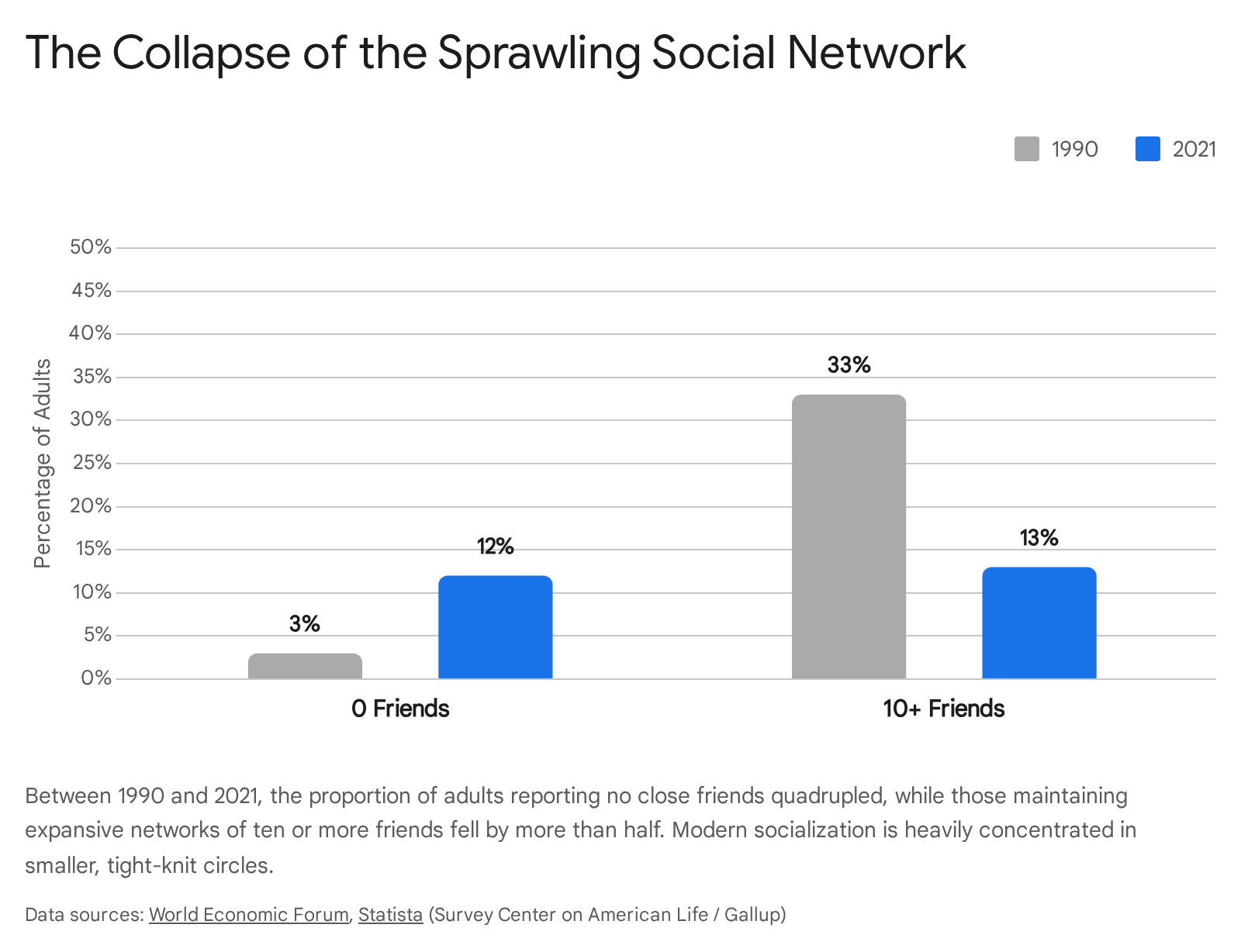
The architecture of human connection is undergoing a profound and unprecedented transformation across the globe. Characterized within sociological discourse as a "friendship recession," the precipitous decline in the size, frequency, and depth of interpersonal networks has alarmed public health officials, economists, and psychologists alike. In 1990, merely 3 percent of adults in the United States reported having no close friends; by 2021, that figure had quadrupled to 12 percent, representing millions of individuals navigating life entirely devoid of a primary platonic support system 123. Concurrently, the proportion of adults boasting robust networks of ten or more close friends plummeted from 33 percent to just 13 percent 123.
However, framing this phenomenon purely as an absolute deficit or a localized Western pathology overlooks the nuanced, structural evolution of social capital. Modern empirical literature - including extensive data from the Journal of Social and Personal Relationships (JSPR), the Pew Research Center, and the Survey Center on American Life - suggests that humanity is not merely "losing" friends. Rather, the baseline definitions, expectations, modalities of maintenance, and geographical distributions of friendship are fundamentally shifting. Driven by the digitization of intimacy, the macroeconomic erosion of physical "third places," and distinct generational paradigms, contemporary relational dynamics are adapting to an environment characterized by severe time poverty, hyper-connectivity, and late-stage individualism.
This comprehensive report deconstructs the state of global friendships, breaking down the phenomenon across specific generational cohorts, decoupling the "quality versus quantity" debate to examine social pruning, exploring the digital frontier of relationship maintenance, and expanding the scope to non-Western geographies to demonstrate the highly synchronized, globalized nature of modern social isolation.
The Evolution of "Friendship" Across Generational Cohorts
The definition of a "friend" is not a static sociological constant. It is a highly malleable construct, shaped by the historical, technological, and economic contexts of an individual's formative years. An analysis of interpersonal dynamics from the Silent Generation through Generation Alpha reveals a stark transition from proximity-based, activity-driven bonds to digitally mediated, emotionally intensive networks.
The Silent Generation and Baby Boomers: Proximity, Institutions, and Shared Activity
For the Silent Generation (1928 - 1945) and Baby Boomers (1946 - 1964), friendship frameworks were largely constructed around physical proximity, institutional affiliation, and geographic stability. These cohorts forged their most enduring bonds within rigid community boundaries: the neighborhood, the workplace, the local parish, or civic organizations 45. Survey data from AARP indicates that Boomers overwhelmingly meet their friends through mutual acquaintances (39%), the workplace (32%), their physical neighborhoods (31%), or religious institutions (28%) 5.
For these older cohorts, the maintenance of friendship is heavily reliant on face-to-face interaction and shared physical activities. Emotional support is often viewed as a secondary byproduct of shared presence rather than the primary objective of the relationship. This is particularly true for Boomer men, whose friendships are historically characterized by "shoulder-to-shoulder" activities - such as sports, shared hobbies, or professional collaboration - rather than "face-to-face" emotional disclosure 5. Consequently, when mobility declines or institutional affiliations wane in later life, these individuals face acute risks of isolation.
However, when these networks are maintained, they serve as profound buffers against cognitive decline. Longitudinal studies evaluating older adult populations demonstrate that frequent interactions with a closest friend have a significantly greater impact on late-life happiness than interactions with extended family or neighbors, compensating for the psychological loss of workplace roles 67. Paradoxically, despite possessing fewer tools for digital maintenance, older adults are often more satisfied with the friendships they do maintain compared to younger cohorts, with 77 percent of those over 50 expressing high satisfaction with their relational networks 8.
Generation X: The Transition to Pragmatism and Individualism
Generation X (1965 - 1980) represents a pivotal transitional cohort in the evolution of social capital. Coming of age during an era of rising suburbanization, the proliferation of dual-income households, and the dawn of the personal computing era, Generation X friendships became markedly more fragmented and individualized than those of their predecessors 4. This generation balances the institutional reliance of Boomers with the nascent technological adoption of Millennials.
In relational maintenance, Generation X exhibits intense pragmatism. They are less likely than Boomers to rely on rigid institutional structures for socializing, yet they retain a preference for tangible, reliable support networks. Current survey data reveals that Gen Xers, often acting as the "sandwich generation" caught between caring for aging parents and raising young children, are highly likely to rely on friends to help solve practical problems and manage acute daily stressors 59. Their networks are typically smaller but fiercely loyal, defined by a stoic approach to emotional support that prioritizes resilience and functional mutual aid over continuous vulnerability 910.
Millennials: Intentionality, Social Pruning, and Emotional Intimacy
Millennials (1981 - 1996) came of age alongside the ubiquitous expansion of the internet, resulting in networks that span vast geographic distances but require exceptionally high levels of intentional maintenance. For this cohort, friendship is deeply intertwined with emotional intelligence, mental health advocacy, and psychological validation 49.
Unlike previous generations, Millennials expect high degrees of emotional support, continuous vulnerability, and self-disclosure from their close friends 89. They frequently utilize "therapy language" to define boundaries, navigate conflicts, and articulate relational needs. Furthermore, Millennials are the primary drivers of "social pruning" - the intentional reduction of casual acquaintances in favor of cultivating a smaller number of deeply intimate, high-quality friendships. Because they frequently relocate for education or employment, their maintenance strategies blend periodic physical meetups with high-frequency digital check-ins, utilizing asynchronous text threads and social media sharing to maintain ambient intimacy 4511.
Generation Z and Generation Alpha: Hyperreality and Digital Primacy
Generation Z (1997 - 2012) and Generation Alpha (2013 - 2025) are the first true digital natives. Their conceptualization of friendship has been fundamentally altered by immersive technologies, algorithmic social media, and the normalization of asynchronous digital communication 412. For these younger cohorts, the boundaries between offline and online relationships are highly porous, if not entirely nonexistent. Nearly 40 percent of Americans now maintain online-only friendships, a trend driven overwhelmingly by teenagers and young adults 13.
For Generation Z, a friend does not need to share physical space; they merely need to share continuous digital presence. However, this hyper-connectivity correlates with an unprecedented psychological paradox: they are the most objectively connected generation in human history, yet they report the highest levels of profound loneliness. Recent Pew Research polling indicates that 22 percent of adults under 50 often feel lonely, compared to just 9 percent of those aged 65 and older 14. The cognitive load of maintaining friendships through carefully curated digital personas, interpreting text-based micro-interactions, and managing vast networks of weak ties often leaves them emotionally exhausted and paradoxically isolated 413.
Stanford University research underscores this shift, noting that the traditional "U-shaped" curve of happiness - where young adults and older adults report the highest well-being, with a dip in middle age - has completely flattened into an upward line. Today, young adults are the least happy demographic group 15. Generation Alpha is poised to push this boundary even further; recent market reports indicate that 64 percent of children are now utilizing AI chatbots for daily interaction, positioning artificial intelligence as a primary, non-human social node in their developmental networks 16.
Comparative Framework: Generational Expectations of Friendship
To synthesize these shifting paradigms, the following table contrasts the baseline definitions, maintenance modalities, and expectations of emotional support across the primary generational cohorts.
| Generational Cohort | Primary Interaction Modality | Expected Contact Frequency | Expectation of Emotional Support | Baseline Definition of a "Close Friend" |
|---|---|---|---|---|
| Silent Gen & Boomers (1928 - 1964) | Face-to-face, voice calls, formal physical gatherings. | Moderate; episodic but heavily structured (e.g., weekly social clubs, church). | Implicit; secondary to shared physical activities and institutional solidarity. | A reliable companion for shared life experiences, hobbies, and mutual aid within a geographic community. |
| Generation X (1965 - 1980) | Mixed: phone calls, email, scheduled in-person meetings. | Moderate to Low; highly pragmatic due to intense career and caregiving demands. | Practical and problem-solving oriented; stoic but dependable in crises. | A trusted confidant who provides pragmatic support and historical continuity, requiring low-maintenance check-ins. |
| Millennials (1981 - 1996) | Digital messaging, social media sharing, intentional IRL meetups. | High; continuous asynchronous text threads mixed with deep IRL catch-ups. | Explicit and central; high emphasis on vulnerability, active listening, and mental health. | An emotionally attuned partner chosen through shared values, serving as a "chosen family" independent of geography. |
| Gen Z & Gen Alpha (1997 - 2025) | Social media (TikTok, Snapchat), gaming lobbies, Discord, AI companions. | Extremely High; constant, asynchronous digital presence and ambient co-existence. | Fluid and complex; high expectation of inclusivity and validation, but hindered by digital friction. | A node in a hyper-connected, often borderless network; frequently includes online-only peers and parasocial entities. |
Deconstructing the "Friendship Recession": Quality vs. Quantity and Social Pruning
A critical misconception dominating the mainstream discourse on the "friendship recession" is the assumption that a reduction in the sheer volume of friends inherently equates to a deficit in social capital or a rise in societal pathology. While extreme isolation - defined as possessing zero close friends - is unequivocally harmful, the widespread societal reduction from sprawling networks of ten or more friends to tighter circles of three to five friends requires a more sophisticated interpretation through the lens of social pruning.
The Neurobiology and Psychology of Deep Ties
Anthropological and psychological frameworks, anchored by concepts like Dunbar's Number, have long suggested that human beings possess a hardwired cognitive limit regarding the number of stable social relationships they can effectively maintain. True emotional intimacy is exceptionally resource-intensive. It demands time, emotional bandwidth, and continuous cognitive updating.
Modern generations, particularly Millennials and older members of Generation Z, are actively engaging in social pruning. Confronted with the exhaustion of maintaining dozens of superficial "weak ties" via social media feeds, individuals are consciously retreating into smaller, high-trust networks. This represents a strategic prioritization of emotional intimacy over expansive, shallow networking. The empirical data supports the efficacy of this approach: individuals who maintain roughly five dependable friends report the highest levels of overall well-being and life satisfaction, while those with a dozen shallow acquaintances often report higher levels of anxiety 1817. Furthermore, 72 percent of individuals possessing at least one close friend express high levels of contentment with their social lives, suggesting that relationship quality serves as a far superior buffer against psychological distress than sheer quantity 20.
The psychological literature supports this shift toward quality. A 2025 publication in the Journal of Social and Personal Relationships highlights that while having a large, diverse social network generally predicts well-being, the actual maintenance of these networks induces high stress 18. When individuals engage in social pruning, they optimize their emotional investments. The true risk lies not in shrinking from fifteen friends to five, but in slipping from three friends to zero.
The Gender Discrepancy in Social Capital
While social pruning can be a healthy psychological adaptation, the friendship recession is not impacting all demographic groups equally. There is a pronounced and alarming gender divergence in the collapse of social networks. Male friendships are disintegrating at a significantly faster rate than female friendships, exposing a vulnerability in how modern men navigate intimacy.
In 1990, 55 percent of American men reported having a minimum of six close friends; by 2021, that number had collapsed to just 27 percent 1617. Furthermore, 15 percent of men currently report having zero close friendships 17. Women have also experienced a numerical decline - dropping from 41 percent to 24 percent in the six-plus friends category - but they remain significantly better insulated against absolute isolation 1617.
This severe disparity is rooted in how different genders historically construct and maintain intimacy. Women's friendships frequently rely on face-to-face (or voice-to-voice) emotional disclosure, vulnerability, and complex, overlapping support networks 141920. A comprehensive 2024 Pew Research Center survey revealed that when seeking emotional support, 54 percent of women would turn to a friend, compared to only 38 percent of men 1114. When geographic or economic disruptions occur, these communicative bonds can often transcend physical distance.
Men, conversely, have been culturally conditioned to forge bonds through shared physical activities, institutional affiliations, and concurrent presence. When suburban sprawl, remote work, or the intense demands of the nuclear family strip away the infrastructure for spontaneous physical activity, male friendships often lack the communicative foundation necessary to survive the transition to digital or long-distance maintenance 1114. Consequently, men are far more likely to rely exclusively on a spouse for emotional support (74 percent of adults look to spouses for primary support), leaving men highly vulnerable to profound, dangerous isolation in the event of divorce or bereavement 1120.
Longitudinal Data and the Anatomy of Network Collapse
To fully grasp the magnitude of the friendship recession, it is vital to examine the longitudinal data. Global surveys indicate a steady contraction of network sizes over the last three decades, accelerating sharply during the COVID-19 pandemic and failing to rebound in its aftermath.
The shift observed in the longitudinal data is not solely a Western phenomenon. Aggregated data spanning multiple global databases - including the OECD, Gallup, and specialized regional health studies - demonstrates that the average number of close friends has universally contracted. The following table summarizes recent global averages regarding the reported number of close friends, illustrating a global mean that hovers precariously near the boundary of healthy social capital.
| Region / Demographic Category | Average Number of Close Friends | % Reporting Zero Close Friends | Longitudinal Shift Notes |
|---|---|---|---|
| Global Average (All Regions) | 3.5 to 5.0 | 12% | Decline observed across 159 countries tracked from 2009 - 2024. |
| North America | 3.6 to 3.8 | 12% | Network sizes roughly halved compared to 1990 baselines. |
| Southeast Asia | 4.7 | < 10% | Maintains slightly higher network density, though urban centers show sharp offline declines. |
| Sub-Saharan Africa | ~ 3.0 | Variable | Lowest average total friends, yet reports highest percentage of friends relied upon for practical survival aid. |
| European Union (EU-21 Average) | 4.0 to 4.7 | 8% | Daily in-person contact dropped from 21% in 2006 to 12% in 2022. |
The loss of these friendships over time is rarely the result of dramatic, interpersonal conflict. A recent survey tracking adult friendship dissolution over a decade found that 50 percent of lost friendships were attributed simply to physical distance and relocation, while 48 percent were dissolved due to divergent life transitions (e.g., marriage, parenthood, career shifts) 21. An additional 25 percent of respondents cited a literal lack of time as the primary reason for abandoning a friendship, highlighting how modern economic pacing actively strangles social bandwidth 21.
The Digital Frontier: Modalities of Modern Maintenance and Parasociality
The rapid displacement of physical socialization by digital interaction is the most visible driver of modern relational shifts. Time-use surveys illustrate a staggering decline in face-to-face interaction across the developed world. For decades, Americans spent an average of 6.5 hours a week physically socializing with friends; between 2014 and 2019, this plummeted to just 4 hours 13. Among teenagers, the drop is even more precipitous: from 140 minutes of daily in-person socialization two decades ago to a mere 40 minutes today, while daily screen time has surged to nearly nine hours 13. In 21 European OECD countries, daily face-to-face interactions with friends fell consistently from 21 percent in 2006 to 16 percent in 2015, and further to 12 percent in 2022 22.
The Illusion of Equivalence and Physiological Deficits
The core issue is not simply that socialization has moved online, but that society operates under the false assumption that digital interactions are physiologically and psychologically interchangeable with in-person interactions. Empirical evidence dictates that they are not.
Research published in sociological and medical journals increasingly demonstrates that primarily digital interactions yield weaker connections and lower psychological well-being. A comprehensive study of adults over 50 found that face-to-face interactions significantly boosted physical and mental well-being, decreasing the odds of being lonely by 20 to 30 percent 1323. Conversely, communication via texts or emails provided negligible psychological benefits. The mechanism is deeply neurobiological: hearing a familiar voice, engaging in physical touch, or reading complex micro-expressions in person triggers the release of oxytocin and reduces cortisol, creating a physiological state of safety and bonding 13. Text-based communication, asynchronous messaging, and algorithmic social media engagement fail to reliably trigger this endocrine response, leaving individuals feeling intellectually "connected," but physiologically starved of community.
Online-Only Friends, Gaming, and Parasociality
Despite these neurobiological deficits, the digital realm has birthed entirely new categories of friendship that hold immense subjective value, particularly for younger cohorts. Nearly 40 percent of Americans now report having online-only friendships 13. Multiplayer gaming communities, Discord servers, and niche internet forums function as the modern, digital equivalents of the mid-century bowling league or neighborhood pub. For marginalized individuals, those with highly specific niche interests, or those living in low-amenity rural areas, these digital platforms provide crucial, life-saving community access that their physical geography cannot offer.
Furthermore, the very concept of friendship is expanding to include parasocial relationships - one-sided relationships with content creators, influencers, or streamers - and, increasingly, artificial intelligence. The rise of AI companions represents a profound, ethically complex frontier in the sociology of connection. With 64 percent of surveyed children using AI chatbots for daily tasks and interaction, and the AI companion app market surging 700 percent between 2022 and 2025, technology is no longer just mediating human-to-human relationships; it is simulating the human end of the relationship entirely 1627. While these tools can alleviate acute, situational loneliness and provide judgment-free sounding boards, sociologists warn they risk atrophy of the complex social skills - such as compromise, conflict resolution, and active listening - required to maintain authentic human bonds in the physical world.
Structural and Economic Determinants of Isolation
To attribute the friendship recession solely to the advent of smartphones or shifting generational values is to ignore the macroeconomic forces actively hostile to community building. Social connections do not exist in a vacuum; they require physical infrastructure, unstructured free time, and surplus economic energy to flourish.
The Eradication of "Third Places"
Sociologist Ray Oldenburg coined the term "Third Places" to describe the informal, accessible public spaces outside of the home (the "first place") and the workplace (the "second place") where community bonds are organically forged 24. Coffee shops, community centers, public parks, local pubs, and municipal libraries historically served as the democratic engines of friendship.
However, modern economic policy, aggressive urban planning, and unchecked suburban sprawl have systematically decimated these environments. Government investment in public infrastructure has slowed, while the hyper-commercialization of remaining spaces has made loitering prohibitively expensive for many 13. Fenced-in yards, gated communities, and multicar garages have replaced walkable sidewalks and front porches, fundamentally altering the built environment to discourage spontaneous neighborhood interaction 25. Research underscores that when individuals lack access to high-amenity neighborhoods with robust third places, their self-reported rates of loneliness skyrocket 24. Conversely, the presence of these spaces is economically vital; recent working papers demonstrate that the introduction of high-quality third places significantly boosts neighborhood housing values and spurs local entrepreneurial startups 25.
The Paradox of Remote Work and Geographic Mobility
The widespread adoption of remote and hybrid work environments has fundamentally decoupled geographic location from economic output, acting as a double-edged sword for human connection. On one hand, remote work has eradicated the forced, daily socialization of the office. For individuals who relied on the workplace as their primary social node, this shift has induced profound isolation and stripped away a vital avenue for cross-generational friendships (historically, 37 percent of adults met their older/younger friends at work) 5242627.
Conversely, remote work critics often conflate the extreme isolation of pandemic-era lockdowns with the permanent reality of distributed labor. Research indicates that the shift to remote work actually increases the amount of control individuals have over their social interactions. Survey data of remote freelancers demonstrates that, without a commute, remote professionals gain an average of 4 hours and 15 minutes per week 26. For many, this surplus time is reallocated to high-value socialization: spending more time with chosen family, investing in local community, or operating out of co-working spaces and cafes 26. Furthermore, remote work facilitates geographic mobility, allowing individuals to relocate away from high-cost urban centers to be closer to aging parents or established peer groups. Thus, remote work does not inherently destroy friendship; it merely shifts the burden of socialization from passive (showing up to an office) to active (intentionally seeking out connection in the community).
Time Poverty, Inflation, and Economic Precarity
Friendship requires a luxury that is increasingly scarce in the modern economy: unstructured time. The rise of the gig economy, stagnating wages relative to the skyrocketing cost of living, and an overarching culture of hyper-productivity have commodified time to an unprecedented degree 13. In the United States, 77 percent of adults work more than 40 hours per week, and the prioritization of career advancement frequently supersedes relationship maintenance 13.
When survival requires maximum economic output, "hanging out" is culturally demoted from a fundamental human need to a frivolous luxury. This is explicitly evident in recent European data. A 2024 Eurofound survey revealed that 30 percent of EU respondents report difficulties making ends meet due to sustained inflation 32. As a direct consequence, the most common expenditures sacrificed by these populations include leisure activities, holidays, and, crucially, getting together with family or friends at least once a month 32. As adult socializing is increasingly deprioritized in favor of economic labor or intensive parenting (parents today spend twice as much time with their children compared to previous generations), solitude transforms from a preference into a mandated default state 313.
Beyond the West: The Global Geography of the Friendship Recession
A pervasive and persistent assumption in sociological discourse is that the friendship recession is a uniquely Western, post-industrial pathology - a symptom of American hyper-individualism or European secularism. However, recent cross-cultural data categorically dismantles this notion. The erosion of interpersonal networks is a highly synchronized, global phenomenon, heavily influenced by rapid urbanization, the penetration of the global digital economy, and shifting cultural demographics in the Global South.
The Crisis of Connection in Asia
In India, culturally celebrated for its sprawling, collectivist family structures and high-density communities, the reality of modern urban life tells a starkly different story. A 2021 Ipsos survey revealed that 43 percent of urban Indians frequently feel lonely and friendless 1. Research conducted by the Tata Institute of Social Sciences (TISS) found that while digital interactions in urban India surged by over 300 percent in the past decade, offline social interactions plummeted by an astonishing 60 percent 1. In Tier 1 cities, extended commutes, hyper-competitive academic environments, and the rise of socially insulated gated communities have transformed neighbors into strangers, resulting in 60 percent of residents experiencing profound loneliness, even when surrounded by millions of others 116. A 2023 report further noted that 40 percent of urban Indian schoolchildren now engage more online than they do offline with peers 1.
Similarly, in Japan and South Korea, deep-seated structural isolation exists alongside an interesting macro-cultural paradox. While public opinion surveys show a doubling in Japanese respondents expressing a "sense of closeness" toward South Korea - driven heavily by youth consumption of pop culture (K-pop, anime, cuisine) - this cultural affinity has largely failed to translate into actual, people-to-people interpersonal connections 2829. The youth in both nations are highly connected to the idea of the other via digital media, yet remain physically isolated within their own borders due to extreme work cultures (e.g., karoshi), historical grievances, and the highest rates of single-person households in modern history 2829.
The Middle East: High Density, High Isolation
Perhaps the most striking subversion of cultural stereotypes regarding isolation is found in the Middle East. The Eastern Mediterranean Region (EMR) is widely perceived globally as socially rich, characterized by vibrant street cafes, strong religious community integration, and tight-knit multigenerational households. Yet, the World Health Organization's Commission on Social Connection recently delivered a striking indictment: the EMR faces some of the highest levels of loneliness and social isolation in the world, second only to the African region 30.
Across the region, 21 percent of individuals report experiencing chronic loneliness. Among older adults, the figures are catastrophic; a targeted study in Lebanon revealed that 46.1 percent of older people are socially isolated, placing the region at the extreme high end of the global spectrum 30. This disconnect between the cultural narrative of "we are already connected" and the epidemiological reality obscures a massive public health crisis. The breakdown of traditional intergenerational ties, combined with staggering youth unemployment, rapid urbanization, and migration due to regional instability, has severely weakened the community structures that historically served as safety nets 30.
China: Macro-Diplomacy vs. Micro-Isolation
In China, the concept of "friendship" is currently operating on two entirely divergent vectors. At the geopolitical, macro-level, Beijing is aggressively expanding its "circle of friends" through vast diplomatic initiatives like the Belt and Road Initiative and BRICS integration. This top-down approach has successfully cultivated high favorability ratings (frequently exceeding 70 percent) across the Middle East, Southeast Asia, and Africa, where populations view China as a vital economic partner 313238394041. The Chinese state views cross-cultural friendship as a primary tool of soft power and economic expansion.
Conversely, at the micro-level, Chinese citizens - particularly the youth - are experiencing their own severe, localized friendship recession. Driven by the immense pressures of the 996 work culture (working from 9 AM to 9 PM, 6 days a week) and a hyper-competitive educational environment, young adults report having an average of just 2.5 close friends 42. To combat this, massive domestic digital infrastructure is being deployed. Social applications designed specifically to tackle the friendship recession through algorithmically matched "soul ties" and virtual avatars have become vastly popular, further cementing the reality that the Global South is actively managing the exact same crisis of connection, utilizing the exact same digital palliatives, as the West 42.
OECD and Global Longitudinal Trends: The Income Gap in Isolation
The truly global nature of this crisis is codified in sweeping longitudinal data spanning 159 countries. Between 2009 and 2024, the global prevalence of social isolation increased by 13.4 percent 334445. A marked, severe escalation occurred concurrently with the onset of the COVID-19 pandemic in 2020. However, unlike economic recessions that eventually rebound, interpersonal isolation failed to return to pre-pandemic baseline levels. By 2024, global isolation was entrenched at 2.6 percentage points above pre-pandemic levels 3344.
Crucially, this exhaustive global data reveals a massive, structural socioeconomic disparity. Isolation is disproportionately, and increasingly, concentrated among lower-income groups globally. By 2024, the income gap in social isolation reached 8.6 percentage points, with over 26.2 percent of lower-income individuals reporting severe isolation compared to just 17.6 percent of higher-income individuals 334434. Across OECD nations, those in the bottom income quintile are significantly lonelier and report vastly lower satisfaction with their relationships 3435.
This data points to a sobering reality: Friendship, fundamentally, requires resources. It requires time away from labor, physical space to gather, and the financial stability to engage in leisure. As global inequality widens, social connection is transforming from a baseline human right into a stratified luxury good.
Conclusion
The global friendship recession is not an isolated psychological failing of modern individuals; it is a highly rational, predictable adaptation to a modernized world that structurally disincentivizes physical community. As the sociological and epidemiological data unequivocally demonstrates, this is a universal phenomenon transcending Western borders, deeply affecting the hyper-urbanized centers of Asia, the Middle East, and the broader Global South.
While the absolute decline in the number of friends is a valid and pressing public health concern - particularly regarding the severe, dangerous isolation of adult men, older populations, and lower-income demographics - it must be contextualized alongside the generational shift toward social pruning. For many Millennials and Generation Z individuals, the reduction of sprawling networks in favor of a handful of highly intimate, emotionally supportive ties represents a healthy, necessary recalibration of social bandwidth in an era of digital exhaustion.
Moving forward, reversing the toxic elements of this recession will require viewing human connection not as an individual hobby, but as critical public infrastructure. The health consequences of isolation are now globally recognized as equivalent to smoking 15 cigarettes a day, directly driving cardiovascular disease, cognitive decline, and premature mortality 3045. Just as policymakers regulate economic markets and environmental hazards, there must be a concerted effort to rebuild the physical "third places," reconsider labor and economic policies that mandate severe time poverty, and critically examine the neurobiological deficits of replacing face-to-face vulnerability with algorithmic convenience. The future of human flourishing depends directly on our ability to engineer a society where friendship is structurally supported, rather than structurally penalized.