
Psychological and neurobiological mechanisms of procrastination
The Deconstruction of the Laziness Myth
Procrastination is an extraordinarily prevalent phenomenon, with epidemiological and psychological data suggesting that it chronically affects between fifteen and twenty percent of the general adult population, while demonstrating even higher prevalence rates within academic and competitive corporate environments 123. Historically, both colloquial understanding and early psychological frameworks moralized procrastination, reducing it to a fundamental character flaw, an expression of sheer laziness, general apathy, or a rudimentary deficit in time management skills 456. However, rigorous empirical research, particularly meta-analyses published in premier peer-reviewed journals such as the Journal of Personality and Social Psychology and Psychological Science, unequivocally dismantles this oversimplified paradigm. The contemporary scientific consensus demonstrates that traits conventionally associated with laziness - such as a lack of motivation, absolute indifference, or general indolence - have little to no causal relationship with chronic, debilitating task delay 1478.
Instead, procrastination is now understood as a profound failure of self-regulation that is deeply rooted in emotional dysregulation and the neurobiological mechanics of threat avoidance 4591011. An individual does not necessarily avoid the task itself; rather, they avoid the aversive emotional states - such as anxiety, profound boredom, frustration, and, most potently, the fear of inadequacy and identity disruption - that the task provokes 456912. By voluntarily postponing an intended course of action despite possessing the explicit knowledge that the delay will yield negative consequences, the individual engages in a maladaptive, emotion-focused coping mechanism. The procrastinator prioritizes short-term mood repair over long-term goal attainment and personal well-being 3591314.
This comprehensive report delivers an exhaustive examination of procrastination through an integrated biopsychosocial framework. It pivots away from antiquated behavioral models to definitively reframe procrastination as an emotional regulation and identity-protection mechanism. By synthesizing recent literature from 2023 onward, the subsequent analysis explores how modern high-stakes environments - characterized by intense knowledge work, the integration of artificial intelligence, and the pervasive use of digital pacifiers - exacerbate these pathological avoidance loops. Furthermore, the report broadens the theoretical scope to encompass the precise neurobiology of identity threat, cross-cultural variances in self-worth and behavioral prediction, and competing psychological frameworks, ultimately providing a nuanced understanding of quintessential self-regulatory failure.
The Paradigm Shift: Procrastination as Emotional Dysregulation
To accurately comprehend procrastination, the analytical framework must completely abandon the concept of time management. Time management interventions alone consistently fail to cure chronic procrastination because they erroneously attempt to solve a complex emotional crisis with logistical scheduling tools 46912. The modern consensus within the psychological sciences, championed by researchers such as Fuschia Sirois and Timothy Pychyl, frames procrastination fundamentally and almost exclusively as an emotion-regulation problem 491012.
The mechanics of this emotional misregulation center on the primacy of short-term mood repair. When an individual is confronted with a task, they project into the future to predict the emotional valence of that engagement 1214. If the task is perceived as difficult, ambiguous, or highly evaluative, it generates an immediate negative affective state in the present. To alleviate this psychological discomfort, the individual engages in an emotion-focused coping strategy: avoiding the task altogether 41214. This behavioral redirection provides an immediate, albeit highly temporary, hedonic shift, bringing a sudden rush of relief to the nervous system 14. The individual feels an instant sense of psychological safety.
However, this relief is ephemeral and ultimately destructive. Because the avoidance is fundamentally irrational - the individual expects to be significantly worse off for the delay - it triggers a secondary wave of negative affect. This secondary emotional wave includes profound guilt, shame, lowered self-esteem, and heightened stress as the temporal distance to the deadline collapses 34510. This secondary distress actively compounds the aversiveness of the original task, creating a spiraling, self-reinforcing feedback loop 915.
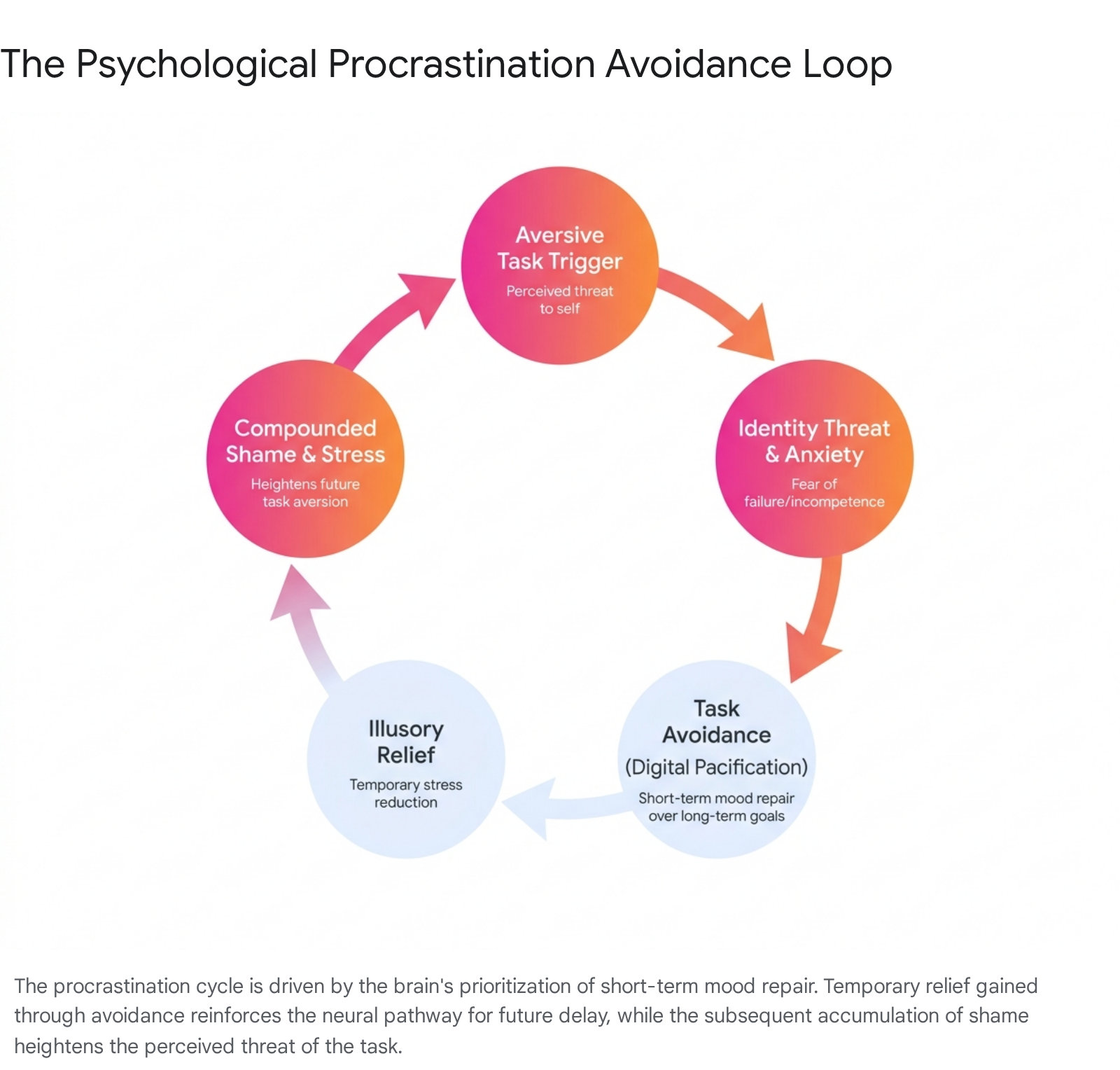
The individual becomes trapped in what researchers term "procrastinatory cognitions," engaging in ruminative, self-blaming thoughts that further deplete the executive and emotional resources required for task initiation 916.
The emotional regulation framework is strongly supported by recent research into self-compassion. If procrastination were truly a manifestation of laziness or apathy, interventions promoting self-kindness and self-forgiveness would theoretically increase the behavior by reducing personal accountability. The empirical reality, however, is precisely the opposite 451013. Higher levels of perceived social support and self-compassion are robust, statistically significant negative predictors of future procrastination 1317. Individuals who respond to their own delays with self-compassion experience a measurable reduction in the negative affect and stress associated with the task, effectively interrupting the shame loop that drives further avoidance 591013. By buffering against negative reactions to self-relevant failures, self-compassion enables the individual to approach the task without the debilitating fear of emotional distress, separating the action from their core sense of self-worth 916.
Symbolic Self-Completion and Identity Protection
While the emotion-regulation model explains the specific mechanics of task avoidance, Symbolic Self-Completion Theory provides critical, nuanced insight into the targets of that avoidance. The tasks most frequently subjected to severe, chronic procrastination are rarely trivial or purely administrative; rather, they are highly salient to the individual's core sense of self, such as academic dissertations, creative portfolios, or major career transitions that define their social and professional standing 1819.
According to Peter Gollwitzer and Robert Wicklund's theory of Symbolic Self-Completion, individuals are deeply and persistently motivated to acquire, maintain, and display symbols that validate their desired self-concept, whether that is the identity of an intellectual, a competent professional, or an innovative artist 212021222324. When an individual experiences a deficiency in a self-definitional area, it produces a state of acute psychological tension and a profound sense of incompleteness 202224. Task execution in these high-stakes domains forces a direct confrontation with objective reality, carrying the inherent, terrifying risk that the resulting performance will fall short of the desired identity standard, thereby threatening the ego 2223.
Procrastination, therefore, functions as a highly sophisticated identity-protection mechanism. By delaying the task, the individual prevents the definitive testing of their abilities, thereby preserving the potential or the illusion of competence 31925. The internal logic of the procrastinating ego dictates that a flawed performance resulting from a deliberate lack of time protects core self-worth far more effectively than a flawed performance resulting from a maximal, dedicated effort 32223. In this framework, perfectionism acts as a potent catalyst; the paralyzing fear of producing imperfect work activates the brain's threat response, forcing the individual into a defensive avoidance posture to maintain their idealized, albeit entirely incomplete, self-image 41528.
Recent developmental psychology research highlights how this manifestation of procrastination intersects with critical periods of identity formation. Among college students and early-career professionals, making definitive academic or career choices requires committing to a specific developmental trajectory, which naturally forecloses other potential "selves" 1925. Delaying decisions serves as a protective barrier during active identity exploration, temporarily mitigating the intense anxiety of choice paralysis 1925. Empirical studies indicate that students with a "diffused" academic identity - those who have not firmly committed to specific academic goals or values - are significantly more likely to engage in severe procrastination compared to those who have secured an "achieved" academic identity 25. By avoiding the work, they avoid committing to an identity they fear they cannot sustain or one that may ultimately prove disappointing.
The Neurobiology of Avoidance: The Amygdala Override
To comprehend the sheer overpowering, seemingly irrational force of the procrastination impulse, the theoretical lens must be broadened to encompass structural neurobiology. Procrastination is not merely a psychological quirk or a behavioral habit; it is a measurable, physiological event characterized by a severe conflict between the limbic system and the prefrontal cortex 326272829.
Evolutionary neurobiology reveals a critical design feature of the human brain: it does not cleanly or reliably differentiate between an external physical predator and an internal psychological threat to identity or social standing 1630313536. The amygdala, functioning as the brain's primary threat detection and emotional labeling center, triggers a rapid cascade of stress hormones, including cortisol and adrenaline, to prepare the organism for survival via fight, flight, or freeze mechanisms upon detecting any perceived danger 162627283637.
When an individual confronts a task intricately tied to their self-worth - and thereby risks failure, peer criticism, or the exposure of incompetence - the amygdala flags this psychological discomfort as an existential threat 1626283138. The resulting physiological arousal creates what researchers term an "amygdala hijack," where the limbic system's uncompromising demand for immediate safety overrides the slower, deliberative functions of the prefrontal cortex 32628313732. The prefrontal cortex, which is responsible for executive functioning, goal-directed behavior, impulse control, and long-term planning, is effectively short-circuited by the flood of stress signals 3262728. The individual flees the task not out of a lack of discipline, but because their neuroanatomy is executing a hard-wired survival response to distance the organism from perceived danger 162833.
Neuroimaging studies utilizing functional magnetic resonance imaging (fMRI) provide robust support for the biological basis of chronic procrastination. Frequent procrastinators consistently demonstrate structural anomalies, most notably a significantly larger amygdala volume compared to non-procrastinators 3272932. A larger amygdala produces a more intense, hyper-reactive alarm response to challenging tasks, generating heightened anxiety and an urgent, overpowering drive to escape 2932. Furthermore, procrastinators exhibit weaker functional connectivity between the amygdala and the dorsal anterior cingulate cortex (dACC), a highly specialized region of the prefrontal cortex essential for impulse control, conflict resolution, and utilizing emotional data to execute goal-directed action 329. Put simply, the procrastinating brain generates a drastically louder threat signal in response to aversive tasks while simultaneously possessing a weaker structural capacity to suppress or regulate that signal 2934.
Intriguingly, event-related potential (ERP) studies suggest that the brain actually maintains a processing advantage for social and identity threats over purely physical ones 353637. Electrophysiological evidence, specifically analyzing the N170, N190, and Early Posterior Negativity (EPN) components, demonstrates that social-evaluative threats, such as angry faces or the prospect of social exclusion, rapidly capture attentional resources and modulate brain activity even when individuals are instructed to focus on physical threats 353637. This neurobiological prioritization explains why the prospect of a negative performance review, public failure, or identity disruption can paralyze an individual far more effectively than abstract, yet objectively more dangerous, physical risks 353637.
Procrastination in Modern High-Stakes Environments
The neurobiological vulnerabilities outlined above are drastically exacerbated by the unique, unprecedented architectures of modern life. The 2023 - 2026 societal and occupational landscape is characterized by severe cognitive overload, continuous digital connectivity, and profound occupational uncertainty, creating a perfect storm for chronic identity-threat avoidance 3846394041.
Knowledge Work and AI-Induced Identity Threat
The contemporary knowledge worker earns a living by deploying intellectual resources, analyzing complex data, and generating creative solutions rather than executing physical labor 39424344. Consequently, their professional identity is inextricably linked to cognitive output and specialized expertise. However, the rapid, pervasive integration of Artificial Intelligence and generative models into the workplace has introduced an unprecedented level of identity threat to this demographic 383846424546.
When technology threatens to replace, automate, or vastly outperform a human's core cognitive competencies, the worker experiences acute, sustained social identity threat 384546. Recent polling from the Harvard Kennedy School in 2025 indicated that nearly seventy percent of college students view AI as a direct threat to their future job prospects, prompting widespread anxiety and major academic pathway shifts toward perceived "AI-proof" human skills 38. This phenomenon extends beyond mere economic anxiety; it is an existential challenge to the self-concept that individuals have meticulously built over years of specialized education and experience 38.
In high-stakes knowledge work, this AI-induced uncertainty continuously triggers the amygdala's threat response, significantly increasing job insecurity and severely decreasing psychological safety 384245. To cope with this pervasive, ambient threat, individuals often engage in withdrawal behaviors. Research highlights that employees navigating employee-AI collaboration frequently exhibit job crafting, knowledge hiding, and pervasive procrastination, acting as defensive, self-protective strategies to manage the overwhelming ambiguity and the fear of obsolescence 4042. Furthermore, immersive digital workspaces, such as the Metaverse, introduce novel forms of cognitive distraction that further tax the already burdened prefrontal cortex, requiring knowledge workers to exert extraordinary effort in arousal filtering and distraction management to simply maintain baseline task focus 39.
Digital Distraction as an Emotional Pacifier
To navigate the chronic stress, identity threat, and persistent amygdala activation characteristic of modern work and academic environments, individuals frequently turn to the very tools causing their cognitive fragmentation: smartphones and digital media. However, contemporary psychological research reframes the concept of "digital distraction." It is not merely a cause of procrastination, but rather a sophisticated mechanism of emotional regulation acting as a "digital pacifier" 4155474858495051.
Short-form video platforms and social media feeds are algorithmically engineered to provide continuous, novel emotional stimulation that hijacks the brain's reward circuitry 4951. When a worker or student encounters an aversive task that triggers an identity threat, they experience a spike in anxiety and immediately reach for their device to self-medicate 4149. The digital pacifier successfully and rapidly distracts the user from stressful thoughts, downregulating the negative affect and providing a fast, low-resource escape from psychological pain 144149.
However, neuroplasticity ensures that the brain learns and adapts from this interaction. Every time an individual avoids a threatening task and successfully soothes their anxiety with a digital pacifier, the brain treats the avoidance as a highly successful survival strategy. This physically reinforces the neural pathways for future delay, causing the amygdala to grow more reactive while weakening the connectivity to the impulse-control centers of the dorsal anterior cingulate cortex 1529.
Longitudinal studies on the use of digital pacifiers offer alarming insights into this dynamic. Research published in Frontiers in Child and Adolescent Psychiatry in 2024 demonstrated that when parents offer digital devices to young children to soothe emotional tantrums, the children fail to develop crucial self-regulatory skills 55474862. Specifically, the reliance on digital emotion regulation erodes the baseline capacity for "effortful control" - the vital cognitive ability to choose a deliberate, goal-oriented response over an automatic, impulsive one 415547485062. This childhood dynamic maps directly onto adult procrastination behaviors; constant exposure to digital stimuli induces severe mental fatigue and weakens the adult's self-regulatory capacity, severely diminishing their ability to delay gratification, tolerate frustration, and sustain focus on long-term academic or professional goals 5051.
Cross-Cultural Dimensions of Avoidance
While the underlying neurobiological hardware of the threat response and procrastination is a universal human trait, the social triggers and the specific interpretations of identity threat are deeply influenced by cultural frameworks. The tension between task delay and identity preservation manifests distinctly across the collectivist-individualist spectrum 852536566.
In individualist societies, prominently featured in Western, Anglo-Saxon countries, an individual's self-concept is largely defined by personal achievement, uniqueness, autonomy, and independence 852535455. Self-worth is inextricably tied to individual output, continuous self-actualization, and competitive performance against peers 85253. In these cultural contexts, procrastination frequently stems from intense perfectionism and the overwhelming pressure to constantly prove individual exceptionalism 86654. When a person in an individualist culture procrastinates, it is typically experienced internally as a profound personal failure, an erosion of self-esteem, or a moral deficit in self-discipline 52.
Interestingly, studies published in the Journal of Personality and Social Psychology indicate that members of individualistic cultures exhibit significantly lower accuracy in predicting their own future behaviors compared to their collectivist counterparts 854. Individualists tend to heavily overestimate their personal dispositional consistency, assuming their future self will act in accordance with their idealized traits, leading to overly optimistic planning fallacies that inadvertently feed chronic procrastination 854.
Conversely, collectivist cultures, which are common in East Asia, Latin America, and parts of Africa, prioritize group harmony, familial obligations, community belonging, and social interdependence 52536566. Self-identity in these cultures is primarily grounded in relationships and the successful fulfillment of defined group roles rather than isolated personal achievements 5354. In these environments, the psychological threat of procrastination is less about failing to achieve personal greatness and more about the anxiety of disrupting social harmony or failing the collective 5266.
For example, in Japanese culture, procrastination is often viewed and judged through the specific lens of meiwaku - the concept of causing trouble or inconvenience for others 52. Through this cultural lens, task delay transforms from a private time management issue into a potential, highly visible breach of the social contract 52. While cross-cultural meta-analyses consistently show that procrastination is globally prevalent, the precise triggers for the amygdala hijack differ profoundly 55. In collectivist societies, the identity threat is rooted in the fear of collective disappointment or bringing shame to the in-group, which can be just as paralyzing as the individualist's fear of personal inadequacy 525366. Furthermore, empirical studies examining multicultural virtual teamwork reveal that introducing collectivist group accountability structures can significantly mitigate individual procrastination tendencies, leveraging social obligation as a counterweight to task aversion 69.
Competing Psychological Views and Limitations
While the emotional regulation and identity-protection framework offers a remarkably robust explanation for chronic procrastination, a comprehensive analysis must address competing psychological views and acknowledge limitations to the primary models, ensuring a fully nuanced interpretation of the behavior.
The Executive Dysfunction Framework
Directly contrasting the emotion-centric view is the executive dysfunction framework, which positions procrastination fundamentally as a cognitive control deficit rather than an emotional choice 112851707172. According to this clinical model, individuals delay tasks not necessarily to avoid emotional discomfort, but because they quite literally lack the neurological hardware and cognitive processes required to initiate and sustain goal-directed behavior 2870.
Executive functions, which are localized primarily in the prefrontal cortex, encompass a suite of higher-order cognitive abilities, including working memory, inhibitory control, planning, organization, and task switching 115170. Individuals with clinical conditions such as Attention Deficit Hyperactivity Disorder (ADHD), autism, or those experiencing severe trauma or chronic burnout exhibit measurable, significant impairments in these specific areas 152872. In these cases, the brain simply cannot organize the required sequential steps to cross the threshold of action. As the clinical literature notes, a standard procrastinator chooses to delay despite maintaining the underlying capacity to act, whereas an individual suffering from executive dysfunction genuinely wants to act but finds themselves cognitively frozen and incapable of initiation 287172.
Quantitative electroencephalogram (QEEG) signatures, such as excessive frontal midline theta or beta wave activity, frequently reveal this anterior cingulate cortex over-activation - a state of thinking excessively about doing a task without the ability to execute it 28. Therefore, behavioral interventions aimed purely at mood repair or self-compassion may be highly insufficient for those suffering from genuine executive dysfunction, who instead require structural environmental support, occupational therapy strategies, or pharmacological interventions aimed at dopamine regulation to restore functional capacity 3287071.
The Evolutionary Perspective: Energy Conservation
Another prominent counter-model derives from evolutionary psychology and evolutionary biology. From this viewpoint, procrastination is not a modern pathology, a failure of self-regulation, or a symptom of executive dysfunction, but rather an ancient, highly adaptive survival mechanism 1473747576.
In ancestral hunter-gatherer environments, resources such as food and shelter were persistently scarce, and immediate physical threats from predators or rival groups were a constant reality 1473. In such volatile settings, there was virtually no evolutionary advantage to long-term planning or abstract goal setting. When immediate survival demanded absolute priority, the human brain evolved to heavily discount future rewards in favor of immediate benefits, a well-documented cognitive bias known as hyperbolic discounting 177.
Therefore, procrastination can be viewed as an evolutionary byproduct of impulsivity and a deep-seated instinct for energy conservation 373747577. By postponing non-essential, abstract future tasks, early humans successfully conserved vital cognitive and physical caloric resources, keeping them in reserve for immediate, life-or-death survival needs 7374. While this "present bias" and preference for immediate gratification was highly adaptive on the ancestral savanna, it becomes a severe liability due to an evolutionary mismatch in modern society, where survival and success rely almost entirely on executing long-term, abstract objectives that offer no immediate tangible reward 14737476.
Comparative Analysis: General Task vs. Identity-Threat Avoidance
To synthesize these complex psychological, neurobiological, and evolutionary mechanisms, it is highly useful to clearly distinguish between routine, general task procrastination and the profound, systemic paralysis induced by identity-threat. The following table delineates the core differences across key dimensions of the behavior.
| Key Dimension | General Task Procrastination | Identity-Threat Avoidance (Chronic Procrastination) |
|---|---|---|
| Underlying Trigger | Task boredom, low subjective utility, lack of immediate reward (Evolutionary/Impulsivity model). | Intense fear of failure, exposure of incompetence, perfectionism (Symbolic Self-Completion). |
| Neurobiological State | Low dopamine tone; general cognitive preference for immediate gratification. | Amygdala hijack; severe cortisol spike; active suppression of the prefrontal cortex (PFC). |
| Primary Emotion | Apathy, mild frustration, boredom, indifference. | Acute anxiety, existential dread, deep shame, imposter syndrome. |
| Typical Task Profile | Administrative chores, routine maintenance, low-stakes errands (e.g., filing taxes, laundry). | High-stakes knowledge work, creative output, academic dissertations, major career transitions. |
| Digital Behavior | Mindless scrolling to pass the time; casual, low-stakes distraction. | Desperate use of "digital pacifiers" to rapidly downregulate a severe, painful stress response. |
| Effective Mitigation Strategy | Time-blocking, environmental friction removal, strict external deadlines. | Self-compassion, cognitive reappraisal, mindfulness, uncoupling self-worth from output. |
Synthesis and Strategic Mitigation
The extensive body of contemporary empirical research fundamentally and irrevocably redefines the concept of procrastination. It is not an artifact of laziness, apathy, or poor character, nor is it a simple failure of scheduling and time management. Rather, it is a highly complex, neurobiologically grounded mechanism of emotional regulation and psychological self-preservation. When tasks threaten an individual's precarious sense of self - particularly in high-pressure, individualistic cultures or within the volatile, AI-threatened modern knowledge economies - the brain's threat detection architecture initiates an avoidance protocol that is neurologically identical to how it handles imminent physical danger.
Understanding the deep neuroscience of the amygdala hijack alongside the psychology of symbolic self-completion dictates a radical shift in mitigation strategies for both individuals and organizations. Traditional punitive measures, strict rigid scheduling, and relentless self-criticism actively worsen the condition; they increase the perceived threat level of the task, thereby triggering a stronger amygdala response and driving deeper, more entrenched avoidance behaviors.
Effective, long-term intervention requires neutralizing the emotional threat at its source. Mitigation strategies must move beyond behavioral band-aids and incorporate evidence-based psychological techniques. Cognitive reappraisal is essential, requiring individuals to consciously reframe a task from an existential test of self-worth to a localized opportunity for learning, which effectively lowers the amygdala's alarm signal and brings the executive functions of the prefrontal cortex back online. Furthermore, the integration of self-compassion is critical to breaking the recursive shame cycle, reducing the compounded negative affect that makes subsequent task initiation feel impossible. Finally, building effortful control through mindfulness and interoception allows individuals to observe the somatic discomfort of a challenging task without automatically reacting with a "flight" response to a digital pacifier. Ultimately, overcoming procrastination requires an acknowledgment of human biology, allowing individuals to bypass moral judgment and implement neurobiologically informed strategies to reclaim their agency.