
Why We Get Déjà Vu
Déjà vu is a fleeting, non-clinical memory illusion caused by a temporary mismatch between the brain's familiarity-generating temporal lobes and its fact-checking frontal regions. Rather than indicating a glitch or a memory failure, contemporary neuroscience suggests this phenomenon is a sign of a healthy, active brain successfully identifying and correcting an erroneous cognitive signal.
The Phenomenology of False Familiarity
The term déjà vu, French for "already seen," was first coined by the French philosopher Émile Boirac in 1876 in his book The Future of the Psychic Sciences 12. Today, cognitive psychology and neuroscience recognize it as a momentary memory illusion characterized by two distinct, conflicting sensations: an overwhelming, visceral feeling that a novel experience has happened before, juxtaposed with the rational, metacognitive awareness that this feeling is impossible 323.
The phenomenon is remarkably common. Global surveys indicate that between 60 percent and 80 percent of the population reports experiencing déjà vu at least once, with some demographic studies suggesting that up to 97 percent of people have encountered it over their lifetimes, and roughly 67 percent experience it on a somewhat regular basis 478.
Despite its prevalence, déjà vu remains notoriously difficult to study in clinical environments. Because episodes are spontaneous, deeply subjective, and usually last only a few seconds, researchers cannot easily capture the event as it happens naturally 389. However, recent advancements in functional magnetic resonance imaging (fMRI), electroencephalography (EEG), and virtual reality have finally allowed scientists to recreate analogues of the experience in the laboratory, pulling back the curtain on one of the brain's most unsettling quirks.
The Neuroscience of Memory Conflict
For decades, the prevailing public and scientific assumption was that déjà vu represented a "glitch" in the brain - a momentary failure of the memory storage system where a new event was accidentally filed directly into long-term memory. However, recent neuroimaging research has radically shifted this perspective.
According to cognitive researchers, déjà vu is not a memory error, but rather the conscious manifestation of the brain's memory monitoring system successfully doing its job 323. To prove this, scientists at the University of St Andrews utilized a modified version of the Deese-Roediger-McDermott (DRM) false memory procedure. In a standard DRM test, participants are given a list of related words - such as bed, night, snooze, dark, and nap. Later, they are asked if they heard the word sleep. Most people will confidently, but falsely, claim they did because the brain falsely recognizes the semantic theme 3105.
To adapt this to trigger déjà vu in an fMRI scanner, researchers first generated this false familiarity, but then provided the participants with a definitive cue indicating that the familiarity was erroneous. This induced a state of "cognitive conflict" mimicking the exact sensation of déjà vu 105.
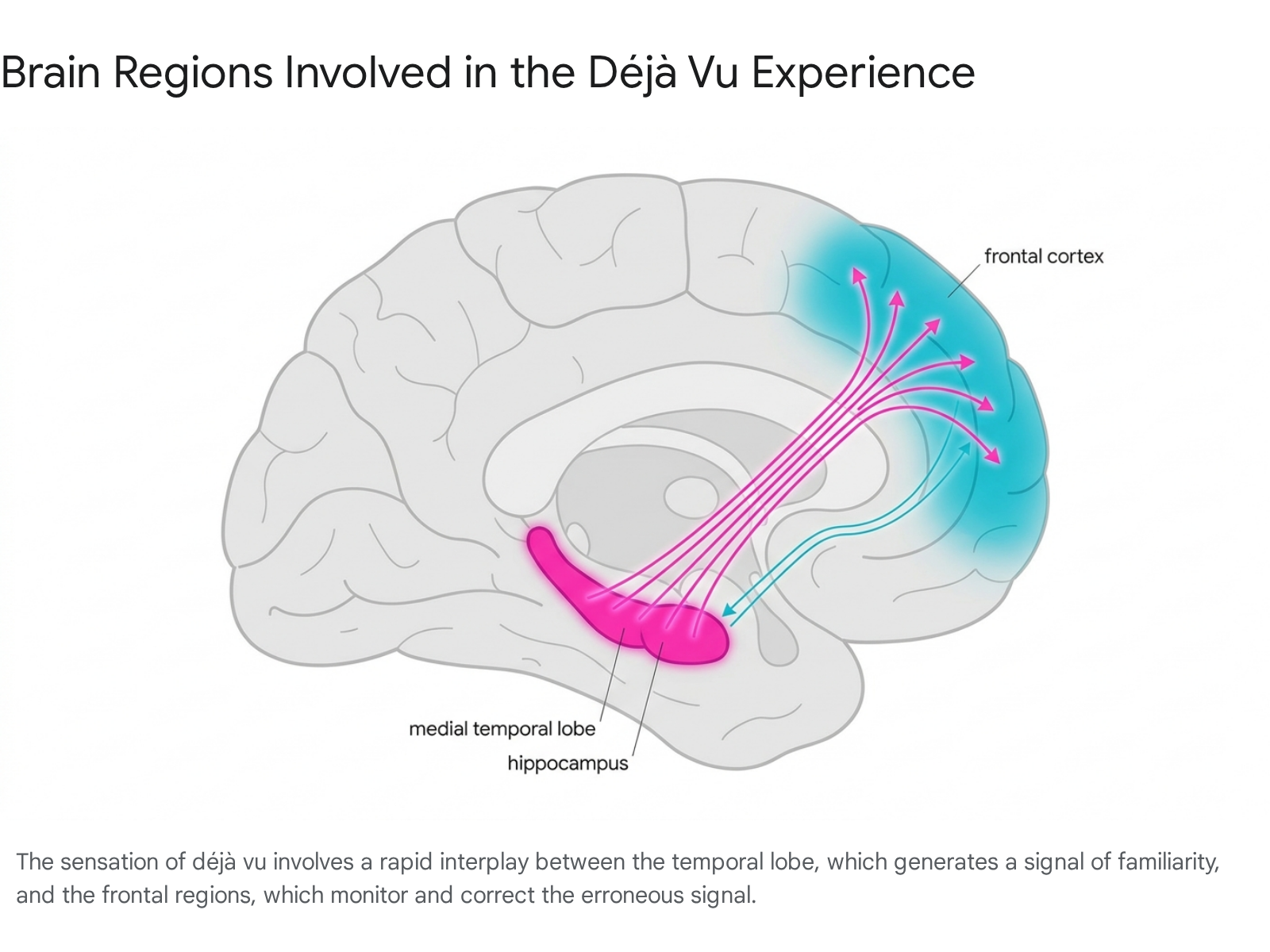
The fMRI scans revealed a surprising mechanism. During the artificially induced déjà vu episodes, the brain regions typically responsible for core memory retrieval - such as the hippocampus - did not show primary activation. Instead, the brain's frontal regions lit up. Specifically, the anterior cingulate cortex, the medial prefrontal cortex, and the parietal cortex showed intense activity 105. These regions are known as the brain's conflict resolution and fact-checking centers.
This data indicates that déjà vu is the sensation of the frontal cortex recognizing that the temporal lobe is sending a false signal, and actively intervening to correct the mismatch 323.
Anatomy of the Medial Temporal Lobe
To understand why the false signal occurs in the first place, one must examine the neuroanatomy of human memory. The sensation of déjà vu is deeply rooted in the medial temporal lobe, a brain region crucial for sensory processing, emotion, and the formation of long-term memories 24613.
Within this region, memory processing is divided between distinct but highly interconnected structures. The hippocampus is primarily responsible for "recollection" - the retrieval of specific, contextual details about a past event, such as where and when it happened. Adjacent to the hippocampus is the rhinal cortex, which includes the entorhinal and perirhinal cortices. The perirhinal cortex acts as the brain's familiarity registry; it provides the immediate, gut-level feeling that an object, face, or scene has been encountered before, without necessarily retrieving the specific context 7158.
During a standard memory recall event, the perirhinal cortex and the hippocampus work in perfect synchronization. You recognize a familiar face, and a fraction of a second later, you recall the person's name and where you met them. However, neuroscientists theorize that during a déjà vu episode, these systems temporarily decouple. The perirhinal cortex fires spontaneously, flooding the brain with an intense signal of familiarity. The hippocampus attempts to retrieve the contextual details to explain this familiarity but finds nothing 79. This "decoupled familiarity hypothesis" explains why the sensation is so haunting: the feeling is overwhelmingly strong, but the rationale is entirely absent.
Leading Cognitive Theories of the Initial Trigger
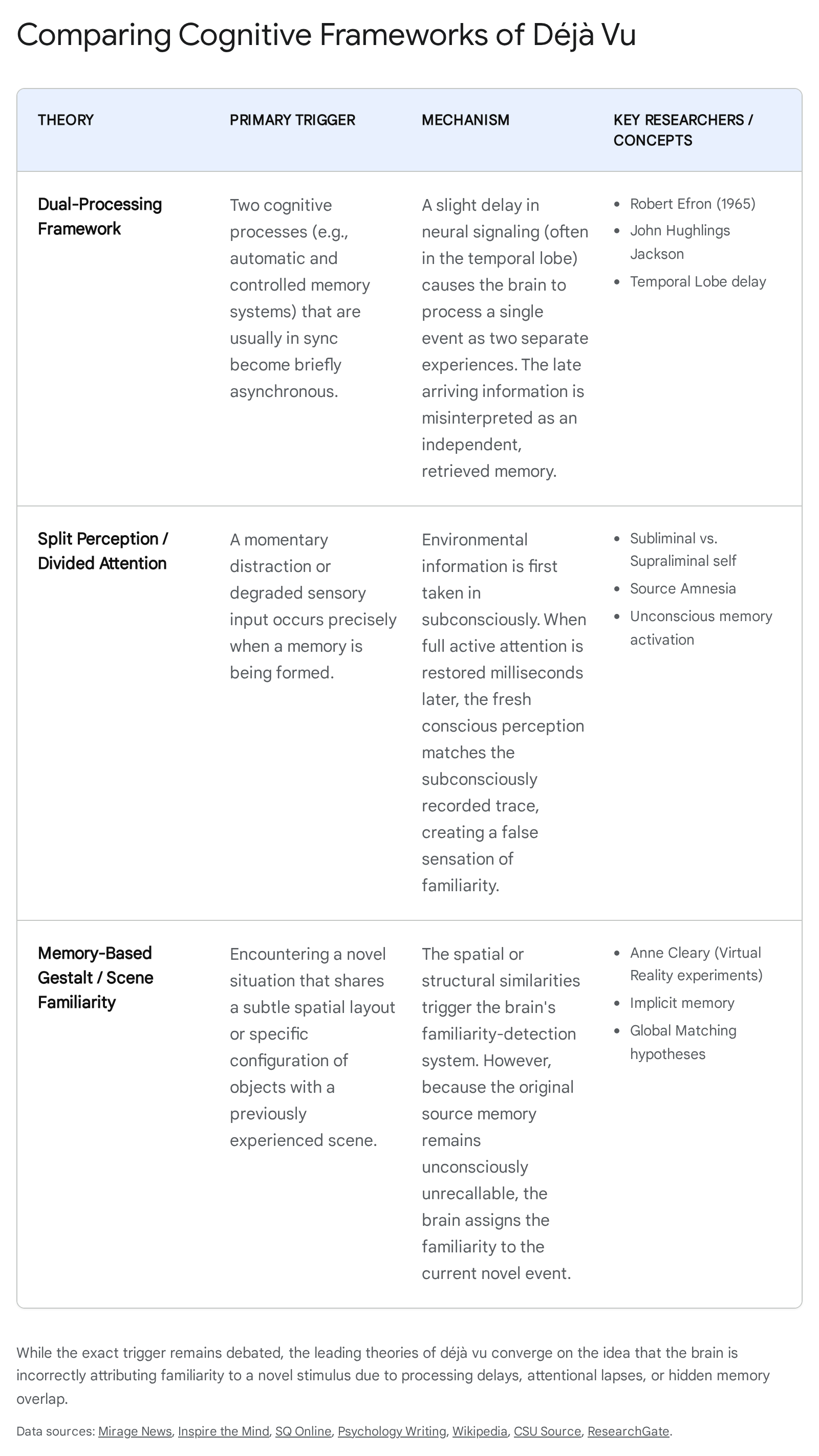
While fMRI scans have revealed how the brain resolves the memory conflict, cognitive scientists are still debating exactly what triggers the perirhinal cortex to misfire in the first place. Over forty distinct theories have been proposed, but the scientific consensus generally groups them into three primary frameworks.
The Dual-Processing Hypothesis
Dual-processing theories suggest that human cognition relies on parallel neurological systems that normally operate in perfect, seamless synchronization. One of the earliest scientific iterations of this theory was proposed by neurologist Robert Efron in 1965. Efron noted that the brain's sorting of incoming sensory signals occurs in the temporal lobe of the left hemisphere. However, sensory signals enter the temporal lobe twice - once from each hemisphere of the brain - normally with a minuscule, imperceptible delay of milliseconds between them 1.
If this timing mechanism is disrupted, even slightly, the two signals become asynchronous. The brain may then process the identical sensory input as two separate, sequential experiences. The first arriving signal is processed subconsciously; when the second, slightly delayed signal arrives and is processed consciously, it matches the newly formed short-term memory 96101920. This forces the brain to interpret the late information as a separate, repeated event, generating the powerful illusion of a relived moment.
The Split Perception and Divided Attention Theory
Closely related to dual-processing is the split perception, or divided attention, hypothesis. This theory shifts the focus from neurological timing to attentional focus. It argues that déjà vu is triggered when a person is momentarily distracted while encountering a new environment or stimulus 891019.
For example, imagine walking into a new café while looking down at a text message. Your peripheral vision takes in the layout of the room subliminally, recording the information outside of your active, conscious awareness. A fraction of a second later, you put your phone away and look up, restoring full attention to the room. The environment suddenly feels inexplicably familiar because your brain is matching your new, conscious perception against the subliminal snapshot it recorded just a moment prior 919.
The Memory-Based Gestalt Theory
Other cognitive scientists argue that déjà vu is not a timing or attention error at all, but rather a highly functional associative memory phenomenon. According to the "Gestalt Familiarity Hypothesis" or the "Global Matching Hypothesis," déjà vu happens when the spatial arrangement or configuration of a novel scene closely matches the layout of a previously experienced, but temporarily unrecalled, memory 2101112.
To test this theory rigorously in a laboratory, cognitive psychologist Anne Cleary and her research team utilized virtual reality environments. They constructed dozens of unique, virtual rooms and layouts that resembled the video game The Sims. Participants were taken on immersive virtual tours of various scenes. Later in the experiment, they were placed in novel scenes that featured entirely different objects and themes, but which shared the exact same spatial grid and underlying configuration as the earlier scenes 101112.
The results were striking: participants reported significantly higher rates of déjà vu when navigating the structurally identical scenes. The data demonstrated that the brain detects the structural familiarity of an environment and triggers a familiarity response, even when the conscious mind completely fails to recall the source memory 1011. In this view, déjà vu is simply a misattribution of familiarity - a failure to identify why a space feels known.
The Illusion of Prediction
A common hallmark of an intense déjà vu episode is the compelling, uncanny feeling of knowing exactly what will happen next 1112. Because the current moment feels exactly like a memory, the brain naturally expects to be able to retrieve the sequence of subsequent events. This predictive feeling has historically fueled supernatural explanations of the phenomenon.
However, experimental evidence confirms that this predictive feeling is purely an illusion. In extended spatial navigation experiments, participants experiencing déjà vu in a virtual maze were asked to predict the direction of the next turn. Despite feeling overwhelmingly certain that they knew the correct path, their predictive accuracy was no better than random chance 111213.
Researchers did, however, identify a direct dose-response relationship: the stronger the underlying, unrecalled memory trace, the more intense the illusory feeling of prediction became. The brain conflates the intense, localized sensation of familiarity with actual predictive ability, underscoring the phenomenon as a purely metacognitive trick rather than a true precognitive event 12.
Demographics: Who Experiences False Familiarity?
Research consistently demonstrates that déjà vu is not distributed equally across the population. Various demographic, behavioral, and psychological factors strongly influence both the frequency and intensity of the experience. Studies show that individuals who experience déjà vu tend to display highly effective recognition memory, reinforcing the theory that the phenomenon requires a robust, healthy cognitive system 1142515.
| Demographic / Behavioral Factor | Correlation with Déjà Vu Frequency | Evidence and Context |
|---|---|---|
| Age | Negative (Decreases with age) | The phenomenon peaks in young adults (ages 15 - 25) and steadily declines in older populations 28252728. Researchers attribute this to the higher levels of excitatory neural activity in younger brains, combined with a highly efficient frontal cortex capable of rapid fact-checking 39. |
| Educational Status | Positive | Higher educational attainment correlates with higher incidences of déjà vu, possibly due to more active cognitive engagement or differing socioeconomic exposures 114252728. |
| Travel Frequency | Positive | Individuals who travel frequently and are exposed to novel environments report déjà vu more often. This strongly supports the Gestalt theory that having a vast, diverse spatial memory bank increases the likelihood of accidental memory-mismatch errors 1142515. |
| Dream Recall | Positive | A robust association exists between the ability to remember dreams and the frequency of déjà vu, hinting at a shared neuro-cognitive mechanism regarding internal memory generation and retrieval 1142516. |
| Fatigue and Stress | Positive (Trigger) | Acute physical fatigue, psychological distress, and sleep deprivation compromise the brain's ability to regulate coordinated cognitive processing. This leads to uncoordinated neurotransmission and more frequent neural misfires in the temporal lobe 2919281630. |
| Biological Sex | Neutral | Large-scale surveys and factor analyses indicate no statistically significant differences in déjà vu frequency between males and females 142527. |
The demographic data provides a fascinating counter-narrative to standard assumptions about aging and memory. Typically, memory errors increase as humans age. However, because déjà vu requires a healthy frontal cortex to flag the error, the decline in déjà vu with advancing age actually reflects a gradual reduction in the brain's ability to detect its own memory mistakes, rather than an improvement in memory accuracy 323.
Furthermore, neurochemical research has highlighted a strong link between the neurotransmitter dopamine and the frequency of déjà vu. Dopamine is an excitatory neurotransmitter heavily involved in the brain regions signaling familiarity. Consequently, individuals taking dopaminergic medications (such as treatments for Parkinson's disease) or recreational drugs that alter dopamine pathways often report significantly elevated rates of the phenomenon 231718.
When Déjà Vu Signals a Medical Condition
While almost all occurrences of déjà vu in the general population are benign neuro-cognitive quirks, the phenomenon holds significant diagnostic importance in clinical neurology. Frequent, intense, and prolonged déjà vu is a primary clinical indicator of temporal lobe epilepsy (TLE). In this context, it acts as an "aura" - a simple partial seizure that serves as a localized warning sign of an impending, larger electrical disruption in the brain 139192021.
In patients with TLE, aberrant, hyper-excitable electrical discharges originate directly in the medial temporal lobe structures, such as the hippocampus and amygdala 72036. Because these structures govern emotion, familiarity, and memory, the seizure manifests subjectively as a profound sense of reliving the past. Differentiating between physiological (benign) déjà vu and pathological (ictal) déjà vu requires careful clinical observation, as the core feeling of familiarity is similar but is accompanied by vastly different secondary symptoms.
| Clinical Feature | Benign (Physiological) Déjà Vu | Epileptic (Ictal) Déjà Vu |
|---|---|---|
| Frequency and Duration | Rare and fleeting, typically lasting only a few seconds before fading naturally 28. | Highly frequent, often occurring in distinct clusters, and noticeably prolonged in duration 13192122. |
| Cognitive Awareness | Complete awareness that the feeling is an illusion; no loss of reality testing 2319. | Often progresses to impaired consciousness, confusion, or déjà vécu (a delusional belief that the event was actually lived) 192122. |
| Emotional State | Mild surprise, curiosity, or a slight, passing eeriness 819. | Frequently accompanied by intense, out-of-context fear, anxiety, or a profound sense of impending dread 17192021. |
| Physical Symptoms | None 29. | May feature ascending epigastric sensations (a "roller coaster" stomach drop), lip-smacking automatisms, or physical headaches 192021. |
| Sensory Hallucinations | None 919. | Frequently associated with gustatory (taste) or olfactory (smell) hallucinations that accompany the seizure 192021. |
Paradoxically, studies comparing epileptic patients with healthy controls have shown that people with temporal lobe epilepsy are actually less likely to experience standard, non-seizure déjà vu in their daily lives compared to the general population. Because chronic TLE damages the neural pathways responsible for baseline recognition memory, patients lose the healthy fact-checking mechanism that generates standard, benign déjà vu experiences 9.
Jamais Vu: The Eerie Opposite
If déjà vu is the sensation of false familiarity, its neuro-cognitive inverse is jamais vu (French for "never seen"). Jamais vu occurs when an objectively familiar situation, person, or word suddenly feels completely novel, strange, or unreal, despite the observer rationally knowing they have encountered it countless times before 13017. Walking into a childhood bedroom and feeling as if one has never been there, or looking at a commonly used word until the spelling appears entirely alien, are classic examples of this unsettling phenomenon.
While significantly less common than déjà vu, jamais vu provides equally profound insights into the mechanics of human cognition. In a widely recognized study that earned the Ig Nobel Prize in 2023, cognitive researchers Christopher Moulin and Akira O'Connor demonstrated that jamais vu can be reliably induced in a laboratory setting through the psychological principle of semantic satiation.
In their experiment, 94 undergraduates were asked to repeatedly write common words (such as "door" or "the") as quickly as possible. The researchers found that roughly 70 percent of subjects experienced a sensation of jamais vu after approximately one minute, or an average of 33 repetitions. Participants reported that the words lost their meaning, felt misspelled, or seemed to belong to an unknown language, and some even reported feeling a loss of control over their hand 2339.
Neuropsychologically, jamais vu represents a temporary disconnection between sensory perception and memory recall 3017. The brain continues to process the visual or auditory input, but the medial temporal lobe fails to output the expected familiarity signal. Researchers theorize that jamais vu serves an evolutionary purpose: it acts as a cognitive "reality check" or neural circuit breaker, preventing the brain from getting trapped in endlessly repetitive processing loops 2339. By making an over-processed, automated stimulus suddenly feel novel, the brain forces the individual to snap out of rote behaviors, restore cognitive flexibility, and redirect their attention. This mechanism has drawn significant interest in psychiatry, particularly regarding its potential links to the repetitive checking behaviors seen in Obsessive Compulsive Disorder (OCD) 2339.
The Broader Family of Memory Parasomnias
Déjà vu and jamais vu are part of a larger spectrum of memory and perceptual anomalies, often referred to as paramnesias. These related phenomena highlight the delicate balance the brain must strike between perception, memory, and reality testing:
- Déjà vécu (Already Lived): A more intense, and often pathological, feeling of having already lived through a situation in its entirety. Unlike benign déjà vu, déjà vécu has behavioral consequences. Patients may withdraw from reality because they firmly, delusionally believe they know exactly what will happen next, losing the metacognitive awareness that their feeling is a trick 1.
- Déjà rêvé (Already Dreamed): The distinct feeling that a current waking experience was previously encountered in a specific dream, conflating internal subconscious generation with external reality 1.
- Presque vu (Almost Seen): Commonly known as the "tip of the tongue" phenomenon. This is characterized by the intense feeling that one is on the verge of retrieving a specific memory, word, or fact, but the retrieval remains frustratingly just out of reach 140.
Cultural and Historical Interpretations Across the Globe
Because the sensation of déjà vu is entirely internal, intensely subjective, and emotionally resonant, humanity has sought to explain it through cultural, spiritual, and mythological frameworks long before the advent of functional neuroimaging. It frequently bridges the gap between physiological sensation and metaphysical belief 78.
In Eastern philosophical traditions, notably Hinduism and Buddhism, the feeling of false familiarity is routinely interpreted through the lens of reincarnation and karma. In these cultures, déjà vu is traditionally viewed not as a neural misfire, but as a genuine, fleeting glimpse into a past life - a brief convergence of the soul's long history with its present reality, offering an opportunity for spiritual reflection 7841.
In various indigenous and African spiritual practices, the sensation is often associated with ancestral connections. Experiencing déjà vu is interpreted as a sign of spiritual guidance, a message from forebears confirming that an individual is aligned with their intended destiny or being protected from unseen forces 741. In European folklore, particularly Celtic traditions, the phenomenon was historically linked to "second sight" or precognition, viewed as a momentary lifting of the veil separating the present from the predetermined future 41.
In modern Western pop culture, the phenomenon was famously popularized by the 1999 film The Matrix as a "glitch" in simulated reality. This metaphor has deeply permeated colloquial language, perfectly capturing the uncanny, reality-bending nature of the event for a technologically literate audience 8414243.
While these varied cultural frameworks differ wildly from the clinical neurobiological model of synaptic delays and medial temporal lobe misfires, they underscore a universal truth: the profound psychological impact that momentary memory illusions exert on human consciousness. The brain's natural tendency is to construct a narrative to explain its own internal states, turning a millisecond delay in a neural circuit into evidence of past lives or simulated realities.
The Future of Déjà Vu Research
As neuroimaging technologies advance, the ability to study spontaneous cognitive phenomena like déjà vu is expanding rapidly. The deployment of ultra-high-field 7-Tesla (7T) fMRI scanners combined with high-density EEG caps is allowing researchers to study brain function at the sub-millimeter level of individual cortical columns 444546. These tools are beginning to map the precise micro-circuitry of the entorhinal and perirhinal cortices, tracking how familiarity signals traverse neural networks in real-time.
Future longitudinal studies aim to track how the frequency of these memory anomalies changes across the lifespan in specific individuals, potentially utilizing them as early, non-invasive biomarkers for cognitive health or impending neurological decline 39. Furthermore, major investments in multidisciplinary research centers - such as the upcoming Utah Mental Health Translational Research Building - are bringing together neurologists, psychiatrists, and data scientists to explore how environmental stressors, genetics, and neural architecture intersect to produce these complex mental states 24.
Bottom line
Déjà vu is a brief, benign illusion of memory caused by a temporary mismatch between the brain's familiarity-generating temporal lobes and its fact-checking frontal regions. Rather than signaling cognitive decline, occasional déjà vu suggests a healthy, active memory-monitoring system capable of catching its own processing delays or attentional lapses. However, if the sensation becomes highly frequent, prolonged, or is accompanied by severe emotional distress and sensory hallucinations, it steps out of the realm of benign neuro-quirks and can serve as a critical clinical indicator for neurological conditions such as temporal lobe epilepsy.