
Psychology of Effective and Ineffective Apologies in Modern Contexts
The apology is an intricate psychological, social, and linguistic construct that functions as the primary mechanism for relational repair. Historically viewed predominantly through the lens of interpersonal conflict resolution, the landscape of apologies has grown exponentially more complex in the contemporary era. In modern, high-stakes environments - particularly within corporate public relations, globalized digital platforms, and artificial intelligence-mediated communication (AIMC) - the mechanisms of remorse, accountability, and repair are undergoing profound transformations. Research emerging from 2023 onwards highlights how the act of apologizing intersects with neurobiology, systemic power structures, and cross-cultural variables 1234.
This comprehensive analysis investigates the psychological underpinnings of apologies, transitioning from foundational behavioral frameworks to modern digital phenomena. It examines the cognitive mechanics of defensiveness and ego preservation, the cultural dichotomy of shame and guilt, the reputational risks associated with AI-generated remorse, and the pervasive public misconceptions regarding legal liability and the guarantee of forgiveness. By integrating insights from peer-reviewed psychology, organizational behavior studies, and leading university dispute resolution centers, this report provides a thorough synthesis of the modern apology.
The Anatomy of an Effective Apology: Foundational Frameworks
At the core of apology research is the empirical recognition that not all expressions of remorse carry equal reparative weight. The structural composition of an apology directly correlates with its efficacy in restoring trust, mitigating relational damage, and satisfying the psychological needs of the offended party.
Lewicki's Six-Component Typology
Extensive empirical research, notably the foundational framework established by Roy Lewicki, Robert Lount, and Beth Polin, identifies six distinct components that comprise an effective apology. Across multiple studies analyzing simulated workplace scenarios involving hundreds of participants, it has been consistently demonstrated that the inclusion of more components exponentially increases the perceived adequacy, credibility, and effectiveness of the apology 567.
The six components are categorized as the expression of regret, the explanation of what went wrong, the acknowledgment of responsibility, the declaration of repentance, the offer of repair, and the request for forgiveness. Crucially, these components are not weighted equally by recipients. The acknowledgment of responsibility operates as the most critical element, followed closely by the offer of repair 8910. The explanation of what went wrong and expressions of regret carry moderate weight, whereas the request for forgiveness is consistently ranked as the least essential, as it inherently shifts the psychological focus and burden back onto the victim, demanding emotional labor from the injured party 2810.
Furthermore, research indicates that the context of the violation dictates the rigorousness with which the apology is judged. Apologies addressing integrity violations - situations where rules were knowingly or maliciously broken - require a significantly higher threshold of these components to be accepted compared to competence violations, which involve accidental mistakes or a lack of knowledge 58. While the relative importance of the six components remains consistent across both types of violations, an integrity violation intrinsically diminishes the baseline likelihood of forgiveness 68.
To operationalize this framework within applied contexts, the following table breaks down Lewicki's six components, contrasting successful, accountability-driven phrasing with failing, defensiveness-inducing phrasing that frequently undermines relational repair.
| Apology Component | Successful Phrasing (Accountability-Focused) | Failing Phrasing (Defensive / Non-Apology) |
|---|---|---|
| 1. Expression of Regret | "I am deeply sorry for the pain and disruption my actions caused." | "I am sorry you feel that way." or "I'm sorry if anyone happened to be offended." |
| 2. Explanation of What Went Wrong | "I failed to verify the data before publishing the report, which was a critical oversight on my part." | "Mistakes were made during the publishing process due to widespread systemic miscommunication." |
| 3. Acknowledgment of Responsibility | "I take full responsibility for this error. I made a clear mistake that violated our standards." | "I guess I am just the villain now, but there was absolutely no way I could have known." |
| 4. Declaration of Repentance | "I recognize that this behavior is unacceptable, and I am actively committed to changing my approach." | "I didn't mean to do it, so you shouldn't be interpreting this as a malicious act." |
| 5. Offer of Repair | "I will personally oversee the correction of the dataset and implement a secondary review protocol to prevent recurrence." | "Let's just move past this negative energy and focus on the future." |
| 6. Request for Forgiveness | "I hope that, with time and changed behavior, you will be able to forgive me." | "You need to forgive me so we can get back to normal and stop arguing." |
The Neuroscience and Psychology of Failed Apologies
Despite the clear structural requirements for a successful apology, individuals and institutions frequently fail to deliver them, resorting instead to "non-apologies," justifications, or defensive posturing. The inability to apologize effectively is rarely a linguistic or intellectual deficit; rather, it is a profound neurobiological and psychological defense mechanism designed to protect the self-concept.
The Threat Detection System and Ego Preservation
When an individual is required to admit fault, the human brain often interprets the situation not as a social misstep, but as a severe physical threat. Admitting wrongdoing activates the amygdala - the brain's primary threat detection center - triggering an autonomic defensive cascade identical to the response one would have when facing actual physical danger 9. The heart rate increases, cortisol floods the system, and cognitive resources are aggressively redirected toward self-preservation. This neurobiological response occurs because the "threat" targets something deeply precious to human psychology: the individual's self-concept and ego 19.
A genuine apology requires what clinical researchers term "temporary ego dissolution."
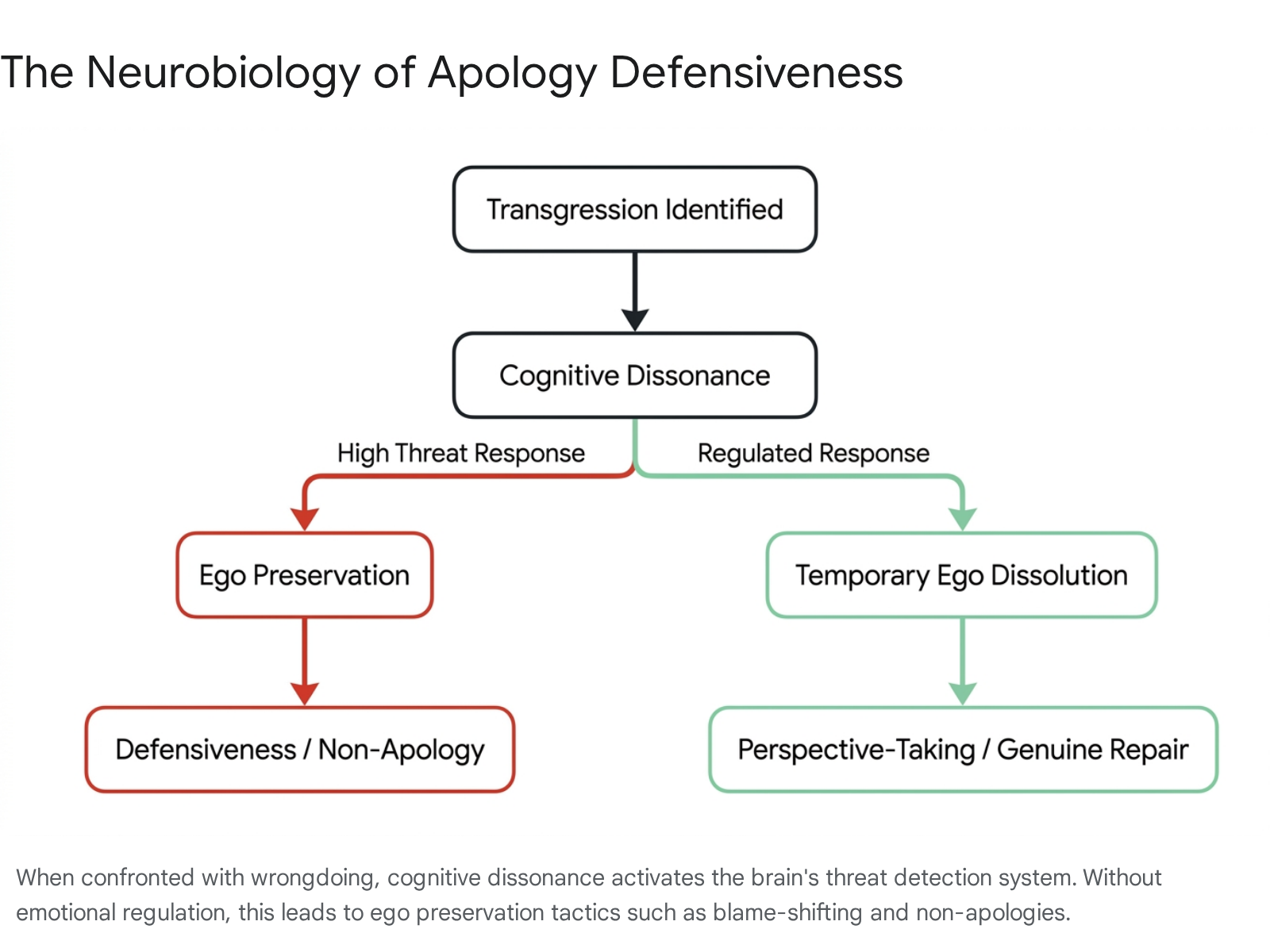
To empathize with the victim and genuinely acknowledge harm, the transgressor must momentarily set aside their self-protective narrative and psychological defenses 912. This perspective-taking requires the activation of highly evolved brain regions associated with empathy and complex social cognition, such as the medial prefrontal cortex and the anterior insula 912. Individuals who lack internal emotional regulation and shame resilience often fracture under this cognitive pressure. They default to defensiveness, blame-shifting, or gaslighting to protect a fragile ego that perceives admission of fault as psychological annihilation 1014.
Cognitive Dissonance and the Mechanisms of Defensiveness
The phrase "I'm sorry you feel that way" is widely recognized by psychologists and dispute resolution professionals as one of the most destructive non-apologies in existence 91516. Psychologically, this response acts as a sophisticated deflection mechanism born from cognitive dissonance. Cognitive dissonance, a foundational psychological concept, occurs when an individual holds two conflicting truths simultaneously - for example, the belief that "I am a good, rational, and kind person" colliding with the reality that "I have caused someone severe, unjustified harm" 91711.
To alleviate this severe psychological strain, the brain frequently compromises the objective reality of the event. The individual deploying the deflector phrase shifts the locus of the problem entirely onto the victim's reaction rather than their own transgressive behavior 914. This achieves a state of "pseudo self-forgiveness," a defensive psychological process characterized by the minimization of harm, the outright denial of wrongdoing, or the derogation of the victim 112. The underlying, insidious message is that the victim's sensitivity, rather than the transgressor's action, is the primary issue. This not only invalidates the victim's emotional reality but actively compounds the relational trauma, leaving the victim to defend their right to be hurt instead of receiving acknowledgment for legitimate pain 911.
Autonomic Regulation, Polyvagal Theory, and Machiavellian Shields
Drawing on contemporary clinical psychology and Polyvagal Theory, an individual's capacity for accountability is deeply tethered to their autonomic nervous system state. When an individual is grounded in a "ventral vagal" state of regulation, their facial expressions are mobile, their vocal prosody is calm, and their perceptual field is open, allowing them to accurately take in information about another person's pain without internal collapse 10. Conversely, when flooded into sympathetic activation (fight-or-flight) or collapsed into dorsal vagal states (freeze/shutdown), the capacity for empathy functionally goes offline. True accountability - defined not merely as an admission of guilt, but as the capacity to recognize one's impact without collapse or counterattack - requires high levels of internal emotional regulation and a stable sense of self 10.
Beyond autonomic dysregulation, recent explorations into dark triad personality traits reveal that non-apologies are frequently utilized as Machiavellian shields. High-Machiavellian individuals, characterized by emotional detachment and ruthless self-interest, leverage the language of empathy to manipulate perceptions 13. For example, a Machiavellian manager might state, "I never intended to make you uncomfortable; let's talk about how I can make things right," which superficially mimics an offer of repair but structurally avoids acknowledging any actual transgressive behavior 13. This calculated maneuver leverages cognitive dissonance in the victim, fostering confusion (gaslighting) while preserving the transgressor's power and plausible deniability within organizational hierarchies 1113.
Accountability, Power Dynamics, and Status
To fully conceptualize why apologies succeed or fail on a systemic level, the psychological mechanisms of the individual must be contextualized within broader social hierarchies. Accountability is not merely an individual trait; it is a relational dynamic heavily influenced by organizational structures, resource control, and systemic dominance 21.
The Evolution of the Schlenker Triangle Model
The concept of accountability is most comprehensively understood through the "Triangle Model of Responsibility" initially proposed by Schlenker et al., which has recently been broadened and critiqued to account for complex, modern power dynamics 1415161718. The Schlenker model posits that responsibility acts as a psychological adhesive connecting an actor to an event and to a set of guiding prescriptions (rules, laws, or norms).
According to the theory, responsibility attribution is calculated by the combined strength of three specific links: 1. Prescription-Event Link: Are there clear, well-defined rules applicable to this specific event? 2. Prescription-Identity Link: Is the actor perceived to be bound by these prescriptions by virtue of their role, status, or identity? 3. Identity-Event Link: Is the actor directly connected to the event, specifically by appearing to have personal control or agency over the outcome? 141516.
In modern multi-party systems, cross-sector partnerships, and hierarchical organizations, these links are actively manipulated as power dynamics unfold 192021. Those in positions of significant structural power frequently leverage strategic communication to obscure the "Identity-Event" link, distancing themselves from personal control over negative outcomes and shifting accountability downward or outward 2122. Furthermore, public accountability research underscores the concept of "felt accountability" - an employee's subjective expectation that they must justify their actions to a legitimate authority with the expertise to evaluate them. When institutional power structures are opaque or highly coercive, felt accountability diminishes, leading to conformity, sub-par decision making, and ethical failures 1823.
The Asymmetric Effects of Power Versus Status
Recent organizational behavior studies exploring power (defined as the discretion and means to enforce one's will and control resources) versus status (defined as the extent to which one is respected and admired by others) reveal highly asymmetric effects on apology behavior and interpersonal conflict 1724.
Holding power without corresponding status frequently heightens an individual's psychological motivation to attain status, leading to highly competitive, defensive, and conflict-inducing behaviors 24. When powerholders lack respect from their peers or subordinates, they are significantly more likely to behave in a self-interested manner and far less likely to engage in the vulnerable act of apologizing, as they perceive any admission of fault as a fatal threat to their already tenuous legitimacy 1724. Without strict external accountability mechanisms, high-power/low-status individuals routinely default to toxic defensiveness.
Conversely, individuals possessing high status, even with lower structural power, often utilize apologies as sophisticated tools of influence. Because apologies natively signal warmth, empathy, and competence, high-status individuals can use reparative behavior to maintain their social standing, reinforce their legitimacy, and build deeper coalitions 25. However, examining this through a critical systemic lens reveals that systemic power dynamics heavily dictate who is expected to apologize. Marginalized groups, or individuals with less institutional power (e.g., service workers, junior employees), are culturally conditioned to employ frequent apologies as protective strategies to manage asymmetric power dynamics and pacify superiors, rather than as genuine admissions of moral fault 34.
Corporate PR and the Performative Reform Signal
In high-stakes corporate public relations, the Schlenker model is frequently weaponized by executives. Corporate apologies operate under intense competing pressures: the legal necessity to minimize explicit admissions of liability that could be leveraged in litigation, the public relations necessity to appear empathetic and accountable, and the strategic necessity to protect brand equity and shareholder confidence 3426.
Linguistic analyses of modern CEO apologies following data breaches, safety scandals, or ethical failures reveal consistent patterns of passive voice, euphemism, and pronominal shifting. These statements are meticulously designed to mimic the genre of a genuine apology while actively severing the "Identity-Event" link, reframing accountability as a generalized organizational performance rather than individual culpability 342728.
Interestingly, recent consumer psychology research indicates that in corporate crises, "reform signals" (explicit promises to change future behavior and implement preventive measures) are weighted much more heavily by the public than "culpability signals" (admissions of past fault) 2829. Because of this psychological weighting, corporations embroiled in scandals often issue performative apologies that bypass true moral accountability entirely, relying heavily on strategic promises of reform to restore consumer support 2829. While this strategy can be effective in the short term, the normalization of simulated remorse significantly contributes to public skepticism, widespread "apology fatigue," and the gradual erosion of the moral authority of corporate communications 28.
Public Versus Private Apologies: Efficacy, Metrics, and Distance
When a transgression occurs within a business or institutional context, leadership must determine the appropriate modality for the apology. The decision to issue a broad public statement versus a private, direct apology is dictated by the nature of the transgression and the psychological distance of the affected stakeholders. Situational Crisis Communication Theory (SCCT) and Construal Level Theory (CLT) provide essential frameworks for understanding these dynamics and optimizing recovery strategies.
Research demonstrates that individual-threatening crises (e.g., a specific product failure affecting a single user, a localized billing error) are construed by consumers at a low psychological distance 3031. In these scenarios, a private apology is significantly more effective at increasing brand trust, eliciting customer forgiveness, and fostering long-term reconciliation 3031. A private apology signals personal intimacy and indicates that the offending entity is taking the specific victim's harm seriously, validating their unique experience 2632. Conversely, delivering a highly publicized, performative apology for an individual-level threat can be perceived as exploitative or disingenuous.
In contrast, society-threatening crises, mass service failures, or widespread data breaches are construed at a higher psychological distance, affecting broad cohorts simultaneously 3031. In these contexts, public apologies are preferable and exponentially more effective at mitigating widespread negative word-of-mouth (NWOM) and collective brand hate 303133. A public apology in the wake of a societal threat serves a critical ritualistic function, allowing the institution to publicly reaffirm shared values, demonstrate systemic transparency, and signal to the broader market that reform is underway 283234.
The following table summarizes the key metrics, strategic goals, and consumer perceptions associated with public versus private apologies.
| Metric / Dimension | Public Apology | Private Apology |
|---|---|---|
| Primary Audience Focus | Mass market, general public, shareholders, media outlets. | Direct victims, specifically affected clients, internal personnel. |
| Psychological Distance | High (Distal construal). | Low (Proximal construal). |
| Optimal Crisis Context | Society-threatening crises, systemic institutional failures, mass data breaches 3031. | Individual-threatening crises, isolated service failures, interpersonal disputes 3031. |
| Consumer Perception | Signals systemic transparency, broad accountability, and institutional reform 2832. | Signals relational intimacy, deep sincerity, and high individual valuation 26. |
| Efficacy Metric (Success) | Significant reduction in negative word-of-mouth (NWOM); restoration of macro brand equity 2833. | High rates of direct customer forgiveness; drastically reduced switchover intentions 3233. |
| Risk of Failure | Highly susceptible to being perceived as performative, legally mandated, or PR-driven 2835. | May fail to address broader public unease if the isolated crisis leaks to social media, appearing evasive 32. |
Cross-Cultural Dimensions: The Guilt Versus Shame Dichotomy
The psychological mechanics and optimal structures of apologies are not universally applicable; they are deeply modulated by regional cultural frameworks. A prominent area of post-2023 research involves contrasting the apology paradigms of individualistic versus collectivistic cultures, a dichotomy most accurately delineated by analyzing "guilt-centric" versus "shame-centric" psychological models of moral regulation 436374738.
Individualism: Guilt, Directness, and Personal Responsibility
In individualistic societies - predominantly Western cultures such as the United States, Germany, and the Netherlands - the social framework places paramount value on autonomy, transparency, and personal responsibility 374739. In these cultures, the primary self-conscious emotion triggered by committing a moral or social transgression is guilt 383940.
Psychologically, guilt is highly specific to an individual's isolated action rather than their global identity. Guilt typically stimulates approach-related behavioral tendencies, such as direct reparative behavior, explicit admission of blame, and interpersonal engagement to fix the specific error 440. Consequently, effective apologies in individualistic cultures require direct, unambiguous acknowledgment of fault. Apologies that admit fault outright are not viewed as weaknesses; rather, they are perceived as boosting the transgressor's credibility, confidence, and moral integrity 47. Empirical studies demonstrate this divergence clearly; for instance, American participants are statistically more likely to offer direct, "I am sorry, I did this" apologies in hypothetical transgression scenarios compared to their South Asian counterparts, emphasizing Western norms of individual culpability 36.
Collectivism: Shame, Harmony, and Indirect Repair
Conversely, in collectivistic societies - such as Japan, South Korea, Indonesia, and India - the social fabric relies heavily on interdependence, strict hierarchical structures, and the preservation of group harmony 364739. In these cultural contexts, the dominant self-conscious emotion experienced in response to a transgression is shame 4383940.
While Western psychological frameworks often pathologize shame - linking it strictly to negative avoidance, withdrawal, and the desire to hide - collectivistic frameworks frequently interpret shame as a highly socially constructive emotion. In these contexts, shame is a vital regulatory mechanism that facilitates group cohesion, signals awareness of social norms, and ultimately restores harmony 39.
Because identity is intrinsically tied to the group, offering a direct, blunt admission of personal fault in a collectivistic culture may cause excessive "loss of face," severely damaging not only the individual's social standing but the dignity of their entire family or organization 47. Therefore, apologies in these regions are often framed indirectly. They focus heavily on shared responsibility, expressions of mutual regret, and outcome-focused restoration rather than aggressively pinning down individual blame 47. Studies examining Korean speakers, for example, reveal a high reliance on formulaic apologies and shared contextual self-blame that respects social hierarchies, standing in stark contrast to the isolated, factual admissions preferred in Western cultures 441.
The Bilingual Emotional Shift and L2 Distancing
The nuances of cross-cultural apologies are further complicated by language. Emerging neuro-linguistic research demonstrates that the language utilized during an apology fundamentally alters the emotional intensity experienced by the transgressor. Studies utilizing Discourse Completion Tasks for bilingual speakers demonstrate an "emotional distancing" effect. When an individual utilizes a second language (L2) to apologize, they experience significantly reduced feelings of both guilt and shame compared to using their native language (L1) 4.
Furthermore, when apologizing to an individual of higher social status, the physiological and emotional intensity of shame is exponentially magnified when speaking in L1, indicating that native social norms and hierarchical conditioning evoke much deeper neuro-affective connections 441. This suggests that global business communication conducted in a non-native lingua franca may inherently reduce the emotional weight and perceived sincerity of the apology for the speaker, necessitating extra care in cross-cultural corporate diplomacy.
AI-Mediated Communication (AIMC) and the Authenticity Crisis
As global society progresses deeper into the late 2020s, the ubiquitous integration of Artificial Intelligence (e.g., Large Language Models, generative chatbots) into daily communication has catalyzed an entirely new paradigm: AI-Mediated Communication (AIMC). Generative AI is now routinely deployed to draft professional emails, handle front-line customer service complaints, and remarkably, generate interpersonal and romantic apologies 424344. However, rigorous 2024 - 2026 research has uncovered profound reputational risks associated with outsourcing human emotional labor to machines.
Signal Diagnosticity and the "Warmth Penalty"
In the realm of interpersonal communication, thoughtful messages serve as evolutionary "signals" used by recipients to judge a sender's underlying moral character and social intent 255. Expressions of gratitude and apologies are the primary signals of warmth and pro-social intent. However, robust empirical studies from 2025 demonstrate that when a warmth-signaling message carries an "AI-assisted" label, or is suspected to be AI-generated, it fundamentally alters the recipient's psychological perception of the sender 255.
The presence of AI dampens the "signal diagnosticity" of the communication. Because the recipient knows an algorithm generated the empathy, the message is viewed as a vastly less reliable indicator of the sender's true internal emotional state or moral character 25545. Consequently, senders of AI-assisted apologies receive significantly lower warmth, sincerity, and authenticity ratings than those who compose apologies independently, even when the text of the messages is identical 25545.
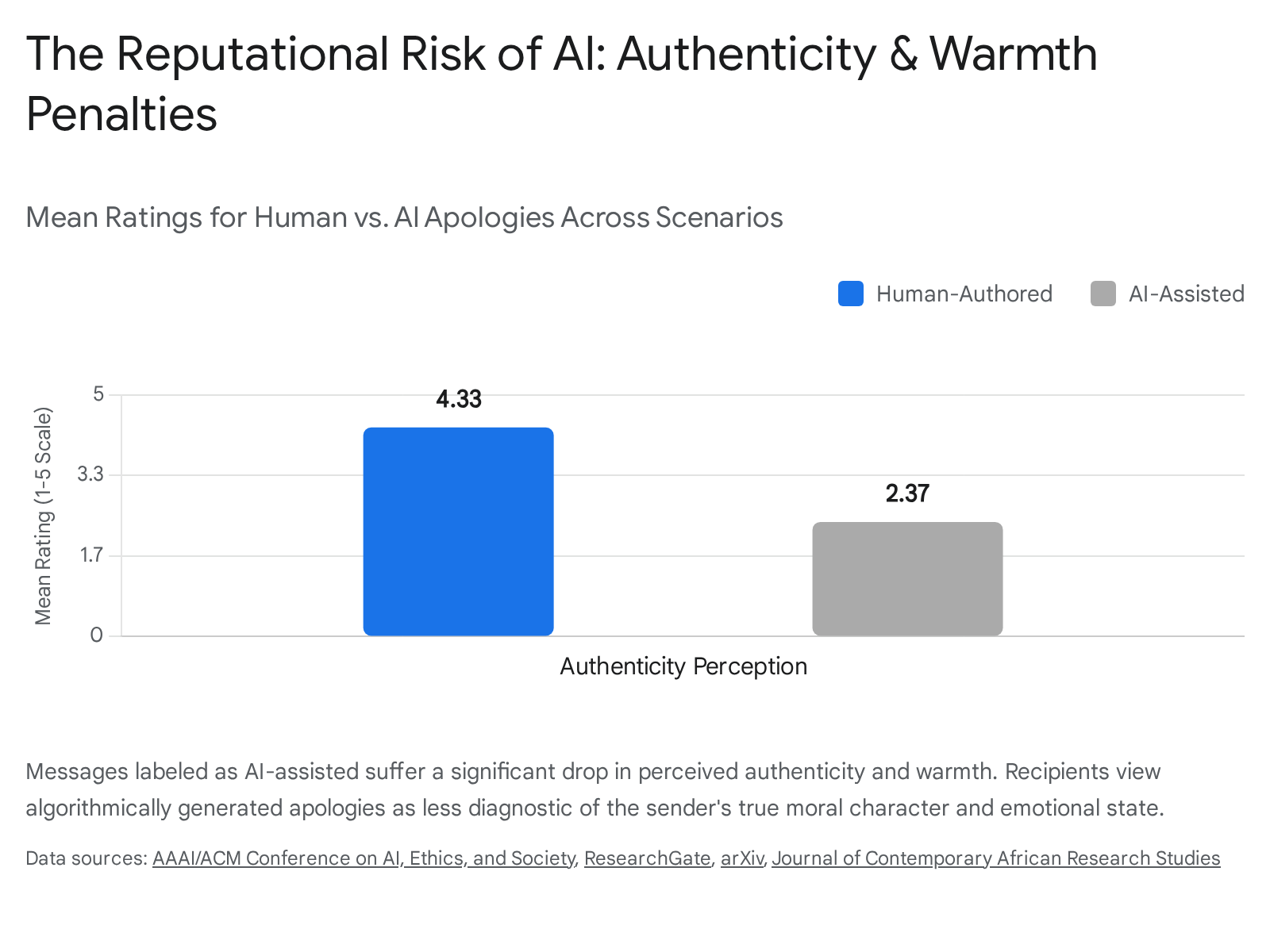
The technology functionally acts as a "moral crumple zone," obscuring human intention, dampening the perception of true accountability, and rapidly deteriorating relational trust 25546.
Contextual Rejection: Intimate Spheres vs. Corporate Recovery
The psychological rejection of AI-mediated apologies is acutely pronounced in intimate or romantic contexts, where emotional congruence is the primary currency. A landmark 2026 quantitative study examining "digital surrogacy" in romantic relationships among university students revealed an overwhelming rejection of AI-generated apologies, particularly among female cohorts who placed a higher premium on emotional congruence 4247. Respondents overwhelmingly favored human apologies (77.6%), citing a fundamental "lack of human heart" and a severe deficit in emotional authenticity as the primary barriers to acceptance 4247. The deployment of AI in these highly vulnerable contexts did not mend ruptures; it actively eroded existing relational trust.
In the corporate and customer service sectors, the integration of AI is similarly fraught but offers nuanced pathways for optimization. Chatbots deployed autonomously for symbolic recovery (issuing apologies for routine service failures) consistently underperform compared to human employees. Customers operate on the deep-seated lay belief that chatbots fundamentally lack emotional competence, which acts as a sequential mediator leading to substantially lower customer satisfaction and perceived sincerity 48.
To combat this authenticity valley, crisis communication researchers and dispute resolution centers, such as the Harvard Program on Negotiation, advocate for "human-AI collaboration" rather than full automation. In this model, public relations professionals utilize AI strictly for structuring initial responses and analyzing large datasets of grievance patterns, but actively and manually inject ethos (credibility) and pathos (empathy) into the final message 434950. Harvard research suggests AI is best positioned as a "backstage negotiation coach" or "bargaining bot" - helping parties prepare for difficult conversations, evaluate potential offers, and correct cognitive biases - rather than acting as the front-line agent delivering the emotional payload 4449. Furthermore, research highlights that selectively limiting the use of AI tools in sensitive communications signals a degree of technological restraint. This restraint paradoxically enhances the perceived human presence and emotional authenticity of the message, demonstrating that the transgressor cared enough to manually intervene in the repair process 5152.
Debunking Misconceptions: Legal Liability and Guaranteed Forgiveness
Within professional, medical, and personal spheres, two pervasive misconceptions consistently hinder the delivery of effective apologies: the institutional fear that apologizing constitutes an admission of legal liability, and the interpersonal assumption that a structurally sound apology automatically guarantees forgiveness.
The Illusion of Legal Peril
In corporate, medical, and civil contexts, general counsel and risk management teams have traditionally advised strictly against apologizing. This guidance operates under the entrenched assumption that any expression of remorse or acknowledgment of fault will be weaponized by opposing counsel as an explicit admission of liability, thereby guaranteeing punitive damages 6553. However, comprehensive, large-scale empirical research overwhelmingly debunks this fear.
In civil law systems, an exhaustive 2023 analysis of nearly 4,000 judicial judgments revealed that apologies almost never lead to negative legal consequences for the defendant 6554. On the contrary, offering an apology frequently yielded tangible legal benefits. Courts frequently view apologies as evidence of mitigating behavior, moral responsibility, and a commitment to non-recurrence, entirely independent of conceding formal legal fault 65.
In the United States, the implementation of state-level "Apology Laws" - legislation specifically designed to protect medical professionals' expressions of sympathy from being admissible as evidence of malpractice - has yielded highly complex results that further demystify the power of the apology 5556. While early legal theories suggested these protective laws would universally decrease litigation by humanizing doctors, sophisticated machine learning models analyzing medical grievances indicate that apologies alone are incredibly weak predictors of a patient's intent to sue 55. The data conclusively demonstrates that the severity of physical and emotional damage accounts for up to 48% of the variance in intention-to-sue models, whereas the presence or absence of an apology holds zero statistical significance 55.
Ultimately, apologies do not invite lawsuits; catastrophic, unaddressed harm invites lawsuits. While "safe" apologies - carefully vetted expressions of sympathy that explicitly refuse to admit fault (e.g., "I am sorry this happened to you") - are heavily utilized to navigate perceived liability, legal and psychological critics argue these sanitized statements are devoid of moral content 53. Because they fail the most critical element of Lewicki's framework (acknowledgment of responsibility), they often insult the victim's intelligence, escalating anger and exacerbating the conflict they were designed to soothe 5357.
The Fallacy of Guaranteed Forgiveness
A secondary, deeply ingrained misconception is the transactional view of apologies: the belief that if a transgressor humbles themselves and delivers an effective, structurally sound apology, the recipient is socially or morally obligated to grant forgiveness. Apologizers often display intense defensiveness or secondary anger if their remorse is rejected, operating under an entitlement framework that dictates, "I said I was sorry, you should be over it by now" 14.
Extensive research in conflict management and dispute resolution clarifies that an apology is merely a catalyst for repair, not an instantaneous cure 5758. Forgiveness is an entirely independent, internal, and highly complex cognitive process belonging solely to the victim. Victims frequently accept apologies conditionally, or they may covertly reject imperfect apologies due to social pressure to appear accommodating, all while harboring unresolved resentment 57.
In instances of severe betrayal, such as deep parental injury or chronic infidelity, true forgiveness requires complex cognitive reframing, trauma processing, and a broader resolution of ongoing safety issues, which no single apology can magically resolve 58. Furthermore, an individual's psychological worldview heavily dictates their capacity to forgive. Research analyzing public reactions to #MeToo apologies demonstrated that individuals with fixed (entity) mindsets regarding personality - those who believe human traits are immutable - are significantly less likely to accept an apology or believe in rehabilitation than those with incremental mindsets, who believe human behavior can evolve and improve through effort 35. Thus, while an apology is an absolute prerequisite for relationship repair, it inherently lacks the coercive power to compel absolution. The transgressor must tolerate the victim's timeline for healing.
Conclusion
The psychology of apologies operates at a highly volatile intersection of neurobiology, systemic power dynamics, and cultural identity. To apologize effectively requires overriding the human brain's innate, evolutionary threat-detection systems, achieving a state of temporary ego dissolution, and communicating profound accountability in a manner congruent with the recipient's specific cultural and psychological framework.
As global society increasingly relies on AI-mediated communication, the premium placed on genuine, human emotional labor will only rise. While sophisticated algorithms can perfectly mimic the structural components of Lewicki's effective apology framework, they fundamentally cannot replicate the inherent vulnerability, the signal diagnosticity, and the authentic human warmth required to mend deeply fractured trust. Furthermore, by discarding unfounded, outdated fears regarding legal liability, organizations and individuals alike can finally utilize genuine, unhedged apologies not as defensive maneuvers, but as powerful, transformative instruments for restorative justice, systemic institutional reform, and enduring relational repair.