
Why We Almost Always Choose the Middle Option
At its psychological core, the compromise effect is a cognitive heuristic driven by extremeness aversion and the innate human desire to minimize post-decision regret. When presented with a set of ordered alternatives, consumers inherently perceive the options at the outer margins of the choice set as carrying disproportionately higher risk. The cheapest option triggers profound anxieties regarding inferior quality, inadequate features, or social embarrassment. Conversely, the most expensive option activates loss aversion, financial insecurity, and fears of unnecessary extravagance. Consequently, the middle option emerges as a psychological safe haven - a rationally and emotionally defensible choice that dramatically minimizes cognitive load and resolves internal conflict without requiring a deep, attribute-by-attribute analytical evaluation.
This behavioral phenomenon is highly visible in everyday commerce, serving as the architectural foundation of the ubiquitous "Goldilocks" pricing strategy. Consider the classic coffee shop menu: when a consumer is confronted with a small coffee for $6.00, a medium for $8.50, and a large for $9.00, the vast majority gravitate toward the medium. Similarly, Software-as-a-Service (SaaS) platforms routinely deploy three-tier pricing architectures - such as a restricted "Starter" tier, an optimized "Professional" tier, and an exorbitant "Enterprise" tier - specifically engineered to make the middle option the path of least resistance. By framing research around frequently asked questions regarding this anomaly, this comprehensive report exhaustively details the mechanical underpinnings, recent digital evolutions in e-commerce, cultural boundary conditions, and actionable consumer defenses surrounding the compromise effect.
What is the Psychological Core of the Compromise Effect?
The foundational understanding of the compromise effect was formally articulated by Itamar Simonson in his seminal 1989 study, fundamentally challenging classical rational choice theory and the established axioms of consumer economics. Standard economic models of utility historically proposed that consumer preferences are fixed, inherently stable, and entirely independent of the surrounding choice set context. Under the classic axiom of regularity - often associated with Luce's choice axiom - introducing a new alternative to a market cannot logically increase the probability of choosing an existing alternative. The compromise effect, however, empirically violates this axiom. Simonson demonstrated that a product's choice share systematically increases when it is positioned as an intermediate option in a newly expanded set, and drastically decreases when it is perceived as an extreme option 123.
This violation occurs because consumer preferences are rarely stable or pre-computed; rather, they are highly malleable constructs formulated "on the fly" during the decision-making process 3. The psychological core of this constructed preference relies on extremeness aversion, anticipated regret, and choice simplification. Humans naturally display a bias toward the mean, finding extreme options difficult to justify. To select the highest tier, a consumer must decisively prioritize quality over price; to choose the lowest, they must strictly prioritize price over quality. The middle option relieves the consumer of this burden, allowing them to avoid sacrificing either priority 564.
Furthermore, decisions are heavily influenced by the social and internal need for justification. The compromise alternative is the easiest to defend to oneself, to a spouse, or to a corporate finance department, as it demonstrably balances competing attributes 85. This heuristic is so deeply embedded in human psychology that it extends far beyond simple consumer goods. For instance, in complex financial planning scenarios in the Netherlands, retirees choosing decumulation strategies for their pension assets consistently default to middle-path expenditure patterns rather than optimizing strictly for liquidity or illiquidity 5. Even in high-stakes, hypothetical geopolitical scenarios regarding nuclear weapon deployment, respondents heavily favor intermediate actions over extreme restraint or extreme escalation, leveraging the compromise effect to partially satisfy multiple conflicting moral and strategic factors 6. Ultimately, the compromise effect acts as a vital mental shortcut in an era of severe decision fatigue, substituting the difficult mathematical calculation of absolute utility with a much simpler visual and relational assessment 11.
How Does the Compromise Effect Differ From the Decoy Effect?
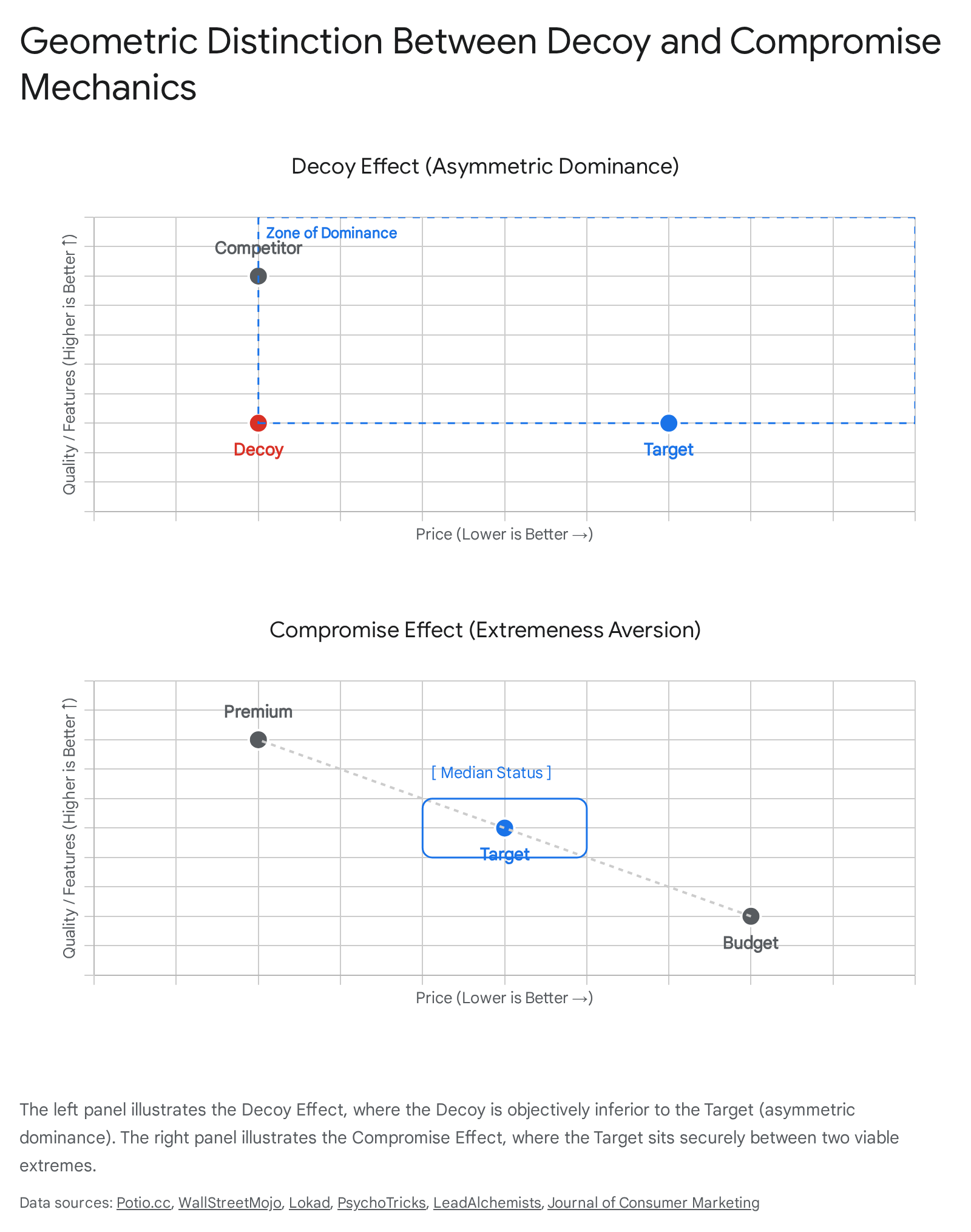
While both the compromise effect and the decoy effect are context-dependent cognitive biases that leverage three-option architectures to manipulate consumer choice, their structural mechanics, geometric layouts, and psychological triggers are distinctly different. Confusing the two is a common error in pricing strategy execution 1213.
The decoy effect, formally known in behavioral economics as asymmetric dominance, involves introducing a third option that is entirely inferior to the target option but superior in some specific dimensions to the competitor option 1113. The sole purpose of the decoy is to be rejected. By acting as a conspicuously poor baseline, it creates a stark contrast that highlights the value of the target product 811. For example, if a digital newspaper subscription costs $59 and a print-and-digital subscription costs $125, introducing a "print-only" subscription for $125 acts as an asymmetrically dominated decoy. No rational actor buys the print-only option because the bundle offers more for the exact same price, but the decoy's presence vastly increases the perceived value of the $125 print-and-digital bundle 4. The cognitive driver here is relative value processing combined with a stark contrast effect 811.
Conversely, the compromise effect does not rely on asymmetric dominance or an objectively inferior decoy. Instead, it relies on expanding the choice continuum with viable alternatives 313. The third option added in a compromise strategy is not a "bad" deal designed for rejection; it is simply an extreme one. This is usually a high-functioning, ultra-premium product at a high price, or a highly restrictive, utilitarian budget product. The consumer considers all three options as potentially viable depending on their exact budget and needs, but gravitates to the center due to extremeness aversion rather than strict dominance 36.
Recent research highlights how these specific architectures are utilized differently in dynamic environments. For instance, in retail environments facing stockouts, the absence of a product creates a "phantom option." Consumers evaluate the remaining available substitutes based on the spatial positions of these out-of-stock phantom products, which can inadvertently trigger a compromise effect if the remaining items suddenly shift into a median relational position 7. Furthermore, eye-tracking studies confirm that the visual layout of these attributes dictates the effect; when an option has one extremely high attribute and one extremely low attribute, the visual processing alters, and consumers may actively prefer the extreme alternative if it aligns with a singular strong preference 15.
How Does the Compromise Effect Manifest in Everyday Pricing Structures?
The compromise effect is the architectural lifeblood of the ubiquitous "Good-Better-Best" pricing model 161718. When executing a tiered strategy, businesses intentionally construct product offerings across varying levels of quality and price. When only two options exist, sales data typically splits relatively evenly or leans toward the budget option. However, when a third, premium option is strategically introduced to complete the triad, a profound psychological shift occurs. Retail analytics consistently demonstrate that the purchase distribution subsequently shifts to approximately 11% for the high end, 66% for the middle, and 23% for the low end 16.
This architecture is heavily reliant on price anchoring. The highest-priced option - even if it is rarely purchased - serves a vital, highly lucrative purpose: it establishes a cognitive anchor regarding the category's maximum justifiable cost 51819. To demonstrate the universality of this framing, the table below illustrates the precise structural deployment of the compromise effect across diverse consumer sectors.
| Industry Context | Tier 1: The Budget Anchor (Avoided due to scarcity) | Tier 2: The Compromise Target (The perceived safe harbor) | Tier 3: The Premium Anchor (Avoided due to extravagance) |
|---|---|---|---|
| B2B SaaS Platform | Personal: $29/month. Limited to basic features. Creates fear of outgrowing the software quickly. 12 | Professional: $119/month. Highlighted as "Recommended." Balances robust capability without enterprise-level expenditure. 12 | Production: $349/month. Acts as the high-price anchor. Makes the $119 tier seem like a logical, safe discount. 12 |
| Cinema Concessions | Small Popcorn: $6.00. Perceived as inadequate volume for the baseline price. 20 | Medium Popcorn: $8.50. Fits the center of the budget. Allows the consumer to feel they are maximizing value without gluttony. 20 | Large Popcorn: $9.00. The extremeness anchor. Placed marginally above the middle tier to make the medium look like a vast saving. 20 |
| Streaming Services | Basic Plan: Low resolution, single screen, highly restrictive. Imposes a penalty on the viewing experience. 21 | Standard Plan: HD resolution, multi-screen. Delivered as the default standard of living for the average household. 21 | Premium Plan: 4K resolution, maximum screens. Deemed unnecessarily luxurious for standard usage. 21 |
| Global FMCG Brands | Single Sachet: $0.05. Designed purely for penetration and trial among low-income segments. 22 | Standard Pouch/Jar: $2.50. The core volume driver offering balanced utility for daily consumption. 22 | Premium Glass Jar: $8.00. Sourced from premium beans, signaling exclusivity and anchoring the brand's quality perception. 22 |
The overarching objective of these designs is not necessarily to sell the high or low ends. The budget tier exists as a defensive mechanism to prevent absolute churn among highly price-sensitive users. The premium tier exists offensively, entirely as a psychological anchor. The ultimate goal is to seamlessly funnel the maximum volume of users into the standard tier, which typically carries the absolute highest profit margin relative to the cost of fulfillment 5212324.
Interestingly, there are specific hardware sectors where the compromise option is structurally disadvantageous to the consumer despite its psychological appeal. In the smartphone manufacturing market, the "middle tier" ($400-$700) is considered a value trap. Because fixed silicon costs (such as a premium processor) consume a disproportionate percentage of the bill of materials (BOM) in a mid-range phone compared to a flagship device, the manufacturer margins are squeezed 23. To compensate, manufacturers heavily compromise on secondary hardware components like cameras or build quality. Consequently, the consumer receives the worst component-quality-to-price ratio in the middle tier, despite feeling that they have made a safe, balanced choice 23.
How is the Compromise Effect Adapting to Digital and E-Commerce Markets (2023 - 2026)?
The rapid transition from static, physical retail environments to dynamic, algorithm-driven digital ecosystems has fundamentally altered the parameters and vulnerabilities of the compromise effect. In modern e-commerce, the application of artificial intelligence, high-frequency algorithmic pricing, and longitudinal engagement tracking has revealed entirely new dimensions of this behavioral heuristic.
Algorithmic Pricing and Drip-Pricing Strategies
Artificial Intelligence now automates scalable price determination across sectors ranging from global hospitality to online grocery retail. A defining characteristic of algorithmic pricing is heightened price variability, with adjustments occurring rapidly in response to micro-fluctuations in localized demand 3. Recent field studies indicate that this algorithmic variability drastically exacerbates consumer price sensitivity 3. When prices fluctuate constantly, consumers lose their internal reference points. To counter this disorientation, platforms increasingly rely on dynamic compromise framing. Algorithms construct three-tier pricing arrays in real-time so that regardless of the baseline price shift, a psychologically comforting middle option is always available to absorb the consumer's anxiety 325. Furthermore, online platforms frequently employ sequential drip-pricing - where base prices are shown initially and hidden fees are introduced at checkout. Platforms utilize the compromise effect within these sequential flows by presenting a heavily promoted "Standard" recommendation early in the search process, reducing the cognitive burden of continuing the search and making the consumer more likely to accept later fees 32627.
Omnichannel Behavior and Brand Tier Moderation
The rise of omnichannel retail allows consumers to interact with brands across multiple physical and digital touchpoints. Recent empirical models demonstrate that the compromise effect significantly moderates the relationship between multichannel behavior and brand revenue, highly dependent on the tier of the brand 18. For high-tier luxury brands, extensive multichannel availability can paradoxically reduce exclusivity and revenues, as luxury buyers shun the "compromise" of broad digital accessibility. However, for middle-tier volume brands, the relationship is intensely positive. Multichannel usage alters the choice context, consistently exposing the consumer to various premium and budget alternatives across different digital platforms, ultimately reinforcing the safety and value proposition of the middle-tier brand 18.
Post-Choice Consumption: The Longitudinal Vulnerability
Perhaps the most significant recent development in the behavioral economics literature regarding the compromise effect comes from Polman and Maglio (2024). Historically, the efficacy of the compromise effect was measured strictly at the point of initial choice: did the consumer purchase the middle option? Polman and Maglio shifted the analytical focus to post-choice active consumption 930.
Through randomized longitudinal experiments, they discovered a stark, counterintuitive divergence between choosing and consuming. While the compromise nudge successfully forced participants to choose the target middle option at the point of sale, those participants actually consumed the option significantly less over time compared to participants who naturally chose an identical, non-nudged option 930.
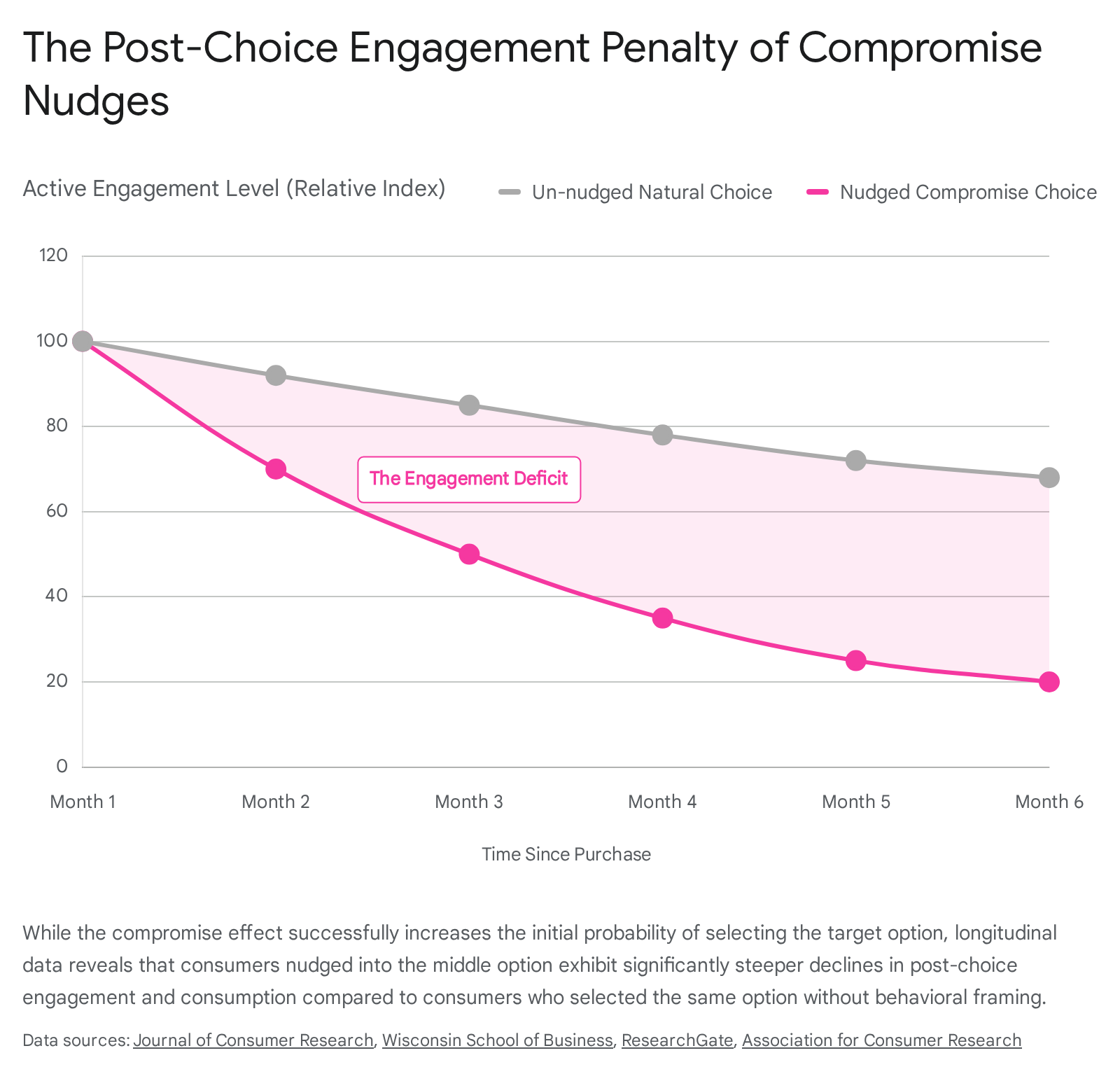
This finding isolates a massive vulnerability for subscription-based e-commerce, hyper-personalized digital environments, and SaaS models. If a pricing page architecture effectively nudges a user into a $119/month mid-tier plan via the compromise effect, but that user's true intrinsic utility aligns closer to the $29/month tier, their post-choice engagement will remain artificially low 3031. In a recurring revenue model, low product engagement mathematically predicts high churn. Therefore, while the compromise effect is highly effective for one-off retail transactions, over-leveraging it in subscription models artificially inflates short-term acquisition metrics while covertly devastating long-term retention and customer lifetime value.
Is the Compromise Effect Universal Across Global Markets?
Historically, the empirical validation of the compromise effect - like much of foundational behavioral economics - has relied heavily on WEIRD (Western, Educated, Industrialized, Rich, Democratic) sample populations. However, extending this research to global and emerging markets reveals that context effects are highly sensitive to cultural cognitive styles, socioeconomic stratification, and local macroeconomic realities.
Cognitive Styles: Holistic vs. Analytic Thinking
Cross-cultural consumer psychology indicates that the compromise effect operates differently across distinct cognitive frameworks. Western cultures typically emphasize an analytic thinking style, wherein consumers detach objects from their environment and evaluate them based on discrete rules, linear logic, and absolute categories. This analytical approach makes them highly susceptible to structured, isolated choice sets where a middle option clearly mathematically balances two competing attributes 310.
Conversely, many Eastern cultures and populations in emerging markets predominantly utilize a holistic thinking style. Holistic thinkers focus on the overarching relationships between objects, the broader context, and continuous environmental fields 10. Recent empirical studies suggest that the attraction and compromise effects are noticeably mitigated in Eastern cultures and emerging markets with holistic leanings 10. Because holistic consumers evaluate products as part of a wider ecosystem of needs, historical relationships, and social contexts rather than just a standalone three-tier matrix, the artificial boundaries of a westernized "Good-Better-Best" pricing display exert significantly less influence over their final choice. Interestingly, when multicultural consumers are forced to engage in a thinking style that mismatches their dominant cultural background (e.g., forcing a holistic thinker to process analytically), the resulting psychological discomfort heavily impacts their susceptibility to these biases 10.
Economic Uncertainty, Class, and Systemic Trust
In emerging markets spanning Latin America, Africa, and Southeast Asia, macroeconomic factors subtly rewrite the rules of extremeness aversion. High global uncertainty negatively impacts financial stability in countries like Brazil, Nigeria, and Mexico, fundamentally altering consumer risk profiles and pushing them toward highly defensive consumption patterns 1134. Furthermore, empirical studies consistently demonstrate a negative correlation between severe income inequality and institutional trust - a key component of social capital - in these markets 12.
When systemic trust is low, consumers view corporate vendor framing with profound skepticism. The introduction of an ultra-premium option (the psychological anchor) might not simply make the middle option look reasonable; in low-trust, highly stratified environments, it often signals vendor greed or triggers suspicions of price manipulation. This leads consumers to reject the entire choice set or default rigidly to the lowest-priced utilitarian option, stripping the compromise effect of its power 151213.
Additionally, research into social exclusion reveals that class dynamics alter context effects. Consumers who feel actively rejected by society increase their propensity to think holistically, which strengthens their preference for asymmetrically dominant options (the decoy effect). Conversely, consumers who feel implicitly ignored by the market increase their propensity to think analytically, which strengthens their preference for compromise options 14. Therefore, while the compromise effect is observable internationally, its magnitude is highly variable and deeply intertwined with the cultural inclination toward analytic thinking, class exclusion, and local economic trust indices.
When Does the Compromise Effect Fail?
The compromise effect is not an infallible law of commerce. Extensive contemporary research indicates that its efficacy degrades rapidly under specific cognitive boundary conditions, precise alterations in choice architecture, and shifts in consumer intent.
The (Un)compromise Effect
A major boundary condition involves the explicit availability of the middle option. In an extensive, large-scale field experiment concerning charitable giving, Ekström (2021/2026) identified what is termed the (un)compromise effect 151640. The standard compromise effect assumes the vendor must explicitly provide the discrete middle option to capture the consumer. However, Ekström demonstrated that when individuals are presented only with two highly polarized extremes (e.g., a $10 suggested donation and a $500 suggested donation), they do not simply pick one or the other. Instead, consumers actively utilize "write-in" categories to construct their own customized middle-ground donation 1640. This proves that extremeness aversion is a deeply internalized cognitive mechanism; even when the choice architecture lacks a median option, the consumer will expend the cognitive effort to invent one to avoid the extremes.
Product Familiarity and Expert Knowledge
The compromise effect operates primarily as a task-simplification strategy. It is designed to reduce the risk of decision errors when consumers are uncertain about their own preferences or the true value of the product 27. Therefore, the effect weakens significantly, or fails entirely, when consumers possess high domain expertise or deep familiarity with the product category 2317. Segment-based analyses reveal that the compromise effect is strong among general quality-seeking consumers but practically insignificant among highly experienced, price-conscious subjects 217. An IT professional purchasing cloud storage will not default to the mid-tier model simply because it is physically located in the middle of a pricing page; their intimate, analytical knowledge of the product's attributes allows them to evaluate inherent utility directly, rendering the contextual framing irrelevant 24.
The Impact of Lay Rationalism and Price Preciseness
"Lay rationalism" refers to the individual psychological tendency to base decisions on cold logic and reason rather than emotion, heuristics, or intuition. Research indicates that consumers with high lay rationalism are largely immune to the compromise effect, particularly when prices are presented as precise, unrounded figures (e.g., $14.37 rather than $15.00 or $14.99) 18. Precise pricing forces the brain out of heuristic processing and into an active analytical mode, systematically breaking the fluent, emotional appeal of the simple "middle option" 718. Similarly, while moderate time pressure can increase reliance on heuristics, severe time constraints can attenuate the compromise effect, suggesting the mechanism requires at least a baseline level of cognitive deliberation to assess the relational positions of the options before choosing the middle ground 101519.
Multiple Compromise Options
The inclusion of too many median options paralyzes the effect entirely. If a vendor offers five or six pricing tiers, thereby creating three distinct "middle" options, the task difficulty drastically increases. The cognitive boundaries between the choices blur, and the clarity of the attributes is lost. Confronted with a crowded, ambiguous middle, consumers experience severe choice overload. To escape this cognitive burden, they paradoxically retreat to either the absolute basic tier or the absolute premium extreme just to simplify the decision, completely negating the intended compromise 2045.
The Rejection Framework
The linguistic framing of the task also dictates the outcome. The compromise effect thrives in a selection task (e.g., "Which of these software plans do you want to buy?"). However, experimental evidence from the Association for Consumer Research (2024) indicates that when consumers are asked to reject less-preferred options (e.g., "Which of these plans do you want to eliminate from consideration?"), the compromise effect is heavily attenuated or completely reversed. The psychological act of active rejection forces the consumer to focus intensely on specific, non-negotiable attribute requirements, completely mitigating the contextual, gravitational pull of the middle ground 31.
Practical and Actionable Takeaways for Consumers
For consumers navigating a global retail landscape that is deeply saturated with sophisticated, AI-driven choice architectures, recognizing and actively defending against the compromise effect requires deliberate cognitive recalibration. Vendors leverage this behavioral effect to maximize their margins; consumers must actively dismantle the framework to protect their own utility and financial resources 1318.
| Defensive Strategy | Psychological Rationale | Implementation Tactic |
|---|---|---|
| Deconstruct the Choice Set | The ultra-premium option in a three-tier setup is rarely designed for mass sale; it operates as a psychological anchor engineered to artificially inflate the perceived value of the middle tier 519. | Before evaluating a purchase, consumers should completely ignore the highest-priced tier. Cover it visually if necessary. Evaluate the middle and lower options strictly on their standalone merits without the artificial anchor skewing perception. |
| Evaluate Absolute Utility | The compromise effect tricks the brain into relative value processing ("Option B is a better deal than Option C"). Consumers must revert to absolute value processing 811. | Ask: "Does the specific feature set of this middle option justify its objective financial cost, entirely independent of what the premium or budget options cost?" |
| Calculate Unit Costs | Pricing models utilize vague marketing nomenclature ("Professional," "Best Value") to obscure raw value. Reducing prices to their barest metrics bypasses the emotional comfort of the median choice 1315. | Strip away the tier names. Mathematically calculate the exact cost per gigabyte, cost per ounce, or cost per user. Comparing raw ratios prevents heuristic reliance. |
| Define Needs Prior to Exposure | Consumer preferences are heavily constructed at the point of sale, making them highly vulnerable to the specific array placed before them 313. | Strictly define required product features and establish a hard maximum budget before viewing any pricing page. If a basic plan meets the pre-defined criteria, the presence of an enticing mid-tier plan becomes irrelevant. |
The Bottom Line
The compromise effect remains one of the most potent, robust, and reliably exploitable heuristics in the domain of consumer psychology. By weaponizing human extremeness aversion and the innate desire to minimize cognitive load, businesses effectively construct pricing architectures that seamlessly funnel consumers toward high-margin, median options. However, as advanced pricing strategies migrate to dynamic, algorithm-driven digital platforms and expand into emerging, non-Western markets characterized by distinct cognitive styles and fluctuating systemic trust, the absolute reliability of the compromise effect is beginning to fracture. Most critically, the recent revelation that nudged choices result in severe post-choice consumption drop-offs exposes a fatal flaw in relying on this heuristic for subscription-based revenue streams. Ultimately, while the compromise effect can successfully dictate what a consumer chooses in the immediate moment of purchase, it cannot artificially manufacture the underlying utility required to keep them satisfied and engaged over the long term.