
Why Majorana Fermions Matter for Quantum Computing
Majorana fermions are elusive particles that mathematically act as their own antiparticles, a concept first theorized in the 1930s but yet to be observed as fundamental particles in nature. In the realm of quantum computing, however, scientists have successfully engineered "quasiparticles" within specialized materials that mimic these exact properties, known as Majorana zero modes. Because these quasiparticles allow quantum information to be encoded globally across multiple physical points rather than in a single fragile location, they offer a pathway to topological quantum computers that are inherently immune to most environmental noise and errors.
The Fragile Foundation of Quantum Computing
To understand why global technology companies and leading physicists are overwhelmingly obsessed with a hypothetical particle from the early twentieth century, it is necessary to first understand the existential crisis at the heart of modern quantum computing. Quantum computers promise to solve computational problems that would take classical supercomputers thousands, if not millions, of years to process 1. They achieve this monumental leap in processing power by utilizing qubits, or quantum bits. While classical bits process data in binary states of zero or one, qubits can exist in a state of superposition, representing zero, one, or any combination of both simultaneously 23. When qubits are entangled with one another, the computational power of the system scales exponentially 3.
However, this extraordinary computational superpower comes with a fatal engineering flaw: qubits are incredibly fragile. Standard qubits, such as those relying on the superconducting circuits utilized by Google and IBM, operate on delicate quantum states that collapse under the slightest environmental interference 42. A stray photon, a microscopic vibration, a cosmic ray, or a tiny fluctuation in temperature causes a phenomenon known as decoherence 46. When decoherence occurs, the quantum state is wiped out, and the ongoing calculation is irreparably corrupted 47. Unlike classical bits, which snap cleanly between a zero and a one, qubits degrade gradually and unpredictably, making errors a constant and compounding threat 4.
For years, the quantum computing industry has tackled this problem through brute-force engineering, primarily through a concept known as quantum error correction. Because individual physical qubits are so prone to failure, engineers string thousands of noisy, unstable physical qubits together to act as a single, reliable "logical" qubit 489. These physical qubits constantly monitor and correct each other, absorbing the errors so the logical qubit can maintain its coherence 68.
This methodology requires a staggering physical hardware overhead. In conventional superconducting architectures utilizing surface codes, it might take tens of thousands or even hundreds of thousands of physical qubits just to yield one stable logical qubit 3. If a commercially viable quantum application requires thousands of logical qubits, the physical machine would need to house millions of fragile components, pushing the limits of cryogenic cooling and microwave control systems 61112. This scalability nightmare is precisely where Majorana fermions enter the conversation. Instead of building millions of fragile qubits and trying to actively correct their errors after they happen, physicists asked a profound question: what if we could build a qubit out of a material that is naturally, mathematically immune to errors from the very start?
Ettore Majorana and the Hunt for the Ghost Particle
The theoretical foundation for this error-proof quantum computer was laid in 1937 by an Italian theoretical physicist named Ettore Majorana 134. At the time, the standard model of quantum mechanics was largely governed by the Dirac equation, formulated by Paul Dirac, which successfully described the behavior of fermions such as electrons 131516. A fundamental consequence of the Dirac equation is that these fermions always have a distinct antimatter counterpart carrying an opposite electrical charge. For every negatively charged electron, there exists a positively charged positron 13. If a Dirac fermion ever encounters its antiparticle, the two immediately annihilate each other in a burst of energy 13.
Majorana, examining Dirac's mathematics, hypothesized a variation of this framework. He proposed a neutral, spin-1⁄2 particle that could be governed entirely by a real-valued wave equation 417. In quantum mechanics, the wave functions of a particle and its antiparticle are mathematically related by complex conjugation. Because a real-valued equation lacks an imaginary component, complex conjugation leaves the wave function entirely unchanged 4. By removing the complex numbers from the equation, Ettore Majorana had proven the mathematical possibility of a particle that is its exact own antiparticle 13418.
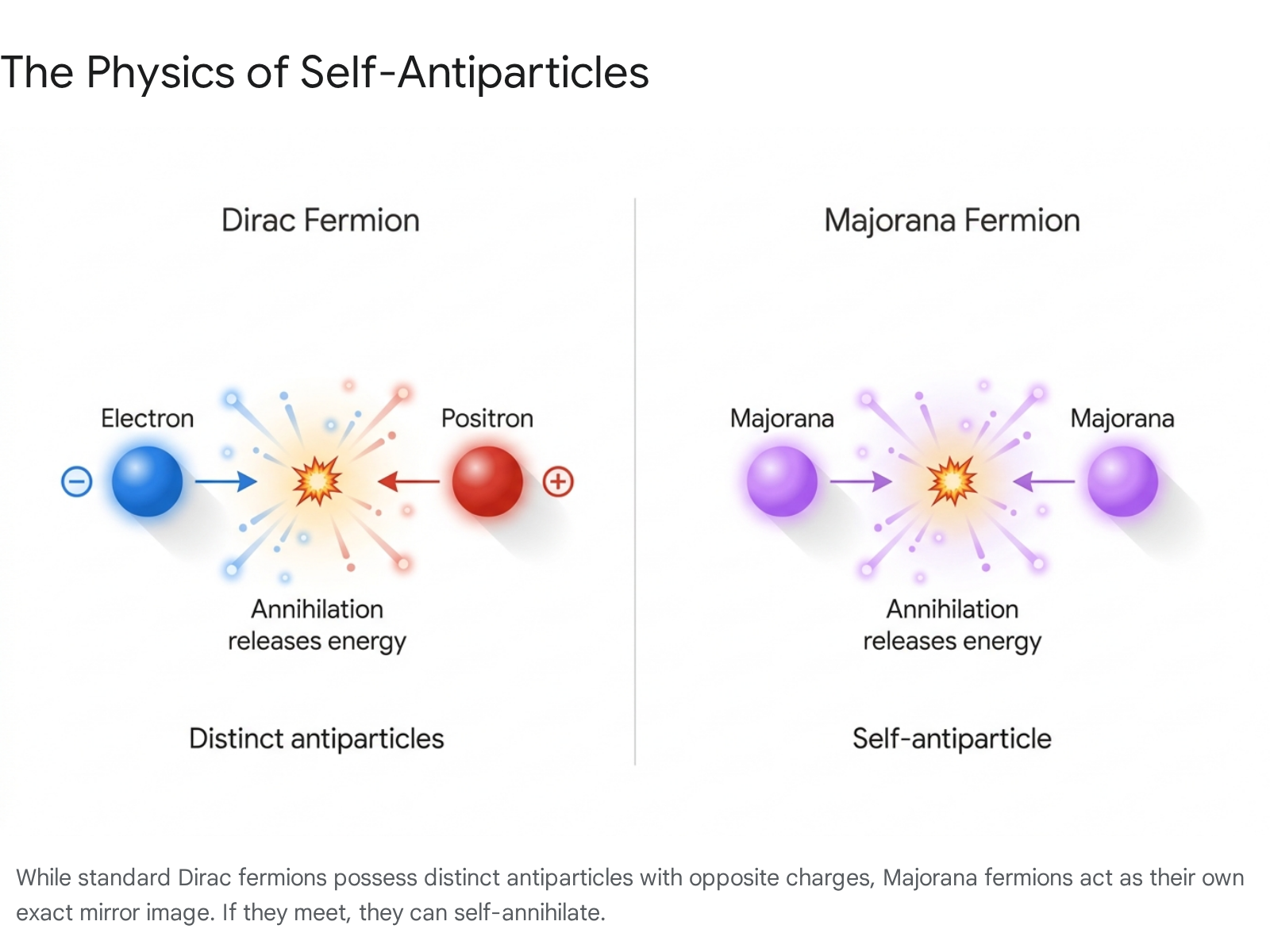
Shortly after publishing this groundbreaking theory, Majorana boarded a ferry from Naples to Palermo in 1938 and vanished mysteriously, leaving behind a legacy that would puzzle physicists for nearly a century 5.
In the decades that followed, particle physicists relentlessly hunted for fundamental Majorana fermions in nature. With the exception of neutrinos, all known elementary fermions in the Standard Model behave as standard Dirac fermions at low energies 4. While some theorists strongly suspect the neutrino might be a Majorana particle - a hypothesis that could be confirmed by observing a rare theoretical process called neutrinoless double beta decay - this remains entirely unproven 415. As of today, no fundamental Majorana fermion has ever been conclusively observed in the vacuum of space 1320.
From Particle Physics to Condensed Matter
While particle physicists searched the cosmos, condensed matter physicists realized they did not necessarily need to find a fundamental Majorana particle to harness its unique mathematics. Instead, they could engineer synthetic materials where the collective, coordinated behavior of ordinary electrons perfectly mimics the mathematics of a Majorana fermion 42021.
These emergent phenomena are not true elementary particles; they are "quasiparticles," commonly referred to in the literature as Majorana bound states or Majorana zero modes 134. To visualize a quasiparticle, consider a wave doing the rounds in a crowded sports stadium. The wave moves around the arena and acts like a single, unified physical entity, even though it is entirely composed of the collective, temporary movements of individual people. Similarly, Majorana zero modes are the emergent result of highly specific electron pairing and interactions inside a specialized physical lattice 45.
The theoretical blueprint for creating these quasiparticles was heavily advanced in 2001 by physicist Alexei Kitaev. Kitaev proposed a mathematical toy model, now known as the Kitaev chain, which described a one-dimensional topological superconductor 16206. Kitaev demonstrated that under highly specific magnetic and superconducting conditions, the electrons in the wire would pair up in such a way that an unpaired Majorana fermion would be left stranded at each extreme end of the nanowire 20. These stranded boundary entities are the Majorana zero modes 2. Because they have zero excitation energy and are localized precisely at the defects or boundaries of the topological phase, they exhibit properties that are drastically different from the conventional electrons that form them 416.
The Promise of Topological Quantum Computing
The ability to isolate Majorana zero modes in a laboratory setting unlocks a radically different approach to building a quantum processor, known as topological quantum computing 111324. This paradigm fundamentally shifts how quantum information is stored and protected, pivoting away from active error correction toward passive, hardware-level immunity 1124.
In a standard quantum computing architecture, information is stored locally. The quantum state might be encoded in the specific spin of a single trapped ion, or in the localized energy levels of a specific superconducting circuit 137. Because the information resides in one specific physical place, it is highly vulnerable. If a stray magnetic field or a burst of thermal energy hits that specific location, the information is flipped, resulting in a computational error 1324.
Topological quantum computing avoids this vulnerability by storing information globally and non-locally. Instead of keeping data in one fixed location, a topological qubit spreads the quantum information across two spatially separated Majorana zero modes located at opposite ends of a nanowire 17248. The quantum state is not defined by either individual particle, but rather by the shared, global parity of the combined system 17.
This distributed architecture provides intrinsic, hardware-level protection against decoherence 111213. Because the information is entirely non-local, a disturbance hitting one end of the nanowire cannot flip the qubit's value 24. To corrupt the stored data, an environmental error would have to be perfectly correlated, striking both Majorana zero modes simultaneously and in a highly specific manner 248. In the realm of quantum mechanics, such synchronized, non-local environmental noise is statistically highly improbable 122427. Consequently, topological qubits are theoretically predicted to remain coherent for vastly longer periods than their conventional counterparts, drastically reducing the crippling physical overhead required for error correction 111327.
The Non-Abelian Mathematics of Braiding
Topological qubits do not merely store information differently; they process data through a bizarre quirk of quantum statistics known as non-Abelian behavior 81624.
In the standard three-dimensional world, all fundamental particles belong to one of two categories: bosons or fermions. If you take two identical fundamental particles and physically swap their positions, the overall quantum state of the system is essentially unchanged (or gains a predictable phase that has no observable consequence) 89. If you swap them back, you return exactly to your starting point. The order in which you perform the swaps does not alter the final mathematical outcome. In mathematics, operations where the order does not matter (like A times B equals B times A) are known as Abelian operations 8.
However, when physics is restricted to two dimensions - such as electrons confined within a flat semiconductor lattice - new rules apply. Quasiparticles in these two-dimensional systems are called "anyons" 162429. Majorana zero modes belong to a special, exotic class of anyons known as non-Abelian anyons 249.
When you physically exchange the positions of two non-Abelian Majorana zero modes, the system retains a fundamental memory of the swap 8169. Exchanging their positions applies a permanent, unitary rotation to the global wave function of the system 8930. Because the order of operations strictly dictates the final state, swapping particle A with particle B, and then particle B with particle C, produces a completely different mathematical outcome than performing the swaps in reverse 9.
This process of exchanging non-Abelian anyons is called "braiding." If one tracks the two-dimensional movement of the quasiparticles as they are swapped back and forth, and charts that movement along a third axis representing time, the intersecting pathways visually resemble intertwined strands of hair 8929.
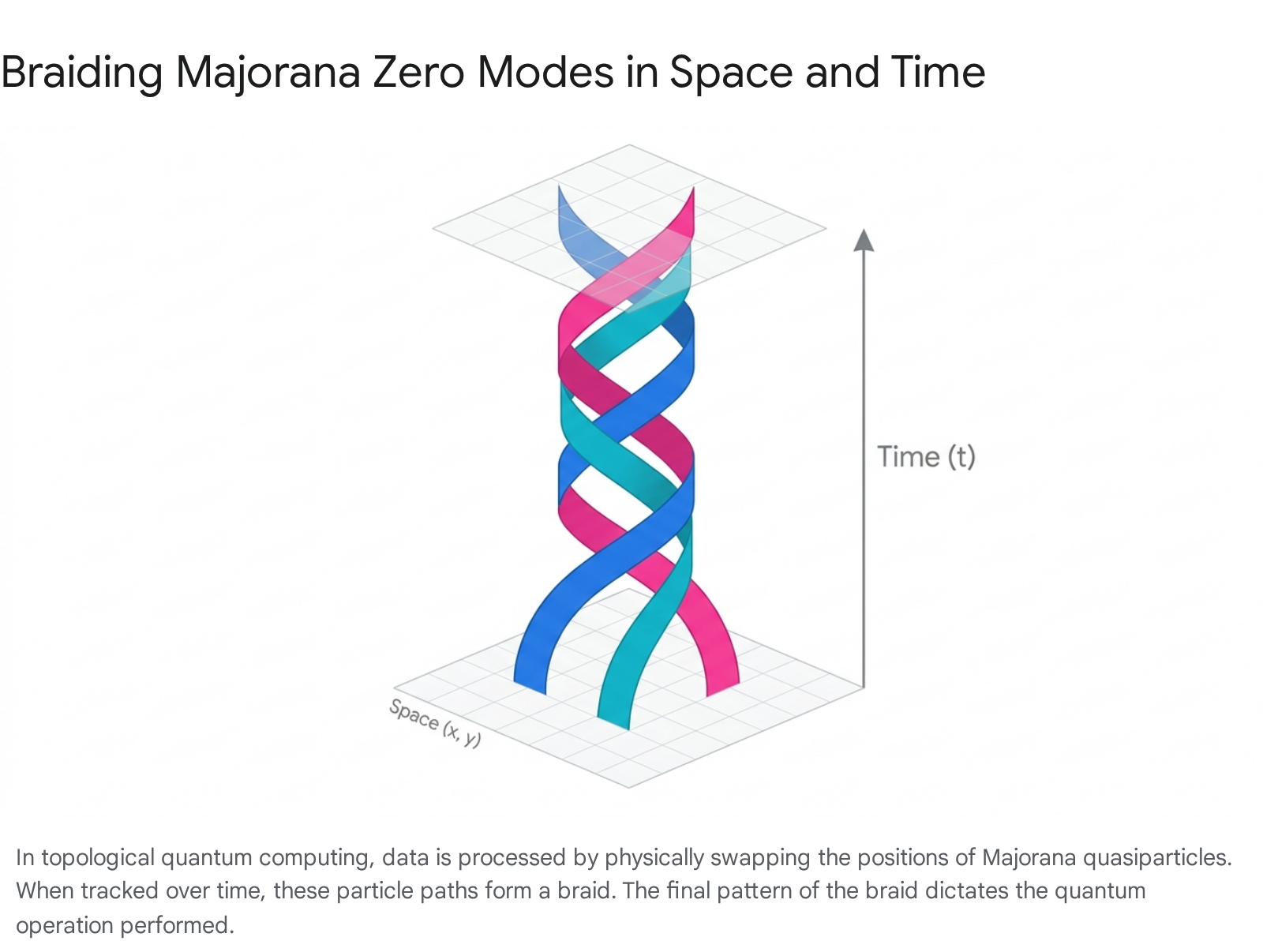
In a topological quantum computer, executing a computational algorithm is achieved by physically braiding these Majorana zero modes around one another 202410. The resulting quantum gate operations depend entirely on the final topology of the braid - meaning the sequence of over-and-under crossings - rather than the precise physical path, timing, or speed of the moving particles 2024. Because continuous analog variables like speed or slight trajectory wobbles do not impact the topological outcome, the computation is fundamentally protected from local perturbations and jitter 2024. The error protection is inextricably woven into the physical geometry of the operation itself.
A Comparison of Qubit Architectures
To fully grasp why tech organizations are pouring billions into realizing the Majorana zero mode, it is vital to contrast topological computing with the current leading quantum platforms. As of 2026, the industry is largely dominated by two mature approaches: superconducting transmon qubits and trapped ion systems 71133.
Superconducting qubits, the platform of choice for companies like Google and IBM, operate on the principles of electrical superconductivity 712. These systems utilize metallic circuits featuring Josephson junctions, which allow current to flow without resistance when cooled to extreme, near-absolute-zero temperatures 712. By manipulating the energy levels in these macroscopic circuits via precise microwave pulses, engineers can execute quantum gates 712. Trapped ion qubits, pioneered by firms like IonQ and Quantinuum, take a different approach. They suspend individual charged atoms in a vacuum using powerful electromagnetic fields, and execute quantum operations by hitting the ions with highly calibrated laser pulses 733.
Both of these mature architectures have demonstrated immense progress. Between 2024 and 2026, the industry definitively entered the fault-tolerant era 713. Google's "Willow" chip and AWS's "Ocelot" processor became the first superconducting platforms to operate "below threshold," demonstrating that scaling up a lattice of physical qubits actually decreased the logical error rate rather than amplifying the noise 271213. Concurrently, trapped ion systems from IonQ achieved an unprecedented 99.99% two-qubit gate fidelity, showcasing remarkable precision 36.
However, despite these milestones, both superconducting and trapped ion systems are fundamentally constrained by the scalability crisis of active error correction.
| Feature | Superconducting Transmon Qubits | Trapped Ion Qubits | Topological (Majorana) Qubits |
|---|---|---|---|
| Physical Mechanism | Microwave-driven superconducting circuits (Josephson junctions) 7. | Individual charged atoms manipulated by precision lasers 733. | Braiding of non-Abelian quasiparticles (Majorana zero modes) 112410. |
| Leading Developers | Google, IBM, Amazon (AWS), Rigetti 271337. | IonQ, Quantinuum, AQT 111337. | Microsoft 1337. |
| Error Protection Strategy | Active error correction via surface codes and heavy redundancy 82427. | Active error correction via structured logical encoding 3314. | Intrinsic hardware-level topological protection 11248. |
| Estimated Resource Overhead (Physical to Logical) | Exceptionally High. Estimates range from 1,000:1 to 100,000:1 311. | Moderate to High. Limited by optical scaling and slow gate speeds 3314. | Exceptionally Low. Theoretical models suggest ratios under 100:1 31124. |
| Current Maturity Stage | High. Devices with hundreds of physical qubits actively operating 113313. | High. Demonstrating industry-leading fidelity and all-to-all connectivity 113314. | Experimental/Nascent. Early-stage multi-qubit hardware prototypes undergoing validation 3312. |
The crux of the rivalry lies in the estimated physical-to-logical overhead ratio. To construct a commercially useful quantum computer capable of cracking advanced cryptography or simulating complex pharmaceuticals, engineers require thousands of pristine logical qubits 412. For superconducting transmon architectures relying on surface codes, safeguarding a single logical qubit might require upwards of ten thousand physical qubits, primarily to absorb errors and execute syndrome measurements 31224. A one-thousand-qubit logical machine would therefore require a chassis containing tens of millions of physical superconducting circuits, posing monumental challenges for cryogenic cooling, wire routing, and cross-talk mitigation 111237.
Topological quantum computing, by contrast, seeks to embed the fault tolerance directly into the physical system. If the Majorana quasiparticles are inherently immune to local noise, the need for redundant error-checking qubits plummets. Microsoft researchers estimate that a topological architecture could slash the resource overhead by orders of magnitude, requiring vastly fewer physical qubits to generate the same number of reliable logical qubits 3111224. This profound efficiency is why the industry remains fixated on Majorana fermions, viewing them as a potential shortcut past the scalability bottleneck of the quantum age 311.
The Delft Controversy and the Replication Crisis
Despite the theoretical elegance of topological qubits, the practical journey to isolate and harness Majorana zero modes has been turbulent, fraught with engineering roadblocks and deep scientific controversy. In fact, the pursuit of the Majorana particle triggered one of the most high-profile replication crises in recent condensed matter physics.
The saga began in 2018, when a research team from QuTech at the Delft University of Technology (TU Delft), in close collaboration with Microsoft, published a landmark paper in the journal Nature 51516. The team, led by prominent physicist Leo Kouwenhoven, claimed to have observed quantized conductance steps in a specialized semiconductor nanowire 515. In the field of topological physics, this highly specific electrical signature was widely considered the definitive "smoking gun" proving the existence of Majorana zero modes 541. The global quantum community celebrated the announcement, believing the topological era had officially commenced 16.
The euphoria, however, was temporary. As independent research groups, most notably a team led by physicist Sergey Frolov at the University of Pittsburgh, attempted to replicate and analyze the Delft findings, glaring inconsistencies began to surface 4142. When independent scientists demanded access to the original raw data, an alarming pattern emerged: the authors of the 2018 paper had selectively cherry-picked data points that supported the existence of Majorana modes while omitting vast swathes of experimental data that contradicted their conclusions 1542.
TU Delft immediately launched an independent integrity investigation. The resulting international expert report concluded that while there was no evidence of intentional, malicious data fabrication, the researchers had been "caught up in the enthusiasm of the moment" and exhibited "partly culpably negligent" behavior by ignoring unhelpful measurements 1542. Consequently, the groundbreaking Nature paper was formally retracted in March 2021 515. Leo Kouwenhoven subsequently stepped down from his position as the director of the Microsoft Quantum Lab 1642.
The Delft retraction shattered confidence in the field 516. For years, progress crawled as funding agencies and journal editors grew deeply skeptical of Majorana claims 1641. Sergey Frolov and his collaborators embarked on a grueling, multi-year replication effort to stress-test the underlying physics. After facing immense pushback from academic journals reluctant to publish replication studies, Frolov's team finally published a comprehensive paper in Science in January 2026 41.
The 2026 Science paper highlighted a profound technical trap hiding in the nanowires: the "smoking gun" problem. The researchers demonstrated that the precise electrical signals previously hailed as definitive proof of Majoranas could easily be generated by far simpler, topologically trivial phenomena known as Andreev bound states 241. Andreev modes mimic the behavior of Majorana zero modes in experimental setups but lack the crucial non-Abelian topological properties required for quantum computation 2. For a period of time, many in the industry believed Microsoft had wagered billions of dollars on a particle that either did not exist or was impossible to tame 311.
Resurgence: Microsoft's Majorana 1 Processor
Following years of quiet engineering and internal restructuring, Microsoft forcefully disrupted the quantum landscape in February 2025 by unveiling "Majorana 1." The company described the device as the world's first quantum processing unit powered by a Topological Core architecture, pivoting the narrative away from theoretical condensed matter physics and toward scalable hardware engineering 113.
To realize Majorana 1, Microsoft abandoned conventional semiconductor wafers and designed an entirely new, highly specialized class of material they branded a "topoconductor" 243. The topoconductor is an intricately engineered heterostructure that combines indium arsenide, a robust semiconductor currently used in advanced infrared detectors, with an overlay of aluminum, which functions as a superconductor at ultra-low temperatures 144. When this hybrid material stack is cooled to near absolute zero and precisely tuned with external magnetic fields, the proximity effect between the aluminum and the indium arsenide induces a state of topological superconductivity 1045. It is within this novel topological state that Microsoft claims Majorana zero modes reliably emerge at the boundaries of the nanowires 2.
The physical architecture of the Majorana 1 chip is a significant departure from standard quantum circuits. Instead of a linear array, Microsoft patterned the aluminum nanowires into distinct "H" shapes 11844. Each H-shaped structure is designed to host four controllable Majorana zero modes, which interact to form a single, highly stable topological qubit known as a tetron 1346.
The H-shape design is critical for scalability. Microsoft notes that these tetron structures can be modularly connected and tiled across a wafer, creating a uniform, repeating grid 1. This tiling architecture theoretically provides a direct geometric pathway to fitting arrays of thousands, and eventually millions, of topological qubits onto a single palm-sized silicon chip, avoiding the sprawling footprint that plagues superconducting transmon systems 12. The initial Majorana 1 prototype announced in 2025 housed eight such topological qubits 1247.
The Shift to Digital Voltage Control
Beyond introducing a new state of matter, the Majorana 1 architecture introduces a massive paradigm shift in how quantum computers orchestrate their operations.
In conventional superconducting quantum computers, operations are executed using continuous, analog microwave pulses 124445. Because each physical qubit suffers from microscopic manufacturing variations, these microwave pulses must be individually and meticulously calibrated for every single qubit in the array 44. Sending millions of distinct, finely tuned microwave signals into a cryogenic refrigerator introduces unmanageable levels of heat, electrical cross-talk, and cabling bottlenecks, fundamentally limiting the size of the machine 1144.
Microsoft engineered the Majorana 1 chip to be controlled digitally. Rather than using complex analog microwave signals to manipulate the qubits, the topological core utilizes simple digital voltage pulses 181244. These voltage pulses act effectively like digital light switches, turning measurements on and off by rapidly connecting and disconnecting adjacent quantum dots from the main nanowires 1844.
Because the quantum gates in a topological system depend on the global geometry of braiding and parity rather than the precise amplitude of an analog wave, the system is highly forgiving 202444. This digital control mechanism drastically simplifies the required classical control electronics, vastly reducing heat generation and making the prospect of orchestrating a million-qubit processor a realistic engineering pipeline rather than a cryogenic impossibility 244. To handle error correction, Microsoft's roadmap indicates they plan to deploy advanced protocols like Floquet codes, which rely exclusively on these rapid, measurement-based digital voltage operations rather than complex sequences of deep physical logic gates 4617.
Reading the Hidden State: Advances in Parity Measurement
The intrinsic stability of topological qubits creates a profound engineering paradox: if quantum information is entirely decoupled and hidden from the local environment to prevent noise from corrupting it, how does the computer actually access and read the data when it needs an answer? 18. Because measuring a single Majorana mode yields zero information about the qubit's state, engineers must find a way to measure the global relationship - the parity - of the distributed modes without collapsing the delicate quantum wave function 178.
Throughout 2025 and early 2026, researchers published a series of breakthroughs demonstrating highly precise solutions to this readout problem, lending substantial empirical weight to Microsoft's hardware claims.
In July 2025, the Azure Quantum team published robust experimental data detailing their ability to perform distinct Pauli-X and Pauli-Z parity measurements on their Majorana tetron devices 3. To achieve this, the team coupled the H-shaped nanowire to an adjacent quantum dot sensor, creating an interferometric "Z-loop" 3. By pulsing the system and utilizing microwave reflectometry to measure how the signals bounced off the quantum dot, the system could reliably determine whether the combined nanowire held an even or an odd number of total electrons - a metric known as charge parity 3.
The results were unprecedented for a topological system. The Pauli-Z parity measurements achieved a single-shot readout fidelity of 99.5%, equating to an assignment error of just 0.5% 3. This demonstrated that the system could not only isolate quantum information in Majorana modes but could consistently extract that information with extreme accuracy, fulfilling a prerequisite for any functional quantum error-correcting code 3.
Months later, in February 2026, a separate research team from the Spanish National Research Council (CSIC) and the Madrid Institute of Materials Science successfully tested an advanced readout method using a "quantum capacitance" probe 8. Operating on a modular Kitaev minimal chain, the CSIC team used the capacitance probe as a highly sensitive global sensor 8. In real time, and utilizing only a single measurement cycle, the researchers successfully distinguished the even or odd parity of the distributed quantum state, proving that the coupled Majorana modes maintained coherence on a millisecond scale 8. These consecutive breakthroughs signaled to the industry that reading topological states was no longer a theoretical hurdle, but an operational reality.
The Future Trajectory and Lingering Uncertainties
If the Majorana architecture continues to scale according to Microsoft's aggressive roadmap, the computational implications are vast. An array of topological qubits operating with low physical-to-logical overhead could drastically accelerate the timeline to commercial quantum advantage 1713.
At utility scale, these machines could execute advanced cryptanalysis, easily overpowering standard encryption models like RSA and Elliptic Curve Cryptography (ECC) by simulating thousands of stable logical qubits with a fraction of the hardware footprint required by competing systems 49. In the realm of chemistry and materials science, millions of topological qubits could simulate the exact electronic structures of complex enzyme families, accelerating pharmaceutical drug discovery and the design of novel catalysts to break down microplastics 14650. Theoretical physicists are even exploring how the non-local, intertwined nature of Majorana qubits might perfectly model the entangled structure of quantum gravity and the curvature of spacetime, opening new frontiers in fundamental physics simulations 47.
However, despite the influx of robust hardware data, the scientific consensus maintains a stance of calibrated uncertainty.
The specter of the 2021 Delft retraction looms large, and critics rightly point out that the recent parity measurements, while highly precise, still do not fundamentally solve the "smoking gun" problem 2. Skeptics argue that highly stable Andreev bound states could theoretically produce similar parity readouts without offering the true non-Abelian statistics required for fault-tolerant computing 2.
Furthermore, the defining feature of a topological quantum computer - the physical, non-Abelian braiding of quasiparticles to execute a computational gate - has not yet been unequivocally demonstrated in a scalable commercial device 81129. Until a laboratory conclusively proves that swapping two Majorana zero modes permanently rotates the global wave function exactly as theory predicts, the Majorana 1 chip remains an incredibly sophisticated, highly stable electromagnetic charge processor, but its status as a true topological quantum computer remains unproven 81151.
Additionally, moving from an eight-qubit laboratory prototype to a datacenter-ready array of millions of tetrons will require overcoming monumental, unforeseen engineering hurdles in materials fabrication, yield consistency, and software compilation 94751.
Bottom line
Majorana fermions - engineered as non-Abelian quasiparticles localized at the ends of specialized superconducting nanowires - represent a radical departure from conventional quantum computing. By encoding data globally across physical space, they offer an architecture intrinsically immune to the local noise and decoherence that currently cripples the industry. While the field suffered a severe credibility crisis following the 2021 Delft retraction, Microsoft's topoconductor-based Majorana 1 chip and recent breakthroughs in high-fidelity parity readout have proven that topological hardware is rapidly maturing. However, until researchers definitively execute non-Abelian braiding and scale these prototypes beyond a handful of qubits, topological quantum computing remains the industry's most brilliant, yet fiercely contested, gamble.