Non-Abelian Anyons in Fault-Tolerant Topological Quantum Computing
Quantum Decoherence and the Need for Topological Protection
The fundamental pursuit of practical quantum information processing is fundamentally constrained by the fragility of the quantum state. In conventional quantum computing architectures, such as superconducting transmons or trapped-ion systems, information is encoded locally in the degrees of freedom of individual physical particles or circuits 123. Because these local states interact continuously with their environment, they are highly susceptible to decoherence driven by thermal fluctuations, electromagnetic interference, and material defects. For instance, while trapped-ion systems utilizing hyperfine qubits (such as $^{171}\text{Yb}^+$) can demonstrate coherence times ranging from seconds to minutes, mainstream superconducting qubits typically operate with coherence times limited to the microsecond regime 1.
To overcome this inherent physical fragility, the conventional paradigm relies on active quantum error correction (QEC). This involves mapping a single logical qubit across a vast array of physical data qubits and continuously performing syndrome measurements via ancillary qubits to detect and correct localized errors 456. However, this software-driven, active approach introduces immense physical overhead, often requiring thousands of physical qubits to sustain a single logical qubit, a reality that complicates the scaling of utility-scale quantum systems 17.
The Intrinsic Topological Paradigm
Topological quantum computing represents a radical departure from active error correction. Rather than combating decoherence through continuous external intervention, this approach seeks to encode quantum information in a medium that is naturally immune to local sources of error 14. Intrinsic topological protection, first conceptualized by theorists such as Alexei Kitaev, relies on the global, topological properties of a many-body quantum system 148.
In such a system, the static physical properties are described by a Hamiltonian in which the relevant eigenstates are insensitive to small, localized perturbations 46. Crucially, the degenerate ground state manifold, which serves as the computational space, is separated from all excited states by a finite energy gap, often referred to as the bandgap or topological gap 69. As long as ambient thermal energy and external noise remain significantly weaker than this topological gap, direct coupling to the environment is forbidden by energy conservation 69. The quantum information is smeared non-locally across the entire system; therefore, no localized interaction, such as a stray magnetic field or cosmic ray impact, can measure or corrupt the encoded state 41011.
Adiabatic Topological Quantum Computing
The manipulation of topological systems can also be integrated with adiabatic quantum computing frameworks, yielding Adiabatic Topological Quantum Computing (ATQC) 4. In ATQC, universal quantum computing is achieved by implementing slow, continuous deformations of the system's Hamiltonian. By smoothly creating, moving, or merging topological features such as quasiparticles or "holes" in a stabilizer code lattice, operations are executed via a continuous adiabatic evolution rather than discrete microwave pulses 4. Provided the deformation occurs slowly enough relative to the system's energy gap, the quantum states remain securely within the protected ground state manifold throughout the computation 4. Whether through physical particle exchange or Hamiltonian deformation, the defining characteristic of topological quantum computing is the reliance on emergent quasiparticles known as non-abelian anyons 4813.
Fractional Statistics and the Braid Group
Spatial Dimensions and Particle Exchange
The existence of anyons is strictly a consequence of reduced dimensionality. In three-dimensional space, the exchange of two identical particles is mathematically governed by the permutation group, $S_n$ 12. If the spatial positions of two identical particles are swapped, and then swapped a second time to return to their original configuration, the topological path of their trajectories can always be smoothly untangled in three dimensions. This topological triviality imposes a strict constraint on quantum mechanics: the multiparticle wavefunction can only acquire a phase factor of $+1$ or $-1$ under exchange 1313. Consequently, all fundamental particles in the three-dimensional universe are restricted to being either bosons (symmetric under exchange) or fermions (antisymmetric under exchange) 1313.
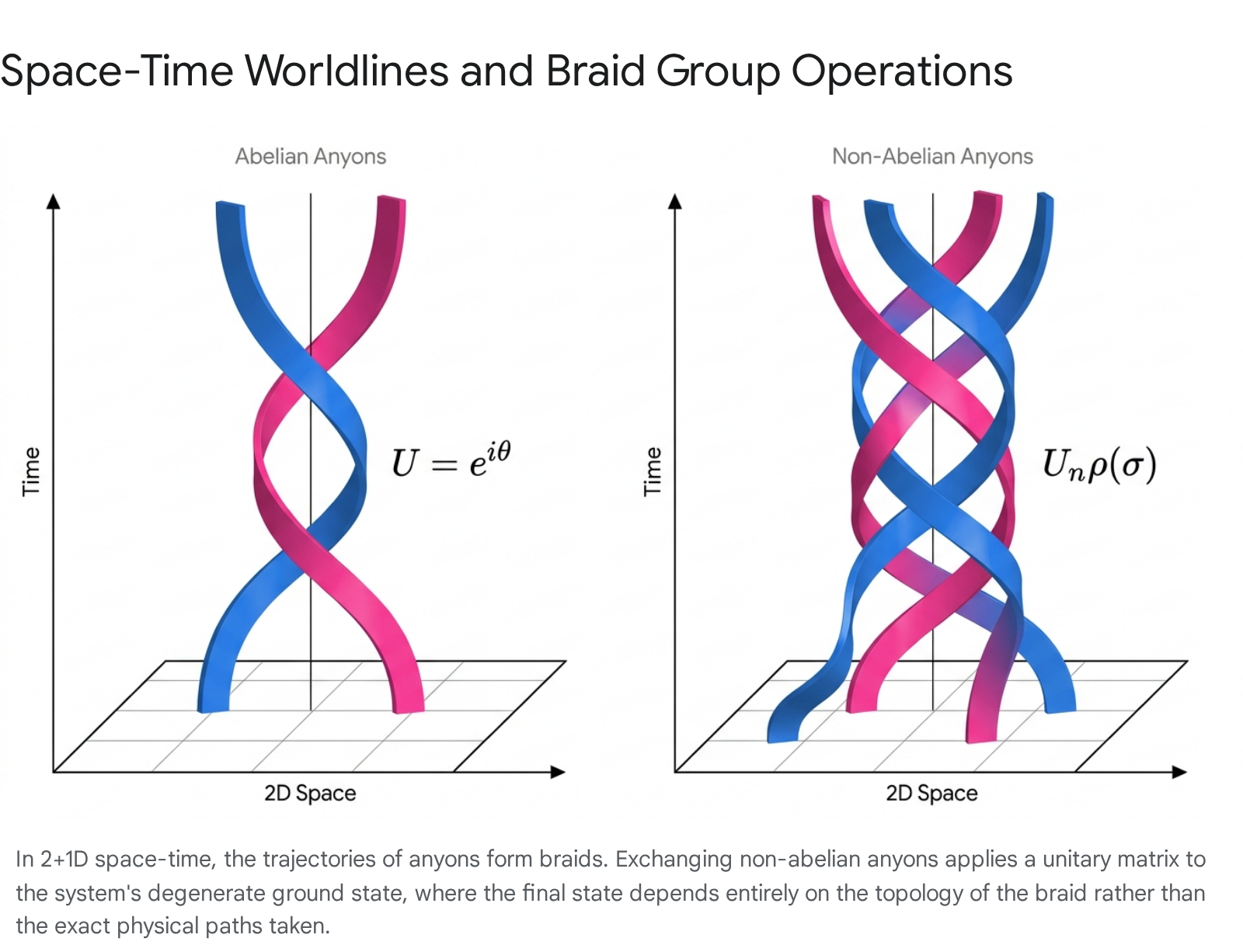
However, when particle motion is artificially confined to two spatial dimensions - such as in a two-dimensional electron gas (2DEG) - the topological rules governing particle exchange are fundamentally altered 1614. In a 2+1-dimensional space-time continuum, the temporal trajectories, or "worldlines," of moving particles trace out distinct paths. When two particles are exchanged, their worldlines can wind around one another to form permanent knots or braids in space-time 61314. Because these worldlines cannot pass through one another, a double exchange (one particle making a full 360-degree loop around another) is not topologically equivalent to the particles remaining stationary 13.
Consequently, the statistics of indistinguishable particles in two dimensions are governed not by the permutation group, but by the infinite braid group, $B_n$ 1215. The mathematical structure of the braid group is defined by generators $\sigma_i$, which represent the counterclockwise exchange of the $i$-th and $(i+1)$-th particles. These generators are subject to two primary geometric constraints. First, exchanges of disjoint pairs do not affect one another, leading to far commutativity: $\sigma_i \sigma_j = \sigma_j \sigma_i$ for $|i - j| \ge 2$. Second, the sequence of adjacent overlapping exchanges must satisfy the Yang-Baxter relation: $\sigma_i \sigma_{i+1} \sigma_i = \sigma_{i+1} \sigma_i \sigma_{i+1}$ 121617.
Abelian Anyons and Phase Accumulation
Because the braid group permits an infinite number of non-equivalent winding configurations, the phase acquired by a wavefunction during an exchange is not restricted to integer values of $\pm 1$. Quasiparticles exhibiting this behavior are known broadly as anyons, a term coined by Frank Wilczek to suggest that "anything goes" in two-dimensional fractional statistics 813.
If the relevant representation of the braid group acting on the system is one-dimensional, the exchange of two particles multiplies the global wavefunction by a generic complex phase factor, $e^{i\theta}$, effectively generating a fractional shift in relative angular momentum 61318. Quasiparticles in this category are known as abelian anyons 613. The fractional quantum Hall effect (FQHE) at the Landau level filling fraction $\nu=1/3$ provides the archetypal physical demonstration of abelian anyons, where quasiparticles carry a fractional charge of $e/3$ and accumulate a corresponding fractional phase upon exchange 181920. While physically profound, abelian anyons cannot be utilized for topological quantum computation. A global phase shift applied to a wavefunction does not alter the measurable state of the system or perform a unitary logic operation 614.
Non-Abelian Anyons and Unitary Matrix Transformations
For topological computation to occur, the ground state of the multi-anyon system must possess a $g$-fold degeneracy, where $g > 1$ 1524. When the ground state is degenerate, the mathematical representation of the braid group becomes higher-dimensional 131524. In this regime, the exchange of two particles does not merely multiply the state by a scalar phase; instead, it applies a $g \times g$ unitary matrix transformation to the degenerate ground state vector 121315.
Assuming an orthonormal basis of the degenerate states defined as $\psi_\alpha$ (where $\alpha = 1, 2, ..., g$), the exchange operation $\sigma_1$ transforms the global quantum state according to the relation: $$\psi_\alpha \rightarrow [\rho(\sigma_1)]{\alpha\beta} \psi\beta$$ where $\rho(\sigma_1)$ is the unitary matrix associated with the exchange 15. Because matrices in higher dimensions generally do not commute (i.e., $AB \neq BA$), the final state of the system becomes strictly dependent on the precise sequence in which the particles are braided. Quasiparticles exhibiting this matrix-driven exchange behavior are termed non-abelian anyons 192122. The non-commuting nature of their worldline braids provides a physical mechanism to manipulate a highly entangled, non-local quantum state simply by moving particles around one another in specific geometrical patterns 101314.
Mathematical Framework of Topological Operations
The behavior of non-abelian anyons and their application in quantum algorithms are formalized mathematically through Modular Tensor Categories (MTCs), which rigorously dictate the allowed rules governing anyon fusion and braiding 2122.
Fusion Rules and F-Matrices
Fusion describes the quantum mechanical outcome when two distinct anyons are brought into close proximity so that they behave as a single composite object 22. Unlike classical particles, the fusion of two non-abelian anyons can yield multiple possible emergent outcomes, which are measured probabilistically based on the underlying topological charges 23. The generalized fusion rule is written algebraically as: $$a \times b = \sum_c N_{ab}^c c$$ where $N_{ab}^c$ is a non-negative integer denoting the number of distinct fusion channels through which anyons $a$ and $b$ can combine to produce a resultant anyon $c$ 1722. If there exists any combination where $\sum_c N_{ab}^c > 1$, the anyon model supports multiple fusion channels and is consequently classified as non-abelian 1722.
When multiple anyons are fused sequentially, the order of fusion operations introduces an additional layer of complexity governed by the $F$-matrix (fusion matrix). For example, if three anyons $a, b, c$ fuse to a total charge $d$, the physical process can be executed in two distinct topologies: fusing $a$ and $b$ first as $(a \times b) \times c$, or fusing $b$ and $c$ first as $a \times (b \times c)$. The $F$-matrix provides the essential unitary basis transformation between these two distinct fusion tree configurations, ensuring mathematical consistency across the Hilbert space through relations known as pentagon equations 162824.
Braiding Operations and R-Matrices
While the $F$-matrix manages fusion topologies, the $R$-matrix dictates the local exchange of two anyons within a specific, isolated fusion channel 1628. If anyons $a$ and $b$ fuse precisely into channel $c$, exchanging their physical positions in a counterclockwise manner applies the specific operation $R_{ab}^c$ to the wavefunction 28.
To execute quantum computation, local exchange $R$-matrices must be combined with the global basis-transforming $F$-matrices. By resolving the consistency constraints dictated by the hexagon equations, physicists compute generalized braiding matrices (often denoted $B$) that operate on the global multi-anyon Hilbert space 2228. A topological quantum algorithm is fundamentally constructed by orchestrating a highly specific temporal sequence of these $B$-matrix operations. By carefully routing anyon worldlines around one another, researchers can engineer arbitrary logical gates. For instance, in specific non-abelian models, a logical Pauli-Z gate on a single encoded qubit can be realized strictly as a sequence of discrete braiding moves, such as $Z_1 = (B_{12} \otimes \text{Id})^2$ 28.
Primary Non-Abelian Anyon Models
The viability of any non-abelian anyon model for practical quantum computing depends intrinsically on whether its resulting braiding matrices can generate a sufficiently dense subset of the special unitary group, thereby achieving universal quantum computation without external supplementation 1616.
The Ising Anyon Model and Majorana Zero Modes
The Ising anyon model is the most heavily researched physical framework in the discipline, primarily because its mathematics map directly to the behavior of Majorana zero modes (MZMs) in solid-state topological superconductors 2531. The theoretical model consists of exactly three particle types: the vacuum or identity state ($1$), the Ising anyon ($\sigma$), and the fermion ($\psi$) 1621.
The defining non-abelian fusion rules governing the Ising model are: * $\sigma \times \sigma = 1 + \psi$ * $\sigma \times \psi = \sigma$ * $\psi \times \psi = 1$ 1622
The critical rule is the fusion of two $\sigma$ anyons (Majoranas), which yields a superposition. When fused, they will either cleanly annihilate into the vacuum ($1$) or combine to form a fermion ($\psi$) 16. Because a single Majorana zero mode represents only half of a conventional fermion, it contains no localized quantum information. A logical qubit must be encoded non-locally using four $\sigma$ anyons with a collective neutral charge 112426. The computational basis states of the qubit map directly to the overall even or odd fermion parity of the fused combinations 1124.
However, the Ising anyon model suffers from a profound limitation regarding computational universality. The specific $R$-matrices governing the exchange of Ising anyons (e.g., $R_{\sigma\sigma}^\psi = \pm e^{3\pi i/8}$) produce braiding matrices that are strictly constrained to the Clifford group of quantum operations 28. While Clifford gates are intrinsically fault-tolerant when generated by braids, the Gottesman-Knill theorem dictates that they can be efficiently simulated by classical computers and cannot achieve universal quantum computation alone 27. To achieve universality, the Ising model requires the external injection of non-Clifford gates (such as the $\pi/8$ $T$-gate). Consequently, a topological computer based solely on Majorana zero modes would still require resource-intensive active error correction protocols, such as magic state distillation, effectively negating a significant portion of the hardware-level advantages topological systems are intended to provide 71727.
The Fibonacci Anyon Model
Due to the limitations of the Ising model, the Fibonacci anyon model represents the theoretical "Holy Grail" of topological quantum computing. It naturally supports fully universal quantum computation purely through anyonic braiding, entirely eliminating the need for magic state distillation 2435. The Fibonacci model achieves this utilizing only two particle types: the vacuum ($1$) and the Fibonacci anyon ($\tau$) 36.
The system derives its immense computational complexity from a single, elegant fusion rule: $$\tau \times \tau = 1 + \tau$$ 21223637
This recursive rule dictates that two Fibonacci anyons can either annihilate into the vacuum or fuse to create another Fibonacci anyon. As the total number of $\tau$ anyons $n$ increases in the system, the dimensional degeneracy of the ground state Hilbert space grows according to the Fibonacci sequence ($1, 1, 2, 3, 5, 8, ...$) 2223. The associated braiding matrices for Fibonacci anyons involve complex rotational phases driven by the golden ratio (such as $e^{\pm 3\pi i / 5}$) 24. Because these operations are incommensurate with standard Clifford rotations, sequences of Fibonacci braids densely populate the unitary group $SU(2)$ 2124. By weaving Fibonacci anyons in sufficiently long and complex patterns, any arbitrary single- or multi-qubit quantum gate can be approximated to any desired level of precision entirely within the protected topological subspace 212435.
| Anyon Model | Primary Particle | Fundamental Fusion Rule | Corresponding Physical System | Universal by Braiding Alone? |
|---|---|---|---|---|
| Ising Model | $\sigma$ (Majorana) | $\sigma \times \sigma = 1 + \psi$ | FQHE $\nu=5/2$; Nanowire Kitaev Chains | No (Restricted to Clifford group) 1728 |
| Fibonacci Model | $\tau$ (Fibonacci) | $\tau \times \tau = 1 + \tau$ | FQHE $\nu=12/5$; $Z_3$ Parafermions | Yes (Densely populates SU(2)) 2124 |
Physical Candidate Platforms for Intrinsic Topology
Developing stable hardware capable of hosting and controlling non-abelian anyons is broadly considered one of the most formidable challenges in modern condensed matter physics and advanced materials engineering 128. Researchers are pursuing several disparate physical platforms to realize these theoretical models.
Fractional Quantum Hall Effect Liquids
The fractional quantum Hall effect occurs when a pristine two-dimensional electron gas (2DEG) is subjected to intense perpendicular magnetic fields at sub-Kelvin temperatures. In this extreme quantum limit, kinetic energy is quenched into discrete Landau levels, and strong Coulomb interactions dominate 3940. The electrons bind with magnetic flux quanta to form strongly correlated composite quasiparticles exhibiting fractional electric charges 184041.
The FQHE state observed at the specific Landau level filling fraction $\nu=5/2$ is widely theorized to be described by the Moore-Read Pfaffian state, which acts mathematically as a topological p-wave paired state of electron-vortex composites 1940. This state naturally supports Ising anyons 3640. While compelling experimental evidence of fractional statistics has been observed via Fabry - Pérot interferometry at abelian filling fractions (such as $\nu=1/3$), the definitive isolation, detection, and controlled braiding of non-abelian excitations at $\nu=5/2$ remains technically elusive. The difficulties stem primarily from bulk-edge coupling interference and the extreme delicacy of the energy gaps 131820.
Even more aggressively sought is the $\nu=12/5$ fractional quantum Hall state. Theoretical models indicate this state corresponds to the Read-Rezayi state, which uniquely supports $Z_3$ parafermions - a mathematical framework explicitly containing the elusive Fibonacci anyon 2139. However, the energy bandgap protecting the $\nu=12/5$ state is exceedingly fragile. Preserving the topological integrity of this state requires sub-millikelvin experimental isolation that is extraordinarily difficult to achieve . As of 2026, research into FQHE systems relies heavily on constructing quasihole bases using complex parton wave functions and developing precise thermal probing techniques to monitor edge-equilibration dynamics 404129.
Semiconductor-Superconductor Hybrid Nanowires
Given the extreme fragility and cryogenic requirements of FQHE states, the commercial industry - led prominently by Microsoft Quantum, alongside academic partners at the Niels Bohr Institute (NBI) - has focused heavily on engineering synthetic topological matter 92830. The leading architecture in this domain utilizes one-dimensional semiconductor nanowires (typically composed of Indium Arsenide or Indium Antimonide) coupled longitudinally to standard s-wave superconductors (such as Aluminum) 930.
By applying a strong external magnetic field parallel to the nanowire to break time-reversal symmetry, the strong spin-orbit coupling inherent within the semiconductor interacts with the proximity-induced superconductivity 6928. Under highly specific tuning of magnetic fields and gate voltages, this interaction drives the hybrid nanowire into a topological superconducting phase 6930. In this synthetic phase, the bulk interior of the wire becomes fully gapped, but the one-dimensional boundaries (the physical ends of the wire) host localized, zero-energy excitations precisely equivalent to Majorana zero modes 62531.
However, this continuous 1D architecture suffers from severe material science challenges. Microscopic disorder - including surface roughness, unintended quantum dot formation, and random charge impurities - can create trivial Andreev bound states 314546. These trivial states closely mimic the zero-bias conductance peaks expected from true topological Majoranas, causing widespread ambiguity in experimental verification 253145.
Discrete Quantum Dot Kitaev Chains
In an effort to bypass the material disorder that plagues continuous nanowires, researchers at QuTech (a collaboration between TU Delft and TNO) have pioneered the discrete "Kitaev chain" architecture within two-dimensional electron gases 331. Rather than relying on pristine, continuous crystal epitaxy to induce a global topological phase, QuTech researchers artificially engineer Majorana states by coupling distinct, localized semiconductor quantum dots via superconducting segments 1131.
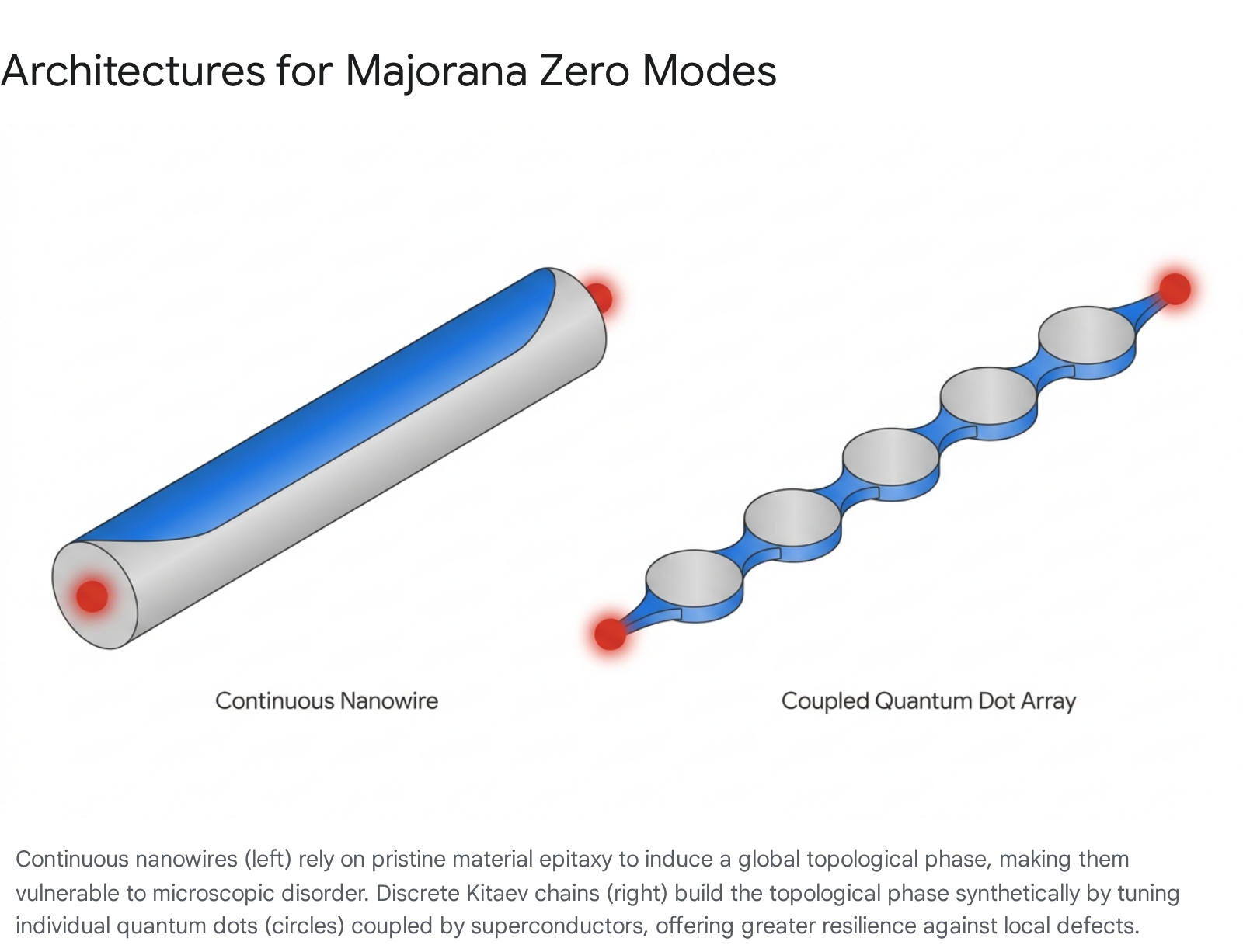
Often referred to as "poor man's Majoranas," this discrete approach allows researchers to precisely and individually tune the electrostatic gates of each quantum dot to locate the exact topological sweet spot 3233. Theoretical models suggest that as these discrete chains are scaled up to roughly twenty or more coupled quantum dots, the system transitions into robust topological islands where Majorana zero modes become remarkably resistant to local fluctuations, mitigating the need for extreme fine-tuning 33.
Progress and Controversies in Solid-State Implementations
The experimental landscape throughout 2025 and 2026 has been characterized by intense scientific debate regarding measurement validity, alongside rapid breakthroughs in parity readout capabilities.
The Microsoft Topological Gap Protocol Debate
To address the ambiguity of trivial zero-bias peaks in Majorana nanowires, Microsoft Quantum introduced the Topological Gap Protocol (TGP) in 2023. The TGP was designed as a rigorous, automated set of electrical measurements intended to decisively identify the topological phase transition by simultaneously assessing local zero-bias peaks and non-local bulk conductance 2530. Utilizing this protocol, Microsoft published high-profile papers in 2023 (Physical Review B) and early 2025 (Nature), claiming to have reliably engineered topological superconductivity and executed early parity readout in a multi-wire "tetron" device 264950.
However, the validity of the TGP algorithm became the subject of intense scrutiny and controversy in 2025. In detailed critiques published on arXiv and presented prominently at the Global Physics Summit, physicist Henry Legg and colleagues argued that the TGP suffers from fatal methodological flaws 264934. The specific technical critiques centered on four primary issues:
- Threshold Instability: Legg demonstrated that the non-local conductance threshold ($G_{th}$) utilized by the TGP to determine whether the bulk wire is "gapped" is highly sensitive to the arbitrary boundaries of the measurement window. By simply altering the range of the applied magnetic field (e.g., measuring from 1.8 to 2.8 Tesla instead of 1.4 to 2.8 Tesla) or adjusting the bias voltage range, the maximum conductance threshold shifts. This shift causes an otherwise identical dataset to completely fail the automated protocol 4935.
- Code Discrepancies: The critique revealed that Microsoft deployed different software functions to analyze data. A function named
analyze_2was used to validate theoretical simulations, while a distinct function,analyze_two, was applied to the actual experimental data 35. When the experimental code was retroactively applied to Microsoft's own simulated data, it generated false positives, directly contradicting the company's claim of a robust "zero false positive" rate 35. - Diluted Definitions: Legg noted that Microsoft redefined the mathematical bounds of the "topological" phase. While earlier definitions required a scattering invariant determinant of $det(r) < -0.9$, the 2023 TGP utilized a significantly weaker standard of $det(r) < 0$. Under this diluted "union" definition, large portions of trivial phase space pass the protocol as true positives 35.
- Gapless Underlying Data: Regarding the 2025 Nature paper claiming successful parity readout, Legg's analysis of the public conductance data repositories indicated that the specific regions where the readout occurred were highly disordered and gapless, fundamentally undermining the claim that the parity was topologically protected 5035.
While Microsoft maintains confidence in the TGP framework and emphasizes ongoing device optimizations 2634, the controversy starkly illustrates the extreme difficulty of proving the existence of intrinsic topological states amid the noise of dirty solid-state environments.
QuTech Parity Readout and Quantum Capacitance
Parallel to the nanowire debate, the discrete quantum dot approach yielded a confirmed, critical milestone. In February 2026, researchers at QuTech and the Niels Bohr Institute achieved the first fast, single-shot readout of fermionic parity in a Majorana-based Kitaev chain device 11. Because topological information is hidden non-locally across paired Majoranas, standard local probes cannot read the logical state of the qubit without collapsing the wavefunction 1136.
The QuTech team circumvented this limitation by employing an innovative technique known as quantum capacitance 1136. They connected a radio-frequency (RF) resonator directly to the superconducting segment bridging two quantum dots. When the system exists in an even parity state, electrons naturally pair into Cooper pairs, allowing them to flow easily in and out of the superconducting condensate under an RF drive 11. Conversely, when the state possesses odd parity, a lone unpaired electron lacks a partner and cannot easily enter the condensate 11.
This distinct charge dynamic subtly alters the quantum capacitance of the device, which manifests as a measurable phase shift in the reflected RF signal 11. This real-time, global probe successfully discriminated parity states in single shots on microsecond timescales, and revealed robust parity coherence lifetimes exceeding one millisecond 1136. Researchers at the Spanish National Research Council (CSIC) confirmed that this global probe elegantly reads the hidden states without inducing local decoherence, solidifying the measurement primitive absolutely necessary for future braiding operations 36.
Niels Bohr Institute and Real-Time Fluctuation Monitoring
The characterization of these delicate states was further accelerated by engineering breakthroughs at the Niels Bohr Institute's Center for Quantum Devices. In early 2026, a research team led by Dr. Fabrizio Berritta successfully integrated commercially available Field-Programmable Gate Arrays (FPGAs) to create a real-time adaptive measurement system 4637.
Previously, standard testing methods required up to a minute to measure qubit performance, forcing researchers to rely on time-averaged energy loss rates that masked rapid, microscopic fluctuations in the substrate materials 4637. By utilizing the high-speed FPGA controller, the NBI team was able to continuously update their estimate of the qubit's relaxation rate within milliseconds. This breakthrough allowed them to track sudden performance swings and spatially fluctuating defects about 100 times faster than prior methods, enabling operators to instantly identify when a qubit shifted from a "good" to a "bad" state 4637. This real-time monitoring capability is viewed as a vital step toward the active calibration required to maintain topological sweet spots in hybrid devices 46.
Digital Simulation of Non-Abelian Anyons
While researchers strive to isolate intrinsic topological matter in complex solid-state devices, an entirely different track has emerged as highly competitive: simulating non-abelian anyons digitally on pristine, highly-controlled atomic qubits.
Quantinuum and the S3 Toric Code
In late 2024 and through 2025, the quantum computing firm Quantinuum successfully engineered non-abelian topological order by digitally simulating the $S_3$ quantum double model on their $H_2$ trapped-ion quantum processor 755. Rather than waiting for materials science to perfect Fibonacci FQHE states, Quantinuum utilized a 54-qubit array to synthesize an $S_3$ toric code wavefunction 55. The team initially prepared the ground state in a $Z_3$ qutrit (three-state) Hilbert space, then applied a complex gauging procedure to transition the system into the $S_3$ toric code 755.
Because the $S_3$ symmetry group is strictly non-abelian, the simulated anyonic fusions act as fundamental computational primitives. By dynamically tracking the simulated anyons and applying coherent braiding sequences via the ion trap's highly connected laser gates, the Quantinuum team implemented a fully universal topological gate set 55. The operations included entangling gates via braiding, X-basis measurements, and Z-basis measurements, proving that non-local information encoded in the internal degrees of freedom of $C_2$-flux anyons could be manipulated fault-tolerantly 55.
Fault-Tolerant Code Switching and Magic States
The digital simulation approach achieved another critical milestone in 2025 when Quantinuum successfully addressed the magic state distillation bottleneck 27. Non-Clifford operations, such as the $T$-gate, are notoriously difficult to implement fault-tolerantly in standard error-correcting codes, historically requiring vast physical qubit overhead 727.
To circumvent this, Quantinuum demonstrated the first fault-tolerant "code switch" between two distinct quantum error-correcting codes 27. The team prepared a high-fidelity magic state within a 15-qubit quantum Reed-Muller (qRM) code - a specific architecture where the $T$-gate is natively transversal and easy to implement 27. Once the state was prepared, they fault-tolerantly transferred the encoded state into a 7-qubit Steane code, where standard Clifford operations and error correction are natively supported 27. This hybrid technique successfully generated a magic state infidelity of $7 \times 10^{-5}$ using only 28 physical qubits, effectively completing a fully error-corrected universal gate set and dramatically lowering the projected resource overhead for digital fault tolerance 2756.
The Competitive Landscape of Quantum Scaling
The pursuit of non-abelian anyons must be contextualized against the massive scaling and performance milestones recently achieved by conventional quantum processors relying on active topological error correction.
Superconducting Processors and the Fault-Tolerance Threshold
In late 2024 and throughout 2025, Google and the University of Science and Technology of China (USTC) published landmark results on their respective 100+ qubit superconducting processors, "Willow" and "Zuchongzhi 3.0 / 3.2" 5573839. Both systems utilized a distance-7 surface code architecture, wherein a grid lattice of physical data qubits is constantly monitored by adjacent ancillary qubits to actively track and correct parity errors 539.
Both Google and USTC successfully crossed the critical "fault-tolerance threshold." This milestone proves definitively that increasing the size of the logical qubit grid (scaling from distance-3 to distance-5 to distance-7) successfully results in an exponential suppression of logical error rates, rather than introducing more noise 53940. Operating below this threshold, the processors executed Random Circuit Sampling (RCS) benchmarks that deeply challenge classical supercomputing limits 541. Google's Willow performed an RCS task in five minutes that would theoretically require the world's fastest supercomputer, Frontier, $10^{25}$ years to simulate 56242.
In fierce international competition, the USTC team unveiled Zuchongzhi 3.0, a 105-qubit processor featuring 182 tunable couplers, which completed an 83-qubit, 32-layer RCS task $10^{15}$ times faster than optimal classical algorithms 57384143. The USTC device achieved remarkable fidelities, including single-qubit gates at 99.90%, two-qubit gates at 99.62%, and coherence times of 72 microseconds 384144. Furthermore, the subsequent iteration, Zuchongzhi 3.2, achieved fault tolerance using a novel "all-microwave quantum state leakage suppression architecture." This allowed the system to achieve an error suppression factor of 1.4 as code distance increased, notably circumventing the complex, hardware-intensive control methods relied upon by Google 394066.
Resource Overhead Comparisons
Despite these extraordinary achievements, the surface code approach remains fundamentally "digital" and highly active. It requires massive operational overhead, often estimated to demand between 1,000 to 10,000 physical qubits for every single reliable logical qubit, largely because the underlying transmon hardware remains physically fragile and error-prone 14766.
By contrast, intrinsic topological quantum computing via non-abelian anyons promises to slash this overhead dramatically. By anchoring the qubit's stability in the static physical topology of the hardware itself, intrinsic systems theorize a near 1:1 physical-to-logical scaling ratio, circumventing the need for continuous active measurement and massive cabling infrastructure 14.
| Feature | Intrinsic TQC (e.g., Majorana Nanowires) | Digital TQC (e.g., Google/USTC Surface Code) |
|---|---|---|
| Method of Protection | Passive: hardware energy gap protects states 146 | Active: software-driven syndrome measurements 46 |
| Information Encoding | Non-local fusion channels of non-abelian anyons 1122 | Local physical qubits entangled in a lattice array 3962 |
| Computational Method | Braiding particle worldlines topologically 6814 | Microwave pulse sequences applying discrete logic gates 139 |
| Current Qubit Scale (2026) | Pre-logical qubit (demonstrating readout) 111 | 105 physical qubits; Distance-7 logical qubits 539 |
| Primary Engineering Challenge | Material purity; mitigating trivial defects 314546 | Cabling, cooling, and massive qubit scaling overhead 766 |
Conclusion
Non-abelian anyons represent the theoretical key to fault-tolerant topological quantum computing due to their unique ability to translate the abstract mathematics of the braid group into physical, highly error-resistant quantum operations. By restricting particle motion to two spatial dimensions, the topology of exchange ensures that small, local perturbations to the system's environment cannot easily measure or corrupt non-locally stored information. The transition from simple abelian phase accumulation to complex non-abelian unitary matrix transformation theoretically enables the execution of quantum algorithms with minimal to zero active error correction overhead, specifically in universal frameworks like the Fibonacci anyon model.
However, the path to commercialization remains deeply bifurcated and technically arduous. While the active error correction milestones achieved by Google's Willow and USTC's Zuchongzhi processors prove that large-scale quantum computation is feasible, the physical scaling overheads demanded by surface codes remain daunting. The pursuit of intrinsic hardware resilience continues through Microsoft's controversial topological gap protocol on hybrid nanowires, and QuTech's rapidly advancing quantum dot Kitaev chains, which recently achieved crucial real-time parity readout. Simultaneously, the digital simulation of anyonic models, such as Quantinuum's S3 toric code and fault-tolerant code switching, demonstrates that the mathematical power of non-abelian anyons can be harnessed effectively even on existing NISQ-era platforms. Ultimately, whether realized in the ultra-cold bulk of a fractional quantum Hall fluid, the synthetic lattice of a trapped-ion array, or the tunable interface of a discrete quantum dot chain, the topological braiding of non-abelian anyons remains the most mathematically elegant path toward scalable, universal quantum computation.