
Topological Weyl semimetals
In 1929, physicist Hermann Weyl formulated a solution to the Dirac equation that described massless fermions possessing a definite chirality, or handedness 123. For nearly a century, these Weyl fermions were primarily pursued within high-energy particle physics, though they remained unobserved as fundamental elementary particles 24. However, the advanced theoretical frameworks of condensed matter physics eventually provided an alternative platform. In highly specific crystalline structures, the collective, low-energy excitations of electrons in a periodic lattice behave identically to the elusive relativistic particles described by Weyl's equations 235.
These materials, officially classified as Weyl semimetals (WSMs), represent a topologically nontrivial phase of matter that bridges high-energy quantum field theory and solid-state materials science 667. A Weyl semimetal is defined by a bulk electronic band structure wherein the conduction and valence bands intersect linearly at isolated, doubly degenerate points in three-dimensional momentum space 148. These intersection points, known as Weyl nodes, act as magnetic monopoles of Berry curvature, serving as the foundational mechanism for a suite of extraordinary quantum phenomena. These phenomena include topologically protected surface states known as Fermi arcs and exotic magnetotransport behaviors like the chiral anomaly 91011.
Theoretical Foundations of Weyl Physics
The existence of Weyl semimetals relies entirely on the precise intersection of band topology and symmetry breaking within crystalline solids. To comprehend the Weyl phase, it is necessary to examine the foundational physics that separates it from conventional metals, semiconductors, and other topological insulators.
Symmetry Breaking and Band Topology
In a standard insulating material, a finite energy gap distinctly separates the valence and conduction bands across the entirety of the Brillouin zone. In topological insulators, strong spin-orbit coupling drives an inversion of these bands, resulting in a fully gapped insulating bulk accompanied by conducting, topologically protected boundary states 910. Topological semimetals, however, emerge when the bulk energy gap closes entirely at specific zero-dimensional points or one-dimensional lines in momentum space 8.
If a crystal possesses both time-reversal symmetry (TRS) and spatial-inversion symmetry (SIS), any band crossing points are subject to Kramers degeneracy, resulting in fourfold degenerate nodes known as Dirac points 1012. A Dirac semimetal, such as Na3Bi or Cd3As2, can be mathematically treated as the superposition of two Weyl nodes of opposite chirality occupying the exact same coordinate in momentum space 101314. Because the net topological charge of a Dirac node is zero, it is not strictly protected by topology against gap-opening perturbations unless specific crystalline symmetries dynamically enforce the crossing 12.
To transition a system from a Dirac semimetal to a Weyl semimetal, either time-reversal symmetry or spatial-inversion symmetry must be explicitly broken 41013. Breaking one of these fundamental symmetries lifts the spin degeneracy of the bands, effectively splitting the fourfold Dirac node into a spatially separated pair of twofold degenerate Weyl nodes 1012. Furthermore, due to the Nielsen-Ninomiya theorem, which enforces charge cancellation across the periodic boundary conditions of the momentum-space Brillouin zone, Weyl nodes are geometrically required to appear in pairs of opposite chirality - specifically, one left-handed and one right-handed fermion 101115.
Topological Charge and Berry Curvature Dynamics
Weyl nodes are remarkably robust topological entities. In momentum space, they act as singularities in the gauge field, meaning they behave as either sources or sinks of Berry curvature 91016. The topological invariant that characterizes a specific Weyl node is its chiral charge, mathematically represented as its Chern number 91217. This invariant is calculated by integrating the Berry curvature over a closed two-dimensional spherical surface enclosing the node within momentum space 1217. Depending on its chirality, a Weyl node will yield a Chern number of either +1 (denoting a source) or -1 (denoting a sink) 17.
Because a single Weyl node possesses a non-zero integer Chern number, it cannot be annihilated or gapped out by minor structural perturbations or localized defects; the only physically permitted mechanism to destroy a Weyl node is to shift it through momentum space until it merges and annihilates with another Weyl node of the opposite chirality 1617. This topological protection makes Weyl fermions highly stable quasiparticles capable of ultra-high mobilities 418.
Visualizing Fermi Arcs and the Brillouin Zone
The bulk-boundary correspondence principle in topological physics mandates that the nontrivial topological invariant of a material's bulk must manifest as gapless states at the physical boundaries of the crystal 91419. In Weyl semimetals, this principle yields the phenomenon of topological Fermi arcs 410.
In a conventional metal, a surface Fermi contour forms a closed, continuous loop, representing a standard two-dimensional electron gas on the boundary. In contrast, a Fermi arc is an open, disjointed segment of a Fermi contour 37. Conceptually, if one visualizes the three-dimensional Brillouin zone as a bounding box containing discrete bulk Weyl nodes of opposite chirality embedded deep within its volume, the Fermi arcs exist exclusively on the two-dimensional exterior planes of that box. These unclosed curves directly connect the two-dimensional surface projections of the bulk Weyl nodes 111820. Because the total chirality in the bulk must sum to zero, every momentum-space source of Berry curvature must connect to a corresponding sink via these exotic surface states 101115.
The topological mechanics of these arcs can also be interpreted semiclassically through the Wannier-Stark ladder under an applied electric field. Electrons undergoing Bloch oscillations in the bulk travel through momentum space until they strike the Brillouin zone boundary 21. The non-trivial Zak phase, integrated along the momentum path normal to the surface, acts as an indicator of the multi-valued topological defects connecting these distinct surfaces, confirming that Fermi arcs are inescapable physical requirements of the Weyl phase 21.
Classification of Nodal Topologies
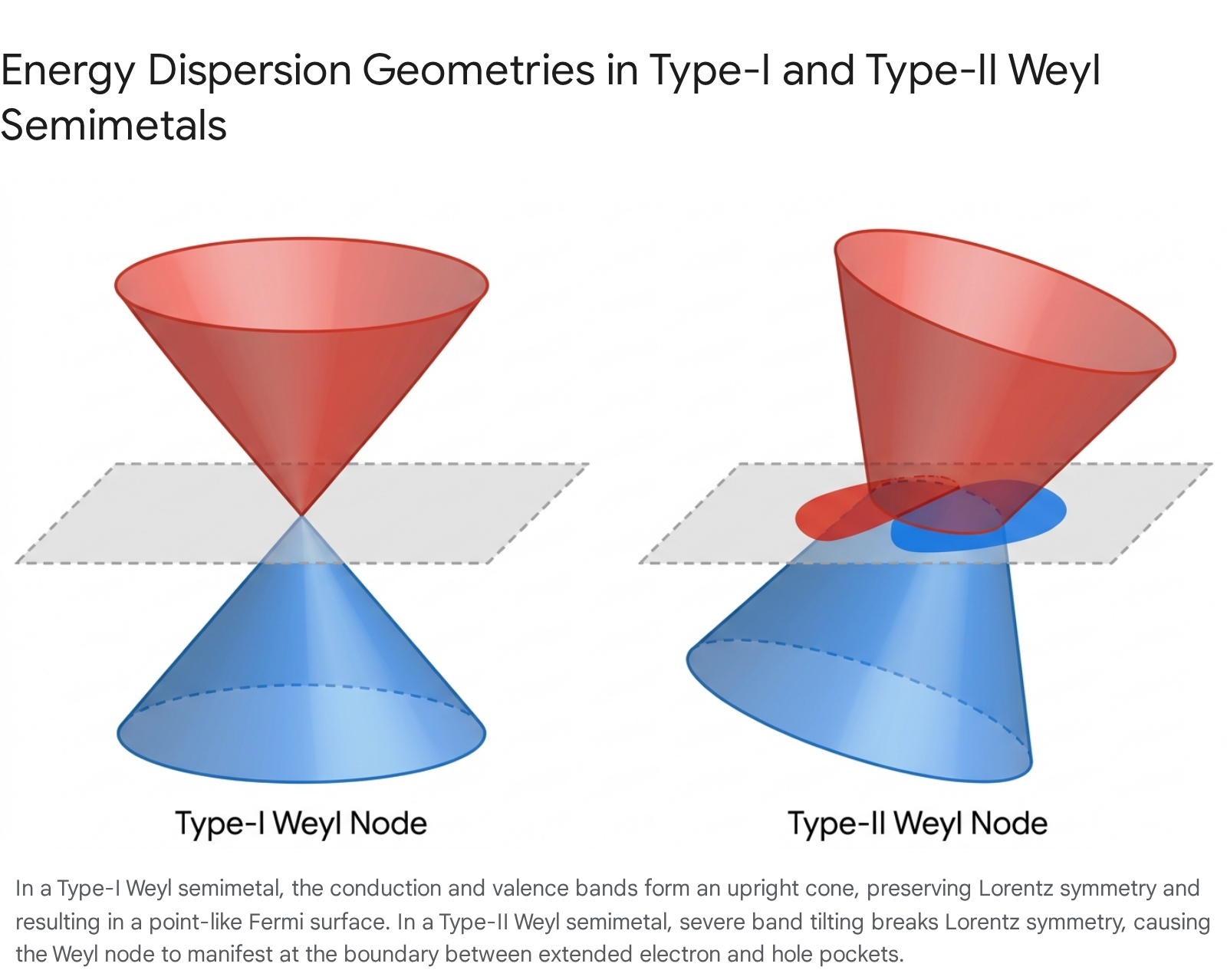
Weyl semimetals are divided into two primary classifications based on the geometric dispersion of their energy bands around the Weyl nodes and their adherence to Lorentz symmetry 102023.
Type-I Weyl Semimetals
Type-I Weyl semimetals conform to the strict Lorentz invariance typically required in high-energy physics 1020. In these materials, the conduction and valence bands disperse linearly in all three momentum directions ($k_x$, $k_y$, $k_z$) symmetrically away from the nodal intersection 18. If the Fermi level is tuned exactly to the energy plane of the Weyl nodes, the Fermi surface shrinks to a zero-dimensional, isolated point, causing the density of states at the Fermi level to vanish almost entirely 1020. The TaAs family of compounds, discovered in 2015, represents the prototypical class of Type-I Weyl semimetals 41020.
Type-II Weyl Semimetals
Because the rigid constraints of Lorentz invariance do not universally apply in condensed matter systems, researchers identified a secondary phase - Type-II Weyl semimetals - which was missed by early high-energy particle theories 520. In these materials, the Weyl cone exhibits a dramatic structural tilt 1020. When this tilt exceeds a critical threshold, the slope of both crossing energy bands shares the same sign along a specific trajectory in momentum space 2223.
Consequently, a Type-II Weyl node does not exist as an isolated, zero-dimensional point within an otherwise empty energy gap. Instead, it occurs at the precise energetic boundary where an extended bulk electron pocket and a bulk hole pocket make physical contact 102024. Because of this overlapping Fermi surface geometry, Type-II semimetals exhibit a finite density of states directly at the node. This results in highly anisotropic transport responses, meaning phenomena such as the chiral anomaly are only observable when external magnetic fields are applied along specific crystallographic axes that intersect the tilted cone appropriately 1022.
The structural and symmetry-based requirements that differentiate the primary topological semimetal phases result in varied observable characteristics, as summarized below.
| Material Phase | Nodal Degeneracy | Required Symmetries | Lorentz Invariance | Fermi Surface Geometry | Characteristic Material Examples |
|---|---|---|---|---|---|
| Dirac Semimetal | 4-fold | Both TRS and SIS must be preserved | Maintained | Point-like (isolated) | Na3Bi, Cd3As2 101314 |
| Type-I Weyl Semimetal | 2-fold | Either TRS or SIS must be broken | Maintained | Point-like (isolated) | TaAs, TaP, NbAs, NbP 1020 |
| Type-II Weyl Semimetal | 2-fold | Either TRS or SIS must be broken | Broken (strong band tilt) | Extended electron and hole pockets touching at a node | WTe2, MoTe2 510 |
Experimental Signatures and Diagnostics
The confident identification of a Weyl semimetal requires the verification of both bulk dynamics and surface electronic configurations. Researchers rely extensively on angle-resolved photoemission spectroscopy (ARPES) to map the band structure and precision magnetotransport measurements to confirm the existence of chiral excitations 102526.
Angle-Resolved Photoemission Spectroscopy
Because a Weyl node is a crossing point in three-dimensional space, detecting it requires the ability to measure electronic states along all three momentum vectors ($k_x$, $k_y$, and $k_z$). ARPES utilizes the photoelectric effect to measure the energy and momentum of emitted electrons, allowing researchers to reconstruct the material's band structure 1026. The critical out-of-plane ($k_z$) resolution is achieved by sweeping incident photon energies using advanced synchrotron light sources 1826.
Soft X-ray ARPES is particularly favored for topological semimetals due to its deep penetration depth, making it highly sensitive to true bulk states, which is necessary to confirm that the observed linear dispersions are not merely superficial artifacts 1024. Simultaneously, vacuum ultraviolet (VUV) ARPES is utilized to map the two-dimensional surface states, definitively revealing the crescent-shaped Fermi arcs that connect the projected bulk nodes 1824. The combination of these spectroscopic modes allows researchers to explicitly prove the bulk-boundary correspondence necessary to declare a material topologically nontrivial 1826.
Chiral Anomaly and Magnetotransport
In standard quantum electrodynamics, the chiral anomaly describes the theoretical non-conservation of chiral charge when massless fermions are subjected to parallel electric and magnetic fields 4718. Because Weyl nodes act as isolated chiral fermions, Weyl semimetals provide a unique solid-state laboratory for observing this high-energy phenomenon 18.
When an external magnetic field ($B$) is applied exactly parallel to an electric field ($E$), the fields break the effective time-reversal symmetry within the specific momentum plane, pumping electrons from the Weyl node of one chirality directly into the Weyl node of the opposite chirality 718. This inter-valley charge pumping process results in an axial charge current that bypasses standard scattering mechanisms 18. Macroscopically, the chiral anomaly manifests as a pronounced decrease in electrical resistance - an effect known as negative longitudinal magnetoresistance (LMR). The material effectively becomes highly conductive precisely when the magnetic field aligns with the electric current 71825.
In Type-II Weyl semimetals, however, the manifestation of the chiral anomaly is far more restrictive. Because the Landau-level spectrum is fully gapped without chiral zero modes unless the magnetic field trajectory intersects the tilted node directly, the negative LMR is heavily dependent on the crystal's exact orientation relative to the applied fields 1022.
Anomalous and Planar Hall Effects
In magnetic Weyl semimetals, where time-reversal symmetry is intrinsically broken by long-range magnetic ordering, the separation of Weyl nodes in momentum space yields massive localized accumulations of Berry curvature 927. Because Berry curvature acts mathematically as an effective magnetic field in momentum space, it deflects the trajectory of conducting electrons independently of any externally applied magnetic fields. This generates a massive intrinsic anomalous Hall effect (AHE) 914.
The magnitude of the AHE in magnetic Weyl systems is tightly correlated with both the spatial separation distance between the nodes and their proximity to the Fermi energy. As the nodes are moved closer to the Fermi level via chemical doping or external tuning, the Hall conductivity scales exponentially 927. Alongside the AHE, these materials also exhibit a distinct planar Hall effect (PHE), further serving as an empirical diagnostic tool for confirming the existence of Weyl nodes in newly synthesized compounds 27.
Prototypical Material Families
The theoretical prediction and subsequent experimental confirmation of topological semimetals have evolved rapidly, spanning distinct families of inorganic compounds with wildly different physical properties.
Non-Magnetic Monopnictides and Dichalcogenides
The transition metal monopnictides, particularly the TaAs family (comprising TaAs, TaP, NbAs, and NbP), were the first experimentally confirmed Weyl semimetals 41025. These are non-centrosymmetric crystals, meaning they achieve the Weyl phase by breaking spatial-inversion symmetry while maintaining time-reversal symmetry 10. Theoretical calculations followed by exhaustive ARPES measurements successfully identified discrete points in the bulk Brillouin zone with linear dispersion, alongside the required crescent-shaped Fermi arcs on the material surface 18. Because these materials preserve time-reversal symmetry, their Weyl nodes exist in highly populated multiplets (often featuring 24 distinct nodes) governed by crystalline symmetries, resulting in highly complex Fermi surface projections 1012. Despite this complexity, the TaAs family boasts record-breaking positive transverse magnetoresistance and ultra-high charge carrier mobilities 710.
Transition metal dichalcogenides (TMDs) such as WTe2 and MoTe2 provided the foundational realizations of Type-II Weyl semimetals 51020. These layered van der Waals materials exhibit a strong tilting of the Weyl cones induced by specific low-temperature lattice distortions 102030. The verification of Type-II nodes in WTe2 and MoTe2 required advanced bulk-sensitive spectroscopy to prove that the electron and hole pockets indeed touched at singular discrete points rather than forming continuously overlapping trivial bands 24.
Magnetic Kagome Lattices
While inversion-breaking WSMs have been heavily studied, magnetic Weyl semimetals - where time-reversal symmetry is explicitly broken - offer a much cleaner topological regime. By relying on magnetic moments rather than broken inversion symmetry, it is theoretically possible to isolate fewer pairs of Weyl nodes and position them much closer to the Fermi level, minimizing interference from trivial conducting bands 913.
The Kagome lattice has emerged as the premier host for exploring magnetic topological states 92829. A Kagome lattice consists of a two-dimensional arrangement of corner-sharing triangles resembling traditional Japanese basket weaving 929. Due to the inherent geometric frustration of this structure, hopping electrons experience destructive quantum interference. This kinetic energy quench generates completely flat bands in the energy spectrum regardless of momentum 62829. According to tight-binding models, a standard Kagome lattice features these flat bands alongside symmetry-protected Dirac crossings and van Hove singularities (points where the density of states sharply diverges) 6928.
When transition metals featuring 3d electrons are arranged in a Kagome lattice, strong spin-orbit coupling combines with magnetic ordering to break time-reversal symmetry, violently splitting the Dirac crossings into Weyl nodes 928. * Co3Sn2S2: Widely recognized as the prototypical magnetic Weyl semimetal, this material is a half-metallic ferromagnet featuring Weyl nodes located merely 60 meV away from the Fermi level. This proximity generates an unprecedentedly large intrinsic anomalous Hall conductivity 91928. * Mn3Sn and Mn3Ge: These are non-collinear antiferromagnets. Despite lacking macroscopic net magnetization, the highly complex non-collinear arrangement of their spins breaks macroscopic time-reversal symmetry. Extensive studies confirm that Mn3Sn hosts active Weyl fermions, and researchers have demonstrated the ability to manipulate the real-space position of these nodes by tuning the magnetic structure with external fields 2728. * (Cr,Bi)2Te3: In late 2024 and early 2025, a major breakthrough was reported involving the chemical engineering of the semiconductor bismuth telluride doped with chromium. This synthesis created a semimetallic Weyl ferromagnet whose Fermi surface consists entirely of Weyl points without any interfering trivial bands. This regime is highly coveted because it ensures that the electromagnetic response is dominated entirely by pure Weyl physics, paving the way for zero-magnetic-field topological devices 3031.
Emerging Heusler Compounds and Heavy Fermions
Beyond pnictides and Kagome lattices, topological signatures are being identified in heavily correlated and structurally complex materials. Heusler compounds, such as GdPtBi and TbPtBi, have been identified as multifunctional platforms where researchers can tune the material between topological insulator phases and magnetic Weyl semimetal phases depending on temperature and magnetic field application 11012.
Furthermore, the heavy fermion compound Ce3Bi4Pd3 has recently demonstrated unusual transport properties driven by the interplay between band-structure topology and severe electronic correlations. In this material, the Kondo effect strongly renormalizes the bands, creating flat quasiparticle structures that house Weyl nodes directly adjacent to the Fermi energy. This correlation-driven topology represents a significant expansion of where Weyl physics can spontaneously emerge 3233.
Engineering and Fermi Level Manipulation
To successfully transition Weyl semimetals from theoretical curiosities into functional components for high-speed electronics, photonics, and quantum spintronics, precise control over their electronic states is absolutely mandatory 11630.
Ultra-Fine Doping Methodologies
A profound and long-standing challenge in utilizing bulk Weyl semimetals is the exact alignment of the Fermi level. The topology of a Weyl node is highly localized in energy. If the Fermi level rests even slightly above or below the node, electrical transport is dominated by conventional bulk carriers from the resulting electron or hole pockets rather than the exotic chiral Weyl fermions 34. The specific "hourglass" geometry of the Weyl cone means the density of states narrows dramatically as it approaches the node, requiring milli-electron-volt (meV) scale precision to hit the geometric pinch-point exactly 34.
While modern two-dimensional materials can easily be tuned via electrostatic or ionic gating, three-dimensional bulk crystals resist such methods due to rapid charge screening 3539. Standard chemical doping during synthesis is typically too coarse to achieve the required accuracy. In a major recent advancement (2023-2024), researchers at the Massachusetts Institute of Technology utilized accelerator-based high-energy hydrogen implantation to continuously and precisely tune the Fermi level of the bulk Weyl semimetal TaP 343539. By implanting negative hydrogen ions ($H^-$), which act as delicate dopants substituting for lattice atoms, the carrier density was controlled tightly enough to shift the Fermi level to within a staggering margin of 0.5 meV from the exact energy of the Weyl nodes 3539. This accelerator-based defect control maintains the crystal's macroscopic structural integrity while permanently locking the material into its optimal topological regime 3539.
Strain Engineering and Chemical Substitution
In materials where chemical doping disrupts the delicate magnetic ordering required for the Weyl phase, researchers employ alternative tuning methods. In the chiral antiferromagnet Mn3Ge, substituting manganese with varying fractions of iron shifts the relative position of the Weyl points. Transport data reveals that as the iron fraction increases, the anomalous Hall conductivity and planar Hall effect decrease significantly, indicating that the iron dopants successfully drive the Weyl points further away from the Fermi surface 27.
In transition metal dichalcogenides like MoTe2, differential thermal expansion between dissimilar substrates can be used to subject the thin single-crystalline flakes to intense biaxial strain. This continuous strain acts as an effective knob to tune the structural transition temperatures and dramatically alter the low-energy electronic properties without altering the chemical composition 30.
Intersections with Superconductivity
Introducing strong electron-electron correlations and many-body pairing effects into topological semimetals produces entirely new emergent phases of matter 632. The interplay between band topology and superconductivity remains one of the most vigorously pursued frontiers in contemporary condensed matter physics.
Weyl Superconductors and Edge Condensates
When a topological semimetal undergoes a phase transition into a superconducting state, it forms a topological superconductor 636. These highly unusual systems are theoretically predicted to host Majorana zero modes - exotic quasiparticles that act as their own antiparticles. Because Majorana zero modes are immune to local decoherence, they are considered the ideal building blocks for fault-tolerant topological quantum computers 93030.
Type-II Weyl semimetals have emerged as leading candidates for topological superconductivity. For instance, bulk MoTe2 exhibits intrinsic superconductivity at an exceedingly low transition temperature ($T_C \approx 0.1$ K) 303738. However, by applying external pressure (up to 11.7 GPa) or biaxial strain, the structural phase transitions are suppressed, and the $T_C$ increases dramatically to 8.2 K. This results in a dome-shaped superconducting phase diagram that strongly mimics the behavior of heavily correlated, high-temperature cuprate superconductors 303738.
The behavior of Cooper pairs within these topological boundaries is complex. Recent (2024) studies injecting supercurrents from standard niobium contacts into MoTe2 edges revealed severe competition between the invasive, standard s-wave pairing potential of the niobium and the intrinsic, unconventional pairing of the MoTe2 36. This incompatibility results in strong stochasticity and anti-hysteretic behavior, strongly suggesting that the superconducting gap function acting along the topological edges is fundamentally different from the gap function operating in the bulk 36.
A separate 2025 study reported the first observation of protected, non-local transport exclusively utilizing the edge modes of the Weyl superconductor candidate FeTe0.55Se0.45 39. The researchers demonstrated resonant charge injection and ballistic transport strictly via the topological edge states. Notably, by physically moving the extraction drain into the bulk of the crystal, the transport mechanism immediately switched from non-local edge transport to a local Andreev reflection, generating a zero-bias conductance peak - a highly sought-after signature confirming unconventional superconducting topology 39.
| Superconductor Candidate | Topological Classification | Transition Temperature ($T_C$) | Key Tuning Mechanism | Notable Quantum Features |
|---|---|---|---|---|
| MoTe2 | Type-II Weyl Semimetal | 0.1 K (ambient), 8.2 K (pressurized) | External pressure, biaxial strain | Dome-shaped phase diagram, edge supercurrents 30363738 |
| WTe2 | Type-II Weyl Semimetal | Sub-Kelvin (requires pressure) | External pressure | Pressure-driven superconductivity alongside giant magnetoresistance 53738 |
| FeTe0.55Se0.45 | Potential Weyl Superconductor | ~14.5 K | Material synthesis / alloying | Topologically protected non-local edge transport, zero-bias conductance peak 39 |
| LaRu3Si2 | Kagome Lattice | ~7 K | Correlation tuning | Nodeless superconductivity driven by Kagome flat bands and van Hove singularities 28 |
Correlated States and Electronic Nematicity
The connection between lattice symmetry, electronic correlation, and superconductivity is heavily evident in materials exhibiting "electronic nematicity." In this phase, electrons spontaneously break the rotational symmetry of the crystal, preferring to align and move along a specific axis despite the underlying symmetric grid of the atomic lattice 40. Late 2024 experimental findings utilizing ultra-low temperature scanning tunneling microscopy (STM) on iron selenide materials provided definitive visual evidence of a superconducting gap that perfectly matches the mathematical predictions for superconductivity driven explicitly by these nematic fluctuations rather than standard phonon interactions 40.
Similarly, the massive densities of states generated by the van Hove singularities and flat bands in Kagome lattices invite profound electronic instabilities 6928. In Kagome systems like AV3Sb5 (A = K, Rb, Cs) and FeGe, Coulomb interactions trigger severe charge density wave (CDW) transitions 928. Recent pressure-tuning experiments on FeGe indicate complex transitions from standard CDW phases into quasi-long-range structural distortions 28. Unlike the CDWs found in conventional metals, the order in Kagome systems is deeply entangled with the topological Dirac nodes, often breaking time-reversal symmetry independently of any bulk magnetism and resulting in highly complex chiral charge orders 69.
Global Research Landscape and Geopolitics
The immense material synthesis requirements, extreme cooling needs, and massive infrastructure necessary for discovering and characterizing topological quantum materials have structured the global research landscape around specific, highly-funded geographical and institutional hubs 4142. Research in this sector has recently shifted from a unipolar, US-dominated ecosystem to a distinctly multipolar landscape defined by aggressive state investments 424344.
Institutional Hubs and Innovation Clusters
As of 2024 and 2025 data aggregations, while the United States maintains the overall lead in aggregate global scientific research fronts, China has established a distinct competitive advantage in the specific domains of chemistry, materials science, and physics - the core pillars of topological material research 44. The Nature Index 2025 Science Cities report indicates that Beijing retains its position as the leading global science city, accompanied closely by Shanghai, Nanjing, and Guangzhou 42. Concurrently, traditional Western innovation hubs such as the Boston metropolitan area, the San Francisco Bay Area, and the New York metropolitan area continue to generate high-impact topological discoveries and patent filings 4142.
The World Intellectual Property Office (WIPO) Global Innovation Index corroborates this shift, noting that the Shenzhen - Hong Kong - Guangzhou region currently leads global innovation clusters based on patent cooperation and scientific co-authorship, closely followed by the Tokyo-Yokohama cluster in Japan and the San Jose-San Francisco cluster in the US 45.
Research Infrastructure and Strategic De-risking
Innovation in Weyl semimetals relies entirely on access to massive, state-sponsored infrastructure. The verification of topological band structures demands high-resolution beamlines at Synchrotron Radiation Facilities (such as the newly upgraded Shanghai Synchrotron Radiation Facility or the BESSY facility in Berlin) for precise ARPES mapping 2646. Similarly, the exploration of the chiral anomaly and the anomalous Hall effect is heavily reliant on extreme magnetic field environments. The Steady High Magnetic Field Facility (SHMFF) in Hefei, China, recently achieved a steady magnetic field of 45.22 Tesla, surpassing prior records held by the United States and significantly expanding the parameter space available to researchers probing topological quantum states 47.
Geopolitical concerns regarding intellectual property security and dual-use technologies have prompted European and North American institutions to initiate "de-risking" strategies regarding high-technology collaborations 4849. Despite these efforts to regulate critical digital and material technologies, joint publications between the EU and China in applied sciences have steadily increased over the last decade 48. However, EU and US policies suggest a concurrent pivot toward building supplementary scientific alliances with middle-power research hubs in India, Japan, and South Korea to diversify the global topological research pipeline and secure supply chains 4950. This is exemplified by the recent critical minerals partnership launched by the US, EU, and Japan, which targets the secure sourcing of elements like lithium, cobalt, and rare earths - the very foundational elements required to synthesize advanced topological magnets and Weyl superconductors 50.