
Why Do We Have Fingerprints and Are They Really Unique
Fingerprints evolved to regulate moisture, enhance tactile sensitivity, and optimize grip on varying surfaces, giving early primates a distinct survival advantage. While developmental biology ensures that no two fingerprints are exactly alike due to the chaotic environment of the womb, the human and technological systems used to match them are inherently subjective, imperfect, and vulnerable to error. Furthermore, recent advancements in artificial intelligence have revealed that different fingers from the exact same person share profound, predictable similarities, fundamentally challenging century-old assumptions in forensic science and digital security.
The Biological Origins of Friction Ridges
The human hand is a highly specialized anatomical structure, and the grooved patterns on its surface - known formally as friction ridges or dermatoglyphics - are the result of a complex interplay between genetics and the intrauterine environment. These ridges are present not only on the fingertips but across the palmar surfaces of the hands and the plantar surfaces of the feet, forming before a human is even born 12.
Embryonic Development and Buckling Instability
The formation of fingerprints is a dynamic morphogenetic process that occurs exclusively during a brief, critical window of fetal development. At approximately six to seven weeks of Estimated Gestational Age (EGA), the basic paddle-like shape of the human hand begins to form 24. During this gastrulation period, the ectoderm differentiates to eventually form the epidermis, while transient swellings of mesenchymal tissue - known as volar pads - emerge on the palmar surface of the hands 243.
The critical stage for friction ridge formation occurs between 10.5 and 16 weeks EGA 43. During this window, basal cells in the epidermis begin to divide rapidly. Because the underlying dermis and the uppermost layers of the skin grow at different rates, a physical phenomenon known as "buckling instability" (or developmental noise) occurs 4. This mechanical stress forces the rapidly proliferating basal cells to fold downward, creating primary ridges 46.
By 15 weeks EGA, the primary ridges experience development in two directions: the downward penetration of sweat glands and the upward push of new cellular growth 43. Between 15 and 17 weeks, secondary ridges appear between the primary ridges 36. As the digits continue to grow and expand, the existing primary ridges are pulled apart, causing them to separate, branch, or end abruptly. This separation creates the fine, randomized details known as minutiae 43. Curiously, the ridges of the hands and fingers appear about one week earlier than those of the feet and toes 6. By 24 to 26 weeks EGA, a protective layer of keratin forms over the epidermis, and the intricate topography of the fingerprint is permanently set for life 36.
The Volar Pad Theory and Pattern Classification
The overarching shape of a fingerprint is heavily dictated by the exact shape, height, and symmetry of the volar pads at the exact moment epidermal buckling begins 23. Fingerprint patterns are universally classified into three broad geometric categories:
- Loops: The most common pattern, occurring in 60 to 65 percent of the global population. Ridges enter from one side of the finger, recurve back on themselves to form a loop shape, and exit on the same side 745. Loops possess one "delta" (a triangular intersection of ridges) and generally form when a volar pad is asymmetrical during regression 35.
- Whorls: Occurring in 30 to 35 percent of the population, whorls form circular or spiral patterns that make a complete circuit 745. Whorls must have at least two deltas and typically form when a volar pad is highly symmetrical and prominent 35.
- Arches: The rarest pattern, found in approximately 5 percent of the population. Ridges enter on one side, rise in the center to form a wave or tent-like peak, and exit on the opposite side without forming loops or deltas 745.
Why Identical Twins Do Not Share Fingerprints
A common misconception is that identical twins, who share nearly identical DNA, possess identical fingerprints. Forensic reality dictates otherwise 110. While genetics heavily influence the general classification of a fingerprint pattern - such as whether a person is predisposed to arches, loops, or whorls - the precise minutiae are the result of random developmental chaos 24.
The intrauterine environment is highly variable. Factors such as the density and flow of amniotic fluid, the exact length of the umbilical cord, the fetus's position and movement, subtle differences in maternal blood pressure, and maternal nutrition all exert unique mechanical pressures on the developing skin of each individual digit 1210. Because no two fetuses - not even twins sharing the same womb - experience these exact identical spatial and mechanical forces at the exact same microsecond of epidermal buckling, their minutiae develop uniquely 16. Identical twins are approximately 55 percent more likely to share the same general pattern of whorls and loops than unrelated individuals, but their fine ridge endings and bifurcations will always differ 6.
The Evolutionary Purpose of Dermatoglyphics
For over a century, biologists debated why primates, koalas, and a select few other mammals evolved these highly specific epidermal ridges 6. Flat, smooth skin would theoretically suffice for basic interaction with the environment, as seen in feline and ursine species 6. The evolutionary persistence of fingerprints suggests they confer a significant survival advantage, which scientists now attribute to a combination of tactile sensitivity, friction optimization, and moisture regulation.
Tactile Sensitivity and the Nervous System
Human fingertips are incredibly dense with sensory nerve endings, particularly Merkel cells and Meissner corpuscles, which provide sophisticated feedback about the physical world 1213. Merkel cells are located closer to the surface of the skin than other receptors and are capable of detecting skin displacements and indentations of less than a single micron - a distance one hundred times smaller than the diameter of a human hair 12.
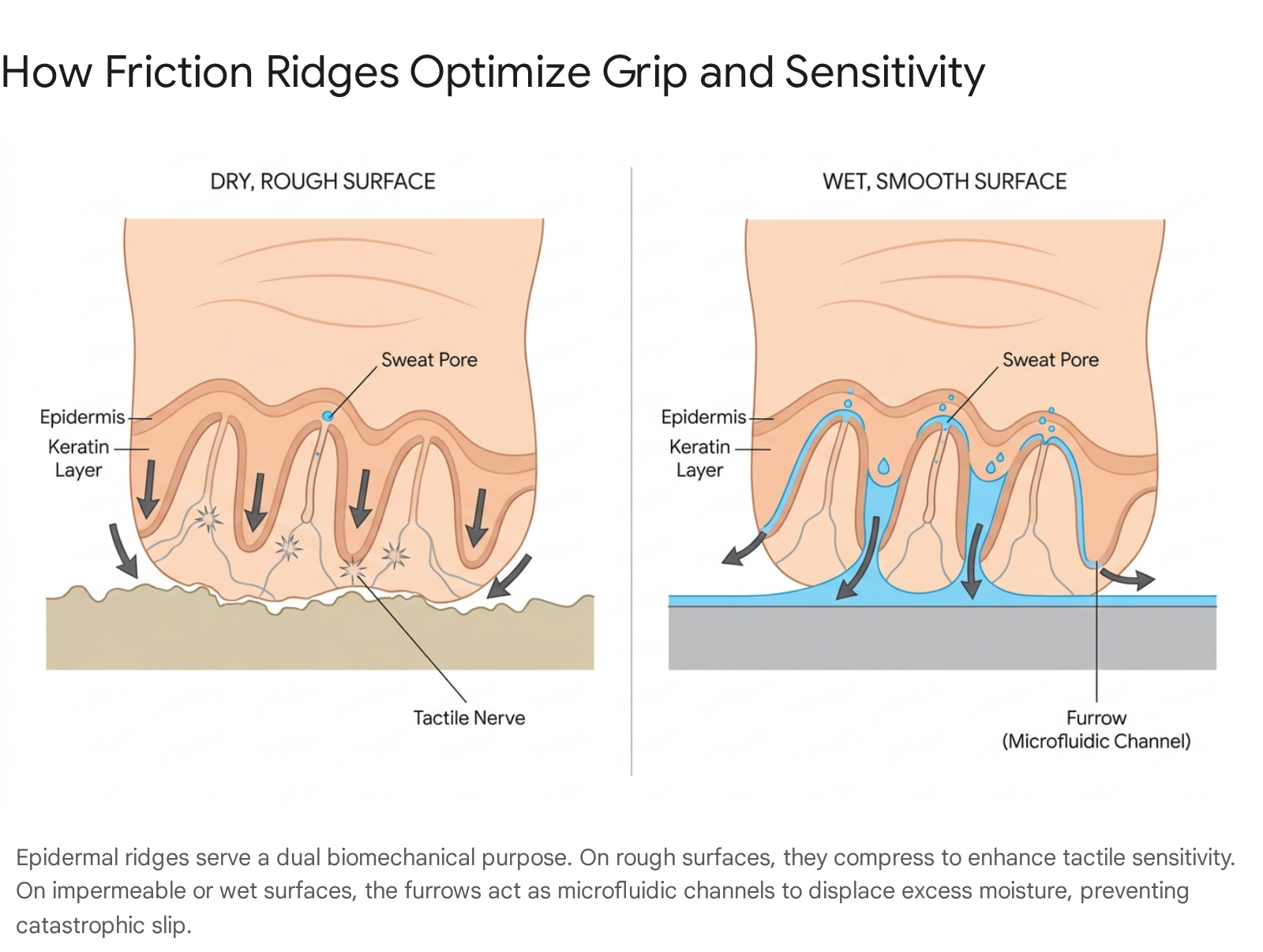
The ridges of a fingerprint act as mechanical amplifiers. When a finger sweeps across a textured surface, the ridges vibrate. These microscopic vibrations are transmitted deep into the skin, precisely matching the frequency sensitivity of the mechanoreceptors 127. This evolutionary adaptation allows humans and other primates to assess the texture, weight, and stability of an object instantaneously, enabling fine motor skills and precision manipulation 67.
The Moisture Regulation Breakthrough
The most significant recent breakthrough in understanding the evolutionary purpose of fingerprints came from a 2020 study published in the Proceedings of the National Academy of Sciences (PNAS) 6. Researchers sought to explain why the volar regions of the hands and feet feature a massive density of sweat glands that respond to psychological stress and anxiety rather than physiological thermoregulation (heat) 6.
The researchers utilized femtosecond laser-based polarization-tunable terahertz wave spectroscopic imaging to observe fingers gripping objects 6. They discovered that fingerprints are an advanced moisture-regulating mechanism designed to prevent "catastrophic slip" 6.
Keratin, the primary protein in the outer layer of skin, requires an optimal level of hydration to maximize friction 6. If the skin is too dry, it lacks grip; if it is too wet, a hydrodynamic fluid layer forms, causing the skin to hydroplane across smooth surfaces 6. When a primate grabs a dry object, the stress-induced sweat glands in the ridges instantly pump moisture to plasticize the keratin, maximizing friction 6. Conversely, when gripping a wet object, the deep furrows between the ridges act as microfluidic channels. The excess water is forced into the furrows and evaporates via side menisci, maintaining the exact hydration balance required to secure a grip 6.
| Evolutionary Theory | Proposed Function | Current Scientific Consensus |
|---|---|---|
| Rough Surface Interlocking | Ridges act like tire treads to interlock with the microscopic peaks and valleys of rough surfaces. | Partially correct, but insufficient to explain the high density of sweat glands or performance on smooth surfaces 6. |
| Tactile Amplification | Ridges vibrate upon contact with textures, transmitting specific frequencies to deep mechanoreceptors. | Highly supported. Ridges enable sub-micron texture detection critical for primate precision manipulation 612. |
| Moisture Regulation | Furrows channel away excess external water while sweat glands precisely hydrate the ridge keratin to optimize friction. | Strongly supported. Explains why palmar sweat glands respond to stress (the need to grip/fight/flee) rather than heat 6. |
Analyzing the Unseen: How Fingerprints Are Used
To utilize fingerprints for forensic or biometric identification, analysts rely on a hierarchical categorization of ridge flow and specific anatomical anomalies.
Latent, Patent, and Plastic Prints
There are three primary types of fingerprints that investigators encounter in the field 5158: 1. Patent Prints: Visible prints created when a finger is coated in a substance like blood, grease, ink, or dirt and touches a surface 515. 2. Plastic Prints: Three-dimensional impressions left in soft, pliable materials such as clay, wax, soap, or fresh paint 515. 3. Latent Prints: The most common and challenging type. Latent prints are invisible transfers of natural sweat, sebum (oils), and environmental contaminants left on a surface 25. They require chemical fuming (like cyanoacrylate or superglue), dusting powders, or alternative light sources to become visible 27158.
The Minutiae That Define Us
While overarching class characteristics (loops, whorls, arches) are used to filter and categorize prints within databases, they cannot uniquely identify an individual 45. Unique identification relies on minutiae - the highly localized, microscopic points where the continuity of a friction ridge is interrupted 9.
The most common minutiae include: * Bifurcations: The point where a single continuous ridge splits into two distinct ridges 15910. * Ridge Endings: A ridge that terminates abruptly within the print 159. * Enclosures (Lakes): A single ridge that bifurcates and subsequently rejoins itself after a short distance, leaving an empty space in the middle 159. * Dots (Islands): An isolated ridge segment whose length is approximately equal to its width 159. * Short Ridges: A ridge that travels a short distance before ending 15.
During a traditional forensic examination, an analyst visually maps the spatial relationship, directionality, and sequence of these minutiae to determine if a latent print from a crime scene shares an identical topological map with a known reference print 24.
The CSI Effect: Hollywood Myths vs. Crime Lab Reality
Public perception of forensic science is heavily skewed by the "CSI Effect," a phenomenon where exaggerated media portrayals lead the general public - and consequently, jury members - to hold unrealistic expectations regarding the speed, accuracy, and availability of forensic evidence 19201112.
In television and film, crime scene technicians easily lift pristine, fully intact fingerprints from any surface, including textured gun grips or fabric 2324. In reality, latent prints are fragile. They typically only survive on non-porous, smooth surfaces like glass, mirrors, metal, or polished wood 52324. Highly textured surfaces, raw wood, or grooved gun grips break up the fragile ridge details, making it incredibly rare to pull a highly detailed, usable print off the handle of a firearm 23.
Furthermore, Hollywood portrays the Automated Fingerprint Identification System (AFIS) as a magical search engine that flashes a "MATCH" alongside the suspect's photograph within seconds 1223. AFIS is a powerful tool, but it does not make final identifications. When an examiner inputs a latent print, AFIS utilizes complex algorithms to return a list of potential candidates who possess statistically similar ridge characteristics 1023. A human examiner must then conduct a painstaking, manual point-by-point comparison under magnification to verify if the latent print matches any of the candidates, a process that can take hours or even days 122325.
| Forensic Reality | Hollywood Portrayal | The Truth |
|---|---|---|
| Surface Viability | Prints easily lifted from gun grips, fabric, and textured surfaces. | Prints require smooth, non-porous surfaces (glass, metal). Textured surfaces break up ridge details 23. |
| Database Matching | AFIS flashes "MATCH" with a single suspect photo in seconds. | AFIS only returns a list of candidates. A human examiner must manually confirm the match 1223. |
| Print Quality | Crime scene prints are pristine, full-hand transfers. | Real latent prints are often smudged, partial, or heavily distorted by environmental factors 223. |
The Myth of Infallibility: Error Rates and Bias
Fingerprint identification was introduced to criminal investigations in the late 19th century and was quickly heralded by courts and the public as an infallible science 1314. However, the reality of latent fingerprint analysis involves high degrees of human subjectivity, imperfect evidentiary samples, and measurable rates of error 131529.
The PCAST Report and False Positive Controversies
The assumption that fingerprint analysis possesses a "zero error rate" was dismantled by a landmark 2016 report published by the President's Council of Advisors on Science and Technology (PCAST) 131617. The PCAST report fundamentally shifted the legal landscape by declaring that while latent fingerprint analysis has "foundational validity," it is a subjective methodology heavily reliant on human judgment, and it possesses a substantial false positive rate 1316.
A false positive occurs when an examiner incorrectly declares that a latent print from a crime scene matches the reference print of an innocent person. PCAST reviewed comprehensive "black box" studies and found that the false positive rate could be as high as 1 error in 306 cases (based on a massive FBI/Noblis study) or even 1 error in 18 cases (based on a study by the Miami-Dade police laboratory) 131819.
The forensic community vigorously debated these figures. The Organization of Scientific Area Committees (OSAC) for Forensic Science argued that the PCAST report failed to detect statistical calculation errors in the Miami-Dade study 1934. OSAC noted that because the Miami-Dade study provided multiple non-mated reference prints for each trial, the actual false positive rate was substantially lower. Out of 3,687 opportunities to make a false positive, only 42 occurred, equating to a 1.1 percent error rate. If clerical errors were removed, the rate dropped to 0.19 percent 19.
Despite debates over the exact mathematical denominator, the scientific consensus is settled: fingerprint identification is not infallible 20. The Department of Justice now explicitly prohibits examiners from testifying that a fingerprint match is "100% certain" or that human fingerprints can be individualized to the exclusion of all other people on Earth with zero margin for error 2021.
Cognitive Bias in the Laboratory
Because the ACE-V method (Analysis, Comparison, Evaluation, and Verification) relies entirely on human visual perception, examiners are highly susceptible to cognitive bias 342223. Cognitive neuroscientists have demonstrated that an examiner's interpretation of an ambiguous, low-quality latent print can be subconsciously altered by task-irrelevant information 2224.
For example, if an examiner is told that the suspect has already confessed, or that the suspect's DNA was found on the weapon, their brain will naturally search for minutiae in the fingerprint that confirm this narrative - a phenomenon known as confirmation bias 2240. The human brain has a tendency to look for shortcuts, leading experts to systematic processing errors stemming from snap judgments based on minimal data 22.
Linear Sequential Unmasking (LSU-E) and Blind Verification
To combat cognitive contamination, modern forensic laboratories are increasingly adopting a protocol known as Linear Sequential Unmasking-Expanded (LSU-E) 22232441. LSU-E requires that examiners analyze the latent evidence in total isolation, documenting all visible minutiae and determining the print's suitability before they are allowed to see the suspect's known reference print or hear any details about the police investigation 2341.
This strictly linear process ensures that the examiner's initial analysis of the evidence cannot be reverse-engineered or distorted by the desired conclusion 4142. Furthermore, laboratories are utilizing "Blind Verification," wherein a second examiner reviews the evidence without knowing the first examiner's conclusion 404325. This independent review acts as a critical failsafe against confirmation bias and human error 4325.
Can You Lose Your Fingerprints?
Despite the forensic maxim that fingerprints are permanent and immutable, specific medical, occupational, and traumatic conditions can alter or entirely erase friction ridges.
Medical Adermatoglyphia and Chemotherapy
Chemical and medical interventions can induce severe, albeit temporary, adermatoglyphia (the loss of fingerprints). Certain antineoplastic chemotherapy drugs, primarily Capecitabine (an oral prodrug of 5-fluorouracil), induce a severe dermatological adverse effect known as Hand-Foot Syndrome (HFS) or palmar-plantar erythrodysesthesia 26272829.
HFS presents as redness, swelling, blistering, and desquamation on the palmar and plantar surfaces 2829. In extreme cases, the condition causes a total loss of fingerprint ridges, resulting in biometric identification failures at border crossings, banks, and on smartphones 262728. Clinical studies indicate that 14 percent of patients treated with capecitabine experience a severe loss of fingerprint quality 26. Fortunately, capecitabine-induced adermatoglyphia is generally reversible, with severe fingerprint quality recovering completely within two to four weeks after the discontinuation of the chemotherapy treatment 2627.
Occupational Wear and Intentional Mutilation
Occupational wear is another common cause of adermatoglyphia. Individuals who engage in intensive manual labor involving abrasive materials - such as bricklaying or masonry - can mechanically wear down their epidermal ridges 12. However, once the abrasive activity ceases, the ridges typically regenerate because the structural blueprint remains anchored deep within the basal layer of the dermis 2.
Intentional mutilation is a method by which individuals actively attempt to erase their biometric signatures. Throughout history, criminals have utilized acid, hot metal, and surgical excision to destroy their prints 1012. In 2009, a suspect named Jose Izquierdo attempted to alter his prints by cutting Z-shaped incisions into his fingertips, swapping the skin flaps, and suturing them back together 10. Despite these extreme measures, the Federal Bureau of Investigation (FBI) notes that mutilation often backfires; the resulting severe scars become highly unique individualizing characteristics that make the suspect even easier to identify 510.
The AI Disruption: Re-evaluating Fingerprint Uniqueness
For over a century, the foundational premise of fingerprint biometrics was that every single fingerprint is entirely unique, even among different fingers belonging to the exact same person 3031. In forensic terms, "intra-person" fingerprints were considered completely unmatchable 32. If a criminal left a right thumbprint at one crime scene and a left index fingerprint at another, investigators had no way to connect the two scenes unless they had the suspect's full ten-print card on file 3233.
The 2024 Columbia University Study
In 2024, a groundbreaking study published in the journal Science Advances by a research team at Columbia University shattered this deeply entrenched paradigm 30325354. The researchers, led by Gabe Guo, fed a public U.S. government database of approximately 60,000 fingerprints into a specialized artificial intelligence framework known as a deep contrastive network 303233.
The neural network was tasked with predicting whether two randomly presented fingerprints belonged to the same person. Traditional forensic software analyzes fingerprints by mapping minutiae (bifurcations and ridge endings) 54. The AI, however, ignored traditional minutiae entirely. Instead, it learned to analyze the overarching spatial relationships, specifically the angles, ridge density, and curvature of the swirls at the absolute center of the fingerprint 3031325354.
The results were unprecedented. The AI proved with over 99.99 percent confidence that fingerprints from different fingers of the same person share profound, predictable similarities 313354. The neural network correctly identified intra-person prints with a success rate of 77 percent for a single pair of fingers, and accuracy increased significantly when multiple pairs were evaluated 303253. The researchers theorize that these similarities are driven by the broader genetic ridge orientation dictated during early fetal development, which affects all fingers universally before environmental noise creates the localized minutiae 5354.
While an accuracy rate of 77 percent is not high enough to secure a criminal conviction in court, the discovery represents a massive leap for investigative intelligence 3355. By recognizing that fingers from the same person are mathematically related, law enforcement can use AI to prioritize leads, exonerate innocent suspects, and connect disparate cold cases that were previously thought to involve entirely different perpetrators 3353.
The Vulnerability of Biometric Security
The unique nature of fingerprints has led to their widespread adoption in commercial security, primarily as an authentication measure for smartphones and digital banking 285657. However, just as the assumption of absolute forensic uniqueness has been challenged, the digital security of fingerprint scanners has proven vulnerable to advanced exploitation.
Smartphone Fingerprint Scanners and False Acceptance Rates
Biometric security relies heavily on False Acceptance Rates (FAR) and liveness detection. Unlike a digital password, which must match perfectly, a fingerprint scanner can never demand a 100 percent match because environmental variables (sweat, dirt, finger placement) constantly alter the image 58. Therefore, scanners operate on a threshold; if the scan is "close enough" to the stored template, access is granted 5834.
The BrutePrint Exploit
In 2023, security researchers Yu Chen and Yiling He unveiled a devastating exploit called "BrutePrint," which demonstrated that Android smartphone fingerprint authentication (SFA) frameworks contain fundamental structural vulnerabilities 603536. Operating on a modest $15 printed circuit board, attackers physically access the target smartphone's motherboard and intercept the Serial Peripheral Interface (SPI) between the fingerprint sensor and the processor 603563.
BrutePrint weaponizes two zero-day vulnerabilities in the Android framework: Cancel-After-Match-Fail (CAMF) and Match-After-Lock (MAL) 566063. Normally, a smartphone will lock a user out after a set number of failed biometric attempts 35. The BrutePrint hardware exploits the CAMF flaw to invalidate the checksum of the fingerprint data, effectively tricking the system into registering a faulty transmission rather than a failed authentication 6035. This bypasses the rate limits, granting the attacker infinite attempts 566035. MAL exploits a side-channel to infer matches even when the device enters a lockout mode 60.
Once infinite attempts are secured, the system uploads a dictionary of synthetic fingerprint templates generated via neural style transfer 5635. By rapidly cycling through thousands of synthetic prints, the system inevitably triggers a false acceptance match, unlocking the device, granting access to private data, and authorizing payments 565736. Tests revealed that the BrutePrint attack successfully bypassed security on 10 widely utilized Android devices, taking anywhere from 40 minutes to 14 hours depending on the number of authorized prints stored on the phone 563463. Notably, iOS devices (iPhones) repelled the attack because Apple encrypts the SPI communication channel between the Touch ID sensor and the system enclave, preventing the hijacking of image data 3563.
Bottom line
Fingerprints are a remarkable evolutionary adaptation, utilizing a complex moisture-regulation system to grant humans optimal grip and sub-micron tactile sensitivity. While developmental biology ensures that every single fingerprint is entirely distinct, the forensic systems used to identify them are highly subjective, susceptible to cognitive bias, and statistically fallible. As artificial intelligence reveals unexpected mathematical similarities between our fingers and hackers expose the vulnerabilities of biometric locks, it is clear that fingerprints are not the infallible, magical identifiers depicted in popular culture, but rather a powerful, nuanced tool requiring rigorous scientific oversight.