
Science of body language and common misconceptions
Nonverbal communication constitutes a critical and highly complex dimension of human interaction, encompassing a wide array of physical modalities, including kinesics (facial expressions and body movements), proxemics (the use of personal space), haptics (touch), and paralinguistics (vocal tone and pitch). Historically, both the general public and specific institutional sectors - such as law enforcement and corporate human resources - have relied heavily on popularized, simplistic interpretations of body language. These models operate under the assumption of somatic determinism, positing that specific physical movements act as highly reliable, deterministic indicators of internal emotional states, cognitive processes, or deceptive intent.
The proliferation of popular psychology literature has entrenched the belief that human beings constantly "leak" their true intentions through micro-expressions, posture shifts, and nervous habits, fostering an entire industry built upon the premise of definitively "reading" people 121. However, contemporary neurobiological, anthropological, and psychological research presents a vastly more complex, nuanced, and culturally contingent framework. The scientific consensus reveals that nonverbal behavior is highly contextual, culturally mediated, and heavily influenced by cognitive load rather than fixed emotional leakage 234. The assumption that universal, hardwired expressions can be translated directly into psychological states without cultural or contextual grounding has been systematically dismantled by empirical evidence 56.
This report synthesizes decades of peer-reviewed empirical research to delineate the actual science of nonverbal communication, systematically deconstruct the fallacies propagated by popular psychology, and examine the modern implications of these misunderstandings in the context of criminal interrogations and the development of artificial intelligence.
The Neurobiology of Facial Expressions
To understand the science of nonverbal communication, it is first necessary to examine the neurological architecture that controls human facial musculature. Human facial expressions are governed by highly specialized and anatomically distinct neural pathways that facilitate different types of movement: voluntary (deliberate) and involuntary (spontaneous) 78.
Cortical and Subcortical Motor Pathways
Voluntary facial movements - such as a deliberate smile posed for a photograph or a polite expression utilized to mask disappointment - are coordinated by cortical pathways. These volitional signals originate primarily in the face area of the primary motor cortex (M1) and the ventrolateral regions of the premotor cortex. These cortical areas send direct efferent signals to the motor neurons in the lateral segment of the contralateral facial nucleus, which subsequently innervates the lower facial muscles 79. This system evolved later in human phylogenetic development, allowing for the strategic modulation of expressions necessary for complex social interactions, group cohesion, and status negotiation 8. The control exerted by the motor cortex is generally coarser and less nuanced than spontaneous expression, which frequently allows astute observers to distinguish a forced expression from an authentic one 8.
Conversely, involuntary, spontaneous facial expressions generated by authentic emotional experiences are mediated by the extrapyramidal tract, which originates in older, subcortical regions of the brain. The limbic system, operating as the brain's emotional processing center, comprises interconnected structures including the amygdala, hypothalamus, hippocampus, and periaqueductal gray (PAG) 10. When a subject experiences an intense authentic emotion, the amygdala and other limbic structures transmit signals through the cingulate motor cortex directly to the facial nucleus 79. The facial nerve ultimately acts as the final common pathway, summating the signals arriving from both the volitional cortical centers and the emotional limbic centers to produce the final facial configuration 8.
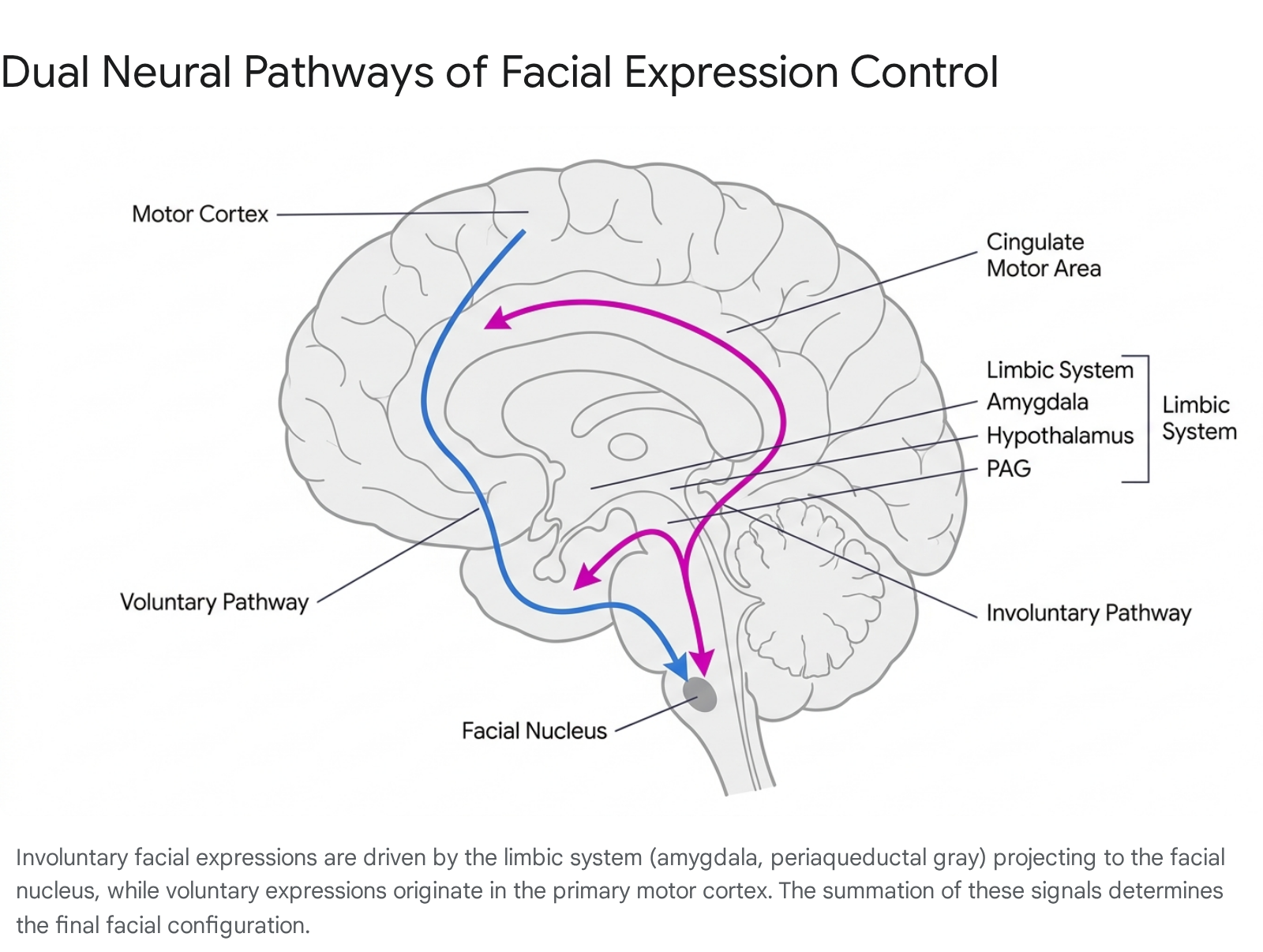
This dual-control mechanism is most clearly observable in clinical neurology among stroke patients. Patients who suffer strokes in the territory of the middle cerebral artery, which damages the primary motor and premotor areas, develop voluntary facial palsy. They are unable to produce a symmetrical, deliberate smile on command; however, if presented with a genuinely humorous stimulus, their limbic pathway remains intact, allowing them to produce a perfectly symmetrical, spontaneous smile 78. Conversely, patients with damage to the anterior cerebral artery, affecting the midcingulate area, retain voluntary control over their facial muscles but exhibit amimia - the inability to produce spontaneous emotional expressions 7.
However, recent functional MRI and electrophysiological research conducted on nonhuman primates suggests that this strict subcortical/cortical dichotomy may be somewhat oversimplified in real-time processing. Studies indicate that emotion-driven facial expressions, such as grimaces, activate many of the same cortical pathways as voluntary movements, including the primary motor cortex and somatosensory cortex 11. This suggests that the cortical coding of emotional facial expressions operates hierarchically, with information flowing from the cingulate cortex to the primary motor cortices to drive real-time adjustments, rendering the strict separation of emotion and cognition artificially rigid 11.
Reevaluating the Duchenne Smile Hypothesis
The neurobiological dichotomy between voluntary and involuntary pathways has historically been operationalized in psychological literature through the study of the "Duchenne smile." Named after the 19th-century French neurologist Guillaume Duchenne, this hypothesis postulates that a genuine smile of joy necessitates the simultaneous, involuntary activation of two specific muscle groups: the zygomaticus major, which pulls the lip corners upward toward the cheekbone, and the orbicularis oculi, which contracts the skin around the eyes, producing distinctive "crow's feet" 1213.
In the Facial Action Coding System (FACS), the activation of the orbicularis oculi is designated as Action Unit 6 (AU6), while the zygomaticus major is designated as Action Unit 12 (AU12) 1415. Pop psychology and traditional discrete emotion theory have long asserted that a smile lacking AU6 is a "fake" or "non-Duchenne" smile, serving as a reliable indicator of deception, forced politeness, or masked negative emotion 121415.
However, modern empirical evaluations applying Bayesian multilevel regression models have fundamentally challenged the strict diagnostic value of the Duchenne smile as a lie detector. Contemporary research indicates that the activation of the orbicularis oculi (AU6) is more accurately categorized as a biometric artifact of smile intensity rather than an exclusive marker of genuine positive affect. When researchers control for the intensity of the zygomaticus major activation (AU12), the unique association between AU6 and self-reported genuine amusement diminishes substantially 1214.
In practical terms, highly intense fake smiles will reliably trigger the eye-constriction muscle, while mild but genuinely happy smiles may not trigger it at all 14. Furthermore, electromyography (EMG) studies reveal that social modulation significantly impacts muscle activation; subjects are more likely to display Duchenne markers when viewing ingroup members compared to outgroup members, regardless of baseline joy 16. Consequently, inferring the authenticity of a subject's emotional state solely by checking for the presence of a Duchenne marker frequently yields false conclusions, highlighting the danger of reducing complex neuro-motor responses to binary "true/false" indicators 1415.
Cross-Cultural Variability in Nonverbal Behavior
A core tenet of popular body language literature is the universality of human expression. Championed in the mid-to-late 20th century by researchers such as Paul Ekman and Silvan Tomkins, the universality hypothesis posits that humans possess a finite set of "basic" emotions - specifically happiness, sadness, fear, disgust, anger, and surprise - that map onto identical, biologically hardwired facial configurations across all cultures 41718. Under this framework, a scowl inherently means anger, and a pout inherently means sadness, irrespective of the subject's geographic or linguistic background 6.
Empirical Challenges to Universality
Contemporary anthropological and psychological research fundamentally refutes strict universality, demonstrating that cultural context significantly shapes both the perception and production of nonverbal cues. A landmark study conducted by Lisa Feldman Barrett and Maria Gendron examined emotion perception among the Himba, a remote ethnic group in the Kunene region of northwestern Namibia, compared to participants in the United States 4619. Using a face-sorting task, the researchers required participants to group images of posed facial expressions. When Western emotion concept words (e.g., "sadness," "disgust") were provided as anchors, both cultures sorted the faces in a roughly similar manner, which historically led researchers to assume universality.
However, in a free-labeling paradigm where participants were asked to sort the faces without pre-provided emotion words, the results diverged completely 46. United States participants grouped the faces according to discrete internal emotional states, utilizing mentalistic labels such as "sadness" or "anger." In contrast, the Himba participants grouped the faces according to physical actions or behavioral contexts, utilizing descriptive labels such as "looking at something" or "laughing" 46. The researchers concluded that the perception of facial expressions is not universally hardwired; rather, it is deeply dependent upon the conceptual and linguistic context of the observer 619.
Furthermore, separate cross-cultural studies utilizing computer graphics platforms to reconstruct mental representations of basic emotions revealed profound divergences between Eastern and Western populations. While Western populations represent each of the six basic emotions with a distinct set of facial movements common to the group, Eastern cultures do not adhere to these standard models. Instead, Eastern populations represent emotional intensity primarily through distinctive, dynamic eye activity, whereas Westerners rely heavily on the lower face and mouth 18. This refutes the long-standing universality hypothesis and highlights the powerful influence of culture in shaping basic behaviors once considered biologically innate 1820.
Proxemics and Kinesthetics Across Cultures
Beyond facial expressions, cultural variability strictly dictates the meaning of hand gestures (kinesthetics), touch (haptics), and the use of personal space (proxemics). Rooted in the theoretical frameworks of Symbolic Interactionism and Embodied Cognition, nonverbal behaviors act as symbols through which individuals negotiate meaning during everyday interactions 21.
Western cultures frequently interpret direct, sustained eye contact as a metric of confidence, honesty, and attentiveness. Conversely, in many East Asian and Middle Eastern cultures, sustained direct eye contact is perceived as invasive, disrespectful, or aggressive, particularly when interacting with authority figures 212223. Proxemic norms are similarly divergent. In Northern Europe and the United States, professional interactions demand a larger radius of personal space, whereas Latin American and Middle Eastern norms dictate closer physical proximity, which is interpreted as warmth, familiarity, and trust 2224.
Fundamental hand gestures share no global baseline and can precipitate severe cross-cultural misunderstandings. The "thumbs-up" sign, ubiquitous as an affirmative signal of approval in Western contexts, carries highly offensive, insulting connotations in parts of the Middle East, South America, and West Africa 23252627. Similarly, the "OK" sign (thumb and forefinger forming a circle) means "fine" in North America, but translates to "money" in Japan, "zero" or "worthless" in France, and functions as a homophobic slur or severe obscenity in Brazil, Greece, and Turkey 222627. Pointing with the index finger is considered deeply rude in East Asian and Latin American cultures; instead, individuals in the Philippines, Puerto Rico, and Native American communities frequently use a subtle pointing motion with their lips 2526. Even highly specific regional gestures, such as "The Forks" in Australia or the "Pinky Raise" in China, carry highly localized semiotic weight that defies universal categorization 28.
Deception Detection and Meta-Analytic Evidence
The assumption that human beings can visually detect lies by observing nervous tics, gaze aversion, or posture shifts is perhaps the most pervasive and legally damaging fallacy in the realm of nonverbal communication. Pop psychology literature routinely asserts that lying induces psychological stress, which "leaks" through the body as observable behavioral anomalies 21. Consequently, laypeople, corporate managers, and police officers alike believe they can spot a liar through physical tells.
Popular Myths Versus Statistical Reality
The definitive empirical answer to the behavioral leakage hypothesis was established by DePaulo et al. in an exhaustive 2003 meta-analysis encompassing 120 samples and investigating 88 distinct nonverbal cues 329.
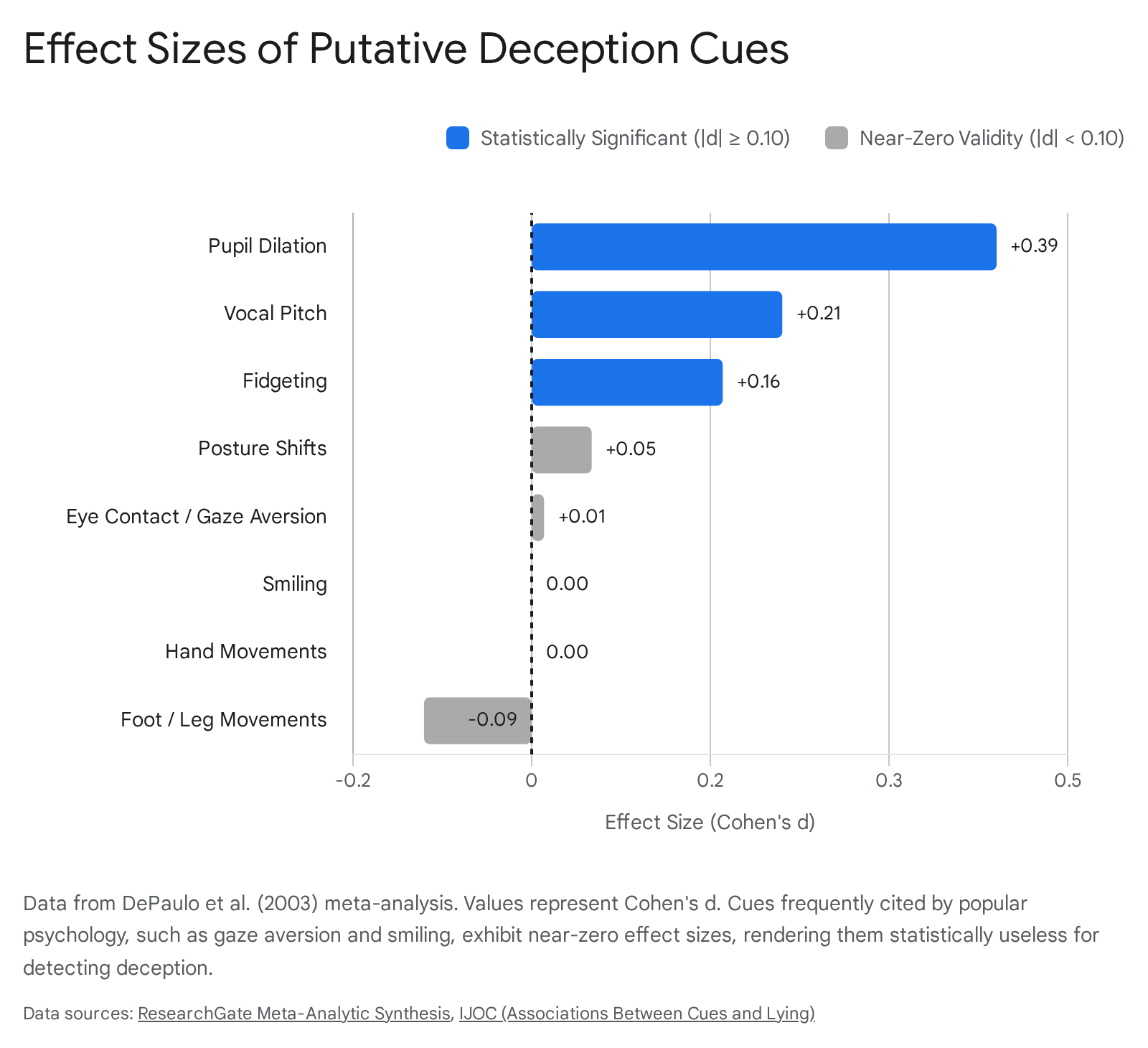
The results systematically dismantled the notion of reliable visual lie detection.
Cues most frequently relied upon by laypeople to infer deceit - such as lack of eye contact, smiling, posture shifts, and hand movements - produced effect sizes ($d$) hovering near absolute zero 29. Specifically, gaze aversion yielded a $d$-value of 0.01, smiling yielded 0.00, and posture shifts yielded 0.05 29. Statistically, there is no reliable visual difference between a truthful individual experiencing the baseline stress of being interviewed and a deceptive individual actively maintaining a cover story. When experts survey the field of deception research, the singular point of consensus exceeding 80% agreement is that gaze aversion is entirely non-diagnostic of deceit 30.
The meta-analysis did identify a few cues that reached statistical significance. Pupil dilation ($d = 0.39$), vocal pitch elevation ($d = 0.21$), and general nervousness ($d = 0.27$) are modestly correlated with deceptive statements 329. However, the magnitude of these effects is considered remarkably small by conventional statistical benchmarks. More importantly, these cues are indicators of cognitive load and physiological arousal, not deception per se. A truthful suspect terrified of false imprisonment or a nervous job applicant will exhibit the exact same pupillary dilation, vocal strain, and physical tension as a guilty suspect 33.
Subsequent meta-analyses by Sporer and Schwandt (2006, 2007) utilized more conservative inclusion criteria and found slightly different results, noting minor significance in hand movements ($d = 0.38$) and response latency ($d = 0.21$), but these conflicting findings further underscore the unreliability of visual cues across varying contexts 29. Human ability to detect lies with no contextual aids results in an average of 54% accuracy - a rate marginally better than random chance 3135.
Interrogation Methodologies and False Confessions
The persistence of body language myths yields severe, occasionally catastrophic consequences within the criminal justice system, particularly concerning how law enforcement officials conduct suspect interrogations. For decades, many North American police departments have utilized accusatorial frameworks, most notably the Reid Technique, developed in the mid-20th century 3135.
The Reid Technique and Behavior Symptom Analysis
The Reid Technique relies fundamentally on a pre-interrogation phase known as the Behavior Analysis Interview (BAI). During this phase, investigators utilize "Behavior Symptom Analysis" to ask hypothetical, behavior-provoking questions and observe the suspect's nonverbal reactions - such as crossed arms, averted gaze, paralinguistic hesitation, or grooming behaviors - to determine if the suspect is deceptive 3532. Proponents of the Reid Technique historically claimed that this process could reveal a deceptive suspect with accuracy rates exceeding 80% 3532.
However, empirical testing has definitively proven that human lie detection based on visual behavior fails to surpass chance levels 23135. Once investigators mistakenly classify an innocent suspect as guilty based on these pseudo-scientific behavioral symptoms, they proceed to the accusatory phase of the Reid Technique. This nine-step interrogation process utilizes isolation, direct confrontation, the prohibition of denials, and the deployment of "minimization themes" 333435. Minimization involves the interrogator suggesting face-saving excuses for the crime, subtly implying that a confession will result in leniency, while maximization tactics exaggerate the strength of the evidence 3435. In many jurisdictions, this includes the use of false evidence ploys, where investigators explicitly lie about possessing DNA, CCTV footage, or failed polygraph results 3637.
The consequences of these methods are well-documented. Controlled laboratory experiments simulating mock crimes (such as the Russano cheating paradigm) have demonstrated that while the Reid Technique is highly effective at extracting confessions from the guilty, it also produces an alarmingly high rate of false confessions among the innocent - sometimes increasing false confession rates by 40-50% compared to non-coercive methods 353338. Vulnerable populations, particularly juveniles and individuals with cognitive impairments, are exceptionally susceptible to these pressure tactics 3539. Real-world data from DNA exonerations corroborates these experimental findings; according to the Innocence Project, police-induced false confessions are present in over 25% of wrongful conviction cases, with 80% of those cases involving false evidence ploys 3539.
The Strategic Use of Evidence Framework
In response to the scientific failure of behavioral lie detection and the crisis of false confessions, psychological researchers developed an information-gathering framework known as the Strategic Use of Evidence (SUE) technique 2404146. Rather than observing posture or eye contact, SUE leverages cognitive load and the inherent psychological differences between guilty and innocent suspects.
Empirical research establishes that guilty suspects naturally adopt avoidance strategies, attempting to withhold incriminating details to protect their cover story. Innocent suspects, conversely, typically adopt an open strategy, assuming the truth will naturally exonerate them 246. In a SUE interview, the investigator begins with open-ended questions, intentionally withholding the specific evidence they possess (e.g., CCTV footage or witness statements) 3140. Because the guilty suspect is unaware of what the investigator knows, they frequently construct a narrative that directly contradicts the withheld evidence. The investigator then reveals the evidence late in the interview, trapping the liar in a verifiable statement-evidence inconsistency 246.
By shifting the investigative focus from highly subjective nonverbal behavior to objectively verifiable verbal inconsistencies, the SUE technique aligns interrogation practices with empirical science. Training studies reveal that investigators utilizing SUE achieve deception detection accuracy rates of roughly 85%, significantly outperforming untrained control groups 231.
The following table summarizes the fundamental differences between these two methodologies based on current forensic psychology literature:
| Feature | Reid Technique (Accusatorial) | Strategic Use of Evidence (Information-Gathering) |
|---|---|---|
| Primary Detection Method | Subjective observation of nonverbal cues (Behavior Symptom Analysis) | Objective analysis of verbal statement-evidence inconsistencies |
| Pacing of Evidence | Presented early to confront, overwhelm, and trap the suspect | Withheld until late to test the suspect's constructed narrative |
| Theoretical Foundation | Stress leakage and somatic determinism | Cognitive load and counter-interrogation strategies |
| Accuracy in Deception Detection | ~54% (statistically equivalent to chance) | ~85% in trained experimental laboratory settings |
| Risk of False Confessions | High (documented in both lab settings and DNA exoneration data) | Minimal; prioritizes factual accuracy over obtaining a confession |
The Replication Crisis in Popular Psychology
The disconnect between the empirical realities detailed above and public perception is largely sustained by a highly lucrative pop-psychology literature industry. Books and seminars that promise to grant readers the ability to secretly decode the thoughts of colleagues, romantic partners, and adversaries rely heavily on reductive, deterministic mappings of gesture to meaning.
The Methodological Flaws of Body Language Literature
A prominent example is Allan and Barbara Pease's internationally bestselling The Definitive Book of Body Language, which claims that human gestures are "scientific facts" giving away true intentions 1. Authors in this genre frequently attribute singular, universal meanings to highly variable physical actions. For instance, the text claims that covering the mouth or touching the face is an automatic indicator of deceit, ignoring the myriad reasons a person might touch their face, ranging from cognitive processing and self-soothing to simple physical pruritus 2. Furthermore, critiques of such literature note pervasive biases, particularly in how male and female interactions are interpreted. Gestures are frequently framed through an aggressive, hyper-sexualized, or dominant/submissive lens, reducing complex professional and social interactions into rudimentary evolutionary stereotypes 247.
Postural Determinism and the Power Posing Hypothesis
The academic domain is not entirely immune to the allure of somatic determinism. In 2010, researchers Carney, Cuddy, and Yap published a highly publicized study proposing the "power posing" hypothesis. They claimed that assuming expansive, high-power nonverbal postures for just two minutes could not only increase subjective feelings of confidence but also cause measurable endocrinological changes - specifically, an elevation in testosterone and a decrease in cortisol, alongside an increase in risk-taking behavior 42. The concept became a cultural phenomenon, popularized by viral public lectures and widespread media coverage.
However, as the replication crisis swept through the social sciences over the subsequent decade, the empirical foundation of the power posing hypothesis collapsed. In 2015, a rigorous conceptual replication by Ranehill et al., utilizing a much larger sample size of 200 participants and superior controls, failed to reproduce any of the physiological or behavioral effects claimed by the original study 42. While participants did self-report feeling subjectively more powerful, their hormone levels and objective risk tolerance remained entirely unchanged. Amidst intense academic scrutiny and debates regarding methodological rigor, the study's lead author, Dana Carney, ultimately renounced the theory entirely, issuing a statement that she no longer believed power posing effects were real 42. This high-profile retraction illustrates the immense danger of drawing vast physiological and behavioral conclusions from isolated kinesthetic variables.
Artificial Intelligence and Emotion Recognition
The pseudoscientific belief that facial configurations operate as transparent windows into human emotion has recently been encoded into modern technology. Over the past decade, a multi-billion-dollar industry has emerged around Artificial Intelligence Emotion Recognition (ER). Technology conglomerates market algorithmic systems to corporations, governments, and educational institutions, claiming their computer vision software can analyze video feeds to determine if a job applicant is trustworthy, if a student is engaged in a lesson, or if a citizen in a public square is exhibiting hostile intent 17434445.
Algorithmic Reliance on Discrete Emotion Theory
These AI systems largely operate on the outdated Ekman models of universal discrete emotions, mapping geometric changes in facial landmarks (e.g., a furrowed brow, stretched lips, or narrowed eyes) directly to definitive affective states 174647. To determine the scientific validity of these systems, the Association for Psychological Science (APS) commissioned an exhaustive, two-year systematic review of over 1,000 empirical studies on emotional expression, led by neuroscientist Lisa Feldman Barrett and a panel of experts representing diverse theoretical camps 54345.
The expert panel arrived at a unanimous conclusion: there is no scientific justification for the premise that a person's emotional state can be reliably inferred solely from their facial movements 5. The data reveals profound limits in algorithmic reliability, specificity, and generalizability 17. For example, the review found that when individuals experience genuine anger, they produce a classic "scowl" less than 30% of the time 4345. The remaining 70% of the time, angry individuals might smile, cry, or maintain a neutral expression, heavily dependent upon the social context and cultural display rules. Furthermore, people frequently scowl when they are not angry - such as when concentrating deeply, experiencing physical discomfort, or listening to a confusing statement 454648.
An AI algorithm designed to flag a "scowl" as a threat or a sign of anger will therefore generate massive rates of false positives and false negatives. Barrett notes that while advanced computer vision algorithms are highly proficient at detecting and measuring facial movements (the observation), the leap from observing a muscle contraction to inferring an internal psychological state (the inference) is an unsupported heuristic leap 1748.
Physiognomy and Ethical Implications
Ethicists, psychologists, and critical technology scholars warn that automated emotion recognition represents a digital resurgence of physiognomy - the discredited 19th-century pseudoscience of assessing a person's character, abilities, and morality based on their physical appearance, facial features, or skull shape 4749505152. By ignoring cultural contexts, individual variability, and the systemic complexities of human expression, emotional AI threatens to encode algorithmic racism and systemic discrimination into hiring, surveillance, and legal procedures 505152.
For instance, individuals on the autism spectrum, or those with other cognitive impairments, frequently exhibit blunted affect or atypical facial responses. These individuals are routinely misclassified by ER software as disengaged, deceptive, or lacking empathy, resulting in severe psychological distress and systemic disadvantages in AI-mediated job interviews and educational tracking systems 4453. The employment of these technologies without robust ethical frameworks infringes upon privacy rights and risks manipulating users by generating a false sense of "pseudo-intimacy" with machines that fundamentally lack empathy 445154. The growing backlash against these unscientific applications has prompted some major corporations, such as HireVue, to completely remove facial emotion analysis from their algorithmic assessments following formal complaints 47.
Conclusion
The rigorous scientific investigation of nonverbal communication dismantling popular dogma reveals a critical truth: the human body is not a biological lie detector, nor is it a transparent transmitter of internal emotion. While nonverbal communication undoubtedly enriches human interaction and serves as a vital component of socialization, it operates as an inherently ambiguous, culturally dependent, and highly contextual secondary channel.
The neurobiology of the human brain, utilizing both cortical and subcortical pathways, allows for sophisticated masking and dual-control of expression, rendering efforts to catalog isolated movements as definitively "genuine" or "fake" profoundly flawed. Furthermore, the anthropological record definitively proves that meaning cannot be divorced from culture; a gesture, gaze, or proxemic habit that signals deep respect in one hemisphere may signal aggression in another. Most critically, the pervasive belief that nervous tension or specific postures reliably indicate deception possesses no statistical backing and actively corrupts investigative and judicial processes. When operationalized via coercive frameworks like the Reid method, these misconceptions directly contribute to false confessions and wrongful convictions.
As society increasingly integrates computer vision and artificial intelligence into its critical decision-making infrastructure, distinguishing empirical science from pop-psychology pseudoscience is no longer merely an academic exercise. Relying on automated physiognomy to judge human character risks scaling the flaws of popular body language myths to an industrial level, underscoring the vital need for evidence-based approaches that respect the profound complexity and variability of human behavior.