
Psychological and neural mechanisms of recreational fear
Recreational fear - a behavioral phenomenon encompassing the voluntary pursuit of frightening, anxiety-inducing, or conventionally aversive experiences for the explicit purpose of enjoyment - presents a profound psychological and evolutionary paradox. From a strictly Darwinian perspective, fear is an adaptive, highly conserved survival mechanism designed to motivate the immediate avoidance of physical and existential threats. It initiates an instantaneous cascade of physiological responses, primarily driven through the sympathetic nervous system, to prepare the biological organism for fight, flight, or freeze responses. Thus, the deliberate pursuit of fear-inducing stimuli, such as consuming supernatural horror media, navigating immersive haunted attractions, engaging in extreme thrill-seeking sports, or even participating in aggressive physical play, appears counterintuitive and maladaptive. Nevertheless, empirical evidence indicates that engagement with recreational fear is a near-universal human behavior that emerges early in the developmental lifecycle. Comprehensive developmental studies reveal that an overwhelming 93% of children actively participate in playful, fear-inducing activities, ranging from physical thrill-seeking like rough-and-tumble play to the consumption of scary media, suggesting that playing with fear is deeply woven into human ontogeny 122.
To fully comprehend the allure of fear, one must adopt a multidisciplinary framework that synthesizes evolutionary psychology, cognitive neuroscience, trait psychology, and cultural anthropology. The following exhaustive analysis deconstructs the mechanics of recreational fear, establishing Paul Rozin's theory of "benign masochism" as a foundational theoretical bedrock. This analysis deeply integrates modern neurobiological data, focusing on threat processing circuitry, physiological synchrony, and recent functional magnetic resonance imaging (fMRI) studies detailing neural network connectivity in clinical populations. Furthermore, the theoretical scope is expanded to incorporate Threat Simulation Theory (TST), charting the application of horror consumption in building psychological resilience and regulating emotion. The analysis actively identifies and systematically debunks enduring cultural misconceptions, particularly the myth that horror consumers possess lower empathy or elevated antisocial traits. Finally, the report critically evaluates the cross-cultural manifestation of recreational fear, deliberately moving beyond conventional Western-centric models to analyze how distinct cultural, spiritual, and socio-economic realities in regions such as Nigeria, Kenya, Indonesia, Brazil, and Lebanon fundamentally shape the production, interpretation, and consumption of frightening stimuli.
Theoretical Foundations: Benign Masochism and the Protective Frame
The cognitive foundation of recreational fear is best articulated through the paradigm of "benign masochism," a psychological concept pioneered by Paul Rozin. Benign masochism describes the distinctly human tendency to seek out negative-valence experiences - such as the painful, burning sensation of capsaicin in spicy food, the profound sorrow induced by tragic narratives, the physical exhaustion of extreme sports, or the terror provoked by horror films - and derive psychological pleasure from the underlying realization that the perceived threat is ultimately harmless 3457. This hedonic reversal occurs when higher-order cognitive systems located in the neocortex actively override primitive, subcortical alarm responses, allowing the individual to experience a profound sense of mastery over a primal, evolutionary reflex 56.
In the specific context of recreational fear, this cognitive override is facilitated and sustained by a psychological construct known as a "protective frame" 5789. The protective frame acts as a cognitive safety net, providing a contextual cue that signals to the brain that the immediate environment, despite presenting intense sensory input strongly suggestive of danger, is structurally and physically secure. In interactive storytelling, virtual reality environments, or commercial haunted house attractions, this frame is established through multiple layers of reassurance: the implicit knowledge of the narrative's artificiality, the presence of institutional safety protocols, or the social buffering provided by being in the company of friends and family 8910. When this protective frame holds intact, the profound biological response to a perceived threat is cognitively reappraised as exhilarating excitement rather than genuine terror.
However, the psychological balance between fear and pleasure is exquisitely delicate. Rigorous empirical investigations, particularly field studies conducted in high-intensity, naturalistic settings utilizing wearable physiological telemetry, have revealed that the relationship between fear intensity and subjective enjoyment is not linear. Instead, it precisely follows an inverted-U-shaped curve 311121314. If the fear stimulus is too weak or predictable, the experience fails to engage the autonomic nervous system and is deemed boring; conversely, if the stimulus is overwhelmingly intense or persists for too long, the protective frame shatters, leading to genuine psychological distress and avoidance behavior. Peak enjoyment resides in a precise "sweet spot" or "Goldilocks zone" - a state of physiological and psychological arousal where the stimulus is frightening enough to trigger robust biological activation, yet manageable enough to permit continuous cognitive reframing 121315.
The Neurobiology of Threat: Distinguishing Genuine Terror from Recreational Thrill
The differentiation between genuine, involuntary fear and controlled recreational fear is profoundly inscribed in human physiology and neural circuitry. Contemporary field studies have systematically mapped these distinctions, moving beyond artificial, low-intensity laboratory stimuli to measure bodily responses in highly dynamic, immersive threat environments 111416.
When a human encounters a genuine, uncontrolled threat, sensory information is relayed to the amygdala, which rapidly signals the hypothalamus to initiate a massive sympathetic nervous system cascade. This authentic fight-or-flight response involves the suppression of gamma-aminobutyric acid (GABA) inhibitory controls within the basolateral amygdala, permitting the expression of profound fear 17. The endocrine system responds with the secretion of corticotropin-releasing hormone (CRH), adrenocorticotropic hormone (ACTH), and ultimately potent glucocorticoids like cortisol, alongside massive dumps of catecholamines such as epinephrine and norepinephrine 4171819. Physiologically, this genuine threat response manifests as a dramatic, sustained spike in tonic heart rate, drastically decreased heart rate variability (HRV), peripheral vasoconstriction, and intense electrodermal activity (EDA) 1619. Crucially, genuine anxiety and prolonged fear heavily activate the bed nucleus of the stria terminalis (BNST), which sustains the physiological alarm state long after an initial startling stimulus has passed, creating a prolonged, slow-onset startle reflex 18. In cases of inescapable real-world threat, this overwhelming allostatic load leads to immune system suppression, cognitive impairment, and severe neurochemical dysregulation 2419.
Conversely, recreational fear leverages the neurobiological architecture of the mammalian play system. While the initial orienting response to a jump scare (phasic arousal) still activates the central nucleus of the amygdala (CeA) and the sympathetic nervous system - resulting in temporary spikes in heart rate and skin conductance - the overarching neurochemical environment is entirely distinct from genuine terror 16182021. The conscious perception of the protective frame engages prefrontal regulatory circuits, specifically the ventromedial prefrontal cortex (vmPFC) and dorsolateral prefrontal cortex (dlPFC), which actively modulate and downregulate the amygdala's output 1422.
Simultaneously, the subcortical play system floods the brain with endogenous dopamine, rendering the frightening experience inherently rewarding, alongside endogenous opioids, which exert a palliative, antinociceptive effect 5620. These neurochemicals biochemically buffer the physical startle, preventing the escalation into a full defensive fight-or-flight state and converting the aversive sensory input into a source of intense euphoria 61920.
Recent psychophysiological data extracted from participants in commercial haunted houses illuminate this dynamic with remarkable granularity. Researchers have established that the subjective experience of being frightened corresponds linearly with large-scale heart rate fluctuations. However, subjective enjoyment corresponds to an inverted-U relationship with small-scale heart rate fluctuations 1123.
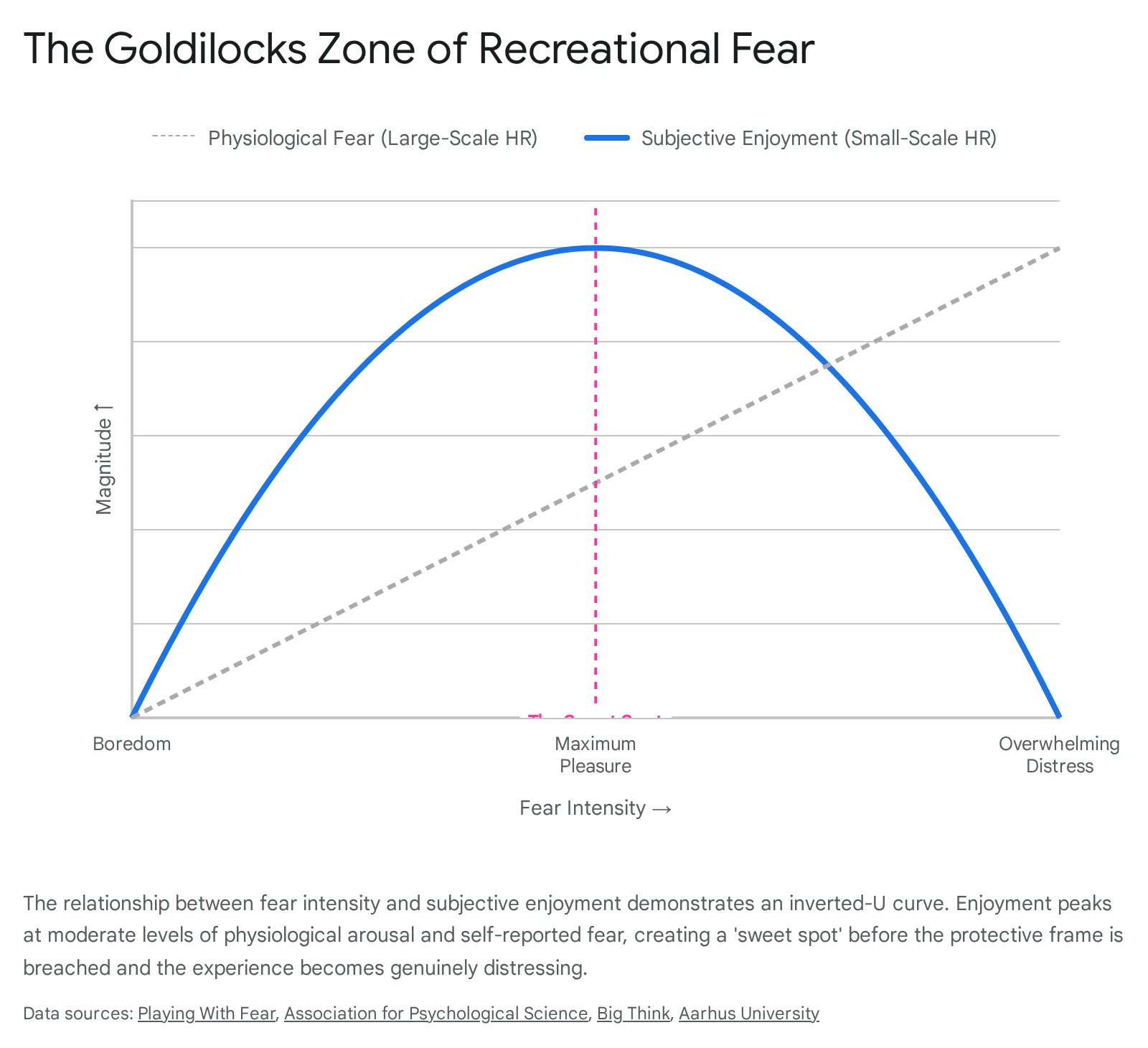
This suggests that pleasure in horror is derived from rapid, highly controlled micro-deviations from baseline homeostasis, rather than massive, sustained autonomic disruptions 1112. Furthermore, social context fundamentally alters physiological threat processing. The presence of socially close individuals during a frightening experience increases overall tonic physiological arousal through a mechanism of fear contagion; yet, it simultaneously enhances physiological heart-rate synchrony and subjective enjoyment 162123. This physiological synchrony acts as a social buffer, reinforcing the protective frame and allowing groups to collectively surf the edge of uncertainty.
Table 1: Comparative Physiological and Cognitive Markers: Genuine Fear vs. Recreational Fear
| Parameter / Domain | Involuntary Genuine Fear (Real-World Threat) | Controlled Recreational Fear (Benign Masochism) |
|---|---|---|
| Cognitive Framing | Perception of immediate, uncontrolled existential or physical danger; absence of any "protective frame" 2627. | Active "protective frame" allowing cognitive distancing; conscious acknowledgment of artificiality or environmental safety 5710. |
| Primary Neural Activation | Sustained hyperactivity in the amygdala, bed nucleus of the stria terminalis (BNST), and periaqueductal gray 171824. | Initial central amygdala (CeA) activation rapidly modulated and downregulated by the ventromedial prefrontal cortex (vmPFC) 141822. |
| Neurochemical Profile | High cortisol/corticosterone, sustained epinephrine release; depletion of dopamine and opioid peptide function over time 41719. | Transient epinephrine spikes counterbalanced by surges in endogenous dopamine (reward) and endogenous opioids (palliative buffering) 5620. |
| Cardiovascular Dynamics | Extreme, sustained elevation in tonic heart rate and blood pressure; profoundly suppressed heart rate variability (HRV) 181929. | "Sweet spot" micro-deviations; enjoyment linked to optimal small-scale heart rate fluctuations and synchronized group rhythms 1123. |
| Startle Reflex | Prolonged, slow-onset startle reflex (light-enhanced startle effect) mediated by the BNST that fails to dissipate quickly 18. | Phasic, fear-potentiated startle response that dissipates rapidly once the acute stimulus passes 18. |
| Behavioral Motivation | Genuine fight, flight, freeze, or fawn responses; profound, long-term avoidance behavior 11920. | Approach behavior, active exploration, threat simulation, and playful engagement (threat-rehearsal) 32025. |
| Long-Term Outcomes | Risk of PTSD, chronic anxiety, immune suppression, and maladaptive allostatic load 241719. | Enhanced emotion regulation, stress resilience, cognitive mastery, and transient normalization of maladaptive neural networks 1425. |
Evolutionary Psychology: Threat Simulation Theory and Predictive Processing
To comprehend why natural selection preserved the complex neural architecture necessary for benign masochism, one must turn to evolutionary psychology, specifically Threat Simulation Theory (TST). Originally formulated by cognitive neuroscientist Antti Revonsuo to explain the evolutionary function of dreaming, TST posits that human consciousness evolved a specialized, highly active biological defense mechanism for the offline simulation of threatening events 31262728. During human evolution, the ancestral environment was fraught with severe predatory, environmental, and social dangers. Individuals who possessed the neural machinery to mentally rehearse threat perception and avoidance behaviors in a low-risk internal environment held a distinct survival advantage, leading to increased reproductive success 262936.
Extensive empirical analyses of dream content strongly support TST, revealing that nearly 75% of adult dreams contain at least one threatening event, commonly involving aggression, interpersonal conflict, fleeing predators, or physical accidents 2837. The system is highly responsive to waking experiences; empirical studies comparing severely traumatized Kurdish children with non-traumatized Finnish children demonstrated that those living in chronically dangerous environments possess a hyper-activated threat simulation system, producing dreams with significantly higher frequencies and severities of simulated threats 26. In essence, the brain utilizes the physical paralysis of REM sleep as a biologically safe virtual reality simulator to practice survival without incurring physical harm 312736.
Recreational fear - specifically the consumption of horror cinema, true crime narratives, and apocalyptic fiction - can be understood as the waking, cultural extension of Threat Simulation Theory. By actively engaging with frightening fictions, modern humans voluntarily immerse themselves in simulated dangers to train and refine their predictive processing models 3031. In predictive processing frameworks, the human brain operates as an advanced inference machine, constantly updating its internal models based on environmental feedback to minimize uncertainty and prediction error 2731. Horror entertainment expertly co-opts these cognitive systems by presenting profound, high-level threats to homeostasis and self-organization (e.g., supernatural monsters, serial killers, infectious outbreaks, societal collapse) operating strictly within a protective frame 2531.
This psychological phenomenon, often termed "morbid curiosity," is not a pathological defect but a highly adaptive, evolutionary learning mechanism. Viewers gather crucial social and ecological knowledge, safely mapping out behavioral and emotional strategies for dealing with dangerous situations 283032. For example, the consumption of true crime media allows individuals - particularly women, who make up the majority of its audience - to simulate scenarios of interpersonal violence, thereby learning about predatory behaviors, honing emotion management, and increasing their perceived psychological preparedness 1133. Consequently, recreational fear functions as an educational technology, an emotional simulator evolved for navigating an inherently uncertain world.
Emotion Regulation, Stress Resilience, and Psychiatric Innovations
The hypothesis that recreational fear functions as a cognitive training ground for threat processing is robustly supported by recent empirical datasets concerning emotion regulation and stress resilience. If horror consumption allows individuals to rehearse anxiety management and threat response, those who regularly engage with the genre should theoretically demonstrate superior coping mechanisms during genuine, real-world crises. This theoretical prediction was rigorously tested and validated during the unprecedented stress of the COVID-19 pandemic.
In comprehensive behavioral studies conducted throughout 2020 and 2021, researchers discovered that avid consumers of horror films reported significantly lower levels of psychological distress and exhibited greater psychological resilience during the initial, highly uncertain months of the global lockdowns 25303443. Notably, fans of "prepper" genres - such as apocalyptic, zombie, and alien-invasion films - reported not only lower psychological distress but also a significantly higher sense of practical preparedness for the pandemic 253043. This phenomenon likely occurred because these individuals had spent hundreds of hours vicariously practicing the regulation of negative emotions (fear, dread, isolation) and simulating the navigation of a collapsed society. Through repeated exposure to simulated danger, they had developed a potent sense of personal agency and emotional flexibility, effectively utilizing fiction as a stress-inoculation tool 253235.
The precise mechanisms by which individuals leverage horror for emotion regulation vary based on their distinct psychological profiles. Empirical taxonomies have identified three distinct categories of recreational horror consumers: 1. Adrenaline Junkies: Individuals who maximize the physiological thrill, seeking the dopaminergic rush and mood elevation that follows the intense parasympathetic rebound after a scare 34. 2. White Knucklers: Consumers who actually find the horror experience highly aversive and anxiety-inducing, yet deliberately force themselves through it to challenge their own boundaries and learn about their personal limits, effectively engaging in a form of self-directed exposure therapy 34. 3. Dark Copers: A complex psychological cohort that utilizes horror explicitly to navigate real-world trauma, anxiety, or psychological distress. They report finding profound comfort in the genre because it provides a tangible, external target for their free-floating anxiety, allowing them to exert conscious control over their emotional state and securely process dread 343536.
The clinical implications of these findings are profound, particularly in the realm of psychiatric intervention and the treatment of mood disorders. Groundbreaking fMRI research published in 2025 has begun to explicitly explore the therapeutic potential of controlled recreational fear for individuals diagnosed with mild-to-moderate depression 142237. Clinical depression is frequently characterized by emotional blunting, anhedonia, and a hyper-connected Default Mode Network (DMN) and Salience Network (SN), which trap the individual in devastating cycles of negative, self-referential rumination 142237.
When exposed to highly arousing, standardized fear stimuli in a controlled setting, depressed participants demonstrated significantly altered neural responses compared to healthy controls. Specifically, they required a much higher intensity of fear stimuli to reach the inverted-U "sweet spot" of enjoyment, a physiological shift directly reflecting their underlying emotional blunting and anhedonia 14. However, during the peak fear experience, these depressed individuals exhibited robust recruitment of the ventromedial prefrontal cortex (vmPFC) and a targeted attenuation of the amygdala, suggesting enhanced engagement of higher-order regulatory circuits 1422. Most critically, resting-state fMRI scans taken immediately after the recreational fear exposure revealed a transient normalization of the dysfunctional DMN-SN connectivity 142237. The intense, present-moment cognitive demand of the simulated threat forced the brain out of its ruminative loop, actively engaging emotion-regulatory networks. While still in preliminary, correlational stages, this cutting-edge research suggests that the structured, time-limited, and voluntary application of severe psychological stimuli could serve as a novel adjunctive therapeutic strategy for resetting maladaptive neural circuits in mood disorders 1437.
Debunking Stereotypes: Empathy, Aggression, and Prosociality in Horror Consumers
A pervasive, enduring cultural myth posits that individuals who habitually consume violent, horrifying, or macabre media must inherently possess blunted empathy, heightened aggression, or underlying antisocial and psychopathic traits 364738. The underlying logic of this stereotype assumes a direct linear transfer: viewing cinematic cruelty must inevitably desensitize the consumer to real-world suffering, eroding their moral compass. However, rigorous psychometric and behavioral studies consistently and emphatically dismantle this assumption, proving that the psychological profile of the average horror fan is frequently the exact antithesis of the coldhearted stereotype.
In recent multi-experiment psychological studies designed explicitly to test the relationship between horror consumption and prosocial traits, researchers found absolutely no negative correlation between genre fandom and affective empathy (the ability to vicariously feel another's emotional pain) 4738. The data definitively revealed that individuals who enjoyed horror films were no more likely to be cruel, selfish, or aggressive than non-fans 4738. In fact, the findings yielded a surprising inverse relationship regarding certain prosocial traits: greater enjoyment of horror was significantly correlated with higher levels of cognitive empathy (the ability to accurately recognize, map, and understand another person's emotional state) and lower levels of coldheartedness 4738.
This apparent paradox is easily resolved when horror consumption is viewed through the lens of emotional engagement rather than violent ideation. To effectively enjoy a horror narrative, the consumer must possess a highly developed capacity for "theory of mind" and cognitive empathy; they must be able to psychologically project themselves into the highly vulnerable position of the protagonist to truly feel the suspense and terror 39. Without high cognitive empathy, the threat simulation fails to engage the viewer's autonomic nervous system, rendering the film boring rather than frightening.
Furthermore, engaging with psychological horror specifically has been shown to yield unexpected prosocial benefits regarding pervasive societal stigmas. Given that psychological horror frequently utilizes severe mental illness as a narrative trope for danger (e.g., the psychotic killer acting as the monster), one might logically assume that consumption of this media exacerbates the dehumanization and marginalization of those with actual psychiatric disorders 3650. However, a 2024 empirical survey published in the Journal of Media Psychology found the exact opposite: greater consumption of psychological horror was statistically associated with less stigmatization and reduced dehumanization of individuals experiencing mental illness 50405241.
Researchers theorize that this unexpected reduction in stigma occurs through complex mechanisms of cognitive habituation and contrast 40. Frequent exposure to extreme, fictionalized depictions of psychiatric distress may lower the consumer's baseline fear and anxiety regarding mental illness in the real world, functioning as a form of exposure therapy 40. Additionally, the extreme, fantastical nature of cinematic antagonists provides a powerful contrast effect, making real-world individuals suffering from mental illness appear markedly less threatening by comparison 40. Thus, rather than eroding moral boundaries or promoting aggression, recreational horror often acts as a complex empathy-training simulator, reinforcing prosocial values by highlighting the fragility of human life and the absolute necessity of cooperation in the face of existential threats 4354.
Trait Psychology: Mapping Personality to Negative-Valence Preferences
While the basic neurological capacity for benign masochism is a universal human trait, the specific vectors through which individuals choose to experience it - whether through consuming extreme capsaicin, jumping from airplanes, or watching supernatural horror - are heavily dictated by differential personality traits. The most robust psychometric tool historically used to predict these preferences is the Sensation Seeking Scale (SSS-V), originally developed by Marvin Zuckerman to understand the biological basis of optimal arousal 554243.
Sensation seeking is defined as the trait-level need for varied, novel, complex, and intense sensations, coupled with the willingness to assume physical, social, legal, or financial risks to acquire such experiences 55424445. The scale is subdivided into four distinct facets: Thrill and Adventure Seeking (TAS; preference for physically risky sports), Experience Seeking (ES; desire for novel sensory or mental experiences), Disinhibition (DIS; preference for socially uninhibited behaviors), and Boredom Susceptibility (BS; a remarkably low tolerance for repetition or monotony) 55424346.
Neurologically, high sensation seekers (HSS) exhibit an overactive approach system and high Sensitivity to Reward (SR), driven by differing baseline dopamine receptor densities and arousal thresholds. Conversely, low sensation seekers (LSS) possess a highly reactive inhibitory system and are exquisitely sensitive to punishment and threat 44454748. In fMRI studies evaluating risk appraisal and dynamic decision-making, HSS individuals display blunted neural responses to negative-valence stimuli and intentionally reduced attention to potential losses, allowing them to easily override defensive reflexes when consuming highly stimulating content 444546. This neurological profile perfectly explains why individuals high in SR and Sensation Seeking are significantly more likely to enjoy the burning trigeminal pain of spicy food, easily translating the capsaicin-induced physiological alarm into a profoundly rewarding gastronomic experience 474849.
Beyond the SSS-V, the Big Five (and HEXACO) personality trait of Openness to Experience (often categorized as Intellect/Imagination) is a massive, independent predictor for the enjoyment of negative-valence media, particularly horror 743505166. Individuals scoring high in Openness exhibit profound neural flexibility, a trait mapping directly to increased gray matter volume in the frontopolar cortex, which governs executive function and the evaluation of novel ideas 52. Crucially, high Openness is also correlated with lower gray matter volume in the right ventromedial prefrontal cortex (vmPFC) and left fronto-insular cortex, structural profiles that effectively reduce automatic inhibitory reactions to unpleasant or threatening stimuli 52. These individuals engage with horror not necessarily for the raw physiological thrill sought by adrenaline junkies, but for the intellectual stimulation, narrative complexity, and the safe psychological exploration of taboo, morbid, or existentially terrifying concepts 73068.
Table 2: Mapping Psychological Profiles to Preferred Negative-Valence Activities
| Preferred Negative-Valence Activity | Primary Psychological Driver / Trait | Neurological & Behavioral Profile |
|---|---|---|
| Horror / Macabre Media Consumption | Intellect/Imagination (Openness), Morbid Curiosity, Need for Affect 730344339. | High cognitive empathy and theory of mind. Driven by the desire to simulate threats, explore existential questions, and practice emotion regulation from a physically safe vantage point; linked to flexible frontopolar cortex activity 7385253. |
| Extreme Thrill / Adventure Sports | Thrill and Adventure Seeking (TAS facet of the SSS-V), High Sensation Seeking 55424345. | Overactive dopaminergic approach system; attenuated neural sensitivity to negative outcomes. Rapid habituation to baseline stimuli necessitates intense, physical risks to achieve optimal arousal homeostasis 444546. |
| Spicy Food / Capsaicin Consumption | Sensitivity to Reward (SR), Experience Seeking (ES), Sensation Seeking 474849. | Innate rewarding response to sensory irritation. Benign masochism transforms trigeminal pain signals into pleasure via cognitive framing and endorphin release, operating independently of sensitivity to punishment 474849. |
| Sad / Tragic Narratives | Empathy, High Environmental Sensitivity, Need for Affect 3954. | High affective reactivity. Enjoyment is derived from catharsis, the safe processing of grief, and the profound physiological relief that follows intense weeping (parasympathetic activation) 53950. |
| True Crime / Paranormal Investigation | Morbid Curiosity, Experience Seeking, Threat Simulation 11303353. | Desire to demystify real-world predators or existential unknowns. Frequently utilized by audiences (notably female demographics) as a mechanism for perceived preparedness, meaning-making, and understanding human malevolence 113033. |
Cross-Cultural Paradigms: The Manifestation of Recreational Fear in Non-Western Societies
The overwhelming majority of psychological literature on recreational fear, benign masochism, and emotion regulation currently relies on WEIRD (Western, Educated, Industrialized, Rich, and Democratic) sampling 55. This creates a critical epistemological blind spot, as the perception of threat, the conceptualization of the supernatural, and the socio-environmental baseline of safety vary radically across global cultures. Examining recreational fear through a diverse cultural lens reveals that while the biological hardware of fear is a universal mammalian trait, the software of its interpretation and consumption is entirely culturally constructed.
In Western contexts, the "protective frame" necessary for recreational fear relies heavily on the firm, secular ontological belief that the monsters depicted on screen (vampires, zombies, demons) are entirely fictional and do not actually exist 56. The thrill is derived from the sheer impossibility of the scenario. However, in many non-Western cultures, the boundaries separating the spiritual, metaphysical, and physical worlds are perceived as highly permeable and actively interacting. In the Nigerian film industry (Nollywood), the horror genre is not categorized as distant, abstract fantasy but is deeply anchored in the lived, everyday spiritual and traditional realities of its massive audience 5673. Nollywood horror heavily features culturally resonant, tangible threats such as bloodsucking witches, malevolent deities, ritualistic killings for wealth, and the dire consequences of breaking moral taboos (evidenced in seminal films like Living in Bondage, Nneka the Pretty Serpent, and Igodo) 5673.
For the Nigerian audience, the horror film is less an exercise in abstract threat simulation and more a vivid reflection of tangible societal anxieties and spiritual warfare. The fear generated is immediate and personal, heavily relying on the audience's preexisting belief systems regarding the supernatural and divine retribution 5673. The cinematic use of Computer-Generated Imagery (CGI) to depict metaphysical environments serves not merely to shock the viewer, but to visualize deeply held African ideologies concerning the battle between good and evil, invariably concluding with a didactic moral lesson where sanity, justice, and communal values triumph over malevolence 545673. This moral framing effectively acts as the localized version of the protective frame; the viewer can endure the terror because the narrative structure guarantees a restoration of moral order and societal balance.
Similarly, qualitative research conducted among Indonesian university students demonstrates that horror consumption in Southeast Asia is a deeply socialized and culturally mediated process. The emotional impact of an Indonesian horror film relies heavily on local Islamic mysticism and entrenched regional folklore regarding spirits 57. The fear is experienced collectively, actively enhancing social cohesion, and the interpretation of the terror is actively shaped by shared religious frameworks 57. In this context, fear is normalized as an integral part of media culture, actively sought out as a communal bonding mechanism rather than a solitary test of psychological endurance.
Cultural variance also fundamentally alters baseline fear profiles in developing demographics. A massive cross-cultural survey using the Fear Survey Schedule for Children (FSSC-R) revealed that Nigerian and Kenyan children report significantly higher total baseline fear levels than their counterparts in the United States, Australia, and China 58. Furthermore, religious affiliation strongly modulated these responses, with Christian children in these African nations reporting higher levels of specific fears compared to Muslim children, suggesting that differing theologies provide varying mechanisms for processing existential dread and the unknown 58.
Crucially, when the physical environment itself is chronically threatening, the psychological relationship to recreational fear shifts dramatically. In Brazil, longitudinal ethnographic studies focusing on street children in Pelotas reveal that constant exposure to severe physical threats, systemic abuse, and urban violence fundamentally alters the affective atmosphere of their daily lives 76. For individuals surviving in environments of chronic insecurity - such as regions experiencing devastating economic collapse, political instability, or active conflict, as detailed in 2026 data concerning university students in Lebanon - the adaptive value of simulated fear diminishes entirely 1132. If a person's baseline physiological state is already characterized by severe allostatic load and hypervigilance due to genuine environmental danger, the biological system cannot afford the energetic cost of engaging with recreational fear 1132. The 2026 Lebanese study highlighted that while morbid curiosity remained present, it did not translate into increased psychological resilience, completely subverting the findings from the Western COVID-19 pandemic studies 32. In such contexts, the protective frame cannot be established because the threat of violence and systemic collapse is not a simulation; it is an inescapable reality. Thus, the psychological luxury of benign masochism and recreational fear is, fundamentally, predicated on a baseline environment of relative safety.
Conclusion
The architecture of recreational fear is a profound testament to the evolutionary ingenuity of the human brain. Far from being a pathological quirk or an indicator of moral degradation, the voluntary pursuit of fear is a highly sophisticated cognitive technology. It leverages the ancient, highly conserved neurobiology of the fight-or-flight response, brilliantly decoupling the physiological arousal from genuine danger through the imposition of a cognitive protective frame and the biochemical buffering effects of endogenous dopamine and opioids.
Rooted deeply in Threat Simulation Theory, recreational fear serves as a vital psychological simulator, allowing individuals to rehearse emotional regulation, map survival strategies, and actively inoculate themselves against the paralyzing effects of real-world anxiety. The empirical data overwhelmingly debunks the cultural stereotype of the antisocial thrill-seeker, revealing instead that consumers of macabre and frightening media frequently possess high cognitive empathy, profound openness to experience, and a superior capacity to navigate systemic crises with psychological resilience.
However, the psychological efficacy and manifestation of recreational fear are contingent upon both individual personality profiles and profound cultural contexts. While Western audiences may consume horror as an abstract exercise in adrenaline modulation and uncertainty reduction, audiences in regions like Nigeria and Indonesia engage with it as a deeply resonant exploration of spiritual reality, moral order, and communal bonding. Ultimately, the rigorous scientific study of recreational fear provides an unparalleled window into the human condition, illustrating how we masterfully utilize simulated darkness to better prepare ourselves for the profound uncertainties of the real world.