
Why Do We Cling to False Beliefs Despite the Facts
Our brains are wired to prioritize social belonging and identity protection over objective truth, fundamentally altering how we process information. When faced with evidence that contradicts deeply held beliefs, we unconsciously filter or reject it to avoid the psychological pain of being estranged from our community. Even after a falsehood is successfully corrected, its shadow often lingers in our memory, continuously shaping our decisions long after the facts have been cleared up.
The Anatomy of a Stubborn Belief
To understand why evidence often fails to change minds, we must look at how the human brain processes reality. We like to think of our minds as objective cameras, recording facts and assembling them into logical conclusions. In truth, our perception is heavily filtered through our expectations, desires, and social allegiances. This filtering process leads to what psychologists call belief perseverance, a phenomenon where a person holds onto an idea even when presented with irrefutable evidence that it is false 1.
Belief perseverance typically falls into three categories. First are self-impressions, which involve how we evaluate our own athletic skills, musical talents, or ability to get along with others. Second are social impressions, which are the enduring beliefs we form about specific people in our lives, such as friends or teachers. Finally, we hold naive theories, which are our fundamental beliefs about how the world works, spanning everything from the causes of global poverty to stereotypes about different generations 1. When coherence in any of these areas is disrupted by new, conflicting information, our brains actively seek to reject the disruption to maintain a sense of internal order 1.
The Classic Dartmouth vs. Princeton Study
One of the most foundational demonstrations of how group allegiance warps objective perception occurred following a notoriously violent football game between Dartmouth and Princeton on November 23, 1951. At the time, Princeton entered the game undefeated, led by their star tailback, Dick Kazmaier, who had recently appeared on the cover of Time magazine 2. By the second quarter, Kazmaier was taken off the field with a broken nose and a mild concussion in a game plagued by severe penalties and rough play 23. The brutal aftermath sparked a flurry of angry editorials on both campuses, with each side blaming the other for the violence 34.
Intrigued by the polarizing reactions to a shared physical event, psychologists Albert Hastorf and Hadley Cantril conducted a landmark study in 1954 titled They Saw a Game: A Case Study. They surveyed students from both universities and asked them to watch a film of the game and objectively count the infractions 344.
The results were staggering. When asked if the game was unnecessarily rough and dirty, 93% of Princeton students said yes, and 86% of them blamed Dartmouth for starting the rough play 34. Meanwhile, while 81% of Dartmouth students agreed the game was "rough," almost half of them characterized the roughness as "fair," and 53% claimed both teams were equally at fault for starting it 34.
The visual evidence did nothing to unify their perspectives. When tallying objective rule violations on the film, Princeton students counted an average of 9.8 infractions by Dartmouth - more than twice the 4.3 infractions Dartmouth students counted for their own team 2. Hastorf and Cantril concluded that the students were not simply lying, forgetting, or being stubborn; they were experiencing fundamentally different realities 45. The event they perceived was actively constructed by their group allegiance. The researchers argued that when encountering a mix of occurrences as complex as a football game, humans primarily experience the events that fulfill a familiar pattern and carry personal relevance 4. People do not merely disagree about how to interpret what they see; their brains shape what they perceive in the first place, an effect often referred to as naive realism 46.
The Objectivity Benchmark: Why Referees Struggle to Stay Neutral
To highlight just how powerful this partisan bias is, it is useful to contrast fans with the people explicitly trained to overcome it: sports referees. Research into the psychology of sports officials reveals that objectivity is not a natural human baseline. Rather, it is a highly strenuous cognitive state that requires immense psychological resilience, training, and self-regulation 78.
The Intense Psychological Demands of Officiating
Referees face intense stress, high-speed decision-making demands, and hostile environments. They must evaluate complex actions, manage the game's flow, keep order, and solve disputes, all while being highly exposed to criticism from players, coaches, spectators, and the media 78. This constant exposure to scrutiny makes them highly susceptible to anxiety, which can negatively influence their mental health, attentional focus, and overall job satisfaction 8.
A study involving 708 football referees in Portugal demonstrated that stress is the primary predictor of negative emotions before and during a game. When officials lack coping mechanisms, their cognitive appraisal suffers, leading to performance errors 7. Yet, their intrinsic motivation and passion for the sport often persist even after making public errors, underscoring the deep psychological commitment required to maintain neutrality 9.
Referee Efficacy and Resilience
To combat the natural human tendency toward biased perception and emotional breakdown, referees rely heavily on a psychological construct known as "referee efficacy." This is defined as the extent to which referees believe they have the capacity to perform successfully in their highly pressured job 8. According to conceptual models, this efficacy is built upon mastery experiences, game knowledge, physical and mental preparedness, and environmental comfort 8. High referee efficacy not only mitigates stress and anxiety but also directly improves decision-making speed and accuracy, reducing athlete rule violations and increasing overall game satisfaction 8.
The contrast is deeply revealing. While referees undergo rigorous psychological conditioning and rely on structured efficacy models to maintain a baseline of neutrality, the average person navigating the world of politics, health, or social issues operates much like the parents and fans in the stands. Without the psychological armor of a referee, everyday people are heavily influenced by the proverbial jersey they are wearing 4.
Motivated Reasoning and the Need to Belong
In cognitive psychology, the tendency to gather evidence to support a desired conclusion is known as motivated reasoning 11. Unlike normal reasoning, which is driven by goals of accuracy and utilizes significant cognitive effort to process information objectively, motivated reasoning is driven by directional goals 11. This is not merely a matter of being lazy or uneducated; it is a highly active psychological process where individuals conform their assessments of information to an end that is extrinsic to accuracy 610.
Identity-Protective Cognition
When motivated reasoning is deployed specifically to defend our social standing or group membership, it is termed identity-protective cognition.
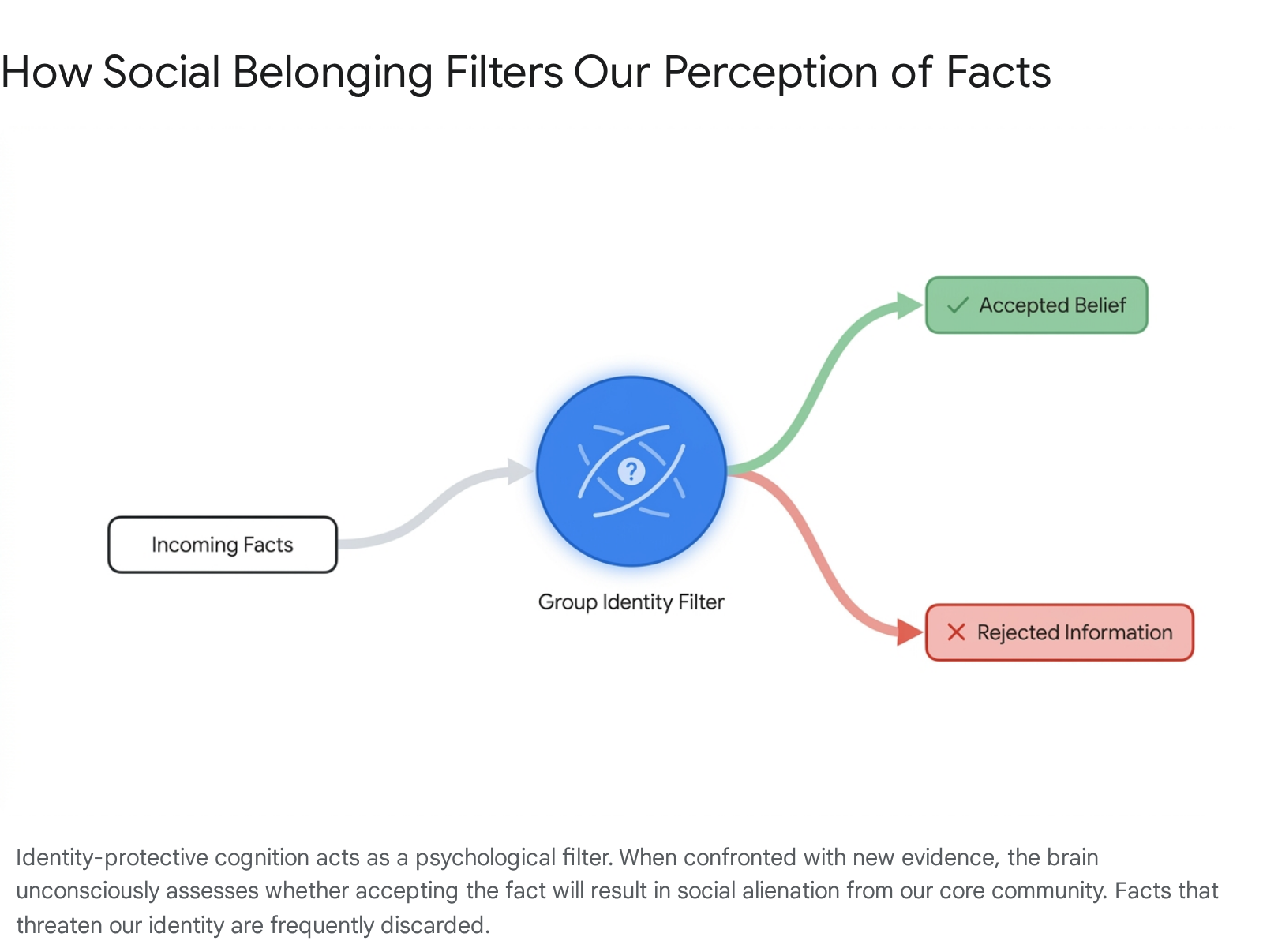
Developed extensively by researcher Dan Kahan and his colleagues, this theory posits that individuals face immense psychic pressure to resist propositions that threaten the character or competence of their reference group 611.
The stakes for the individual dictate how they process facts. For the average citizen, the personal physical cost of being wrong about the science of climate change, gun control, or a viral pandemic is virtually zero; an individual's personal error will not alter the global outcome 1012. However, the social cost of agreeing with a scientific consensus that contradicts their community's deeply held values can be devastating. Assenting to such propositions can result in severe social alienation, loss of material and emotional support, and a drop in self-esteem 615. Therefore, human beings have evolved to prioritize social cohesion over objective truth, viewing culture as prior to fact 15.
These processes manifest through several discrete psychological mechanisms. Through biased search, individuals selectively seek out information that supports their position. Through biased assimilation, they selectively credit or dismiss evidence based purely on its congeniality to their identity. Furthermore, they impute greater trustworthiness and knowledge to experts who reside within their affinity group while dismissing outside experts 6.
The "White Male Effect" and Risk Perception
One of the most striking empirical examples of identity-protective cognition is the "White Male Effect." Researchers have long documented that white men, on average, perceive various societal and environmental risks to be significantly lower than women and minority groups do 13.
Applying the cultural theory of risk, Kahan suggests this phenomenon is driven by motivated cognition. Hierarchical and individualistic white men express intense risk skepticism when activities that are integral to their cultural identities - such as commerce, industrialization, or gun ownership - are challenged as harmful 13. A large-scale study of 1,800 individuals confirmed that cultural worldviews interact profoundly with gender and race, dictating how individuals selectively credit or dismiss asserted dangers to support their preferred form of social organization 13.
The Intelligence Trap
Perhaps the most counterintuitive finding in this field is that higher intelligence does not cure motivated reasoning; it often exacerbates it. One might assume that individuals who rely on reflective, deliberative "System 2" thinking would be immune to bias. However, empirical studies show that individuals who score highest on cognitive reflection tests are actually the most likely to display ideologically motivated cognition 1012.
These individuals do not use their superior intellect to objectively uncover the truth. Instead, they use their advanced analytical skills to construct more sophisticated, technically complex defenses for the beliefs that are dominant in their group 61012. Because they are highly proficient at rationalization, they can seamlessly turn complex policy-relevant facts into divisive symbols of political identity, proving that motivated reasoning is not a failure of logic, but a highly successful application of intellect toward social survival 1012.
Cross-Cultural Differences in Processing Facts
While the drive to protect one's identity and engage in motivated reasoning is a universal human trait, the specific ways we process information, set goals, and persist in our beliefs vary significantly across cultures. Psychologists broadly categorize cultural frameworks into two dimensions: individualistic and collectivistic. Much of the research in cross-cultural psychology has contrasted Western societies, which lean heavily toward individualism, with East Asian, Latin American, and African societies, which lean toward collectivism 141516.
In individualistic cultures, the self is viewed as autonomous, independent, and defined primarily by personal traits and achievements. People in these cultures tend to view their characteristics as relatively stable and unchanging 141516. Cognitive processes in individualistic societies often favor analytic thinking, where individuals focus on objects and facts independently from their broader context, understanding them in terms of their inherent essence 17. Relationships are often viewed as voluntary, based on mutual benefit and the calculation of personal gains 1415.
In contrast, collectivistic cultures foster an interdependent view of the self. Identity is inextricably tied to relationships, social obligations, and group harmony 141518. People in these cultures view themselves as malleable, highly dependent on the situational context, and they tend to utilize holistic thinking modes 1417. Power and status in these cultures are conceptualized through adherence to social norms and demonstrated warmth, rather than sheer personal achievement 16.
Self-Enhancement vs. Self-Improvement
These deep-seated cultural dimensions profoundly influence how people react to evidence about themselves and their performance. Westerners typically exhibit a "promotion bias" - they are highly motivated by self-enhancement, personal power, and the need to view themselves in a positive light 161719. Because the independent self is viewed as stable, discovering negative traits is highly damaging to their self-esteem 17. Consequently, when presented with success, North Americans are likely to persist longer at a task, whereas failure prompts them to disengage entirely to protect their ego 2021.
Conversely, East Asians and other collectivist groups (such as Chileans) often exhibit a "prevention bias" centered on continuous self-improvement 1920. Because the interdependent self is viewed as malleable, discovering a flaw is not a permanent indictment of their character, but rather an opportunity to improve for the benefit of the group 17. In behavioral studies measuring persistence, Japanese and Chilean participants persisted significantly longer on tasks after receiving failure feedback, showcasing a stark contrast to the American response to identical stimuli 2021.
The "Holier-Than-Thou" Effect
When it comes to predicting human behavior, cultural backgrounds also dictate our level of self-delusion. In a series of studies examining the "holier-than-thou" effect, researchers asked participants to predict their own future moral and altruistic behaviors, such as donating money or avoiding rude actions. Respondents from individualistic cultures consistently overestimated the likelihood that they would act generously compared to their peers, displaying a massive blind spot regarding their own flaws 22.
Collectivists, however, demonstrated far greater self-insight. They provided highly accurate predictions of their own future behaviors, maintaining realistic expectations about their actions in situations with moral overtones 22.
| Cultural Feature | Individualistic Cultures (e.g., US, UK) | Collectivistic Cultures (e.g., East Asia, Latin America) |
|---|---|---|
| Core View of the Self | Independent, autonomous, trait-based 141516 | Interdependent, relational, context-dependent 141516 |
| Dominant Cognitive Style | Analytic (focus on objects in isolation) 17 | Holistic (focus on context and relationships) 17 |
| Response to Failure Feedback | Tendency to disengage to protect self-esteem 2021 | Tendency to persist and improve (self-critical motivation) 2021 |
| Self-Prediction Accuracy | High delusion; vastly overestimates own generosity 22 | High accuracy; realistic predictions of own moral behavior 22 |
| Primary Motivation Driver | Promotion bias, personal power, and self-enhancement 161719 | Prevention bias, socialized power, and group harmony 1619 |
Economic Behavior and Information Flow
These cultural paradigms bleed directly into economic behavior and the spread of information. Laboratory experiments utilizing the ultimatum game and dictator game reveal that when participants' minds are primed with collectivistic texts, they exhibit significantly more altruistic allocation behavior and become more tolerant of unfair allocations directed toward them 23.
Furthermore, the flow of information is altered by the cultural context. Collectivist societies tend to be high-context cultures, where communication relies heavily on insinuations, gestures, and tight-knit community gatherings. This allows both accurate information and misinformation to spread rapidly through deep social networks, as seen in global responses to the COVID-19 pandemic 28. Western cultures, being low-context, prefer explicit, straightforward communication but often exhibit a higher baseline resistance to new information, demanding individualized justification for claims 28.
The Continued Influence Effect vs. The Backfire Effect
When discussing why people aggressively cling to false beliefs, it is critical to distinguish between the actual mechanisms of memory and the highly publicized, but largely misunderstood, "Backfire Effect."
For years, communicators and journalists feared the Backfire Effect - the hypothesis that presenting someone with a factual correction would actually cause them to double down and believe the original misinformation even more strongly 24. The "worldview backfire effect" suggested that challenging a person's core belief system would trigger a defensive entrenchment, making fact-checking counterproductive 24. A related concept, the "familiarity backfire effect," posited that simply repeating a falsehood in the process of debunking it would make the myth more familiar, and therefore more accepted 24.
However, recent psychological consensus from massive, global replication studies shows that the Backfire Effect is not a robust empirical phenomenon 24. In reality, when presented with a credible fact-check, most people do actually update their beliefs in the correct direction. Meta-analyses indicate that corrections are generally effective, and fact-checkers are extremely unlikely to cause increased belief in falsehoods at the group level 24.
The actual, pervasive danger is the Continued Influence Effect (CIE). In this scenario, individuals consciously accept the factual correction and update their immediate stated beliefs. However, the original misinformation leaves a persistent trace in their memory 24. Later, when making decisions, recalling events, or inferring conclusions, they will still unconsciously draw upon the debunked falsehood 2430. The correction works superficially, but it rarely erases the original narrative entirely, leaving the misinformation to exert a lingering, invisible influence.
The Digital Architecture of Echo Chambers
The psychological vulnerabilities that lead to belief perseverance and the Continued Influence Effect have been radically amplified by the digital architecture of the modern internet. Today, social media algorithms function as modern-day gatekeepers, explicitly designed to filter, prioritize, and serve content based on massive troves of behavioral data, engagement metrics, and historical preferences 2532.
Designing for Polarization and FOMO
Because algorithms are ultimately optimized to maximize screen time to serve targeted advertisements, they naturally exploit our inherent cognitive biases. They promote "filter bubbles" and "echo chambers" - digitally enclosed spaces where users encounter almost exclusively opinions, news, and peers that match their pre-existing worldviews 322627. When emotionally charged, divisive, or sensational posts generate higher engagement, the algorithm prioritizes them, inadvertently fueling political polarization, entrenching polarized beliefs, and accelerating the spread of misinformation 253226.
This algorithmic curation relies heavily on creating a Fear Of Missing Out (FOMO). By constantly displaying information that is popular with friends and followers, users feel intense social pressure to stay connected 25. The psychological effects are profound, particularly on youth. Longitudinal studies indicate that constant exposure to algorithm-driven, personalized feeds is linked to shorter attention spans, heightened social comparison, weaker real-life social skills, and severe trouble with emotional control 322728.
UX/UI Design and Cognitive Load
The user interface (UX/UI) design of digital platforms also plays a hidden but pivotal role in how misinformation sticks and how the Continued Influence Effect operates. UX design dictates how users navigate information, prioritizing usability, visual aesthetics, and personalization to build trust and satisfaction 363738. In highly competitive markets, like Singapore's digital economy, flawless navigation structure and aesthetic appeal have been shown to directly drive long-term user retention and platform loyalty 3839.
However, this exact design philosophy can exacerbate belief perseverance. Complex, information-heavy interfaces increase a user's cognitive load 30. When cognitive load is high, the brain lacks the processing power to critically evaluate claims, causing users to fall back on mental shortcuts and making them highly susceptible to holding onto debunked misinformation 30. Conversely, streamlined, intuitive UI designs that minimize friction can help users process corrective information more effectively 30.
Two notable real-world examples illustrate the power of the Continued Influence Effect in product marketing and UX design 30: 1. The "Milk" Myth: For decades, advertising campaigns positioned milk as the ultimate and necessary source of calcium for healthy bones. Even after extensive scientific evidence debunked this specific exclusivity, the initial marketing persists in the public consciousness, continually influencing dietary habits and consumer purchasing decisions 30. 2. The Samsung Note 7 Crisis: When Samsung experienced a crisis with its flagship Note 7 due to exploding batteries, the CIE was clearly evident. Despite massive safety warnings, media coverage, and extensive manufacturer recalls, a segment of consumers persisted in using the faulty devices. Their initial positive perception of the product's UX and branding remained so entrenched that it overshadowed the newer, critical information regarding extreme physical danger 30.
Belief Perseverance Under Extreme Societal Stress
The stakes of belief perseverance are highest during times of political turmoil and democratic backsliding. When institutions weaken and societal norms are threatened, the psychological mechanisms of identity protection shift into overdrive.
In a massive 2024 - 2025 scholarly initiative known as the "Psychology of Pushback," researchers analyzed how periods of institutional stress alter mental health, well-being, and political attitudes 293031. The data revealed that politics directly impacts psychological well-being by dictating the distribution of resources, rights, and protections 32. For instance, across five weekly polling waves in early 2025, researchers noted a massive partisan well-being gap in the United States, with Republicans reporting significantly higher life satisfaction and happiness than Democrats 32.
Interestingly, while societal crises - such as economic turmoil, climate change, and narratives of democratic decline - generally increase youth anxiety, this "future anxiety" does not necessarily drive young people toward authoritarianism. A pre-registered study of 988 UK adolescents found that young people who were the most anxious about the future were actually the most supportive of equal rights, political pluralism, and democratic principles 33. Rather than retreating into rigid dogma, their anxiety fostered a desire for inclusive governance.
However, for marginalized groups, institutional threats trigger severe "identity vigilance." Across five cross-sectional waves from 2017 to 2025, researchers tracked the psychological state of LGBTQ+ individuals 34. As these participants perceived a steady decline in the possibility of progressive social change, their group identification, collective efficacy, and desires to preserve their identity paradoxically increased 34. Those who felt the most threatened reported the deepest psychological attachment to their group. In these high-stakes environments, the need to rely on the community for survival intensifies, which in turn primes the exact conditions necessary for rigid identity-protective cognition and motivated reasoning.
Evidence-Based Strategies for Communicating the Truth
If presenting raw facts alone cannot break through identity-protective cognition, and if social media algorithms are fundamentally designed to reinforce our biases, how can society successfully counter false beliefs? The field of misinformation research is evolving rapidly, moving past the assumption that users are merely irrational or lazy 353637. Instead, psychologists advocate for several evidence-based interventions tailored to how the human brain actually works.
1. Psychological Inoculation (Prebunking)
Because debunking a falsehood after it has spread is severely hindered by the Continued Influence Effect, psychologists now advocate for "prebunking" or psychological inoculation as the first line of defense 3538. Similar to a medical vaccine, this involves pre-exposing individuals to a weakened dose of manipulative techniques 353940.
By learning the underlying tactics of deception - such as emotional manipulation, false dichotomies, cherry-picking, or the use of bot accounts - individuals build cognitive antibodies. Often delivered through gamified simulations that allow users to play the role of an online manipulator, this approach protects them when they encounter real, weaponized misinformation in the wild 373940. Studies from 2024 confirm that psychological inoculation successfully improves disinformation recognition and builds resilience even in highly polarized environments 35.
2. Cultivating Intellectual Humility and True Discernment
Interventions must be carefully designed to avoid inducing "blind skepticism," a state where individuals become so universally cynical that they reject valid scientific information and true claims alongside the false ones 35. Instead, the goal is to teach "true discernment."
Research consistently links the psychological trait of intellectual humility - the metacognitive recognition that one's own beliefs and knowledge are fallible - with a far greater ability to distinguish between true and false news headlines 3035. People with high intellectual humility do not simply doubt everything; they apply critical scrutiny effectively when they feel uncertain. Interventions that boost metacognition and self-reflection are vastly more effective than merely telling people to "trust the science" 35.
Furthermore, individual personality traits play a nuanced role. A massive re-analysis of over 140,000 observations in 2024 confirmed that individuals high in conscientiousness are significantly less likely to share fake news, while those high in extraversion are more likely to share it 41.
3. Leveraging Trusted Messengers and Social Norms
Because the acceptance of misinformation is deeply tied to social identity and group loyalty, a factual correction delivered by a perceived outsider will almost certainly be rejected 38. Corrections are vastly more effective when they come from trusted sources within a person's own community, such as religious figures, specific political leaders, or local cultural icons 3839.
Furthermore, leveraging social norms can drastically alter behavior. People often share false content to signal group loyalty. Approaches that crowdsource accuracy judgments and display consensus warnings next to posts can significantly reduce the spread of false content, especially when these signals reflect the norms of the user's in-group 3540.
4. Designing Culturally Sensitive Interventions
Finally, a "one-size-fits-all" approach to fact-checking fails on a global scale. Different cultures require different intervention strategies. A study comparing social media users in the UK and Arab countries found significant cross-cultural differences in what motivates people to challenge misinformation online. For Arab users, the perceived "relationship cost" was the primary predictor of their willingness to correct a peer, reflecting a collectivist priority on harmony 42. In contrast, UK participants were driven more by injunctive norms and the perceived negative impact on the person being challenged 42. Interventions must be specifically tailored to whether a culture prioritizes individual autonomy or collective cohesion 3542.
Bottom line
We keep believing things that aren't true because our brains prioritize social survival, group identity, and internal coherence over objective accuracy. While outright "backfire effects" are rare, the Continued Influence Effect ensures that debunked misinformation often leaves a lingering, invisible imprint on our memory and decision-making. Overcoming these deeply ingrained biases requires more than simply presenting facts; it requires deploying psychological inoculation, fostering intellectual humility, and redesigning digital platforms to reward true discernment rather than partisan outrage.