
Why Do Bad Habits Stick and Good Ones Fade
Bad habits effortlessly hijack the brain's reward circuitry by delivering immediate, concentrated bursts of dopamine while demanding almost zero environmental friction. Good habits, conversely, require the brain's energy-hungry prefrontal cortex to endure delayed gratification, making them structurally fragile during the months it takes for neurological rewiring to complete. When humans experience stress or fatigue, exhausted cognitive control centers go offline, leaving the brain to default to the path of least resistance: the deeply ingrained, automatic routines that are hardest to break.
The Neurobiology of Autopilot: How Habits Form
It is tempting to view daily human behavior as a series of conscious, deliberate choices. In reality, modern behavioral science reveals that nearly 45 percent of everyday actions are habitual, governed by automated neural processes that require minimal conscious deliberation 12. To understand why certain habits cling stubbornly to human behavior while others dissipate, one must examine how the central nervous system manages its metabolic energy.
The human brain is a relentless efficiency engine. Every novel decision, complex calculation, or unfamiliar physical action demands significant metabolic resources. These high-level cognitive processes are primarily managed by the prefrontal cortex - the brain region responsible for executive function, impulse control, self-regulation, and long-term planning 345. Because the prefrontal cortex requires so much energy to operate, the brain constantly seeks ways to offload repetitive tasks to more efficient, lower-energy neural pathways.
The Shift from the Prefrontal Cortex to the Basal Ganglia
When an individual attempts to build a new, positive habit - such as adhering to a morning exercise routine or learning a new language - the prefrontal cortex is heavily recruited to do the initial heavy lifting. The individual must consciously monitor their environment, weigh various options, and exert significant willpower to initiate and follow through with the behavior 4. However, as this action is repeated in a consistent context, a critical neurological transition occurs.
Through the mechanism of neuroplasticity, the brain strengthens the neural connections associated with that specific behavior 346. Over time, control of the behavior gradually shifts from the conscious prefrontal cortex to the basal ganglia, a primitive subcortical structure located deep within the brain that handles pattern recognition, motor control, and automatic routines 347. Once a behavior is fully encoded - specifically in the dorsolateral striatum, which anchors the stimulus-response system - it essentially runs on autopilot 57. The behavior is no longer driven by a conscious goal; instead, it is triggered automatically by environmental cues.
This neurological efficiency is a double-edged sword. On one hand, it allows humans to drive a car, type on a keyboard, or navigate a familiar commute without actively thinking about every micro-movement, preserving cognitive bandwidth for other tasks 13. On the other hand, it means that once a negative habit is firmly locked into the basal ganglia, stopping it requires a massive, conscious override from the prefrontal cortex - a brain region that fatigues quickly under stress or cognitive load.
Synaptic Rewiring and the KCC2 Protein
Recent breakthroughs in neuroscience have provided an even deeper look into the cellular mechanics of habit formation. Researchers investigating how cues become linked with rewards have identified the critical role of a specific brain protein called KCC2 4.
The KCC2 protein helps regulate how quickly and powerfully the brain forms new reward associations. When levels of this protein drop, dopamine neurons in the brain fire much more intensely and rapidly 4. This accelerated firing strengthens new neural associations in a manner that closely resembles how addictive behaviors take root. Rat studies have demonstrated that even brief, synchronized bursts of this neural activity can vastly amplify reward learning 4. This mechanism offers profound insight into why everyday triggers - such as the smell of morning coffee - can provoke an almost irresistible craving for a cigarette in a smoker. The brain's hardware is physically altering its firing patterns to prioritize these highly reinforced associations, making the "bad" habit form faster and stick more tenaciously than expected 4.
Prefrontal Cortex vs. Basal Ganglia: The Battle for Control
To fully grasp the mechanics of habit formation and decay, it is helpful to contrast the two primary neural systems competing for behavioral control.
| Feature | Prefrontal Cortex (Goal-Directed System) | Basal Ganglia (Stimulus-Response System) |
|---|---|---|
| Primary Function | Executive control, decision-making, planning 45 | Automation, pattern recognition, routine execution 37 |
| Energy Requirement | High (metabolically expensive) | Low (highly efficient) |
| Speed of Action | Slow and deliberate | Fast and reflexive |
| Flexibility | High (adapts easily to new information) | Low (rigid, persists despite outcome changes) 55 |
| Role in Habits | Initiates new habits; overrides bad habits 34 | Stores and executes established habits 34 |
The Dopamine Trap: Instant vs. Delayed Gratification
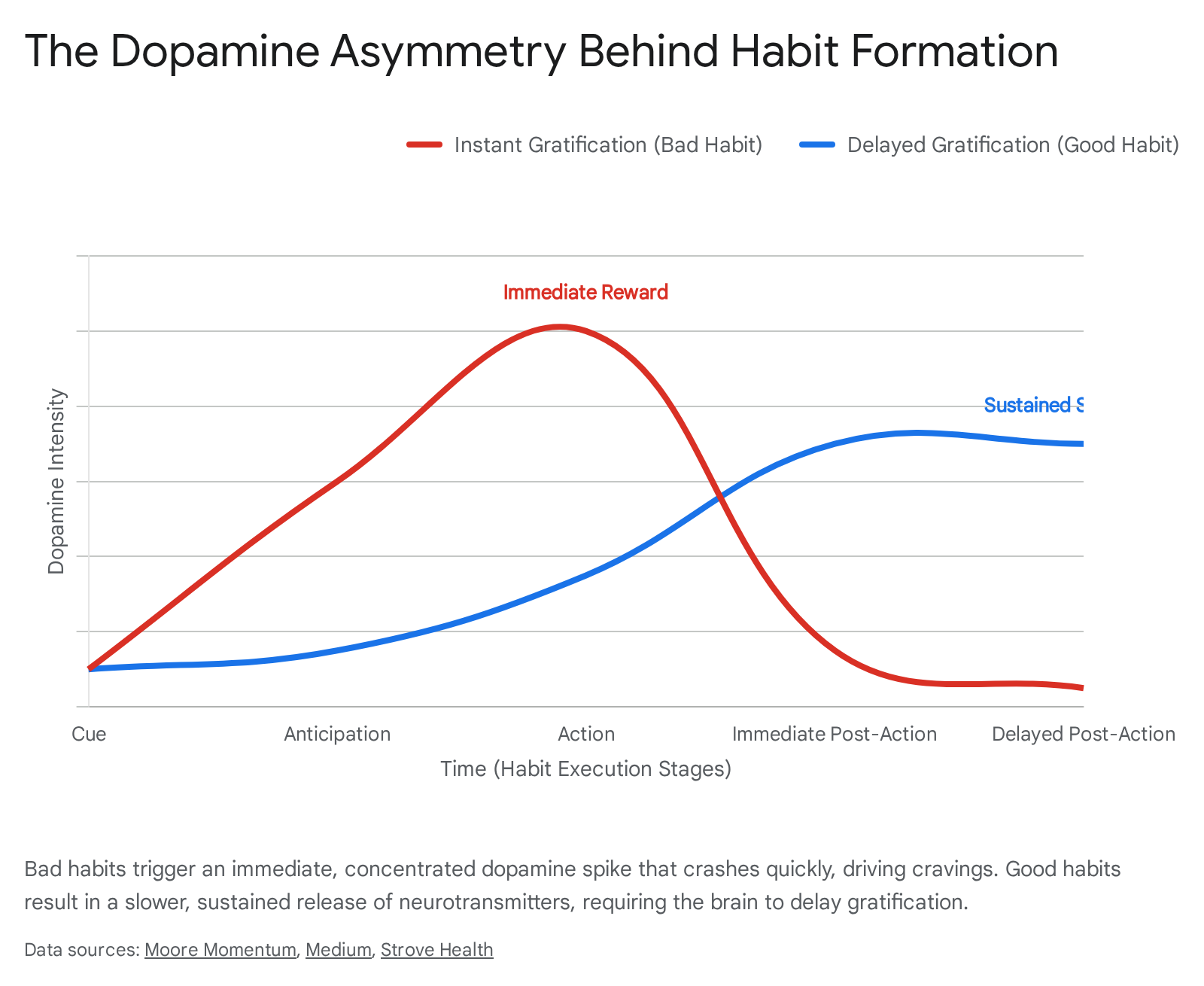
If all habits, both beneficial and detrimental, eventually migrate to the basal ganglia, why is it so much easier to automate a destructive habit? The answer lies in the neurochemistry of motivation - specifically the neurotransmitter dopamine - and the evolutionary timeline of human gratification.
Contrary to early scientific assumptions and popular belief, dopamine is not simply a chemical that delivers pleasure. It is the brain's primary molecule of motivation, anticipation, and associative learning. Dopamine spikes when an individual expects a reward, driving the organism to take action to secure that reward 1111213. In the context of habit formation, dopamine reinforces the neural pathways that connect a specific cue to a rewarding routine, increasing the mathematical probability that the behavior will be repeated 713.
Reward Prediction Errors (RPE) and Sensory Prediction Errors (SPE)
The brain learns through a process of continuous calculation, constantly comparing what it expects to happen against what actually happens. When an outcome is better than expected, the brain generates a Reward Prediction Error (RPE) 146. RPEs are encoded in dopaminergic and subcortical circuits, and they act as powerful teaching signals. A large, positive RPE releases a flood of dopamine, forcefully reinforcing the choice that led to the unexpectedly large reward 146.
Simultaneously, the brain utilizes Sensory Prediction Errors (SPEs) to update its expectations about the environment when sensory events deviate from prior predictions, a process generally localized to the cortex 146. While both mechanisms are at play, it is the RPE that primarily drives the deep, compulsive reinforcement of bad habits.
Supernormal Stimuli and "Bad" Dopamine
Modern society is saturated with "supernormal stimuli" - engineered experiences that provide unnaturally concentrated spikes of dopamine with almost no effort required 127. Scrolling endlessly through algorithmic social media feeds, consuming hyper-palatable processed foods, playing highly stimulating video games, and using recreational drugs all exploit this ancient reward circuitry 1278.
When an individual consumes a sugary, high-fat snack, the brain registers an immense, rapid reward, triggering a massive RPE. The brain quickly learns that this specific routine (eating junk food) paired with a specific cue (feeling stressed, or sitting on the couch) leads to a phenomenal neurochemical payoff 1712. This dopamine pathway is heavily reinforced, making the habit stick rapidly. These rapid, low-effort dopamine hits are often categorized colloquially as "bad dopamine" because they trap individuals in cycles of short-term reward at the expense of long-term fulfillment, often leading to dopamine desensitization where everyday activities feel increasingly dull 13718.
The Burden of Delayed Gratification
Conversely, beneficial habits generally rely on delayed gratification. The rewards of engaging in strenuous cardiovascular exercise, studying for an exam, or choosing a nutrient-dense salad over fast food are abstract, future-oriented, and slow to materialize 1113. An individual does not receive an overpowering, intoxicating surge of dopamine after a single 20-minute jog or a single meditation session 13.
Building a good habit requires an individual to invest immediate physical or mental effort for a payoff that may not arrive for weeks or months. This necessitates the prefrontal cortex to actively suppress the innate desire for instant pleasure - a monumental cognitive task 11910. The brain's natural bias is tilted toward "reward asymmetry," wherein immediate, low-effort rewards heavily outweigh distant, high-effort benefits in the brain's neurological calculus 101112.
This delay in reward makes the early stages of positive habit formation incredibly fragile. The dopamine release from exercise is more sustained and has long-term benefits - such as increasing dopamine receptor availability and promoting neuroplasticity - but it lacks the aggressive, immediate spike that quickly encodes bad habits into the basal ganglia 1313.
Orexin and the Diet Battle: Choosing Between Exercise and Junk Food
To further understand why humans struggle to choose good habits over bad ones, neuroscientists have begun looking beyond dopamine. Recent research out of ETH Zurich highlights the role of orexin, a brain chemical crucial for general motivation and decision-making 14.
In a sophisticated behavioral experiment, researchers offered mice the choice between a running wheel and a "milkshake bar" serving a highly palatable, fat-and-sugar-rich strawberry milkshake. Because the brain releases dopamine during both exercise and eating, dopamine alone could not explain why an organism might choose one over the other. The study found that mice with an intact orexin system spent twice as much time exercising and half as much time drinking milkshakes compared to mice whose orexin systems were blocked 14. When orexin was inhibited, the decision swung heavily in favor of the instant gratification of the milkshake, and the mice largely abandoned the running wheel. This suggests that the orexin system is central to adjudicating between competing rewards, actively helping the brain prioritize healthy exertion over ubiquitous, tasty temptations 14.
Furthermore, the consumption of "junk food" causes rapid physical changes in the brain that make resisting it increasingly difficult. Studies have shown that consuming a junk-food diet increases the function of calcium-permeable AMPA receptors (CP-AMPARs) in the nucleus accumbens - a key reward center in the brain 15. This upregulation of CP-AMPARs occurs rapidly, persists for weeks even after the junk food is removed, and is particularly pronounced in subjects highly susceptible to obesity, making the mesolimbic circuits hyper-responsive to future temptations 15.
Behavioral Economics and the Reward Landscape
The mechanics of habit formation do not exist in a vacuum; they interact continuously with the complex environments humans navigate. Behavioral economics provides a framework for understanding how structural incentives and environmental designs influence the longevity of habits.
Reward Asymmetry and Behavioral Entropy
In behavioral economics, "reward asymmetry" describes situations where the gains or losses associated with different choices are fundamentally unequal, naturally skewing behavior 101126. Modern digital and food environments are characterized by massive reward asymmetry.
As the density and variance of immediate digital reinforcements (like social media notifications) increase, the "reward gradients" in an individual's environment become steeper and more asymmetric 1016. This promotes the emergence of dominant "attractor regions" in behavior. Sustained exposure to these high-density reinforcements leads to a progressive reduction in "behavioral entropy" - a narrowing of an individual's behavioral repertoire 101628. Essentially, the intense, easy rewards of digital consumption and processed foods exert such a strong gravitational pull that individuals stop exploring other, healthier behavioral options, becoming trapped in highly constrained, repetitive loops.
The Stanford Marshmallow Experiment Reconsidered
The struggle between instant and delayed gratification is famously illustrated by the Stanford Marshmallow Experiment conducted by Walter Mischel in 1970 1117. In this classic study, children were offered one marshmallow immediately or two if they could wait 15 minutes. Early interpretations suggested that the innate ability to delay gratification (willpower) was a primary predictor of future life success, including better educational attainment and health outcomes 1117.
However, modern replications and behavioral analyses have drastically reshaped this narrative. Recent studies featuring much larger, more diverse populations demonstrated that the effect size of the original study was overstated 17. More importantly, researchers clarified that the decision to wait was not merely a test of biological willpower; it was a test of environmental trust. Children who believed the environment was reliable, or who came from stable economic backgrounds, were much more likely to wait 1117. If a child grew up in uncertainty where promised future rewards rarely materialized, taking the immediate marshmallow was the deeply rational, adaptive choice 11.
This realization shifts the blame from individual discipline to structural context. Delayed gratification is a cognitive skill shaped by biology, belief systems, and environmental stability. For individuals living in chronic uncertainty or poverty, the brain is actively trained to prioritize immediate gains over distant promises - a phenomenon known as temporal discounting 111819.
Policy Inequity and Prosocial Habit Decay
The principles of reward asymmetry also apply to broader social and prosocial habits. Recent models utilizing Large Language Models to simulate behavioral economics have shown that "policy inequity" rapidly degrades good habits 26. When individuals perceive reward asymmetry (e.g., some people receive recognition for a prosocial act while others do not) or burden asymmetry (e.g., people face unequal costs for the same task), their motivation to engage in prosocial behavior drops by up to 32 percent 26. Fairness and structural equity are therefore critical environmental factors required to sustain positive, cooperative habits over time.
The 21-Day Myth and the True Timeline of Habit Formation
One of the most persistent reasons good habits fade is rooted in a massive societal misunderstanding about the timelines required for neuroplastic change. When individuals feel like failures because their new diet or workout routine does not feel automatic after three weeks, they are often falling victim to the notorious "21-day myth" 620.
The Origins of the 21-Day Misunderstanding
The 21-day timeline originated in the 1950s with Dr. Maxwell Maltz, a plastic surgeon who noticed a peculiar pattern among his patients. Maltz observed that it took patients about 21 days to adjust to seeing their new faces after surgery, or to stop feeling phantom limb sensations after an amputation 62122. He codified these observations in his blockbuster 1960 book Psycho-Cybernetics, writing that it required a "minimum of about 21 days" for a new mental image to gel 621.
Over the subsequent decades, this observation was cited by self-help professionals like Zig Ziglar and Tony Robbins. Like a long game of telephone, Maltz's specific observation about adjusting to a physical change was shortened, stripped of the word "minimum," and universally misapplied as a statistical fact about forming new behavioral habits 621.
Modern Evidence: The 66-Day Average
Contemporary psychology and neuroscience have comprehensively debunked the 21-day rule. A landmark 2009 study published in the European Journal of Social Psychology by Dr. Phillippa Lally and colleagues at University College London rigorously tracked the habit formation of 96 people over 12 weeks 6202135.
The headline finding from Lally's data was that the average time it takes for a new behavior to reach automaticity is actually 66 days 6202135.
Crucially, the data revealed massive individual variability. Depending on the complexity of the behavior, the individual's baseline, and the environment, forming a habit can take anywhere from 18 days to 254 days 202135. A simple habit like drinking a glass of water upon waking might automate quickly, while a complex habit like adhering to a new, rigorous exercise routine might take eight months 72122.
Recent Systematic Reviews
More recent systematic reviews conducted in 2024 and 2025 have confirmed these extended timelines. A comprehensive review by researchers at the University of South Australia, analyzing data from over 2,600 participants across 20 studies, found that the median time taken to form new, healthy habits was roughly 59 to 66 days, with the process stretching up to 335 days for more complex lifestyle overhauls 222324.
When people expect a habit to become effortless in three weeks, they inevitably hit a wall of exhaustion on Day 22. They assume they lack inherent discipline, when in reality, their brain is merely in the early stages of neurological remodeling. Understanding that true neural consolidation - the transfer of behavior from the cortex to the dorsolateral striatum - takes months, helps set realistic expectations and prevents premature abandonment of good habits 6722.
Environmental Friction and Choice Architecture
A frequently overlooked driver of why bad habits persist and good habits fail is "environmental friction." In behavioral science, "choice architecture" refers to the way the layout of an individual's environment nudges them toward certain decisions 3839. Friction is any obstacle - whether physical, mental, or logistical - that makes a desired behavior harder to perform 3840.
Many individuals blame a lack of willpower when they fail to maintain a positive habit, but the true culprit is often excessive environmental friction. If an individual wishes to go to the gym, but the gym is a 20-minute drive away, is heavily crowded, and requires packing a bag the night before, the physical and mental friction is immense. The cognitive load required to overcome these hurdles is significant 3840.
Conversely, bad habits are often engineered to exist in frictionless environments. If a smartphone is resting on a nightstand within arm's reach, the friction required to endlessly scroll through social media is virtually zero 3840. Studies reveal that even minuscule interruptions can create decision points that derail routines. Conversely, reducing the start time of a habit by as little as 20 seconds can drastically boost follow-through by up to 300% 40.
Limbic Friction and Habit Stacking
Neuroscientist Andrew Huberman describes "limbic friction" as the mental strain required to overcome states of anxiousness, distraction, or fatigue to perform a task 40. To overcome this, behavioral scientists heavily advocate for manipulating environmental cues to reduce cognitive load.
One of the most effective methods is "habit stacking." This involves anchoring a new, desired behavior to an already established routine that shares the same environmental context 7338. For example, deciding to stretch for five minutes immediately after brewing the morning coffee. The existing habit (coffee) acts as a reliable neural trigger for the new habit (stretching). Because the environment already signals the first behavior, stacking makes the secondary behavior automatic over time, bypassing the need for the prefrontal cortex to generate independent motivation 738.
| Environmental Factor | Impact on Good Habits | Impact on Bad Habits | Strategy for Optimization |
|---|---|---|---|
| Physical Distance | Increases friction; lowers adherence 3840 | Decreases friction if near; drives compulsive use 3840 | Place healthy cues in plain sight; hide temptations 3840. |
| Cognitive Load | High decision fatigue causes burnout 740 | Automated routines bypass decision fatigue 7 | Use implementation intentions (exact time/place planning) 37. |
| Contextual Cues | Requires new environmental triggers to initiate 35 | Easily triggered by established environments 55 | Utilize "Habit Stacking" to link new behaviors to old cues 738. |
Stress, Relapse, and Neural Disruption
Even deeply ingrained good habits can fade, and old bad habits can unexpectedly resurface. The primary, universal catalyst for this behavioral regression is acute or chronic stress 2526.
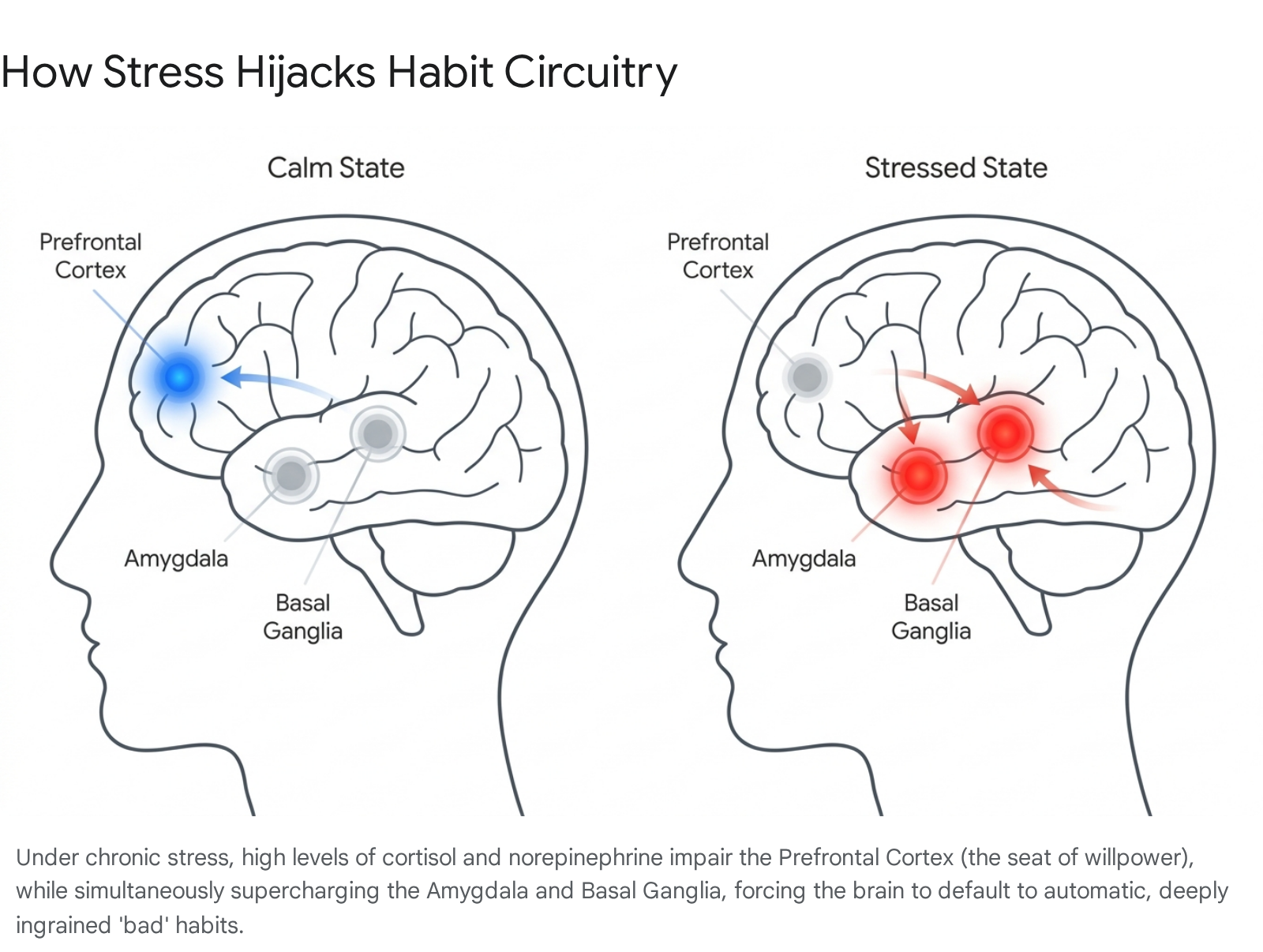
Basic research into the neurobiology of the stress response demonstrates that high levels of catecholamines (such as norepinephrine and dopamine) released during stressful events rapidly impair the top-down cognitive functions of the prefrontal cortex 27. High levels of norepinephrine engage low-affinity alpha-1 adrenoceptors, which swiftly reduce the firing of prefrontal cortex neurons 27. Effectively, stress shuts down the brain's executive control center, severely handicapping abstract reasoning, impulse control, and the ability to maintain long-term goals 2744.
At the exact same time, stress hormones strengthen the emotional and habitual responses of the amygdala and the basal ganglia 2744. Chronic stress even leads to dendritic atrophy in the prefrontal cortex and dendritic extension in the amygdala, literally rewiring the brain to favor primitive, reactive states over reflective, thoughtful states 2527.
Cholinergic Interneurons and the Stress Highway
Recent studies mapping the physical pathways of the brain have identified a "direct line" connecting the brain's stress centers (the central amygdala) directly to the habit-forming machinery in the dorsal striatum 26. The brain utilizes a chemical called corticotropin-releasing factor (CRF) to send stress messages across this pathway.
These CRF signals target specialized cells called cholinergic interneurons (CINs) 26. In a healthy, calm brain, CINs act as traffic controllers. They respond to mild stress signals by boosting the release of acetylcholine, helping the brain pause, remain flexible, and adjust behavior intelligently 26. However, substance abuse (such as alcohol consumption) and chronic, overwhelming stress effectively "cut the wire" to this system 2644. They blunt the ability of CINs to respond properly.
Without these traffic controllers, the brain's ability to think before acting is disabled. The individual is trapped in rigid, habitual behaviors 26. If an individual has spent years relying on smoking or snacking to soothe anxiety, and only three months practicing mindfulness, a highly stressful event will cause the brain to automatically route behavior through the heavily myelinated, deeply entrenched five-year-old neural circuit 2544. This neurobiological reality explains why stress is such a universal and potent trigger for addiction relapse and the abandonment of new, fragile habits.
The Anatomy of Habit Decay
While an immense amount of scientific literature focuses on habit formation, the study of habit decay - the specific temporal trajectory of how an old habit weakens over time - is an emerging frontier in behavioral psychology.
A groundbreaking 2024 intensive longitudinal study (published in 2025) sought to understand exactly how habit strength decreases when individuals actively try to degrade health-risk behaviors, such as sedentary living, unhealthy snacking, alcohol consumption, and smoking 284629. Tracking 194 individuals over 91 days, the researchers collected nearly 12,000 daily observations 2846.
The study found that habit decay does not happen linearly. Instead, when an individual successfully stops performing a bad habit, the decay typically follows a decelerating negative trend - often modeled perfectly by asymptotic or logistic mathematical models 284629. This means that the initial decrease in the urge to perform the bad habit drops sharply at first, but then the decay process slows down, lingering at a low, stubborn level for weeks 2829.
The Idiosyncratic Timeline of Unlearning
Crucially, the time it took for the decay of a bad habit to fully stabilize ranged massively from 1 day to 65 days (with a median of 9 to 10 days) 2829. The research highlighted that habit decay is a highly idiosyncratic process characterized by substantial between-person heterogeneity; individual differences accounted for 76% of the variance in decay rates, outweighing differences between the specific types of bad habits themselves 2829.
Furthermore, earlier psychological research validates that occasional lapses or slip-ups do not inherently reset the neurological decay process. Phillippa Lally's foundational habit data showed that missing one opportunity to perform a behavior did not materially affect the habit formation or decay process 202148. What typically destroys the momentum of breaking a bad habit is not the biochemical reality of a single lapse, but the psychological shame narrative the individual constructs around the slip-up (e.g., "I missed a day, therefore I have failed completely"), which causes them to abandon the effort entirely 3530.
Cross-Cultural Perspectives on Habit Formation
It is important to acknowledge that a significant portion of foundational psychological and behavioral research has historically relied heavily on "WEIRD" populations - participants from Western, Educated, Industrialized, Rich, and Democratic societies 3132. The strict, individualistic framing of "self-discipline," "willpower," and solitary goal-setting often overlooks how interdependent and collectivist cultures might approach motivation and habit formation differently 3133.
For example, studies comparing close relationships in the United States and Thailand show that while individuals in both cultures undergo a "transformation of motivation" to suppress selfish impulses in favor of pro-relationship behaviors, those in interdependent cultures may prioritize maintaining group harmony over individual goal-achievement from the outset 33.
However, emerging research tracking populations across Asia, Africa, and Latin America suggests that the underlying neurobiological mechanics of the basal ganglia and the psychological reality of dopamine-driven reward asymmetry remain universal 313435. Global health initiatives - such as those currently being advanced by the BRICS nations (Brazil, Russia, India, China, South Africa, and new members) focusing on non-communicable diseases, mental wellness, and healthy lifestyle promotion - recognize these shared biological vulnerabilities 3536. While the specific environmental cues, available resources, and societal reinforcements may vary vastly by culture, the human brain's fundamental, evolutionary desire to conserve metabolic energy by automating highly rewarding behaviors is a shared global trait 3757.
Bottom line
Bad habits stick because they expertly exploit the brain's evolutionary desire for instant dopamine and low-effort routines, rapidly embedding themselves into the automated processing of the basal ganglia. Good habits fade because they demand sustained, high-energy effort from the easily fatigued prefrontal cortex to endure delayed gratification, taking an average of 66 days to neurologically cement themselves. Ultimately, overcoming bad habits relies less on raw willpower and more on intentionally designing environments that reduce friction for good choices, while recognizing that the brain will fiercely revert to deeply entrenched routines during times of stress.