
How Long It Actually Takes to Form a Habit
The pervasive claim that it takes exactly 21 days to form a new habit is a persistent cultural myth completely unsupported by modern behavioral science. Comprehensive research spanning self-reported diaries to machine-learning analysis of millions of real-world actions reveals that the true average is roughly 66 days, with a median of two months and an outer range extending up to a full year. The actual time required to achieve behavioral automaticity depends heavily on the complexity of the action, the stability of the environmental cues, and the individual's psychological approach.
The Origin of the 21-Day Myth
If you have ever tried to establish a daily meditation practice, adopt a healthier diet, or commit to a new exercise routine, you have likely encountered the popular assurance that it takes just three weeks to wire a new behavior into your brain. This "21-day rule" is one of the most widely circulated pieces of self-help advice in the modern era. However, its origins lie in anecdotal observation rather than rigorous scientific methodology.
The myth traces back to 1960 and the publication of Psycho-Cybernetics, a massively influential book written by Dr. Maxwell Maltz 123. Maltz was a plastic surgeon, not a psychologist or a neuroscientist. During his clinical practice, he noticed a recurring pattern among his patients: following a procedure, such as a rhinoplasty or the amputation of a limb, it generally took the patient about 21 days to mentally adjust to their new physical reality or to stop experiencing "phantom limb" sensations 123.
Maltz observed that his own adjustments to new routines seemed to follow a similar timeline, prompting him to write that it usually requires a minimum of about 21 days for an old mental image to dissolve and a new one to coalesce 23. Over the subsequent decades, as the self-help industry exploded in popularity, the nuance of Maltz's observation was lost. The critical qualifier - "a minimum of about 21 days" - was quietly erased by motivational speakers and authors seeking to package behavior change into a highly marketable, easily digestible timeframe 234.
The result was a societal expectation that profound behavioral shifts could be permanently locked in over the course of a three-week challenge. When millions of people naturally failed to automate complex behaviors like daily running or radical dietary changes in just 21 days, the resulting shame and perceived failure often caused them to abandon their goals entirely 35. It was not until the early twenty-first century that behavioral scientists began to rigorously track the habit-formation process in real-world settings to uncover the true timelines required for human behavioral change.
What Modern Research Actually Shows
To understand how long habits genuinely take to form, researchers have moved away from anecdotal reflections and toward longitudinal studies, self-reported automaticity indices, and massive datasets analyzed by machine learning.
The Landmark Lally Study (2009)
The foundational study in modern habit research was conducted in 2009 by Dr. Phillippa Lally and her colleagues at University College London, subsequently published in the European Journal of Social Psychology 126. The research team sought to map the actual trajectory of habit formation in a real-world environment.
They recruited 96 volunteers who chose a new eating, drinking, or exercise behavior to integrate into their daily lives over a 12-week period 127. Crucially, the participants did not just report whether they performed the behavior; they regularly completed the Self-Report Habit Index (SRHI), which measures "automaticity." Automaticity is the psychological hallmark of a habit - the feeling that a behavior is enacted without conscious thought, cognitive friction, or the need for sustained willpower 18.
When Lally's team modeled the data, they discovered that habit formation follows an asymptotic curve 6. Initially, when a person repeats a behavior, the gains in automaticity are steep. However, over time, the increases begin to level off until the behavior reaches a plateau - the asymptote - where it becomes as automatic as it is ever going to be 6.
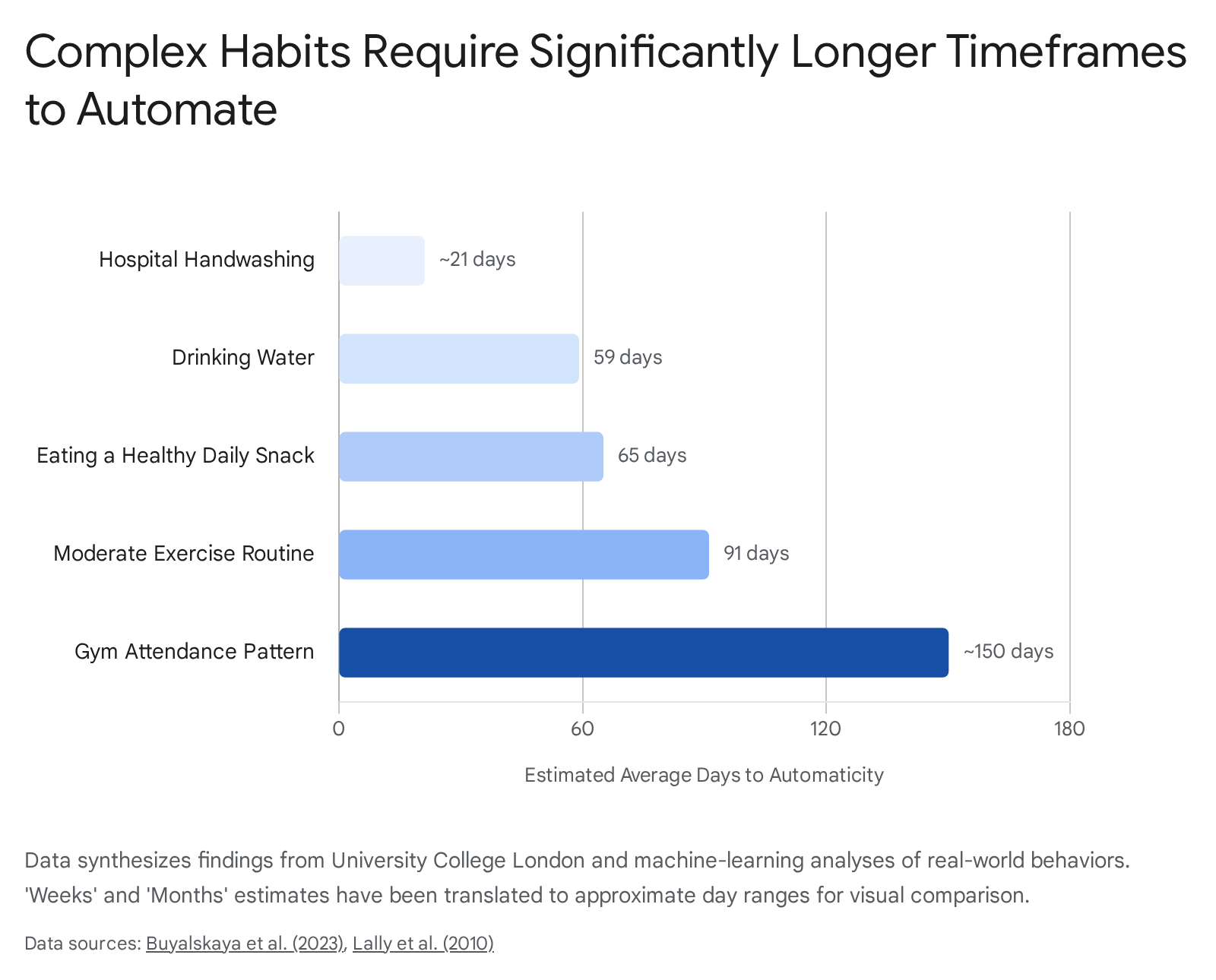
The results completely dismantled the 21-day myth. The researchers found that it took an average of 66 days for a behavior to reach peak automaticity 126. Furthermore, the timeline was highly variable, spanning from a minimum of 18 days for the fastest adopters to a projected maximum of 254 days for others 126. The complexity of the behavior played a massive role: simpler habits, like drinking a glass of water after breakfast, formed much faster (averaging 59 days) than more complex behaviors, like exercising after work, which took an average of 91 days to automate 7.
Big Data and Machine Learning Confirm Extended Timelines
While the Lally study was groundbreaking, it relied on self-reported psychological indices from fewer than 100 people. Recent advances in behavioral science have allowed researchers to analyze the objective actions of millions of people to see how habits actually form in the wild.
In a massive 2023 study published in the Proceedings of the National Academy of Sciences (PNAS), a research team led by Anastasia Buyalskaya applied machine learning techniques to two enormous datasets: 12 million gym attendance records from over 60,000 gymgoers, and 40 million hospital handwashing events from over 5,000 healthcare workers 10111.
Instead of asking people how habitual they felt, the researchers used an approach called Predicting Context Sensitivity (PCS) 101. This method identifies which environmental context variables best predict a person's behavior, establishing an objective curve for when a behavior becomes highly predictable - the true mark of an entrenched habit 101.
The machine learning data confirmed the lack of a universal magic number. Hospital handwashing habits, which are simple, frequent, and tied to strict environmental cues, formed on the order of a few weeks 10111. In stark contrast, going to the gym - a highly complex behavior requiring planning, physical exertion, and travel - took months of consistent repetition to become a predictable habit 10113.
Interestingly, the PNAS study also confirmed a phenomenon previously observed in animal learning models: reward devaluation 101. When a behavior is newly formed, a person requires conscious motivation or an immediate reward to execute it. But once the behavior transitions into a true habit, it becomes "reward-insensitive" 101. The researchers found that highly habitual gymgoers were far less responsive to new behavioral interventions or shifting rewards than novice gymgoers 101. They executed the behavior simply because it was their routine, independent of external incentives.
The 2024 Global Meta-Analysis
Further consolidating these extended timelines, a 2024 systematic review and meta-analysis published in the journal Healthcare by Ben Singh and colleagues examined 20 experimental intervention studies involving 2,601 participants across various health behaviors, including diet, exercise, flossing, and vitamin consumption 141516.
The meta-analysis revealed tremendous individual variability in habit formation across the population 1416. Among the studies that directly measured time to automaticity, the researchers found that the median time to form a habit was 59 to 66 days, while the mean time was significantly higher, ranging from 106 to 154 days 141617. The total observed range spanned from just 4 days to a staggering 335 days 141617.
The significant gap between the median (roughly two months) and the mean (three and a half to five months) indicates a statistical skew in human behavior. While many people can automate a behavior in a couple of months, a substantial portion of the population requires nearly a full year of continuous, deliberate practice for a complex behavior to truly stick 141618.
Comparing the Major Timelines
To synthesize the current consensus in behavioral science, the following table compares the foundational and recent large-scale studies on habit formation timelines, illustrating the evolution from self-reported data to objective machine-learning analytics.
| Study & Year | Methodology & Sample Size | Behaviors Analyzed | Average/Median Time to Habit | Total Range Observed |
|---|---|---|---|---|
| Lally et al. (2009) 126 | Self-reported daily diaries; 96 participants. | Diet, hydration, moderate exercise. | 66 days (Average) | 18 to 254 days |
| Buyalskaya et al. (2023) 10111 | Machine learning of objective data; ~65,000 subjects. | Gym attendance, hospital handwashing. | Weeks (Hygiene) Months (Gym) |
Highly variable based on complexity |
| Singh et al. (2024) 141617 | Systematic review & meta-analysis; 2,601 participants. | Exercise, flossing, diet, hydration. | 59-66 days (Median) 106-154 days (Mean) |
4 to 335 days |
The Neuroscience of Automaticity: Paving the Neural Pathway
Understanding why it takes months rather than days to form a habit requires looking at the physical structure of the brain. Habit formation is fundamentally a process of neuroplasticity - the brain's ability to reorganize itself by forming new neural connections in response to repeated stimuli 7.
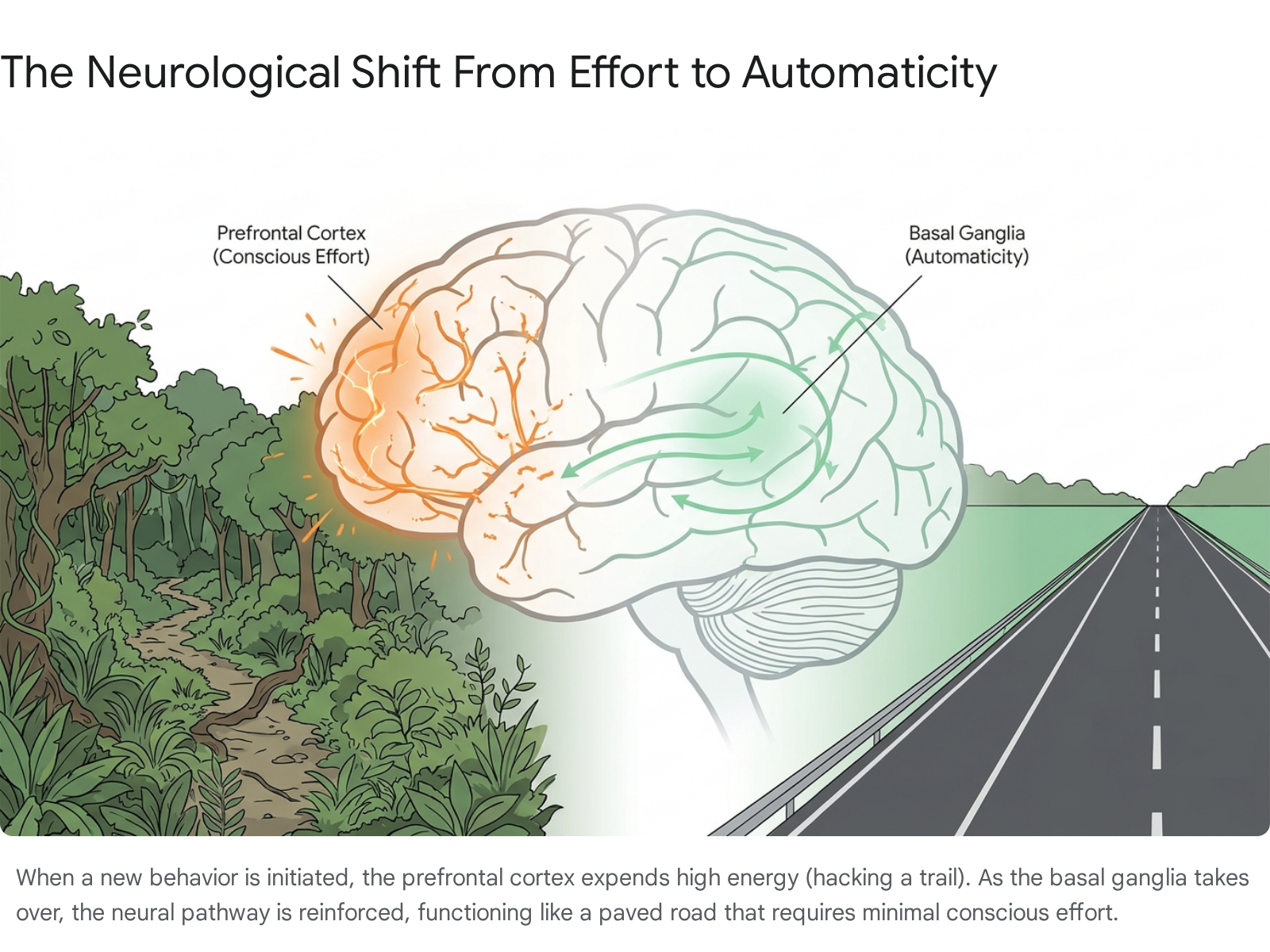
When you perform a novel behavior, the action is directed by the prefrontal cortex, the area of the brain responsible for conscious decision-making, executive function, and willpower. Utilizing the prefrontal cortex requires significant cognitive energy and focus. However, the human brain is an efficiency engine. If a behavior is repeated in the exact same context frequently enough, the neurological burden gradually shifts away from the prefrontal cortex and into the basal ganglia, an older, deeper brain structure associated with pattern recognition, motor control, and automatic procedural routines 19.
A useful analogy frequently utilized by behavioral scientists and neuroscientists is the difference between navigating a dense forest and driving on a paved highway 20212. When you first attempt a new behavior - for instance, adopting a new stretching routine every morning - it is like hacking your way through a thick, untamed forest trail. It is slow, requires active focus, and if you stop paying attention, you will quickly lose your way 2021.
However, with every deliberate repetition, you clear a little more brush. Eventually, the trail becomes a well-worn dirt path, which is much easier to walk. After 60 to 90 days of sustained practice, the path is metaphorically paved over 7. It becomes a neurological superhighway. At this point, the basal ganglia takes over, and traveling that specific path requires almost zero conscious effort or motivation.
This is exactly why behavior change feels so exhausting during the first month. The brain literally has to build the physical infrastructure to support the new action. Neuroscience research suggests that it takes roughly six to eight repetitions to initially foster neurogenesis (the sprouting of new neural pathways), but translating those new pathways into the robust, insulated neural circuits required for true automaticity takes a minimum of two months of sustained practice 7.
Variables That Dramatically Alter the Timeline
Because human behavior does not occur in a vacuum, relying on a rigid, one-size-fits-all estimate for habit formation is inherently flawed. Both the 2024 meta-analysis and modern cross-cultural studies reveal that several key variables dictate whether a habit will form in 30 days or closer to 300 days.
Complexity and Behavioral Friction
As demonstrated by the PNAS big data analysis comparing handwashing to gym attendance, complexity is the primary barrier to automaticity 101. A habit is considered complex if it requires multiple sub-steps, intense physical exertion, or significant disruption to an existing daily schedule.
If a habit carries a high degree of "friction" - meaning there are logistical or physical obstacles between the individual and the action - the brain will resist automating it. Flossing one tooth or drinking a glass of water requires incredibly low friction and can be automated rapidly. Conversely, driving twenty minutes in traffic to a gym, changing clothes, and engaging in strenuous activity requires immense friction and will predictably take months to encode 11423.
Timing and Environmental Stability
According to the 2024 meta-analysis by Singh et al., behaviors practiced in the morning form into habits significantly faster than those practiced in the afternoon or evening, boasting success rates that are up to 43% higher 13141923.
There are two primary physiological and psychological reasons for this phenomenon. First, willpower and executive function - which are absolutely necessary to force the behavior in the early, high-friction stages - are generally at their peak after a night of rest 13. Second, morning routines (like waking up, using the bathroom, and making coffee) provide highly stable environmental cues. The brain relies entirely on a stable context to trigger a habitual response. If your environment is chaotic or the timing of the cue is constantly shifting, the basal ganglia struggles to associate a specific environmental trigger with the desired behavior 6.
Cultural and Societal Context
Habit formation is deeply influenced by the macro-environment and the broader cultural values surrounding the individual. A fascinating study involving 2,000 participants from the University of Tokyo explored how cultural dimensions impact the speed of behavior change across different demographics 6.
The researchers found that individuals in collectivist cultures (such as Japan) demonstrated significantly faster habit formation for socially reinforced behaviors compared to individuals in highly individualist cultures (such as the United States) 6. In collectivist societies, the cultural mandate heavily prioritizes group cohesion, interpersonal harmony, and social coordination 3. Therefore, when a new behavior aligns with social expectations or is collectively reinforced by the community, the social friction is radically lowered. The external social environment acts as a powerful reinforcing cue, accelerating the psychological shift toward automaticity without requiring the individual to rely solely on internal willpower 634.
Identity Alignment and Personality Traits
Individual differences in personality also play a highly measurable role in the speed of habit acquisition. Studies published in the Personality and Social Psychology Bulletin indicate that people with naturally higher trait conscientiousness can form new habits approximately 20% faster than those with lower scores in that specific trait 6.
Furthermore, whether the habit aligns with the individual's core self-concept drastically alters the success rate. The 2024 meta-analysis found that people who actively selected their own habit goals achieved 37% higher success rates compared to those whose habits were assigned to them externally (such as a doctor ordering a patient to exercise) 1319.
This is heavily tied to the concept of identity-based habits. Research published in the Journal of Personality and Social Psychology in 2024 revealed that framing a new habit in terms of identity - stating "I am a person who exercises daily" rather than "I want to lose ten pounds" - increased long-term habit adherence by an impressive 32% 2326. When a behavior is viewed as an expression of personal identity, each repetition becomes a psychological vote of confidence in that identity, making the individual much more resilient against temporary dips in motivation 1926.
The "Missing a Day" Phenomenon
A pervasive fear among people attempting to build a new habit is that breaking their consecutive streak will ruin their progress and reset their neuroplasticity back to zero. A common side effect of modern digital habit-tracking apps is the gamification of "unbroken streaks," which inadvertently punishes users severely for a single lapse 523.
However, the scientific data is highly forgiving on this front. In Lally's original 2009 study, the researchers specifically analyzed the mathematical impact of skipped days on the habit formation asymptotic curve. They found that missing a single day did not materially affect the long-term habit formation process or delay the onset of automaticity 145.
From a neuroplasticity standpoint, the brain's dopamine and learning systems do not track arbitrary, calendar-based "streaks." They track overall volume and consistency 5. If you miss a day, the neural pathway you are building does not instantly deteriorate. However, missing a full week does result in a significant drop in automaticity, allowing the newly formed neural connections to weaken and the behavior to slip back toward requiring executive function 4.
The primary danger of missing a day is not neurological, but psychological. Behavioral experts note that when individuals miss a single day, they often construct a devastating negative narrative, internalizing a profound sense of failure that causes them to abandon the effort entirely - a phenomenon sometimes referred to as the "what the hell" effect 5. The empirical research proves that rapid recovery from a lapse is vastly more important to long-term success than flawless streak preservation.
Evidence-Based Strategies to Accelerate Habit Formation
While you cannot force your brain's basal ganglia to automate a highly complex behavior in just 21 days, decades of psychological research have identified highly effective, evidence-based interventions that bridge the massive gap between initial intention and eventual automaticity.
Utilizing Implementation Intentions
Merely setting a general goal (e.g., "I will exercise more this year") relies purely on motivation, which neurobiologically is a fleeting and unreliable resource. Instead, behavioral psychologists strongly recommend using implementation intentions - highly specific "if-then" plans that explicitly link a situational cue directly to a desired response 727.
A massive meta-analysis conducted by Gollwitzer and Sheeran, encompassing over 8,000 participants across 94 independent experimental studies, found that implementation intentions possess a powerful, medium-to-large effect size (d = 0.65) on successful goal achievement 727. A subsequent 2025 meta-analysis by Carrero et al., focusing specifically on pro-environmental behaviors across 10,466 participants, found an even larger overall effect size (d = 0.781) 28.
When individuals formulate specific plans - such as, "If I pour my morning coffee, then I will immediately do two minutes of stretching" - they effectively pre-load the decision into their brain, bypassing the need for in-the-moment willpower. In specialized clinical trials, people who wrote specific if-then plans for exercise adhered to their routines at an astonishing 91% rate, compared to just 35% to 38% in control groups who only set general motivation-based goals 13.
Habit Stacking and Environment Design
A highly practical real-world application of implementation intentions is the concept of "habit stacking." Because the adult brain already has incredibly thick, insulated neural pathways dedicated to existing daily routines (like brushing teeth, taking a shower, or commuting), individuals can leverage that existing neurological infrastructure to build new habits 619.
By anchoring a new, fragile behavior directly to an old, robust habit, you eliminate the need for the brain to recognize a brand new environmental cue. Research published in the Journal of Applied Psychology in 2025 indicates that structured approaches utilizing habit stacking improve the successful formation of new habits by 64% compared to attempting to establish standalone behaviors in isolation 1923.
Furthermore, modifying the physical environment yields massive dividends. Because the basal ganglia links visual stimuli with automatic action, relying on internal willpower to resist bad habits requires constant, exhausting cognitive load. Studies demonstrate that strategic environmental modifications - such as leaving running shoes directly next to the bed, or keeping junk food completely out of the house - increase overall habit adherence by up to 58% 1923. By reducing the physical friction required to start a positive behavior, and increasing the friction for negative behaviors, you manipulate the likelihood of repetition, which remains the sole driver of automaticity.
Effective Tracking and Feedback Loops
The science of habit measurement has also evolved, showing that how a person tracks their progress influences their success. Studies indicate that tracking the process of a habit (e.g., tracking the days you spent exercising) rather than the outcome (e.g., tracking weight loss) leads to 37% higher habit persistence 23. This aligns perfectly with the neurological understanding that habits are about establishing behavioral patterns, not achieving immediate biological results.
Furthermore, engaging in regular feedback loops - where an individual reviews their tracking data to optimize their cues, refine their timing, or scale back the complexity of the habit if they are failing - is a hallmark of successful habit formers.
Bottom line
The popular societal claim that habits form in exactly 21 days is a damaging myth; modern behavioral science and machine learning data reveal that it takes an average of roughly two to three months (59 to 66 days median) for a new behavior to become genuinely automatic. This timeline is highly variable, ranging from a few short weeks for simple, low-friction tasks like handwashing, to nearly a full year for complex, high-friction actions like daily gym attendance. While an occasional missed day will not destroy the neurological pathways you are actively building, achieving true automaticity requires environmental consistency, structured psychological planning like implementation intentions, and the patience to repeat a behavior long after the initial motivation inevitably fades.