
Who Works From Home in 2026 and How It Is Changing
In 2026, remote work has permanently stabilized, accounting for roughly 28% of all paid workdays in the United States and driving a massive structural shift toward hybrid models for knowledge workers. While a stark demographic divide strongly favors highly educated and mid-career professionals, aggressive corporate return-to-office mandates have largely backfired, triggering elevated turnover rates and declining manager engagement rather than restoring traditional office norms.
The Post-Pandemic Equilibrium: Remote Work Settles In
For the first half of the 2020s, the workplace was defined by extreme volatility - from emergency lockdowns forcing a sudden distributed workforce to corporate executives desperately trying to pull employees back into physical buildings. However, as we move through 2026, the data clearly demonstrates that this volatility has ended. Remote work is no longer a temporary experiment; it is an established, structural pillar of the modern global economy.
Three independent data sources tracked by Stanford University's WFH Research group - which include monthly surveys of thousands of workers, building access records from Kastle Systems, and cell phone tracking data from Placer.ai - confirm that the remote work trend line has flattened into a durable plateau 12. The share of all paid workdays performed remotely in the United States currently hovers between 26% and 29% 123. To put this into historical context, this stabilized rate represents a permanent shift that is approximately five to six times higher than the pre-pandemic baseline of 4.7% to 5.2% recorded in 2019 45.
According to the latest data from the U.S. Current Population Survey (CPS) and the American Community Survey (ACS), between 34.3 million and 37.4 million Americans now work remotely at least part of the time 3678. This fulfills early projections made by labor analysts, who predicted that over 32 million Americans would be working remotely by the mid-2020s 67. The reality is that the workforce has simply adapted to a new paradigm, and the infrastructure to support it has matured past the point of reversal.
The Triumph of the Hybrid Model
The narrative that companies are completely abandoning remote work is largely a myth perpetuated by a vocal minority of executives. While it is true that 83% of global CEOs anticipated a full return to full-time office work by 2027, the operational reality on the ground tells a very different story 78. By early 2026, 82% of U.S. companies offered some form of flexible work arrangement, recognizing that flexibility is now a baseline expectation for retaining talent rather than a unique perk 1.
Hybrid work has emerged as the definitive victor in the tug-of-war between employees demanding total location independence and executives desiring constant physical oversight. Among remote-capable workers in the United States, roughly 51% to 53% currently operate on a hybrid schedule, 26% to 28% are fully remote, and only about 20% to 21% work entirely on-site 1347. The most commonly adopted hybrid framework is the "3-2 model," which requires employees to be in the office for three days while allowing two days of remote work 1.
Fully remote jobs, while certainly rarer than during their 2021 and 2022 peak, still make up roughly 8% to 10% of new U.S. job postings 34. This is still triple the pre-pandemic baseline, indicating a sustained market for fully distributed roles. However, recent job posting data from early 2026 shows a slight decline in newly posted remote and hybrid roles compared to 2025, which suggests that many companies have finally locked in their permanent post-pandemic operational models and are no longer actively transitioning roles 9.
The Phenomenon of "Hybrid Creep"
Despite the dominance of hybrid work, the balance of power within those arrangements remains contested. Throughout 2024 and 2025, labor economists identified a phenomenon dubbed "hybrid creep." This refers to employers steadily introducing more stringent on-site stipulations, attempting to quietly shift the balance of the workweek back toward the office 13. For example, the percentage of employees mandated to be present in the office four days a week increased from 23% in 2023 to 32% in 2024, and reached 34% by 2025 7.
Simultaneously, the modern flexible schedule has given rise to new economic behaviors, such as "polyworking." With the autonomy provided by remote days, 28% of employees in 2025 admitted to having additional jobs or side hustles, leveraging their lack of a commute to diversify their income streams 13. This practice has forced employers to rethink how they measure productivity, shifting from monitoring hours logged at a desk to evaluating actual output and deliverables.
The Federal Versus Private Sector Divergence
One of the most fascinating developments in the 2026 labor market is the stark contrast between government policies and private-sector realities. The U.S. federal government's aggressive push to end remote work for its employees has acted as a massive natural experiment in the efficacy of mandates.
In early 2025, the percentage of federal employees utilizing telework plunged to just 18.2%, down dramatically from 31.3% a year earlier 3. The percentage of federal workers in hybrid arrangements dropped precipitously from 61% to 28% after these mandates took effect 8. By mid-2025, 46% of federal workers were fully on-site, a rate more than double the national average for knowledge workers 3.
Meanwhile, the private sector has largely maintained its remote workforce, seemingly ignoring the government's lead. Approximately 20.8% of private wage and salary workers teleworked in April 2025, keeping private-sector flexibility significantly higher than federal adoption 3. This divergence clearly indicates that in highly competitive private-sector labor markets, strict mandates are viewed as too costly to enforce due to the risk of talent flight. Conversely, hierarchical government structures, which operate somewhat insulated from free-market labor competition, can force compliance - though often at the hidden cost of employee morale and bureaucratic efficiency 8.
Demographic Stratification: The New Workforce Divide
The ability to work from home is not a universal privilege distributed evenly across the population. Instead, it is heavily stratified by education, income, age, gender, and race. This uneven distribution is creating a new dividing line in the modern workforce, separating those with physical location autonomy from those tied to geographic constraints.
The Education and Income Gap
Educational attainment is the single strongest predictor of whether an employee has access to remote work. The modern economy heavily reserves geographic flexibility for its knowledge workers.
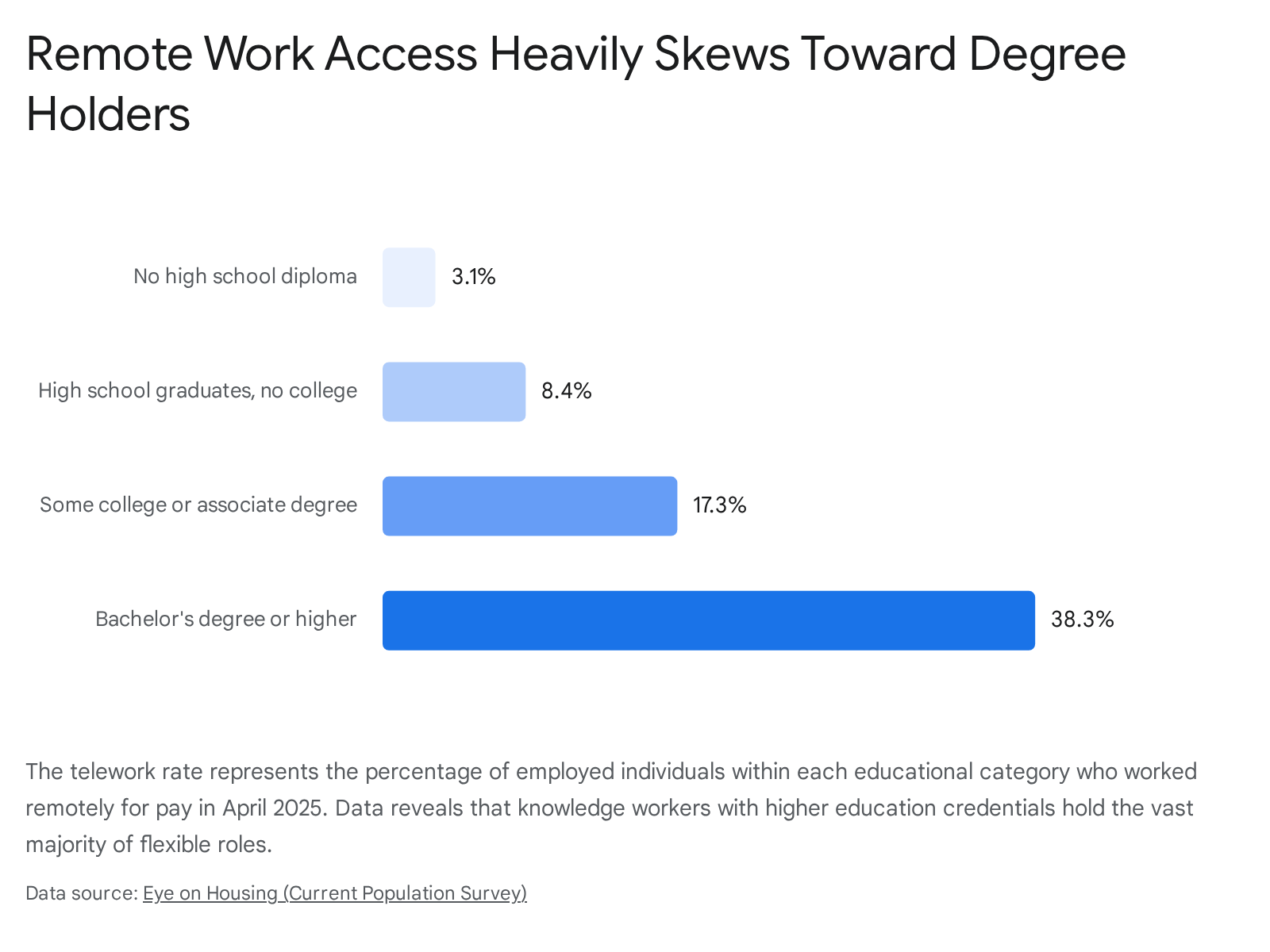
According to early 2025 data from the U.S. Current Population Survey, a mere 3.1% of workers without a high school diploma teleworked 6. This rate increases modestly to 8.4% for high school graduates with no college experience, and to 17.3% for those with some college or an associate degree 6. However, the rate surges to 38.3% for workers with a bachelor's degree or higher 6. Furthermore, individuals with advanced degrees enjoy the absolute highest overall telework rates, ranging from 41.2% to 46.8% depending on the specific survey methodology used by the Bureau of Labor Statistics 78.
Income tracks almost identically with these educational lines. Remote work is heavily concentrated in high-income, white-collar regions. The 2020 - 2024 American Community Survey highlights that counties with economies built around energy, manufacturing, and port industries show telework rates as shockingly low as 3.4% 5. Conversely, of the 313 U.S. counties with more than 100,000 workers, not a single one saw a decline in people working from home between 2019 and 2024, demonstrating that where white-collar hubs exist, remote work is expanding relentlessly 5.
Age, Gender, and Race Disparities
Age plays a significant, though notably non-linear, role in remote work adoption. In 2024 and 2025, workers aged 16 - 24 had the lowest telework participation of any age group, sitting at just 6% to 7.9% 6714. This is largely because younger workers are disproportionately employed in entry-level, retail, food service, or hospitality roles that intrinsically require physical presence.
Conversely, the 25 - 54 age bracket dominates remote work. Specifically, the 35 - 44 cohort enjoys the highest participation rate, hovering around 27% 677. Millennials (aged 25 - 39) now account for the largest overall demographic share of remote employees at 48% 14. This makes logical sense within a career lifecycle: these workers have accumulated the necessary seniority to demand flexibility, and they are in their prime child-rearing years where work-life balance is at a premium. Older workers (aged 55 and up) maintain a telework rate of around 23%, slightly lower than their middle-aged counterparts 610.
Gender dynamics in remote work also reveal shifting societal preferences and caregiving burdens. Women consistently outpace men in overall telework participation. Nearly 25% of employed women worked from home in April 2025, compared to about 19% to 21% of employed men 6714. Working mothers, in particular, show the absolute highest desire to maintain work-from-home flexibility, largely to manage ongoing caregiving responsibilities 1311. The perceived loss of this benefit carries high stakes; a 2025 Pew Research Center survey found that 49% of women would be highly likely to leave their jobs if remote options were revoked, compared to 43% of men 1312.
Racial and ethnic disparities are also distinctly visible in telework access, reflecting broader occupational segregation in the U.S. economy. Early 2024 demographic data shows that Asian workers had the highest telework rate at 32.8% 14. White workers followed at 23.2%, while Black workers sat at 17.1%, and Hispanic/Latino workers had the lowest access at 12.4% 14. These disparities correlate heavily with industry representation, as Asian and White workers are statistically more likely to be employed in the tech, finance, and professional services sectors that most easily support distributed work.
| Demographic Category | Highest Remote Participation Group | Lowest Remote Participation Group |
|---|---|---|
| Education Level | Advanced Degree (~41.2% - 46.8%) | No High School Diploma (~3.1%) |
| Age Bracket | 35 - 44 years old (~27.0%) | 16 - 24 years old (~6.0% - 7.9%) |
| Gender Identity | Women (~25.0%) | Men (~19.0% - 21.0%) |
| Race/Ethnicity | Asian (~32.8%) | Hispanic/Latino (~12.4%) |
| Industry Sector | Technology / IT (~67.0%) | Food Service / Hospitality (~4.8%) |
Table 1: Summary of U.S. demographic disparities in remote work adoption based on aggregated 2024 - 2025 labor studies 67714.
The Pushback: Return-to-Office Mandates and Employee Retention
As we advance through 2026, the corporate world is engaged in a high-stakes standoff. On one side, executives cite improved productivity, spontaneous collaboration, stronger company culture, and easier management as their primary justifications for demanding a return to the office (RTO) 13. According to Resume Builder data, an astonishing 90% of companies plan to require some form of in-office presence by the end of 2025 14. Major corporations like Amazon, Dell, Google, and Meta have all tightened their hybrid work policies, with some instituting strict badge-swipe tracking mechanisms to monitor compliance 14.
However, the enforcement of these mandates has proven to be a dangerous, and often financially catastrophic, gamble for human resources departments.
The Hidden Costs and Failures of RTO Mandates
When companies issue strict RTO mandates, they consistently experience severe organizational blowback. Comprehensive data tracking S&P 500 firms covering over three million workers reveals that companies with strict RTO mandates experience a 169% employee turnover rate 15. In stark contrast, companies that maintain flexible arrangements experience a 149% turnover rate 15.
This 13% to 20% differential in attrition frequently costs companies their most valuable and hardest-to-replace assets: senior talent and high-performing specialists 1415. Senior employees, who possess the leverage to find new jobs, simply leave when their autonomy is threatened. Research confirms that 46% to 64% of remote workers say they would either quit immediately or begin actively job hunting if forced back to a physical desk 131415. This is not merely an empty threat; stated intent closely matches actual departure rates tracked three to six months post-mandate 15. In fact, 80% of companies that enforced RTO policies readily admit they lost valuable talent directly because of those policies 15.
Furthermore, enforcing these rules is proving nearly impossible without destroying company morale. While mandates technically increased required office days by 12% between 2024 and 2025, actual measured office attendance only increased by a marginal 1% to 3% 13. Employees are effectively participating in "shadow compliance," showing up just enough to avoid being fired but actively resisting full compliance. It is unsurprising that 99% of companies enforcing RTO mandates report noticeable declines in employee engagement, and independent analyses of millions of Glassdoor reviews show significant drops in job satisfaction ratings immediately following mandate announcements 15.
Conversely, flexibility is proving to be the ultimate retention tool. Approximately 76% of companies report experiencing greater employee retention simply by allowing remote work 1315.
The Salary Trade-off
The financial logic of RTO is also highly debated, as remote work has effectively become an untaxed form of compensation. Employees themselves save roughly $2,500 to $10,000 annually on commuting costs, professional apparel, and daily meals 814. Eliminating the commute saves remote workers an average of 55 to 72 minutes per day, returning over 230 hours a year to their personal lives 1016.
Because of these massive lifestyle and financial benefits, remote workers are fiercely protective of their arrangements. Surveys indicate that 40% of U.S. workers would willingly accept 95% or less of their current salary just to retain the option to work remotely 7. Nearly 10% would take a massive 20% pay cut 7.
If companies want employees back in the office, they must pay a steep premium for it. Approximately 66% of professionals state they would only be willing to return to the office five days a week if offered a significantly higher salary to offset their lost time and increased expenses 7.
For employers, the math is equally compelling on the remote side. Companies save an average of $11,000 to $12,000 annually per half-time remote worker through a reduced real estate footprint, lowered absentee rates, and vastly diminished turnover replacement costs 81416.
Productivity, Economics, and the Junior Hiring Paradox
The widespread executive assumption that remote work damages productivity is fundamentally not supported by broad economic data. In fact, macroeconomic indicators suggest the exact opposite.
Debunking the Productivity Myth
Total factor productivity (TFP) - an economic metric that measures efficiency gains from labor, capital, and innovation combined - grew 1% annually in the United States between 2019 and 2025 17. This is significantly above the sluggish 0.6% pace recorded in the decade between 2007 and 2019 17. Stanford economist Nicholas Bloom, a leading researcher on workplace dynamics, notes that for every 1 percentage-point increase in remote work participation, there is a corresponding 0.08 percentage-point increase in TFP growth 1.
Controlled academic studies further dismantle the anti-productivity narrative. A landmark randomized control trial involving call center workers found a 13% performance increase when working from home, primarily driven by fewer breaks, fewer sick days, and a quieter environment that allowed for deeper focus 11618. Another rigorous 2026 study published in the journal Nature revealed that well-organized hybrid teams actually outperform fully in-office teams by a margin of 5%, while simultaneously dropping employee attrition by a massive 33% 1.
However, it is crucial to apply calibrated uncertainty here: remote work is not a magic bullet that fixes a broken company. It acts as an amplifier of existing structural weaknesses. If an organization relies heavily on physical proximity to cover for poor documentation, weak asynchronous communication, and vague management directives, remote work will cause their productivity to plummet. In contrast, companies with strong documentation habits and intentional communication structures turn remote work into a competitive advantage 16.
The Junior Hiring Collapse
While senior employees thrive in remote environments, an unexpected and severe consequence of the remote work revolution has been its negative impact on entry-level talent. A major May 2026 working paper by researchers at the University of Warwick, the London School of Economics, and Oxford's Ellison Institute highlights that the permanent shift to hybrid work may be actively suppressing junior hiring 19.
Senior professionals enjoy the vast majority of flexible work options, with 20% utilizing hybrid schedules and 8% working fully remote. In contrast, entry-level workers are offered much less flexibility, with only 13% working hybrid and 6% fully remote 9. Because senior workers are rarely present in the physical office, the traditional, unwritten pathways for junior employee development - shadowing a mentor, overhearing complex business conversations, and receiving spontaneous feedback - have severely degraded 19.
As a result, companies are becoming increasingly hesitant to invest in unproven entry-level talent, perceiving the training costs in a distributed environment as too high. Instead, they prefer to recruit experienced, senior employees who can onboard themselves remotely and deliver value immediately. This phenomenon is suppressing junior hiring across multiple sectors. Importantly, this trend is occurring simultaneously with the rise of artificial intelligence, and many economists argue that what is often misattributed to AI replacing junior workers is actually the structural friction caused by remote work environments failing to nurture them 19.
The Global Landscape of Distributed Work
Remote work is not a uniform global phenomenon. While it thrives in the English-speaking world, it faces significant cultural, legal, and infrastructural headwinds in other regions, radically reshaping the geography of labor 11.
North America and Europe
North America, alongside the United Kingdom and Australia, consistently maintains the highest levels of working from home globally. College-educated workers in these regions average between 1.5 to 2 days a week working remotely 1120. Australia has embraced the model deeply, with nearly 46% of employed Australians working from home at least some of the time by mid-2025 10. The UK follows closely, with roughly 40% of jobs featuring some remote component 10.
The European Union has also successfully normalized flexible work, but at slightly lower intensities than the U.S. In 2025, 9% of EU employed persons usually worked from home, with another 13% doing so occasionally, bringing total participation to 22% 2627. This is nearly triple the EU's pre-COVID baseline 27.
However, Europe is heavily fractured by its regional economies. The Netherlands leads the continent with over 51.9% of workers operating remotely at least occasionally, closely followed by highly digitized Nordic countries like Sweden (45.3%) and Finland (42%) 26. By contrast, Eastern and Southern European countries, which possess larger manufacturing bases and in-person service sectors, show minimal adoption. Romania and Bulgaria record remote work rates of just 1.2% to 3% 2621. The prevalence of telework in Europe acts as a direct proxy for the degree of tertiarization (shift to a services economy) and digitalization of a specific country's economy 26.
Latin America: The Nearshoring Boom
Perhaps the most dramatic shift in the global labor market has occurred in Latin America (LATAM), which has experienced an unprecedented remote work boom, transforming into a prime "nearshoring" hub for North American companies.
Prior to 2020, only 14% of Latin American workers were fully remote; by the post-pandemic era, up to 36% of the applicable workforce had adopted remote structures 29. By 2023, over 80% of firms in the region had introduced at least hybrid or partially remote policies 2231. The region now hosts nearly 2 million software developers, fueled by active investments in digital upskilling and a surging middle class eager to access global wages 2922.
U.S. companies are flocking to LATAM talent due to three intersecting factors: highly skilled bilingual workforces (with 80% English proficiency in customer-facing remote roles), highly competitive labor costs that bypass domestic inflation, and perfect timezone alignment with the United States 2923.
| Country | Key Nearshoring Strengths | Target Hiring Roles | Time Zone Alignment (U.S.) |
|---|---|---|---|
| Mexico | Exploding tech hubs (Guadalajara), massive bilingual labor pool | Software engineering, IT, Customer support | High (Central Time) |
| Colombia | High English proficiency, highly cost-effective salary structures | Customer service, Admin support, Tech | High (Eastern Time) |
| Brazil | Deep technical expertise, massive diverse domestic market | Advanced software engineering, Data analysis | High (Eastern Time) |
| Costa Rica | Stable economy, strong government-backed tech initiatives | Technical support, Finance, HR | High (Central Time) |
| Chile | Premier education system, highly skilled engineering | Complex software development, Engineering | High (Eastern Time) |
Table 2: Summary of top Latin American nearshoring markets and their strategic advantages for remote hiring in 2025-2026 23.
Asia: The Cultural Tug-of-War
In stark contrast to the Americas, Asia consistently records the lowest remote work adoption rates globally, averaging just 0.5 to 1 day per week 11.
In Japan, despite a desperate pandemic-driven push by the government, remote work has stalled. By 2024-2025, adoption stood at around 24.6% to 24.8% 2033. While this is higher than the 2019 baseline of 8.8%, the intensity of remote work is exceptionally low. Japanese workers average only 0.5 days a week at home 34. Full remote work remains stalled at a mere 8.7% 24. The resistance in Japan is deeply cultural and systemic. It is rooted in a reliance on paper documents, the mandatory hanko (personal physical seal) approval system, and a deeply entrenched corporate ethos that explicitly equates physical presence with dedication and loyalty 3424. Furthermore, unpaid "service overtime" (sābisu zangyō) remains common, creating intense peer pressure to remain at the desk 34.
In Singapore, the market is highly digitized but remains stubbornly office-led. While 85% of companies have officially adopted hybrid models, workers still spend an average of 62% of their workweek in the office 2526. Interestingly, work patterns in Singapore are becoming paradoxically solitary; time spent working entirely alone while sitting in the office rose to 48% in 2026, while actual in-person collaboration fell to 23% 26. To manage the friction of hybrid setups and global teams, Singapore is leading the world in remote work automation, with 65% of HR leaders expecting two-thirds of routine management tasks to be automated by AI by the end of 2026 27.
Psychology, Well-Being, and the Middle Manager Crisis
The shift to distributed work has profoundly altered employee psychology and organizational health. While the benefits of eliminating the commute are mathematically clear, the human cost is complex, giving rise to a severe crisis in middle management.
The Loneliness Paradox and the Hybrid "Sweet Spot"
Gallup's State of the Global Workplace: 2025 report reveals a fascinating psychological paradox. Exclusively remote employees are actually the most engaged segment of the workforce, boasting a 31% engagement rate 39. They consistently report feeling more productive, appreciate the autonomy, and enjoy drastically improved work-life balance 3940.
However, they are also the most vulnerable to isolation. Fully remote workers are significantly more likely to report daily stress (45%) compared to on-site workers (38%), and between 25% and 27% of fully remote employees report experiencing meaningful daily loneliness - a rate 56% higher than their on-site counterparts 1639. Remote employees also attend 50% more meetings than their office colleagues, leading to high rates of digital exhaustion and burnout 16.
Because of these conflicting extremes, hybrid work has emerged as the psychological "sweet spot." Employees in hybrid roles report the absolute highest levels of overall life satisfaction (thriving) at 42% 139. Hybrid work manages to successfully blend the deep-focus autonomy of the home office with the vital social infrastructure and connection of the physical workplace.
The Collapse of Manager Engagement
Perhaps the most alarming statistic to emerge in 2024 and 2025 is the collapse of middle management morale. Global employee engagement fell from 23% to 21%, a seemingly small drop that actually mirrors the worst days of the 2020 lockdowns, costing the global economy an estimated $438 billion in lost productivity 394142.
This systemic decline is almost entirely driven by a severe drop in manager engagement, which plummeted from 30% to 27% 394142. The pain is particularly acute for younger demographics: managers under 35 saw engagement drop by five points, while female managers experienced a staggering seven-point decline 394142.
Following the pandemic, managers became the "shock absorbers" of the corporate world. They are caught in a brutal vise: pressured aggressively by executives above them to enforce unpopular return-to-office mandates, while simultaneously trying to accommodate the flexibility, burnout, and mental health needs of the employees below them 4142. Adding to this burden is the fact that 56% of managers globally lack basic training on how to handle these new dynamics 41. Organizations that fail to train their managers in remote coaching and asynchronous communication are watching their leadership layers burn out. The data indicates that as HR teams become leaner, the successful management of a global, distributed workforce will require an integrated technology stack and managers who are trained to lead by measurable outcomes, rather than by line-of-sight physical presence 2728.
Bottom line
Remote work is no longer a temporary experiment but a permanent, structurally integrated feature of the global economy. It primarily benefits highly educated, mid-career knowledge workers, while geography heavily dictates adoption rates, with Latin America booming as a nearshore hub and Asia resisting cultural shifts. While corporate mandates attempting to force a full return to the physical office frequently result in severe talent attrition and collapsed engagement, the data firmly establishes the hybrid model as the optimal balance for both productivity and employee well-being. However, organizations must urgently address the rising burnout among middle managers and the narrowing development pathways for entry-level talent, or risk deeply undermining the long-term viability of their distributed workforce.