
Performance comparison of remote, hybrid, and co-located teams
1. Introduction and Historical Context
The structural transformation of the global workplace, catalyzed by the sudden disruption of the 2020 pandemic, has transitioned from a temporary emergency measure into a durable, macroeconomic reconfiguration of labor. Early foundational research, most notably Stanford economist Nicholas Bloom's 2015 randomized controlled trial of call center employees at Ctrip, established the initial empirical baseline indicating that remote work could increase output in routine, independent tasks by up to 13% 11. However, the unprecedented scale of the pandemic-era shift - where the share of paid workdays performed from home in the United States surged from an estimated 7% in 2019 to over 60% by the spring of 2020 - necessitated a much broader and highly nuanced investigation into the limits, benefits, and psychological implications of distributed work 234.
As the global economy advances through the mid-2020s, the hyperbolic debates characterizing the early post-pandemic years have yielded to empirical stabilization. By 2024 and 2025, rigorous panel data from the National Bureau of Economic Research (NBER) and the Global Survey of Working Arrangements (G-SWA) confirmed that the post-pandemic retreat from peak remote work had effectively bottomed out, establishing a new global equilibrium 456. Yet, the prevailing corporate narratives that remote work is universally superior for productivity - or conversely, that strict Return-to-Office (RTO) mandates inherently restore traditional corporate efficiency and innovation - are fundamentally flawed.
The objective performance outcomes of any spatial workplace model are highly contingent upon the cognitive complexity of the task, the demographic profile and tenure of the employee, the technological infrastructure deployed, and the underlying macro-cultural dimensions of the region in question. This report systematically deconstructs the contemporary dynamics of remote, hybrid, and co-located work models. Relying extensively on peer-reviewed management literature, organizational psychology, and rigorous economic working papers published from 2023 to 2026, this analysis dissects the true impacts of spatial flexibility. By correcting pervasive fallacies regarding self-reported productivity, proximity bias, and the economics of RTO mandates, this document provides a definitive, evidence-based framework for understanding the modern distribution of labor.
2. The Stabilization of Distributed Work: Global Metrics and Adoption Trajectories
The trajectory of remote work adoption has definitively flattened into a sustained, long-term paradigm, moving far beyond the experimental phase into structural permanence. According to the 2024 - 2025 waves of the G-SWA, which aggregates harmonized data from over 16,000 college-educated employees across 40 nations, the average number of fully paid days worked from home stabilized at approximately 1.27 to 1.33 days per week globally 45. This signifies that roughly 25% of all workdays for college-educated professionals globally are now conducted away from traditional corporate premises, a figure that has remained remarkably consistent since the rapid declines of 2022 4.
However, this global average obscures profound regional heterogeneity. The adoption of remote work is not merely a function of technological readiness; it is deeply intertwined with cultural dimensions, housing infrastructure, and institutional variables. English-speaking advanced economies consistently exhibit the highest penetration of distributed work. The United States, Canada, the United Kingdom, Australia, and New Zealand average between 1.4 and 2 days at home per week 57. Within this cohort, Canada leads with an average of 1.7 remote days per week, while the United States maintains a steady rate where approximately 33% of employed individuals report working from home on any given workday 79.
European and Latin American labor markets occupy the middle tier, averaging approximately one day of remote work per week 45. Within Europe, there is significant intra-regional variation; countries with robust digital infrastructures and high unionization like Finland, Germany, and the Netherlands average 1.0 remote days per week, whereas Greece lags significantly at 0.5 days 7. Latin American hubs, such as Chile and Mexico, average 1.0 and 0.8 days respectively, driven largely by multinational corporate policies superimposed on local workforces 7.
In stark contrast, adoption rates in Asia average less than 0.7 days per week, despite housing some of the world's most advanced technological infrastructures 578. South Korea, for instance, reports an exceedingly low average of 0.4 remote days per week, while Singapore marginally leads the region at 0.9 days 7. The Middle East and Africa (MEA) region presents a similarly constrained picture, where remote work is predominantly limited to expatriate hubs and technology sectors, bounded heavily by infrastructural limitations 11.
The following table summarizes the stabilized regional adoption rates of remote work as of the 2024 - 2025 period, illustrating the structural ceiling reached in various global markets.
| Global Region | Average Remote Days per Week (College-Educated Workers) | Market Characteristics and Leading Nations |
|---|---|---|
| English-Speaking | 1.4 to 2.0 days | High cultural individualism, robust suburban housing. (Canada: 1.7, UK: 1.5, USA: ~1.5) 57. |
| Europe | 1.0 to 1.5 days | Moderated by collective bargaining and 'right to disconnect' laws. (Germany/Netherlands: 1.0, Greece: 0.5) 5712. |
| Latin America | ~1.0 day | Constrained by broadband penetration; driven by multinational presence. (Chile: 1.0, Mexico: 0.8) 57. |
| Asia-Pacific | 0.5 to 1.0 day | High power distance, dense urban housing, strong presenteeism culture. (Singapore: 0.9, South Korea: 0.4) 57. |
| Middle East & Africa | < 1.0 day | Severe digital divide outside urban hubs; strong co-location preference in GCC. (South Africa remote roles: 3.7%) 511. |
These stabilized figures indicate that organizations globally have largely exited the reactionary phase of workplace design. The data reflects a structural ceiling imposed not by a lack of software or desire, but by the intrinsic requirements of certain organizational structures, the physical constraints of urban housing markets, and the prevailing cultural paradigms regarding management, supervision, and trust.
3. Cultural Dimensions, Geographic Divergence, and Technological Constraints
To comprehend why remote work adoption varies so drastically across borders, one must examine the macro-cultural frameworks that govern organizational behavior. Research published in the Proceedings of the National Academy of Sciences (PNAS) indicates that cultural individualism accounts for 29% of the cross-country variation in remote work rates, representing the single most powerful predictive factor - surpassing industry structure, population density, and economic development 3.
3.1. The Role of Power Distance and Fear of Authority
Applying Geert Hofstede's Cultural Dimensions Theory reveals critical friction points for remote work in non-Western contexts. In regions characterized by high Power Distance - defined as the degree to which unequal distributions of power are accepted and expected by subordinates - remote work inherently conflicts with traditional modes of leadership 91011. Many Asian and Middle Eastern corporate cultures rely on authoritarian leadership models where compliance, loyalty, and performance are historically signaled through physical presence and visible deference to superiors 911.
When these rigid hierarchies are transposed into a remote environment, subordinates frequently experience an acute "fear of authority" that paralyzes workflow 1011. The physical distance exacerbates psychological distance. In a high-power-distance setting, employees are highly hesitant to initiate lateral communication, offer spontaneous suggestions, or clarify strategic ambiguities without explicit, formal prompting from managers. This leads to severe communication latency, as the natural flow of information hits artificial bottlenecks 1011.
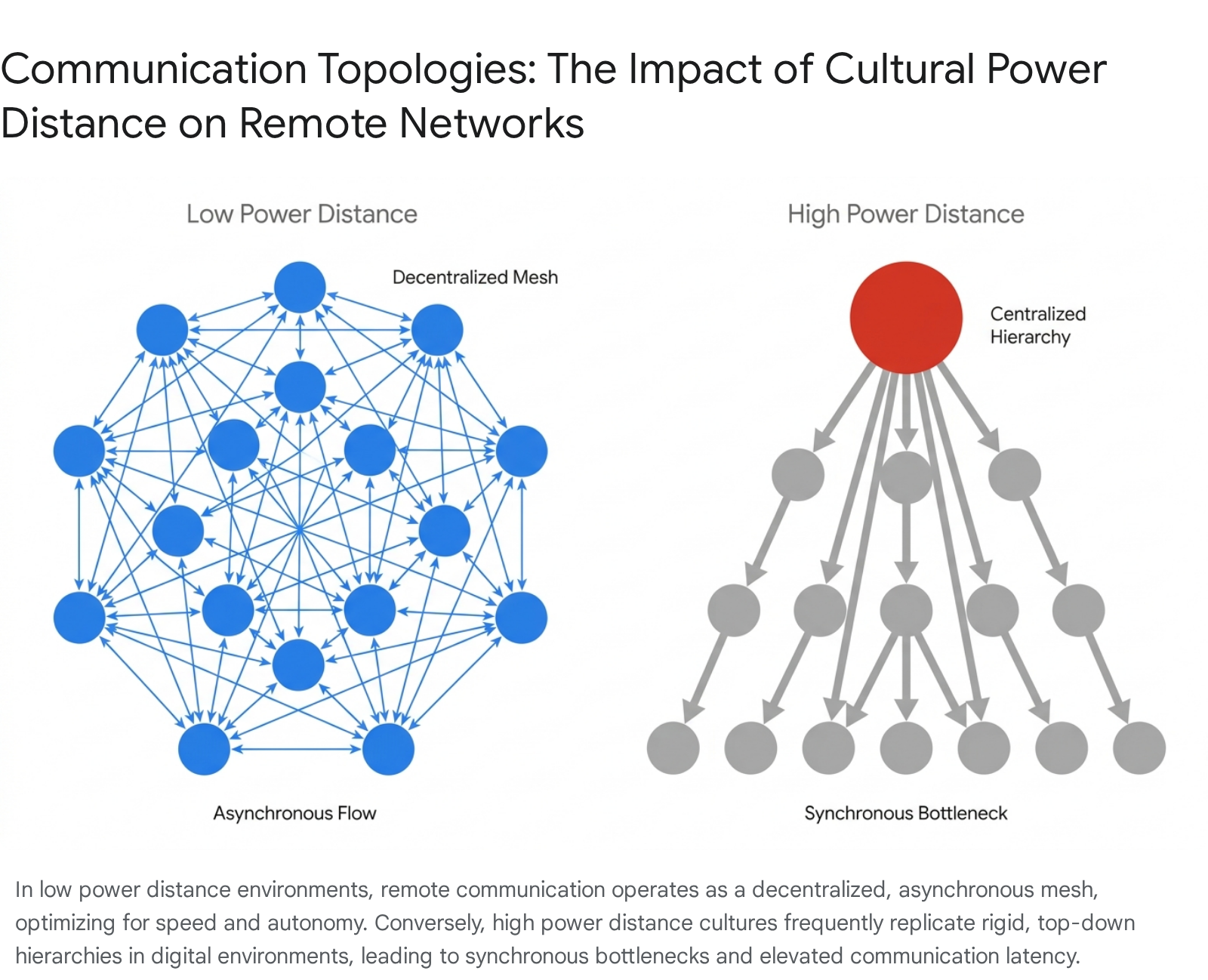
Furthermore, managers in these environments often substitute physical supervision with invasive digital monitoring, demanding real-time synchronous availability, which entirely negates the primary productivity benefits of remote autonomy 9.
3.2. Infrastructure and Real Estate Constraints
Beyond psychological variables, physical infrastructure dictates practical remote capabilities. In the Middle East and Africa (MEA), the widespread adoption of remote work faces a hard ceiling imposed by digital connectivity limitations. In 2024, Africa's overall internet-use rate averaged only 38%, which fundamentally restricts the scalability of distributed models outside of highly concentrated, affluent urban centers 11.
Furthermore, urban spatial realities sharply shape remote work desirability. In dense Asian metropolises, high real estate costs often result in cramped, multi-generational living conditions that are structurally unconducive to focused professional work. Employees in these regions frequently cite a lack of ergonomic space, familial distractions, and acute "loneliness" as primary reasons for voluntarily returning to the office, contrasting sharply with the suburban spatial advantages (e.g., dedicated home offices) enjoyed by many North American and Australian workers 916. Consequently, prime office real estate in major Middle Eastern hubs like Dubai maintains near-zero vacancy rates (0.3% in Q2 2025), reflecting a persistent cultural and infrastructural reliance on co-located facilities, whereas US office vacancy rates hovered near 20% during the same period 1117.
4. Deconstructing the Productivity Paradox: Objective Metrics vs. Cognitive Bias
A central, enduring challenge in contemporary organizational research is separating objective performance data from the subjective perceptions of both management and labor. The discourse surrounding remote productivity is heavily plagued by confirmation bias, flawed self-reporting methodologies, and the dangerous misattribution of input metrics (hours logged) to actual output metrics (value created). Correcting these misconceptions is paramount for designing effective workforce policies.
4.1. The Illusion of Self-Reported Productivity
Survey data reliably illustrates a massive perception gap across the hierarchy of organizations. On average, remote workers subjectively estimate their own productivity to be 7% higher when working from home, while managers systematically estimate that their remote teams are 33.5% less productive 18. A comprehensive 2024 survey of technology workers revealed that 87.9% of employees rate their personal productivity as "high" when given location flexibility. Yet, top-level managers reported feeling 44.4% more productive when strictly in the office, creating a persistent ideological clash 19.
This divergence necessitates a strict reliance on objective software telemetry. When transitioning from self-reported surveys to measured, uninterrupted work time, remote environments present a distinct, quantifiable advantage for concentrated execution. Telemetry data from 2025 tracking thousands of workers indicates that remote employees spend 59.48% of their week in deep, focused work, compared to just 48.5% for office workers 19. In actual minutes, remote workers average 4.55 hours of deep focus time per day, versus 3.72 hours for office workers - yielding roughly 4.15 additional hours of deep work per week 19.
The primary mechanism driving this advantage is the drastic reduction of unscheduled context switching. The modern open-plan office is an engine of cognitive disruption. Data indicates that office workers experience an average of 884 interruptions annually, compared to 723 for remote workers 19. Because organizational psychology research demonstrates that it takes an average of 23 minutes to cognitively refocus after an interruption, this 18% reduction in localized distraction translates directly to massive recovered output capacity. Specifically, office workers lose approximately 6.52 hours per week simply trying to get back on track after disruptions, resulting in remote workers gaining back roughly 62 hours of productive execution time annually 19.
| Metric | Fully Remote Worker | Co-Located Office Worker | Differential |
|---|---|---|---|
| Weekly Focus Time | 59.48% | 48.5% | +10.98% advantage remote 19 |
| Daily Deep Work Hours | 4.55 hours | 3.72 hours | +0.83 hours daily 19 |
| Annual Interruptions | 723 | 884 | -18% fewer disruptions 19 |
| Time Lost to Context Switching | ~5.33 hours/week | 6.52 hours/week | 62 hours gained annually 19 |
4.2. The Fallacy of Logged Hours and the "50-Hour Cliff"
However, extrapolating this focus-time advantage to a blanket executive statement that "remote work universally increases productivity" is a perilous oversimplification that ignores boundary collapse. A critical corporate misconception is the conflation of increased labor hours with increased productivity.
A rigorous 2023 study published in the Journal of Political Economy Microeconomics by Gibbs, Mengel, and Siemroth examining over 10,000 skilled professionals at an Asian IT services company utilized precise personnel analytics to measure the shift to fully remote work 1. The empirical findings were stark: total hours worked spiked by approximately 30%, largely driven by an 18% surge in after-hours labor 1. Yet, the average output delivered by these employees remained flat. Consequently, true productivity - defined mathematically as output divided by hours worked - actually declined by 8% to 19% 1.
This phenomenon illustrates the danger of boundary collapse in remote settings, where the blurring of work-life delineation leads to performative presenteeism, digital burnout, and highly inefficient workflows 202112. Employees often engage in "coffee badging" or continuous availability signaling to placate anxious managers. Medical and physiological research confirms that human productivity is not infinitely scalable; it suffers a precipitous decline when labor exceeds 50 hours per week. Working beyond 55 hours per week introduces severe diminishing returns, causing hourly output to drop off a cliff, and elevates the risk of cardiovascular events by 17% and stroke by 35% according to the World Health Organization 23. Therefore, equating late-night availability on corporate chat applications with "high performance" is a metric failure that severely compromises long-term workforce sustainability.
4.3. Proximity Bias and Gendered Evaluation Penalties
The reliance on visible effort (proximity bias) over objective output also introduces severe, systemic biases into organizational performance evaluations. A 2025 empirical study from the University of Illinois Urbana-Champaign exposed the insidious nature of this bias, particularly concerning telecommuting mothers 13.
The researchers found that when remote workers failed to meet strict performance targets, managers instinctively attributed the failure of telecommuting mothers to a "lack of effort" or distraction by domestic duties, evaluating them significantly more harshly than telecommuting fathers who exhibited the exact same objective performance shortfall 13. Remote work inadvertently activated gender-based stereotypes that were relatively dormant in traditional, visible office settings. The researchers discovered a purely data-driven remedy: when managers were presented with objective time-tracking telemetry proving that the telecommuting mothers logged just as many continuous working hours as their male counterparts, the evaluation bias instantly vanished 13. This underscores the critical necessity of transitioning from observational management to outcome-based and objectively calibrated management in distributed teams.
5. Task Specificity: Routine Execution vs. Complex Innovation
The fundamental flaw in early remote work literature was the assumption of task homogeneity. The efficacy of a spatial work model is entirely dictated by the cognitive demands of the workflow being executed. The modern literature strictly bifurcates tasks into two distinct categories: routine, individual execution versus complex, synchronous problem-solving.
5.1. The Advantage of Remote Routine Execution
For tasks that are highly standardized, independently executed, and precisely measurable - such as data entry, software quality assurance, or call center operations - fully remote models yield unequivocal performance enhancements. A 2024 NBER working paper examining Tempo BPO, a massive call center in Turkey, documented a 9.1% to 10.5% sustained increase in objective productivity (calls handled per hour) when operations shifted remotely 14.
The primary driver of this gain was the elimination of ambient office noise. In the co-located environment, background chatter impaired auditory processing, whereas the quiet of the home environment allowed agents to process customer queries faster and with greater accuracy, reducing average call duration by 14% without degrading customer service quality ratings 14. For independent knowledge workers, this principle scales proportionally; the physical isolation of the remote environment acts as a cognitive shield against the constant friction of the modern open-plan office 12.
5.2. The Innovation Penalty in Distributed Networks
Conversely, for tasks requiring complex, unstructured problem-solving, creative brainstorming, and cross-functional design, excessive remote work imposes a severe and measurable "innovation penalty." Innovation is rarely a linear, asynchronous process; it thrives on stochastic interactions, immediate feedback loops, and the collision of disparate ideas - often termed "productive accidents."
A comprehensive 2024 study analyzing over 48,000 employees at HCL Technologies, a major Indian IT services firm, tracked the quantity and quality of ideas submitted to an internal innovation portal across different work models 15. The researchers found that while the absolute quantity of ideas remained stable during fully remote periods, the quality of those ideas suffered drastically. The probability of an idea being shared with a client dropped by 9 percentage points, and the probability of receiving a high client rating fell by 18 percentage points compared to co-located work 15. More alarmingly, during poorly coordinated hybrid phases (where teams were scattered across locations randomly), the sheer quantity of innovative ideas generated fell by 22% compared to fully co-located periods 15.
The root cause of this decline is the rapid decay of "weak ties" in remote networks. A massive 2022 analysis of 60,000 Microsoft employees published in Nature Human Behaviour demonstrated that fully remote work causes organizational networks to become highly siloed 1. Workers communicate intensely with their immediate team (strong ties) but cease spontaneous interaction with adjacent departments (weak ties) 1. Because breakthrough innovation typically occurs at the intersection of different disciplines, this network insularity severely strangles creative output.
Furthermore, innovation suffers from "communication latency." In a physical office, resolving a complex ambiguity might require a three-minute synchronous whiteboard session. In a distributed setting, this exact exchange is translated into a fragmented, asynchronous sequence of emails and chat messages spanning several hours or days 1628. While asynchronous communication is excellent for transferring explicit, factual knowledge, it is highly inefficient for transferring tacit knowledge, navigating nuance, or resolving complex, multi-variable strategic disputes 1628.
6. Demographic Divergence: The Junior Penalty and Senior Leverage
Workplace location policy does not impact all employees equally. The data reveals a sharp divergence in the optimal environments for early-career professionals versus tenured senior staff, creating a fundamental tension in organizational design that must be managed structurally.
6.1. Onboarding, Mentorship, and the Junior Penalty
For junior employees and new hires, the physical office acts as a crucial, accelerated learning environment. Professional development for recent graduates relies heavily on osmotic learning - overhearing senior colleagues negotiate, observing conflict resolution, and receiving immediate, informal micro-corrections throughout the day.
A critical 2023 study by economists from Harvard and the Federal Reserve Bank of New York highlighted this dynamic among software engineers. The research found that engineers sitting in different buildings on the same corporate campus actually wrote more lines of code than those sitting adjacently, mirroring the deep-work focus advantage 17. However, the physically separated engineers commented far less on their peers' code, indicating a severe reduction in mentorship, peer review, and knowledge transfer 17. In purely remote settings, junior employees report high levels of anxiety regarding communication latency; lacking the visual cues of an office (e.g., seeing if a manager's door is open or if they look busy), they hesitate to ask for help, fearing they are interrupting via digital channels 17.
Time-use data starkly quantifies this deficit. According to WFH Research, employees working in an office spend an average of 14 minutes per day receiving direct mentorship, compared to just 10 minutes for those working from home 18. Furthermore, in-office workers spend 18 minutes on formal training compared to 14 minutes remotely 18. Over a career, this compounded deficit results in slower professional maturation, weaker skill acquisition, and a shallower attachment to the corporate culture 18. Even the highly successful Turkish call center study noted a critical caveat: remote workers who received their initial onboarding and training in-person ultimately achieved higher long-run productivity and significantly lower attrition than those who were onboarded purely remotely 14.
6.2. Senior Autonomy and the Retention Imperative
Conversely, senior and highly tenured employees - who already possess deep institutional knowledge, robust internal networks, and high human capital - extract maximum utility from remote work 311920. They no longer require the same volume of osmotic learning; instead, they require deep focus to execute complex, high-stakes strategies. For this demographic, geographical flexibility is paramount, serving as a primary lever for work-life integration and burnout prevention 12.
Because high-performing senior talent possesses significant market leverage, their preferences dictate the labor market. As discussed in the subsequent section, when organizations attempt to force this specific demographic back into traditional daily commutes without clear justification, the resultant friction leads to severe institutional damage and talent flight.
7. The Economics of Return-to-Office (RTO) Mandates
Driven by fears of declining innovation, the sunk costs of empty commercial real estate portfolios, and a desire to regain traditional managerial oversight, a significant cohort of major corporations instituted strict Return-to-Office (RTO) mandates between 2023 and 2025 20. Proponents argued these mandates would restore corporate culture and boost productivity. However, rigorous econometric analyses of these mandates reveal that they frequently trigger catastrophic, self-inflicted losses in human capital.
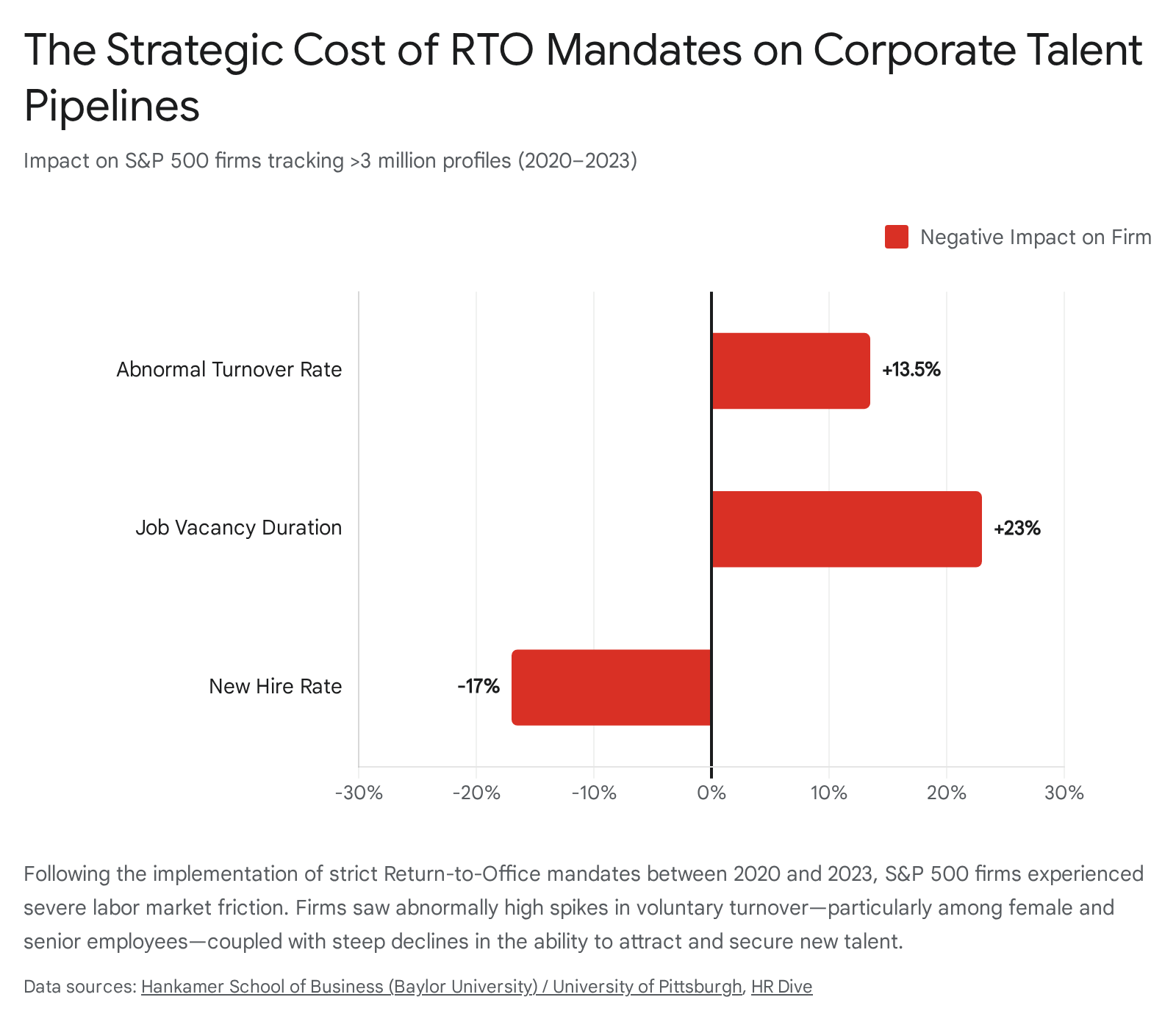
A landmark 2024 - 2025 study conducted by researchers at the University of Pittsburgh and the Hankamer School of Business at Baylor University analyzed the RTO mandates of 54 major technology and financial firms within the S&P 500, tracking the movement of over three million individual LinkedIn profiles 1920. The empirical outcomes of forced RTO policies are starkly negative.
7.1. Abnormal Turnover and Human Capital Flight
Firms enforcing strict RTO mandates experienced an average 13% to 14% increase in abnormal voluntary turnover 3120. Crucially, this turnover was not uniformly distributed across the organizational chart; it disproportionately hollowed out the most valuable segments of the workforce. High-skilled employees and senior management - individuals with exceptional market leverage and external options - were the first to exit 3120.
Furthermore, these mandates severely compromised corporate diversity and inclusion goals. Female employees were nearly three times more likely to resign post-mandate compared to their male counterparts 20. The sudden lack of geographic and temporal flexibility forced primary caregivers out of the organization. Many departing employees willingly accepted lateral or even lower-ranked positions at competing firms simply to preserve flexible working conditions, choosing lifestyle autonomy over hierarchical advancement 20.
7.2. Stealth Layoffs and Institutional Damage
Surveys indicate that a substantial subset of corporate executives (roughly 25%) viewed RTO mandates as a proxy for "stealth layoffs" - a cynical mechanism to induce voluntary attrition and reduce headcount without paying severance or suffering the public relations fallout of formal layoffs 3134. However, the economic reality of this strategy proved disastrous. By using mandates as a blunt instrument, organizations lost control over who departed, predictably bleeding their highest-performing, hardest-to-replace innovators.
Simultaneously, these mandates inflicted severe friction on inbound talent pipelines. Firms demanding strict in-office compliance saw their job vacancy durations increase by 23% (from an average of 51 to 63 days) and their overall hire rates plunge by 17% relative to national benchmarks 20. The financial damage of this strategy is massive when calculating recruitment costs, lost institutional knowledge, and project delays. Ultimately, this dynamic acts as a massive human capital subsidy from inflexible incumbents to agile competitors. Smaller, remote-friendly firms actively recruit the senior talent alienated by S&P 500 mandates, absorbing elite human capital while bypassing the massive costs of early-career training and development 3120.
8. Comparative Analysis of Primary Workplace Models
To synthesize the empirical literature, organizations must transition from binary thinking (remote versus office) to managing a spectrum of operational models. The three dominant frameworks - Fully Remote, Structured Hybrid, and Fully Co-Located - possess distinct economic, communicative, and psychological profiles.
The concept of a Structured Hybrid model requires explicit definition. "Unstructured" or "flextime" hybrid - where employees unilaterally choose which days to attend the office - has proven highly destructive to innovation and productivity 1535. It results in "scattered" teams facing the worst elements of remote communication latency without the benefits of co-located synergy 15. Conversely, a Structured Hybrid model enforces coordinated "anchor days" (e.g., all team members must be present Tuesday through Thursday), optimizing the physical environment for synchronous collaboration while reserving remote days (Monday and Friday) for deep, independent execution 12183536.
A definitive 2024 study by Nicholas Bloom published in Nature demonstrated the superiority of this model. Analyzing 1,600 employees at Trip.com randomized into full-time office versus a structured hybrid model, the study found hybrid work had zero negative impact on productivity or promotions, but slashed employee quit rates by 33%, saving the company millions in attrition costs 1921.
8.1. Empirical Comparison Matrix
The following comprehensive table synthesizes the empirical consensus on how these three distinct models perform across critical organizational dimensions, satisfying the structural requirements of this analysis.
| Dimension | Fully Remote Model | Structured Hybrid Model (Coordinated Anchor Days) | Fully Co-Located Model (Traditional 5-Day Office) |
|---|---|---|---|
| Individual Productivity | High (Routine Tasks): Excels in generating deep focus time. Eliminates commute fatigue, enabling approximately 22% more uninterrupted work hours per week 19. Best suited for highly independent, standardized execution. | Optimized Balance: Captures the focus-time benefits of remote days while utilizing in-office anchor days to rapidly unblock complex tasks. Consistently outperforms other models in complex corporate environments 193538. | Moderate to Low: High vulnerability to ambient noise and unscheduled interruptions (averaging 884/year) 19. Commute friction reduces total energy available for deep execution. |
| Innovation Output | Declining: High risk of network insularity. "Weak ties" decay rapidly, limiting the cross-pollination of ideas 1. Reduces both the volume and quality of spontaneous, unstructured brainstorming 15. | Maximized: Synchronous anchor days facilitate the high-bandwidth, stochastic "watercooler" interactions necessary for ideation. Remote days subsequently allow for the focused codification of those ideas 1536. | Moderate: Facilitates high-bandwidth interaction and continuous physical presence, but high interruption rates can restrict the deep cognitive synthesis required to fully execute complex creative work. |
| Employee Retention | High (With Isolation Risks): Extremely attractive for recruitment and preferred by tenured talent. However, lack of physical proximity can lead to weak corporate attachment, social isolation, and eventual churn 92223. | Highest (The "Sweet Spot"): Stanford research proves structured hybrid reduces resignation rates by a massive 33% 1921. Maintains high flexibility while ensuring sufficient physical connection to build social capital. | Critically Low: Enforcing this model post-2023 triggers up to 14% abnormal turnover 20. Alienates top-tier talent, caretakers, and diverse demographics, driving them directly to flexible competitors 1920. |
| Communication Latency | High (Asynchronous): Reliance on textual platforms delays complex dispute resolution. Fosters "fear of authority" in high-power-distance cultures 1011. Limits informal, over-the-shoulder mentorship 17. | Low/Managed: Channels complex, highly ambiguous, and conflict-heavy communications to synchronous in-office days, reserving asynchronous digital tools for routine status updates 162835. | Minimal (Synchronous): Immediate access to peers and leadership accelerates real-time decision-making and continuous osmotic learning, making it highly optimal for onboarding junior staff 1718. |
9. Strategic Conclusions and Future Outlook
The exhaustive analysis of post-2023 organizational data completely dispels the notion that workplace location policy is a simple binary choice between progressive flexibility and traditional corporate discipline. Instead, it is a highly complex optimization problem governed by the specific architecture of a firm's human capital, the cognitive demands of its workflows, and the cultural environment in which it operates.
The empirical evidence dictates the following strategic conclusions for modern enterprises:
- The Dominance of Structured Hybridity: For the vast majority of knowledge-based organizations, the Structured Hybrid model - anchored by coordinated, mandatory in-person days - consistently dominates both fully remote and fully co-located arrangements across nearly all macroeconomic performance metrics. It successfully isolates the variables required for productivity (deep, uninterrupted focus at home) and innovation (high-bandwidth, synchronous interaction in the office) 19153521.
- RTO Mandates as Value Destruction: Reverting to a strict, five-day co-located model operates against overwhelming market forces and established psychological preferences. The data confirms that rigid RTO mandates do not restore productivity; rather, they initiate a catastrophic "brain drain." By triggering double-digit spikes in abnormal turnover among senior, high-performing, and diverse cohorts, inflexible firms are actively subsidizing the talent pipelines of their more agile competitors 311920.
- Demographic and Task Calibration: Management must abandon uniform, one-size-fits-all policies. Junior employees require a significantly higher frequency of physical co-location to facilitate osmotic learning, mentorship, and psychological safety, while senior staff extract maximal value from autonomy 1718. Similarly, routine operational tasks should be heavily decentralized to leverage focus time, whereas complex creative workflows demand synchronized physical presence to prevent innovation decay 1415.
- Replacing Surveillance with Outcomes: The transition to distributed work exposes the severe limitations of proximity-based management. Evaluating employees based on visible hours logged perpetuates systemic biases, severely penalizes efficiency, and fails entirely to capture actual value creation 2313. Firms must invest in robust, objective output telemetry rather than invasive digital surveillance to manage modern workforces.
As the global economy settles permanently into this new equilibrium, the ultimate competitive advantage will not belong to organizations boasting the most impressive commercial real estate, nor to those that entirely abandon the physical office to save capital. The future inevitably belongs to institutions that treat geographic flexibility not as an employee perk, but as a dynamic, structural tool utilized to systematically optimize cognitive load, foster high-level innovation, and secure elite human capital.