
Which Colleges and Majors Are Best for Pre-Med
The most effective undergraduate major for medical school is not strictly biology, but rather the discipline in which an applicant can maintain the highest grade point average while mastering the prerequisite sciences. Furthermore, institutional prestige matters significantly less than the caliber of pre-health advising, clinical exposure, and research opportunities a college consistently provides to its students.
The Current Medical School Admissions Landscape
The pursuit of a medical degree remains one of the most competitive academic endeavors in the United States. During the 2024 - 2025 application cycle, 54,699 individuals applied for admission to U.S. allopathic (MD-granting) medical schools, an increase from previous post-pandemic cycles, pushing the total national medical school enrollment past a historic threshold of 100,000 students 12.
Despite efforts to expand medical school class sizes to address projected physician shortages, the overall acceptance rate hovers around 43% to 44% 13. With such fierce competition, prospective applicants routinely agonize over finding the perfect formula for acceptance, starting with their choice of undergraduate major and institution. However, a deep dive into the data provided by the Association of American Medical Colleges (AAMC) and peer-reviewed educational outcomes reveals that many widely held beliefs about the "pre-med" track are fundamentally flawed.
The Myth of the Biology Default
For decades, incoming college freshmen have overwhelmingly assumed that "pre-med" is synonymous with a biological sciences major. The logic appears sound on the surface: medical school requires a deep understanding of human biology, and the Medical College Admission Test (MCAT) heavily tests cellular, biochemical, and molecular concepts.
By sheer volume, the biological sciences are undeniably the default path. In recent application cycles, biology majors accounted for over half of the entire medical school applicant pool 4. During the 2023 - 2024 application cycle, roughly 30,202 applicants hailed from biological science backgrounds, resulting in 13,420 matriculants 44.
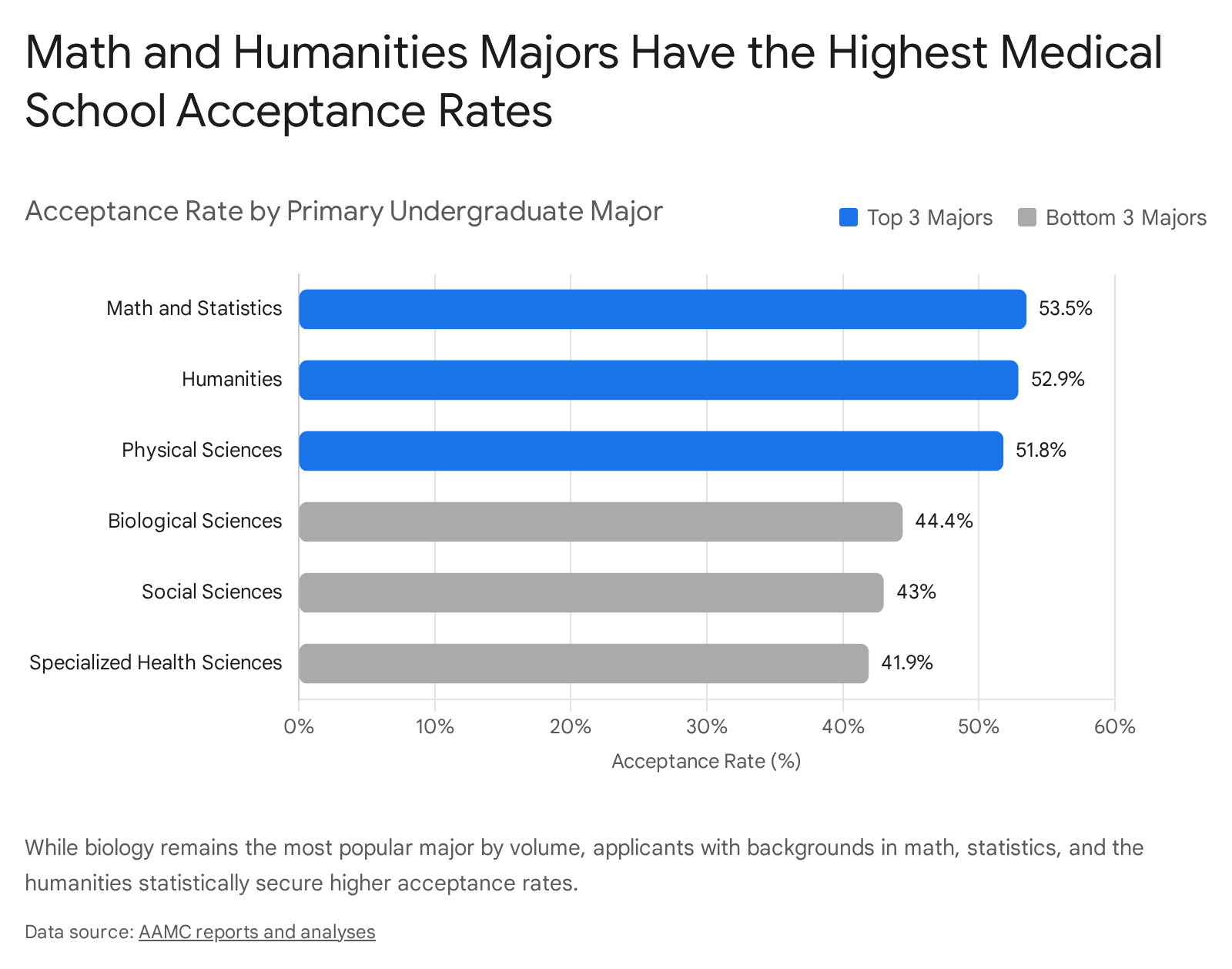
However, popularity does not equate to a statistical advantage. When analyzing acceptance rates by primary undergraduate major, the AAMC data clearly demonstrates that non-traditional science, technology, engineering, and mathematics (STEM) majors, as well as humanities majors, possess a statistically significant admissions advantage 4.
Students majoring in math and statistics historically achieve the highest acceptance rates, often exceeding 53%, followed closely by humanities majors at nearly 53%, and physical science majors (such as chemistry and physics) at almost 52% 4. In contrast, the acceptance rate for biological sciences majors sits at roughly 44% 4. Specialized health science majors - such as nursing, kinesiology, or public health - often see some of the lowest overall acceptance rates for MD programs, dipping below 42% 4.
Why Non-Science Majors Succeed
The immediate question this data raises is why these non-traditional majors perform so well. The answer lies in a combination of cognitive diversity, holistic admissions practices, and standardized testing performance.
Medical schools actively seek to build diverse cohorts to improve the educational environment and ultimately serve a diverse patient population. A class composed entirely of biology majors risks intellectual homogenization. An applicant who has spent four years analyzing classical literature, studying macroeconomic policy, or proving abstract mathematical theorems brings a distinct problem-solving lens to a clinical team. Furthermore, non-science majors who successfully complete the rigorous pre-med science prerequisites demonstrate remarkable intellectual versatility. They prove they can handle organic chemistry and physics just as well as the science majors, while simultaneously excelling in entirely different academic disciplines.
This intellectual versatility pays significant dividends on the MCAT. The MCAT is not merely a test of scientific recall; it is fundamentally an exam of critical thinking and reading comprehension 5. The Critical Analysis and Reasoning Skills (CARS) section of the MCAT frequently proves to be a significant hurdle for traditional science majors. Humanities and social science majors, whose coursework relies heavily on digesting dense texts, synthesizing arguments, and recognizing logical fallacies, are uniquely prepared for this section 7.
Consequently, humanities and math majors who apply to medical school often boast higher overall average MCAT scores than their biological science peers 7. It is important to note that this does not imply a humanities major magically boosts a student's intelligence; rather, there is likely a self-selection bias at play, where highly capable students who major in quantitative or humanities fields and still pursue medicine are generally very high academic achievers.
Comparing the Metrics: MCAT and GPA by Major
A review of AAMC data for recent matriculating classes shows that students from non-traditional majors score equivalently or higher on key metrics compared to traditional pre-meds.
| Primary Undergraduate Major | Mean Total MCAT Score (Applicants) | Mean Total MCAT Score (Matriculants) | Mean Total GPA (Matriculants) |
|---|---|---|---|
| Math and Statistics | 511.9 | 516.1 | 3.79 |
| Physical Sciences | 509.5 | 513.8 | 3.77 |
| Humanities | 509.0 | 513.1 | 3.76 |
| Biological Sciences | 506.3 | 511.5 | 3.78 |
| Social Sciences | 505.8 | 511.6 | 3.73 |
| Specialized Health Sciences | 503.3 | 510.2 | 3.77 |
Table: Data reflecting the 2023 - 2024 applicant and matriculant pool. While the mean undergraduate GPA remains remarkably consistent across majors for accepted students, MCAT averages skew higher for math and humanities backgrounds 4.
Does Your Major Affect Performance in Medical School?
If humanities and math majors secure acceptances at higher rates, does their lack of upper-level biology coursework hurt them once they actually begin their medical education? Peer-reviewed studies tracking medical students through their rigorous first years suggest the impact is minimal.
Extensive longitudinal research indicates that an applicant's choice of undergraduate major has little, if any, statistically significant effect on long-term performance in medical school or during residency evaluations 6. Once a student has mastered the foundational prerequisites, their specific bachelor's degree ceases to be a defining factor in their clinical acumen.
There is a slight nuance regarding the immediate transition into medical school. A retrospective cohort study of osteopathic medical students (classes of 2019 - 2023) found that those with biological science majors performed slightly better in first-semester molecular medicine courses compared to non-science majors, though the major had no association with performance in gross anatomy 78. Another study investigating academic success across a medical degree program at Deakin University found that students with prior health-related undergraduate degrees performed better overall across all years than those with strictly biomedical science backgrounds, challenging the traditional biomedical pathway 910.
Ultimately, these variations are relatively minor. The consensus among medical educators is that strong overall academic discipline, indicated by a high undergraduate GPA and a competitive MCAT score, is a far better predictor of medical school success than the specific title of the undergraduate degree 7.
The Toll of the Pre-Med Track
The pressure to major in biology while maintaining an exceptional GPA takes a measurable toll on undergraduates. Research investigating academic stress among college students indicates that undergraduates on the "pre-med" track face immense pressure to maintain high GPAs, driven by the intense competition and low overall acceptance rates 11. The need to maintain a high GPA is frequently cited as a primary driver of academic stress, and students with slightly lower GPAs are statistically far more likely to abandon the pre-med track entirely, often citing the toll on their mental health 11. This further supports the strategy of selecting a major in which a student is genuinely interested and can naturally excel, rather than suffering through a biology degree that jeopardizes their GPA and well-being.
College Prestige vs. Pre-Med Support Infrastructure
A common source of anxiety for high school seniors is whether attending an elite Ivy League or top-tier liberal arts college is a prerequisite for medical school admission. While elite institutions do send a high volume of students to medical programs, this correlation is largely driven by the academic caliber of the students who are admitted to those colleges in the first place, rather than the name on the diploma acting as a golden ticket.
Medical school admissions committees are acutely aware of grade inflation, deflation, and institutional rigor. However, an applicant with a 3.9 GPA and a 515 MCAT from a mid-tier state university will almost always fare better in the admissions process than an applicant with a 3.3 GPA and a 505 MCAT from an Ivy League university. The core metrics remain the gatekeepers. AAMC data consistently shows that the median undergraduate GPA for matriculants hovers between 3.86 and 3.88, regardless of the undergraduate institution 112.
What truly separates a highly effective college choice from a poor one for a pre-med student is the infrastructure of support. Prospective pre-med students should evaluate potential undergraduate institutions based on the strength of their pre-health advising office. Crucial questions to ask include: * Does the university provide a strong committee letter of evaluation? * Are there abundant, accessible opportunities for undergraduates to engage in primary laboratory research? * Is the campus located near a major teaching hospital or medical center?
A university located adjacent to a major teaching hospital offers immense logistical advantages for a student trying to accumulate the hundreds of clinical hours required for a competitive application. Conversely, a highly prestigious college in an isolated rural setting might make it incredibly difficult to secure meaningful, sustained patient interaction without owning a vehicle and commuting long distances.
Furthermore, taking a "gap year" has become the definitive norm. According to AAMC data, nearly 60% of matriculating medical students take at least one gap year between their college graduation and medical school matriculation to build their clinical resumes, conduct research, or work to save money 13. The resources a college provides to help secure post-graduate fellowships or clinical jobs are often just as important as the four-year degree itself.
The 17 Core Competencies: What Admissions Committees Truly Want
If the specific major and college name are secondary, what exactly are medical schools evaluating when they look at a candidate? The answer is codified in the AAMC's 17 Premed Competencies for Entering Medical Students.
Originally introduced in 2011, this framework was thoroughly updated in late 2023 for the 2024 - 2025 application cycle to better reflect the modern demands of healthcare and medical education 1415. These competencies guide how admissions committees review coursework, essays, letters of recommendation, and interviews. They are divided into three broad categories: Science Competencies, Thinking and Reasoning Competencies, and Professional Competencies 14.
While the Science and Reasoning competencies are relatively straightforward - measured primarily by GPA, MCAT scores, and research experience - the Professional Competencies are the true battleground of the medical school application. They require applicants to demonstrate behavioral traits through sustained, real-world action 1617.
The most notable recent updates to these guidelines underscore a growing emphasis on diversity, equity, inclusion, and interpersonal emotional intelligence in medicine. Three new competencies were formally added or refined: * Cultural Awareness (Understanding Others): Recognizing how historical, social, political, and economic factors shape behavior and respecting diverse perspectives 14. * Cultural Humility (Self-Awareness): Engaging openly with differing viewpoints, reflecting on personal biases, and adapting approaches to promote inclusivity 14. * Empathy and Compassion: Understanding others' experiences and responding with care, sensitivity, and support 14.
Medical schools no longer simply want students who state they "want to help people." They look for an Ethical Responsibility to Self and Others, demanding that applicants have navigated morally complex situations with integrity 141516. They want evidence of Reliability and Dependability, looking for candidates who have maintained long-term commitments rather than flitting between short-term, resume-padding activities 14.
To satisfy these competencies, applicants cannot simply list them in a personal statement. If a student claims to have "Resilience and Adaptability," the admissions committee expects to see a narrative detailing a specific failure, the student's emotional management during that crisis, and the constructive changes they implemented afterward to demonstrate continuous growth 141518.
The Era of Holistic Review and "Distance Traveled"
To accurately assess these 17 competencies, medical schools have largely moved beyond strict, computerized metric cutoffs in favor of "Holistic Review." Holistic review is defined by the AAMC as a mission-aligned admissions process that considers an applicant's experiences, attributes, and academic metrics alongside the value they will contribute to learning, practice, and teaching 192021.
In a study exploring how admissions officers implement this, researchers found three dominant working definitions of holistic review: looking at the "whole file" (ignoring no parts of the application), looking at the "whole person" (valuing character traits), and looking at the "whole context" (understanding the socioeconomic environment of the applicant) 22.
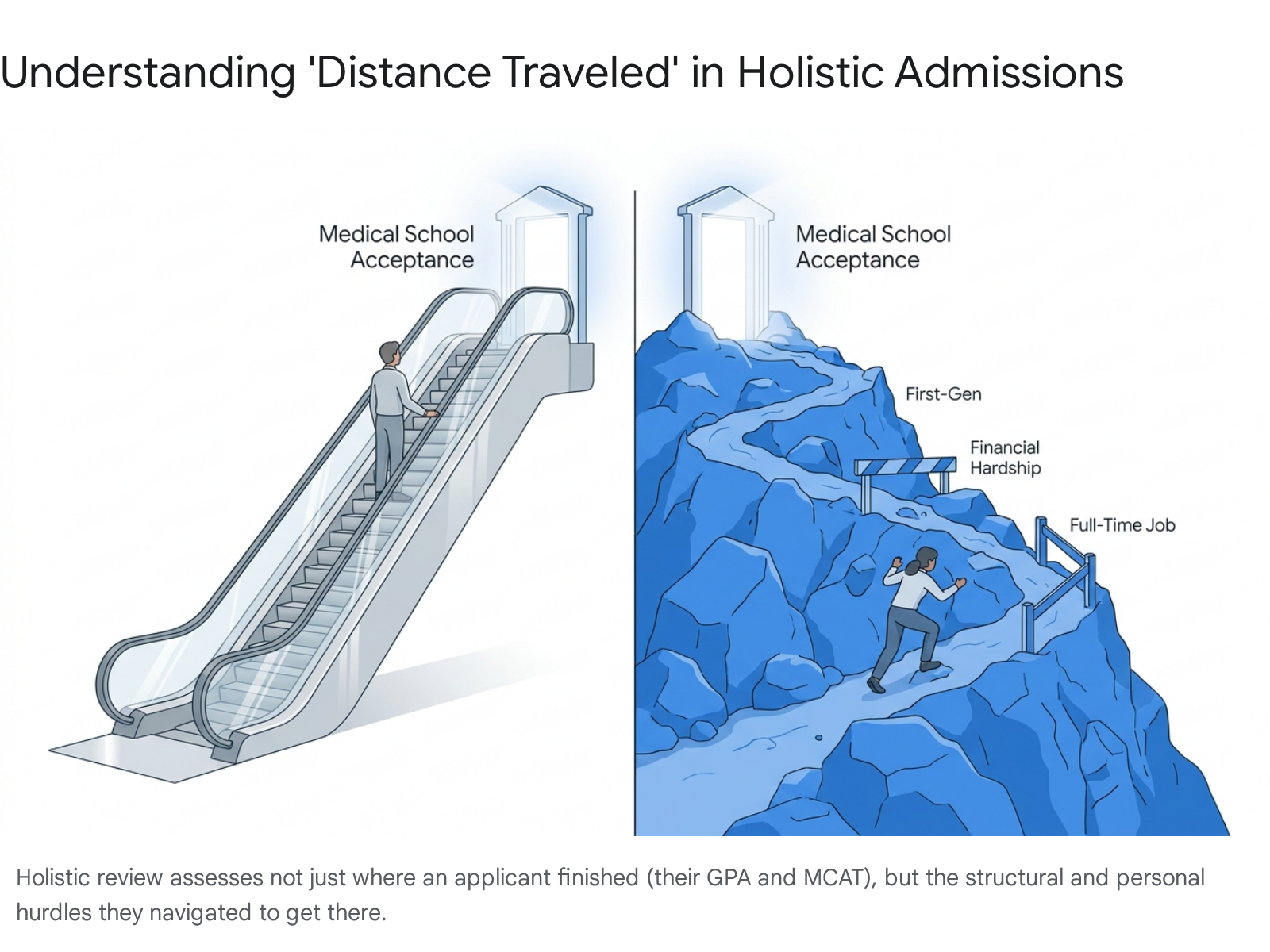
Central to this "whole context" review is the concept of "Distance Traveled." This term has become a cornerstone of medical school admissions language. Distance traveled refers to the metaphorical journey an applicant has undertaken, specifically measuring the obstacles, hardships, privileges, and systemic disadvantages they have navigated to reach the point of applying to medical school 13192122232425262728.
An admissions committee views a 3.7 GPA differently depending on the context. A 3.7 GPA achieved by a student from an affluent background, whose parents are physicians, and who had the financial resources to take unpaid research internships and afford expensive MCAT prep courses, is commendable. However, a 3.7 GPA achieved by a first-generation college student who worked 30 hours a week to support their family, navigated systemic poverty, or overcame a severe chronic health condition represents a much greater "distance traveled" 2225262728.
Admissions officers gather this context through demographic data, secondary essays, and specific prompts on the American Medical College Application Service (AMCAS) application. The AMCAS includes an "Impactful Experiences" section specifically designed for applicants to describe family background, financial deficits, community settings, or general life challenges that influenced their journey 26.
This shift toward holistic review and the evaluation of distance traveled has become even more pronounced in the aftermath of the 2023 Supreme Court decision restricting race-based affirmative action in college admissions 2031. Medical schools, deeply committed to producing a physician workforce that mirrors the diversity of the patient population to reduce health disparities, are increasingly relying on socioeconomic factors, geographic background (such as rural upbringing), and narratives of resilience to identify diverse talent 2029.
How Admissions Officers Score Extracurricular Experiences
To standardize the review of these diverse experiences across thousands of applications, many top-tier medical schools utilize internal rubrics. While specific rubrics are closely guarded, insights from admissions experts and leaked frameworks reveal a tiered grading system for extracurricular activities and clinical exposure 3034.
An applicant's experiences are generally categorized by the depth of their involvement and the scope of their impact: * Tier 1 (Basic): Involvement is completely passive. The applicant held no real responsibility and there is no evidence of a lasting contribution (e.g., shadowing a physician twice in one year) 30. * Tier 2 (Occasional): Involvement was brief or infrequent. The activity had limited influence, and the applicant's contribution was only moderately demonstrated (e.g., volunteering to check blood pressure at a clinic once a quarter) 30. * Tier 3 (Established): Strong, consistent evidence that the applicant has been committed over time. Responsibilities are clear, and their role grew in scope and complexity (e.g., serving as a caseworker for a mobile clinic for two years, eventually interviewing patients and managing social service connections) 30. * Tier 4 (Catalyst): The highest tier involves true leadership and innovation. The applicant identified a systemic problem within their community or organization, developed a solution, and left a lasting, measurable impact after their departure (e.g., creating a new automated partnership system between a clinic and local vendors) 30.
Medical schools are looking for applicants whose portfolios lean heavily toward the "Established" and "Catalyst" tiers.
The Second Chance Pipeline: Post-Baccalaureate Programs
Not all students realize they want to be physicians at age eighteen, and many who do stumble during their difficult undergraduate science courses. For these students, a low GPA or a lack of prerequisite courses is no longer the end of the road. Post-baccalaureate (post-bacc) pre-medical programs have become a structural pillar of the modern medical school pipeline.
Enrollment in post-baccalaureate programs has surged. Federal education data and institutional reporting suggest that post-bacc enrollment has grown by well over 100% since 2010, drastically outpacing the general growth rate of medical school applicants 3531. Because of this, the "non-traditional" applicant is rapidly becoming the new normal.
Post-bacc programs generally fall into two distinct categories, serving entirely different applicant profiles:
- Career Changers: These programs are designed for students who achieved strong undergraduate GPAs (often 3.5 or higher) in non-science fields but never took the pre-med prerequisites 335. A humanities major who decides at age 25 to pursue medicine is an ideal candidate. Structured post-bacc programs provide an intensive, accelerated pathway to complete chemistry, biology, and physics requirements. Because these applicants already have a proven track record of academic excellence, completing a career-changer post-bacc with high grades makes them highly competitive at top-tier MD programs 335.
- Academic Enhancers: These programs, which often include Special Master's Programs (SMPs), are designed for students who completed the pre-med prerequisites but graduated with a low science GPA (typically between 2.8 and 3.2) 335. These programs offer graduate-level science courses, often mirroring the first-year medical school curriculum, allowing students to prove they can handle the academic rigor.
Do academic enhancement programs actually work? The data suggests they are powerful levers, but only under specific conditions. A post-bacc program cannot magically erase a poor undergraduate record. The math of probability dictates that taking 30 credits of post-bacc work at a 3.8 GPA will only marginally raise a cumulative undergraduate GPA of 2.8 35. However, medical schools look closely at academic trends. An applicant who graduates with a 3.0 undergraduate GPA, but subsequently completes an intensive Special Master's Program with a 3.8 GPA and pairs it with a strong MCAT score (e.g., 510+), fundamentally changes their narrative 335. While elite MD programs may still be out of reach, this profile opens the door to state MD programs and drastically improves acceptance probabilities at Osteopathic (DO) medical schools, where the average accepted GPA is roughly 3.5 to 3.6 335.
Furthermore, post-bacc programs explicitly designed to support disadvantaged students have shown remarkable success. A 50-year retrospective study of Wayne State University's premedical post-baccalaureate program found that of the students admitted to the program, 85.9% successfully matriculated to the School of Medicine, and the vast majority went on to practice primary care in medically underserved areas 32.
Macro-Trends in the Application Landscape (2024 - 2025)
Understanding the demographic and macro-level shifts in medical school admissions is crucial for setting realistic expectations. The landscape in 2024 and 2025 looks vastly different than it did a decade ago.
Total enrollment in U.S. MD-granting medical schools has reached historic highs, approaching and crossing the 100,000-student threshold in the 2024 - 2025 academic year 233. This is largely due to the opening of new medical schools and the expansion of class sizes at existing institutions 33.
Simultaneously, the frantic surge in medical school applications seen during the height of the COVID-19 pandemic has stabilized. After peaking at over 62,000 applicants in 2021 - 2022, the applicant pool has settled back to historical norms, hovering between 51,000 and 54,000 applicants over the last few cycles 11233343536. The acceptance rate has slightly improved, moving from 43.7% in 2023 to over 44% in recent data 142.
Demographically, medicine has undergone a profound gender shift. For nearly a decade, women have comprised the majority of the applicant pool, the matriculant pool, and total medical school enrollment, currently making up roughly 55% to 57% of these groups 1212.
However, the pursuit of racial and socioeconomic diversity faces new headwinds. In the 2024 - 2025 cycle, while the number of Black, African American, Hispanic, and Latino first-time applicants increased, the number of matriculants from these historically underrepresented groups saw double-digit percentage declines 12313442. Similarly, the proportion of first-generation college students and students from lower socioeconomic backgrounds enrolling in medical school has seen slight, persistent declines over the last few years 2123133. These statistics highlight the critical importance of the holistic review process; as direct consideration of race is restricted by law, admissions committees are leaning heavier than ever on the "distance traveled" narratives to build a physician workforce that can effectively serve diverse communities 2031.
Bottom line
Choosing the right college and major for medical school has less to do with the prestige of a biology degree and everything to do with where an applicant can maintain a high GPA while developing a deep portfolio of clinical and life experiences. Admissions committees prioritize cognitive diversity, ethical responsibility, and the "distance traveled" over a cookie-cutter academic resume. While the path has become more complex with the rise of post-baccalaureate programs and shifting diversity metrics, applicants who authentically align their academic strengths with the AAMC's core professional competencies position themselves for the highest probability of success.