
What Is a Good SAT Score for Top Colleges
A good SAT score for top colleges is generally one that falls within or above the institution's middle 50 percent range for admitted students, typically requiring a composite score of 1500 or higher for the Ivy League and elite private universities. For highly selective public flagships, competitive scores often range from 1350 to 1500, with rigorous STEM majors demanding math subscores near perfection. As elite institutions rapidly reinstate mandatory testing requirements, presenting a score in the top quartile of historical data ensures an applicant remains highly competitive.
The modern college admissions landscape often resembles an opaque and unforgiving crucible, generating profound anxiety for prospective students and their families. With acceptance rates at elite universities plummeting into the single digits, the sheer volume of highly qualified applicants has created a hyper-competitive environment where perfection seems like the baseline rather than the exception 123. Amidst the stress of curating flawless transcripts, compelling personal essays, and world-class extracurricular profiles, standardized testing remains a towering source of apprehension. To navigate this stress, families must rely on objective data rather than rumor or anecdotal fear, anchoring their expectations to a crucial metric known as the "middle 50 percent rule." Understanding this metric strips away the mystique of admissions, transforming the vague directive to "score well" into a precise, strategic target.
What is the middle 50 percent SAT score?
The middle 50 percent SAT score represents the interquartile range ($P_{25} \leq X \leq P_{75}$) of standardized test scores for the most recently enrolled freshman class at a given institution 12. Universities report this data annually through the Common Data Set (CDS), a standardized collaborative reporting initiative utilized by higher education institutions and publishers, such as the College Board, Peterson's, and U.S. News & World Report, to ensure data accuracy and consistency across the educational sector 345.
When examining a college's middle 50 percent, the lower number reflects the 25th percentile - meaning exactly 25 percent of enrolled students scored at or below this threshold 29. The higher number reflects the 75th percentile, indicating that 25 percent of enrolled students scored at or above this mark 29. The remaining 50 percent of the student body falls squarely between these two figures, constituting the statistical core of the incoming class.
This interquartile range is vastly more useful to applicants than a simple statistical average or median. Averages can be heavily skewed by outliers, whereas the middle 50 percent illuminates the exact band of academic readiness that an admissions committee considers standard for their campus 1. If an applicant's score falls within this range, they are considered academically competitive and a viable match for the institution, possessing the cognitive aptitude required to handle the college's curriculum 110. A score at or above the 75th percentile positions an applicant as exceptionally strong, indicating they outscored the vast majority of their admitted peers 111. Conversely, a score below the 25th percentile suggests the application will need to rely heavily on extraordinary compensating factors - such as institutional hooks, recruited athletic status, first-generation standing, or exceptional personal narratives - to secure admission 1012.
The percentiles assigned to SAT scores by the College Board further contextualize these ranges. The SAT composite score, which ranges from 400 to 1600, combines the Evidence-Based Reading and Writing (EBRW) and Math sections 10. A score of 1400, while representing the 93rd percentile nationally and indicating strong performance, falls well below the 25th percentile of every Ivy League institution 2. To breach the 99th percentile nationally, a student generally must score a 1530 or higher 13. Because the curve is exceptionally tight at the top end, a relatively small raw score improvement can yield a massive leap in competitiveness.
Do I need a 1600 for the Ivy League?
A pervasive and damaging myth in college admissions is the belief that a perfect 1600 on the SAT is an unspoken prerequisite for Ivy League acceptance. While securing a 1600 is an undeniably rare feat - placing a student firmly at the apex of the 99th percentile nationally - it is neither a requirement nor a guarantee of admission 13. Elite universities practice holistic review, meaning they assess applicants as multidimensional individuals rather than mere composite numbers, valuing intellectual vitality, resilience, community impact, and diversity of thought 14616.
The data unequivocally dispels the 1600 myth. Across the Ivy League, the 75th percentile of enrolled students generally tops out between 1560 and 1580 217. For instance, Harvard University, Yale University, and Princeton University all report a middle 50 percent range of 1500 to 1580 for recent incoming classes 29. This indicates that fully 75 percent of the students walking through the gates of the most prestigious universities in the world did not achieve a perfect score. Similarly, the University of Pennsylvania (Penn), Brown University, and Dartmouth College report ranges of 1500 to 1570, while Cornell University reports 1480 to 1560 2.
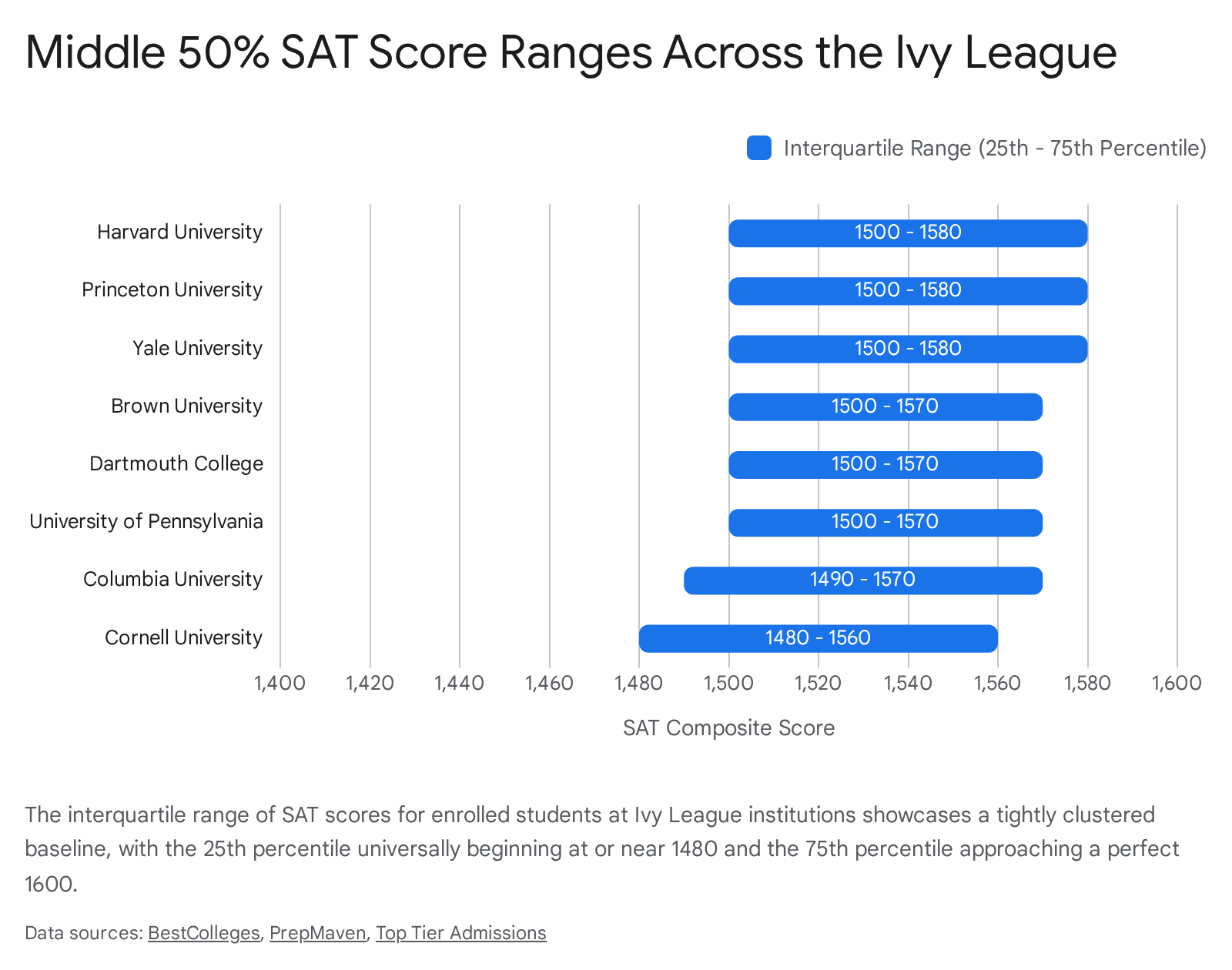
In the highly selective echelons of college admissions, there is a concept known as "score equivalence." Once an applicant crosses a certain threshold - typically around 1550 - admissions officers view the score as definitive proof of supreme academic readiness 1218. The difference between a 1550 and a 1600 is often a matter of missing one or two questions on the exam, an arbitrary margin of error that does not convey any meaningful difference in intrinsic intellectual capability or future collegiate success. At institutions boasting single-digit acceptance rates, a 1550 or higher will successfully push an application past the initial academic screening phase, but it is the qualitative components of the application - the student's essays, letters of recommendation, and extracurricular leadership - that ultimately secure the offer of admission 121619. Conversely, thousands of students with perfect 1600s are rejected annually because their applications lacked the character, narrative depth, or sustained passion these universities prize 1019.
To understand the intense compression of these applicant pools, one must examine the broader admissions statistics. During the most recent fully documented admissions cycle for the Class of 2028, Harvard College received an astonishing 54,008 applications, extending offers to merely 1,937 students - a historic overall acceptance rate of 3.59% 20. Within this highly restricted cohort, the middle 50 percent of SAT scores ranged from 1500 to 1580 2. The Early Action round saw a significantly higher acceptance rate of 8.74%, compared to the punishing 2.70% Regular Decision rate, highlighting the strategic advantage of early application protocols 20.
Similar trends are evident across the Ivy League. Columbia University received 60,248 applications and admitted 2,319 (3.85%), with an SAT range of 1490 to 1570 220. Yale University admitted 3.73% of its 57,465 applicants, while Brown admitted 5.16% of 48,881 applicants 20. Even Cornell, which boasts the highest acceptance rate in the Ivy League at 8.41%, processed 65,612 applications 20. Given this staggering volume of highly qualified candidates, an SAT score serves primarily as a foundational threshold of competence rather than the sole deciding factor.
The Paradigm Shift: Why Elite Colleges are Reinstating Mandatory Testing
The landscape of standardized testing underwent a seismic disruption in 2020. Faced with the sudden, global closure of testing centers due to the COVID-19 pandemic, virtually every university in the United States adopted emergency test-optional policies to ensure equity and accessibility 62122. For a brief period, test-optional admissions became the dominant paradigm, leading many commentators to speculate that the SAT and ACT would eventually be phased out of elite admissions entirely, lauded as an end to a system frequently criticized for favoring affluent students with access to expensive test preparation 623.
However, as the pandemic receded and universities gathered years of internal, longitudinal data regarding the academic performance and retention of students admitted without scores, the pendulum began to swing back with forceful momentum 2425. A distinct wave of prestigious universities concluded that the test-optional experiment, while morally necessary during a global crisis, ultimately deprived admissions committees of a vital, predictive metric 2627. Grade inflation across American high schools has severely compromised the utility of the unweighted GPA; research indicates that nearly half of all high school seniors now graduate with an "A" average 2528. In an era where a 4.0 GPA is commonplace, standardized tests provide a necessary objective baseline to evaluate academic potential across wildly disparate educational environments 2325.
The vanguard of this reversion was led by elite STEM institutions. The Massachusetts Institute of Technology (MIT) and the California Institute of Technology (Caltech) were among the first to reinstate mandatory testing, with Caltech's policy applying to Fall 2025 admissions 2930. Their rationale was grounded in strict quantitative analysis: success in their notoriously grueling mathematics and physics curricula was highly correlated with top-tier SAT Math scores, and removing that metric hindered their ability to accurately predict freshman survival rates and ensure cohort readiness 24.
The broader Ivy League followed shortly after, catalyzed by Dartmouth College. In early 2024, Dartmouth announced the reinstatement of its testing requirement after an internal faculty study revealed a counterintuitive truth: test-optional policies were actually harming low-income and under-resourced students 182429. The study demonstrated that admissions officers struggled to identify high-potential students from unknown or underperforming high schools without a standardized metric. For example, a score of 1450 might fall below Dartmouth's overall 25th percentile of 1500, but if that score belonged to a student from a rural, under-resourced high school where the average SAT is 1000, it signaled profound academic resilience and brilliance 624. Without the score, that student's application often failed to stand out amidst a sea of unweighted 4.0 GPAs from elite preparatory academies.
Following Dartmouth's data-driven rationale, a domino effect cascaded across the highest tiers of American higher education. Yale University reinstated testing for the Class of 2029 (Fall 2025 admission) but adopted a unique "test-flexible" policy. Yale applicants must submit standardized scores, but they may choose between the SAT, ACT, Advanced Placement (AP), or International Baccalaureate (IB) exams 31327. However, Yale mandates that if a student chooses to fulfill the requirement with AP or IB exams, they must submit all subject scores, preventing the strategic withholding of suboptimal results (e.g., submitting only 5s while hiding 3s) 3134.
Harvard University abruptly abandoned its previous commitment to remain test-optional through 2030, announcing that students applying for Fall 2025 admission must submit SAT or ACT scores 836. When Harvard announced its pivot, Dean of the Faculty of Arts and Sciences Hopi Hoekstra cited research by Opportunity Insights, led by economists Raj Chetty, David Deming, and John Friedman, which mirrored Dartmouth's findings: standardized tests are highly predictive of college success and serve as a crucial tool for identifying talent across socioeconomic divides 68. Brown University swiftly followed suit, returning to mandatory testing for Fall 2025 to evaluate academic readiness accurately 2937.
The Second Wave: Reinstatements for the Fall 2026 Cycle
The momentum continued through 2024 and 2025 as more institutions finalized their internal analyses, leading to a second wave of reinstatements slated for the Fall 2026 admissions cycle. The University of Pennsylvania (Penn) announced it would reinstate testing requirements for Fall 2026 to bring "clarity and transparency" to the application process, aiming to remove the paralyzing uncertainty applicants face when deciding whether to submit scores 910. Penn noted that while tests are required, they remain just one component of a broad, holistic assessment 940.
Cornell University announced a phased return. While maintaining a test-optional or test-blind stance for the Fall 2025 cycle across various colleges, Cornell will mandate standardized test scores for all eight of its undergraduate colleges and schools beginning in Fall 2026 111213. A multiyear study conducted by Cornell's Task Force on Standardized Testing in Admissions found no clear indication that test-optional policies increased diversity; in fact, the percentage of underrepresented minority students slightly decreased during the test-optional years 1213.
Outside the Ivy League, Stanford University reversed its test-optional stance, requiring SAT or ACT scores for Fall 2026 applicants 4414. A faculty review at Stanford confirmed a strong correlation between standardized testing and academic performance 1547. Concurrently, to comply with California Assembly Bill 1780 - which prohibits universities benefiting from state-funded financial assistance from providing legacy or donor preferences in admissions - Stanford opted to withdraw from the state-sponsored Cal Grant program. By replacing state funds with internal university funding, Stanford retained its right to consider legacy status during the holistic review of academically qualified applicants 441516.
Johns Hopkins University also ended its pandemic-era pause, mandating SAT or ACT scores for Fall 2026 applicants seeking entry to the Krieger School of Arts and Sciences or the Whiting School of Engineering 232627. The university concluded that three years of test-optional data refined their understanding of the tests' value as an important predictive metric for collegiate success 2627.
Among highly selective public flagships, the University of Texas at Austin required SAT or ACT scores for Fall 2025 applicants, alongside the University of Florida system, the University of Georgia, and Florida State University, which have maintained strict testing requirements throughout recent cycles 293049.
Conversely, the University of California system (including UC Berkeley, UCLA, and UC Irvine) remains entirely "test-blind" - meaning they will not review SAT or ACT scores even if submitted - due to a 2021 legal settlement and ongoing state-level mandates regarding equity 281718. However, this policy is generating significant internal friction. Recently, over 600 STEM faculty members across the UC system petitioned the Board of Regents to reinstate the SAT/ACT requirement, citing alarming increases in students lacking foundational math skills 19. The faculty cited a UC San Diego report indicating that the number of students arriving with math skills below the high-school level increased by nearly 30 times over the past five years, arguing that grade inflation renders GPAs unreliable for predicting success in rigorous STEM coursework 19. Furthermore, the U.S. Department of Justice launched investigations into UC admissions policies regarding potential violations of anti-discrimination laws linked to the removal of objective merit-based testing 28.
Should I submit my score if a college is test-optional?
While a massive wave of elite colleges has reinstated mandatory testing, hundreds of esteemed institutions - such as the University of Chicago, Vanderbilt University, Washington University in St. Louis, Emory University, and the University of Notre Dame - continue to offer test-optional pathways for the immediate future 375354. For applicants targeting these schools, the decision to submit or withhold a score is one of the most fraught strategic choices in modern admissions.
A dangerous and persistent myth surrounding test-optional policies is the assumption that admissions officers simply do not care about test scores if they are not strictly required. This is patently false. When an applicant submits a top-tier SAT score, it definitively verifies their academic excellence, providing independent validation of their high school GPA and rigor 5520. Furthermore, admissions officers operate with natural, unavoidable human biases; in the highly competitive tiers, withholding a score when an applicant attends a well-resourced preparatory school often triggers the assumption that the exam was taken and the resulting score was simply too low to submit 257.
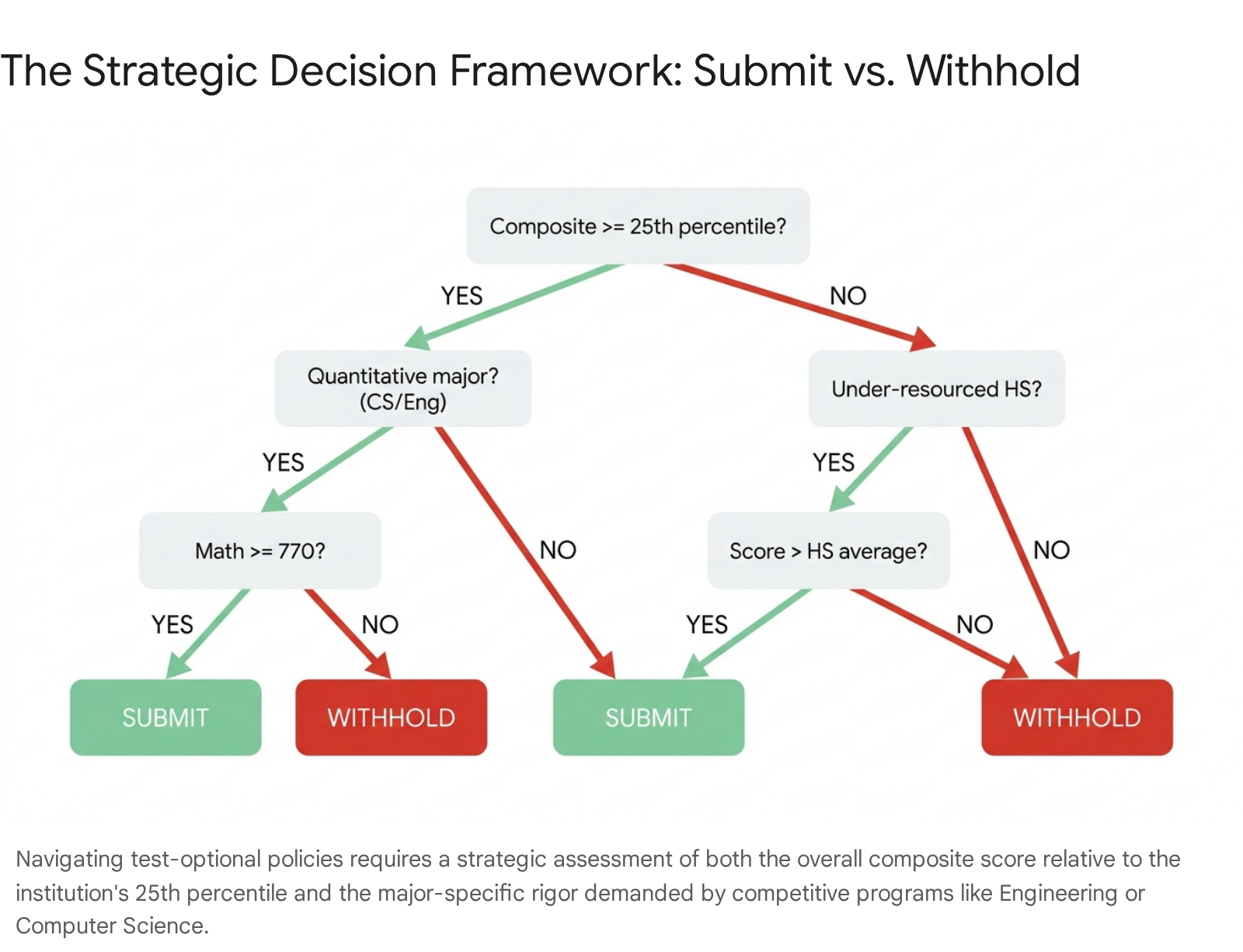
The definitive rule of thumb for navigating the submit-versus-withhold dilemma is rooted in the 25th percentile. Applicants must meticulously research the target institution's most recent Common Data Set. If an applicant's composite SAT score falls at or above the 25th percentile of the enrolled class, they should generally submit it 1053. Submitting a score in this range signals that the student is firmly capable of handling the academic rigor of the institution. If the score falls below the 25th percentile, the applicant should heavily consider withholding it to avoid dragging down their overall academic profile, relying instead on the strength of their transcript, course rigor, and extracurriculars.
The primary exception to this rule is for students from underrepresented or low-income backgrounds; if a score is below the institutional 25th percentile but significantly higher than the local high school average, submitting it provides vital, positive context regarding the student's intellectual trajectory and resilience 624.
To understand the competitive dynamics of test-optional environments, it is necessary to examine the data from institutions that maintain these policies. At the University of Chicago, which boasts a staggering 4.48% acceptance rate and an 88.29% yield rate, the university remains test-optional 5859. However, for the most recent academic year, 49% of enrolled students submitted SAT scores and 27% submitted ACT scores 58. The median SAT score for those admitted was an exceptional 1550, with a middle 50 percent range of 1500 to 1580 5458. For students applying to UChicago, withholding a score is viable, but submitting a score below 1500 places the applicant at a distinct statistical disadvantage compared to the submitter pool 1259.
Similarly, Emory University maintained a test-optional policy and admitted 10.3% of its 34,614 applicants 260. The enrolled class presented a middle 50 percent SAT range of 1480 to 1540 260. Notably, 43% of enrolled students submitted SAT scores and 20% submitted ACT scores 2. While tests are deemed "important" rather than "very important" in Emory's CDS, the data reveals that nearly two-thirds of the enrolled class utilized standardized testing to validate their 3.84 average unweighted high school GPAs 255.
At the University of Notre Dame, the acceptance rate stands at 11.3%, with a middle 50 percent SAT range of 1470 to 1540 121. An incredible 92% of enrolled students ranked in the top tenth of their high school class 1. In such a high-achieving cohort, an SAT score in the 1500s serves as a vital differentiator. Washington University in St. Louis (WashU) presents another fascinating case study. With a 12% overall acceptance rate and a middle 50 percent SAT range of 1500 to 1570, WashU remains test-optional 5362. However, WashU fills an aggressive 61% of its incoming class through binding Early Decision rounds, where the admit rate is roughly 25% - more than double the Regular Decision rate 62. In the hyper-competitive Regular Decision round, where the effective acceptance rate drops into the single digits, withholding an SAT score removes a critical piece of affirmative academic evidence.
Finally, Georgetown University operates with a unique, test-required policy that strictly mandates applicants to submit scores from all test sittings, forbidding the use of Score Choice 1922. With an acceptance rate of 12.9% and a middle 50 percent SAT range of 1400 to 1540, Georgetown requires comprehensive transparency regarding an applicant's testing history to perform its holistic evaluation 1963.
How the Rule of Thumb Varies by Major: Computer Science and Engineering
The 25th percentile rule of thumb requires critical modification when applying to specific, highly competitive academic disciplines - most notably, Computer Science (CS) and Engineering. Programs at top-tier institutions, such as MIT, Stanford, Carnegie Mellon's School of Computer Science, and the engineering colleges at elite state universities like Georgia Tech and UT Austin, view the SAT Math section as a non-negotiable prerequisite 6465.
Because engineering and computer science coursework relies heavily on advanced calculus, physics, and complex analytical reasoning, an applicant's composite SAT score is significantly less relevant than their specific Math subscore 165. For highly selective CS and Engineering programs, a competitive SAT Math score typically resides in the 770 to 800 range, with the most selective programs practically requiring a perfect or near-perfect 800 106465.
Consider the strategic implications for an applicant holding a 1480 composite score applying to a test-optional engineering program. If that 1480 is comprised of a 780 Evidence-Based Reading and Writing (EBRW) score and a 700 Math score, the applicant is statistically weak for a top engineering curriculum 110. In a test-optional environment, they should likely withhold the score, as a 700 Math suggests potential struggles with advanced quantitative coursework compared to peers scoring 780+ 10. Conversely, if the 1480 composite is achieved via an 800 Math score and a 680 EBRW score, the profile powerfully signals quantitative readiness 10. The applicant should undoubtedly submit this score, as the stellar math performance heavily outweighs the lower verbal score in the context of STEM admissions, proving their capability to handle the specific rigors of the major 10.
Comprehensive Tier Analysis of Top Colleges
To build a balanced and strategic college list, applicants must carefully align their academic profiles with the precise expectations of individual universities. The table below synthesizes the most recent Common Data Set metrics and the finalized testing policies for the 2024, 2025, and 2026 admissions cycles across various tiers of highly selective institutions in the United States.
| Institution | Middle 50% SAT Range | Current Testing Policy (2025 / 2026 Cycles) |
|---|---|---|
| Ivy League & Elite Tech | ||
| Massachusetts Institute of Technology | 1520 - 1580 | Test-Required 1730 |
| Harvard University | 1500 - 1580 | Test-Required (Effective Fall 2025) 28 |
| Yale University | 1500 - 1580 | Test-Flexible (SAT, ACT, AP, or IB) 220 |
| Princeton University | 1500 - 1580 | Test-Optional (2025) / Required (Fall 2026) 224 |
| Stanford University | 1510 - 1570 | Test-Optional (2025) / Required (Fall 2026) 441457 |
| Brown University | 1500 - 1570 | Test-Required (Effective Fall 2025) 229 |
| Dartmouth College | 1500 - 1570 | Test-Required (Effective Fall 2025) 224 |
| Univ. of Pennsylvania (UPenn) | 1500 - 1570 | Test-Optional (2025) / Required (Fall 2026) 29 |
| Columbia University | 1490 - 1570 | Permanently Test-Optional 2 |
| Cornell University | 1480 - 1560 | Phased Optional (2025) / Required (Fall 2026) 211 |
| California Institute of Technology | Not Reported | Test-Required (Effective Fall 2025) 2957 |
| Highly Selective Privates | ||
| University of Chicago | 1500 - 1580 | Test-Optional 354 |
| Johns Hopkins University | 1530 - 1560 | Test-Optional (2025) / Required (Fall 2026) 2366 |
| Washington University in St. Louis | 1500 - 1570 | Test-Optional 153 |
| Vanderbilt University | 1510 - 1560 | Test-Optional (through Fall 2027) 137 |
| Georgetown University | 1400 - 1540 | Test-Required (All scores must be submitted) 1963 |
| University of Notre Dame | 1470 - 1540 | Test-Optional 121 |
| Emory University | 1480 - 1540 | Test-Optional 260 |
| New York University (NYU) | 1430 - 1550 | Test-Flexible 118 |
| Highly Selective Publics | ||
| University of Texas at Austin | 1240 - 1480 | Test-Required (Effective Fall 2025) 294922 |
| Georgia Institute of Technology | 1370 - 1530 | Test-Required 3064 |
| University of Florida | 1340 - 1490 | Test-Required 2930 |
| UC Berkeley & UCLA | N/A (Test-Blind) | Test-Blind (through 2026) 2818 |
Note: Data reflects the most recently available 25th to 75th percentile ranges for enrolled students as reported in official IPEDS and CDS filings. Ranges may fluctuate slightly across reporting years. For universities like Cornell with phased rollouts, some individual colleges remain optional or score-free in 2025 before full university-wide mandates in 2026.
The rapid closure of the test-optional window among America's most elite universities necessitates a fundamental shift in application strategy. Students can no longer view standardized test preparation as an optional pursuit to be abandoned if initial scores prove unsatisfactory. The return of required testing demands proactive, sustained preparation to ensure applicants can present scores commensurate with the intense academic rigor of their target institutions.
For students applying in upcoming cycles, leveraging "superscoring" policies is more critical than ever. The vast majority of top-tier universities - including Harvard, Stanford, and Johns Hopkins - allow applicants to combine their highest Math score from one test date with their highest Evidence-Based Reading and Writing score from a different test date to form the highest possible composite score 34536423. Because of this advantageous policy, students should plan to sit for the SAT or ACT multiple times (typically two to three administrations) to strategically maximize each section 3453. As elite institutions re-embrace standardized testing to cut through the noise of widespread grade inflation, an exceptional SAT score serves as a powerful equalizer, remaining one of the few uniform metrics capable of validating an applicant's intellect and proving they possess the foundational aptitude required to thrive in highly demanding undergraduate environments 2569.
Bottom line
A good SAT score for top colleges is defined not by a mythical perfect 1600, but by the institution's middle 50 percent range. For the Ivy League and elite peer institutions, a highly competitive applicant generally presents a score between 1500 and 1580, while highly selective public flagships seek scores spanning the upper 1300s to 1500. With an undeniable wave of elite universities - including MIT, Harvard, Stanford, Yale, Dartmouth, Brown, and UT Austin - reinstating mandatory testing requirements, the pandemic-era reliance on test-optional strategies is ending for top-tier admissions. Applicants must prepare rigorously to achieve a score that sits at or above the 25th percentile of their target school, paying particular attention to near-perfect math subscores if pursuing competitive STEM majors. Ultimately, while an exceptional score will not guarantee admission on its own, it remains a vital prerequisite for validating academic readiness in a hyper-competitive landscape.