
What the Science Says About Psychedelic Therapy
Psychedelics have demonstrated profound, rapid symptom relief for severe depression and trauma in late-stage clinical trials, positioning them on the cusp of federal approval. However, major regulatory setbacks and recent data analysis reveal that patient expectation and trial design flaws may artificially inflate some of these dramatic success rates. While classic psychedelics and newer synthetic neuroplastogens offer a uniquely durable alternative to daily pills, they are emerging as specialized pharmacological tools requiring intensive clinical oversight rather than miraculous cure-alls.
Introduction to the Psychedelic Renaissance
For decades, classic psychedelics like psilocybin and LSD, along with empathogens like MDMA, were relegated to the fringes of medicine. Trapped behind strict international drug scheduling laws and the enduring cultural legacy of the 1960s, these compounds were widely considered to have a high potential for abuse and no accepted medical use. Today, that paradigm has shifted entirely. They are now the subject of rigorous Phase 3 clinical trials, multi-million dollar biotechnology investments, and accelerated federal review pathways.
The promise driving this renaissance is immense. Mental healthcare is currently facing a crisis of efficacy, particularly concerning Treatment-Resistant Depression (TRD) and Post-Traumatic Stress Disorder (PTSD). Millions of patients do not respond to standard selective serotonin reuptake inhibitors (SSRIs) or traditional cognitive behavioral therapies. Psychedelic interventions offer a radically different mechanism: rather than requiring daily administration to manage serotonin levels, they are administered in just one to four acute sessions alongside specialized psychological support. The biological goal is to induce rapid neuroplasticity - rewiring maladaptive neural pathways - while the psychological goal is to facilitate deep emotional processing.
Yet, as the science transitions from small, highly curated academic studies to massive commercial trials intended to secure U.S. Food and Drug Administration (FDA) approval, the narrative is becoming far more nuanced. Researchers and regulators are grappling with profound methodological hurdles. How do you conduct a blinded trial when the drug induces a profound altered state of consciousness? How do you separate the pharmacological effect of the drug from the psychological effect of the therapy? And how do you ensure safety in the real world when these substances scale beyond tightly controlled clinical environments?
What Does the Latest Psilocybin Research Show?
Psilocybin, the psychoactive alkaloid found in "magic mushrooms," is currently the furthest along in the global regulatory pipeline for the treatment of severe depression. Decades of small-scale studies at institutions like Johns Hopkins and Imperial College London hinted at its potential, but the landscape shifted permanently with the publication of rigorous, large-sample, multi-center Phase 3 data.
The COMPASS Pathways Phase 3 Program
The most significant and scrutinized data pool comes from COMPASS Pathways, which has developed COMP360, a proprietary, pharmaceutical-grade synthetic formulation of psilocybin. COMP360 is administered in a highly controlled clinical setting alongside psychological support, generally lasting six to eight hours per session. It is specifically targeted at Treatment-Resistant Depression, which is generally defined as a major depressive episode that has failed to respond to at least two adequate courses of traditional antidepressants 2.
In 2022, COMPASS published Phase 2b data in the New England Journal of Medicine, involving 233 participants, which showed that a single 25 mg dose produced a rapid reduction in depressive symptoms 14. Building on this, the company launched an expansive pivotal Phase 3 program. In February 2026, COMPASS reported highly anticipated positive topline results from two consecutive Phase 3 trials: COMP005 and COMP006 56.
The COMP005 trial evaluated a single 25 mg dose of COMP360 against an inert placebo in 258 participants in the United States 1. At Week 6, the 25 mg dose produced a statistically significant reduction in depressive symptoms, separating from the placebo by -3.6 points on the Montgomery-Åsberg Depression Rating Scale (MADRS), a standard clinical questionnaire used to measure depression severity 1.
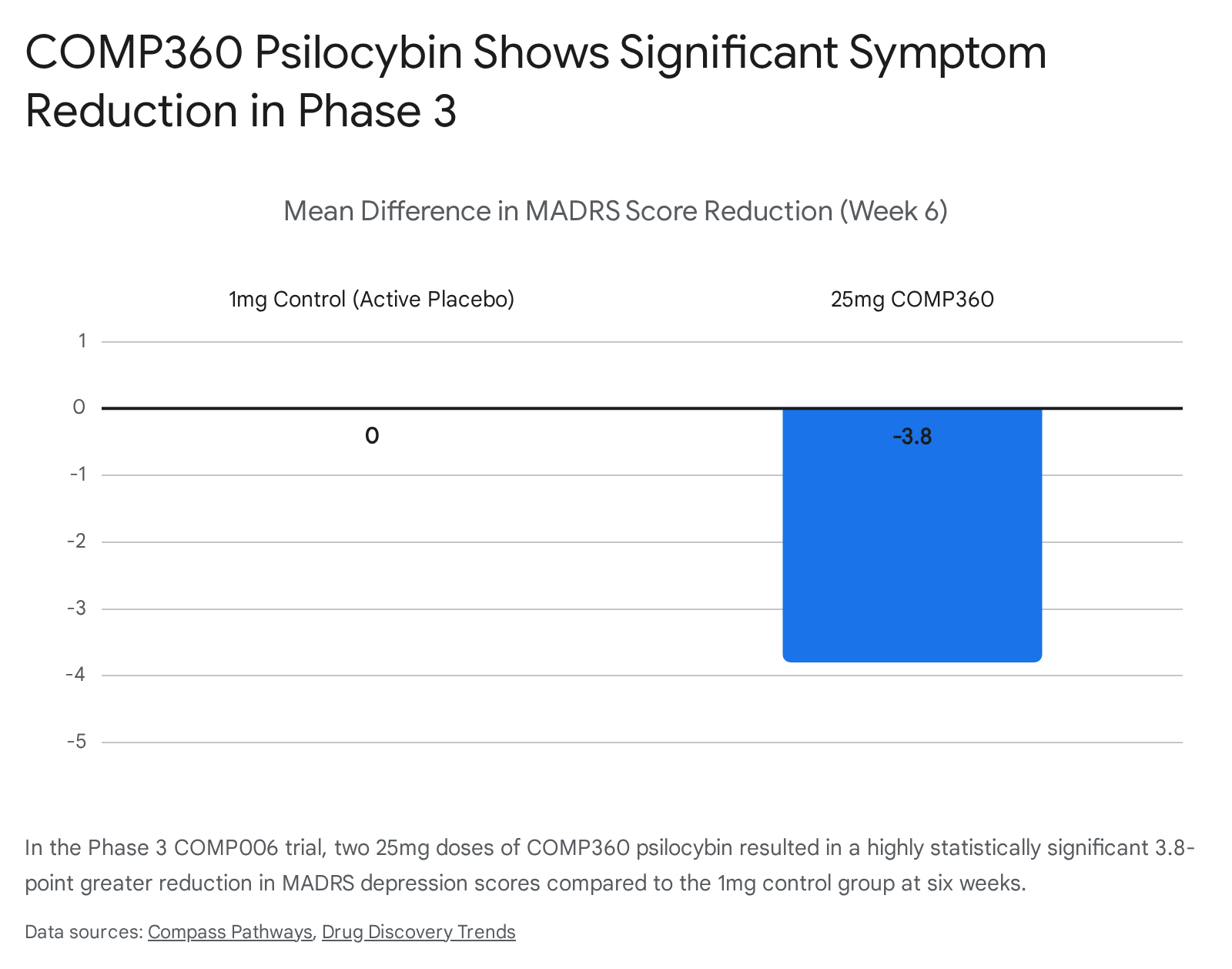
The COMP006 trial was larger and methodologically more complex. It enrolled 581 participants across North America and Europe, testing two fixed doses of 25 mg (administered three weeks apart) against a 10 mg arm and a 1 mg active-comparator control arm 16. The 1 mg dose was chosen specifically because it is considered a sub-perceptual "micro-dose" that acts as a better placebo than an inert pill, ideally preserving some blinding integrity 12. The data confirmed a highly statistically significant and clinically meaningful reduction in symptom severity, with a mean difference of -3.8 points comparing the 25 mg group to the 1 mg group 16.
Crucially, the onset of symptom relief was remarkably rapid. Patients in the 25 mg arm who achieved a clinically meaningful response showed statistically significant improvements as early as the day following administration, and these improvements were maintained at all measured time points through Week 6 68. Follow-up data from the COMP005 trial further suggested that patients who responded at Week 6 often maintained their durability of effect out to at least 26 weeks, suggesting that one or two doses could offer half a year of relief 68.
Redefining Clinical Success in Depression
While the biotechnology market reacted enthusiastically to these trials - sending COMPASS stock surging upward by roughly 34% - independent researchers and healthcare payers immediately scrutinized the specifics of the data 1.
In standard antidepressant drug trials, a "clinical response" is almost universally defined as a 50% or greater reduction in MADRS scores. In the COMP006 trial, COMPASS noted that 39% of participants on the high dose achieved what the company defined as a clinically meaningful reduction 1. However, the company set that threshold at a 25% reduction in MADRS, rather than the conventional 50% 1. In the COMP005 trial, only 25% of participants met this lower 25% threshold at Week 6 1. Furthermore, remission rates - the percentage of patients whose depression essentially disappears entirely (typically a MADRS score of 10 or below) - were not initially disclosed in the topline Phase 3 data releases 1.
This raises a vital and highly debated question for the psychiatric community: Is psilocybin meaningfully better in terms of pure symptom reduction than the antidepressant pills we already have, or is it simply a different physiological mechanism used to achieve similarly modest results?
The Imperial College Trial: Psilocybin vs. Escitalopram
To answer whether psilocybin is definitively "better" than traditional drugs, researchers must look beyond placebo comparisons and evaluate head-to-head performance. A pivotal study led by researchers at Imperial College London (Erritzoe et al.), published across late 2024 and 2025 in The Lancet's eClinicalMedicine, directly compared psilocybin therapy against a standard, widely prescribed SSRI known as escitalopram (Lexapro) 345.
The randomized, double-blind trial took patients with moderate-to-severe Major Depressive Disorder (MDD) and assigned them to one of two distinct treatment paradigms. The psilocybin group received two 25 mg doses of the psychedelic combined with psychological support over a six-week period. The escitalopram group received a standard six-week course of daily pills (starting at 10 mg and increasing to 20 mg), plus matched psychological support 4.
At the six-month follow-up point, the study found that both treatments yielded sustained and fundamentally similar improvements in primary depressive symptom severity 34. The mean difference between the two groups on the Quick Inventory of Depressive Symptomatology (QIDS-SR-16) was not statistically significant (p = 0.311) 46. When measuring the raw absence of sadness and negative emotion, psilocybin and standard SSRIs essentially tied 3.
However, psilocybin vastly outperformed the SSRI in crucial secondary outcome measures. Patients taking psilocybin reported significantly greater improvements in social functioning, psychological connectedness to the world around them, and their overall sense of meaning in life 34. Researchers noted that the psilocybin group showed greater mean differences in the Work and Social Adjustment Scale (WSAS) and the Meaning in Life Questionnaire (MLQ) 46.
Furthermore, secondary analyses revealed that psilocybin was superior at remediating negative cognitive biases 1314. On the Life Orientation Test (LOT-R), patients taking psilocybin reported a large, significant increase in self-reported optimism six weeks after treatment, whereas those taking escitalopram saw no meaningful change in optimism 1314. Conversely, while escitalopram made patients less pessimistic about negative life events, it failed to boost their positive outlook 13.
These findings - along with long-term follow-up studies indicating high remission rates extending out to five years in some academic cohorts - suggest that psilocybin acts uniquely 78. It may not be a more potent pure "antidepressant" when measured by standard symptom checklists, but it appears to act as a catalyst for overall psychosocial well-being, avoiding the emotional blunting and reduced libido commonly associated with daily SSRI use 38.
The MDMA Rejection and the Crisis of Clinical Trial Design
If psilocybin represents the steady, evidence-backed advance of psychedelic medicine, the trajectory of MDMA for Post-Traumatic Stress Disorder represents the field's greatest cautionary tale and steepest regulatory learning curve.
Initial Promise in PTSD
For years, the Multidisciplinary Association for Psychedelic Studies (MAPS) and its corporate public-benefit spin-off, Lykos Therapeutics, championed MDMA-assisted psychotherapy as the eventual vanguard of FDA approval 918. MDMA is an empathogen, meaning it elicits intense feelings of empathy, social connectedness, and emotional safety. The theoretical model is that MDMA reduces sensations of fear and threat in the brain's amygdala, allowing patients to engage deeply in exposure therapy and process horrific traumatic memories without being overwhelmed by hyperarousal or panic 1020.
Lykos conducted two massive Phase 3 clinical trials, known as MAPP1 and MAPP2, measuring the safety and efficacy of midomafetamine (MDMA) capsules combined with intensive psychological intervention 1122. The topline data was heralded as revolutionary. In MAPP1, 88% of patients treated with MDMA experienced a clinically meaningful improvement in PTSD symptoms, and an astonishing 67% no longer qualified for a PTSD diagnosis at the end of the trial, compared to just 32% in the placebo group 11. Based on these figures, Lykos submitted a New Drug Application (NDA) to the FDA, and many analysts assumed approval in 2024 was a foregone conclusion.
The FDA Advisory Committee's Historic Rejection
The momentum abruptly halted in June 2024 during a meeting of the FDA's Psychopharmacologic Drugs Advisory Committee (PDAC). The independent panel of mental health experts reviewed the Lykos application and delivered a stunning rebuke. The committee voted 9-to-2 that the available data did not show MDMA was effective, and 10-to-1 that the drug's benefits did not outweigh its risks, even with the FDA's proposed Risk Evaluation and Mitigation Strategy (REMS) in place 1112.
In August 2024, the FDA officially followed the panel's advice, issuing a Complete Response Letter (CRL) rejecting the drug and requiring Lykos to conduct an entirely new, multi-year Phase 3 trial 252627.
The rejection was not based on a belief that MDMA strictly "doesn't work," but rather on severe structural and methodological flaws in how the data was gathered:
- Functional Unblinding and Expectation Bias: MDMA induces profound physiological and psychological effects, from intense euphoria to pupil dilation and sweating. In the Lykos trials, nearly all patients accurately guessed whether they received the active drug or the inert placebo 10. The FDA committee noted that this "functional unblinding" makes it incredibly difficult to isolate the drug's true chemical efficacy from the placebo effect - especially in a patient population desperate for relief 10.
- The Psychotherapy Conundrum: Lykos's model intricately combined the drug with a specific, proprietary brand of intensive psychotherapy. The FDA is tasked with evaluating the safety and efficacy of chemical drugs, not therapeutic protocols . Regulators and advisory panel members expressed deep concern over how to label a drug when the relative contribution of the psychotherapy to the patient's improvement could not be accurately isolated or standardized 22.
- Safety Data and Trial Misconduct: Ahead of the meeting, the influential Institute for Clinical and Economic Review (ICER) and the American Psychological Association (APA) raised alarms over trial conduct 10. The FDA found that Lykos failed to properly collect "positive" adverse events (such as the potential for future drug abuse) and raised alarms over cardiovascular risks, including significant, unmitigated spikes in blood pressure and pulse 1025. More disturbingly, FDA inspections revealed unreported adverse events and boundary violations, including instances of sexual misconduct by unlicensed therapists at specific trial sites, fatally damaging the reliability of the safety data 1025.
- Lack of Durability: The FDA criticized the lack of long-term data establishing how MDMA should be used chronically to treat a lifelong disease like PTSD, rather than just measuring symptoms a few weeks post-treatment 25.
In response to the CRL, Lykos initiated a massive restructuring, laying off 75% of its staff 13. The company brought in a new interim CEO, Michael Mullette, and a new Chief Medical Officer, David Hough (who previously helped steer the psychiatric drug Spravato to approval), to negotiate a path forward with the FDA, which may include third-party data audits 2213.
The Unblinding Problem and the Williams Meta-Analysis
The Lykos debacle dragged the problem of "functional unblinding" into the spotlight, casting a shadow over the entire psychedelic field. As psychedelic companies march toward FDA approval, regulators fear that the dramatic efficacy rates seen in early trials are largely an illusion driven by expectation bias.
In March 2026, a landmark systematic review and meta-analysis led by Williams, Barnett, and Szigeti was published in JAMA Psychiatry, sparking intense debate 1415. The researchers tackled the blinding problem mathematically. In a properly blinded trial for a traditional SSRI, patients correctly guess their treatment assignment about 63% of the time due to subtle side effects 31. In psychedelic trials, that number leaps to 90-95% 1431.
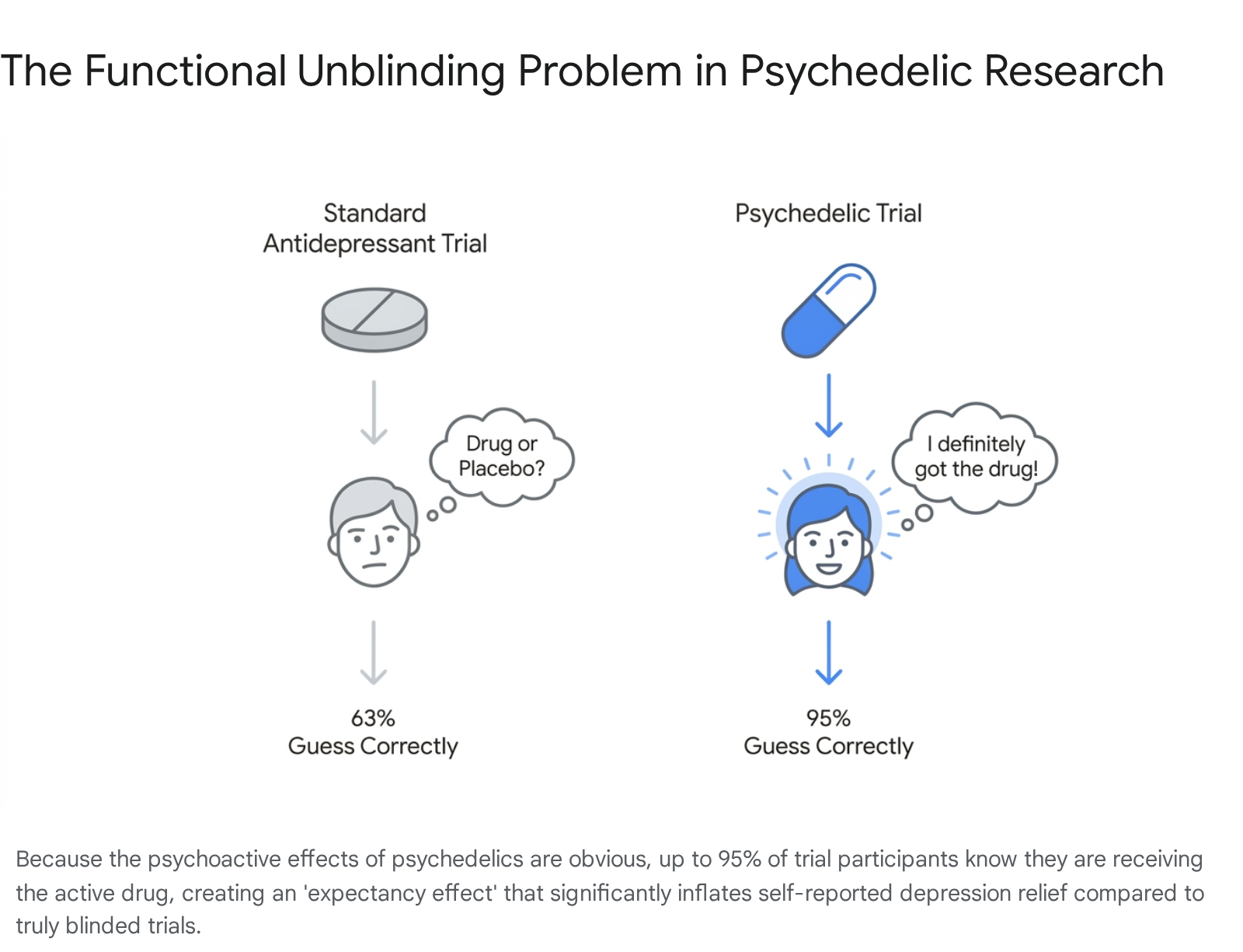
When patients know they are receiving a highly hyped, culturally celebrated substance, their expectancy soars, artificially inflating their self-reported improvement on depression questionnaires. Conversely, patients who realize they received a placebo in a psychedelic trial often experience a "disappointment effect," making their symptoms appear worse and widening the efficacy gap artificially 3132.
To correct for this, Williams and colleagues designed a clever meta-analysis. They compared the results of 8 Psychedelic-Assisted Therapy (PAT) trials against 16 historical trials for traditional antidepressants (TADs) that were explicitly open-label - meaning the patients in those historical trials also knew exactly what drug they were taking 141532.
The results were sobering. When the playing field was leveled regarding patient expectation, psychedelic therapy was not significantly more effective than standard open-label antidepressants for treating major depression 141533. The estimated difference between the two treatments was a mere 0.3 points on the Hamilton Depression Rating Scale (HAM-D) favoring the traditional antidepressants, a clinically negligible amount (p = 0.73) 143233.
The meta-analysis proved that blinding integrity matters immensely. For standard antidepressants, open-label trials produced significantly better outcomes than blinded trials (a difference of 1.3 points) simply because the patients knew they were being treated 141533. This same expectation effect appears to be carrying much of the statistical weight in psychedelic trials. The authors concluded that their results "argue against highly optimistic narratives surrounding PAT" and highlight the absolute importance of blinding integrity 1533.
Proponents of psychedelics push back on this framing. Prominent researchers like Robin Carhart-Harris argue that comparing disparate datasets is like "comparing apples with oranges," and that finding "no difference on the primary endpoint" is vastly different from saying the drugs don't work 3116. They reiterate that psychedelics offer equivalent symptom relief with far fewer long-term side effects and much better secondary outcomes 31. Nonetheless, the data makes it clear that psychedelics are subject to the exact same psychological biases as any other medicine.
Next-Generation Psychedelics and Neuroplastogens
In response to the lengthy duration of classic psychedelics and the regulatory hurdles faced by MDMA, the biotechnology sector is pivoting toward second-generation compounds and entirely new chemical entities optimized for the clinic.
Methylone (TSND-201): A Non-Hallucinogenic Alternative
The failure of the Lykos MDMA application created a massive vacuum in PTSD research. Moving to fill that gap is methylone (also known as β-keto-MDMA), a close structural cousin of MDMA that is currently being advanced by Transcend Therapeutics 1736.
Methylone acts on monoamine transporters to increase serotonin and dopamine similarly to MDMA, but crucially, it does not have significant activity at the 5HT-2a serotonin receptors 3718. This pharmacological distinction means it is generally not hallucinogenic 3739.
This altered profile is deeply attractive to regulators and pharmaceutical companies (such as Otsuka Pharmaceutical, which announced plans to acquire Transcend in early 2026) because it solves the exact problems that doomed Lykos 36. First, without overt hallucinations, placebo-controlled trials can maintain their blind much better 17. Second, methylone does not require intensive, hours-long psychotherapy. In the Phase 2 IMPACT-1 trial for Transcend's formulation (TSND-201), patients received the drug with basic nondirective medical monitoring, bypassing the hard-to-regulate therapeutic frameworks characteristic of the MAPS/Lykos model 1737.
The clinical results have been highly promising. Published in JAMA Psychiatry in February 2026, the IMPACT-1 trial enrolled 65 adults with severe PTSD (CAPS-5 scores ≥35) across the U.S., UK, and Ireland 3718. Patients received four once-weekly oral doses of TSND-201 and showed a rapid, statistically significant 9.64-point placebo-adjusted reduction on the CAPS-5 severity scale at day 64 173718. Adverse events like headaches, nausea, and dry mouth were mostly transient, resolving within a day 3637. With FDA Breakthrough Therapy designation in hand, Phase 3 trials are currently underway 3637.
LSD and the Definium Therapeutics Pipeline
LSD, historically the most stigmatized of the classic psychedelics, is seeing a rigorous clinical revival through Definium Therapeutics (which rebranded from MindMed in early 2026 to signal its transition into a late-stage psychiatry company) 4041.
Definium has developed DT120 (formerly MM120), a proprietary, pharmaceutically optimized formulation of lysergide D-tartrate designed as an orally disintegrating tablet (ODT) 404142. Utilizing specific fast-dissolve technology, the tablet aims to speed absorption and reduce the gastrointestinal distress often associated with raw psychedelics 4042.
The company is targeting both Generalized Anxiety Disorder (GAD) and Major Depressive Disorder (MDD). In Phase 2b trials for GAD, the compound demonstrated a massive 65% clinical response rate and a 48% remission rate sustained over 12 weeks 4043. Buoyed by FDA Breakthrough Therapy Designation, Definium launched the Phase 3 "Emerge" study for MDD in April 2025 (targeting 140 participants), alongside two massive Phase 3 trials for anxiety known as "Voyage" and "Panorama," with major data readouts anticipated in the second half of 2026 40414243. While an LSD session can last eight to twelve hours, requiring significant clinic time, the durability of a single dose makes it an attractive commercial prospect 43.
Deuterated Psilocybin and Short-Acting DMT
Other companies are focusing on drastically shortening the psychedelic experience to make it more commercially viable for healthcare systems that cannot dedicate a hospital bed to a single patient for eight hours.
Helus Pharma (which rebranded from Cybin in early 2026) is advancing HLP003, a deuterated psilocybin analog for Major Depressive Disorder 1841. Deuteration alters the molecule's chemical bonds to optimize its half-life, providing the profound therapeutic effects of psilocybin but clearing the patient's system much faster 18. Phase 2 data showed an incredible 71% remission rate at 12 months after just two doses, and the company expects topline data from its pivotal Phase 3 "APPROACH" study by late 2026 1841.
Similarly, companies like Beckley Psytech are utilizing 5-MeO-DMT, a notoriously potent and rapid-acting psychedelic. Formulated as an intranasal spray, the drug induces a profound altered state that lasts under an hour, meaning patients can be safely discharged from the clinic within two hours of dosing 1843.
Table 1: The Late-Stage Psychedelic Clinical Pipeline (As of Mid-2026)
| Company | Drug Candidate / Mechanism | Target Condition | Current Phase Status | Expected Key Readout / Milestone |
|---|---|---|---|---|
| COMPASS Pathways | COMP360 (Synthetic Psilocybin) | Treatment-Resistant Depression | Phase 3 Completed | Potential NDA Submission Q4 2026 26 |
| Usona Institute | PSIL201 (Psilocybin) | Major Depressive Disorder | Phase 3 Ongoing | CNPV Recipient, Data Late 2026 519 |
| Transcend Therapeutics | TSND-201 (Methylone) | Severe PTSD | Phase 3 Initiating | Phase 2 Published in JAMA Feb 2026 37 |
| Definium (MindMed) | DT120 / MM120 (LSD D-tartrate) | MDD & Generalized Anxiety | Phase 3 Ongoing | Phase 3 Readouts H2 2026 4142 |
| Helus Pharma (Cybin) | HLP003 (Deuterated Psilocybin) | Major Depressive Disorder | Phase 3 Ongoing | Topline Data Q4 2026 1841 |
| Lykos Therapeutics | Midomafetamine (MDMA) | Severe PTSD | Pre-Phase 3 (Repeat) | Restructuring following 2024 FDA Rejection 2613 |
What Are the Real-World Safety Risks?
If these drugs are to enter standard psychiatric practice, their safety profiles must be flawlessly understood.
Acute Tolerability and Suicidal Ideation
In controlled clinical settings, the acute physical safety profile of classic psychedelics is remarkably clean. They are not physiologically toxic, they do not cause respiratory depression, and the risk of lethal overdose is practically non-existent.
In the COMPASS Phase 3 TRD trials, serious adverse events were rare. Crucially for a population suffering from severe, chronic depression, independent data safety monitoring boards found no clinically meaningful imbalance in suicidal ideation between the active psilocybin group and the control group, with ideation rates falling below 1% across the board 168. Most treatment-emergent adverse events - such as headaches, nausea, anxiety, fatigue, and expected visual hallucinations - resolved within 24 hours of administration 168.
Understanding Hallucinogen Persisting Perception Disorder (HPPD)
However, broader rollout outside tightly controlled trials carries distinct, long-term psychiatric risks, most notably Hallucinogen Persisting Perception Disorder (HPPD).
HPPD is a poorly understood condition characterized by the re-emergence of perceptual symptoms experienced during acute hallucinogen intoxication, occurring long after the drug has left the system 2021. Patients describe a variety of visual and sensory anomalies, including visual snow (a persistent grainy, pixelated overlay on their vision), palinopsia (lingering trailing images of moving objects), nyctalopia (night blindness), and intense photophobia (photosensitivity) 2021. A 2025 study found that HPPD patients were over 10 times more likely to experience severe photosensitivity than control groups 2122.
Recent observational data clarifies the prevalence of this condition. A prospective cohort study published in PNAS Nexus in 2025 tracked naturalistic psychedelic users and found that mild, subclinical visual anomalies are actually quite common 23. Over 30% of participants reported some form of HPPD-type visual effects a month after using psychedelics 23. However, these anomalies were rarely severe; less than 1% found the symptoms distressing enough to meet the psychiatric diagnostic criteria for full-blown HPPD 23. True, debilitating HPPD is estimated to affect roughly 1 in 50,000 hallucinogen users, though exact epidemiological estimates vary wildly 2024.
While rare, HPPD lacks a clear, universal pharmacological cure. A 2025 systematic review of existing medication studies found that while benzodiazepines are largely ineffective for LSD-induced HPPD, treatments utilizing anti-epileptics (like levetiracetam) or alpha agonists (like clonidine) reported substantial symptom reduction 24. Notably, the review warned that the antipsychotic agent risperidone often aggravated HPPD symptoms and should be avoided 24. The existence of HPPD underscores the absolute necessity of rigorous medical screening prior to psychedelic therapy, particularly to exclude patients with personal or family histories of perceptual processing disorders, psychotic disorders, or severe visual snow 2023.
Where Is Psychedelic Therapy Currently Legal?
As clinical data matures, the geopolitical and regulatory landscape is shifting at an unprecedented pace, driven by patient advocacy, veteran groups seeking PTSD relief, and changing political winds.
The U.S. Federal Landscape and Executive Action
In the United States, classic psychedelics remain Schedule I substances under the Controlled Substances Act, but the federal review pipeline was unexpectedly supercharged in the spring of 2026.
On April 18, 2026, President Donald Trump signed Executive Order 14401, titled "Accelerating Medical Treatments for Serious Mental Illness" 525. The order explicitly directed federal health agencies to loosen restrictions and fast-track research and review pathways for investigational psychedelics aimed at treating veterans and the broader public 525.
Less than a week later, the FDA utilized its Commissioner's National Priority Voucher (CNPV) program to grant ultra-fast review statuses to three companies: COMPASS Pathways, Usona Institute, and Transcend Therapeutics 51926. These highly coveted vouchers allow the FDA to compress their standard New Drug Application review windows from a period of many months down to just a few weeks 19. This move signals a clear federal intent to push these medications toward commercial availability by late 2026 or 2027 519.
However, medical experts and the FDA itself caution that an executive order is not automatic approval. The drugs must still clear clinical efficacy hurdles. Furthermore, even if approved, treatment will mandate administration in a certified healthcare facility under medical supervision; these will not be take-home prescriptions 2553.
State-Level Initiatives and Decentralized Access
While federal regulators meticulously parse clinical trial data, individual U.S. states have bypassed the FDA entirely to create their own frameworks. * Oregon: Oregon became the first state to launch regulated psilocybin service centers for the public in 2023. Operating outside the medical model, these centers focus on supported adult use. By early 2026, roughly 16,000 clients had received psilocybin in state-licensed facilities 554. * Colorado: Following a 2022 voter initiative, Colorado opened its first state-licensed healing center in 2025 and currently boasts 34 active centers 554. Unlike Oregon, Colorado also decriminalized the personal cultivation and use of natural psychedelics 5455. * New Mexico: In early 2025, New Mexico became the first state to create a strictly medical psilocybin program through the state legislature rather than a ballot initiative, aiming for full operational status by late 2026 specifically for qualifying physical and mental conditions 55455.
Global Pioneers: Australia and Canada
Internationally, Australia made history on July 1, 2023, when its Therapeutic Goods Administration (TGA) formally rescheduled psilocybin and MDMA from Schedule 9 (prohibited substances) to Schedule 8 (controlled medicines) for specific medical uses 565727. This landmark decision allowed specifically authorized psychiatrists - approved under the Authorised Prescriber Scheme and governed by a Human Research Ethics Committee - to prescribe psilocybin for Treatment-Resistant Depression and MDMA for Treatment-Resistant PTSD outside of clinical trials 2759.
The Australian rollout was championed by advocacy groups like Mind Medicine Australia 5727. However, widespread prescribing has been intentionally slow, constrained by strict training requirements, high costs, and a bottleneck of psychiatrists willing to navigate the complex ethics board approvals required to safely administer the therapies in clinics 57.
Canada, widely regarded as a regulatory frontrunner, relies on a more piecemeal but highly progressive system. While possessing psychedelics remains largely illegal for the general public, Health Canada utilizes Section 56 exemptions and a Special Access Programme to allow clinicians to import and administer restricted substances to treat palliative care patients and severe, treatment-resistant psychiatric cases 28. Beyond compassionate access, Canada's progressive financial markets have made the Canadian Securities Exchange (CSE) the de facto hub for global psychedelic biotech capital, facilitating hundreds of millions in funding to push clinical trials forward worldwide .
Bottom line
Psilocybin and newer non-hallucinogenic compounds like methylone show profound, rapid, and sustained efficacy for major depressive disorders and PTSD, consistently clearing the primary endpoints in rigorous late-stage clinical trials. However, the data is complicated by the "functional unblinding" inherent to psychedelic experiences, meaning patient expectation plays a massive, measurable role in the reported symptom relief. As the FDA and global regulators prepare to evaluate the first New Drug Applications for these substances in late 2026 and 2027, the medical community must view them not as magic bullets, but as powerful new tools that - when combined with careful clinical oversight - offer unique secondary benefits and a durable alternative to daily psychiatric medications.