
How Psychedelic Therapy Compares to Antidepressants
When the expectation effect is leveled, the evidence suggests that psychedelic-assisted therapy is no more effective at reducing raw depression scores than traditional open-label antidepressants. However, rather than acting as a daily neurochemical buffer, psychedelics offer a fundamentally different therapeutic pathway - triggering rapid neuroplasticity and emotional processing - though they come with significantly higher financial costs, intensive clinical time commitments, and distinct cardiovascular and psychiatric risks.
For years, the "psychedelic renaissance" has dominated psychiatric news. Early clinical trials heralded substances like psilocybin (the active compound in "magic mushrooms") and MDMA as revolutionary, unparalleled treatments for major depressive disorder (MDD) and post-traumatic stress disorder (PTSD). However, as the science matures and regulatory bodies scrutinize late-stage data, a more nuanced reality is emerging. To understand whether psychedelics represent a true paradigm shift or simply an alternative treatment modality, we must look past the initial hype. This report examines the most recent clinical data to compare how psychedelic-assisted therapy and traditional antidepressants perform regarding true efficacy, biological mechanisms, side effects, and real-world accessibility.
The Core Debate: Do Psychedelics Work Better?
In early-phase clinical trials, psychedelic therapy appeared to blow traditional antidepressants out of the water in terms of symptom reduction. However, researchers are increasingly recognizing that comparing a mind-altering psychedelic to a standard daily pill in a clinical trial introduces a massive methodological flaw: functional unblinding.
The "Unblinding" Problem in Clinical Trials
The gold standard of medical research is the double-blind, placebo-controlled trial, where neither the patient nor the doctor knows whether the patient received the active drug or a placebo. This design controls for the placebo effect - the psychological boost a patient gets simply from believing they are receiving a helpful treatment.
With traditional antidepressants like selective serotonin reuptake inhibitors (SSRIs), double-blinding works reasonably well. The physiological effects of SSRIs are subtle enough that patients in standard trials correctly guess their treatment assignment only about 60% to 63% of the time 12. With psychedelics, true blinding is virtually impossible. A patient given a clinical dose of psilocybin will experience unmistakable visual distortions, altered perceptions, and profound subjective experiences. In psychedelic trials, patients correctly guess their assignment 90% to 95% of the time, even when researchers use active placebos like niacin that cause mild physical flushing 1234.
This creates a severe expectation bias. A patient who signs up for a psychedelic trial, hopes for a breakthrough, and realizes they have received the placebo often experiences a "nocebo" effect - a wave of disappointment that can artificially worsen their depression scores 12. Because the control group performs so poorly in the "basement" of expectations, the psychedelic treatment looks artificially exceptional by comparison 1.
The 2026 JAMA Psychiatry Meta-Analysis
To solve this expectation problem, a landmark 2026 meta-analysis published in JAMA Psychiatry by Williams, Barnett, and Szigeti took a novel approach 2. Because psychedelic trials are essentially always "open-label" (meaning the patient knows they are getting the active drug), the researchers argued that the fairest comparison is to measure them against open-label trials of traditional antidepressants, where those patients also knew they were getting the real medication 35.
The researchers analyzed 24 trials: 8 psychedelic-assisted therapy (PAT) trials involving 249 patients, and 16 open-label traditional antidepressant (TAD) trials involving 7,921 patients 56. The findings introduced a sobering reality to the psychedelic field. When both patient groups benefited equally from the knowledge that they were receiving an active treatment, the massive advantage previously attributed to psychedelics vanished 34.
Historically, previous double-blind studies suggested psychedelics had a massive 7.3-point advantage over placebos on the Hamilton Depression Rating Scale (HAM-D), while SSRIs only showed a 2.4-point advantage over blinded placebos 2. However, the 2026 data indicates that when comparing psychedelics directly to open-label antidepressants, the difference in efficacy shrinks to a statistically negligible 0.3 points (P = .73), favoring the antidepressants 256. A 0.3-point difference is well below the roughly 3.0-point threshold considered to be a minimal clinically important difference. Furthermore, the analysis proved that while unblinding significantly improved outcomes for traditional antidepressant trials (by 1.3 points), it made no statistical difference for psychedelic trials, confirming that psychedelic trials operate entirely as open-label studies regardless of design 57.
Importantly, these findings do not mean psychedelics are ineffective. Patients in both the psychedelic and open-label antidepressant groups saw their depression scores drop substantially - by roughly 12 points on a standard scale 3. It simply indicates that psychedelics are not a miraculous cure that vastly outperforms existing medications; rather, they are comparably effective when tested on a level playing field 147.
Head-to-Head: Psilocybin vs. Escitalopram
These meta-analysis results align closely with direct head-to-head clinical trials. In a widely cited Phase 2, double-blind, randomized controlled trial published in the New England Journal of Medicine in 2021, researchers at Imperial College London compared psilocybin directly against escitalopram (a common SSRI, brand name Lexapro) over a 6-week period 86.
Out of 59 patients, the study found no statistically significant difference in the primary measure of depression between the two groups. The mean change on the 16-item Quick Inventory of Depressive Symptomatology-Self-Report (QIDS-SR-16) was - 8.0 points in the psilocybin group and - 6.0 points in the escitalopram group, leaving a non-significant between-group difference of 2.0 points (P = 0.17) 86. However, secondary outcomes - which measure broader aspects of well-being rather than just the absence of depressive symptoms - generally favored psilocybin, with 57% of the psilocybin group achieving clinical remission compared to 28% of the escitalopram group at week 6 86.
A 6-month follow-up to this trial, published in 2024 in eClinicalMedicine, confirmed the durability of these treatments. At six months, both conditions yielded sustained, long-term improvements in depressive symptom severity, with a non-significant mean difference of 1.51 points on the QIDS-SR-16 scale 7. Yet, the psilocybin group demonstrated significantly greater long-term improvements in psychosocial functioning, psychological connectedness, and overall meaning in life 78. This suggests that while both treatments alleviate clinical depression equally well, psychedelics may uniquely improve how patients relate to themselves and their environment.
Interestingly, a secondary analysis published in 2024 revealed that patient expectations heavily influenced these results. For individuals who entered the trial with low expectations for escitalopram, psilocybin was significantly better at reducing symptoms. But for patients who actually expected the SSRI to work, the efficacy between the two treatments was virtually identical 9.
Neurobiology: How the Mechanisms Differ
If psychedelics and SSRIs result in similar reductions in depression scores, why is there such intense interest in advancing both? The answer lies in the fundamentally different neurobiological mechanisms through which they achieve these results 1011.
SSRIs and the Synaptic Cleft
Conventional psychiatric medications, such as SSRIs and Serotonin-Norepinephrine Reuptake Inhibitors (SNRIs), operate under the monoaminergic hypothesis of depression 15. They work primarily at the synaptic cleft - the microscopic gap between neurons. Usually, after serotonin is released to transmit a neural signal, it is quickly reabsorbed (reuptake) by the transmitting brain cell. SSRIs block this reabsorption, leaving more serotonin active in the synapse to facilitate continuous communication 101617.
Over time, this increased availability of serotonin activates intracellular signaling pathways - such as the cAMP-CREB cascade - which promotes the expression of brain-derived neurotrophic factor (BDNF), a protein crucial for neuron survival 12. This approach requires sustained, daily administration to maintain therapeutic effects 210. While effective for many, it leaves a significant portion of patients searching for alternatives due to emotional numbing, persistent symptoms, or a lack of deeper psychological insight 16.
Psychedelics, Intracellular Receptors, and Critical Periods
Psychedelics do not merely pool serotonin between cells; they penetrate the neuron itself. Research by Dr. David Olson's team (published in 2018 and 2023) demonstrated that classic psychedelics physically enter the cell to activate intracellular 5-HT2A receptors 16. This internal activation triggers a rapid cascade of growth pathways, leading to the physical growth of new dendritic spines and the structural remodeling of neural networks within hours 1612.
Furthermore, research by Dr. Gul Dölen (2019, 2023) suggests that psychedelics can temporarily reopen "critical periods" in the adult brain 16. Critical periods are developmental windows - usually occurring in childhood - when the brain is exceptionally sensitive to learning and environmental inputs. By enhancing neuroplasticity and reopening these windows, psychedelics help the adult brain create entirely new neural pathways rather than just modifying existing ones 151617.
The Default Mode Network (DMN) and Entropy
At a macroscopic systems level, psychedelics dramatically alter the brain's functional connectivity. Brain imaging (fMRI) studies show that psychedelics suppress the Default Mode Network (DMN) 1913. The DMN is a heavily connected hub of brain structures responsible for self-reflection, self-criticism, autobiographical memory, and the ego 1913. In individuals suffering from depression, anxiety, or addiction, the DMN often becomes hyperactive and rigid, trapping the person in relentless loops of negative rumination and maladaptive cognitive patterns 111921.
Dr. Robin Carhart-Harris conceptualized this phenomenon through the REBUS model (Relaxed Beliefs Under Psychedelics) 2122. Under this model, psychedelics temporarily dissolve the brain's rigid, top-down constraints on perception, shifting the brain into a state of higher entropy (disorder) 2122.
Researchers frequently liken this to "shaking the snow globe" or powdering over a snow-covered ski slope 132223.
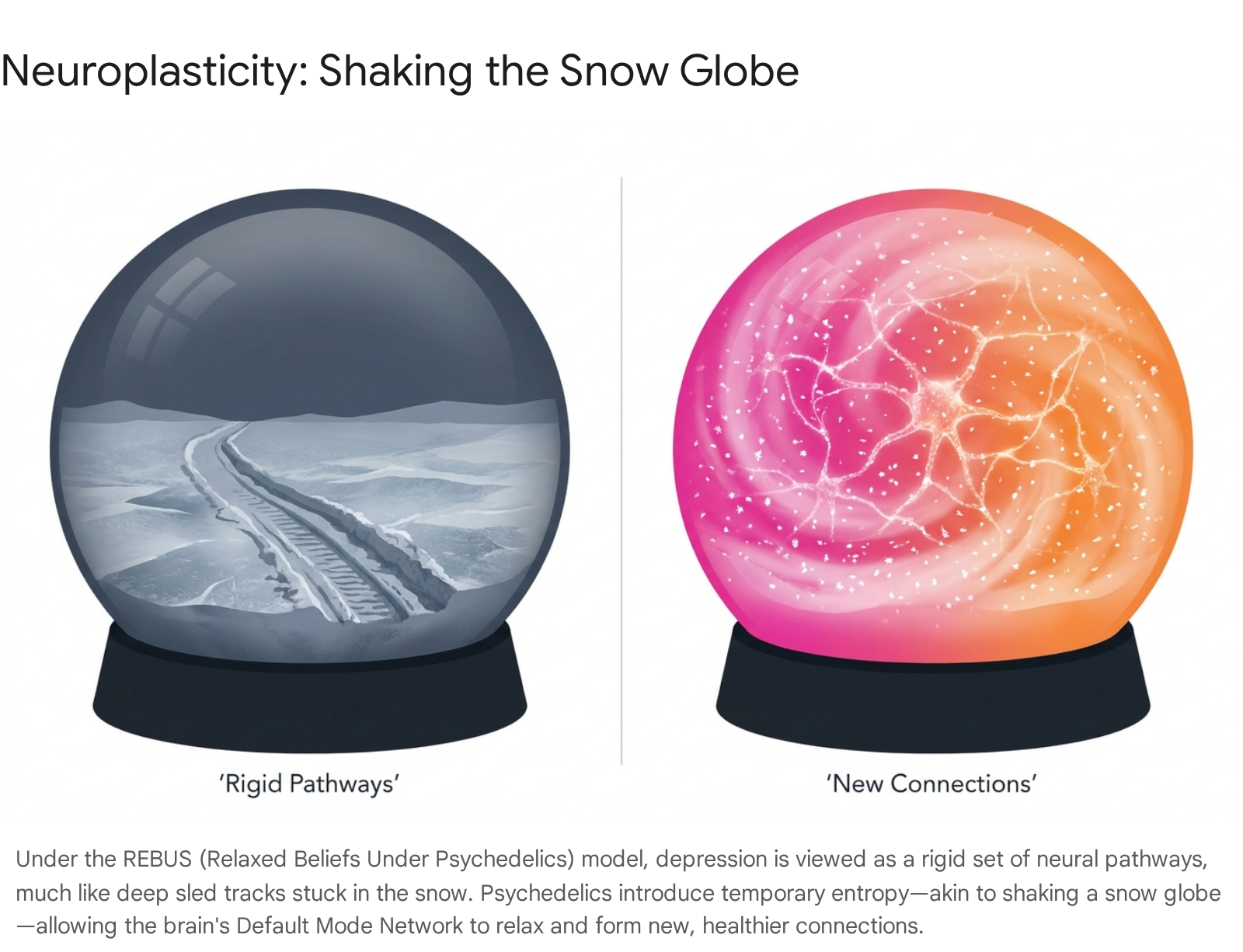
If depressive thoughts are like a sled that has carved deep, inescapable tracks into the snow, psychedelics act like a fresh blizzard. By temporarily elevating brain entropy, they flatten the snow, allowing the patient to glide down a new, healthier path 2223. This window of neuroplasticity allows the patient to access and process repressed emotional content and trauma from a place of equanimity, rather than fear 1021.
The Patient Experience: Pills vs. Protocols
Because their biological mechanisms are so distinct, the logistical delivery of these treatments bears almost no resemblance to one another. Psychedelics are not a "take-home" medication picked up at a local pharmacy 14.
The Psychedelic-Assisted Therapy (PAT) Framework
When administered in approved clinical trials or legal frameworks, psychedelic therapy is delivered as a comprehensive, multi-week package of care consisting of three distinct phases 1516:
- Preparation (1 - 3 sessions): Conducted over one to three weeks, patients meet with their therapy team to build genuine rapport, review medical histories, set intentions, and learn grounding techniques for navigating challenging altered states 152717. Establishing deep trust is considered a primary safety requirement to minimize the risk of panic during the dosing session 161718.
- Dosing Session (1 - 3 sessions): The patient ingests the compound (e.g., psilocybin, MDMA) in a comfortable, controlled clinical room. The patient rests, often wearing an eye mask and listening to a curated music playlist to encourage internal focus 2718. The session lasts 4 to 8 hours depending on the drug's duration. Crucially, the patient is never left alone; one or two trained therapists sit with them for the entire duration to provide psychological support, manage emotional distress, and monitor physical safety 162718.
- Integration (1 - 3 sessions): In the days and weeks following the dosing session, patients meet with their therapists to process the images, emotions, and insights gained during the altered state 1518. Without integration, researchers note that the benefits of a session may fade; with integration, patients weave these insights into actionable behavioral changes and meaning-making in their daily lives 271718.
| Feature | Traditional Antidepressants (SSRIs/SNRIs) | Psychedelic-Assisted Therapy (PAT) |
|---|---|---|
| Administration Method | Daily oral pill taken independently at home. | 1 to 3 strictly supervised clinical dosing sessions. |
| Clinical Time Commitment | Minimal daily routine; occasional 15-minute medication management checks. | 20+ hours of direct clinical contact time (Preparation, Dosing, and Integration) over a few months. |
| Therapeutic Paradigm | Symptom management through sustained neurochemical buffering. | Catalyst for rapid psychological breakthroughs and deep trauma processing. |
| Onset of Action | Weeks to months for full therapeutic effect. | Hours to days (rapid onset of neuroplasticity). |
Side Effects and Safety Profiles
While both treatments carry risks, the nature of those risks is entirely different. Traditional antidepressants carry a high burden of chronic, daily side effects, whereas psychedelics carry acute risks related strictly to the intensity of the dosing session 10.
SSRI Burden: Sexual Dysfunction and PSSD
One of the most profound and widely reported drawbacks of SSRIs is sexual dysfunction. Systematic reviews and unblinded studies estimate that between 58% and 70% of patients taking SSRIs experience significant sexual side effects during active treatment, including loss of libido, erectile dysfunction, delayed ejaculation, and anorgasmia (the inability to orgasm) 19202133.
While medical consensus previously assumed this dysfunction resolved when the medication was stopped, an emerging and severe condition known as Post-SSRI Sexual Dysfunction (PSSD) is gaining clinical recognition from bodies like the European Medicines Agency 222324. A 19-year retrospective cohort analysis in Israel evaluated 12,302 males and found that approximately 0.46% (1 in 216) of patients treated with serotonergic antidepressants developed persistent, irreversible erectile dysfunction long after discontinuing the drug 2237. While 0.46% represents a small percentage, the sheer volume of global SSRI prescriptions means tens of thousands of individuals are left with permanent sexual disability 3725.
By contrast, psychedelics do not carry this risk. In fact, a recent meta-analysis of clinical trials comparing psilocybin to escitalopram showed that psilocybin actually improved sexual functioning, satisfaction, and libido post-treatment, making it a highly appealing alternative for patients suffering from SSRI-induced sexual dysfunction 826.
Antidepressant Discontinuation Syndrome
Stopping SSRIs is notoriously difficult. Abruptly quitting or rapidly tapering can trigger Antidepressant Discontinuation Syndrome (often referred to by patients as antidepressant withdrawal) 2527. Symptoms typically begin within two to four days and are summarized by the medical mnemonic FINISH: Flu-like symptoms, Insomnia, Nausea, Imbalance (vertigo), Sensory disturbances (including painful "brain zaps" or electrical shocks in the skull), and Hyperarousal (anxiety, mania, or irritability) 27282930.
The prevalence of these withdrawal effects is fiercely debated. A 2024 meta-analysis suggested that only 1 in 6 patients experience withdrawal effects directly attributable to the drug, with only 3% experiencing severe symptoms 44. However, critics argue this review relied on short-term trials (8-12 weeks) and ignored long-term users. Conversely, a survey of patients in London who had taken antidepressants for more than two years found that up to 25% reported "severe" withdrawal effects when trying to stop 2544. Psychedelics, which are not physically addictive and do not require daily dosing, entirely eliminate the risk of physical discontinuation syndromes 10.
The Medication Overlap Dilemma
For patients currently on SSRIs who wish to try psychedelic therapy, there is a complex clinical dilemma. Psychedelics and SSRIs both act on the serotonin system. Research indicates that chronic use of SSRIs downregulates serotonin receptors, which significantly blunts or diminishes the efficacy and subjective effects of psychedelics like psilocybin and MDMA 163132. A sensitivity analysis found that this dampening effect can last for up to three months following the discontinuation of the antidepressant 47.
Consequently, most clinical trials require patients to completely taper off their antidepressants before receiving a psychedelic 4733. However, forcing a patient with Treatment-Resistant Depression (TRD) to endure Antidepressant Discontinuation Syndrome risks a severe relapse of depression or a spike in suicidal ideation precisely when they are preparing for a vulnerable psychedelic session 254749. Determining whether a patient should suffer through SSRI withdrawal to maximize the psychedelic's effect, or stay on the SSRI and risk a muted therapeutic response, remains one of the most difficult ethical questions in modern psychedelic medicine 3132.
Medical and Psychiatric Contraindications for Psychedelics
While psychedelics are physically well-tolerated in healthy populations, their safety profile is highly dependent on rigorous patient screening. They pose both physiological and psychological risks that standard SSRIs do not, necessitating strict contraindications 3451.
Cardiovascular and Neurological Risks
The most common physiological side effect of classic psychedelics is a transient but significant spike in blood pressure and heart rate, similar to the exertion of moderate aerobic exercise 523536. Because of this, individuals with uncontrolled high blood pressure, a history of cardiac arrest, congestive heart failure, or severe coronary artery disease are strictly excluded from clinical trials and legal therapeutic frameworks 3352353637.
Neurologically, psilocybin can lower the seizure threshold in susceptible individuals. Therefore, patients with epilepsy, a history of seizures, or severe cognitive impairment (such as dementia) are also broadly contraindicated 353637.
Psychiatric Screening and Exclusions
Psychiatrically, psychedelics are known to destabilize individuals with certain underlying vulnerabilities. The intense nature of a psychedelic trip - which can include temporary panic, confusion, and the resurfacing of severe repressed trauma - has the potential to trigger manic episodes or prolonged psychosis in susceptible individuals 334936.
Clinical protocols universally exclude individuals with a personal or first-degree family history of schizophrenia, bipolar I disorder, schizoaffective disorder, or other psychotic disorders 3349523537. Furthermore, patients exhibiting active suicidal ideation with a plan or intent are excluded until they can be psychiatrically stabilized using conventional means 495235.
| Risk Category | Traditional Antidepressants (SSRIs/SNRIs) | Psychedelic-Assisted Therapy (PAT) |
|---|---|---|
| Physical Dependence | High (Discontinuation syndrome, "brain zaps", nausea). | None (Non-addictive, single or infrequent dosing). |
| Sexual Function | High risk of dysfunction (58-70%); minor risk of permanent PSSD. | Improved or unaffected sexual functioning. |
| Cardiovascular Risk | Minimal. | Acute spikes in blood pressure/heart rate during dosing. |
| Psychiatric Exclusions | Few; standard first-line care for most mood disorders. | Strictly contraindicated for history of Psychosis, Bipolar I, and Schizophrenia. |
The Financial and Demographic Divide
Efficacy and biology aside, the real-world viability of psychedelic therapy is currently bottlenecked by extreme logistical and financial barriers, raising concerns about equitable access.
The Staggering Cost of Supported Therapy
Psychedelic compounds themselves are cheap to synthesize, often costing less than $25 per dose 38. The immense cost of the therapy comes from the human labor required to deliver it safely. Requiring one or two highly trained clinical professionals to sit in a room with a single patient for eight hours, bracketed by multiple preparatory and integration psychotherapy sessions, is astronomically expensive to scale 3839.
Estimates from the recent Phase 3 MDMA trials suggest the true cost of delivering a complete PAT protocol is around $11,000 per patient 38. Even at commercial ketamine clinics (which utilize the only widely legal psychedelic-adjacent compound), assisted psychotherapy packages often range from $3,000 to $5,000 3839. Because these therapies are largely experimental and unapproved by major federal agencies, insurance companies do not cover them, forcing patients to pay entirely out-of-pocket 3839. Conversely, generic SSRIs are widely covered by insurance and can cost mere pennies a day, making them infinitely more accessible to the general public 1040.
A Lack of Diversity in Clinical Trials
This financial and logistical barrier has resulted in a glaring lack of diversity in psychedelic research, limiting the generalizability of the findings 414243. A 2025 systematic review of 21 randomized controlled trials for psilocybin- and MDMA-assisted therapy evaluated the demographics of 1,034 participants 4142.
The review revealed that participant samples are overwhelmingly affluent, educated, and white 4143. Across these trials, Black/African-American participants made up only 2.2% of subjects, and Hispanic/Latino participants comprised just 7.2% - figures that are severely underrepresented compared to US population demographics and standard non-psychedelic clinical trials (where Black representation often exceeds 10-20%) 414244. Furthermore, data regarding sexual orientation (reported in only 9.5% of studies) and gender identity (0%) was virtually non-existent 414244. Until clinical models can be delivered affordably and inclusive recruitment strategies are prioritized, psychedelic therapy risks becoming a boutique treatment available only to a privileged demographic 3842.
The Evolving Global Regulatory Landscape (2024 - 2026)
The legal framework surrounding these treatments is evolving rapidly, with starkly different regulatory approaches adopted globally.
The United States: FDA Rejection of MDMA
In the United States, the psychedelic medicine industry faced a massive setback in August 2024. Lykos Therapeutics (formerly MAPS) submitted a New Drug Application (NDA) to the FDA to approve MDMA-assisted therapy for PTSD 4564. Phase 3 trials had shown remarkable efficacy, with 71.2% of participants no longer meeting the criteria for PTSD after treatment 6546.
Despite these promising results, the FDA issued a Complete Response Letter (CRL) rejecting the application 104565. Following a 10-1 vote against approval by an independent advisory committee, the FDA cited several severe concerns. These included the insurmountable functional unblinding of the trials (which compromised data reliability), cardiovascular risks, and the difficulty of regulating the mandatory psychotherapy component of the treatment, as the FDA traditionally only regulates drugs, not psychological protocols 43644768.
The decision was also heavily influenced by allegations of severe ethical misconduct by therapists at a trial site, which led to the retraction of three published papers in the journal Psychopharmacology just days before the FDA's decision 45646869. The FDA requested that Lykos conduct an entirely new, multi-year Phase 3 trial to address these safety and blinding issues, pushing potential US approval years into the future 456547.
Australia and Canada: Pragmatic Access
While the US stalls, other nations have pushed forward with pragmatic medical access: * Australia: In a world-first move, Australia's Therapeutic Goods Administration (TGA) rescheduled psilocybin and MDMA to Schedule 8 (Controlled Medicines) in July 2023. This progressive framework allows authorized psychiatrists to legally prescribe MDMA for PTSD and psilocybin for treatment-resistant depression in tightly controlled medical environments 70717374. * Canada: While Health Canada does not permit general prescription of psychedelics, it allows targeted access via a Special Access Program (SAP). Through the SAP, physicians can request psilocybin or MDMA for patients with severe, life-threatening conditions (such as end-of-life distress, cluster headaches, or treatment-resistant depression) when conventional therapies have failed 48495078. By early 2024, hundreds of Canadians had legally accessed these compounds through the SAP 48.
Europe and the United Kingdom
In Europe, the regulatory environment is preparing for eventual integration. The European Medicines Agency (EMA) published updated clinical investigation guidelines for depression in late 2025 that formally outline how to study psychedelics, signaling a clear regulatory pathway for the future 5180. At the state level, the Czech Republic signed a landmark bill legalizing medical psilocybin for use under strict clinical conditions starting in 2026 7451.
In the UK, pressure is mounting to reschedule psilocybin from Schedule 1 to Schedule 2. Currently, its Schedule 1 status imposes immense financial and bureaucratic barriers on clinical research. Following recommendations from the Home Affairs Committee and the Advisory Council on the Misuse of Drugs (ACMD) in 2023, the UK government agreed in principle in 2025 to ease these licensing requirements for hospital and university research, potentially accelerating the timeline for domestic clinical trials 525354.
Bottom line
When the expectation effect is leveled in rigorous clinical comparisons, psychedelic-assisted therapy does not drastically outperform standard open-label antidepressants in raw symptom reduction. However, psychedelics offer a fundamentally different therapeutic path - trading the daily emotional buffering and severe sexual side effects of SSRIs for rapid neuroplasticity, intense clinical monitoring, and a highly expensive therapy protocol. Until the severe logistical costs, lack of trial diversity, and regulatory hurdles surrounding clinical blinding are resolved, psychedelics will likely remain a specialized, secondary option for those who have failed conventional care rather than a first-line replacement for standard antidepressants.