
What the Science Says About Journaling for Well-Being
Journaling is a scientifically validated practice that can reduce stress, improve sleep, and boost emotional well-being when utilized with specific, structured techniques. However, the benefits are not unconditional; while directed writing that focuses on meaning-making offers measurable psychological advantages, unstructured venting can sometimes worsen distress by trapping individuals in cycles of negative rumination. Ultimately, the effectiveness of therapeutic writing depends heavily on the specific protocol used, the writer's baseline mental state, and the cultural context in which they live.
The Medicalization of the Diary
For centuries, keeping a diary was viewed primarily as a historical or personal record-keeping endeavor. It was not until the late 1980s that psychology began to rigorously investigate the act of writing as a clinical intervention. The pioneer of this movement was Dr. James Pennebaker, a psychologist whose early experiments tested a radical hypothesis: that the physical act of translating traumatic or stressful experiences into structured language could yield measurable improvements in physical and psychological health 123.
Pennebaker's foundational research asked participants to write continuously about their deepest thoughts and feelings regarding a severe trauma for fifteen to thirty minutes across three or four consecutive days 14. The control groups were asked to write about superficial, emotionally neutral topics, such as their plans for the day or time management strategies 45. The initial results were staggering. Participants in the expressive writing group reported better physical health, demonstrated improved immune system functioning, and visited the campus health center roughly fifty percent less often in the months following the exercise than those in the control group 2457.
This intervention, now known as the Pennebaker Writing Protocol or Written Emotional Disclosure, launched an entire subfield of psychological and physiological research. Today, over two hundred peer-reviewed studies have explored the health effects of various writing exercises, exploring applications ranging from cardiovascular health to post-traumatic stress disorder 1. Yet, as the volume of research has grown, the scientific consensus has become more nuanced. While early studies suggested massive, generalized health benefits, recent comprehensive meta-analyses paint a more calibrated picture. Journaling is now recognized as a highly effective, low-cost adjunctive therapy, but it is not a standalone cure-all, and its effect sizes are generally small to moderate depending on the specific condition being treated 6978.
The Neuroscience of Writing: Cognitive Offloading
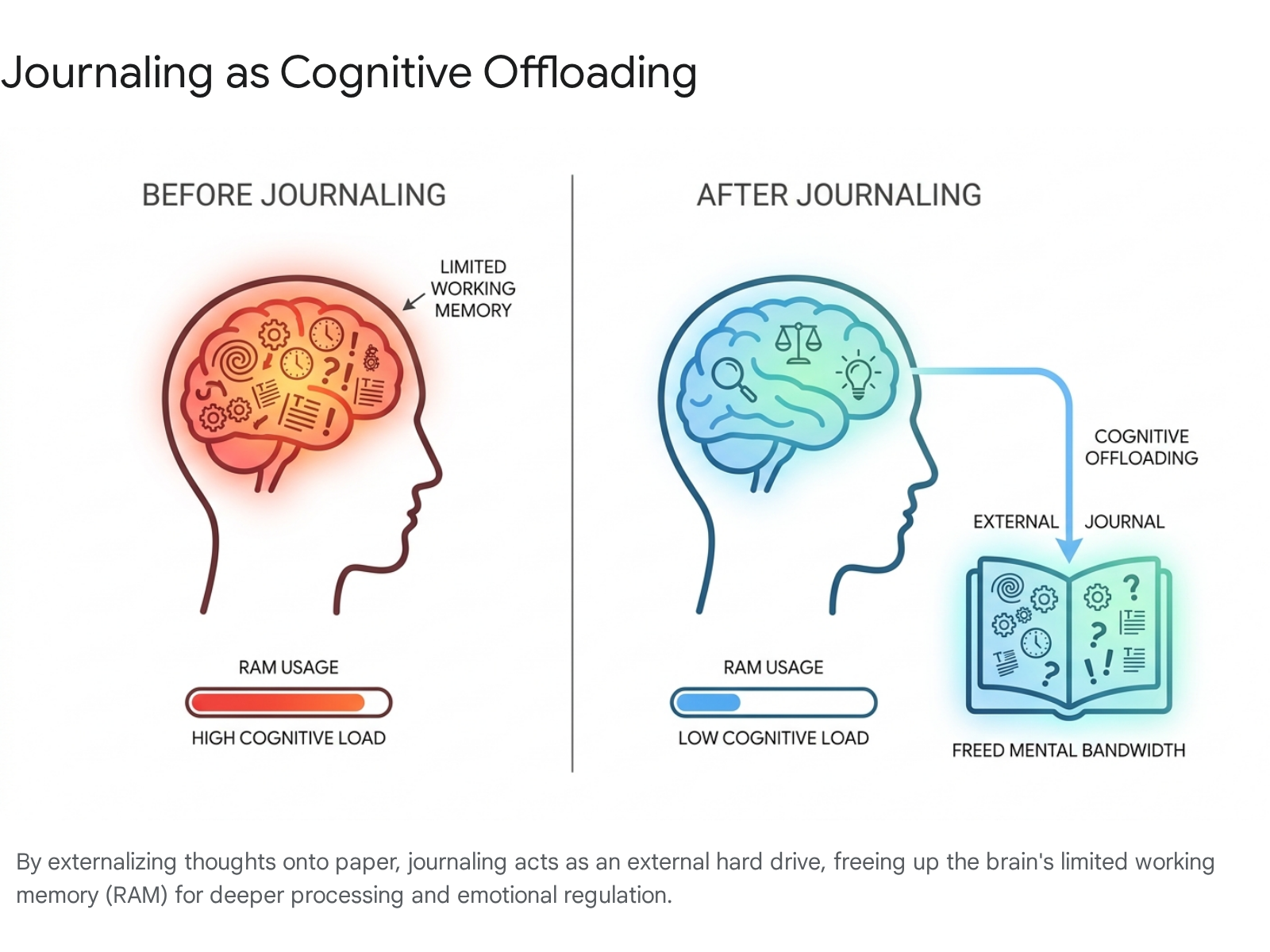
To understand why simply writing things down can alleviate psychological distress, it is helpful to view the human brain through the lens of Cognitive Load Theory and distributed cognition. Educational psychologists and cognitive scientists frequently use a computer's Random Access Memory (RAM) as an analogy for human working memory 91310.
Working memory is the cognitive system responsible for temporarily holding and processing the information needed for complex tasks. It has a strictly limited capacity. When an individual is stressed, anxious, or overwhelmed with tasks, their working memory becomes clogged with unresolved thoughts, fears, and mental to-do lists. This state of cognitive overload restricts the brain's ability to focus, solve problems, or process new information, leading to decision fatigue and heightened anxiety 131112.
Journaling acts as a form of cognitive offloading, which is the practice of using external tools to alter the information-processing requirements of a task to reduce mental demand 131314. By transferring thoughts from the mind to a piece of paper or a digital document, the brain is essentially granted permission to stop actively holding onto that information. In the framework of Cognitive Load Theory, this reduces extraneous cognitive load, thereby freeing up germane load - the mental bandwidth required for higher-order problem solving and emotional regulation 1215.
The "Brain Dump" and Sleep Architecture
The clinical evidence for the immediate benefits of cognitive offloading is robust. One of the most common applications of this theory is the "brain dump" technique, which involves an unstructured, rapid-fire listing of every thought, task, or worry currently occupying the mind 112021.
Researchers at Baylor University tested this mechanism directly in the context of sleep latency, which measures how long it takes an individual to fall asleep. Participants were divided into two groups right before bed. One group spent five minutes writing a list of tasks they had already completed that day, while the other group spent five minutes writing a "brain dump" to-do list of everything they needed to accomplish in the coming days. The researchers found that the group who offloaded their future worries onto paper fell asleep significantly faster - reducing sleep onset latency by approximately nine minutes compared to the control group 2022. By moving the mental queue to a physical space, the brain's vigilance networks were able to power down.
Similarly, an influential study published in the journal Science demonstrated that students who wrote about their anxieties for ten minutes immediately before taking a high-stakes exam improved their test scores by nearly a full grade point. The act of writing offloaded the emotional burden of performance anxiety, freeing up working memory capacity to actually execute the academic tasks at hand 2022.
Expressive Writing: Processing Trauma and Stress
While cognitive offloading explains why rapid list-making works for immediate mental clutter, deeper emotional healing requires different protocols. The scientific literature on therapeutic journaling generally divides into two distinct theoretical approaches: Expressive Writing, which focuses on processing negative emotions and trauma, and Positive Psychology Interventions, which focus on cultivating positive affective states.
Expressive writing requires individuals to write continuously about their deepest thoughts and feelings regarding a specific stressful or traumatic event. The mechanism of action here is not merely emotional catharsis. While "getting it off your chest" feels good temporarily, decades of research indicate that the true therapeutic power of expressive writing lies in cognitive restructuring and narrative formation 491624.
Linguistic Shifts in the Healing Process
When a traumatic or highly stressful event occurs, the memory is often stored in a fragmented, highly emotional, and disorganized manner within the brain. Pennebaker's linguistic analyses of thousands of journal entries revealed that individuals who benefit most from expressive writing undergo a specific, measurable linguistic shift over their consecutive writing sessions.
On the first day of the protocol, their writing is often chaotic and relies heavily on negative emotion words. However, by the third or fourth day, their writing becomes more structured and features a significant increase in causal words, such as "because" and "effect," as well as insight words, such as "understand," "consider," and "realize" 916.
This linguistic evolution suggests that expressive writing forces the brain to organize chaotic emotional fragments into a coherent narrative with a beginning, middle, and end. Once a trauma has a logical narrative structure, the brain can file it away as a past event rather than experiencing it as an ongoing, ambient threat 162425. Functional MRI scans support this theory, revealing that individuals who journal about their emotions show increased activation in the prefrontal cortex - the area associated with decision-making and emotional regulation - and decreased activity in the amygdala, the brain's primary fear and stress response center 2627. This neural mechanism, often referred to as affect labeling, physically diminishes the intensity of the stress response.
Efficacy in Specific Medical Populations
The efficacy of expressive writing has been tested extensively across various clinical and high-stress populations. For instance, studies examining first-year nursing students found that those who completed a four-day expressive writing protocol about academic and transitional stress exhibited a marked and sustained reduction in perceived stress levels across physical, academic, and interpersonal domains, with benefits persisting at a three-month follow-up 17.
In oncology settings, expressive writing has been deployed to help cancer patients manage the immense psychological burden of their diagnoses. A scoping review of literature from 2015 to 2025 assessing patients with cancer found that expressive writing interventions improved quality of life, reduced body image distress, and facilitated the cognitive processing of the illness 18. The ability to write privately about fears of mortality and the physical toll of treatment provides a therapeutic containment space that routine medical care often lacks.
Positive Psychology Interventions (PPIs)
Recognizing that exploring trauma can be intensely draining and is not suitable for everyone, the field of Positive Psychology developed alternative writing protocols. These interventions are designed to actively cultivate well-being, resilience, and optimism rather than solely mitigating psychological suffering. Two of the most heavily researched Positive Psychology Interventions are Gratitude Journaling and the "Best Possible Self" exercise 5192021.
The Science of Gratitude Journaling
Gratitude journaling involves regularly writing down specific things one is thankful for, typically listing three to five items per day or a few times a week 33. The psychological mechanism behind this practice relies on retraining the brain's default attentional networks. Human brains possess a built-in "negativity bias" - an evolutionary wiring that forces us to constantly scan the environment for threats and dwell on negative social interactions. Gratitude journaling forces the brain to actively scan the environment for positive stimuli, gradually shifting the baseline lens through which the world is viewed 3322.
The empirical evidence supporting this practice is substantial. A massive 2025 meta-analysis covering over 10,000 participants across 34 culturally diverse countries confirmed that gratitude interventions produce reliable, albeit small to moderate, improvements in positive affect, optimism, and life satisfaction 23. Furthermore, studies have shown that gratitude journaling can reduce symptoms of depression and anxiety in clinical populations, lower resting cortisol levels by up to twenty-three percent, and even improve biological markers related to cardiovascular health 27362438.
It is important to note that clinical gratitude journaling is not equivalent to toxic positivity. It does not require individuals to ignore their pain or pretend that difficult circumstances are acceptable; rather, it asks them to consciously recognize the supportive elements that exist alongside their challenges 33.
The "Best Possible Self" Exercise
In the "Best Possible Self" (BPS) exercise, participants write about their life at some point in the future, imagining that everything has gone as well as it possibly could. They are instructed to envision success across multiple core life domains, such as career, romantic relationships, physical health, and social life 225.
Meta-analyses show that the BPS intervention is remarkably effective at immediately boosting positive affect and fostering long-term trait optimism. By simulating future success, the exercise enhances self-efficacy and clarifies goal structures, often yielding stronger and more consistent short-term well-being enhancements than standard expressive writing, which can temporarily depress mood immediately after a session 252126.
Comparing the Core Journaling Protocols
To understand which technique serves which psychological need, the following table summarizes the most evidence-backed journaling frameworks, their standard dosages, and their primary mechanisms of action based on the current literature.
| Journaling Protocol | Standard Dosage | Best Used For | Primary Mechanism of Action |
|---|---|---|---|
| Brain Dump | 5 - 15 mins, as needed (often before bed) | Overwhelm, insomnia, acute anxiety, racing thoughts | Cognitive Offloading: Externalizes working memory to reduce immediate cognitive load and bypass vigilance networks 131120. |
| Expressive Writing | 15 - 20 mins, 3 - 4 consecutive days | Processing acute stress, specific trauma, grief, major life transitions | Narrative Restructuring: Transforms fragmented emotional memories into coherent, manageable narratives, engaging the prefrontal cortex 121627. |
| Gratitude Journaling | 5 mins, 3 - 7 times per week | General low mood, mild depression, building resilience | Attentional Retraining: Overrides the brain's negativity bias by forcing conscious recognition of positive environmental stimuli 332236. |
| Best Possible Self | 15 mins, 1 - 3 sessions | Lack of direction, pessimism, building self-efficacy and hope | Future-Oriented Reframing: Enhances optimism and clarifies goal structures by psychologically simulating future success 22526. |
The Rumination Trap: When Journaling Backfires
One of the most critical nuances in the science of journaling is that writing about your feelings is not universally beneficial. In fact, under the wrong conditions, journaling can significantly worsen an individual's mental health. This psychological hazard is known in the clinical literature as the "rumination trap" 274228.
Rumination is defined as the repetitive, passive, and cyclical focus on the symptoms of one's distress and its possible causes and consequences, without moving toward problem-solving or emotional resolution 28. When individuals use a journal merely for unstructured venting - endlessly detailing how angry, sad, or victimized they feel without seeking perspective or narrative evolution - they are engaging in written rumination.
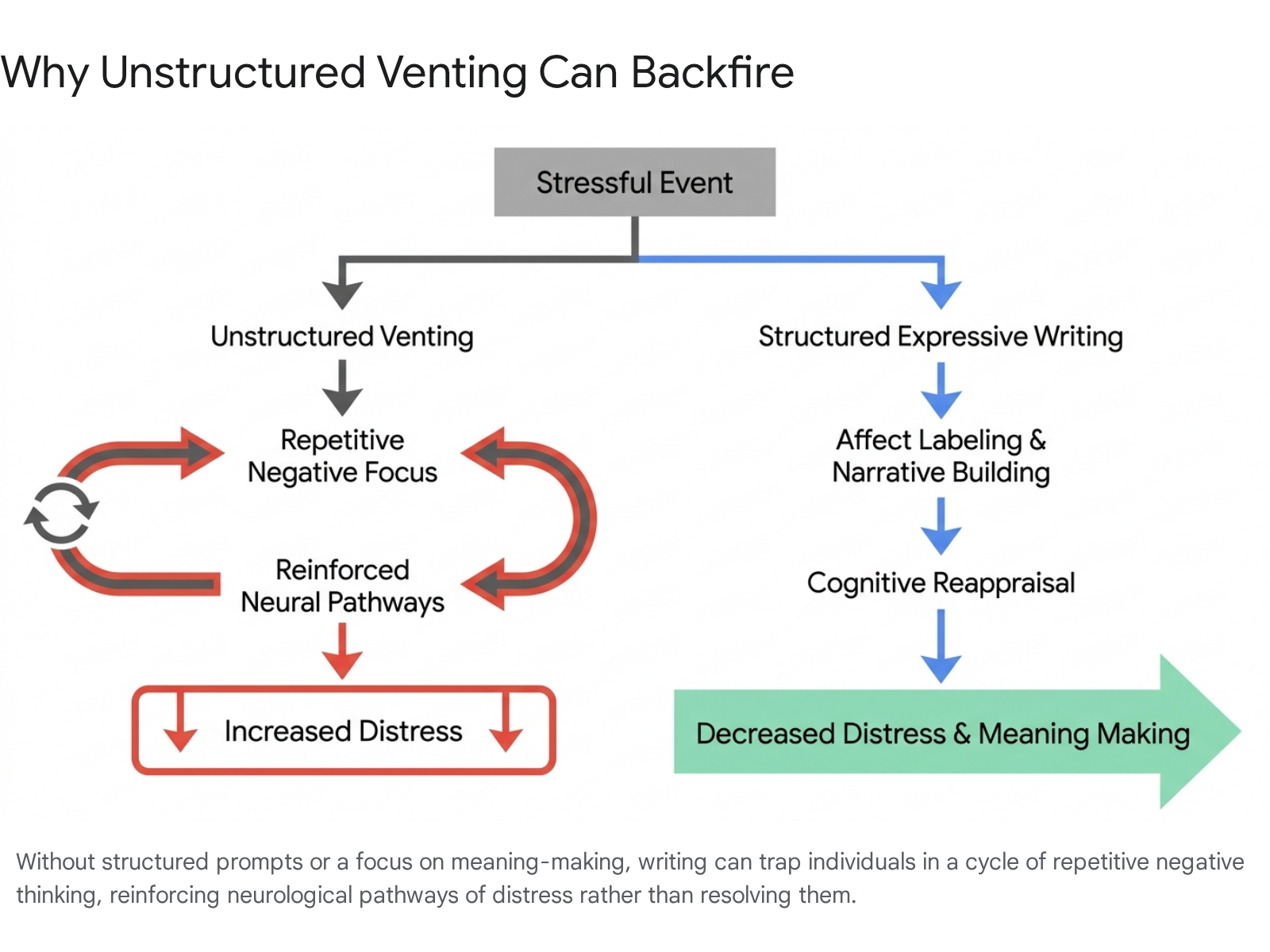
Research consistently shows that while expressive writing relies on processing negative emotions, raw emotional discharge is not cathartic if it lacks cognitive structure. For example, laboratory research indicates that aggressive venting can amplify anger rather than reduce it, keeping physiological arousal elevated and reinforcing neural circuits of reactivity 7944. In a therapeutic context, a clinician who simply allows a patient to vent without guiding the emotional process may inadvertently validate patterns of rumination rather than promote adaptive regulation 44. The same holds true for a blank journal page.
High Ruminators and the Divorce Study
This danger is particularly acute for individuals going through highly distressing, protracted life events. A landmark 2013 study by Sbarra and colleagues examined the effects of expressive writing on 90 adults who had recently gone through a marital separation. The study found that for individuals who were naturally "high ruminators" - people prone to brooding over negative events - traditional expressive writing actually impeded their emotional recovery and increased their emotional distress compared to a control group 525.
To avoid the rumination trap, psychologists advise several structural safeguards. First, individuals should limit the duration of their writing sessions to fifteen or twenty minutes, as writing endlessly can invite a downward spiral 252946. Second, writers must force perspective shifts; if a journal entry is spiraling, they should deliberately shift the narrative to write about the event from a third-person perspective or explicitly write about what can be learned from the situation. Finally, using structured, highly specific prompts designed by mental health professionals is vastly safer than staring at a blank page for individuals highly prone to anxiety or depression 5202730.
Cultural Nuances: Does One Size Fit All?
The scientific literature on therapeutic writing has historically been critiqued for relying heavily on WEIRD (Western, Educated, Industrialized, Rich, and Democratic) populations 31. As researchers have expanded their scope globally, fascinating nuances regarding culture, emotion norms, and individual psychology have emerged, challenging the assumption that journaling works identically for everyone.
Individualism, Collectivism, and Emotion Norms
A central tenet of expressive writing is that verbalizing and deeply examining negative emotions leads to healing. This concept is heavily grounded in Western psychological frameworks that prioritize individualism, the pursuit of comfort, and the expression of the "authentic self." However, this assumption does not universally hold true across different cultural contexts.
In highly collectivistic cultures, there is often a greater emphasis on social harmony, interdependence, and the suppression of disruptive individual emotions in favor of group cohesion 323334. A study by Kim (2011) directly tested this hypothesis by having European American and Asian American participants complete a traditional expressive writing protocol about traumatic events. While the European Americans exhibited increased use of insight words and reported fewer illness symptoms a month later, neither of these benefits were observed in the Asian American cohort. The cultural de-emphasis on verbalization in meaning-making rendered the intervention largely ineffective for that specific group 32.
Similarly, a 2025 cross-cultural study on the "Best Possible Self" intervention compared Dutch (Western) and Chinese (Eastern) college students. The Dutch participants reported robust immediate benefits in positive affect, trait optimism, and life satisfaction. In contrast, the Chinese participants reported changes mostly in negative outcomes initially, and only began to show modest benefits after multiple, repeated sessions 26.
Interestingly, recent massive global studies on emotional norms, which analyzed data from over 200,000 participants in 69 distinct countries, found that people in highly individualistic cultures experience much greater pressure to conform to socially desirable "happy" emotions than those in collectivist cultures 3334. Therefore, journaling may serve as a much-needed private pressure valve in Western societies where expressing negative emotions publicly is highly stigmatized, whereas it may feel unnatural or counterproductive in cultures with different emotional architectures.
Clinical Applications and Meta-Analytic Realities
It is vital to distinguish between journaling for everyday wellness and journaling as a primary treatment for clinical psychopathology. While individual studies often report dramatic results, large-scale meta-analyses that aggregate data across thousands of patients provide the most accurate picture of what journaling can and cannot do.
Meta-analyses indicate that for non-clinical populations dealing with general stress, burnout, or academic pressure, brief positive expressive writing interventions yield consistent, reliable benefits 17213536. However, for individuals with clinical diagnoses - such as Major Depressive Disorder or Post-Traumatic Stress Disorder - the evidence is decidedly mixed.
A 2023 meta-analysis by Guo of 31 randomized controlled trials found that expressive writing has a significant but small overall effect on reducing symptoms of depression, anxiety, and stress 97. Another comprehensive review found that while journaling interventions showed a statistically significant improvement in mental health symptoms compared to control arms, the average reduction in psychometric scores was around five percent 8.
Effect Sizes Across Mental Health Conditions
To quantify the consensus of the scientific community, the following table aggregates findings from major systematic reviews and meta-analyses regarding the effectiveness of journaling on specific mental health outcomes.
| Health Outcome | Average Effect Size (Cohen's d / Hedges' g) | Interpretation of the Clinical Evidence |
|---|---|---|
| Anxiety Symptoms | Small to Moderate (d ≈ 0.12 - 0.30) | Consistent but modest symptom reduction across both Expressive Writing and Gratitude interventions, particularly when sustained for more than 30 days 782454. |
| Depressive Symptoms | Small (d ≈ 0.13 - 0.31) | Statistically significant but small reductions. Viewed universally as an adjunctive therapy, not a replacement for antidepressants or cognitive behavioral therapy 7203738. |
| Subjective Well-being | Moderate (d ≈ 0.29 - 0.47) | Strongest and most consistent benefits are seen from Positive Psychology Interventions, improving overall happiness and life satisfaction 202135. |
| PTSD / Trauma | Mixed / Small | Highly dependent on the protocol. Can be effective for specific trauma processing, but carries severe risks of rumination if unstructured 83857. |
| Physical Health | Inconsistent | Early studies showed large effects; modern meta-analyses show minor to no reliable long-term effects on objective physical biomarkers 42138. |
(Note: In psychological research, effect sizes typically categorize 0.2 as a small effect, 0.5 as a moderate effect, and 0.8 as a large effect.)
Methodological Flaws in Journaling Research
The scientific community notes that the literature on journaling suffers from significant methodological heterogeneity. Many studies rely on small sample sizes, utilize varying control groups, and lack long-term follow-up assessments. Furthermore, it is incredibly difficult to design a true "placebo" control group for a writing exercise, leading to concerns about selection bias and the placebo effect 583940. Despite these limitations, the consensus remains that because journaling is a zero-cost intervention with a virtually non-existent side-effect profile (when rumination is avoided), its cost-benefit ratio heavily favors its use as a complementary tool in mental healthcare 860.
Evidence-Based Guidelines for Effective Journaling
For individuals looking to translate the clinical science into a daily habit, the literature is remarkably clear on one point: how you write matters just as much as what you write. The evidence points to several best practices for maximizing the psychological benefits of journaling while minimizing the risks.
First, consistency is far more important than duration. You do not need to write for an hour a day to see benefits. Pennebaker's original, highly effective protocol required only fifteen to twenty minutes for four consecutive days 1227. More recent data suggests that writing for just ten to fifteen minutes, three to four times a week, is sufficient to produce optimal results and foster lasting neurological changes without causing emotional exhaustion 2946.
Second, privacy is paramount to the therapeutic process. Studies reveal that expressive writing interventions are significantly more effective when the participant is absolutely assured that their journal will remain strictly private. When individuals believe their writing will be analyzed, judged, or read by a researcher or family member, they unconsciously engage in self-censorship, which entirely neutralizes the therapeutic mechanism of emotional disclosure 38.
Finally, the most effective approach is to match the tool to the specific psychological problem. If you are lying awake at night with a racing mind, utilizing a five-minute unstructured brain dump is the most efficient way to offload working memory and induce sleep 112046. If you are recovering from a discrete, highly stressful life event, the structured expressive writing protocol will help process the trauma and build a coherent narrative 1. Alternatively, if you are feeling generally pessimistic, burnt out, or stuck in a rut, bypassing trauma processing entirely to use Positive Psychology Interventions - such as writing a Best Possible Self narrative or maintaining a daily gratitude list - will provide the most reliable boost to your daily well-being 2533.
Bottom line
The scientific evidence confirms that journaling is a potent, low-cost tool for enhancing mental clarity, regulating emotions, and improving subjective well-being. By functioning as a form of cognitive offloading and a mechanism for narrative restructuring, structured writing can demonstrably reduce symptoms of stress, anxiety, and mild depression. However, it is not a magic bullet; unstructured venting can trap individuals in harmful cycles of rumination, and the magnitude of the benefits varies significantly based on an individual's cultural background and the severity of their clinical symptoms.