
Do Gratitude Practices Actually Work
While purchasing premium gratitude journals or mindfulness applications offers structured support, scientific evidence indicates that the psychological benefits stem from the cognitive practice itself, not the commercial medium. Extensive meta-analyses reveal that gratitude interventions produce modest but reliable enhancements in positive affect and overall well-being, though they are not a standalone cure for clinical depression or anxiety. Ultimately, an intentional, evidence-based habit of reflecting on positive events can reshape neural pathways and mitigate stress, regardless of the tools employed.
The Hook: Is Buying a Gratitude Journal or Mindfulness App Worth the Time?
In an era defined by an ever-expanding wellness industry, consumers are inundated with targeted advertisements for premium gratitude journals, mindfulness applications, and guided reflection tools. Products like The Five Minute Journal, Happify, and various self-care applications promise transformative mental health benefits, often accompanied by subscription fees or premium price tags 12. This commercialization raises a critical question: is investing time and financial resources into a specialized gratitude journal or mindfulness app actually worth it?
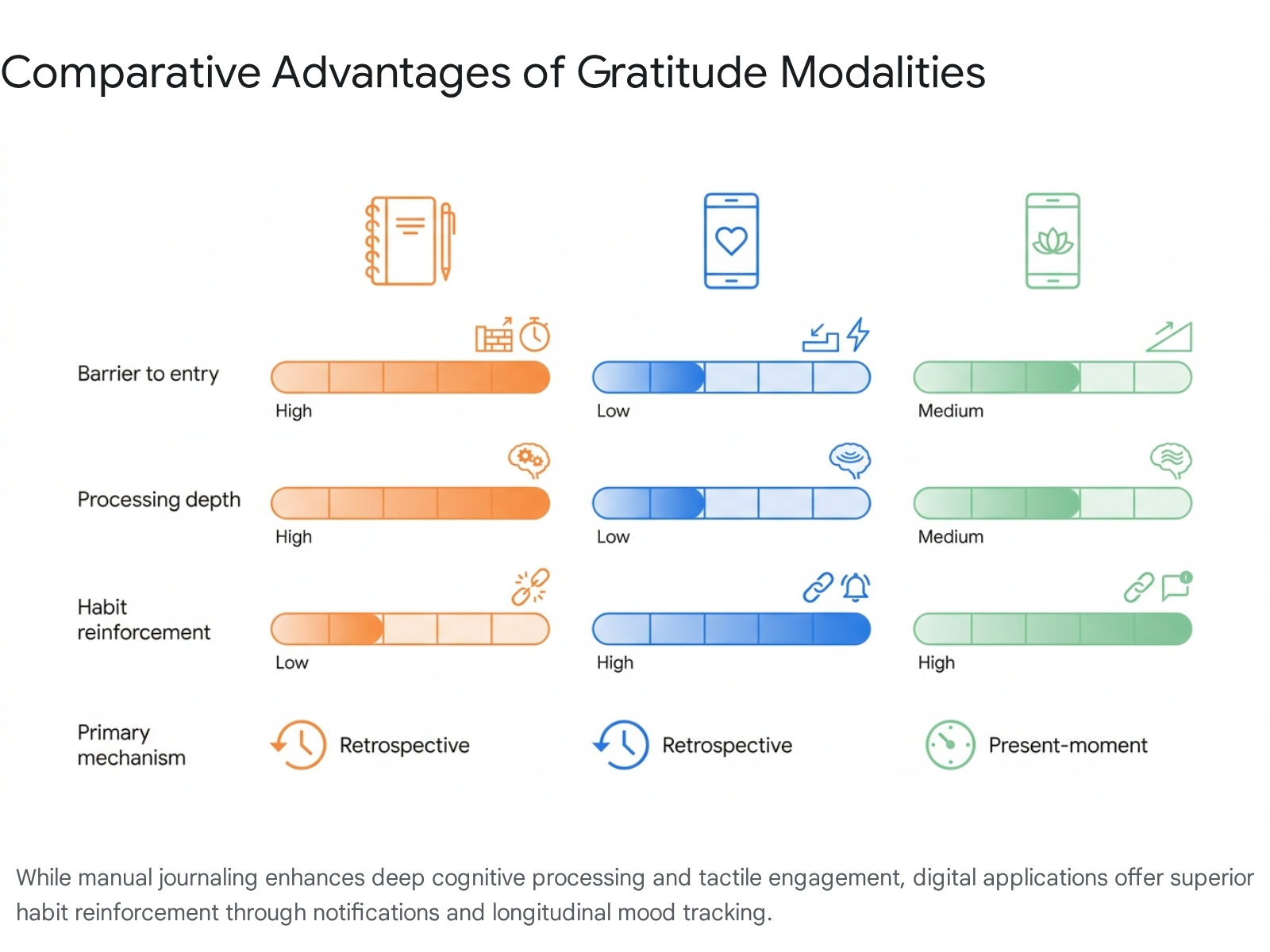
The empirical literature indicates that while these tools provide excellent frameworks for habit formation, the medium matters far less than the psychological mechanism 3. Head-to-head comparisons between analog and digital journaling reveal that both modalities demonstrate therapeutic effectiveness 4. Handwriting in a physical journal offers unique neurocognitive benefits, particularly increased mindful attention, decreased digital distraction, and a deeper cognitive processing of grateful experiences 34. The physical act of writing slows down thought processes, activating the prefrontal cortex and demanding a level of focused engagement that typing often bypasses.
Conversely, digital applications and mindfulness platforms excel in accessibility, behavioral reinforcement, and longitudinal tracking 45. Apps often employ gamification, automated push notifications, and structured prompts (such as morning intentions and evening reflections) that lower the barrier to entry and promote consistency 46. Furthermore, digital formats circumvent the "blank page syndrome" by utilizing guided reflection, which reduces the cognitive labor required to initiate a journaling session 3. Facing a blank notebook can sometimes feel like an administrative burden or cognitive labor for an exhausted individual, whereas an app prompting a user to simply list three good things requires minimal friction 37.
When comparing gratitude journaling apps to broader mindfulness and meditation apps (such as Calm or Headspace), the distinction lies in their temporal focus and cognitive demands. Mindfulness meditation trains immediate, present-moment awareness and physiological down-regulation, which can be highly effective for acute stress reduction but often requires significant mental effort and sustained attention - especially for beginners 35. Gratitude journaling, by contrast, operates on retrospective memory consolidation; it actively builds a cognitive archive of positive events 5. For individuals experiencing high cognitive depletion, dedicating five minutes to listing positive occurrences can be a highly sustainable entry point into daily mental health maintenance, offering similar stress-reduction benefits with arguably less initial resistance than seated meditation 89. Ultimately, the choice between a branded app, a premium notebook, or a scrap of paper should be dictated by personal lifestyle and adherence preferences, as the therapeutic superiority lies in the consistency of the habit, not the hardware 34.
Does Gratitude Journaling Actually Work? The Empirical Reality
The question of whether gratitude interventions "work" requires a precise definition of the desired outcome. If the goal is a modest, measurable increase in subjective well-being, positive affect, and life satisfaction, the empirical consensus is affirmative. By 2024, scores of psychological experiments had investigated gratitude interventions across diverse demographics - including students, healthcare practitioners, and clinical patients - with systematic reviews confirming their general efficacy 1.
The most comprehensive synthesis of this data to date is a 2025 meta-analysis published in the Proceedings of the National Academy of Sciences (PNAS) by Choi et al., which analyzed 145 studies encompassing 24,804 participants across 28 countries 2345. The study found that gratitude interventions yield a small, but statistically significant, overall increase in well-being, quantified by a Hedges' g effect size of 0.19 (95% CI [0.15, 0.22], P < 0.001) 2415.
To interpret this finding, an effect size of 0.19 is generally categorized as "small" in psychological research. However, the nuances of the data reveal specific areas where gratitude exercises excel. The interventions demonstrated varying effectiveness depending on the specific well-being metric being assessed, indicating that gratitude functions primarily as an enhancer of positive emotions rather than a robust shield against negative ones.
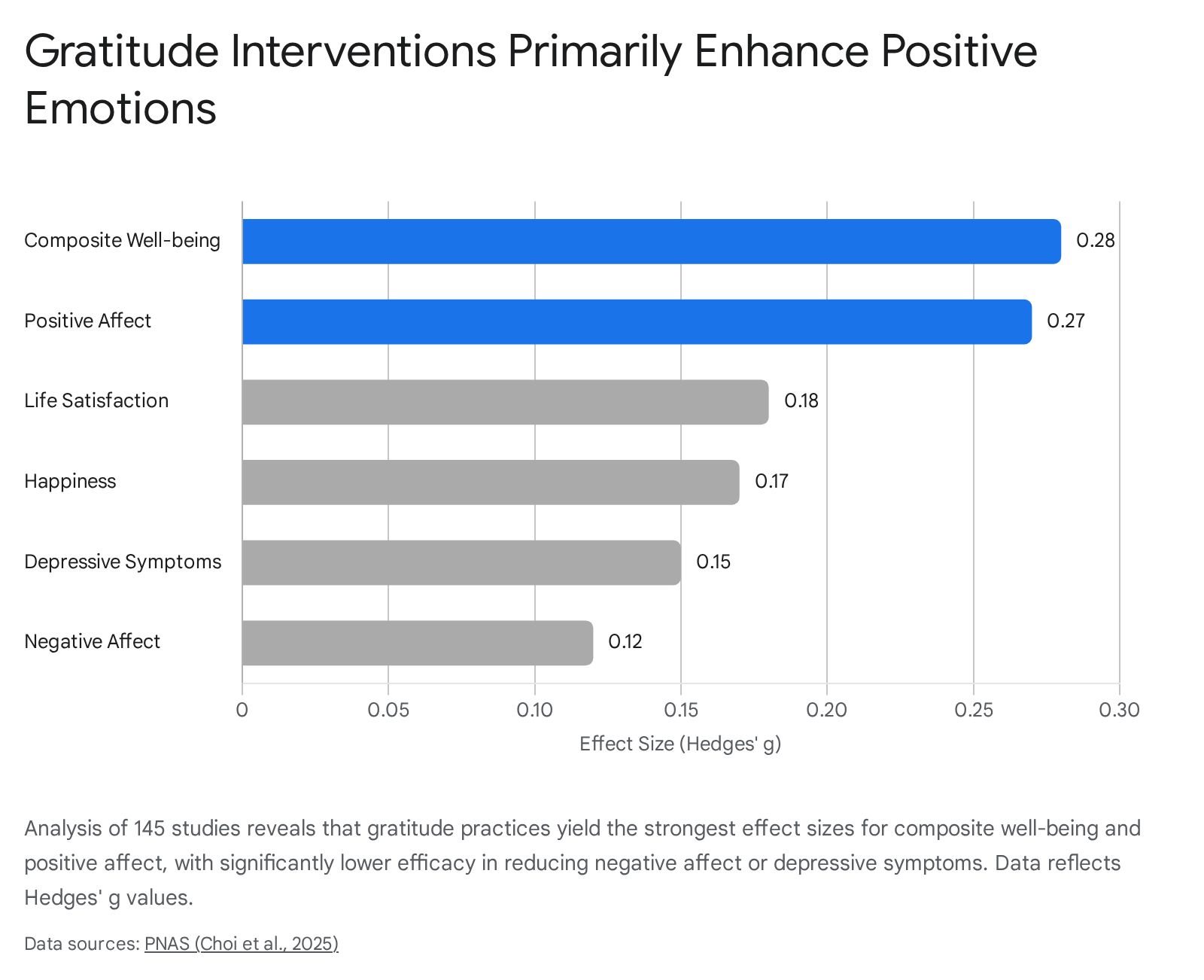
| Well-Being Outcome Measured | Hedges' g Effect Size | Implication |
|---|---|---|
| Composite Well-Being | 0.28 | Moderate enhancement when multiple positive psychological markers are combined. |
| Positive Affect | 0.27 | Strongest specific impact, actively generating feelings of joy, optimism, and alertness. |
| Life Satisfaction | 0.18 | Small positive shift in cognitive appraisal of one's overall life circumstances. |
| Happiness | 0.17 | Minor elevation in generalized subjective happiness. |
| Depressive Symptoms | 0.15 | Weak effect; insufficient as a primary intervention for clinical depression. |
| Negative Affect | 0.12 | Weakest impact; gratitude does little to actively suppress or eliminate existing negative emotions. |
Data sourced from the 2025 PNAS meta-analysis by Choi et al., analyzing 145 studies and 24,804 participants 2.
The efficacy of gratitude is also heavily influenced by the methodological design of the studies measuring it. When researchers compare gratitude journaling to a "measurement-only" control group (where participants do nothing and simply sit on a waitlist), the benefits appear pronounced 678. However, when compared to "active control" conditions - where participants engage in an alternative, emotionally neutral activity, such as writing about their daily class schedule or listing neutral life events - the unique therapeutic advantage of gratitude diminishes 7910. This suggests that simply engaging in a structured, reflective, and distraction-free cognitive task accounts for a considerable portion of the observed psychological benefits 7.
Contrasting Evidence Against Wellness Hype: Clinical Depression vs. Mood Boost
The commercial wellness sector has frequently co-opted preliminary positive psychology research, amplifying small effect sizes into sweeping claims of miraculous healing. Across social media platforms, lifestyle influencers promote gratitude journals and mindful living as potent interventions capable of "curing" clinical depression, alleviating severe anxiety, or entirely restructuring human health 21111224.
The scale of health misinformation in the wellness space is staggering. A 2025 study led by the University of Sydney, published in JAMA Network Open, analyzed nearly 1,000 posts from social media influencers reaching almost 200 million followers, finding that the vast majority of medical and wellness claims were "overwhelmingly misleading" and failed to mention potential harms or rely on scientific evidence 11. Similarly, a 2023 study from Macquarie University published in Health Promotion Perspectives examined popular health influencers, discovering that only 49% of their claims had any evidentiary backing, and a mere 10% were supported by high-quality evidence such as randomized controlled trials 13. Strikingly, the researchers noted that when influencers did cite rigorous scientific papers, their engagement rates plummeted, incentivizing the continuous promotion of sensationalized, cure-all narratives over nuanced scientific truth 13. In more egregious cases, influencers have been found attaching completely unrelated or fabricated PubMed identification numbers (PMIDs) to their posts, creating a false veneer of scientific credibility to sell wellness products and protocols 21.
When evaluating the specific impact of gratitude on clinical populations, the scientific evidence presents a stark contrast to this wellness hype. The data requires a nuanced distinction between experiencing a temporary mood boost in a healthy population and achieving clinical remission from major depressive disorder (MDD) or generalized anxiety disorder (GAD).
On the optimistic side of the literature, some meta-analyses suggest supplementary benefits. A 2022/2023 systematic review and meta-analysis published in Einstein (Sao Paulo) evaluated 64 randomized clinical trials 261415. For patients exhibiting anxiety symptoms (measured via the GAD-7), gratitude interventions resulted in a 7.76% lower symptom score compared to control groups 2616. Similarly, for depressive symptoms (measured via the PHQ-9), gratitude interventions yielded a 6.89% symptom reduction 2616. The authors concluded that acts of gratitude can serve as a viable therapeutic complement, functioning alongside established medical protocols to minimize psychiatric illness, though they acknowledged the effect sizes remain small compared to primary medical therapies 2616.
However, rigorous counter-evidence suggests that enthusiasm for gratitude as a clinical intervention should be heavily tempered. A highly cited meta-analysis conducted by researchers at Ohio State University (Cregg & Cheavens) examined 27 studies focusing specifically on symptoms of depression and anxiety, analyzing 3,675 participants 71017. They found that gratitude interventions exerted only a "small effect" on depression and anxiety at post-test (Hedges' g = -0.29) and at follow-up (g = -0.23) 731. Crucially, when gratitude exercises were compared to active control conditions rather than waitlists, the difference in symptom relief was trivial 731. The gratitude interventions were not significantly better at relieving clinical distress than seemingly unrelated cognitive activities 717.
The clinical reality is that while expressing gratitude has intrinsic virtue and is linked to a lower baseline incidence of mental health issues, deploying it as a primary intervention for individuals already in the throes of a depressive episode is largely ineffective 1017. The cognitive load and emotional exhaustion inherent in clinical depression often make it exceedingly difficult for individuals to fully enact and internalize positive reframing 1017. Consequently, psychologists strongly advise pursuing treatments with robust evidence of efficacy - such as Cognitive Behavioral Therapy (CBT) and pharmacological interventions - for clinical disorders, relegating gratitude journaling to the role of a supplementary lifestyle habit rather than a standalone cure 71017.
The Psychological and Neural Mechanisms of Gratitude
Understanding why a simple written exercise can yield measurable changes in human affect requires examining the neurobiological foundations of gratitude. The mechanisms underlying these benefits are not merely the result of superficial positive thinking; they involve a sophisticated orchestration across reward processing centers, emotional regulation networks, and physiological stress response systems 418.
Functional magnetic resonance imaging (fMRI) studies demonstrate that engaging in structured gratitude practices induces synchronized activation across multiple brain regions, most notably the medial prefrontal cortex (mPFC) and the anterior cingulate cortex (ACC) 4. The mPFC is essential for moral cognition, value judgments, and the processing of social reward 4. When an individual consciously reflects on a positive aspect of their life or an act of kindness received from another, the mPFC synthesizes these appraisals, helping the brain encode the event with high emotional valence 418. Simultaneously, the ACC contributes to emotional regulation, empathy, and perspective-taking, bridging the cognitive recognition of a positive event with the physiological sensation of appreciation 4.
At a neurochemical level, the deliberate practice of gratitude stimulates the production of key neurotransmitters, primarily dopamine and serotonin 19. Dopamine, the brain's primary reward chemical, provides an immediate feeling of pleasure and reinforces the behavior, increasing the likelihood that the individual will seek out positive interactions in the future 19. Serotonin enhances mood stabilization, calmness, and overall well-being 19. Furthermore, expressing appreciation to others has been shown to release oxytocin, a neuropeptide that expands blood vessels, reduces blood pressure, protects cardiovascular health, and deepens interpersonal connection and trust 19.
Gratitude also exerts a profound regulatory effect on the autonomic nervous system. Individuals engaged in regular gratitude practices demonstrate reduced levels of cortisol (the primary stress hormone) and a down-regulation of the sympathetic nervous system's "fight or flight" response 1934. This physiological shift toward parasympathetic dominance not only reduces feelings of subjective anxiety but also yields measurable improvements in peripheral biomarkers, such as reduced cellular inflammation and improved cardiovascular functioning 1920.
Another vital mechanism is the improvement of sleep architecture. Research indicates that gratitude interventions, particularly when performed in the evening, significantly enhance sleep quality by reducing pre-sleep cognitive arousal 36. By actively focusing on positive events, practitioners interrupt the cycle of rumination - habitually replaying past mistakes and worrying about future threats - which is a primary hindrance to sleep onset 36. Over time, the repeated activation of these neural and physiological pathways induces neuroplasticity; the brain literally reshapes its synaptic architecture, making it easier for the individual to default to a grateful, positive cognitive schema in the face of future stressors, rather than defaulting to the brain's evolutionary negativity bias 42419.
Cross-Cultural and Non-Western Perspectives
A significant limitation in early positive psychology research was its heavy reliance on Western, Educated, Industrialized, Rich, and Democratic (WEIRD) populations, raising critical questions about whether gratitude interventions are universally applicable or culturally bound 37. The 2025 PNAS meta-analysis by Choi et al. provided a much-needed multinational megastudy, drawing data from 145 studies across 28 countries to assess cross-cultural variability 23.
The findings revealed significant between-country differences in the effectiveness of gratitude practices. Interventions were highly effective in promoting well-being in several non-Western and European regions, while showing negligible effects in others.
| Country | Hedges' g Effect Size | Statistical Significance |
|---|---|---|
| Hong Kong | 0.60 | Highly Significant |
| Spain | 0.49 | Highly Significant |
| Malaysia | 0.43 | Highly Significant |
| China | 0.36 | Significant |
| South Korea | 0.34 | Significant |
| Germany | 0.26 | Significant |
| United States | 0.14 | Significant (but comparatively low) |
| France | 0.09 | Not Significant |
| Japan | 0.04 | Not Significant |
Data derived from Choi et al. (2025) highlighting cross-cultural variability in gratitude intervention efficacy 2. Note that effects in countries like India (g=0.18), the UK (g=0.19), and the Netherlands (g=0.23) also failed to reach statistical significance thresholds in this specific meta-analysis 2.
Interestingly, the researchers found that traditional macro-level cultural variables - such as individualism versus collectivism, cultural tightness, GDP per capita, and dominant religion - did not adequately explain or moderate these cross-cultural variances 2.
However, specific cultural nuances regarding social obligation play a critical role in intervention design and outcomes. For example, among Asian populations, the specific exercise of "expressing gratitude to others" (such as writing and delivering a gratitude letter to a benefactor) frequently failed to yield statistically significant well-being improvements, producing a weak effect size (g = 0.14, P = 0.106) 2. Researchers hypothesize that in highly relational or hierarchical cultures, explicitly acknowledging a benefactor's sacrifice can inadvertently elicit negative moral emotions, such as indebtedness, guilt, or the heavy burden of reciprocity, thereby neutralizing the intended positive affect 12. In these contexts, gratitude is deeply intertwined with social obligation rather than purely individualistic joy. This underscores the necessity for culturally tailored interventions - such as focusing on intrapersonal reflection (e.g., private journaling or mental subtraction) rather than interpersonal expression in certain demographics - rather than employing a monolithic "one-size-fits-all" approach to global wellness 2.
How Often Should I Practice It? The Science of Dosage
A common misconception perpetuated by the productivity and wellness industries is that if a practice is beneficial, doing it daily is inherently superior. However, psychological research regarding the dosage and temporal frequency of gratitude interventions paints a more complex picture, heavily influenced by the phenomenon of hedonic adaptation.
Hedonic adaptation - often referred to as the hedonic treadmill - is the human tendency to rapidly acclimate to consistent stimuli, whether positive or negative 3839. When individuals count their blessings every single day in the exact same format, the cognitive novelty of the exercise diminishes. Over time, the brain habituates to the practice, transforming an emotionally resonant exercise of deep reflection into a rote, administrative checklist 3940.
This dynamic was highlighted in seminal positive psychology studies by Sonja Lyubomirsky and colleagues, which compared participants who wrote in a gratitude journal once a week versus those who journaled three times a week. Counterintuitively, the cohort that practiced gratitude only once a week reported significantly greater improvements in well-being than the group practicing three times a week 93940. For the high-frequency group, well-being actually decreased over time, suggesting that over-practicing can induce fatigue, make the activity feel burdensome, and ultimately accelerate hedonic adaptation, causing the individual to become numb to the benefits of counting their blessings 93940.
Therefore, the optimal frequency depends entirely on the specific intervention and the practitioner's baseline. The highly validated "Three Good Things" exercise (detailed below) is often prescribed as a daily practice for an initial, intensive sprint of one to two weeks to establish neuroplastic changes and alter the practitioner's cognitive baseline 43841. Following this initial period, researchers recommend a reduction to a maintenance phase of three to four times a week to sustain the benefits without triggering habituation 441. For broader, less structured journaling practices, engaging deeply in a weekly reflection session often yields more sustainable and meaningful emotional shifts than forcing daily, shallow entries 94042.
Can Forced Gratitude Be Harmful? The Backfire Effect
Despite its widespread promotion as a universally benign and universally applicable practice, gratitude interventions carry potential psychological risks. The wellness industry's insistence on mandatory optimism has given rise to the phenomenon of "toxic positivity" - the overgeneralization of a happy, optimistic state that results in the denial, minimization, and invalidation of authentic human emotional experience 24.
When gratitude is forced, particularly during periods of acute distress, grief, or systemic burnout, it often acts as a mechanism for emotional suppression 24. For instance, corporate wellness programs that encourage gratitude journaling while refusing to address systemic issues like poor management or inadequate compensation are weaponizing gratitude to silence legitimate grievances 24. Telling an exploited or burned-out employee to "be grateful they have a job in this economy" is not a therapeutic intervention; it is "gratitude shaming" 24. This dynamic leads to severe cognitive dissonance and spiritual bypassing, wherein individuals use forced positivity to avoid confronting uncomfortable truths, ultimately increasing the instability of the mind 24.
Furthermore, clinical research identifies a distinct and measurable "backfire effect" among individuals with low self-esteem or severe clinical depression 2043. Depressed individuals possess a rigid cognitive bias toward negative interpretations and often struggle to update these interpretations even when presented with positive stimuli 43. If forced to identify things they are grateful for during a severe depressive episode, a clinically depressed individual may draw a blank. This failure to perform the exercise inadvertently reinforces their feelings of worthlessness, hopelessness, or the belief that their life is entirely devoid of value 43. Alternatively, if they are instructed to write a gratitude letter to a benefactor, they may experience overwhelming feelings of indebtedness, guilt, and inadequacy, feeling incapable of ever repaying the perceived kindness 120. Because depressed individuals are more sensitive to feelings of guilt and burden, interventions that elicit indebtedness can cause the therapy to actively backfire, worsening their psychological state 20.
The Alternative: Counterfactual Gratitude
To mitigate these risks, particularly for individuals experiencing hardship, some practitioners and researchers advocate for "counterfactual gratitude" (or mental subtraction) 2444. Rather than forcing a positive appraisal of a negative situation, counterfactual gratitude involves expressing appreciation for the absence of specific hardships or visualizing how a situation could be worse 4421. For example, rather than an athlete forcing gratitude for an injury, they might practice counterfactual gratitude that their body still allows them to walk, or an individual might express gratitude that they do not have to worry about living in a war zone 44. This approach provides perspective and grounds the individual without forcing them to artificially manufacture positive emotions about their current, valid distress, acknowledging reality while fostering a gentler, more accessible form of appreciation 244421.
Practical Takeaways Based on Mixed or Weak Evidence
Given the mixed evidence regarding clinical applications and the high variability in cross-cultural efficacy, applying gratitude research to daily life requires a pragmatic approach. While gratitude is not a cure for clinical depression, it remains a highly effective, low-cost tool for psychological maintenance in non-clinical populations.
To maximize benefits, individuals should diversify their gratitude portfolio to prevent hedonic adaptation. Instead of exclusively relying on traditional journaling, practitioners can rotate through different modalities - such as mental subtraction, gratitude letters, or savoring walks - to keep the cognitive processing novel and engaging 4146. Furthermore, practitioners should abandon the pressure of daily perfection; missing a day of journaling does not negate the benefits, and transitioning to a weekly, deeper reflection may actually yield superior long-term results 3440. Finally, individuals must allow for emotional authenticity. If a gratitude practice feels forced, induces guilt, or serves as a distraction from necessary problem-solving, it should be paused in favor of addressing the root cause of the distress.
Comparing Gratitude Practices
Decades of positive psychology research have validated several distinct methodologies for cultivating gratitude. The following table synthesizes the most prominent interventions, detailing their execution, time commitment, and empirical strength.
| Gratitude Practice | Description & Methodology | Recommended Frequency & Time | Evidence & Clinical Nuance |
|---|---|---|---|
| Three Good Things | Writing down three specific positive events from the day and reflecting on why they occurred. Moves focus from mere appreciation to causal attribution. | Daily for 1 - 2 weeks, then 3x weekly for maintenance. Takes ~10 minutes. | Strong. Proven to increase happiness and decrease depressive symptoms for up to 6 months post-intervention in healthy populations 384041. |
| Gratitude Letter | Writing a detailed letter of thanks to a benefactor who has never been properly thanked, optimally delivered and read in person. | As needed, or monthly. Takes 15 - 30 minutes to write; additional time for delivery. | Strong but contextual. Produces the largest immediate, short-term boost in well-being of any PPI, but can trigger indebtedness or guilt in some cultural contexts (e.g., Asian populations) 2203647. |
| Mental Subtraction | Counterfactual thinking: vividly imagining life without a specific positive event, achievement, or important relationship, recognizing its absence to deepen appreciation. | Once a week, focusing on a different event or person. Takes ~15 minutes. | Moderate-Strong. Highly effective at counteracting hedonic adaptation. Prevents habituation better than standard listing by utilizing negative contrast 41212249. |
| Counting Blessings | Standard gratitude journaling. Listing 3-5 things one is thankful for (events, health, people) without deep causal analysis. | Once a week. Takes 5-10 minutes. | Moderate. Effective for baseline well-being, but highly prone to habituation if done daily. Shows trivial effects against active control groups in clinical anxiety/depression 7940. |
Bottom Line
The scientific consensus supports gratitude as a valuable, low-cost tool for enhancing psychological resilience and overall well-being, yet it requires a pragmatic approach stripped of commercial wellness hyperbole. Whether executed in a premium app or on a basic notepad, the cognitive shift achieved through practices like "Three Good Things" or "Mental Subtraction" can measurably improve positive affect, reduce physiological stress, and reshape neural pathways over time. However, the evidence remains weak regarding its efficacy as a primary treatment for clinical depression or anxiety, and forcing gratitude during acute distress can actively backfire. Individuals should approach gratitude not as a medical panacea or an exercise in toxic positivity, but as an intentional, sustainable habit - practiced a few times a week - designed to broaden perspective and consolidate positive life experiences.