
What the Science Says About Awe and Well-Being
Awe is a profound psychological and physiological response to vastness that transcends our current understanding of the world. Recent clinical research maps this distinct emotion directly to measurable improvements in physical and mental health, including reduced inflammation, lowered depression, and enhanced social connectedness. Cultivating brief, everyday moments of wonder offers an accessible, evidence-based intervention for bolstering human resilience, provided the emotion is experienced safely rather than as a threat.
The Anatomy of Awe: Defining the Ineffable
For centuries, the experience of awe was primarily the domain of philosophers, poets, and theologians, often associated exclusively with religious reverence or the terrifying sublime of untamed nature. However, over the past two decades, psychological science has operationalized awe, transforming it from an ineffable mystery into a measurable, distinct emotion with profound implications for human health.
The modern scientific understanding of awe largely stems from foundational work published in 2003, which established two core cognitive appraisals required to trigger the emotion. The first is "vastness," which refers to encountering something that is physically or conceptually larger than the self. Vastness can be perceptual, such as standing at the edge of the Grand Canyon, or conceptual, such as grasping the mathematical complexity of the universe or the concept of infinity 1234. The second required appraisal is a "need for accommodation." When an individual encounters immense vastness, their existing mental schemas - the cognitive frameworks they use to understand the world - prove inadequate. The mind is forced to accommodate or update its belief systems to process the new, overwhelming information 123.
During this middle-suspended moment of cognitive uncertainty, where assimilation fails but accommodation has not yet taken place, the emotion of awe arises 2. This transformative process has been recently formalized into a Cognitive Behavioural Model of Awe. Following a 2024 systematic review of 57 distinct empirical studies, researchers outlined how the cognitive appraisal of vastness acts as an activating stimulus that directly drives a cascade of subsequent emotional, physiological, and behavioral responses 164. Because awe requires the brain to process new paradigms, it is frequently categorized alongside curiosity and surprise as an "epistemic emotion" - an emotion inherently tied to acquiring new knowledge and expanding one's understanding of reality 16.
Measuring the Unmeasurable: The Awe-SM and Beyond
To study awe rigorously in clinical and naturalistic settings, researchers have spent years developing validated psychometric tools. Initially, scientists utilized broad emotion scales that captured general positive affect, but the complexity of awe necessitated specialized instruments. Weidman and colleagues highlighted that relying on dispositional perspectives - simply asking people if they are prone to feeling awe in general - failed to capture the immediate, somatic reality of the emotion 5.
This realization led to the development of the Awe Experience Scale (AWE-S), a robust state measure designed to evaluate the multidimensional nature of awe. Exploratory and confirmatory factor analyses revealed that the AWE-S captures six distinct factors of the awe experience: altered time perception, self-diminishment, connectedness, perceived vastness, physical sensations, and the need for accommodation 296. While highly accurate, the AWE-S is lengthy and often triggers "respondent burden" - a phenomenon where survey fatigue leads to data degradation, particularly in field studies or momentary ecological assessments 7.
Recognizing the need for rapid assessment in naturalistic settings, such as when evaluating visitor experiences at museums, during nature walks, or in clinical therapy, researchers developed the Awe Short Measure (Awe-SM) in 2025. Validated across multiple cohorts, the Awe-SM development began with an exploratory factor analysis of 246 participants, resulting in a concise nine-item solution. A subsequent confirmatory factor analysis with 576 participants solidified its validity 8. The Awe-SM efficiently isolates the three most critical components of state awe.
| Awe-SM Factor | Psychological Definition | Behavioral Indicator |
|---|---|---|
| Connectedness | A feeling of deep integration with the external world, humanity, or the surrounding environment. | Increased desire to help others; viewing the self as part of a larger collective entity. |
| Absorption | Being entirely cognitively engaged and captivated by the present moment, losing track of mundane concerns. | Altered perception of time; hyper-focus on the activating stimulus. |
| Perception | The sensory and conceptual recognition of vastness and physical or cognitive expansion. | Recognizing patterns, scale, or beauty that exceed normal daily parameters. |
Table 1: The three primary factors of the Awe Short Measure (Awe-SM), validated in 2025 to capture the immediate experience of awe in field settings 8.
By utilizing refined tools like the Awe-SM, scientists can now draw highly accurate, direct correlations between brief moments of wonder and long-term changes in psychological health.
The Eight Wonders of Life: Triggers of Everyday Awe
A common misconception is that awe requires a monumental, once-in-a-lifetime event, such as a solar eclipse, a life-changing religious pilgrimage, or witnessing a devastating natural disaster. While those certainly qualify, extensive cross-cultural research reveals that awe is highly accessible in daily life and triggered by remarkably common stimuli.
Following a major study involving the translation of over 2,600 personal narratives of awe gathered from 26 different languages, researcher Dacher Keltner identified what he termed the "Eight Wonders of Life." These represent the primary categories of stimuli that trigger awe across the global human population, bypassing cultural and geographical boundaries 41314.
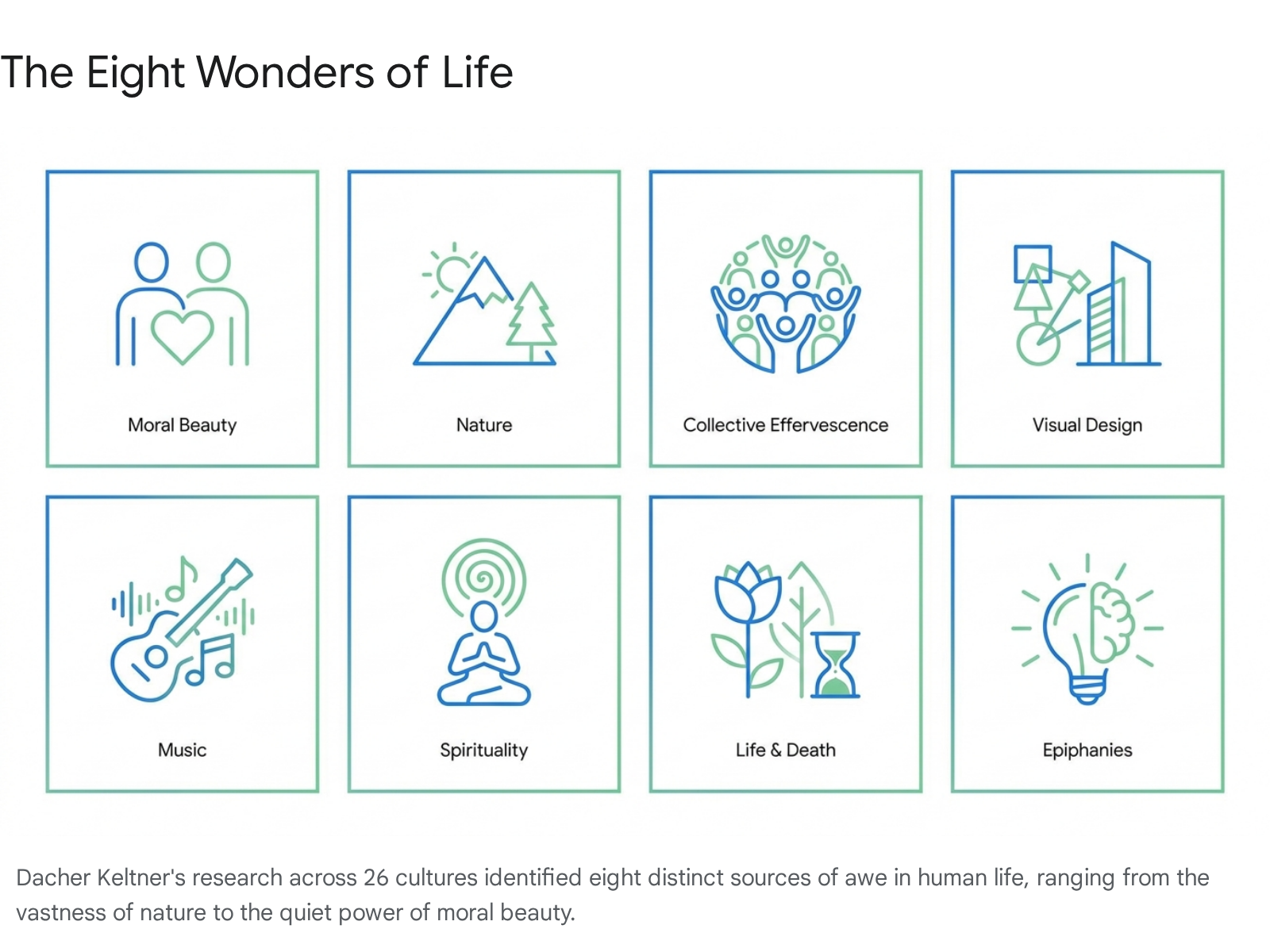
Surprisingly, the most common trigger for awe globally is not the grandeur of nature, but the phenomenon of moral beauty. This occurs when witnessing the extreme courage, kindness, physical strength, or profound overcoming of other people. Seeing a stranger perform a selfless act of rescue or watching an individual persevere through immense personal adversity triggers a profound sense of awe that elevates the observer 34139. Following closely is nature, encompassing the physical majesty of the biosphere, from a towering redwood forest to a simple, vibrant sunset observed from a city window 34.
Awe is also highly prevalent in group settings through a mechanism known as collective effervescence. A term originally coined by the French sociologist Émile Durkheim, this refers to the shared, electric energy felt when moving or vocalizing in unison with a large group of people. It is a state commonly experienced at symphonic concerts, massive sporting events, coordinated dance floors, or passionate political marches 3414. Similarly, human creations inspire wonder through visual design and music. The awe inspired by human-made creations encompasses towering architecture, intricate paintings, and stunning visual arts, while music elicits a profound emotional and physiological response, often accompanied by aesthetic chills, through powerful symphonies, hymns, or melodic arrangements 3414.
The final three wonders venture into the abstract and existential. Spiritual and religious encounters - such as mystical experiences, deep meditation, silent prayer, or a profound sense of connection to a higher power - are potent sources of awe 3414. The visceral wonder of life and death, felt when witnessing the birth of a child or the peaceful passing of a loved one, highlights the fragile and mysterious boundary of human existence 341416. Finally, epiphanies - the sudden cognitive realization or the grasping of a grand philosophical or scientific truth - trigger the same vastness and need for accommodation found when staring into the Grand Canyon 3414.
The Neurobiology of Wonder: What Happens in the Brain and Body
When an individual experiences awe, the effects are not limited to a fleeting psychological state; they manifest deeply within the body's autonomic and central nervous systems. The physiological profile of awe is highly distinct from other positive emotions like joy, amusement, or simple contentment, marking it as a unique pathway to physical health.
The Small Self and the Default Mode Network
One of the most profound psychological effects of awe is the induction of the "small self." Awe actively shifts human attention away from individual, ego-driven concerns, anxieties, and mundane stressors, redirecting focus toward the broader environment and collective humanity 1710. When people feel awe, they subjectively rate their own presence as smaller and less significant, yet ironically feel more connected to the world around them.
Neuroscientific research supports this psychological phenomenon. Experiences of awe are directly associated with reduced activation in the Default Mode Network (DMN), a complex network of interacting brain regions tightly linked to self-reflection, mind-wandering, rumination, and ego-centric thinking 911. When the DMN quiets down, the relentless internal loop of self-criticism, future-oriented anxiety, and past-oriented regret tends to fade. This creates a mental environment highly conducive to profound inner calm and reduces the cognitive patterns that maintain depressive symptoms 917.
Vagal Tone, Interleukin-6, and the Parasympathetic Shift
Awe exerts a unique and measurable influence on the autonomic nervous system. Unlike high-arousal states of manic excitement, enthusiasm, or fear, typical experiences of positive awe are characterized by an elevated "vagal tone" 91112. The vagus nerve is the primary neural component of the parasympathetic nervous system, which is responsible for the body's "rest and digest" and cellular recovery functions. High vagal tone is a primary indicator of robust emotional regulation, social engagement capability, lowered resting heart rate, and overall cardiovascular health 911.
Simultaneously, the experience of awe has been biologically linked to a reduction in systemic inflammation. In comprehensive studies comparing various positive emotions, dispositional awe (the tendency to frequently experience awe) was the most robust predictor of lower levels of interleukin-6 (IL-6), a primary pro-inflammatory cytokine 9212213. Chronic elevation of IL-6 is widely associated with an increased risk of autoimmune diseases, cardiovascular problems, and major depression 9. The emerging scientific consensus that regular experiences of wonder can act as a natural anti-inflammatory intervention presents a compelling new frontier in mind-body medicine 922.
The Paradox of Aesthetic Chills
A fascinating physiological quirk of the awe experience is the sensation of chills or goosebumps, clinically known as piloerection. While goosebumps are generally associated with physical cold or intense fear, the "aesthetic chills" experienced during awe - such as when listening to an emotionally resonant piece of music or witnessing a breathtaking vista - represent a highly unique psychophysiological state.
Researchers theorize that these aesthetic chills reflect a brief, intense spike in sympathetic nervous system arousal that occurs simultaneously within a broader, overarching context of parasympathetic calming 91112. This state of "sympathovagal interplay" suggests that awe is not merely relaxation, but a state of hyper-aware physiological activation that paradoxically feels entirely safe and soothing 11.
The Dangers of the Sublime: Positive Versus Threat-Based Awe
While the physiological and psychological benefits of awe are vast, the specific context and cognitive appraisal of the event dictate whether the experience is ultimately healing or harmful. Awe is not uniformly positive. Researchers increasingly delineate between "positive awe" and "threat-based awe," noting that the modern psychological definition of the emotion must account for its darker, historical roots in dread and terror 92414.
Positive awe is triggered by non-threatening stimuli - a magnificent sunrise, a masterful symphony, or witnessing an act of immense moral courage. It yields all the benefits previously discussed: increased vagal tone, reduced inflammation, deactivation of the DMN, and significantly enhanced subjective well-being 914.
Threat-based awe, conversely, is triggered by vast, incomprehensible phenomena that pose a direct or existential danger to the observer's safety. Examples include witnessing a terrifying tornado, experiencing a violent societal collapse, surviving an earthquake, or facing what is perceived as a wrathful, omnipotent deity 914. When a threat appraisal is salient, the physiological profile of awe shifts dramatically. Instead of parasympathetic calm, threat-based awe yields the mind-and-body profile of chronic stress and trauma, driven by acute sympathetic nervous system activation 912.
| Feature | Positive Awe | Threat-Based Awe |
|---|---|---|
| Common Triggers | Nature vistas, moral beauty, music, art, scientific epiphanies. | Natural disasters, violent collective events, extreme weather, wrathful deities. |
| Primary Emotions | Reverence, wonder, joy, deep compassion, calmness. | Fear, powerlessness, dread, acute anxiety, panic. |
| Autonomic Response | Increased vagal tone (parasympathetic dominance), lowered resting heart rate. | Sympathetic nervous system activation (fight or flight response), elevated heart rate. |
| Neural Activity | Deactivation of the Default Mode Network, reduced self-focus. | Diverging activity; heightened activation of amygdala and threat-detection centers. |
| Well-Being Impact | Highly beneficial; reduces depression, anxiety, and systemic inflammation. | Minimal to no well-being benefits; high potential for psychological distress and trauma. |
| Prosocial Effect | Increases generosity, charitable intent, and social integration. | Lower effects on prosociality; potential for behavioral withdrawal and isolation. |
Table 2: The distinct physiological and psychological differences between positive awe and threat-based awe. The mental health benefits of awe rely entirely on the absence of a threat appraisal 9122414.
Mediation analyses have revealed that the positive relationship between awe and well-being is strongly mediated by a feeling of nature connectedness or social integration 24. However, during threat-based awe, the primary psychological mediator is a profound sense of powerlessness, which negates any potential uplift in mood 24. In clinical, architectural, or therapeutic applications, it is vital to ensure that awe interventions focus strictly on safe, positive awe, as inducing threat-based awe can exacerbate anxiety and physical health issues 926.
Clinical Applications: Awe as a Targeted Intervention
With the physiological mechanisms of the emotion clearly mapped, researchers have moved beyond cross-sectional, observational studies to active interventions. The core scientific question has shifted to whether "dosing" people with awe can actively treat chronic psychological distress, loneliness, and clinical depression. Recent randomized controlled clinical trials suggest the answer is decidedly yes.
The Long COVID Clinical Trial
One of the most robust demonstrations of awe as a direct clinical intervention emerged from a 2025 study focused on patients suffering from long COVID. Individuals with post-acute sequelae of SARS-CoV-2 infection frequently experience sustained, debilitating psychological distress, including persistent depression, generalized anxiety, and brain fog, long after their acute physical symptoms have resolved 152816.
Researchers conducted a randomized controlled clinical trial involving 68 patients who met the official diagnostic criteria for long COVID 16. The intervention group (N = 30) participated in brief, synchronous online sessions specifically designed to cultivate awe, while the control group (N = 38) continued their standard daily routines 1528.
The results were striking and statistically significant. The awe intervention group experienced dramatic reductions in clinical depression symptoms compared to the control group. Furthermore, the intervention resulted in significant decreases in overall life stress and a corresponding improvement in general psychological well-being 28.
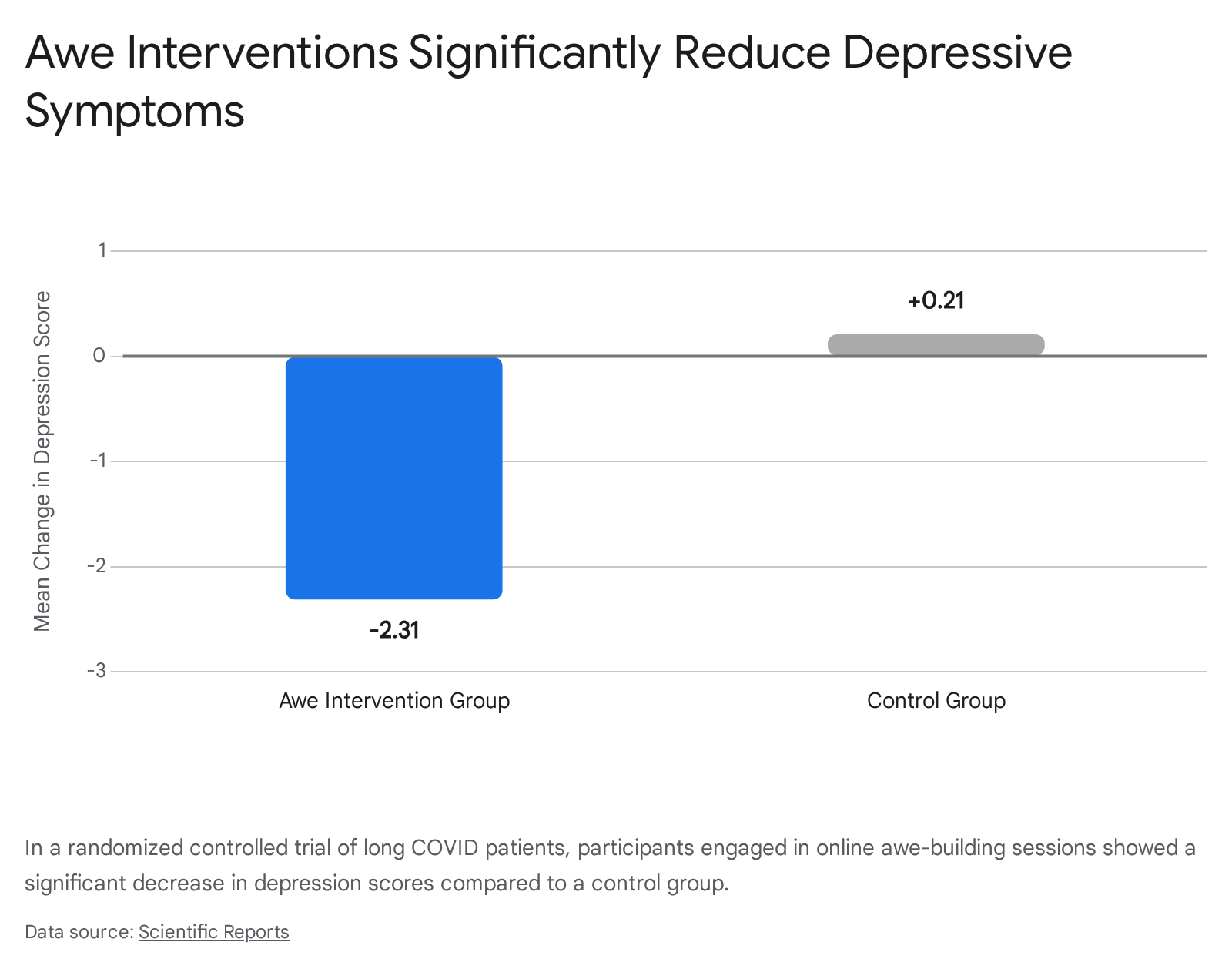
The effect sizes measured in the study were large, ranging from $d = 0.78$ to $0.96$. This level of efficacy demonstrates a robustness rarely seen in such brief, low-cost psychological interventions 152830. Interestingly, researchers found no significant differences between the two groups regarding generalized anxiety symptoms. This nuance suggests that while awe is highly effective at targeting the rumination, lack of purpose, and hopelessness characteristic of depression, it may be less effective at immediately mitigating hyper-vigilant anxiety states 2816. The study highlighted that the influence of awe on stress and well-being operates independently of just feeling generally "happy," isolating awe as a unique therapeutic asset 1613.
The Awe Walk and Healthy Aging
For healthy older adults facing the natural psychological challenges of aging - such as increased isolation, mobility loss, and a general decline in positive affect - awe has proven equally beneficial. In a landmark 2020 study out of the University of California, San Francisco (UCSF), neuroscientists assigned 60 healthy older adults (with a median age of 75) to take weekly 15-minute outdoor walks for eight weeks 313233.
Half the participants were explicitly instructed to approach their walks with an "awe mindset." They were asked to intentionally shift their focus outward, looking for things in their environment that were vast, unexpected, or beautiful. The control group was simply told to walk outside for exercise 3317.
Researchers tracked the emotional states of the participants using daily surveys and an innovative metric: the "selfie." Participants were required to take a self-portrait on their walk each week. Over the eight-week period, the awe walkers exhibited an increasingly "small self" in their photographs - they physically took up less space in the camera frame, allowing the background landscape to dominate the picture 171735. Furthermore, independent analysts who coded the photos found that the smile intensity of the awe walkers increased progressively throughout the duration of the study 1735.
The control group actually walked more frequently during the study period, likely assuming the research was entirely focused on physical fitness. However, without the intentional psychological shift toward an awe mindset, they did not experience the same emotional benefits. The awe group reported significantly less daily distress, increased joy, and a noticeable surge in prosocial emotions like gratitude, admiration, and compassion 331718.
Virtual Reality and Nature-Based Interventions
Because awe is historically difficult to summon on demand in a sterile laboratory setting, researchers have increasingly turned to immersive technologies and structured outdoor programs. Comprehensive evidence maps analyzing Nature-Based Interventions (NBIs) for the elderly demonstrate that activities like forest bathing, therapeutic gardens, and nature walks reliably improve both cardiovascular markers and mental health outcomes 3719.
However, for populations unable to access the outdoors - such as bedridden hospital patients or those in severe physical decline - virtual reality presents a breakthrough. Systematic evidence shows that Virtual Reality Environments (VREs) designed to induce perceptual vastness successfully replicate the psychological benefits of in-person awe 2620. When users are exposed to immersive, 360-degree simulations of deep space, underwater ecosystems, or grand architecture, they report significantly higher levels of state awe, a deep sense of physical presence, and predominantly positive affect compared to neutral virtual environments 9620. This opens highly promising avenues to deliver the therapeutic benefits of awe to isolated individuals without them needing to leave their clinical settings.
The Social Ripple Effect: Does Awe Make Us Better People?
The psychological phenomenon of the "small self" does significantly more than reduce an individual's stress levels; it acts as a potent social glue. By diminishing ego-centric concerns and minimizing narcissistic tendencies, awe naturally expands an individual's circle of moral concern, integrating them more deeply into social collectives 171040.
Extensive behavioral research demonstrates that individuals experiencing state awe - or those who naturally possess a high dispositional trait for awe - are significantly more likely to engage in prosocial behaviors. They tend to be more generous in economic sharing games, are more willing to volunteer their time to charities, and display higher baseline levels of cooperation and sharing 92217.
Furthermore, awe has been heavily linked to pro-environmental behavior and ecological intent. When individuals experience awe in nature, their sense of interconnectedness with the biosphere increases. Experimental studies utilizing climate change messaging found that inducing awe shifted attention away from self-centered perspectives and toward larger entities, such as humanity and the Earth. This shift in neurocognitive processing directly predicted a higher likelihood of engaging in eco-friendly consumption and sustainable practices 14041.
Navigating the "Mixed Evidence"
It is critical to note that the path from experiencing an emotion to executing a behavioral change is not entirely linear, and some literature points to "mixed evidence" regarding awe and strict prosocial output 42434421.
While feelings of social connectedness reliably increase following an awe intervention, translating that subjective feeling into measurable, costly sacrifices for others can vary wildly based on individual personality traits. For example, individuals who score high on the personality trait of "absorption" (the tendency to become fully immersed in sensory or imaginative experiences) may experience awe more deeply but not necessarily translate it into immediate prosocial action in a laboratory setting 44. Furthermore, a meta-analysis on contact with natural environments produced mixed evidence regarding whether nature primarily reduces negative affect or exclusively boosts positive affect, indicating that the specific elements of the environment play a massive role 43.
There is also complex interplay with religiosity; highly religious individuals may experience high levels of mixed emotions (both positive and negative) during awe-inducing events, complicating a purely positive well-being narrative 21. Nevertheless, despite these contextual variables, the scientific consensus strongly suggests that awe creates a psychological baseline that makes prosocial, cooperative, and highly engaged actions much more likely to occur than in a neutral state 9.
Cultural Nuances: How Society Shapes the Experience of Awe
While awe is a universally recognized human emotion across the globe, cultural context heavily influences how it is experienced, interpreted, and processed. The triggers that induce awe, and the exact emotional flavor of the experience, shift depending on the societal environment.
Individualism Versus Collectivism
The most prominent cultural divide impacting emotion research lies along the spectrum of individualism versus collectivism. Research spearheaded by global identity networks, such as the extensive cross-cultural analyses led by Vivian Vignoles at the University of Sussex, has long established that cultures prioritize different models of selfhood. Some cultures emphasize independent autonomy (individualism), while others emphasize interdependent belonging and group cohesion (collectivism) 464748.
Historically, researchers relied on older metrics like Hofstede's Individualism-Collectivism index, which problematically equated collectivism with inherent prosociality and individualism with selfishness 4922. Modern theories, such as Motivated Identity Construction Theory (MICT), suggest a more nuanced reality: people across all cultures strive for distinctiveness, belonging, and meaning, but the methods they use to satisfy these motives vary by society 4723. Because meaning in life relies heavily on variables like coherence, purpose, and existential mattering, a culture's baseline values fundamentally shape what an individual finds vast and awe-inspiring 485224.
The Role of Fear in Cross-Cultural Awe
This cultural backdrop alters the flavor of awe. In a major comparative study utilizing both long-term daily diaries and standardized laboratory inductions, researchers discovered distinct differences between how people in the United States (a highly individualistic culture) and China (a highly collectivistic culture) experience the emotion 1025.
- Divergent Triggers: Americans are significantly more likely to experience awe in response to their own personal achievements or during solitary experiences in grand nature. Conversely, Chinese individuals are more frequently triggered to feel awe by the actions of other people, moral beauty, or collective social events 10.
- The Inclusion of Fear: Chinese participants consistently report higher levels of fear and apprehension mingled with their awe experiences compared to American participants, who report a higher ratio of purely positive emotion 25.
- Physiological Shifts: The autonomic nervous system responds differently across cultures during awe. While awe triggered noticeable differences in heart rate across the two demographics, other markers like respiratory sinus arrhythmia (RSA) and skin conductance levels remained relatively stable, suggesting the biological underpinnings of awe adapt to cultural definitions of fear 25.
Understanding these cultural nuances is absolutely vital for the future of global mental health. An awe-based clinical intervention designed successfully for a Western audience might need structural adjustment to ensure it does not trigger unintentional threat-based appraisals or cultural alienation in a non-Western context 25.
| Cultural Context | Primary Awe Triggers | Emotional Valence | Autonomic Response Trends |
|---|---|---|---|
| Highly Individualistic (e.g., United States) | Solitary nature experiences, personal achievements, self-focus. | Primarily positive; wonder, joy, and inspiration. | Higher association with parasympathetic calm (increased RSA). |
| Highly Collectivistic (e.g., China) | Collective events, actions of others, moral beauty, group effervescence. | Mixed emotions; higher baseline inclusion of fear and apprehension. | Autonomic responses highly reactive to the presence of threat/fear (altered heart rate). |
Table 3: Cross-cultural variations in the experience of awe, highlighting the divergence between individualistic and collectivistic psychological frameworks 1025.
Cultivating Awe: Evidence-Based Practices for Daily Life
The most empowering takeaway from the current volume of psychological literature is that awe is not a passive event that must be waited for; it is an active mindset that can be cultivated. Clinical studies, therapists, and psychological institutes recommend several low-cost, low-effort practices to actively integrate wonder into daily routines to manage stress and boost resilience.
- The Awe Walk: Dedicate 15 to 20 minutes a week to walk outside without a specific destination, and ideally without a smartphone. Approach the environment with fresh eyes. Look for the unexpected: the fractal patterns in a falling leaf, the complex architecture of a historic building, or the sheer vastness of the clouds overhead. The goal is to intentionally shift attention entirely outward, ignoring internal rumination 22312627.
- Awe Narratives: The simple act of remembering and writing about a past experience of awe can vividly conjure the physiological benefits of the emotion in the present. Studies show that participants who write deeply about an awe-inspiring memory report a sense of time slowing down, drastically reduced stress, and increased overall life satisfaction compared to those who write about neutral memories 322.
- Micro-Dosing Wonder: Incorporating brief moments of vastness into domestic life provides momentary deactivations of the ego that compound over time. This can include watching a high-definition nature documentary, listening closely to an emotionally resonant piece of orchestral music, taking a few minutes for deep prayer or meditation, or simply pausing to deeply consider the technological marvel of the internet connecting the globe 3142618.
Bottom line
The scientific consensus increasingly views awe not merely as a pleasant luxury, but as a vital psychological nutrient for human well-being. By activating the parasympathetic nervous system, quieting the ego-driven default mode network, and reducing systemic bodily inflammation, experiences of positive awe provide a profound biological buffer against chronic stress and clinical depression. While the exact behavioral outputs and physical markers of awe can vary based on cultural background and whether the stimulus is perceived as safe or threatening, the conscious cultivation of everyday wonder remains a powerful, highly accessible, and evidence-based tool for lasting emotional resilience.