Psychology and neuroscience of awe and its impact on values
The empirical study of awe has undergone a profound transformation over the past two decades. Once relegated to the domains of theology, philosophy, and romantic literature - where figures ranging from Edmund Burke and Immanuel Kant to Ralph Waldo Emerson and William James attempted to articulate its sublime dimensions - awe is now recognized as a rigorously quantifiable psychological construct with far-reaching implications for human cognition, neurobiology, and social behavior 123. The evolutionary roots of this emotion extend deep into our phylogenetic past, arguably manifesting in the "waterfall displays" of chimpanzees observed by Jane Goodall, suggesting that the capacity to feel moved by vast environmental forces predates modern human cognition 1. Originating as a formalized scientific discipline with foundational conceptual models in the early 2000s, the field has rapidly expanded, driven by advances in functional neuroimaging, psychometrics, and cross-cultural psychology. Contemporary research demonstrates that awe is not merely a passive aesthetic reaction but a potent, self-transcendent emotion that fundamentally rewires the human brain, diminishes egocentricity, and catalyzes prosocial collective action 345.
As the literature has matured, however, the complexities and nuances of awe have become increasingly apparent. Recent investigations from 2023 onwards reveal that awe is not a monolith; it exists on a dynamic spectrum from deeply positive, parasympathetic-dominant states to threat-based, sympathetic-driven states characterized by feelings of powerlessness and existential dread 567. Furthermore, the triggers of awe extend far beyond the grand natural vistas traditionally associated with the emotion, encompassing the everyday moral beauty of human interaction, collective effervescence, and intellectual epiphanies 8910. The manifestation of awe is also deeply contingent upon cultural frameworks, with individualistic and collectivistic societies exhibiting divergent emotional appraisals, physiological arousal patterns, and behavioral responses 21112. This comprehensive report delivers an exhaustive synthesis of the modern science of awe, calibrating recent neurobiological and psychometric breakthroughs against foundational baseline theories, correcting pervasive popular misconceptions, and critically evaluating the methodological limitations that currently define the boundaries of the field.
The Architecture of Awe: Definitions, Scope, and Epistemic Distinctiveness
To understand the profound behavioral and neurological shifts induced by awe, it is strictly necessary to explicitly define the emotion within modern psychological parameters, distinguishing it from related epistemic and affective states such as wonder, fear, and surprise.
Core Conceptualization: Vastness and Cognitive Accommodation
The authoritative baseline for the psychological study of awe remains the bipartite conceptualization introduced by Dacher Keltner and Jonathan Haidt in 2003, which posits that awe is elicited by two central, simultaneous appraisals: perceived vastness and a requisite need for cognitive accommodation 351314.
Perceived vastness refers to an encounter with any stimulus that is dramatically larger than the self or the self's ordinary, everyday frame of reference 513. Crucially, this vastness is not exclusively physical, such as gazing at a towering mountain, a massive redwood forest, or the expansive cosmos. Vastness can be conceptual, temporal, or social 51516. Encountering an exceptionally complex mathematical equation, witnessing a profound act of moral courage, observing the beginning or end of life, or confronting the deep expanse of evolutionary time all fulfill the psychological criteria for perceived vastness 11517. The stimulus must overwhelm the observer's current understanding of scale, complexity, or human capacity.
When an individual encounters such a vast stimulus, their existing mental schemas and predictive models are often insufficient to process the incoming information. This failure of existing paradigms triggers a need for accommodation - a concept borrowed from Piagetian developmental psychology describing the active process of adjusting, expanding, or completely rewriting one's mental structures to make sense of novel, overwhelmingly complex stimuli 131819. Awe occurs precisely at the juncture where the mind stretches to accommodate the incomprehensible.
It is this dual requirement that precisely delineates awe from related epistemic emotions. For instance, surprise also involves an unexpected stimulus that violates expectations, but it is typically fleeting and does not necessitate the deep, structural cognitive reorganization required by awe 20. Wonder, while closely related and frequently conflated with awe in popular discourse, is more accurately characterized as the inquisitive, exploratory state that follows awe; awe itself is the initial, overwhelming emotional strike, whereas wonder is the subsequent pursuit of meaning 1015. Fear, particularly in the context of physical danger, drives an avoidance response, whereas awe, even when tinged with terror, often compels the observer to remain engaged and absorb the magnitude of the stimulus 1.
The Duality of Awe: Positive Versus Threat-Based Affect
While early empirical work largely treated awe as a uniformly positive, peak experience akin to joy or profound inspiration, recent and more nuanced scholarship has illuminated the emotion's inherent duality. Awe is an ambivalent affective state that can be broadly categorized into positive awe and threat-based (or "dark") awe 671720.
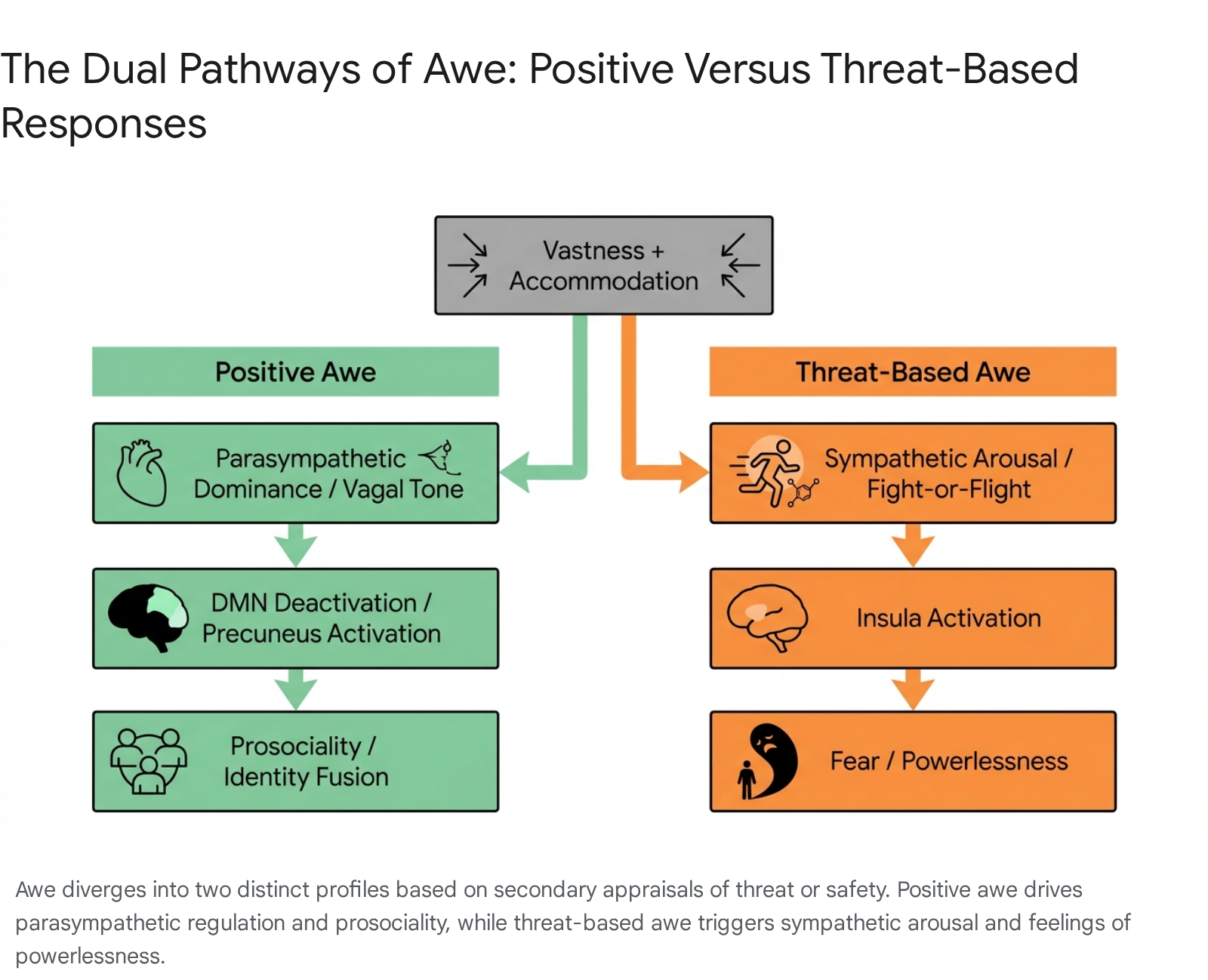
Positive awe is characterized by feelings of connection, inspiration, self-transcendence, and openness to experience. Physiologically, it is associated with parasympathetic nervous system dominance. This is marked by an elevated vagal tone, reduced sympathetic autonomic arousal, increased oxytocin release, and a significant reduction in pro-inflammatory cytokines such as interleukin-6 (IL-6) 6222122. This variant of awe fosters feelings of profound safety, cognitive flexibility, and integration into a larger social or natural whole.
Conversely, threat-based awe arises when the appraisal of vastness is accompanied by secondary appraisals of extreme danger, uncontrollability, or impending peril. Examples include witnessing a violent storm, a catastrophic natural disaster, the devastating ecological impacts of the climate crisis, or undergoing a terrifying psychedelic journey 51725. Threat-based awe involves a heavy admixture of fear, horror, and anxiety, triggering intense sympathetic autonomic arousal, commonly known as the "fight-or-flight" response 56. While both variants involve the core appraisals of vastness and accommodation, threat-based awe is heavily mediated by feelings of powerlessness and existential insignificance 46. Advanced electroencephalography (EEG) and virtual reality (VR) studies from 2025 utilizing deep representational learning and hidden Markov modeling have demonstrated that the ambivalent feelings inherent to awe are spatially distinct from purely positive or negative emotions in latent neural-feeling spaces, confirming that awe is uniquely characterized by its affective complexity 7. This distinction between positive and threat-based pathways is critical, as assuming awe is exclusively a positive peak experience overlooks a significant portion of human psychological reality, particularly in contexts involving trauma, climate anxiety, or cross-cultural variations in emotional processing.
Correcting Misconceptions: The Primacy of Everyday and Interpersonal Awe
A pervasive and persistent misconception in both popular psychology and early empirical study designs is that awe is an exceedingly rare emotion, exclusively triggered by extraordinary, once-in-a-lifetime events. The common archetype positions awe as an emotion reserved for those standing at the edge of the Grand Canyon, viewing Earth from the vacuum of orbit, or experiencing profound mystical states via classical psychedelics 8916. While these extraordinary stimuli are undoubtedly highly effective at inducing awe in both naturalistic and clinical settings, the field's historical insistence on grandiosity obscures the fundamental reality of "everyday awe."
The "Eight Wonders of Life" Global Taxonomy
To capture the true ecological distribution of awe triggers and correct this WEIRD (Western, Educated, Industrialized, Rich, Democratic) sample bias, researchers executed an unprecedented global study gathering over 2,600 written narratives from individuals across 26 countries, translated from 20 different languages 89101516. This culturally, economically, and demographically diverse sample yielded a comprehensive taxonomy classified as the "Eight Wonders of Life" 8102324. The resulting data definitively disproved the notion that awe is rare; across demographics, respondents reported experiencing genuine awe an average of twice a week 16. Furthermore, the study dismantled the deeply entrenched assumption that awe is primarily a reaction to physical landscapes and environmental vastness.
The most prominent trigger of awe worldwide is not nature, but the moral beauty of other human beings 891923. Accounting for a vast majority of reported experiences - with over 95% of moral beauty narratives stemming from actions taken on behalf of others - interpersonal awe is elicited by witnessing exceptional virtue, courage, kindness, and the extraordinary overcoming of adversity by ordinary individuals 81024. Acts such as strangers performing CPR, teachers dedicating their lives to vulnerable students, or marginalized individuals showing indomitable perseverance (sometimes referred to as "Yu Gong-inspired awe" in Chinese contexts) consistently evoke profound awe responses 828. This revelation marks a critical paradigm shift in the field: awe is fundamentally a deeply social and relational emotion, interwoven with human ethics and interpersonal connection.
The recognition of everyday awe has also led researchers to identify a modern societal affliction termed "awe deficiency disorder." In highly industrialized, distraction-heavy environments characterized by chronic self-focus and digital saturation, individuals become insulated from the everyday wonders that naturally trigger parasympathetic resetting and psychological broadening 19. Consequently, intentional interventions, such as 15-minute "awe walks" where individuals are instructed to actively seek out vastness in mundane settings (e.g., observing the intricate visual design of urban architecture or the resilience of a small plant growing in concrete), have been shown to significantly reduce daily stress and physical complaints 212329.
Table 1: The Global Taxonomy of Awe Triggers
The following table synthesizes the distinct triggers of awe identified in the 26-country global taxonomy research, categorizing the specific stimuli that successfully challenge human mental schemas and induce cognitive accommodation 810232430.
| Awe Trigger Category | Core Description & Eliciting Stimuli | Primary Appraisals & Mechanisms | Dominant Contexts & Observations |
|---|---|---|---|
| Moral Beauty | Witnessing exceptional human virtue, courage, altruism, strength, or resilience. Acts of self-sacrifice and kindness. | Conceptual vastness; redefines the observer's understanding of human capacity for goodness and perseverance. | The most universally reported trigger worldwide. Highly effective at inducing prosocial shifts, even among privileged populations. |
| Nature | Encounters with grand physical landscapes, flora, fauna, violent storms, or astronomical phenomena. | Physical and temporal vastness; invokes feelings of ecological interconnectedness or existential insignificance. | Frequently utilized in laboratory inductions (e.g., VR, videos); heavily emphasized in WEIRD (Western) samples and nature-based tourism. |
| Collective Effervescence | Synchronized, shared experiences in large groups (e.g., dancing, sporting events, concerts, religious rituals). | Social vastness; drives identity fusion and the profound merging of the individual self with a larger collective entity. | Promotes deep social cohesion; often linked to elevated oxytocin levels and parasympathetic regulation. |
| Music | Auditory experiences that evoke deep emotional resonance, chills, goosebumps, or temporal distortion. | Acoustic and emotional vastness; transcends linguistic processing and challenges standard cognitive parsing. | Universally accessible; demonstrates a distinct neurophysiological signature compared to standard aesthetic appreciation. |
| Visual Design | Human-made art, monumental architecture, intricate geometric patterns, or technological marvels. | Perceptual complexity; elicits profound admiration for human ingenuity, capability, and aesthetic perfection. | Common in urban environments and global work contexts; bridges the gap between everyday aesthetic appreciation and peak awe. |
| Spirituality & Religion | Mystical encounters, profound meditation, prayer, or overwhelming feelings of divine presence. | Metaphysical vastness; facilitates radical ego dissolution and connection to an ultimate, unexplainable reality. | Deeply intertwined with historical definitions of awe; often indistinguishable from the highest peaks of natural or psychedelic awe. |
| Life and Death | Witnessing childbirth, confronting human mortality, or observing the biological life cycle in transition. | Existential vastness; directly challenges fundamental mental schemas regarding existence, purpose, and finality. | Consistently evokes a highly ambivalent, mixed-affect variant of awe that incorporates both profound beauty and existential fear. |
| Epiphanies | Sudden intellectual breakthroughs, grasping profound philosophical concepts, or realizing deep scientific truths. | Cognitive vastness; the sudden, seamless accommodation of highly complex information into a unified theory. | Common in academic, scientific, and contemplative settings; serves as a primary driver of epistemic curiosity and exploration. |
By recognizing these eight distinct pathways, researchers can move beyond monolithic models of awe, tailoring specific interventions and measurements to specific domains. For example, clinical psychologists can leverage narratives of moral beauty to reduce burnout and loneliness in healthcare workers, while environmental psychologists can utilize nature-based awe to foster ecological stewardship and sustainable behaviors 25323334.
Recent Developments in Psychometrics and Assessment (2023 - 2025)
As the theoretical understanding of awe has expanded beyond mere philosophical speculation, the necessity for robust, validated psychometric tools has grown in tandem. Prior to 2019, awe was frequently measured using inconsistent single-item scales, ad-hoc questionnaires, or emotion-recall prompts that lacked standardization 2535. The introduction of the 30-item Awe Experience Scale (AWE-S) established a much-needed gold standard, isolating six core facets of the state experience of awe: altered time perception, self-diminishment, connectedness, perceived vastness, physical sensations, and the need for accommodation 132526.
However, recent methodological advancements from 2024 and 2025 have significantly refined how awe is quantified, specifically addressing issues of participant burden, the vital distinction between state versus trait experiences, and the assessment of highly vulnerable or clinical populations.
Optimizing State Measurement: The AWE-SF and Awe-SM
Recognizing that a comprehensive 30-item scale is highly burdensome - particularly in time-sensitive clinical settings, high-stress ecological environments, or during acute pharmacological interventions such as psychedelic-assisted therapy - researchers sought to distill the essence of the AWE-S. This effort culminated in the validation of the 12-item Awe Experience Scale Short Form (AWE-SF) in 2024 13262728. This instrument preserves the psychometric integrity and multidimensionality of the original six-factor structure by retaining the top two loading items for each specific facet 26.
The deployment of the AWE-SF in clinical and psychedelic samples has yielded critical insights into the divergent pathways of awe. Studies indicate that high scores on the facets of connection and vastness strongly predict mystical-type, long-term positive experiences and increased psychological richness. Conversely, high scores on the facets of accommodation and self-loss are significantly associated with negative emotional states and challenging, anxiety-driven psychedelic experiences 132627. This psychometric division perfectly mirrors the theoretical duality of positive versus threat-based awe.
Concurrently, the Awe Short Measure (Awe-SM) was introduced in 2025 to provide a rapid, succinct assessment of state awe 2539. The Awe-SM is a nine-item, three-factor instrument capturing connectedness, absorption, and perception 2539. It offers a highly efficient alternative for ecological momentary assessment (EMA) studies, allowing researchers to capture data on "everyday awe" in real-time via mobile devices without significantly interrupting the subject's experience or inducing survey fatigue.
Capturing Disposition: The Trait Inventory of Awe
While the AWE-S, AWE-SF, and Awe-SM are designed to measure state awe (the acute, transient emotional response to a specific stimulus), assessing dispositional or trait awe (an individual's chronic baseline propensity to experience awe across diverse situations) requires a fundamentally different architectural approach.
The recently developed and validated Trait Inventory of Awe (2025) fills this significant void in the literature 29414243. This comprehensive instrument allows researchers to explore how an individual's innate threshold for awe interacts with established personality domains. For example, structural equation modeling has confirmed that individuals scoring high in Openness to Experience and Extraversion possess a significantly higher dispositional propensity for awe, which subsequently acts as a strong mediator for increased subjective well-being and interpersonal forgiveness 4330. Paired with the newly validated Inventory of Self-Efficacy for Awe, these tools are particularly vital for assessing the baseline psychological resilience of highly vulnerable populations, such as residents of homeless shelters, and for designing targeted, longitudinal positive psychology interventions that rely on awe to rebuild meaning in life 2942.
Neurobiology and Physiological Correlates of Awe
The transition of awe from a philosophical concept to an empirical science has been heavily driven by functional neuroimaging and physiological monitoring. Awe produces a highly distinct, replicable biological signature that actively suppresses egocentricity, recalibrates the autonomic nervous system, and facilitates deep social integration.
Default Mode Network (DMN) Deactivation and the "Small Self"
The most significant neurobiological finding regarding awe is its profound suppressive interaction with the Default Mode Network (DMN) 15333146. The DMN - comprising interconnected cortical hubs such as the medial prefrontal cortex (mPFC), the posterior cingulate cortex (PCC), the superior frontal gyrus (SFG), and the bilateral angular gyrus - is highly active during self-referential processing, autobiographical memory retrieval, mind-wandering, and ego-centric rumination 314632.
Functional magnetic resonance imaging (fMRI) studies consistently demonstrate that acute experiences of awe cause a profound deactivation of these core DMN regions 333146. By neurologically quieting the DMN, awe literally silences the biological substrates of the "self." This cortical dampening corresponds perfectly with the subjective behavioral reports of the "small self" phenomenon - the ubiquitous feeling that one's personal desires, daily anxieties, and social status are utterly insignificant in the grander scheme of the universe 33031. This biological "unselfing" is the primary mechanism by which awe reduces acute anxiety and disrupts the repetitive, maladaptive negative thinking that characterizes depressive disorders, offering a compelling therapeutic rationale for awe-based clinical interventions 333148.
Identity Fusion, the mPFC, and the TPJ
While awe diminishes the individual, isolated self, it simultaneously expands the collective self. Recent literature from 2024 and 2025 posits that awe serves a critical evolutionary function by promoting "identity fusion" - an apex form of social connection where the boundaries between personal identity and the identity of a collaborative group completely dissolve, aligning personal and collective goals without diminishing individual agency 20333435.
This profound prosocial integration is orchestrated by the complex interplay between the suppressed mPFC and the temporoparietal junction (TPJ), a brain region critical for empathy, moral cognition, and social perspective-taking. Evolutionary psychiatrists have mapped this to the "Sacrifex" archetype (or Healer archetype), which encodes symbolic devotion and self-transcendence 3333. Under the influence of awe, the brain reallocates cognitive resources away from individual self-preservation toward collective affiliation. This process is further modulated by heightened serotonergic (particularly 5HT-2A receptor) and oxytocinergic signaling, which drastically increase neuroplasticity, enhance epistemic trust, and foster a readiness to engage in self-sacrifice for the perceived greater good 333336.
Structural Differences: Positive versus Negative Awe
Voxel-based morphometry (VBM) analyses reveal that the duality of awe is reflected not just in transient functional activation, but in the long-term structural anatomy of the human brain. Individuals with a higher dispositional propensity for positive awe exhibit greater regional gray matter volume (rGMV) in the precuneus, a region implicated in visuospatial imagery, episodic memory, and self-reflection devoid of threat 5202537.
Conversely, a propensity for negative, threat-based awe is strongly correlated with significantly reduced gray matter volume in the left and right insula, as well as the superior temporal gyrus 5202537. The insula is deeply involved in interoception, the processing of visceral pain, and the evaluation of fear and risk. Variations in the structural density of these regions appear to dictate whether an individual appraises a vast stimulus as an opportunity for transcendent, joyous connection or as a source of overwhelming existential dread and powerlessness.
Table 2: Neurological Imaging Findings vs. Behavioral Outcomes
The following table aligns specific neurobiological substrates activated or deactivated during awe states with their corresponding psychological and behavioral outcomes, highlighting the emotion's complex physical footprint 520333133.
| Neural Network / Brain Region | Imaging Modality | Awe Variant / Facet | Associated Behavioral & Psychological Outcomes |
|---|---|---|---|
| Default Mode Network (DMN) (mPFC, PCC, Angular Gyrus, SFG) | fMRI (Functional Deactivation) | Universal Awe (Self-Diminishment) | "Small self" effect; profound reduction in ego-centric rumination; decreased anxiety; shift in focus from internal, autobiographical states to external phenomena. |
| Temporoparietal Junction (TPJ) | fMRI (Functional Coupling with mPFC) | Positive Awe / Interpersonal Awe | Identity fusion; enhanced empathy; advanced social perspective-taking; increased prosociality, altruism, and in-group cooperation. |
| Precuneus | VBM (Increased rGMV) | Positive Awe (Dispositional) | High propensity for transcendent, positive awe experiences; strong dispositional capacity for self-reflection and integration devoid of threat appraisals. |
| Insula (Bilateral) & Superior Temporal Gyrus | VBM (Decreased rGMV) | Threat-Based (Negative) Awe | Heightened sensitivity to threat appraisals; feelings of intense powerlessness, interoceptive distress, and existential fear in the presence of vast stimuli. |
| Ventral Striatum & Orbitofrontal Cortex | fMRI (Functional Activation) | Positive Awe (Reward processing) | Feelings of profound inspiration, reward, and motivation; drives epistemic curiosity and the active desire to explore the unknown. |
Cross-Cultural Perspectives: Individualism, Collectivism, and Prosociality
A central debate in the contemporary science of emotion is the extent to which awe is an innate human universal versus a culturally constructed phenomenon. While the peripheral physiological responses to awe (e.g., goosebumps, vagal tone shifts, facial expressions) appear functionally universal across the globe, the subjective cognitive appraisal, emotional valence, and downstream behavioral consequences of awe are heavily moderated by an individual's cultural context 241112.
Culturally Contingent Valence: Is Awe Always Positive?
A critical limitation of early awe research was its near-exclusive reliance on WEIRD samples 1115. In modern Western cultures, which are predominantly individualistic, awe is largely conceptualized, sought after, and experienced as a profoundly positive, uplifting emotion 111238.
However, rigorous cross-cultural studies utilizing two-week daily diary methods and standardized laboratory inductions reveal a starkly divergent reality in Eastern, collectivistic cultures. In populations from China, for example, awe is frequently experienced as a mixed or highly ambivalent emotion, tinged heavily with fear, anxiety, and a persistent recognition of threat 1118. This divergence aligns closely with broader cultural orientations toward emotional arousal. Western cultures, which emphasize autonomy and self-enhancement, prioritize high-arousal, positive emotions to assert individual influence over the environment. Eastern cultures, conversely, often prioritize low-arousal states to maintain harmony and are highly attuned to social hierarchies and vast external forces that demand conformity or pose collective threats 12. Consequently, the modern, exclusively positive conceptualization of awe is essentially a Western artifact; true global awe encompasses a deep respect for, and inherent fear of, uncontrollable vastness 11.
The "Small Self" and Magnitudes of Prosocial Shifts
Despite deep differences in valence, awe consistently triggers the "small self" effect across both individualistic and collectivistic cultures 26. However, the baseline sizes of the self differ drastically. Collectivists inherently operate with a more interdependent, less prominent sense of individual self compared to highly autonomous, self-aggrandizing individualists 2123940.
The prosocial consequences of awe - such as increased generosity, ethical decision-making, and collective engagement - are robustly documented across cultural divides, yet the magnitude and precise mechanism of these shifts vary significantly 236. * In Individualistic Cultures: Awe produces a dramatic reduction in self-importance, effectively shocking the highly autonomous ego and forcing an outward gaze. This radical, temporary psychological shift leads to significant, measurable spikes in prosocial behavior, as individualists temporarily adopt a collective mindset that is otherwise foreign to their daily functioning 241. * In Collectivistic Cultures: Because collectivists already prioritize group harmony and interdependence, their baseline for prosociality is inherently higher. When experiencing awe, rather than a radical identity shock, collectivists experience a profound strengthening of existing social ties and an intensification of their interdependent networks 228. Comprehensive meta-analyses evaluating 57 independent effect sizes across nearly 21,000 individuals indicate that adolescents and adults with high dispositional awe within collectivistic cultural backgrounds are exceptionally inclined toward prosocial action, representing an absolute apex of community cohesion 28.
Interestingly, culturally priming individuals can temporarily alter their prosocial responses to awe. When individualists are primed with collectivist values (via pronoun circling tasks or group imagination exercises) prior to engaging in behavioral economics games like the Ultimatum or Dictator games, their altruistic allocation behavior increases significantly. Conversely, when Chinese participants who are historically influenced by collectivist values are explicitly primed with individualism, their tolerance for unfairness plummets and their generosity decreases, highlighting the immense plasticity of culturally driven prosocial behavior when exposed to awe 39.
Methodological Limitations and Future Directions
While the empirical and theoretical advancements in the study of awe over the last two decades are undeniably impressive, the field remains constrained by several significant methodological limitations. A critical evaluation of these barriers is strictly necessary to accurately calibrate the reliability of current findings and direct future research paradigms.
The Limits of Ecological Validity: Lab-Induced Versus Real-World Awe
To study awe under highly controlled, replicable conditions, researchers rely almost entirely on standardized inductions: asking participants to recall past memories, showing high-definition videos of nature (e.g., sweeping drone footage of mountains), or, increasingly, utilizing immersive Virtual Reality (VR) environments 3142594361. While VR has proven highly effective at triggering the core psychological dimensions of vastness and the need for accommodation 4361, these laboratory methods inherently lack true ecological validity.
Watching a video of a towering redwood forest or a massive storm on a screen produces measurable neurological shifts and self-reported feelings of smallness, but it cannot replicate the full sensory, somatic, and existential immersion of in vivo naturalistic awe. Actually standing in the physical presence of ancient trees or a raging ocean involves feeling the ambient temperature, sensing the scale with binocular vision, and recognizing one's genuine, physical vulnerability in the wild 2344. Laboratory stimuli are fundamentally safe; the participant is consciously aware they are in a controlled, risk-free environment. Consequently, lab-induced awe artificially skews toward a positive valence, frequently failing to capture the threat-based dread, awe-inspiring powerlessness, or profound spiritual resonance of real-world phenomena. Future methodologies must bridge this critical gap by expanding the use of wearable, ambulatory biometric sensors (capturing heart rate variability, skin conductance, and mobile EEG) to monitor individuals during real-world, highly evocative events, such as religious pilgrimages, intense wilderness expeditions, or massive collective rituals.
The Contamination of Self-Reported Prosociality: Social Desirability Bias
A second, and perhaps more pervasive limitation undermining the field is the heavy reliance on self-reported metrics to quantify the prosocial benefits of awe. Studies frequently conclude that post-awe, participants express a significantly greater willingness to volunteer their time, donate to charity, or assist a stranger in need 2444546.
However, these self-reports are highly vulnerable to Social Desirability Bias (SDB) - the deeply ingrained human tendency for respondents to answer survey questions in a manner that will be viewed favorably by researchers or society, often over-reporting "good" behavior and under-reporting selfishness 4447486768. Because awe acts as a moral elevator that highlights virtue and interconnectedness, participants who have just experienced an awe induction may feel a heightened, subconscious pressure to project a virtuous persona, leading them to artificially inflate their prosocial intentions on standard questionnaires 224768. Empirical comparisons across sociology and psychology consistently demonstrate massive, statistically significant discrepancies between what people claim they will do in self-administered surveys (e.g., frequency of exercising, church attendance, or charitable giving) and their actual, objectively tracked behaviors 2249.
To circumvent the contaminating effects of SDB, researchers must increasingly rely on observable, criterion-based behavioral metrics rather than hypothetical scenarios. The integration of behavioral economics models - such as the Dictator Game or the Ultimatum Game, where participants must forfeit actual, tangible financial compensation to help an anonymous stranger - provides a much more rigorous, ecologically sound measure of true altruism 3303950. While early studies employing these specific economic games confirm that awe does indeed prompt actual, measurable financial generosity 3, the continued methodological shift away from easily manipulated self-report questionnaires toward costly, objectively observable behaviors is absolutely essential for the ongoing maturation of awe science.
Conclusion
The rigorous scientific inquiry into awe over the past two decades has thoroughly dismantled the archaic notion that this profound emotion is an intangible, purely mystical anomaly beyond the reach of empirical measurement. Through precise neurobiological mapping, advanced psychometric deployment, and expansive cross-cultural study, awe has been unmasked as a fundamental, evolutionarily conserved architectural feature of the human mind - an emotional mechanism explicitly designed to dissolve the rigid boundaries of the individual ego and forcibly integrate the self into the broader physical and social collective.
The developments of recent years have introduced vital, paradigm-shifting nuance to this framework. By acknowledging the duality of positive and threat-based awe, researchers can now appreciate the emotion's full spectrum, from healing parasympathetic transcendence to the stark, sympathetic realization of human vulnerability in the face of uncontrollable vastness. Furthermore, the demystification of awe's triggers - proving definitively that the moral beauty of everyday human interaction is the world's most reliable and frequent source of wonder - democratizes the emotion, proving it is readily accessible outside of pristine wilderness or grand cathedrals.
As the field moves forward, the scientific imperative will be to transcend the sterile confines of laboratory inductions and the inherent biases of self-reported surveys. By measuring awe in the wild and tracking its capacity to generate tangible, costly prosocial action across diverse cultural landscapes, science can fully leverage the transformative power of this extraordinary emotion to foster psychological resilience, deep empathy, and vital collective cohesion in an increasingly complex and fragmented world.