
What Research Says About the Gut-Brain Connection
Trillions of microscopic organisms living in the human digestive tract exist in constant, bidirectional communication with the brain, actively influencing stress levels, mood, sleep architecture, and cognitive health. Recent landmark clinical trials demonstrate that targeted diets and specific probiotic strains can measurably reduce anxiety and fortify the blood-brain barrier against neuroinflammation, though significant hurdles remain in translating animal research into individualized human therapies. While clinical science confirms a powerful biological highway linking gut physiology to psychiatric outcomes, much of the internet's wellness marketing heavily exaggerates these findings, often promoting unverified diagnoses over evidence-based medicine.
Anatomy of the Microbiota-Gut-Brain Axis
For decades, the human gastrointestinal tract was viewed through a strictly mechanical lens, treated as a biological tube responsible only for breaking down food, absorbing nutrients, and expelling waste. Today, it is understood to be the command center of a vast, interconnected network known as the microbiota-gut-brain axis 12.
To understand this connection, one must first understand the scale of the microbiome. The human gut is a complex, dynamic ecosystem hosting trillions of microorganisms, including bacteria, viruses, fungi, and archaea 34. This community acts as a "virtual organ" with immense metabolic versatility. The microbial community in the gut encodes approximately 150 times more genetic material than the entire human genome 4. These microbes do not just reside passively in the body; they actively metabolize dietary components, interact with the host's immune system, and manufacture chemical signals that dictate central nervous system function 34.
The communication between the gut and the brain is entirely bidirectional 13. The brain influences intestinal activities - such as motility, transit time, and the secretion of digestive juices - while the gut influences mood, cognition, and stress responses 2. This two-way communication relies on three primary, overlapping pathways: the neural network, the immune system, and the endocrine system 25.
The Vagus Nerve: A Biological Superhighway
The most direct physical link between the gastrointestinal tract and the brain is the vagus nerve. Originating in the brainstem and wandering down through the neck into the torso, the vagus nerve is a vast bioelectronic highway composed of roughly 200,000 distinct nerve fibers that touch major organs including the heart, lungs, and intestines 67.
The vagus nerve is not a top-down management system. Approximately 80% of the nerve fibers in the vagus nerve are afferent, meaning they carry sensory signals upward from the body to the brain, while only 20% are efferent, sending information from the brain downward . This architectural reality means the gut is continuously updating the brain on the status of digestion, localized inflammation, and microbial activity 7.
This nerve also serves as the body's primary "brake pedal." It acts as the main control center for the parasympathetic nervous system, which governs the "rest-and-digest" physiological state 7. When activated, it drops the heart rate, slows breathing, and lowers levels of cortisol and systemic inflammation . Individuals with high "vagal tone" - meaning their nervous system can efficiently switch into a relaxed state - tend to exhibit greater psychological well-being and stress resilience . Conversely, low vagal tone is associated with chronic stress, depression, and higher levels of baseline inflammation .
The scientific community recognizes the therapeutic potential of this neural pathway. The US National Institutes of Health (NIH) Common Fund recently launched the SPARC (Stimulating Peripheral Activity to Relieve Conditions) program to meticulously map these nerve fibers 6. By understanding exactly which nerve "lanes" carry which signals, researchers are refining Vagus Nerve Stimulation (VNS) therapies 6. Using electronic devices to stimulate the nerve has been shown to alter brain activity, promote neurogenesis by upregulating brain-derived neurotrophic factor (BDNF), and offer potential treatments for conditions ranging from treatment-resistant depression to chronic inflammatory disorders 698.
Chemical Messengers: Neurotransmitters and Metabolites
While the vagus nerve provides a direct electrical connection, the gut also communicates with the brain via a complex chemical language. Gut microbes are prolific manufacturers of neuroactive substances. Certain strains of gut bacteria directly synthesize or modulate the production of vital neurotransmitters, including dopamine, serotonin, and gamma-aminobutyric acid (GABA) 119. Current physiological data indicates that approximately 95% of the body's serotonin - a neurotransmitter heavily implicated in mood regulation, sleep, and happiness - is produced in the gastrointestinal tract, a process largely mediated by host-microbe interactions 13.
However, the most significant mediators of the gut-brain connection are short-chain fatty acids (SCFAs). When gut bacteria ferment dietary fiber - the complex carbohydrates that human enzymes cannot digest - they produce SCFAs, primarily acetate, propionate, and butyrate 1011. These molecules serve as the primary energy source for the epithelial cells lining the colon, but they also spill over into systemic circulation to exert profound effects on the central nervous system and metabolic health 1213.
Defending the Brain: SCFAs and the Blood-Brain Barrier
The central nervous system is protected by the blood-brain barrier (BBB), a highly selective, semipermeable border of tightly packed endothelial cells 1415. This barrier regulates the transfer of solutes from the circulatory system into the central nervous system, preventing toxins, peripheral immune factors, and pathogens from entering the delicate neural tissue 1415. In neurodegenerative diseases like Alzheimer's and Parkinson's, as well as in major depressive disorder and aging, this barrier can become compromised, leading to severe neuroinflammation 1015.
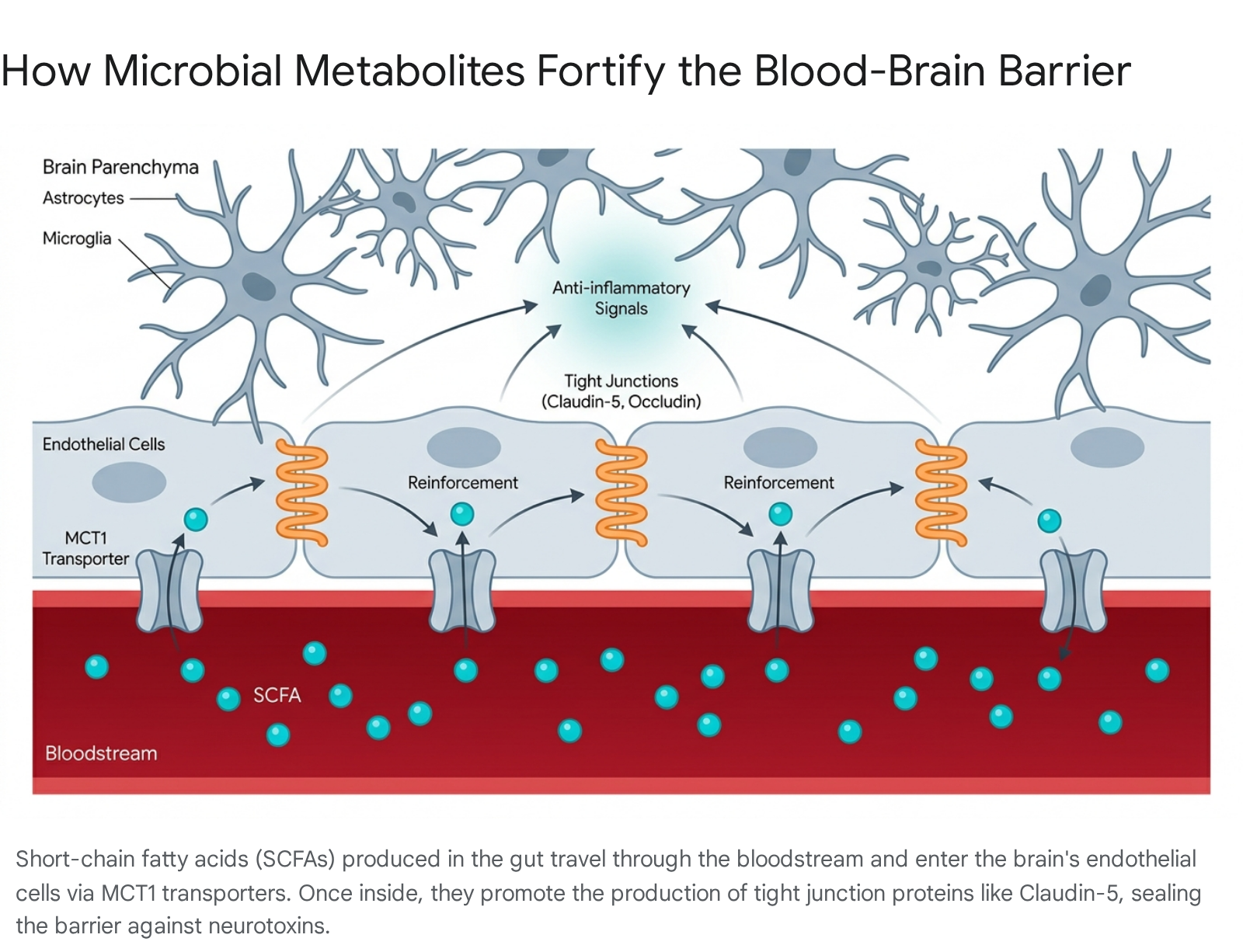
Recent research demonstrates that gut-derived SCFAs play a highly specific, critical role in preserving the physical integrity of the blood-brain barrier 10. Because SCFAs are small molecules, they can cross into the brain's endothelial cells via specialized transport proteins. In human and rodent brain endothelium, the entry of SCFAs into the brain parenchyma is primarily mediated by Monocarboxylate Transporter 1 (MCT1, also known as SLC16A1), which acts as a proton-dependent cotransporter 1016. Additionally, the transporter SLC5A8 facilitates SCFA uptake in neurons 1016.
Once inside the cells of the BBB, SCFAs operate on an epigenetic level. They act as histone deacetylase (HDAC) inhibitors, a complex mechanism that alters gene transcription 1012. By inhibiting HDAC, SCFAs upregulate the genetic expression of "tight junction" proteins, specifically Claudin-5, Occludin, and ZO-1 1014. These proteins act like physiological mortar, actively sealing the gaps between the endothelial cells of the blood-brain barrier and preventing harmful, pro-inflammatory molecules from leaking into the brain 1021. Furthermore, once across the barrier, SCFAs calm the brain's resident immune cells (microglia) and support astrocyte function, aggressively reducing systemic neuroinflammation 2122.
The Psychobiotic Revolution and Dietary Interventions
As the mechanisms of gut-brain signaling have become clearer, clinical focus has shifted to therapeutic interventions. In 2013, researchers Dr. John Cryan and Dr. Ted Dinan at University College Cork (UCC) and APC Microbiome Ireland coined the term "psychobiotics" to describe any targeted microbiota intervention - such as live bacteria or specific dietary fibers - that positively supports mental health by interacting with the gut microbiome 1724.
A decade of subsequent research yielded a landmark clinical trial demonstrating the efficacy of a whole-diet psychobiotic approach. Published in the journal Molecular Psychiatry in 2022, the trial recruited 45 healthy adults who typically consumed a low-fiber diet, randomizing them into two cohorts for four weeks 1819. One group received standard dietary advice based on the traditional food pyramid, while the other was educated by a registered dietitian on how to strictly follow a "psychobiotic diet" specifically engineered to feed the gut microbiome 2419.
The psychobiotic diet heavily emphasized two components: prebiotics (fibrous foods that feed beneficial microbes) and fermented foods (which naturally contain live, beneficial probiotics) 1718.
| Food Category | Daily / Weekly Target | Key Examples Provided to Participants |
|---|---|---|
| Prebiotic Fruits & Vegetables | 6 to 8 servings per day | Onions, leeks, cabbage, apples, bananas, oats, asparagus, garlic 1827 |
| Whole Grains | 5 to 8 servings per day | Barley, oats, whole wheat 1827 |
| Fermented Foods | 2 to 3 servings per day (1 serving = 200ml / 1 cup) | Sauerkraut, kefir, kombucha, kimchi 181927 |
| Legumes | 3 to 4 servings per week | Lentils, chickpeas, kidney beans, black beans 1827 |
Table 1: The specific dietary parameters of the psychobiotic diet utilized in the APC Microbiome Ireland clinical trial.
The results of the four-week trial were highly significant. While both groups reported improvements in overall sleep quality, the participants on the psychobiotic diet experienced a marked reduction in perceived stress 1819. More importantly, the effect was dose-dependent: those who adhered most strictly to the psychobiotic food quotas experienced the strongest decreases in stress levels 1718.
Interestingly, when researchers analyzed the participants' stool via shotgun sequencing, they found only subtle shifts in the actual taxonomic composition of the gut bacteria 1718. However, metabolic profiling revealed significant changes in the levels of 40 specific lipid chemicals and metabolites 1828. This provided a profound secondary insight for researchers: a dietary intervention does not necessarily have to radically restructure the baseline population of bacteria in the gut to improve mental health. By changing the substrate the existing bacteria are fed, the host rapidly alters the metabolic exhaust - the neuroactive chemicals and metabolites - those microbes produce, which in turn signals the brain to lower the systemic stress response 1828.
Evidence from Human Clinical Trials (2024 - 2026)
Moving beyond whole-diet approaches, massive strides have been made recently in isolating specific bacterial strains to treat distinct psychiatric conditions. The clinical consensus is maturing rapidly, transitioning from early enthusiasm derived from mouse models to rigorous human trials.
A comprehensive meta-analysis published in late 2025 reviewed 72 randomized controlled trials (RCTs) involving over 6,000 participants 20. The analysis investigated the specific effects of probiotics, prebiotics, and synbiotics (combinations of both) on mood disorders. The researchers found that probiotic supplementation resulted in a statistically significant, moderate-to-large reduction in depressive symptoms compared to placebo (Standardized Mean Difference [SMD] = - 0.53) 2021. Anxiety symptoms were also significantly reduced, though the pooled effect size was generally more moderate (SMD = - 0.44) 2021.
Another 2025 meta-analysis examining probiotics for clinical depression found that both single-strain and multi-strain formulations effectively lowered symptom severity 22. The evidence indicates that psychobiotics may be especially useful in cases of treatment-resistant depression, acting synergistically with traditional pharmaceutical antidepressants to target the neuroinflammatory components of the disease 23.
The Microbiome's Psychiatric Signatures
Through high-throughput DNA sequencing and metagenomic analysis, researchers are now identifying specific "dysbiosis signatures" - predictable imbalances in the gut flora - associated with various psychiatric and neurological disorders 2425.
| Psychiatric Condition | Observed Microbiome Alterations (Dysbiosis Signature) | Potential Mechanism / Implication |
|---|---|---|
| Major Depressive Disorder (MDD) | Loss of overall microbial diversity; elevated Firmicutes; reduced SCFA-producing bacteria 324. | Decreased SCFAs lead to higher systemic inflammation, which blunts serotonin production and drives depressive behaviors 324. |
| Anxiety Disorders | Elevated levels of Proteobacteria; decreased populations of SCFA producers 324. | Chronic low-grade inflammation signals the brain's stress centers, heightening HPA axis reactivity 324. |
| Bipolar Disorder (BD) | Altered Firmicutes/Bacteroidetes ratio; severe reduction in Faecalibacterium 324. | Loss of potent anti-inflammatory microbes correlates with self-reported symptom severity and mood destabilization 326. |
| Schizophrenia | Severe reduction in Lactobacillus species; presence of endotoxemia (bacterial toxins in blood) 2425. | Increased gut permeability and systemic inflammation may contribute to cognitive and behavioral symptoms 2425. |
Table 2: Common microbial signatures associated with specific mental health conditions based on 2025/2026 meta-analyses.
Furthermore, clinical trials are identifying which specific strains offer the most robust therapeutic benefits. For instance, the combination of Lactobacillus helveticus R0052 and Bifidobacterium longum R0175 consistently demonstrates strong results for reducing anxiety and lowering cortisol in human trials 13. Other strains, such as Bifidobacterium breve A1, have shown specific efficacy in improving memory and visual-spatial abilities in older adults with mild cognitive impairment 27.
Lifestyle Factors: Sleep and Exercise
The gut-brain axis is highly sensitive to lifestyle factors beyond diet, notably sleep architecture and physical exercise, both of which operate in a bidirectional loop with the microbiome.
Sleep Architecture and Gut Rhythms
The gut microbiome exhibits its own circadian rhythms, which are closely linked to the host's biological clock and stress-hormone pathways 3728. Recent clinical reviews in 2025 have confirmed that gut microbiota dysbiosis both results from and contributes to sleep disturbances, creating a vicious physiological cycle that perpetuates insomnia 37.
In human clinical trials, total microbiome diversity is positively correlated with increased sleep efficiency and total sleep time, while it is negatively correlated with "wake after sleep onset" (sleep fragmentation) 3929. Even minor disruptions in routine have a measurable impact; studies indicate that shifting sleep duration by just 90 minutes can interfere with gut microbiome composition and encourage the growth of bacterial species with unfavorable health associations 39.
Conversely, targeting the microbiome can improve sleep. In insomnia patients, who frequently exhibit decreased populations of beneficial Ruminococcaceae species, probiotic interventions have proven effective 37. Double-blind trials utilizing strains like Lactobacillus plantarum (JYLP-326 and PS128) have been shown to significantly improve the Pittsburgh Sleep Quality Index (PSQI) and reduce concurrent depressive symptoms in patients suffering from chronic insomnia 30.
The Gut-Brain-Muscle Axis
The emerging concept of the "gut-brain-muscle axis" suggests that physical activity fundamentally alters the microbiome to support brain health 4231. Moderate aerobic exercise has been shown to significantly increase the abundance of butyrate-producing bacteria, such as Faecalibacterium prausnitzii and Roseburia intestinalis, independent of dietary changes 4232.
This exercise-induced surge in SCFAs provides more fuel for the intestinal lining, reduces systemic inflammation, and stimulates the release of exercise-induced myokines like irisin 3132. These myokines subsequently cross the blood-brain barrier and promote the expression of Brain-Derived Neurotrophic Factor (BDNF), enhancing neuroplasticity and protecting against cognitive decline 3132.
However, intensity matters. While moderate, consistent endurance exercise is highly beneficial, extreme, exhaustive exercise - particularly in hot, humid environments - can temporarily cause intestinal permeability ("leaky gut") due to severe heat stress and the redirection of blood flow away from the gastrointestinal tract to the skeletal muscles 42.
Global Diversity: The Missing Piece in Microbiome Research
While the sheer volume of microbiome research has exploded, it has historically suffered from a massive blind spot: a severe lack of population diversity. The vast majority of microbiome research has focused almost exclusively on populations in industrialized Western nations, effectively ignoring the 84% of the global population living in low- and middle-income countries 3334.
Because the gut microbiome is highly adaptive to local environments, endemic diets, and lifestyle factors, this Western-centric focus has provided science with a heavily skewed map of human biology 33. To correct this, major global genomic initiatives have launched to broaden the scope of microbiome data.
The AWI-Gen 2 Project
The groundbreaking AWI-Gen 2 Microbiome Project, a massive collaborative study led jointly by researchers at Stanford University and the University of the Witwatersrand, recently mapped the gut microbiomes of over 1,800 individuals across six diverse communities in Burkina Faso, Ghana, Kenya, and South Africa 3334. This population-representative study intentionally centered on diverse African communities, ranging from rural farming villages to dense urban settlements, revealing incredible microbial diversity previously unknown to science 33. Utilizing advanced shotgun sequencing, the researchers identified over 40,000 novel viral genomes within the human gut, including nine highly prevalent new "jumbophages" 47.
The AWI-Gen 2 study clearly demonstrated how rapid urbanization uniquely shapes the gut. For instance, the bacterium Treponema succinifaciens, which is traditionally associated with rural, fiber-heavy diets, was previously thought to be completely absent in urban environments. However, the African cohort data revealed that its presence is highly dependent on a specific diet-related nutrient niche, and it is rapidly lost upon exposure to antibiotics common in transitioning urban centers 3347. The study also provided some of the first large-scale data on how the microbiomes of people living with HIV (PLWH) respond to antiretroviral therapy in African populations, noting specific microbial enrichments linked to systemic inflammation 3447.
The GLOW Initiative in Asia
Similarly, the newly launched GLOW (Gut Linked Outcomes in Wellbeing) initiative in Singapore is tracking over 6,000 participants from diverse Asian ancestries to study the intersection of the microbiome and mental health 35. Building on the PRECISE-SG100K cohort - which collects genomic and health data from 100,000 Singaporeans - the multi-institutional study aims to decouple which gut-brain mechanisms are universal human biological traits and which are merely artifacts of the modern Western lifestyle 35. By incorporating populations from varying degrees of industrialization, scientists hope to develop precision psychobiotics that are culturally and biologically relevant on a global scale 35.
The Translational Gap: Why Mice Aren't Men
If administering a specific probiotic can reverse depressive behaviors in a laboratory mouse, why do these interventions so frequently fail to yield dramatic, consistent results in human clinical trials? This discrepancy, known in the scientific community as the "translational gap," remains one of the most significant hurdles in modern psychobiotic research 13650.
For decades, the gold standard method for studying the gut-brain axis relied on germ-free mice - animals born in sterile environments with no microbiome of their own 37. Researchers routinely introduce human stool into these mice (creating "humanized" models) to isolate how specific bacterial communities affect brain development and anxiety-like behaviors 3853. However, a closer look at comparative biology reveals severe limitations to this paradigm.
| Biological Feature | Human Gut Microbiome | Murine (Mouse) Gut Microbiome |
|---|---|---|
| Species Overlap | Highly diverse, specialized for a varied, omnivorous diet. | Only 2.65% to 5% of bacterial species are shared with humans 3854. |
| Dominant Genera | Prevotella, Faecalibacterium, Ruminococcus dominate 38. | Lactobacillus, Alistipes, Turicibacter dominate 38. |
| GI Anatomy | Thick mucosal wall; relatively small cecum 38. | Thin muscularis mucosae; massive cecum designed for fermenting raw plant matter 38. |
| Behavioral Impact | Food is cooked, washed, and highly processed. | Mice engage in coprophagia (eating their own feces), constantly re-inoculating their gut flora 38. |
| Immune Response | Microbiome co-evolved with the host to properly stimulate immune tolerance 53. | When colonized with human bacteria, the mouse immune system is only weakly stimulated, fundamentally altering host-microbe crosstalk 53. |
Table 3: Key anatomical and microbial differences between human and murine models that complicate the translation of preclinical research to human therapies.
Because of these profound physiological differences, bacterial strains that produce potent neuroactive effects in a mouse gut often fail to survive, colonize, or exert the same metabolic influence in a human gut 5053.
Furthermore, even when a human consumes a high-quality, clinically validated probiotic supplement, it does not guarantee that the bacteria will take up permanent residence. A landmark study published in the journal Cell utilized invasive endoscopy and colonoscopy to accurately track probiotic colonization inside the human digestive tract, rather than relying solely on stool samples 39. The researchers discovered that humans generally fall into two distinct categories: "persisters" (whose native microbiome permits the foreign probiotics to colonize) and "resisters" (whose established microbiome quickly expels the invading probiotics, rendering the supplement largely useless for long-term colonization) 39.
This biological reality explains why psychobiotic effects are highly strain-specific and incredibly individualized 50. As Dr. Gerard Clarke, a leading neurobehavioral scientist, recently presented at the IPA World Congress, the future of psychobiotics requires moving away from generic, off-the-shelf probiotics. Instead, clinical focus must shift toward precision interventions tailored to an individual's specific biological subtype, utilizing computational tools to match patients with the exact microbial mechanisms required to treat their unique inflammatory or stress-response profile 50.
Wellness Hype vs. Scientific Reality: The "Leaky Gut" Debate
The rapid explosion of legitimate, peer-reviewed microbiome research has unfortunately spawned a shadow industry of wellness marketing that heavily exaggerates, oversimplifies, or actively distorts the science.
The most prominent example of this disconnect is "Leaky Gut Syndrome." In popular media, social media wellness spaces, and alternative medicine clinics, leaky gut syndrome is frequently pitched as a definitive, universal medical diagnosis responsible for an impossibly wide array of ailments, ranging from weight gain and chronic fatigue to autism, severe depression, and psoriasis 5640. To capitalize on this, many wellness influencers aggressively market unregulated stool tests and expensive dietary supplements promising to "cure" the condition 564142.
The scientific and gastroenterological consensus paints a strictly different picture. "Intestinal permeability" - where the tight junctions of the gut wall become physically compromised, allowing antigens and larger molecules to pass into the bloodstream - is a real, documented physiological phenomenon 5640. It is a known feature and symptom of recognized, severe diseases like Crohn's disease, celiac disease, and is often induced by chemotherapy or the heavy use of NSAID pain relievers 5641.
However, the medical establishment explicitly does not recognize "Leaky Gut Syndrome" as a standalone disease 4041. Gastroenterologists stress that increased intestinal permeability is typically a symptom of an underlying issue, not the singular root cause of the myriad systemic and psychiatric diseases claimed by wellness marketers 5641. Furthermore, the at-home stool tests marketed to diagnose this syndrome (often measuring markers like fecal zonulin) are largely unregulated and lack the rigorous clinical validation required to make accurate medical diagnoses 5641. Concentrating on evidence-based therapies - such as increasing dietary prebiotic fiber to naturally boost SCFA production - is scientifically supported, whereas buying into unverified, umbrella syndromes often leads patients to pursue useless or potentially harmful alternative treatments 564042.
Bottom line
The microbiota-gut-brain axis is a confirmed, bidirectional communication network that heavily influences human emotion, stress resilience, sleep architecture, and cognitive health. While interventions like the psychobiotic diet and targeted probiotic strains show genuine clinical promise in alleviating symptoms of depression and anxiety, the therapeutic effects are highly individualized, and the leap from animal models to human medicine remains complex. Consumers should focus on evidence-based dietary shifts - such as increasing prebiotics, whole grains, and fermented foods to boost neuroprotective short-chain fatty acids - rather than seeking quick fixes through unregulated wellness fads.