
What Ocean Acidification Means for Marine Life
Ocean acidification is a progressive and fundamental shift in seawater chemistry caused by the ocean's absorption of human-emitted carbon dioxide. This chemical transformation fundamentally depletes the minerals that marine organisms - such as corals, crabs, and oysters - need to build their shells and skeletons. As these foundational species struggle to survive, the ripple effects threaten to disrupt marine food webs, jeopardize global seafood supplies, and degrade the natural coral barriers that protect coastal real estate from catastrophic storm damage.
What Causes the Ocean to Acidify?
To understand the threat of ocean acidification, it is necessary to first examine the chemical chain reaction occurring at the water's surface. Since the dawn of the Industrial Revolution, human activities - primarily the burning of fossil fuels, cement production, and widespread deforestation - have drastically increased the concentration of carbon dioxide (CO2) in the Earth's atmosphere. Today, atmospheric CO2 exceeds 422 parts per million, a level not seen in millions of years 1.
The world's oceans operate as a massive, natural carbon sink. They absorb approximately 25% to 30% of all anthropogenic CO2 emissions, equating to roughly 25 million tonnes of CO2 every single day 123. While this rapid absorption has historically helped buffer the planet against even more severe climate warming by pulling greenhouse gases out of the air, it comes at a steep environmental cost to the marine ecosystem.
When carbon dioxide dissolves in seawater, it reacts with water molecules (H2O) to form a weak acid known as carbonic acid (H2CO3) 14. This carbonic acid is unstable and quickly dissociates, releasing free hydrogen ions (H+) and bicarbonate ions (HCO3-) into the water column 15. It is this sudden and unnatural influx of free hydrogen ions that drives the process of ocean acidification.
An abundance of hydrogen ions lowers the overall pH of the ocean. Crucially, these newly freed hydrogen ions naturally seek out and bind with available carbonate ions (CO3--) to form even more bicarbonate. This chemical binding acts as a thief in the marine environment, locking away the free carbonate ions that countless marine organisms desperately need to survive and grow 15.
The Misconception of the pH Scale
When discussing ocean acidification, a common misconception among the general public is that the ocean is literally turning into a highly corrosive acid, akin to battery acid or vinegar. In chemistry, the pH scale is a measure of how acidic or basic a water-based solution is. The scale runs from 0 to 14, where a pH of 7.0 is perfectly neutral. Anything below 7.0 is considered acidic, and anything above 7.0 is considered basic (or alkaline) 46.
The ocean is naturally alkaline. Between 1950 and 2020, the average pH of the ocean's surface fell from approximately 8.15 to 8.05 1. Because the pH scale is logarithmic - meaning each whole number represents a tenfold change in chemistry - a seemingly small drop of just 0.1 pH units actually represents a massive 26% to 30% increase in the concentration of hydrogen ions 178. Therefore, the ocean is not becoming an "acid" in the absolute sense; rather, it is undergoing a process of neutralization, shifting away from its natural alkaline state at a rate unprecedented in the last 2 to 50 million years 457. Without significant intervention, surface ocean pH is projected to decline by an additional 0.3 to 0.4 units by the end of this century 27.
Crossing a Critical Planetary Boundary
The global scientific community tracks "planetary boundaries" - a set of critical thresholds in Earth's natural systems that, if crossed, push the planet out of a safe operating space for human civilization. Recent large-scale evaluations reveal that the planetary boundary for ocean acidification was officially breached around the year 2020 91010.
This breach was not determined by a simple pH reading, but by measuring the "aragonite saturation state," a key indicator that evaluates how easily marine animals can extract calcium carbonate from the water. A 20% drop in aragonite saturation compared to pre-industrial levels is the established threshold for entering the danger zone. By 2020, approximately 40% of the ocean's surface waters and a staggering 60% of subsurface waters (down to a depth of 200 meters) had crossed this critical threshold 910.
Subsurface acidification is particularly alarming. The upper 200 meters of the water column constitute a vital habitat for the vast majority of the ocean's food web. Because this acidification is happening out of sight, many of the most devastating biological impacts are already underway in deep pelagic zones where monitoring is difficult 910.
How Does Changing Chemistry Threaten Marine Life?
Ocean acidification does not impact all marine life equally. Species responses are highly variable, largely dictated by their physiological characteristics, their life stage, and the specific type of minerals they use to build their bodies 111213.
The Plight of Marine Calcifiers
Organisms that rely on calcium carbonate for structural protection are broadly termed "calcifying organisms" or "calcifiers." They build their shells and skeletons by combining calcium with the carbonate ions floating in seawater 5. As ocean acidification depletes the supply of free carbonate ions, calcifiers are forced to expend significantly more internal metabolic energy just to maintain their existing structures, let alone grow new ones 5.
Furthermore, not all calcium carbonate is created equal. The vulnerability of a species often correlates with the specific polymorph of calcium carbonate it uses. Many of the most vulnerable creatures, such as tropical reef-building corals and pelagic sea snails, build their skeletons out of aragonite or high-magnesium calcite. Aragonite is roughly 50% more soluble than standard low-magnesium calcite 1314. When the aragonite saturation state drops below 1.0, the water becomes physically corrosive to these organisms, causing their shells to dissolve faster than they can be repaired 1415.
Laboratory meta-analyses synthesizing hundreds of studies reveal that this chemical stress causes significant negative effects on calcification, reproduction, and survival rates across a broad spectrum of marine life 1116.
A Summary of Species Vulnerability
The following table summarizes how different taxonomic groups respond to increased oceanic acidity, factoring in their structural mineralogy and observed physiological changes.
| Taxonomic Group | Primary Structural Material | Vulnerability Level | Observed Responses to Ocean Acidification |
|---|---|---|---|
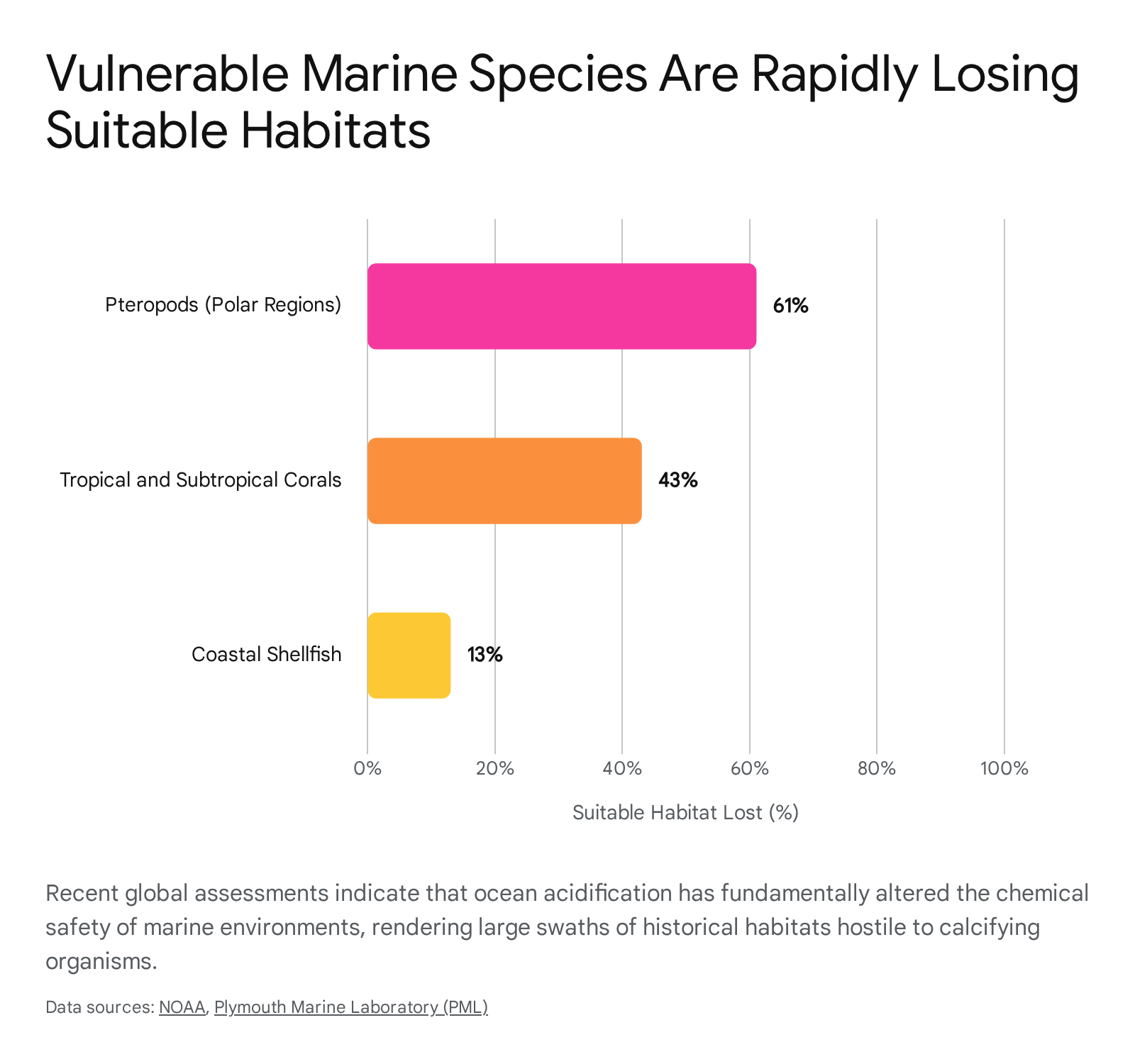
| Corals | Aragonite (Calcium Carbonate) | High | 15 - 40% reduction in calcification; weaker and thinner skeletons; heightened vulnerability to storm damage and thermal bleaching 111618. |
| Pteropods (Sea Butterflies) | Aragonite | Very High | Severe shell dissolution; thinner shells; estimated 61% loss of suitable polar habitats 101417. |
| Bivalve Mollusks (Oysters, Clams) | Calcium Carbonate | High | Reduced larval survival; physical deformities; impaired shell strength; estimated 13% loss of coastal habitats 101118. |
| Crustaceans (Crabs, Shrimp) | Chitin & Calcite | Moderate | Maintained calcification in some adults, but severe impairment of foraging behavior, vision, and predator detection 101113. |
| Marine Plants (Seagrasses, Fleshy Algae) | None (Photosynthetic) | Low (Potential Benefit) | Average 22% increase in growth; enhanced photosynthetic rates due to CO2 enrichment 711. |
Sensory Disruption in Non-Calcifiers
Even non-calcifying organisms that do not build shells are threatened by changing ocean chemistry. Acidification interferes with the fundamental acid-base balance within the bodily fluids of marine animals, leading to increased oxidative stress 518.
To survive in highly acidic water, fish and crustaceans must dedicate immense metabolic energy to maintaining their internal chemistry. This physiological trade-off detracts from their ability to grow, reproduce, or hunt efficiently 518. This invisible stress frequently manifests as neurological and sensory impairment. Research indicates that elevated acidity degrades the olfactory (smell) and visual systems of marine life.
For instance, the Dungeness crab - a vital commercial species on the North American coast - exhibits a reduced ability to navigate and locate prey in acidified conditions due to its reliance on chemical sensing 10. Similarly, certain fish larvae lose their ability to smell and avoid predators, and clownfish have demonstrated altered swimming patterns when exposed to lower pH levels 5721.
Early Life Stages Are the Most Vulnerable
While some adult marine organisms possess physiological mechanisms to temporarily buffer against acidity, their early developmental stages are vastly more vulnerable 518. Many marine species spend their early lives as microscopic larvae or veligers, dispersing via ocean currents. Because they are so small and lack developed biological defenses, they are highly susceptible to chemical stress.
Studies show that sea urchin and oyster larvae often fail to develop properly in acidified conditions, exhibiting physical deformities, reduced hatch rates, and an inability to begin initial calcification 51818. In a study of the polar pteropod Limacina helicina antarctica, researchers observed that exposure to acidified and warming conditions caused high larval mortality (up to 39%), with extensive shell malformation occurring before the larvae could even reach maturity 19. The extreme vulnerability of these larvae means that even if adult organisms manage to reproduce, their offspring may not survive to sustain the population 5.
Are There Any Winners?
While ocean acidification is overwhelmingly detrimental to the marine ecosystem, a few distinct groups of organisms may actually benefit from the influx of carbon dioxide.
Certain species of marine plants, such as fleshy algae, seagrasses, and specific diatoms, utilize dissolved CO2 directly for photosynthesis. In laboratory meta-analyses, elevated CO2 conditions led to an average 22% increase in growth among fleshy algae and an 18% increase among diatoms 711.
Additionally, shifting ocean chemistry may drastically alter the balance of "biofouling communities" - the tiny creatures that attach themselves to ships' hulls, underwater construction, and rocks. A study conducted by the University of Cambridge revealed that as acidity increased, shelled biofouling organisms like tube worms saw their populations plummet to just one-fifth of their normal numbers. In stark contrast, soft-bodied animals like sponges and sea squirts doubled or even quadrupled in number 20. While these shifts create isolated "winners," they fundamentally rewrite the three-dimensional complexity of local ecosystems, eliminating the intricate habitats that other species rely upon for shelter.
Where Are the Most Vulnerable Regions?
Ocean acidification is a global phenomenon, but its intensity and timeline vary drastically depending on regional oceanography, water temperature, localized human activities, and natural currents.
Polar Regions and the Southern Ocean
Basic chemistry dictates that cold water naturally absorbs and holds more carbon dioxide than warm water. Consequently, high-latitude environments like the Arctic and the Southern Ocean are acidifying at an accelerated pace 114.
In the Southern Ocean, open waters have experienced acidification rates 15% higher than the global mean, pushing up to 87% of the region's surface waters past safe planetary boundaries 921. The natural upwelling of deep, historical waters - which already contain higher concentrations of natural CO2 - mixes with newly absorbed anthropogenic carbon at the surface. This creates highly corrosive conditions for local marine life 1721.
The primary victims in this region are pteropods, commonly known as sea butterflies. These tiny, swimming sea snails secrete incredibly thin (10-15 μm) aragonite shells and form the bedrock of the polar food web, serving as a vital food source for fish and krill 1422. When live pteropods were extracted from the top 200 meters of the Southern Ocean, scanning electron microscopes revealed severe levels of shell dissolution. Laboratory incubations confirmed that just eight days in aragonite-undersaturated water produces significant etching and shell degradation 17. As the Southern Ocean continues to absorb carbon, these undersaturation events are projected to become more prevalent in space and time, occurring in over 70% of Southern Ocean surface waters by the 2070s under high-emission scenarios 21.
The Pacific Coast of North America
On the west coast of North America, stretching along California and the Pacific Northwest, the California Current System creates a powerful upwelling engine. This oceanographic process cycles deep, cold, and nutrient-dense water from the ocean floor up to the surface 23.
Because dead organic matter naturally sinks and decomposes at the ocean floor - releasing CO2 in the process - this deep water is naturally acidic and low in oxygen. When this naturally corrosive deep water is pushed to the surface and combined with surface waters burdened by modern greenhouse gas emissions, it creates a severe "amplification effect" 23. Analyses of centuries-old coral skeletons in the region indicate that CO2 is accumulating in North American coastal waters significantly faster than in the atmosphere 23.
This creates conditions uniquely hostile to local commercial fisheries. The Dungeness crab fishery has already experienced population declines, with acidity explaining approximately 45% of the red king crab population decline since the year 2000 24. Furthermore, ocean acidification can exacerbate the toxicity of algal blooms. Frequent delays in the California Dungeness crab season have occurred due to elevated levels of domoic acid - a naturally occurring neurotoxin produced by marine algae that accumulates in shellfish under specific ocean conditions 28.
The Pacific Islands and Southeast Asia
In warmer, tropical regions, the primary concern shifts from pelagic food webs to the structural integrity of coral reefs. Southeast Asia's Coral Triangle is a hub of unparalleled marine biodiversity, containing more than 75% of the world's reef-building coral species and supporting the livelihoods of over 360 million people 2526.
Similarly, Pacific Island nations like Fiji, Samoa, and Niue consist of up to 98% ocean territory and rely overwhelmingly on their surrounding reef ecosystems for sustenance, economic revenue, and physical survival 327.
By the year 2050, models suggest that only about 15% of the world's coral reefs will reside in waters with aragonite saturation levels adequate for sustainable, healthy growth 3. In these regions, acidification does not act alone; it operates in tandem with severe marine heatwaves. While thermal stress causes acute coral bleaching (the expulsion of symbiotic algae), acidification chronically weakens the remaining coral skeleton. This synergistic effect severely hinders the reef's ability to recover from thermal shock, storms, or disease 728. During the global bleaching event spanning 2023 to 2025 - the most severe on record - an estimated 84% of global reefs were impacted, highlighting the urgent threat of these compounded climate stressors 28.
The Socio-Economic Ripple Effect
The degradation of marine ecosystems translates directly into severe socio-economic consequences for human populations. Without deep reductions in global carbon emissions, the collapse of key marine species will fundamentally alter global supply chains, local food security, and financial markets.
The economic toll of ocean acidification on world fisheries is estimated to reach $10 billion annually 3429. However, modeling the exact economic future is fraught with uncertainty. Economic forecasts must account for complex, non-linear relationships between future emissions scenarios, market prices, operational costs, and the adaptive capacity of both fish and human fleets 303132. While some early economic reviews yielded mixed results, the consensus points to largely negative economic effects, particularly for coastal communities reliant on specific vulnerable taxa 3033.
Food Security and Seafood Prices
The fishing and aquaculture sectors are highly exposed to shifting ocean chemistry. In Southeast Asia, coastal populations consume nearly double the global average of marine-sourced protein, relying on seafood for 38% of their animal protein intake. The regional seafood industry contributes approximately $49 billion to the Southeast Asian economy 2. However, fish stocks in the region have already plummeted by an estimated 70% to 95% since the 1950s due to a combination of overfishing, destructive trawling, and habitat destruction, pushing local food security toward a dangerous tipping point 34. Acidification threatens to accelerate this decline by destroying the coral nurseries that juvenile fish rely upon.
Globally, the effects of a changing ocean are already visible in consumer markets. Shellfish yields have proven highly volatile. Retail data analysis into early 2026 indicates that overall pound sales for shellfish have trended downward, posting average declines of eight to ten percentage points year-over-year 35. When specific coastal fisheries experience emergency closures - such as the aforementioned domoic acid delays in the California crab season - seafood markets are forced to source from out-of-state or international suppliers. This supply chain disruption drives up prices for consumers during peak holiday seasons and inflicts severe economic pain on local fishers who lose their primary source of income 28.
Furthermore, the global seafood market is navigating complex policy battles and geopolitical trade uncertainty. In North America, producers are calling for a renewal of the Canada - United States - Mexico Agreement (CUSMA) to stabilize a deeply integrated agricultural market facing mounting environmental constraints 36. As global economic uncertainty rises - driven by tariffs and inflation - the added variable of climate-induced fishery collapse makes long-term commercial planning incredibly difficult 373839.
The Coastal Insurance Crisis
Beyond fisheries and tourism, coral reefs provide a critical, albeit hidden, financial service: natural coastal defense. Healthy reef systems act as massive underwater seawalls, effectively dissipating up to 97% of incoming wave energy during severe tropical storms and hurricanes 18. Globally, reefs prevent an estimated $94 billion in coastal flood damage every single year, providing natural security for over 100 million people 3446. Replacing these natural defenses with artificial, engineered seawalls would cost an estimated $2 trillion globally 34.
As ocean acidification and warming dissolve these natural barriers, coastal communities are left highly exposed to unfiltered wave energy and storm surges. This is not merely an ecological tragedy; it is a financial crisis.
Anthropogenic carbon emissions alter fundamental ocean chemistry, which in turn degrades marine biology, specifically calcifying coral reefs. As these reefs weaken and dissolve, they lose their structural integrity and their ability to act as friction barriers against the ocean. Consequently, large storm waves that would have once been broken offshore now bypass the degraded reef entirely, crashing directly into shorelines. This unfiltered physical impact leads to flooded coastal homes, destroyed infrastructure, and massive economic losses. This direct pathway from carbon emissions to property destruction is actively influencing actuarial risk models in the global financial sector, forcing insurers to drastically drive up property insurance premiums in vulnerable regions 18344740.
The global financial sector, particularly property insurance and risk management, has heavily incorporated this habitat loss into its pricing models. Actuaries now explicitly account for reef degradation when calculating coastal property risks and expected losses 18. Consequently, homeowners in high-risk coastal zones are facing staggering insurance premiums. In states like California, certain zip codes exposed to high climate and coastal risks may see home insurance premiums increase by 55% - or an average of $1,015 more annually - by 2026 47.
These soaring insurance costs are already chipping away at the foundation of the real estate market. A recent study by the National Bureau of Economic Research found that high premiums are dragging down home values by over $40,000 in areas highly exposed to natural disasters, as global investors begin to aggressively reprice disaster risk 41. In many disaster-prone zip codes, the primary concern for homeowners is no longer the price of the premium, but whether insurance carriers will agree to write a policy at all, leading to a crisis of uninsurable coastal real estate 50.
Can We Adapt? Solutions and Future Outlook
Given the dire projections, scientists and policymakers are actively exploring how marine ecosystems might adapt, and what interventions can mitigate the worst impacts.
The Limits of Biological Adaptation
A critical question in oceanography is whether marine organisms possess the capacity to genetically adapt to a more acidic ocean, or if they can only temporarily acclimatize. Multi-generational laboratory studies on rapidly reproducing organisms, such as certain algae and phytoplankton, show that genetic adaptation to high CO2 is possible for some species 4243. Culturing the coccolithophore Emiliania huxleyi over hundreds of generations revealed that long-term adaptation could potentially reverse some of the negative calcification responses observed in short-term "shock" studies 43.
However, adaptation is vastly more difficult for long-lived organisms like corals, commercially valuable fish, and slow-growing mollusks. Given the unprecedented rate at which ocean chemistry is currently changing, it is highly unlikely that complex marine plants and animals will have the evolutionary time required to adapt or migrate as they have during slower climatic shifts in Earth's deep geological past 542.
Local Interventions: Blue Carbon and Parametric Insurance
While the ultimate solution requires global carbon reduction, local interventions can help buffer specific ecosystems. The restoration of "blue carbon" habitats - such as mangroves, seagrass plains, and tidal marshes - offers a localized defense. These marine forests can absorb up to five times more carbon than terrestrial forests, drawing CO2 out of the local water column and providing a slightly less acidic refuge for vulnerable larvae and juvenile fish 4445.
To adapt to the vanishing natural infrastructure of coral reefs, innovative financial mechanisms are emerging. In the Caribbean and the Mesoamerican Reef regions, environmental organizations (like the MAR Fund), insurance brokers (like WTW), and local governments have launched "parametric insurance" programs for coral reefs 5546.
Unlike traditional indemnity insurance, which requires lengthy claims adjustments and damage assessments, parametric insurance pays out automatically and rapidly when a specific environmental trigger is met - such as a Category 3 hurricane passing within a certain radius. This immediate influx of capital allows local conservationists and dive teams to enter the water within days of a storm to physically repair, right, and stabilize damaged coral colonies before they are permanently smothered by sand or algae 5546. This scalable model is currently protecting thousands of hectares of coral and securing billions in reef-related income across Colombia, Costa Rica, and the broader Caribbean 5546.
Furthermore, Pacific Island nations are leading the charge in establishing regional monitoring networks. Initiatives like the Pacific Islands Ocean Acidification Centre (PIOAC) are training local scientists to collect robust, localized data, ensuring that the unique vulnerabilities of island nations are represented in global policy discussions, such as the IPCC reports 4748.
Bottom line
Ocean acidification is actively rewriting the chemical baseline of the world's oceans, posing an existential threat to calcifying marine life and the complex food webs they support. While isolated species may exhibit temporary resilience, the widespread dissolution of coral reefs and polar habitats signals a severe disruption to global food security and coastal infrastructure. Although localized adaptations like blue carbon restoration and parametric reef insurance offer temporary buffers, the scientific consensus remains unwavering: the only permanent solution to halting ocean acidification is a drastic and immediate reduction in global anthropogenic carbon dioxide emissions.