
How Loneliness Harms Physical Health
Loneliness acts as a chronic biological stressor that triggers the human body's evolutionary "fight-or-flight" survival mechanisms, leading to prolonged systemic inflammation and severely dysregulated stress hormones. Over time, this heightened state of physiological alert damages the cardiovascular and immune systems, accelerating cellular aging and significantly increasing the risk of premature death. By shifting gene expression away from antiviral defense and toward aggressive inflammation, chronic loneliness fundamentally alters how the human body operates at the molecular level.
The Paradigm Shift in Public Health
For decades, the medical community viewed loneliness primarily through a psychological or sociological lens, treating it as an unfortunate emotional state rather than a pressing clinical hazard. Today, that paradigm has shifted entirely. A robust and growing body of psychoneuroimmunology research demonstrates that feeling socially disconnected is a profound biological stressor that compromises structural brain health, impairs immune function, and shortens the human lifespan.
The global scale of this issue has prompted international health authorities to redefine social connection as a fundamental pillar of public health. In 2025, the World Health Organization (WHO) Commission on Social Connection released a landmark flagship report revealing that one in six people worldwide experiences loneliness 123. The commission's findings present a stark reality: loneliness is linked to an estimated 100 deaths every hour, culminating in more than 871,000 deaths annually 12.
While loneliness is frequently stereotyped as an affliction of the elderly, the epidemiological data reveals a crisis that spans all age demographics and geographic boundaries. The WHO reports that approximately one in five adolescents and young adults experience loneliness globally, with rates reaching nearly 24% in low-income countries compared to 11% in high-income nations 24. Among young adults aged 15 to 34, particularly young men, feelings of chronic isolation have surged, exacerbated by delayed life milestones and the rise of remote work environments 5. Concurrently, roughly one in three older adults continues to face severe social isolation 14. The recognition of this crisis has led to urgent calls for systemic interventions, reframing loneliness from a silent personal struggle to a modifiable determinant of global health 34.
Quantifying the Lethality: Mortality Benchmarks
The modern scientific understanding of loneliness as a lethal condition traces its origins to a groundbreaking 2010 meta-analysis led by Dr. Julianne Holt-Lunstad. By synthesizing data from 148 independent studies encompassing more than 308,000 participants followed for an average of 7.5 years, researchers sought to benchmark the mortality risk of lacking social connection against other well-established physiological threats 567.
The analysis revealed that individuals with strong, adequate social relationships possessed a 50% greater likelihood of survival compared to those who were socially isolated 56. To contextualize the magnitude of this effect for the general public and policymakers, the researchers translated the hazard ratios into familiar public health metrics. The data indicated that the mortality impact of being socially disconnected is comparable to smoking up to 15 cigarettes a day 811.
This specific statistic - often cited by the U.S. Surgeon General and international health bodies - stems from benchmarking the overall effect size of lacking social connection against the known mortality risks of moderate daily smoking 11. The research further demonstrated that the lethality of loneliness exceeds the mortality risks associated with several heavily funded public health targets, including excessive alcohol consumption, physical inactivity, and obesity 69.
Recent epidemiological updates and comparative meta-analyses continue to validate these findings. When assessing various environmental and lifestyle risks, social disconnection consistently ranks among the most dangerous.
| Risk Factor | Estimated Increase in Mortality Risk | Primary Biological Mechanism of Harm |
|---|---|---|
| Air Pollution (High Exposure) | 36% to 41% | Respiratory and systemic oxidative stress 1011. |
| Social Isolation / Loneliness | 26% to 35% | HPA axis dysregulation, chronic systemic inflammation, immune suppression 51216. |
| Physical Inactivity | ~20% to 31% | Metabolic syndrome, cardiovascular deconditioning 101113. |
| Obesity | ~20% | Adipose tissue inflammation, insulin resistance 81618. |
The data emphasizes that while societies invest billions in mitigating the risks of physical inactivity and poor air quality, the structural isolation of populations acts as an equally potent, compounding hazard 81016.
The Evolutionary Biology of the "Loneliness Alarm"
To understand why a perceived lack of social contact physically damages the cellular structure of the human body, one must examine the evolutionary history of the species. Humans are inherently social creatures. Throughout hominid evolution, humans possessed limited physical endowments compared to natural predators; survival depended entirely on collective action, shared resources, and mutual protection within small, interdependent tribes 1415.
In a prehistoric environment, separation from the group did not merely result in a lack of conversation - it was an acute physical emergency. An isolated human faced a sharply increased probability of death from starvation, predation, or untreated injury 14. Consequently, evolutionary forces engineered a powerful internal alarm system designed to protect individuals from the lethal dangers of isolation.
Just as physical pain evolved to warn an organism of tissue damage, and hunger evolved to signal a caloric deficit, loneliness evolved as a highly aversive biological signal 151617. According to evolutionary psychologists, the distressing sensation of loneliness is the body's way of motivating an individual to repair frayed social bonds and seek the safety of the group 1417.
Because the evolutionary cost of ignoring this alarm was death, the brain is wired to treat social isolation as a mortal threat. When a person feels lonely, the brain triggers a state of subconscious hypervigilance, scanning the environment for social threats 1416. This response operates on the "smoke detector principle" of human anxiety: it is far safer for the brain to overreact to a false alarm (e.g., misinterpreting a neutral facial expression as rejection) than to underreact to a real threat (e.g., being ousted from the tribe) 18.
While this heightened state of physiological arousal was highly adaptive for a lost hunter-gatherer who needed to remain hyper-alert to survive a night alone in the savanna, it becomes profoundly maladaptive in the modern era. Today, a person can live alone in a secure apartment, perfectly safe from predators, yet their brain - detecting a lack of meaningful connection - will continuously sound the evolutionary alarm, flooding the body with survival hormones for months or years on end 1418.
Differentiating Objective Isolation from Subjective Loneliness
While the terms are often used interchangeably in casual discourse, psychoneuroimmunology draws a strict, measurable distinction between social isolation and loneliness. They represent fundamentally different phenomena that leave distinct biological footprints on the human body 1920.
Social isolation is an objective, quantifiable state. It is defined by the measurable absence of social relationships, such as living alone, having a small social network, or experiencing an infrequent number of social contacts 192021.
Loneliness, conversely, is a subjective emotional experience. It is defined as the distressing psychological discrepancy between an individual's desired level of social connection and their actual experience 212223. It is entirely possible to be objectively isolated without feeling lonely, just as it is common to feel profoundly lonely while surrounded by family members or colleagues if those relationships lack depth and psychological safety 1924.
Recent studies, including extensive data from the Midlife in the United States (MIDUS) Refresher study, have revealed that objective isolation and subjective loneliness damage the body through independent physiological pathways 2025.
The Independent Biological Signatures
Researchers analyzing middle-aged adults found that social isolation and loneliness independently affect both the endocrine system and the innate immune system.
Objective social isolation (such as living alone) is strongly associated with a flattened diurnal cortisol slope, indicating a fundamental dysregulation of the body's daily stress hormone rhythms 2025. Furthermore, objective isolation is tightly linked to elevated levels of C-reactive protein (CRP), a key biomarker of systemic inflammation 20. This suggests that the physical absence of others removes a "social buffering" effect, leading to chronic physiological wear and tear.
Subjective loneliness, on the other hand, exerts its own distinct toll. Independent of how many people a person interacts with, the internal feeling of loneliness is strongly associated with elevated levels of Interleukin-6 (IL-6), another potent pro-inflammatory cytokine, as well as a heightened cortisol awakening response (CAR) 202526.
Because these mechanisms operate independently, an individual who is both objectively isolated and subjectively lonely faces a compounded biological burden 20. Understanding this distinction is critical for medical professionals, as interventions must address both the structural barriers to socialization and the psychological distortions that prevent meaningful connection 1920.
Endocrine Disruption: The HPA Axis and Cortisol Rhythms
When the brain's threat-detection centers - particularly the amygdala - perceive the vulnerability of loneliness, they signal the hypothalamus to activate the body's primary stress management infrastructure: the hypothalamic-pituitary-adrenal (HPA) axis 427.
The HPA axis responds to stress by releasing a cascade of hormones, culminating in the secretion of glucocorticoids, most notably cortisol, from the adrenal glands 2728. In a healthy, socially secure individual, cortisol follows a distinct diurnal rhythm. Levels peak sharply in the early morning to mobilize energy and prepare the body for the day's demands, then steadily decline throughout the afternoon and evening, allowing the body to enter a restorative state for sleep 2930.
Chronic loneliness fundamentally distorts this rhythm. Studies observing young and middle-aged adults indicate that loneliness alters cortisol secretion in several detrimental ways 2529. First, lonely individuals frequently exhibit an exaggerated cortisol awakening response (CAR). Their morning cortisol levels spike abnormally high, a physiological reflection of a hypervigilant brain bracing for the anticipated social threats and stressors of the coming day 2930.
Second, trait loneliness is associated with a flattened diurnal cortisol slope 2529. Instead of declining appropriately as the day progresses, cortisol levels remain unnaturally elevated into the evening. This sustained exposure to stress hormones prevents the cardiovascular system from resting and severely disrupts metabolic and cellular repair processes 2729.
Perhaps most damagingly, prolonged, unremitting activation of the HPA axis leads to a phenomenon known as glucocorticoid resistance 427. Normally, cortisol binds to glucocorticoid receptors to suppress inflammatory signaling once a threat has passed, acting as a vital brake on the immune system 30. However, when tissues are constantly bathed in high levels of cortisol due to chronic loneliness, they begin to downregulate their receptors, effectively becoming numb to the hormone's signaling 427. Without cortisol's inhibitory effect, the immune system's inflammatory response is left unchecked, leading to widespread, low-grade systemic inflammation 2730.
Immunometabolic Alterations and the CTRA
The most profound and complex physical changes caused by loneliness occur at the genomic level within the immune system. Researchers have identified a specific shift in gene expression triggered by chronic psychosocial stress, termed the Conserved Transcriptional Response to Adversity (CTRA) 31.
When the autonomic nervous system is locked in a state of sympathetic "fight-or-flight" activation due to perceived isolation, it sends neural signals directly to the bone marrow, altering the development and programming of immune cells 3132. From an evolutionary perspective, an isolated human faces a very specific threat matrix. Without the protection of a tribe, they are at a much higher risk of suffering traumatic injuries from predators or rival groups, which introduces bacteria into the bloodstream. Conversely, because they are not in close proximity to other humans, their risk of contracting a socially transmitted viral infection is relatively low 31.
Evolution adapted the immune system to anticipate this specific environment. In response to the biological signal of loneliness, the body aggressively upregulates the expression of genes responsible for pro-inflammatory responses (which are necessary to heal physical wounds and fight bacterial infections) while simultaneously downregulating the genes responsible for antiviral responses (which are deemed less immediately necessary) 273132.
In the modern world, this evolutionary adaptation is a devastating mismatch. The primary threats to an isolated person in a modern city are not animal attacks, but chronic, inflammation-driven diseases 3133. By permanently shifting the immune baseline, chronic loneliness traps the body in a state of unresolving, systemic inflammation 3132.
This state is readily identifiable in blood serum tests. Middle-aged and older adults experiencing chronic loneliness consistently demonstrate elevated levels of key acute-phase reactants and pro-inflammatory cytokines, including C-reactive protein (CRP), fibrinogen, and Interleukin-6 (IL-6) 263435. A recent study of over 42,000 adults in the UK Biobank found that loneliness and isolation lead to increases in several specific brain-expressed proteins associated with immune response and inflammation, cementing the biological link between a perceived lack of social connection and altered immune behavior 3642. Over time, this chronic inflammation damages arterial walls, fuels insulin resistance, and accelerates neurodegeneration 192433.
Epigenetic Aging and Cellular Degeneration
The physiological toll of loneliness extends beyond circulating hormones and immune cells; it actively accelerates the rate at which the human body ages at the cellular level. Recent advances in molecular biology allow researchers to measure "biological age" - the physical wear and tear on cells - which can differ significantly from chronological age.
This measurement relies on "epigenetic clocks," which analyze patterns of DNA methylation to estimate the pace of biological aging. Two of the most predictive clocks for morbidity and mortality are GrimAge and DunedinPACE 3337.
In a robust 2025 study utilizing data from the Midlife in the United States (MIDUS) project, researchers investigated the impact of "cumulative social advantage" on epigenetic aging 3744. Cumulative social advantage was quantified using 16 indicators spanning a lifetime, including the warmth of parental relationships in childhood, community involvement, religious support, and the depth of ongoing friendships in adulthood 3344.
The findings provided striking molecular evidence that social relationships dictate the pace of aging. Adults with high cumulative social advantage - those embedded in rich, sustained social networks over their lifetimes - demonstrated significantly slower epigenetic aging across multiple clocks, particularly GrimAge and DunedinPACE 3744. Furthermore, these socially connected individuals exhibited much lower levels of chronic systemic inflammation, commonly referred to as "inflammaging," which is a primary driver of cardiovascular and neurodegenerative diseases 33.
Interestingly, the study found no significant associations between long-term social advantage and short-term stress markers measured via overnight urine samples, such as immediate catecholamine output 333745. This suggests that the protective power of deep social ties shapes biology not merely by buffering fleeting daily stressors, but through a slow, compounding stabilization of fundamental epigenetic processes and long-term inflammation control 3345.
Manifestations of Disease: Cardiovascular and Cognitive Decline
The ultimate consequence of prolonged HPA axis dysregulation, chronic inflammation, and accelerated epigenetic aging is an early onset of severe chronic disease. The WHO notes that loneliness acts as a systemic multiplier for cardiovascular, metabolic, and neurological conditions 118.
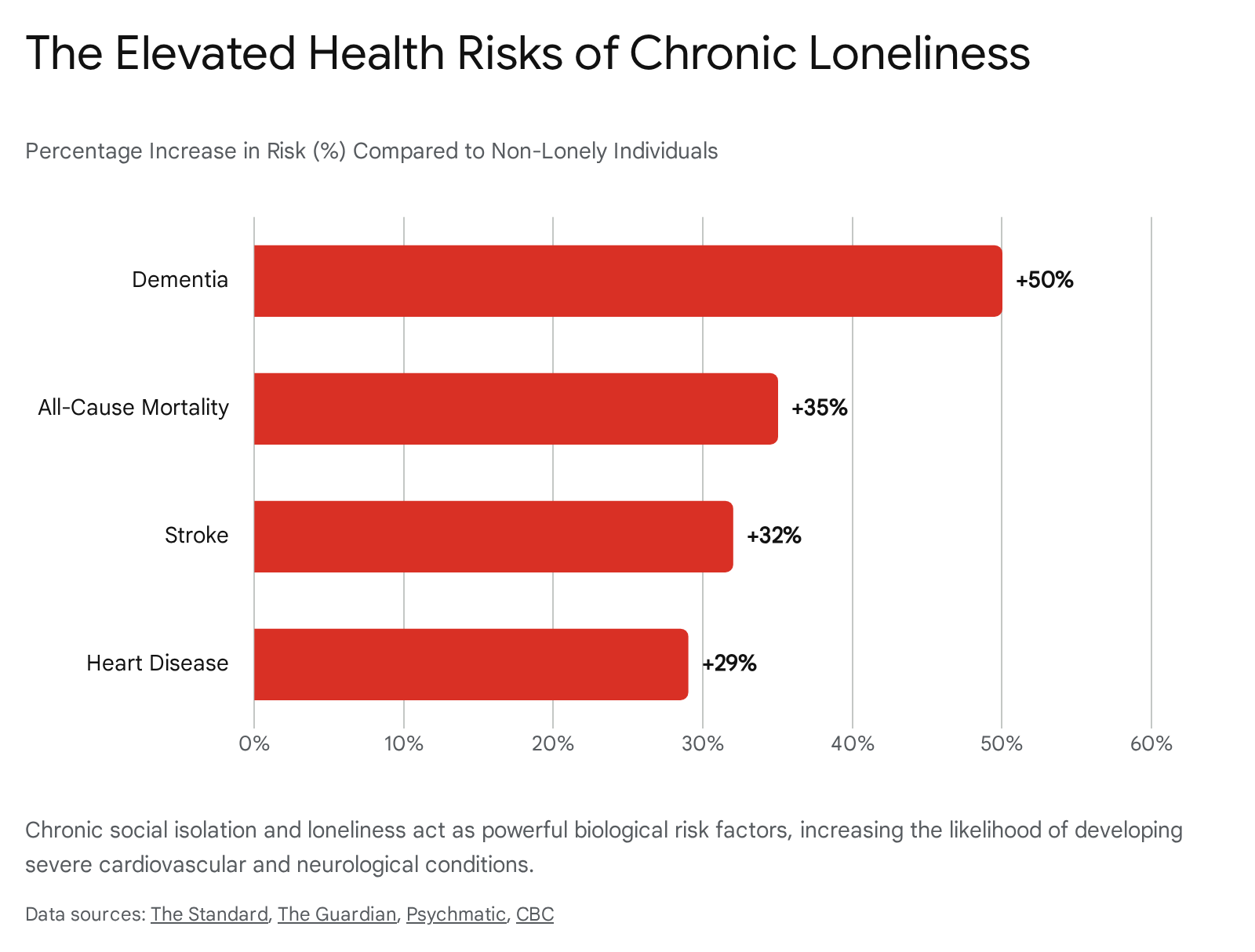
The physiological wear and tear of isolation is highly specific in its targets. Elevated levels of fibrinogen and CRP directly compromise the cardiovascular system, increasing arterial stiffness and coagulation tendency 1934. As a result, chronic loneliness is associated with a 29% increased risk of developing incident coronary artery disease and a 32% increased risk of stroke 82438.
In the brain, the damage is equally profound. Chronically elevated cortisol damages the hippocampus and limits neuroplasticity, while systemic inflammation breaches the blood-brain barrier 1927. Older adults experiencing high levels of social isolation demonstrate a 50% increased risk of developing dementia and Alzheimer's disease, driven by this persistent neuroinflammation and a lack of cognitive engagement 538. Furthermore, a 2024 systematic review published in The Lancet Healthy Longevity analyzed over 130 studies, finding a direct pathway where loneliness leads to an increase in physical frailty - characterized by muscle loss and decreased walking speed - which in turn creates a vicious cycle of further isolation, falls, and bodily decline 39.
Cross-Cultural Variations in the Physiological Stress Response
While the biological mechanisms linking social exclusion to inflammation are universal human traits, the psychological triggers that activate the "loneliness alarm" vary significantly depending on an individual's cultural context.
Sociologists broadly classify cultures along a spectrum of individualism and collectivism. Individualistic cultures (predominant in Western Europe and North America) emphasize personal autonomy, uniqueness, and independence 4849. Collectivistic cultures (predominant in Asia, Africa, and parts of the Middle East) emphasize group harmony, interpersonal obligations, and profound interdependence 4849.
A common assumption is that members of collectivist cultures, who rely heavily on social embeddedness, would suffer greater physiological damage from social exclusion. However, psychophysiological experiments reveal a paradox. In a notable cross-cultural study, researchers utilized the "Cyberball" paradigm - a pre-programmed online ball-tossing game designed to abruptly exclude and ignore the participant 48.
When comparing participants from an individualistic culture (Germany) to those from collectivistic cultures (China, India, and Turkey), researchers found that individualists were far more physically negatively affected by sudden social exclusion. German participants exhibited significant, immediate spikes in heart rate and cardiovascular stress upon realizing they were being ostracized by strangers 48. Conversely, participants from collectivist cultures did not display these immediate autonomic stress reactions 48.
Researchers theorize this difference lies in the structural composition of the self. Because the "collectivistic self" is deeply rooted in broad, stable community and family networks, it is less fragile and less susceptible to the immediate threat of exclusion by random individuals 48. The individualistic self, isolated by its pursuit of autonomy, requires constant validation of personal belonging, making it highly reactive to immediate rejection 48.
However, this does not mean collectivists are protected from loneliness. The cultural expectations surrounding relationships dictate the type of isolation that causes harm. In individualistic societies, loneliness is primarily triggered by a lack of close, voluntary friendships and a lack of confidants 4041. In collectivist societies, loneliness is triggered most acutely by weak family bonds, a failure to meet obligatory social roles, or living alone in a society where intergenerational living is the norm 494041. Because the cultural expectation of being embedded is so absolute in collectivist societies, the psychological discrepancy - and subsequent biological stress - can be severe when those expectations are not met 4942.
Reversibility: Clinical and Behavioral Interventions
Because loneliness is a biological state with severe downstream health consequences, public health strategies have increasingly focused on interventions capable of reversing this physiological damage. The data indicates that the structural damage to the brain and cardiovascular system can be mitigated if interventions are applied before irreversible cognitive or physical decline sets in 19.
However, resolving the biological crisis of loneliness is not simply a matter of increasing social contact. Because chronic loneliness rewires the brain to become hypervigilant, isolated individuals often unconsciously interpret ambiguous social cues as hostile, anticipate rejection, and display defensive behaviors that inadvertently push potential connections away 154344. Therefore, effective interventions must target both the environment and the individual's psychological processing.
Meta-analyses of hundreds of clinical trials have identified several pathways capable of reducing the perception of loneliness and reversing its physiological markers 4345.
| Intervention Strategy | Primary Method | Physiological and Psychological Impact |
|---|---|---|
| Cognitive Behavioral Therapy (CBT) | Identifying and altering maladaptive social cognitions and hypervigilance. | Reduces the perception of threat, lowering baseline anxiety and preventing the chronic activation of the HPA axis 4344. |
| Physical Exercise | Moderate to vigorous aerobic training and group physical activity. | Directly reduces cortisol, normalizes the HPA axis, activates the parasympathetic nervous system, and reduces circulating IL-6 and CRP 45465747. |
| Prosocial Engagement | Structured volunteering and community skill-building. | Increases sense of purpose, shown to directly reverse the CTRA gene expression profile, lowering systemic inflammation 3148. |
| Animal-Assisted Therapy | Interaction with therapy animals, particularly in long-term care facilities. | Demonstrates large effect sizes in reducing perceived loneliness by providing safe, non-judgmental connection that lowers immediate autonomic stress 4548. |
A 2025 meta-analysis published by the American Psychological Association, examining over 280 studies, confirmed that psychological interventions like CBT demonstrate the strongest and most sustained effects in reducing loneliness 43. By teaching individuals to notice their automatic assumptions of rejection and replace them with balanced interpretations, CBT effectively disarms the brain's "loneliness alarm" at the source 43.
Furthermore, addressing the physiological buildup of stress hormones directly through exercise provides a unique dual benefit. Regular physical activity not only provides opportunities for social facilitation but acts as a potent biological intervention that actively suppresses pro-inflammatory cytokines like TNF-alpha and IL-6, physically clearing the inflammatory burden caused by isolation 5747. Finally, mindfulness training has been shown in clinical trials to enhance stimulated IL-6 production in a healthy manner, improving innate immune responsivity and immunocompetence in lonely older adults 49.
The consensus among public health experts is that no single intervention is a panacea. The most effective strategies combine multiple objectives: improving social skills, providing structured opportunities for social contact, and utilizing psychological therapies to correct maladaptive threat perception, thereby returning the body's neuroendocrine and immune systems to a state of homeostasis 4448.
Bottom line
Loneliness is not merely an emotional deficit, but a profound evolutionary alarm system that interprets social isolation as a mortal threat. When activated chronically, this hypervigilance dysregulates the HPA axis and fundamentally alters immune gene expression, trading long-term cellular health for short-term inflammatory defense. This biological cascade accelerates epigenetic aging and drastically increases the risk of cardiovascular disease, dementia, and premature death, rivaling the lethality of smoking and obesity. Fortunately, the physiological damage is not entirely permanent; targeted interventions combining cognitive therapy, structured community engagement, and physical activity can effectively disarm the threat response, reduce systemic inflammation, and restore biological equilibrium.