
Greenhouse Effect vs Ozone Depletion: What's the Difference
The greenhouse effect is an atmospheric process where specific gases trap infrared heat close to Earth's surface, a mechanism that human activity has dangerously amplified to drive global climate change. In contrast, ozone depletion refers to the chemical destruction of a high-altitude protective shield that blocks harmful ultraviolet radiation from the sun, primarily caused by synthetic industrial refrigerants and aerosols. While humanity has successfully organized to heal the ozone layer through global chemical bans, the emission of greenhouse gases continues to accelerate, presenting a far more complex and escalating planetary crisis.
What Is the Greenhouse Effect?
To understand how the greenhouse effect differs from ozone depletion, it is essential to view the Earth's atmosphere as a layered system where different invisible gases perform entirely different physical functions. The greenhouse effect is fundamentally a thermodynamic process that dictates the temperature of the planet. It occurs primarily in the troposphere, the lowest layer of the atmosphere that extends from the Earth's surface up to roughly ten miles (15 kilometers) in altitude 112.
The mechanics of the greenhouse effect rely on the difference between incoming solar energy and outgoing planetary heat. The sun is incredibly hot, meaning it emits energy primarily as shortwave radiation, which includes visible light and ultraviolet energy 43. The Earth's atmosphere is largely transparent to this shortwave radiation. When this sunlight reaches the Earth, the planet's surface absorbs the energy and warms up. Because the Earth is much cooler than the sun, it emits this absorbed energy back outward as longwave, invisible infrared radiation - what we commonly feel as heat 434.
If the atmosphere were composed entirely of oxygen and nitrogen, this infrared heat would escape seamlessly into the vacuum of space. However, the atmosphere contains trace amounts of complex molecules known as greenhouse gases. These gases possess a molecular structure that allows them to absorb longwave infrared radiation. When they absorb this outgoing heat, they vibrate and re-emit the energy in all directions, including back down toward the surface 478.
This process is entirely natural and absolutely critical for the survival of life. Without the baseline natural greenhouse effect, Earth's average surface temperature would hover around -18°C (0°F), rendering the planet a barren, uninhabitable ball of ice rather than the temperate world that currently sustains diverse ecosystems 7.
The Enhanced Greenhouse Effect and Anthropogenic Warming
The environmental crisis humanity faces today is not the existence of the greenhouse effect, but its rapid and unnatural enhancement. Through the combustion of fossil fuels (coal, oil, and natural gas), widespread deforestation, and industrial agriculture, human civilization has flooded the troposphere with an overwhelming volume of greenhouse gases 438. This thickened atmospheric "blanket" traps far more infrared radiation than the natural baseline, violently disrupting the global climate system 85.
The primary drivers of this enhanced greenhouse effect include several key gases, each with distinct atmospheric lifespans and heat-trapping capabilities:
- Carbon Dioxide (CO2): Carbon dioxide is the most significant driver of contemporary climate change. While it is not the most potent gas per molecule, its sheer volume and incredibly long atmospheric lifespan - lasting centuries to millennia - make it the dominant force in planetary warming. CO2 is released primarily through fossil fuel combustion and changes in land use, such as clearing forests that would otherwise absorb the gas 8106.
- Methane (CH4): Methane is a highly potent short-lived climate pollutant. It accounts for approximately 16% of the total warming effect on the planet 12. Although it remains in the atmosphere for only about nine to twelve years, its capacity to trap heat in the short term is vastly superior to carbon dioxide. Methane emissions stem from natural wetlands, livestock digestion, rice cultivation, and the extraction and transport of fossil fuels 81012.
- Nitrous Oxide (N2O): Nitrous oxide is emitted heavily through the application of nitrogen-based fertilizers in agriculture, as well as through various industrial operations. It possesses a potent warming effect and, like carbon dioxide, has a long atmospheric lifespan, locking in future temperature increases 8612.
The Unprecedented Scale of Recent Warming
The accumulation of these heat-trapping gases is accelerating at an unprecedented rate. The World Meteorological Organization (WMO) releases an annual Greenhouse Gas Bulletin to track these concentrations based on data from the Global Atmosphere Watch network. The 2024 report revealed that global carbon dioxide levels experienced their steepest-ever increase, rising to 423.9 parts per million (ppm) 127. This marks a 52% increase above pre-industrial levels and a 12.5% increase in just the last two decades 127. Methane and nitrous oxide also reached record highs of 1942 parts per billion (ppb) and 338.0 ppb, respectively 67.
To quantify exactly how much extra heat is being retained by the Earth system, the National Oceanic and Atmospheric Administration (NOAA) utilizes the Annual Greenhouse Gas Index (AGGI). The index acts as a proxy for radiative forcing, which is the difference between incoming energy and outgoing energy.
The AGGI uses the year 1990 as its baseline, assigning it a value of 1.0, because 1990 was the reference year for the Kyoto Protocol emissions reduction targets 8910. According to NOAA's recent analyses, the AGGI reached a value of 1.54 in 2024. This starkly illustrates that the human contribution to atmospheric warming from long-lived greenhouse gases has surged by 54% since 1990 89.
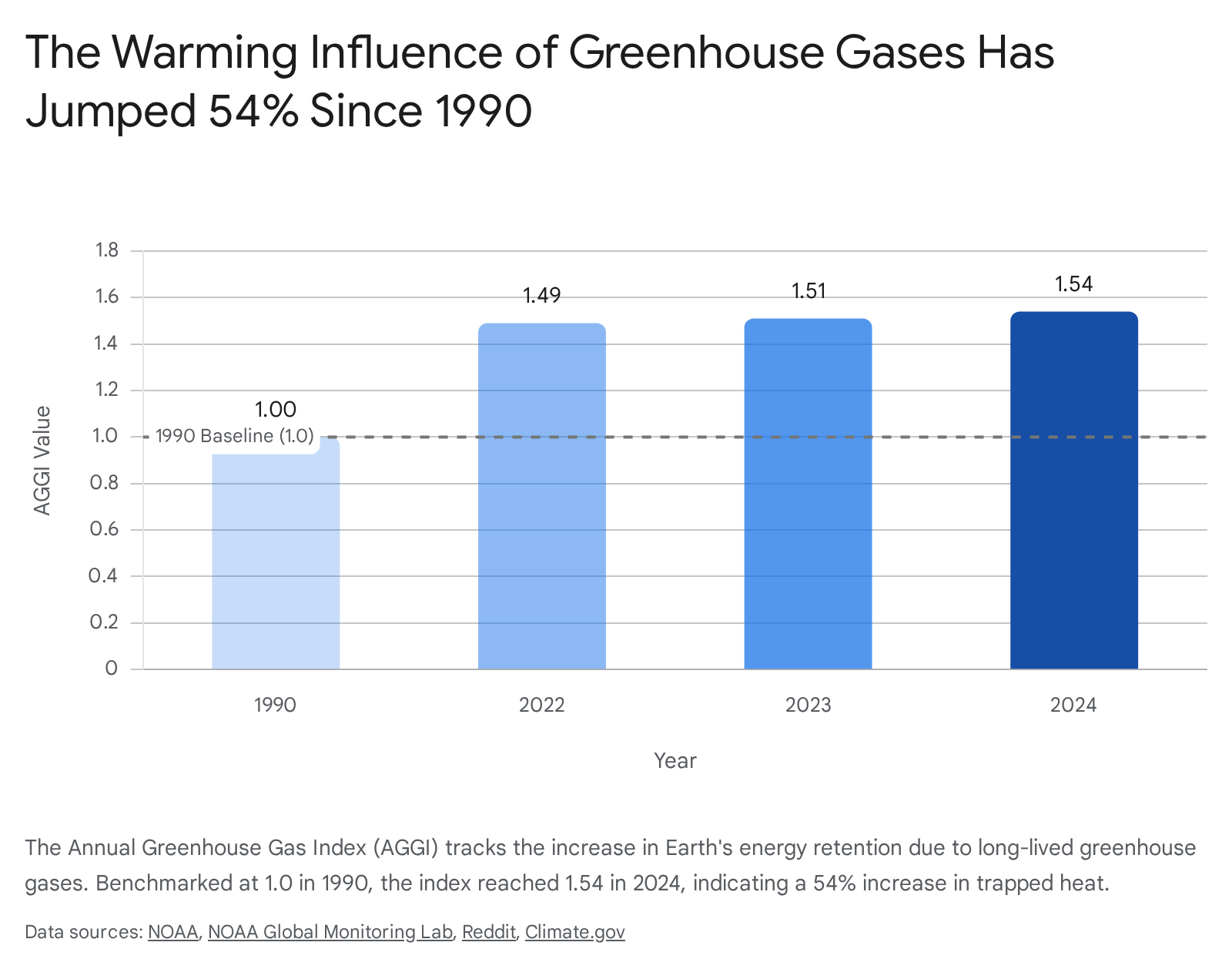
To put this in historical context, it took approximately 240 years from the dawn of the Industrial Revolution to reach the 1990 baseline, but it took only 34 years to increase that warming influence by another 54% 81011.
The consequences of this amplified greenhouse effect are profound and systemic. As the troposphere warms, the entire global climate system is destabilized. This results in the melting of terrestrial glaciers, rising global sea levels, the intensification of extreme weather events, and a highly erratic global water cycle oscillating between severe droughts and devastating deluges 11812.
What Is Ozone Depletion?
While the greenhouse effect is a phenomenon of heat retention in the lower atmosphere, ozone depletion is the chemical destruction of a radiation shield in the upper atmosphere. The mechanisms, locations, and consequences of these two processes are fundamentally different.
Ozone is a relatively simple molecule composed of three oxygen atoms (O3). In the troposphere where humans live, ozone is a rare and highly toxic pollutant. However, roughly 90% of all atmospheric ozone is concentrated high above the surface in the stratosphere, an atmospheric layer extending from roughly 10 miles to 30 miles (15 to 50 kilometers) in altitude 1213.
This stratospheric ozone layer is vital to the preservation of life on Earth. It acts as a planetary sunscreen, absorbing the majority of the sun's high-energy ultraviolet (UV) radiation 713. Specifically, the ozone layer blocks all of the most energetic UV-C radiation and the vast majority of harmful UV-B radiation 213. Without this protective barrier, intense UV radiation would strike the Earth's surface unimpeded. This would lead to catastrophic increases in human skin cancer rates, widespread development of cataracts and permanent blindness, severe suppression of the human immune system, and devastating damage to agricultural crops, terrestrial ecosystems, and the phytoplankton that form the base of the marine food web 1141314.
The Chemistry of Ozone Destruction
The depletion of this vital shield is not caused by the accumulation of heat, but rather by the introduction of synthetic, human-made chemicals. Beginning in the early 20th century, industrial chemists developed a suite of incredibly stable compounds known as chlorofluorocarbons (CFCs), along with related halons and other ozone-depleting substances (ODS) 415. Because these chemicals are non-flammable, non-toxic to breathe, and highly stable, they were widely adopted for use as propellants in aerosol spray cans (like hairspray and deodorants), as coolants in refrigerators and air conditioners, and as blowing agents for foam packaging 4151624.
The stability of CFCs made them excellent industrial products, but it also became their fatal flaw. When released into the troposphere, CFCs do not break down or wash out in the rain. Instead, over the course of a year or two, atmospheric turbulence mixes them globally, and they slowly drift upward into the stratosphere 1517.
Once CFC molecules rise above the bulk of the protective ozone layer, they are suddenly exposed to the raw, unfiltered intensity of the sun's ultraviolet light. This intense UV radiation provides enough energy to physically shatter the stable CFC molecules, a process known as photodissociation 15. This shattering releases highly reactive chlorine and bromine atoms 15.
These free halogen atoms are incredibly destructive to ozone. A single chlorine atom acts as a chemical catalyst; it strips an oxygen atom away from an ozone molecule (O3), breaking it down into regular oxygen gas (O2), which provides zero UV protection 215. Because the chlorine atom is a catalyst, it is not consumed in the reaction. It is free to move on and destroy another ozone molecule, and then another. Scientists estimate that a single chlorine atom can destroy tens of thousands of ozone molecules before it eventually bonds with another chemical and settles out of the stratosphere 26.
The Mystery of the Antarctic Ozone Hole
If ozone-depleting substances like CFCs were manufactured largely in the Northern Hemisphere and mixed evenly throughout the global atmosphere, why did the most severe ozone depletion manifest as a localized "hole" exclusively over Antarctica?
The answer lies in the unique and extreme meteorology of the South Pole. Ozone depletion is a seasonal phenomenon that requires a very specific set of environmental conditions to operate at maximum efficiency. During the dark Antarctic winter, the massive, ocean-surrounded landmass creates a highly symmetrical weather pattern. This symmetry generates a powerful band of circulating winds known as the polar vortex, which acts as an invisible wall, completely isolating the stratospheric air over the Antarctic continent 172718.
Cut off from the rest of the global atmosphere, the air inside the polar vortex plunges to extraordinarily low temperatures, often dropping below -78°C (-108°F) 1518. These frigid conditions allow for the formation of rare, high-altitude clouds known as Polar Stratospheric Clouds (PSCs) 71718.
The formation of PSCs is the critical missing link in the ozone hole mechanism. The ice crystals that make up these clouds provide a physical, solid surface in the otherwise gaseous stratosphere. Unreactive chlorine compounds that have drifted into the vortex settle on these ice crystals and undergo chemical reactions that convert them into highly reactive chlorine gas 151718.
Throughout the dark winter, this reactive chlorine gas silently accumulates inside the vortex 27. When the polar night ends and the sun finally rises in the Antarctic spring (September and October), the returning UV light strikes the accumulated chlorine gas, splitting it into billions of free chlorine radicals 1727. This triggers a massive, explosive chemical reaction that rapidly destroys the ozone layer within the vortex, forming the infamous "ozone hole" 1527.
While the Arctic also experiences winter, its geography is vastly different. The Arctic is an ocean surrounded by uneven landmasses and mountain ranges, which disrupts wind patterns and prevents the Northern Hemisphere polar vortex from becoming as tight, stable, or cold as its southern counterpart 1727. Because the Arctic rarely reaches the extreme temperatures required to form widespread Polar Stratospheric Clouds for long durations, it does not experience the same severe, annual ozone hole, though measurable depletion does occur 151718.
A Side-by-Side Comparison of the Two Phenomena
To clarify the profound distinctions between the enhanced greenhouse effect and ozone depletion, it is helpful to view their attributes side-by-side. They operate in different zones of the sky, rely on fundamentally different physical mechanisms, and threaten the planet in distinct ways.
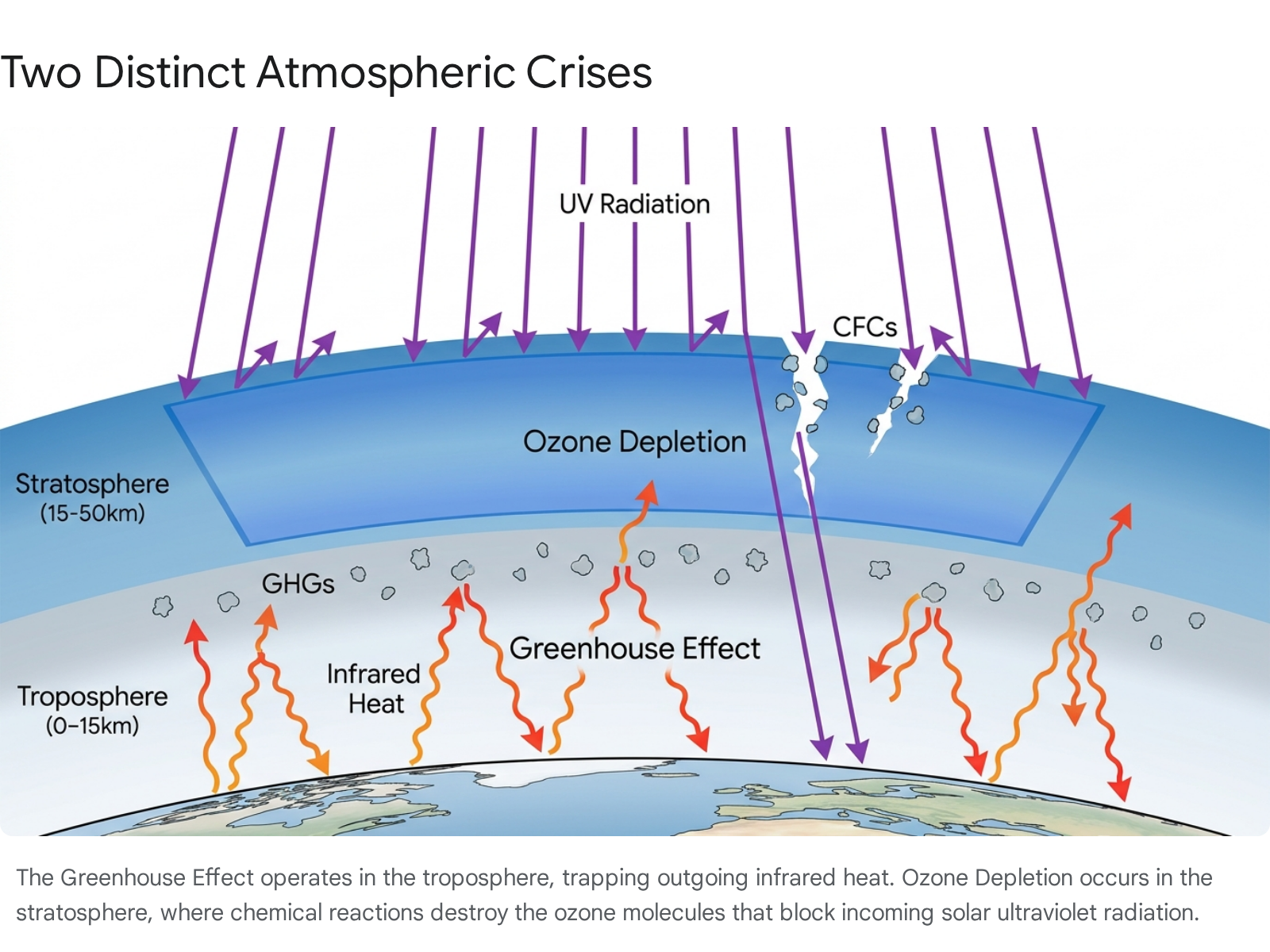
The following table summarizes the core differences between the two environmental issues:
| Feature | The Enhanced Greenhouse Effect | Ozone Depletion |
|---|---|---|
| Atmospheric Location | Troposphere (Ground level to ~15km altitude) 12 | Stratosphere (~15km to 50km altitude) 12 |
| Primary Mechanism | Gas molecules absorb and re-emit outgoing infrared thermal radiation back toward Earth 47. | Synthetic chemicals break down O3 molecules, allowing incoming ultraviolet radiation to pass through 415. |
| Main Responsible Gases | Carbon Dioxide (CO2), Methane (CH4), Nitrous Oxide (N2O) 78. | Chlorofluorocarbons (CFCs), Halons, and other industrial halocarbons 429. |
| Direct Human Consequence | Extreme weather, sea-level rise, severe droughts, flooding, disrupted water cycles 1812. | Increased rates of skin cancer, cataracts, and systemic immune suppression 41815. |
| Geographic Scope | Global warming occurs universally, as GHGs are well-mixed globally 8. | While global thinning occurs, the most severe destruction is highly localized over Antarctica 1517. |
| Status of the Problem | Rapidly worsening. The warming influence of GHGs has grown 54% since 1990 8. | Healing. ODS are largely phased out, and the layer is projected to recover by mid-century 19. |
Where Do the Two Environmental Issues Overlap?
Though fundamentally different in mechanism and consequence, climate change and ozone depletion are deeply interconnected through atmospheric physics, industrial chemistry, and global policy. Sometimes efforts to solve one problem have inadvertently exacerbated the other, and the changing climate continues to alter the rate at which the ozone heals.
The HFC Paradox: Trading One Crisis for Another
The international response to the ozone hole is widely considered the greatest environmental policy success in human history. Under the 1987 Montreal Protocol, the global community agreed to rapidly phase out the production of CFCs and other ozone-depleting substances 151920. However, the global economy still required refrigerants to keep food cold, buildings air-conditioned, and industrial processes functioning.
To bridge this gap, the chemical industry developed hydrofluorocarbons (HFCs) as a direct replacement for CFCs 2421. From the perspective of the ozone layer, HFCs were brilliant. Because they do not contain the destructive chlorine or bromine atoms, their ozone-depleting potential is essentially zero 2422. The transition to HFCs allowed the global economy to abandon CFCs and saved the stratospheric ozone layer.
However, a severe unintended consequence quickly became apparent. While HFCs do not destroy ozone, they are extraordinarily potent "super" greenhouse gases 1921. The molecular structure of HFCs makes them thousands of times more effective at trapping infrared heat in the troposphere than an equivalent mass of carbon dioxide 2122. As the developing world rapidly modernized and adopted refrigeration and air conditioning, the production of HFCs skyrocketed, growing at a rate of 8% to 15% annually 2123.
Recognizing that solving the ozone crisis was inadvertently accelerating the climate crisis, the international community returned to the negotiating table. This led to the Kigali Amendment to the Montreal Protocol, a landmark agreement to phase down the use of HFCs 1921.
The language of this policy is highly specific: it mandates an "HFC phase-down" rather than a total "phase-out." Because modern HVAC and refrigeration systems still require functional gases, governments agreed to reduce the total consumption of HFCs to 15% to 20% of their original baselines on a CO2-equivalent basis 37. This allows industries to blend HFCs with newer, lower global warming potential (GWP) chemicals, slowly transitioning the market without causing economic collapse 37. The World Meteorological Organization notes that the successful implementation of the Kigali Amendment is on track to prevent up to 0.5°C of catastrophic global warming by the end of the century 2122.
For the average consumer, this regulatory phase-down is largely invisible. Consumers are not required to discard existing appliances; rather, regulations focus on the chemical makeup of newly manufactured equipment, ensuring that as old air conditioners are naturally replaced, the new units utilize next-generation, climate-friendly refrigerants 22.
Stratospheric Cooling: The Greenhouse Feedback Loop
A lesser-known physical interaction between the two phenomena is how the enhanced greenhouse effect structurally alters the upper atmosphere, creating a feedback loop that interferes with ozone recovery.
Because greenhouse gases like CO2 trap massive amounts of infrared heat close to the Earth's surface in the troposphere, significantly less heat is allowed to radiate upward into the stratosphere 34. Consequently, as the surface of the planet rapidly warms, the stratosphere is experiencing a prolonged cooling trend 34.
This stratospheric cooling presents a significant mechanical problem for the healing of the ozone layer. As established previously, the aggressive chemical reactions that destroy ozone occur most efficiently on the icy surfaces of Polar Stratospheric Clouds (PSCs) 1518. These clouds only form when temperatures drop below the extreme threshold of -78°C 18.
A stratosphere that is artificially cooled by the greenhouse effect means that these critical temperature thresholds are reached more frequently, and the resulting PSCs persist for longer durations over larger areas 34. Essentially, global warming preserves and extends the precise meteorological conditions that promote chlorine-driven ozone destruction. This positive feedback loop means that even as human emissions of CFCs drop to zero, the recovery of the ozone hole could be significantly delayed by the physical changes wrought by climate change 34.
The Dual Nature of Tropospheric Ozone
The final major intersection of these two issues is the role of ozone itself, which acts as a "Jekyll and Hyde" gas depending entirely on its altitude.
- Stratospheric ("Good") Ozone: As discussed, the naturally occurring ozone layer high in the stratosphere protects terrestrial life from ionizing ultraviolet radiation 13. It is protected under international treaties.
- Tropospheric ("Bad") Ozone: Closer to the ground, ozone is not naturally emitted; it is a secondary, toxic air pollutant. It forms when sunlight bakes chemical precursor emissions - specifically nitrogen oxides (NOx) and volatile organic compounds (VOCs) - released from vehicle exhausts, power plants, and industrial solvents 132425.
At ground level, this "bad" ozone is the primary ingredient in urban smog 213. Inhalation of tropospheric ozone causes severe respiratory illnesses, exacerbates asthma, and is linked to approximately one million premature deaths annually 242641. Furthermore, it induces oxidative stress in plants, disrupting photosynthesis and slashing the yields of staple crops like wheat and maize, causing global economic losses estimated between $11 billion and $18 billion annually 242627.
Crucially, tropospheric ozone is not just a pollutant; it is also a highly potent, short-lived greenhouse gas 2426. Because of its molecular structure, it absorbs radiation and alters evaporation rates and cloud formation 2426. Despite having an atmospheric lifespan ranging from only a few hours to a few weeks, the accumulation of tropospheric ozone since the pre-industrial era makes it the third most significant contributor to global warming, behind only carbon dioxide and methane 2427. Research indicates that tropospheric ozone is responsible for approximately 0.23°C of present-day global warming 2627.
The chemistry of tropospheric ozone introduces even more complexity into climate mitigation. Ozone governs the atmosphere's oxidation capacity by acting as the primary source of hydroxyl (OH) radicals. These OH radicals are responsible for scrubbing other greenhouse gases out of the air. If policymakers successfully reduce the pollution that causes tropospheric ozone, they improve human health, but they inadvertently suppress OH concentrations. Fewer OH radicals mean that methane (a potent greenhouse gas) lingers in the atmosphere for a longer period, potentially offsetting the climate benefits of reducing the ozone 27. This intertwined chemistry presents a unique challenge for scientists attempting to draft integrated climate and clean air policies 2627.
The Psychology of the Aerosol Myth: Why We Confuse the Two Crises
Despite decades of distinct scientific research and highly divergent policy responses, the general public continuously conflates global warming with the ozone hole. Extensive pedagogical studies have documented this persistent confusion. Surveys of university students and pre-service educators consistently reveal a dominant mental model: a vast majority incorrectly believe that the ozone hole allows more heat from the sun to enter the atmosphere, thereby causing global warming 282930. Conversely, many believe that reducing carbon dioxide emissions will heal the ozone layer 30.
This confusion is scientifically unfounded. While it is true that the ozone hole allows more UV radiation to reach the surface, this radiation does not cause significant heating. Ultraviolet light accounts for only about 8% of the total energy emitted by the sun 14. The vast majority of the sun's energy arrives as visible light and near-infrared radiation. The additional physical thermal energy added to the Earth system through the Antarctic ozone hole is negligible - far too small to explain the massive, global warming trend of the past century 14.
Why Did the Misconception Stick?
If the science is clear, why does the public remain confused? Sociologists and science communicators point to how popular culture consumed environmental news in the late 20th century.
The concept of an "ozone hole" caused by aerosol hairspray provided an easily digestible, highly visual metaphor 244731. The public could easily picture a literal hole in a shield allowing dangerous rays to beam down. Furthermore, the threat of the ozone hole was immediate, personal, and visceral: unfiltered UV light causes skin cancer and blindness 1431. This created what sociologists call a "hot crisis" - a scenario that prompts rapid emotional response and swift political action 31.
Crucially, the solution to the ozone crisis was relatively painless for the average citizen. Banning CFCs in hairsprays and refrigerators was a technological switch implemented by chemical manufacturers 4749. Consumers did not have to give up their air conditioners or their aerosol beauty products; the industry simply changed the invisible propellant gas inside the can 2447.
Climate change, on the other hand, lacks a simple bridging metaphor. It relies on complex concepts like statistical weather anomalies, the invisible accumulation of carbon, and long-delayed global impacts 31. More importantly, the solution to climate change is not a simple chemical swap; it requires a fundamental, global overhaul of the entire fossil-fuel-based energy economy, altering how humanity travels, builds, and consumes 4731.
Because the ozone hole was the first major global atmospheric crisis to capture public attention, people naturally mapped their understanding of the new crisis (climate change) onto the framework of the old one 331. When the media reported that consumer hairsprays were destroying the atmosphere, millions of well-intentioned citizens switched to pump-spray bottles 4749. Decades later, because they solved the "hairspray problem," many individuals mistakenly concluded they had also addressed the global warming crisis 4749.
Current Trajectories and Future Outlooks
The divergent trajectories of these two atmospheric crises offer both immense hope and a stark, urgent warning.
The battle against ozone depletion stands as a testament to the power of swift, science-based international cooperation. Because of the near-universal ratification of the Montreal Protocol, over 99% of ozone-depleting substances have been permanently phased out of global production 16. The WMO reports that this intervention has worked: the stratospheric ozone layer is healing 19.
If current policies are maintained, the ozone layer is projected to return to its healthy 1980 benchmarks by around 2040 for the majority of the globe, by 2045 over the Arctic, and by 2066 over the Antarctic 161920. Recent observational data confirms this long-term recovery trend. WMO and NOAA tracking showed that the Antarctic ozone holes in 2024 and 2025 were notably smaller, shorter-lived, and later-forming than the large deficits recorded earlier in the decade 1220. While experts caution that continued scientific monitoring remains essential to track rogue emissions and atmospheric fluctuations, the crisis is fundamentally contained 20.
Conversely, the fight against the enhanced greenhouse effect remains an escalating, uncontained crisis. Despite global agreements like the Paris Accord, the latest data illustrates that the accumulation of long-lived greenhouse gases has not peaked. The 2024 WMO Bulletin explicitly warned that carbon dioxide is accumulating faster than at any time during human existence, locking in elevated temperatures for decades even if emissions were rapidly reduced to net zero tomorrow 632.
The physical impacts of this trapped heat are becoming increasingly severe. The WMO noted that global temperatures recently breached the significant 1.5°C threshold relative to pre-industrial times, driven by long-term warming combined with El Niño conditions 6. This heat is degrading the planet's natural ability to regulate itself. Natural carbon sinks - like terrestrial forests and oceans - are losing their efficiency. In 2024, widespread droughts, heat stress, and massive vegetation fires severely reduced the amount of carbon absorbed by land ecosystems, meaning a higher percentage of human emissions remains in the atmosphere, further accelerating the warming cycle 101232.
Bottom line
The greenhouse effect is an energy-retention process where gases like carbon dioxide and methane trap outgoing infrared heat in the lower atmosphere, driving profound global climate change. Ozone depletion is a distinct chemical process where synthetic industrial refrigerants break down the upper atmosphere's protective shield, allowing harmful incoming ultraviolet radiation to reach the surface. While swift international action successfully banned ozone-destroying chemicals and put the ozone layer on a clear path to recovery, greenhouse gas emissions continue to accelerate rapidly, demanding systemic overhauls of global energy and agricultural infrastructure to prevent catastrophic planetary warming.