Psychological effects and coping strategies for youth climate anxiety
The accelerating pace of anthropogenic climate change has precipitated a concurrent psychological crisis, particularly among young people who anticipate bearing the lifelong consequences of ecological degradation. This phenomenon, widely documented in psychological literature as climate anxiety or eco-anxiety, represents a profound emotional and cognitive response to the threat of environmental collapse. While climate anxiety is increasingly recognized by psychiatric professionals as a rational response rather than a pathological defect, its severity can precipitate significant functional impairment, chronic distress, and complex mental health challenges among youth. This report synthesizes current research on the psychological manifestations of climate anxiety, demographic and geographic disparities in its prevalence, the clinical debate surrounding its diagnostic classification, and the diverse cognitive coping mechanisms young people employ. Furthermore, it examines the complex psychological duality of youth climate activism, which serves simultaneously as a source of community empowerment and a catalyst for profound burnout.
Global Prevalence and Functional Impairment
Empirical data reveals that climate anxiety is not a fringe phenomenon but a pervasive, defining generational experience. The foundational 2021 global survey published in the journal The Lancet Planetary Health, which assessed 10,000 individuals aged 16 to 25 across ten countries, established the baseline for contemporary understanding of youth climate distress 12. The findings indicated that 59% of respondents were very or extremely worried about climate change, while 84% reported being at least moderately worried 13.
The psychological burden of this ecological awareness translates directly into daily functional impairment. Over 45% of the global youth cohort reported that their feelings regarding climate change negatively affected their daily lives, including their ability to eat, sleep, concentrate, attend school, and maintain relationships 145. The cognitive dimensions of this anxiety are equally stark: 75% of respondents endorsed the statement that the future is frightening, and 83% believed that humanity has failed to care for the planet 13. Young people frequently report a broad spectrum of negative affective states, with more than half of surveyed global youth experiencing sadness, fear, anxiety, anger, powerlessness, helplessness, and guilt 167.
Subsequent localized studies have reinforced and expanded upon these global findings. A 2024 survey of 15,793 youth in the United States demonstrated that 85% were at least moderately worried about climate impacts, with 38.3% reporting that these feelings negatively affected their daily functioning and 42.8% stating that climate change actively impacted their mental health 48. Furthermore, research indicates that climate anxiety influences major, long-term life decisions. Approximately 20% to 30% of surveyed young adults express fear or reluctance regarding having children due to the warming climate, a figure that rises among individuals who have directly experienced severe weather events 3. In highly vulnerable micro-states, the prevalence is nearly universal; for instance, a 2020 study in Tuvalu found that 95% of respondents expressed climate anxiety, with 87% indicating an influence on their ability to behave normally 9. Similarly, 38% of surveyed Greenlanders reported strong or moderate feelings of fear concerning climate change 9.
Demographic Variations in Climate Distress
The psychological impact of climate change does not affect all demographics equally within the youth cohort. Epidemiological studies highlight distinct variations based on age, gender, and educational context. Research indicates that climate anxiety generally increases throughout adolescence and peaks in early adulthood 2. Cross-sectional studies of youth aged 16 to 25 demonstrate small but significant positive correlations showing that concern and negative emotions about climate change are higher among older respondents within that bracket 10. This is theorized to occur because older adolescents and young adults possess a more developed capacity to envisage a hypothetical future and recognize the long-term socioeconomic implications of ecological degradation 2.
Gender differences are also consistently observed in the literature. Young women and girls report significantly higher levels of eco-anxiety, climate worry, and negative emotions than young men and boys 210. Conversely, male respondents tend to express greater optimism regarding the future and demonstrate higher levels of faith in governmental responses to the climate crisis 10. Furthermore, educational context plays a role in psychological vulnerability. Students enrolled in environmental degree programs or courses frequently exhibit heightened levels of specific coping mechanisms, driven by their intense academic exposure to the severity of planetary boundaries being overshot 211.
Regional Disparities and Geographic Vulnerability
While climate anxiety is a global phenomenon, its intensity and epidemiological footprint vary significantly across geographic regions. The psychological burden is demonstrably heavier in the Global South, where populations face the most immediate and severe physical consequences of climate change despite having contributed the least to historical greenhouse gas emissions 12. The 74 lowest-income countries combined emit only 10% of the world's total greenhouse gas emissions, yet they endure the most severe climate impacts due to geographic exposure, socioeconomic sensitivity, and low adaptive capacity 13.
Populations in the Global South frequently experience climate anxiety as an immediate, existential threat rather than a theoretical future scenario. Extreme weather events, such as catastrophic flooding, heatwaves, and prolonged droughts, act as direct trauma catalysts that compound baseline eco-anxiety 1214. In the Philippines, an overwhelming 84% of youth report being extremely or highly worried about the climate crisis, marking the highest vulnerability among surveyed nations 1615. Similarly, youth in India, Nigeria, and Brazil report significantly stronger psychological impacts and higher rates of functional impairment compared to their peers in the United States, the United Kingdom, and Finland 121015.
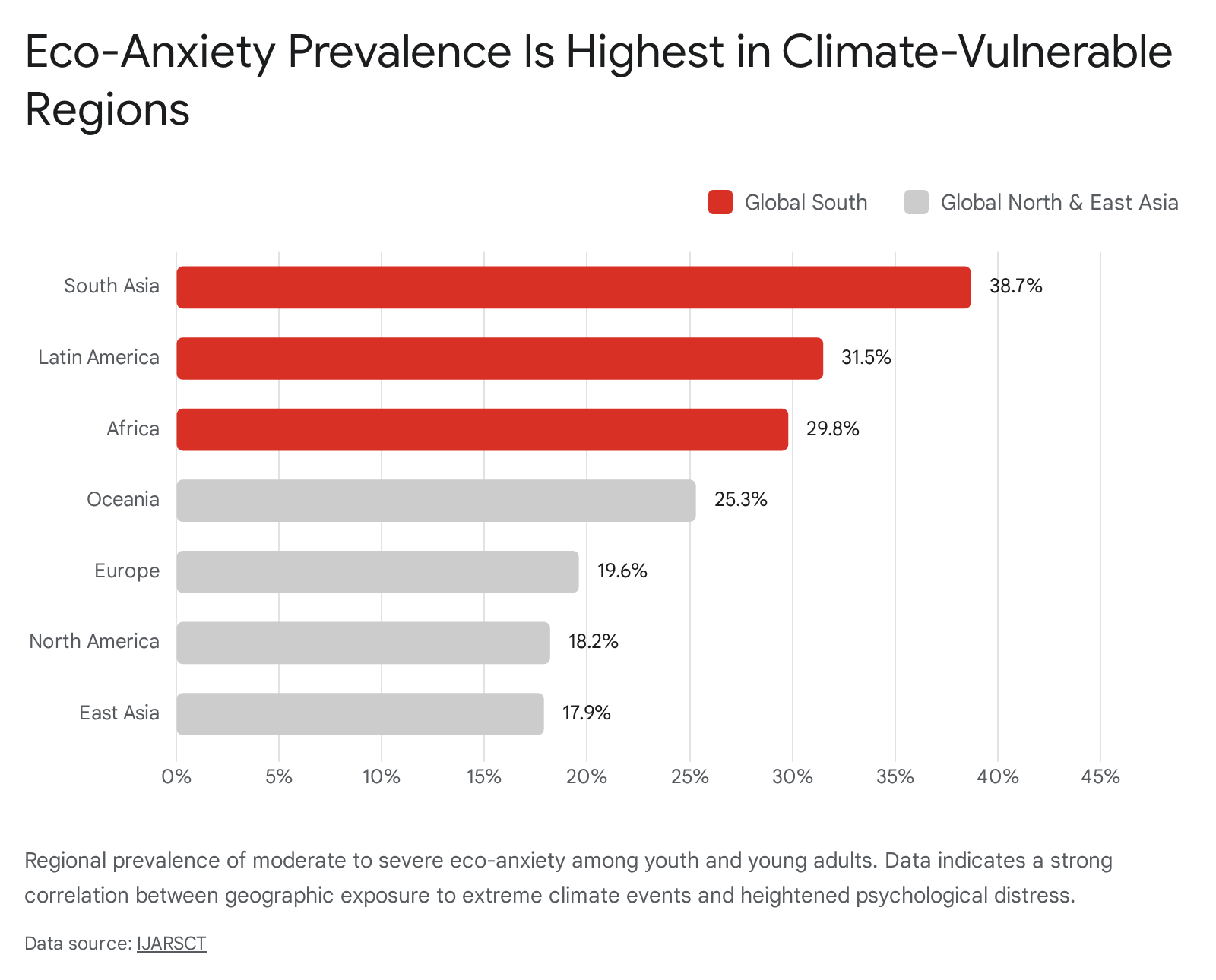
The epidemiological landscape of eco-anxiety demonstrates clear stratification based on regional vulnerability. Survey data utilizing the standardized Hogg Eco-Anxiety Scale (HEAS-13) establishes a definitive hierarchy of psychological burden across continents.
| Global Region | Prevalence of Moderate to Severe Eco-anxiety (%) | 95% Confidence Interval |
|---|---|---|
| South Asia | 38.7% | 35.2 - 42.3 |
| Latin America | 31.5% | 28.1 - 34.9 |
| Africa | 29.8% | 26.4 - 33.2 |
| Oceania | 25.3% | 22.1 - 28.5 |
| Europe | 19.6% | 16.7 - 22.5 |
| North America | 18.2% | 15.4 - 21.0 |
| East Asia | 17.9% | 15.1 - 20.7 |
The disparity in climate anxiety is deeply intertwined with systemic inequalities and a lack of adaptive resources. While communities in the Global North generally possess the infrastructure, financial capital, and insurance networks to implement physical adaptations, populations in the Global South often face the reality of forced migration or starvation when communities are affected by climate events 1316. This relative powerlessness against immediate physical threats drastically elevates the rates of reported anxiety, depression, and post-traumatic stress disorder in these regions 512.
Cultural paradigms and media consumption also influence regional manifestations of climate distress. For instance, despite the high prevalence of climate concern globally, anomalies exist in nations with differing environmental engagement histories. In Japan, data indicates that 14.6% of Generation Z respondents are not worried about climate change, marking the highest rate of non-concern among surveyed nations 15. Furthermore, 41.6% of Japanese youth report that they do not discuss climate change with others, highlighting cultural differences in emotional expression and social processing of environmental fears 15.
Clinical Classification and Diagnostic Frameworks
As the prevalence of climate anxiety increases, mental health professionals face a critical debate regarding its clinical classification. Leading psychiatrists emphasize that climate anxiety is not an inherent pathology, delusion, or irrational phobia. Rather, it is a healthy, constructive, and accurate psychological response to a real, escalating, and scientifically validated threat 51718. Consequently, climate anxiety is not officially recognized as a distinct standalone mental health disorder in the primary diagnostic manuals relied upon by psychologists and psychiatrists 19.
However, clinicians acknowledge that while the origin of the anxiety is rational, the symptoms can become debilitating enough to impair daily functioning and exacerbate existing mental health vulnerabilities. In severe cases, climate anxiety can precipitate or worsen Generalized Anxiety Disorder (GAD), Major Depressive Disorder (MDD), or Post-Traumatic Stress Disorder (PTSD), particularly among youth who have survived extreme weather events 5181920. To navigate this clinical complexity, researchers have developed psychometric tools such as the Climate Change Anxiety Scale (CCAS). The CCAS evaluates both cognitive-emotional impairment and functional impairment, allowing clinicians to detect when rational climate worry crosses the threshold into clinically significant psychological distress requiring intervention 2122.
A significant development in the clinical recognition of climate distress occurred with the September 2025 updates to the American Psychiatric Association's Diagnostic and Statistical Manual of Mental Disorders, Fifth Edition, Text Revision (DSM-5-TR). While the APA did not create a specific climate anxiety disorder, they expanded the supplementary Z-code 65.8, officially renaming it "Moral, Religious, or Spiritual Problem" to explicitly codify "moral distress" and "moral injury" 2324. Z-codes (or V-codes) are used to document conditions that are not mental disorders but may be a primary focus of clinical attention and influence a patient's overall mental health status 1725. Many researchers and clinicians argue that the profound grief, powerlessness, and betrayal young people feel toward older generations and governments - who they perceive as having failed to protect the biosphere - perfectly aligns with the concept of moral injury 1623. This classification update provides a formal mechanism for clinicians to validate, document, and treat severe climate distress without pathologizing the patient's rational apprehension regarding the future 23.
Mechanisms of Psychological Coping
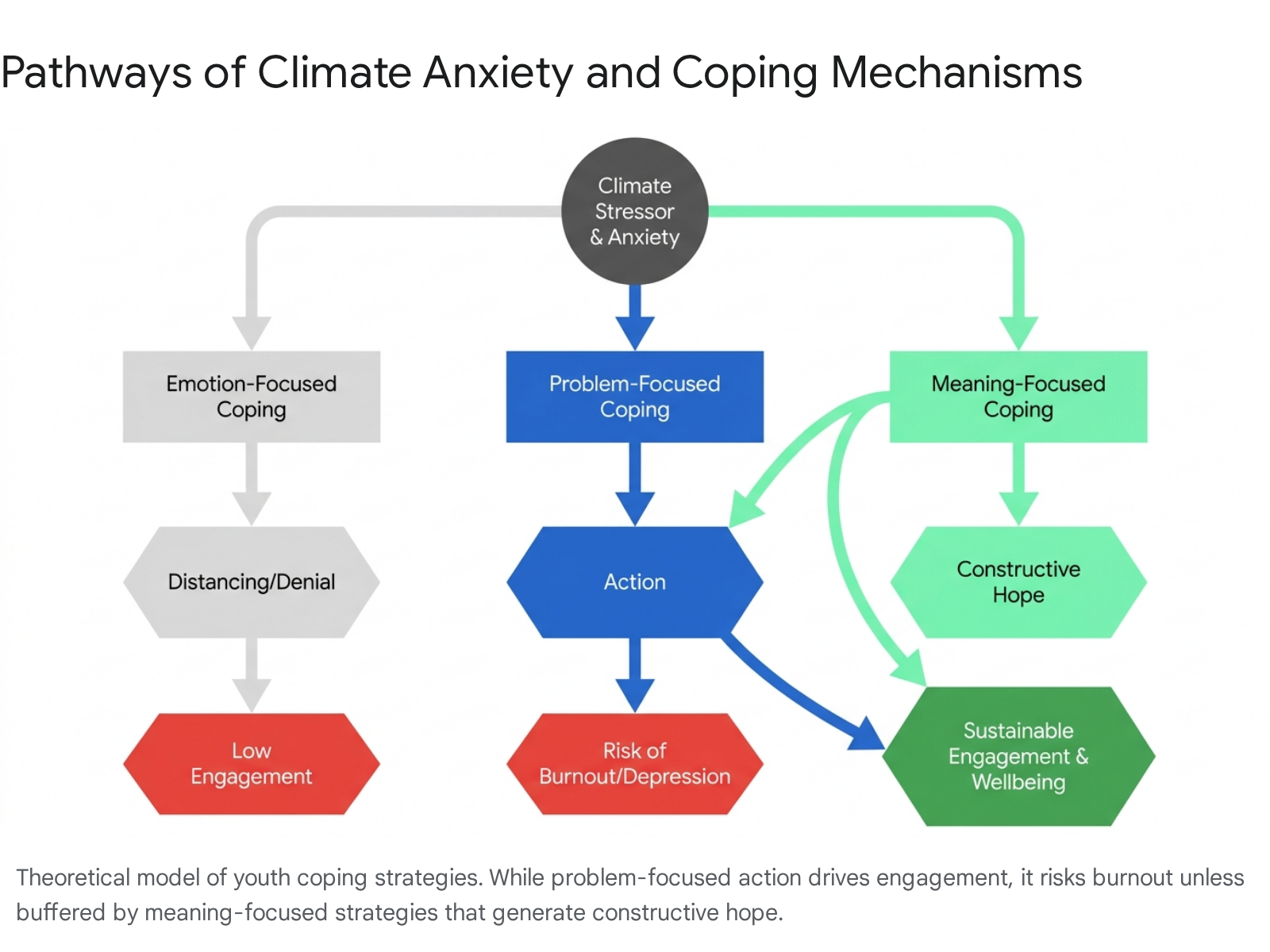
Given that climate anxiety is a chronic, escalating stressor with no immediate or localized resolution, psychological research has increasingly focused on how youth cope with this sustained emotional burden. Coping strategies are composites of cognitive and behavioral efforts used to manage internal and external demands 26. These strategies dictate whether an individual channels their anxiety into resilient, adaptive action or succumbs to maladaptive psychological deterioration. Environmental psychology, heavily informed by the longitudinal research of Maria Ojala, identifies three primary coping mechanisms utilized by young people: emotion-focused, problem-focused, and meaning-focused coping 27282930.
Emotion-Focused Coping (Maladaptive Avoidance)
Emotion-focused coping involves attempts to minimize the emotional distress of the climate crisis rather than addressing the actual stressor itself 272931. In the context of climate change, this frequently manifests as cognitive avoidance, distancing, or the outright denial of the problem's severity 2832. While distancing may provide short-term relief from intense anxiety and protect an individual's immediate sense of wellbeing, it is widely classified as a maladaptive strategy in the long term 2633. Studies on adolescent cohorts indicate that youth who rely heavily on emotion-focused coping demonstrate the lowest levels of environmental efficacy, engage in the fewest pro-environmental behaviors, and often harbor underlying pessimistic outlooks regarding humanity's future 2834.
Problem-Focused Coping (Action and Vulnerability)
Problem-focused coping directs an individual's cognitive and behavioral efforts toward solving the stressor 2729. For youth confronting climate change, this translates into seeking detailed information, drastically altering personal consumption habits, or participating in direct political activism 2835. While problem-focused coping is strongly and positively correlated with pro-environmental behavior, it carries significant, often overlooked psychological risks 2832.
Research indicates that when young people rely exclusively on problem-focused strategies, they frequently report higher levels of clinical anxiety, stress, and depression 2832. Because the magnitude of the global climate crisis inevitably outpaces individual action, a purely problem-solving approach often results in profound frustration. The realization that individual sacrifices (such as recycling or altering diets) are insufficient to halt systemic ecological degradation can trigger emotional exhaustion if not buffered by other cognitive strategies 32.
Meaning-Focused Coping (Adaptive Resilience)
Meaning-focused coping has emerged in the psychological literature as the most critical adaptive buffer against the detrimental mental health effects of climate anxiety 2730. This strategy involves profound cognitive reframing: acknowledging the grim severity of the crisis while actively seeking out sources of constructive hope 30. Key elements of meaning-focused coping include actively placing trust in other societal actors (such as scientists, educators, and progressive politicians), recognizing historical precedents where humanity has overcome seemingly insurmountable challenges, and finding a sense of personal purpose through collective environmental engagement 28293536.
Crucially, meaning-focused coping acts as a regulatory psychological buffer. Research on adolescent cohorts demonstrates that when problem-focused coping (taking action) is paired with meaning-focused coping (cultivating hope and trust), the risk of depression and anxiety drops significantly 2830. Youth employing this dual strategy report higher life satisfaction, increased optimism, and sustained environmental engagement without succumbing to emotional burnout 28.
Behavioral Coping Profiles Among Youth
Youth do not utilize coping strategies in isolation; rather, they combine them into broader behavioral profiles. A cluster analysis of late adolescents in Sweden identified three distinct patterns based on how these strategies are synthesized, providing profound insight into behavioral outcomes.
| Coping Profile | Strategy Combination | Psychological and Behavioral Outcomes |
|---|---|---|
| Solution-Oriented (43%) | High Problem-Focused + High Meaning-Focused | Highest levels of moral responsibility, pro-environmental behavior, and optimism. Acknowledges worry but channels it adaptively into sustained action. |
| Avoidant (33%) | High Emotion-Focused (Denial/Distancing) + High Meaning-Focused | Lower pessimism but significantly lower moral responsibility and lower engagement in climate action. Prioritizes emotional protection over problem-solving. |
| Uninvolved (24%) | Low on all coping strategies | Lowest optimism, highest pessimism, and high vulnerability to mental distress due to a lack of active cognitive processing. |
These profiles demonstrate that attempting to eliminate climate worry through avoidance is ultimately less protective for youth mental health than acknowledging the worry and utilizing meaning-focused strategies to process it constructively 343738.
The Duality of Youth Climate Activism
For many young people, participating in the global climate justice movement is a direct extension of adaptive coping. However, sociological and psychological studies reveal that climate activism represents a profound double-edged sword for youth mental health, operating simultaneously as a protective factor and a primary vector for psychological distress 394041.
Empowerment and the Collectivization of Despair
Activism can significantly mitigate the feelings of isolation, powerlessness, and eco-paralysis that frequently accompany climate anxiety. When youth transition from individual worry to shared collective action, they experience measurable mental health benefits. Taking physical action combats guilt, increases a sense of self-efficacy, and fosters strong social connections 353642. Studies indicate that being embedded in a community of like-minded individuals allows young people to collectivize their despair 3943. By sharing their fears openly with peers who validate their emotional experiences, youth generate communal hope, which is vital for long-term psychological resilience 93943. Whether through policy advocacy, organizing school strikes, or participating in art-based resistance, activism serves as a vital conduit for young people to reclaim agency over their futures 4041.
Eco-Burnout and Institutional Betrayal
Conversely, activism exposes young people to intense psychological demands that frequently culminate in severe eco-burnout 3941. The symptoms of youth activist burnout mirror traditional occupational burnout, encompassing physical exhaustion, emotional detachment, brain fog, helplessness, and a profound sense of personal failure 4144.
Several unique, compounding stressors precipitate this burnout among young climate activists. First, youth activists operate under the intense burden of survival responsibility. They are keenly aware that they are fighting for their own future livability, creating an unsustainable internal pressure to maintain constant engagement, often at the expense of sleep, education, and leisure 414245. Second, a phenomenon known as adultification forces young people into high-stakes leadership roles without the developmental maturity, structural support, or mentorship required to navigate political resistance and systemic apathy 41.
Furthermore, a major driver of activist distress is the persistent invalidation youth face from adults and political leaders. Surveys reveal that nearly 58% of youth feel ignored or dismissed when expressing climate concerns 3. This generational misalignment - where youth perceive older generations as prioritizing short-term economic gains over long-term planetary survival - breeds chronic frustration and a deep sense of institutional betrayal 1245.
Intersectionality and Minority Stress in Activism
The psychological toll of climate activism is further exacerbated by intersecting socio-economic vulnerabilities. Activists of color and those operating within the Global South face compounded psychological burdens 124244. These young people must frequently navigate systemic racism and exclusion within environmental spaces themselves, operate with fewer financial and mental health resources, and manage the immediate trauma of disproportionate climate impacts on their local communities 424446. Additionally, activists from the Global South are often excluded from international climate conferences due to funding constraints or visa issues, further deepening feelings of marginalization and powerlessness on the global stage 42.
Conclusion
Climate anxiety represents a defining psychological paradigm for modern youth. It is not an irrational pathology, but rather an evidence-based apprehension regarding an unstable future, characterized by a complex interplay of grief, fear, and moral distress. The burden of this anxiety is inherently unequal, disproportionately afflicting youth in the Global South and marginalized communities situated at the forefront of ecological disaster.
While the psychiatric community has rightly resisted classifying climate anxiety as an individual disorder, the recognition of environmental distress under updated diagnostic frameworks for moral injury underscores the systemic nature of the crisis. To safeguard the psychological well-being of young people, interventions must transcend simple risk-awareness and avoid the pitfalls of demanding unceasing activism. Equipping youth with meaning-focused coping strategies - fostering trust, communal solidarity, and constructive hope - is essential. By providing robust intergenerational mentorship and validating their legitimate fears, society can help young people navigate the narrow path between paralyzing despair and unsustainable activist burnout, empowering them to face the future with resilient agency.