
What Is a Personal Brand and Does It Help Your Career
A personal brand is the intentional, strategic practice of defining and expressing an individual's unique professional value to a target audience. Empirical research confirms that a robust personal brand directly increases perceived employability, salary potential, and overall career satisfaction by serving as a critical differentiator in a crowded labor market. However, cultivating one effectively requires carefully calibrating authenticity to avoid workplace penalties, navigating complex cultural norms, and steering clear of the reputational risks associated with digital oversharing.
Decoding the Personal Brand: Origins and Definitions
The concept of a "personal brand" is occasionally dismissed as a modern social media invention, but its roots in management science and organizational psychology run much deeper. Tracing back to Tom Peters' seminal 1997 article "The Brand Called You," personal branding has evolved from a niche corporate strategy into a fundamental requirement for career survival in the digital age 1.
At its core, personal branding is a proactive, strategic process. It involves creating, positioning, and maintaining a positive impression of oneself, based on a unique combination of individual characteristics 23. This process signals a specific promise to a target audience through a differentiated narrative and visual imagery 2. Unlike traditional corporate branding, which focuses on products or services, personal branding commodifies human capital, cultural capital, and social capital, transforming an individual's expertise into a recognizable and valuable entity in the labor market 45.
In modern organizational behavior literature, personal branding sits at the intersection of marketing, sociology, communication, and psychology 3. It has emerged as an essential means of attaining career success in an era characterized by flexible work arrangements, project-based structures, and the "gig economy," where the responsibility for career advancement has shifted entirely from the organization to the individual 23.
Personal Branding vs. Reputation Management
A critical distinction must be made between personal branding and reputation management. While the two concepts are symbiotic and frequently conflated, they operate on entirely different timelines, psychological principles, and strategic objectives. If personal branding is the architectural design and construction of a house, reputation management is the security system and maintenance crew 5.
Personal branding is the intentional effort to shape, express, and magnify the value an individual offers to the world 7. It is inherently proactive and offensive. Reputation management, conversely, is the ongoing process of preserving and maintaining the way others perceive that brand 57. Public relations professionals often equate proactive reputation management to purchasing car insurance, while reactive reputation management is akin to paying for the damages after an accident 8.
| Feature | Personal Branding | Reputation Management |
|---|---|---|
| Primary Goal | Build and project a desired image to attract opportunities (Attraction). | Monitor, preserve, and safeguard the existing public image (Mitigation). |
| Timing | Proactive, strategic, and forward-looking. | Reactive, defensive, or ongoing based on perception shifts. |
| Locus of Control | High control: The individual dictates what and how to share. | Limited control: Heavily influenced by what others say or publish. |
| Nature of Action | Offensive: Focused on highlighting strengths, uniqueness, and expertise. | Defensive: Focused on mitigating damage and maintaining public sentiment. |
Table 1: The structural differences between personal branding and reputation management 579.
A well-defined personal brand lessens the need for extensive reputation management down the road, as it builds a buffer of trust and credibility with the audience 510. However, even the most brilliantly crafted personal brand requires ongoing reputation management as a reality check to ensure the intended message is weathering shifts in public perception 510.
The Tangible Career ROI: Empirical Evidence of Impact
Skepticism surrounding personal branding often stems from a historical lack of quantifiable evidence. However, a growing body of empirical research demonstrates that personal branding yields highly tangible, measurable career outcomes.
In a comprehensive two-part study spanning Western and Asian cultural contexts (N=477), researchers developed the Personal Brand Equity (PBE) scale to measure the direct impact of branding on career success 211. The research established that personal branding does not directly cause career satisfaction in a vacuum. Instead, it functions through a powerful mediating variable: perceived employability 212.
Individuals who actively engage in personal branding experience a significant boost in their perceived employability - their self-assessed and demonstrable ability to identify and realize career opportunities in both internal and external labor markets 26. This elevated employability fully mediates the path to greater career satisfaction 26. The studies reveal that personal branding activities are most effective when they successfully signal professional value to a target audience, generating three critical dimensions of Personal Brand Equity: 1. Brand Appeal: The emotional connection and motivation associated with the individual's identity 7. 2. Brand Differentiation: The unique skills and knowledge that separate the individual from competitors 7. 3. Brand Recognition: How well the individual's brand is known within their industry or professional network 78.
Salary Premiums and Corporate Alignment
The financial implications of building strong Personal Brand Equity are striking. Survey data indicates a significant positive correlation between high scores on the PBE scale and higher job satisfaction, faster promotion rates, and increased salary potential 7. Industry reports align with these academic findings, suggesting that 70% of employers consider a candidate's personal brand to be more important than their traditional resume 1. Furthermore, professionals who achieve the status of a "global superstar" within their niche - those with the highest tier of visible expertise - can command up to 13 times more pay than their less-visible peers 1.
Interestingly, the impact of personal branding on salary is also influenced by the nature of the employing organization. Research from Duke University's Fuqua School of Business indicates that highly unique, "horizontally differentiated" brands tend to pay higher salaries to attract employees whose personal brands align perfectly with their distinct culture 9. Conversely, highly prestigious, "vertically differentiated" corporate brands sometimes pay lower wages, relying on the "psychic income" and resume-building power their prestige offers to employees 9. In both scenarios, an employee's established personal brand dictates their negotiating leverage and long-term career trajectory.
The Hidden Job Market: Active vs. Passive Candidates
The financial premium placed on personal brands is closely tied to how modern recruitment operates. According to global workforce data from platforms like LinkedIn, 70% of the talent market consists of "passive candidates" 1718.
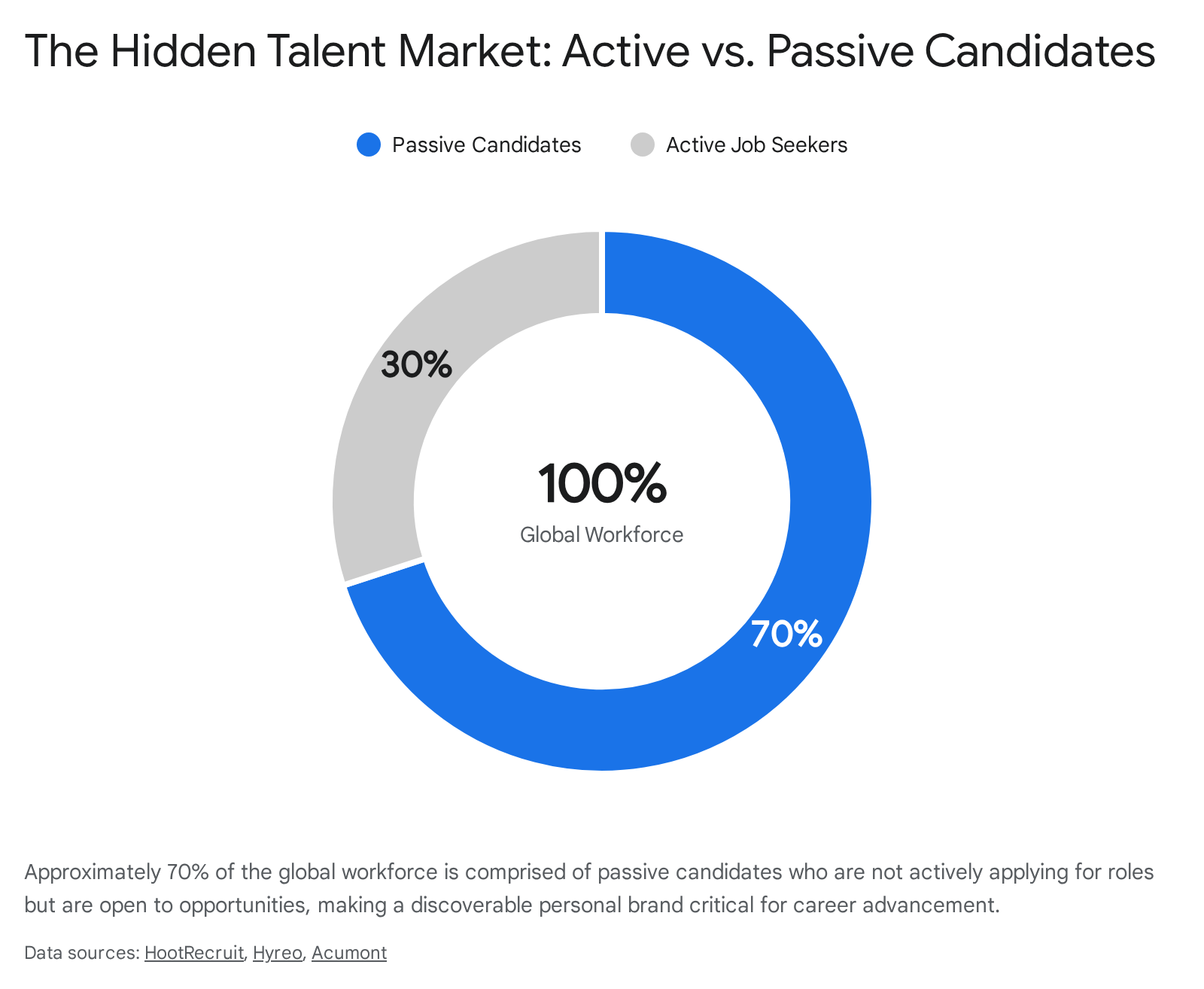
These are professionals who are currently employed and not actively applying for jobs, but who remain open to the right opportunity if approached correctly 171819.
Recruiters actively hunt for this passive talent because they are often perceived as higher-quality hires. Because they are already employed, they are vetted by the market, require less investment in training, and are not desperately job hunting, meaning they will carefully evaluate opportunities for a mutual fit 1720. Furthermore, research shows that passive candidates are 120% more likely to want to make a substantive impact in their next role compared to active job seekers 17.
Because passive candidates do not submit inbound applications, recruiters rely entirely on digital footprints, social media presence, and industry reputation to find them 1819. A professional with a strong personal brand acts as a magnet for these hidden opportunities, receiving inbound inquiries that bypass the traditional, highly competitive application process 2021. Without a visible personal brand, professionals limit themselves to competing for the 30% of jobs available to active seekers, completely cutting themselves off from the vast majority of premium opportunities 17.
Strategic Imperatives for Founders vs. General Employees
While personal branding benefits professionals across the spectrum, the stakes, strategies, and outcomes differ vastly depending on whether the individual is an employee or a company founder.
For startup founders and C-level executives, the personal brand is often indistinguishable from the corporate brand. In the early stages of a business, before the company has established strong market recognition, the founder's reputation serves as a proxy for the company's credibility 2223. This visibility has massive financial implications. Data indicates that 87% of investors consider a founder's personal brand a significant factor in their funding decisions 24. Furthermore, nearly half (48%) of a company's overall reputation is directly attributed to the personal brand of its leader 24.
The financial markets reward this visibility: CEOs who maintain strong personal brands see their companies' share prices increase up to 80% faster than those of their less-visible peers in the Fortune 250 22. Founder branding also heavily influences talent acquisition, increasing the positive outcome of attracting top talent by 70% and retaining staff by 77% 24.
For general employees, personal branding serves a different suite of objectives. It acts as an engine for internal mobility and external employability 610. Employees with established internal brands - those who are known for specific expertise and intrapreneurship behaviors - are more likely to be tapped for hidden internal opportunities and cross-functional leadership roles 610. Externally, employees who advocate for their industry and display thought leadership generate business leads that convert seven times more frequently for their employers, making them highly valuable, revenue-generating assets to their organizations 1.
The "Authenticity Trap" and the Distraction Penalty
One of the most persistent myths in modern personal branding is the directive to "just be yourself." Driven by a cultural shift toward vulnerability, professionals are frequently encouraged to bring their "whole selves" to work and share deeply personal aspects of their lives online. However, psychological research reveals that unfiltered authenticity is fraught with hidden career risks.
A prominent study published in the Journal of Applied Psychology investigated the outcomes of employees sharing positive non-work events (e.g., getting a new puppy, running a marathon) with colleagues 26. The findings exposed a stark "hierarchy effect." When senior leaders share personal wins, they receive a "warmth benefit" - they are humanized, viewed as relatable, and their social standing increases 26. However, when junior or front-line employees share the exact same information, they suffer a "distraction penalty" 26.
Because junior employees have less established social capital, their personal disclosures are often unconsciously interpreted as a lack of focus or commitment to their roles 26. This creates a paradox: the junior employees who most need to build social capital are the ones most likely to be penalized for attempting to do so through personal disclosure 26.
Oversharing can shift the focus away from a professional's qualifications and inadvertently trigger unconscious biases or raise red flags regarding their reliability 27. Whether in a job interview or on a LinkedIn feed, sharing overly personal details, financial struggles, or workplace frustrations rarely builds a brand; instead, it creates perceived obstacles for hiring managers and colleagues 2728.
The Authenticity Dimmer Switch
To navigate this landscape, organizational psychologists suggest abandoning the idea of authenticity as a binary light switch - where an individual is either entirely "real" or entirely "fake." Instead, authenticity should be treated as a conceptual dimmer switch 2911.
On one extreme of this spectrum is the rigid corporate facade, where a professional shares nothing, resulting in a cold, untrustworthy persona. On the opposite extreme is chronic oversharing, characterized by unfiltered impulsivity that triggers the distraction penalty and sabotages careers 29.
In the middle lies the optimal zone of "bounded authenticity" or strategic authenticity 291112. This requires adjusting the dial based on the context, the audience, and hierarchical positioning 2911. Leaders who master this do not suppress who they are; rather, they discern which version of themselves the moment demands 29. They filter their storytelling by asking, "What part of this experience will resonate best with my audience's needs?" 32. The goal is to reveal enough slight imperfection to signal trust and competence, without crossing into unprofessional territory that erodes authority 13.
Navigating Cultural Landmines in Global Markets
The concept of personal branding is heavily influenced by Western, and specifically American, cultural norms that prize individualism, self-promotion, and independence 3414. When these assertive strategies are deployed globally, they frequently collide with localized social norms, resulting in severe professional backlash.
In Australia, New Zealand, and the United Kingdom, high achievers must navigate "Tall Poppy Syndrome" 3615. This cultural phenomenon describes the tendency to criticize, undermine, or resent individuals who achieve notable success or stand out too prominently from the crowd 3638. The metaphor - derived from an ancient Roman story of cutting the heads off the tallest poppies in a garden to assert dominance - suggests that society attempts to bring high achievers "back down to earth" to maintain egalitarianism 36. In these environments, overt self-promotion is viewed as arrogance, and success is expected to be downplayed; those who fail to perform humility are socially punished 1538.
Similarly, in Scandinavian countries, the unwritten social code of Jantelagen (the Law of Jante) dictates that individuals should not act as if they are better or smarter than anyone else 14. It prioritizes collective unity, modesty, and a flat social hierarchy over individual ambition 14. In Japan, the equivalent proverb states, "the nail that sticks out gets hammered down," emphasizing group harmony and conformity over individual disruption 14.
| Cultural Concept | Primary Regions | Core Philosophy | Impact on Personal Branding |
|---|---|---|---|
| Individualism | United States | Autonomy, self-expression, and standing out. | Direct self-promotion and assertive visibility are rewarded and expected. |
| Tall Poppy Syndrome | Australia, New Zealand, UK | Egalitarianism; deep suspicion of those who rise above the group. | Self-promotion must be highly calibrated with self-deprecation and humility. |
| Jantelagen | Scandinavia (Sweden, Norway, Denmark) | Collective wellbeing, modesty, and strict equality. | Bragging or drawing attention to individual success is heavily penalized; the focus must remain on team achievements. |
| Group Harmony | Japan, many Asian cultures | Conformity, collective success, and saving face. | Standing out disrupts harmony; branding must emphasize contribution to the whole rather than individual brilliance. |
Table 2: Cultural variations in the acceptance and implementation of personal branding strategies 143639.
To brand effectively across borders, professionals must practice high cultural intelligence. A self-promotional strategy that secures a promotion in Silicon Valley may result in social ostracization in Stockholm or Sydney 3414. In collectivist or highly egalitarian cultures, personal branding must pivot away from "I achieved X" toward "Here is what we learned together," framing excellence as a shared resource rather than a personal triumph 38.
Personal Branding for Introverts: The Power of Depth
Conventional wisdom often falsely equates a strong personal brand with extroversion - assuming one must be the loudest voice in the room, the most prolific poster, or a relentless networker 16. This misconception discourages introverts, who may find constant social interaction and content creation exhausting or inauthentic 16.
However, evidence suggests that introversion can actually be a distinct advantage in personal branding. Because introverts tend to process information thoroughly, detach emotionally, and reflect deeply before speaking, their contributions are often viewed as more substantive in an age of instant reactions and "hot takes" 41.
Personal branding expert Goldie Chan emphasizes that introverts should reject the pressure to mimic extroverted metrics of success (such as posting daily or attending massive networking events) 164142. Instead, introverts thrive by adopting a "depth over breadth" strategy 41. This involves: 1. The Hub and Wagon Wheel Model: Focusing intensely on a specific niche or a single platform (like writing long-form, reflective articles on LinkedIn) rather than attempting to be omnipresent across all social media channels 3241. 2. Intentional Networking: Favoring small, curated environments - such as a specific industry roundtable or a virtual book club - where deep, one-on-one relationships can be cultivated without sensory drain 32. 3. The Battery Test: Implementing strict boundaries around digital engagement to preserve energy reserves. This means scheduling specific, time-boxed blocks for networking and responding to messages, then completely disconnecting to focus on deep work 41.
By being selectively present, introverts can ensure that when they do show up, their contributions are highly valuable, authentic, and professionally resonant, avoiding the "email pit of despair" that comes with being perpetually online 41.
The Artificial Intelligence Era and the Human Brand Advantage
The proliferation of Generative Artificial Intelligence (GAI) is fundamentally reshaping the labor market and altering the calculus of personal branding. LinkedIn's Economic Graph data reveals that by 2030, 70% of the skills required for most jobs will change, largely driven by AI adoption as a catalyst 17. The pace at which professionals are adapting is staggering, with a 140% increase in the rate members add new skills to their profiles since 2022 17.
Paradoxically, as machines become highly proficient at technical execution and content generation, the market value of uniquely human traits is skyrocketing 1744. Among US C-level executives, there has been a 31% rise in the inclusion of human skills (such as communication, adaptability, and leadership) on professional profiles, with communication ranking as the number one most in-demand skill globally in 2024 17.
In the realm of personal branding, AI has created an era of "synthetic abundance" 44. Anyone can prompt an AI to write a polished article or generate a sleek logo in seconds, resulting in a digital landscape flooded with high-quality, yet generic, content 44. Because AI models trend toward the median - training on what has already been done - they struggle with true originality, lived emotional experience, and deep intentionality 4445.
This dynamic has triggered a massive consumer and professional pushback. The 2024 Edelman Trust Barometer indicates that 71% of respondents actively distrust brands that rely heavily on AI-generated communication, citing a lack of authenticity and transparency 44. Conversely, 63% are more likely to support brands that explicitly show "human intent" and acknowledge the people behind the content 44.
For professionals building a brand in 2025 and beyond, this means differentiation can no longer rely purely on the volume or polish of content 44. The "Human Brand Advantage" belongs to those who use AI to enhance efficiency behind the scenes, but rely on human insight, vulnerability, and emotion to connect with their audience 4446. A brand must stand for a belief system and a unique perspective - elements that algorithms simply cannot replicate 44.
Establishing and Auditing a Personal Brand
Whether an individual intentionally curates it or not, they already have a personal brand. The digital footprint - the trail of data left behind online - is constantly shaping professional reputations 47.
Digital footprints are categorized into two distinct types: * Active Digital Footprints: Data an individual intentionally shares, such as social media posts, published articles, online portfolios, and public forum comments 2147. * Passive Digital Footprints: Data collected in the background without explicit input or awareness, such as IP logs, browsing history, cookies, and tags by third parties 2147.
With 98% of employers researching candidates online, and 54% rejecting candidates based on poor online presence, failing to manage both active and passive footprints is a severe career liability 148. Taking control requires a systematic "Personal Brand Audit," a framework popularized by researchers at Harvard Business School 18.
Step 1: Inventory Brand Equity Take stock of the assets currently supporting the brand. This includes credentials (degrees, awards), social capital (the size and quality of a professional network), and cultural capital (emotional intelligence and lived experiences) 4. This requires searching one's own name online and reviewing the results to understand what story is currently being told to an unbiased observer 18.
Step 2: Define a Value Proposition Identify a core purpose. Who is the target audience, and what unique problem is being solved for them? This should be distilled into a single, coherent sentence (e.g., "I am a supply chain analyst who uses predictive data to help mid-sized manufacturers survive global disruptions") 45.
Step 3: Analyze for Alignment and Gaps Compare the reality of the digital footprint against the desired value proposition. Where do contradictions exist? If the goal is to be seen as an innovative tech leader, but a LinkedIn profile strictly lists administrative tasks and a public feed is filled with personal complaints, a massive gap exists that requires immediate correction 18.
Step 4: Construct and Socialize the Narrative Once gaps are identified, construct stories that provide evidence of the value proposition. Update digital profiles to reflect this focused narrative, remove or suppress content that contradicts professional goals, and begin actively contributing insights that align with the specific industry space the professional wishes to own 4.
Bottom line
A personal brand is not a vanity project; it is a highly quantifiable economic asset that actively dictates employability, salary trajectories, and the ability to attract passive opportunities in the modern workforce. However, successfully wielding this asset requires nuanced execution. Professionals must balance the demand for authenticity against the risks of the "distraction penalty," adapt their messaging to local cultural norms to avoid social backlash, and double down on uniquely human insights to stand out in an AI-saturated market.