
LinkedIn personal branding and algorithmic strategies for 2026
The strategic utility of LinkedIn has fundamentally shifted over the past three years. Long considered a digital resume repository and passive networking utility, the platform has matured into a primary engine for B2B revenue generation, thought leadership distribution, and corporate positioning 12. With over 1.12 billion registered members and approximately 424 million monthly active users, the platform hosts an unprecedented concentration of global buying power, including 65 million decision-makers and 10 million C-level executives 23.
However, the mechanisms governing visibility and influence on the platform underwent a severe structural transformation between late 2024 and early 2026. Following sweeping architectural changes to the platform's recommendation engine - driven by the deployment of large language models (LLMs) and advanced neural retrieval systems - the era of volume-driven engagement optimization has ended 45. Today, establishing a personal brand requires a calibrated alignment of semantic authority, sustained narrative, and high-retention content formatting. This report synthesizes platform engineering data, engagement benchmarks, and B2B buyer behavioral studies to outline the contemporary parameters of professional visibility.
The Algorithmic Architecture Transition
To understand how to build a personal brand in 2026, it is necessary to first deconstruct the engineering evolution that governs content distribution. Throughout late 2024 and 2025, LinkedIn systematically retired its legacy processing infrastructure. The previous architecture functioned as a fragmented assembly line of task-specific machine learning models that optimized for binary signals such as clicks, likes, and connection requests 46. In its place, the platform deployed a unified 150-billion-parameter foundation model referred to as 360Brew 68.
Transition from Social Graph to Interest Graph
The legacy LinkedIn algorithm prioritized the "Social Graph," meaning content distribution was heavily dependent on immediate network connections 7. If a user's first-degree connections engaged with a post, it was subsequently broadcast to their respective networks, rewarding broad, generalized content and massive follower counts 710.
The 2026 architecture operates on an "Interest Graph." Distribution is now determined by topical relevance rather than network proximity 710. The system actively evaluates the semantic meaning of content and delivers it to users who have demonstrated a historical interest in that specific topic, regardless of whether they follow the creator 108. This fundamental pivot means that highly specialized, niche content can achieve significant organic reach, while generic, broad-appeal posts experience suppressed distribution 8.
Semantic Reasoning Systems
The new architecture operates as a semantic reasoning engine. 360Brew, a decoder-only transformer model built upon a Mixture of Experts architecture (incorporating elements from the LLaMA 3 and Mixtral families), was fine-tuned exclusively on LinkedIn's proprietary professional data, encompassing profiles, job descriptions, and multi-year user interaction logs 691011.
The deployment of this AI relies on a sophisticated two-stage pipeline for feed generation:
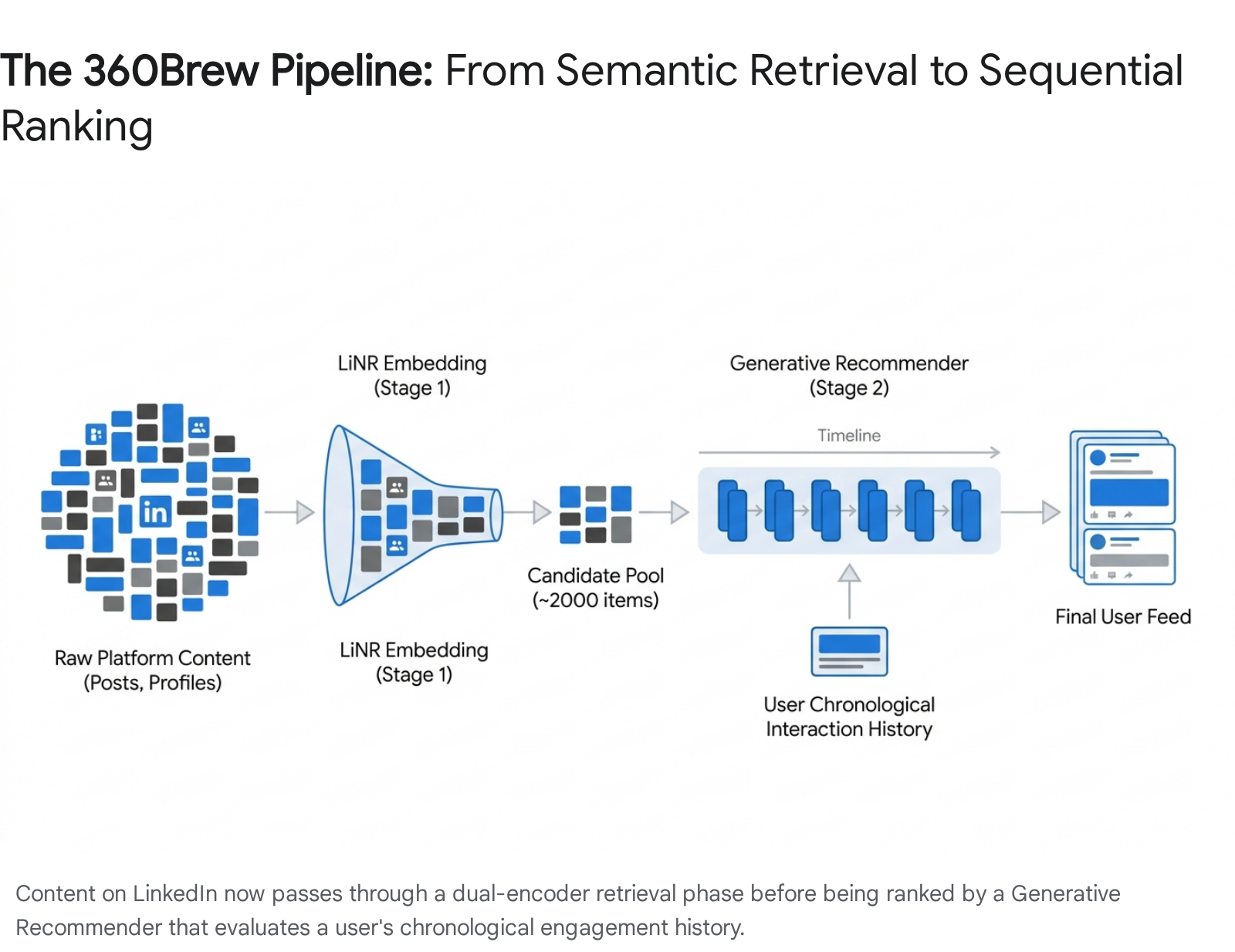
- Model-Based Neural Retrieval (LiNR): The first stage utilizes a GPU-accelerated dual-encoder system that generates high-quality semantic embeddings for both users and content 101213. Instead of relying on traditional keyword overlap, LiNR matches the inherent contextual meaning of a post to a user's professional interests. This initial layer filters hundreds of millions of candidate posts down to a select pool (roughly 2,000) within milliseconds 111415.
- Generative Recommender (GR): The second stage ranks these candidates. Unlike legacy models that scored posts in isolation based on static attributes, the transformer-based GR model processes a user's interaction history chronologically - treating their past 1,000 interactions as a continuous sequence 131519. This allows the AI to map the trajectory of a professional's learning curve and evolving interests, scoring posts based on long-term semantic relevance rather than momentary impulse 1516.
Topic DNA and Profile Alignment
The transition to semantic reasoning has fundamentally altered how personal profiles are audited. The 360Brew system cross-references a user's profile - including their headline, 'About' section, and professional experience - directly against the content they publish 717. This mechanism, identified by platform analysts as "Topic DNA," establishes a baseline of creator credibility 1823.
If a corporate executive whose profile categorizes them as a supply chain specialist begins publishing content regarding cryptocurrency trading, the natural language processing model detects a semantic mismatch 171920. Consequently, the system lowers its confidence in the creator's authority and actively suppresses the post's distribution 171920. Building a resilient personal brand requires strict adherence to two or three core content pillars over a sustained period (typically 60 to 90 days) before the algorithm unlocks broader reach within that specific niche 2021. The profile itself is no longer merely a static resume; it serves as the foundational prompt for the AI's content distribution logic 920.
The Depth Score Evaluation Framework
In tandem with the 360Brew deployment, LinkedIn fundamentally altered the telemetry used to measure content success. Internal engineering data revealed that while engagement optimization tactics (e.g., reaction bait, forced cliffhangers) successfully drove clicks throughout 2024 and 2025, they resulted in declining aggregate user satisfaction 522. In response, the platform introduced the "Depth Score" 2324.
Primary Engagement Signals
The Depth Score pivots the recommendation engine away from vanity metrics and toward audience retention and practical utility. High-performing content is evaluated on the following weighted signals:
- Dwell Time: The primary component of the Depth Score. The algorithm measures precisely how long a user spends reading or viewing content on the screen 182324. Posts that retain active attention for substantial periods (e.g., 45+ seconds) generate significantly stronger distribution signals than posts that accumulate rapid, surface-level reactions 1718. The system is capable of detecting "click bounces" (where a user clicks 'see more' but immediately scrolls away) and deprioritizes that content accordingly 1822.
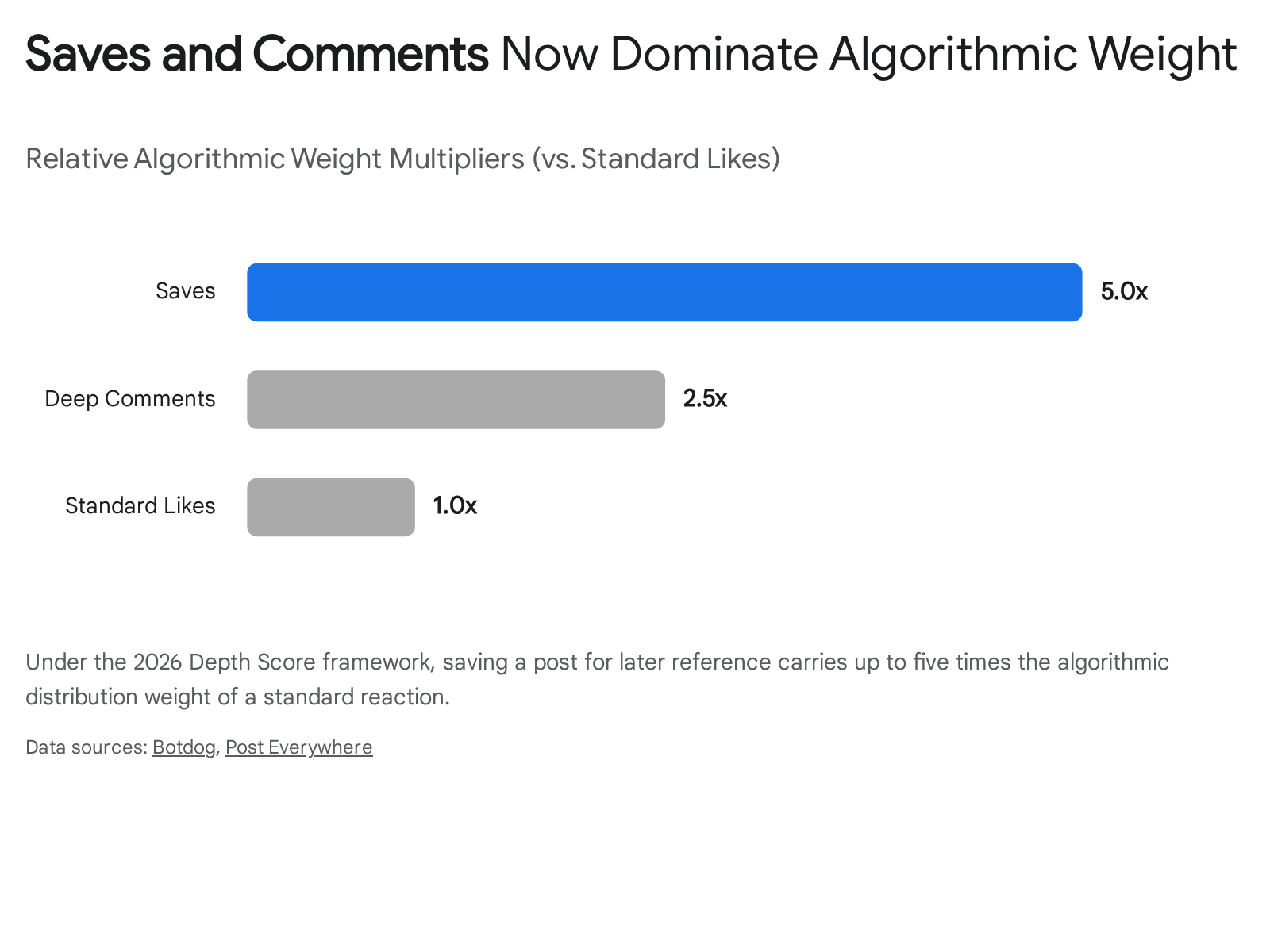
- Saves and Private Shares: The bookmarking feature ("Saves") is currently interpreted as the most profound indicator of content quality, signaling that the material holds lasting reference value 2425. Analytic studies reveal that a single "Save" drives up to five times more organic reach than a standard "Like," and double the reach of a standard comment 826.
Similarly, sharing content to private direct messages signals that the material holds high contextual value for specific peer-to-peer interactions 2425. * Comment Quality and Nesting: Superficial replies (e.g., "Great post!", "Agree") are detected by the AI and heavily discounted 1722. The algorithm specifically rewards substantive comments of 15 words or more, particularly when they initiate back-and-forth dialogue 1727. A single nested thread involving three or more exchanges between different participants can amplify a post's reach by over a factor of five 2728.
Algorithmic Penalties and Suppression Triggers
The shift toward the Depth Score has introduced stringent penalties for behaviors that disrupt the user experience or attempt to artificially inflate metrics.
- External Link Suppression: LinkedIn's primary commercial objective is to retain users within its own ecosystem. Posts containing links to external websites face aggressive suppression, resulting in an approximate 60% reduction in organic reach compared to identical posts without links 1823. The common historical workaround of placing an external link in the first comment has been largely neutralized; the 2026 algorithm identifies this as "bridge behavior" and applies corresponding reach penalties 1823.
- Detection of Engagement Pods: Coordinated engagement groups, once a staple of platform growth hacking, are effectively obsolete. LinkedIn's pattern recognition AI detects reciprocal engagement networks with 97% accuracy, resulting in immediate algorithmic shadowbans 2127. Accounts participating in pods have experienced reach reductions from thousands to hundreds of views overnight, and face 60-to-90-day recovery periods upon ceasing the behavior 623.
- Suppression of Engagement Bait: Explicitly soliciting interactions through templated phrases (e.g., "Comment YES if you agree," "Like to support") is classified as low-quality content by the initial filtering layer and is actively suppressed before it reaches the broader ranking stage 132326. Similarly, formatting designed solely to game the algorithm, such as artificial line-break cliffhangers (colloquially known as "broetry"), is penalized 5.
Content Format Performance and Benchmarks
The introduction of 360Brew has caused an aggregate drop in organic reach across the platform. Multiple industry reports indicate that median post views fell by roughly 50%, overall engagement volumes declined by 25%, and follower growth rates dropped by 59% year-over-year entering 2026 131829. The algorithm now prefers precision delivery, sending posts to fewer but highly targeted users 2630. Within this constrained environment, content formatting plays a disproportionate role in generating the Dwell Time necessary to trigger wider visibility.
Format Engagement Comparison
The following table synthesizes 2026 performance benchmarks across primary content formats. It illustrates the stark contrast in expected engagement based on structural choices, highlighting the dominance of formats that demand sustained attention.
| Content Format | Average Engagement Rate (2026) | Primary Algorithmic Advantage | Known Pitfalls & Penalties |
|---|---|---|---|
| Native Documents (PDF Carousels) | 5.85% - 7.00% 183031 | Maximizes Dwell Time & Saves; forces user interaction. | Exceeding 10 slides significantly lowers completion rate. 20 |
| Multi-Image Posts | 6.45% - 6.60% 2731 | High visual interruption in mobile feeds. | Using generic stock imagery instead of authentic photos. 2632 |
| Native Video (< 90 seconds) | 5.60% - 6.00% 1831 | Strong mobile engagement; high emotional resonance. | Lack of captions; 68% drop-off if first 3 seconds are weak. 33 |
| LinkedIn Newsletters | 5.76% 34 | Bypasses the feed algorithm; delivers via push notifications. | Inconsistent publishing cadence limits subscriber retention. 35 |
| Strategic Text-Only Posts | 2.00% - 4.00% 1836 | High readability; effective for sparking deep dialogue. | Dense corporate jargon; exceeding 10th-grade reading level. 2527 |
Note: Variance in reported engagement rates (e.g., isolated studies reporting carousels exceeding 20% 37) often stems from differing calculation methodologies - specifically whether engagement is divided by total followers or by actual impressions. When normalized by impressions, the 5% to 7% range represents the platform median for top-performing formats 3031.
The Dominance of Native Documents
Across multiple benchmark studies analyzing millions of posts, native document uploads (PDF carousels) consistently secure the highest engagement rates on the platform 18303143. Because each horizontal swipe through a document slide requires active user input and extends time-on-page, carousels perfectly satisfy the Depth Score's demand for high dwell time 202330. Furthermore, they deliver structured, digestible insights that inherently encourage users to save the post for later reference 43. Document posts generate up to three times more dwell time than standard text or image updates, making them the most reliable engine for organic growth in 2026 2123.
Newsletters and Collaborative Articles
LinkedIn has aggressively incentivized formats that foster deep, recurring readership and establish definitive subject matter expertise.
- Newsletters: This format bypasses the volatility of the feed algorithm entirely. Every published edition is delivered directly to subscribers via push notification and email, creating a highly resilient distribution channel 18. By early 2026, newsletter subscriptions had grown 150% year-over-year, generating engagement rates of 5.76% and reaching an average of five times more people than standard posts 2334. Long-form content (1,500 - 2,000 words) published monthly, supplemented by shorter weekly updates, provides the optimal cadence for sustained subscriber retention 35. Unlike transient feed posts, newsletter editions generate static URLs that index in search engines, providing ongoing organic traffic from platforms like Google 34.
- Collaborative Articles: LinkedIn's AI-powered collaborative articles boast a staggering 12.3% engagement rate 3033. Contributing high-value, original insights to these articles allows experts to earn "Community Top Voice" badges. These badges serve as a formalized credibility signal, accelerating semantic authority within the 360Brew system and boosting the creator's overall profile visibility 2730.
The Evolution of Video Content
While video content experienced a 36% year-over-year decline in total views platform-wide due to rapid feed saturation and shifts in distribution priorities, it remains highly potent when executed correctly 3143. Short, native vertical videos (under 90 seconds) continue to drive robust engagement (averaging 5.60%) 182433. Because 80% of users watch video on the platform without sound, prominent captions and subtitles are mandatory, increasing total view time by an average of 28% 33. The critical window for video retention is the first three seconds; content lacking an immediate, specific hook suffers a 68% audience drop-off rate 33.
Buyer Psychology and the "Hidden Buyer"
The algorithmic constraints of the platform mirror a broader evolution in B2B procurement psychology. As organic reach becomes tighter, the economic value of the impressions generated has increased. Content must be positioned to influence highly specific decision-making structures within target organizations.
Decentralized Buying Committees
The 2025 Edelman-LinkedIn B2B Thought Leadership Impact Report revealed that modern buying decisions are rarely centralized with a single executive. They are heavily influenced by "hidden buyers" - internal stakeholders in operations, finance, legal, compliance, and procurement who possess veto power but rarely interface directly with sales teams 3839. More than 40% of B2B deals currently stall due to internal misalignment within these expanded buying groups 3840.
Traditional outbound sales tactics struggle to reach these individuals, with 71% of hidden buyers reporting little to no interaction with sales representatives 40. However, personal branding through thought leadership is highly effective at penetrating this opaque layer. Hidden buyers consume thought leadership at rates equal to target buyers, with 63% spending over an hour per week consuming professional content 3940. Crucially, 95% of hidden decision-makers state that compelling thought leadership makes them more open to subsequent sales and marketing outreach 3940.
The Demand for Perspective-Shifting Content
Hidden buyers are not seeking superficial tips or validation of their existing beliefs. The data indicates that 91% of decision-makers value thought leadership that helps them uncover needs they did not know they had, and 86% actively prefer ideas that challenge their baseline assumptions 240. They gravitate toward bold, perspective-shifting content rather than academic deep dives or generic industry summaries 3840.
For challenger brands and independent consultants, an authoritative personal brand serves as a powerful market equalizer. According to the data, 53% of B2B decision-makers acknowledge that when a vendor's thought leadership is exceptional, brand recognition matters significantly less 3940. During the crucial RFP process, 79% of hidden buyers are more likely to advocate for a vendor that consistently produces high-quality insights, demonstrating that personal branding operates as a tangible sales enablement tool 23940.
The Economics of Personal Branding
The shift toward personal branding is not merely an exercise in vanity or visibility; it is a highly measurable sales methodology. Research comparing conversion rates demonstrates a massive discrepancy between inbound leads generated through content authority versus traditional cold outbound efforts.
Inbound leads attracted through sustained content and engagement boast an average close rate of 14.6%, compared to a meager 1.7% for leads contacted without prior interaction 41.
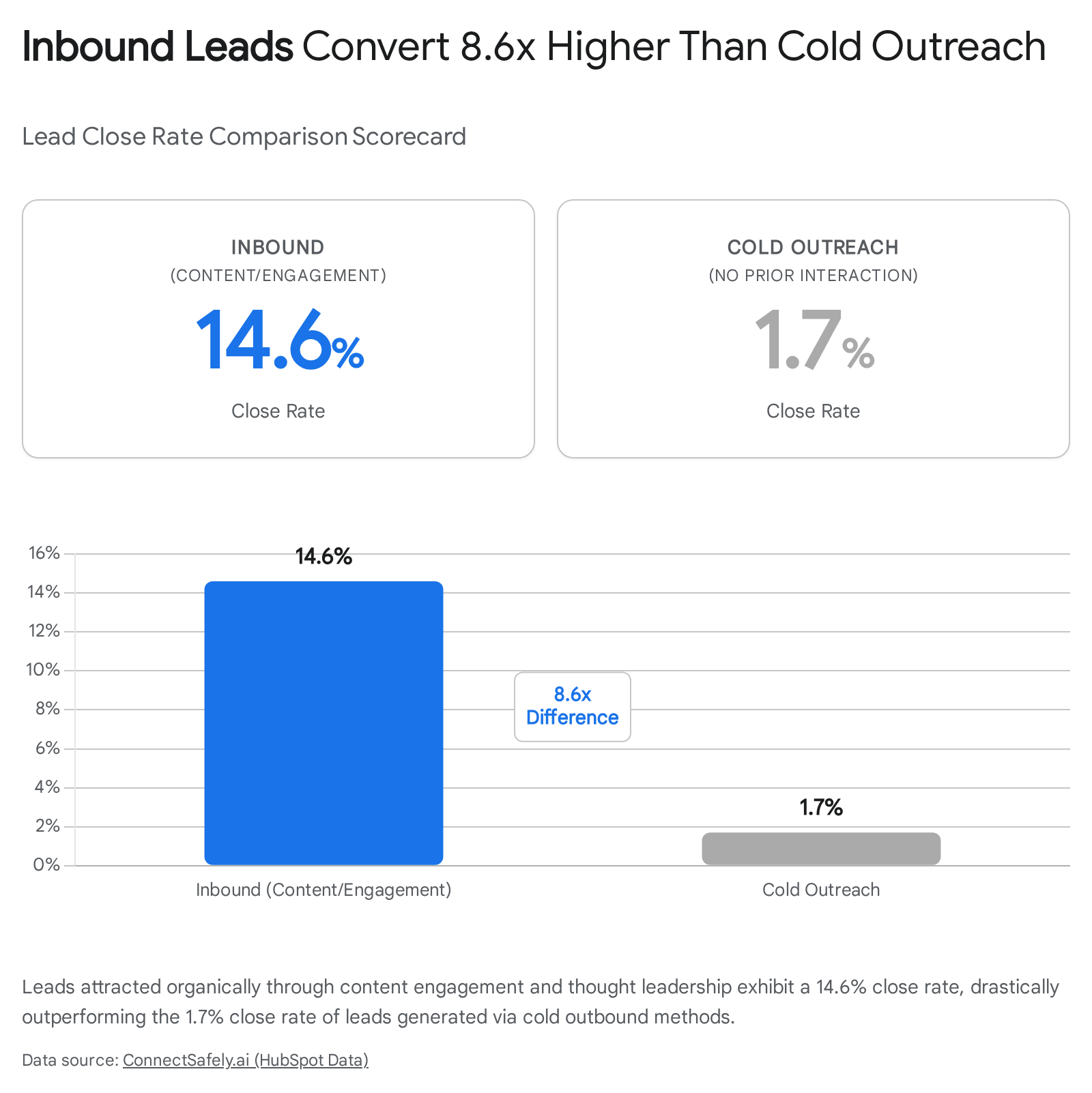
This 8.6x multiplier is driven by pre-established trust and authority 41. When an executive or founder publishes consistently, they provide essential "air cover" for sales initiatives, lowering resistance and accelerating pipeline velocity 42. Furthermore, 72% of B2B salespeople report that utilizing social media and personal branding directly leads to better performance compared to peers who rely solely on traditional methods 1.
Crucially, this authority must originate from individuals, not corporate entities. Personal profiles generate up to 8x more engagement and 5.6x more organic reach than identical content posted to company pages 3. The algorithm inherently penalizes corporate broadcasting; the average organic reach for a company page has fallen to just 2% to 4% of its follower base, and overall company page reach dropped by 60% to 66% between 2024 and 2026 212328. The modern B2B market dictates that buyers connect with, vet, and purchase from individuals. Corporate pages are now largely relegated to trust verification, recruitment, and scaling paid advertising, while personal profiles serve as the primary engine for organic growth and lead generation 28.
Execution and Cadence Strategies
Understanding the algorithmic architecture and buyer psychology must be translated into an operational publishing strategy. The data points toward consistency, precise timing, and proactive community management as the primary levers for sustained growth.
The 90-Minute Golden Window
Once a post passes the initial 360Brew AI quality filter, it undergoes a "Small Audience Test," where it is shown to a highly targeted segment (roughly 2% to 5%) of the user's network 1843. The velocity and depth of engagement within the first 60 to 90 minutes of publication dictate whether the post will be distributed to a broader audience 1828.
Because of this rigid testing window, passive publishing (scheduling a post and logging off) is highly ineffective. Creators must actively nurture their posts immediately after publication. Replying to comments not only fosters dialogue but directly manipulates the algorithm: posts where the author actively replies to comments earn up to a 30% lift in total engagement across the platform 3744. Furthermore, commenting thoughtfully on the posts of other industry leaders 15 to 30 minutes before and after publishing your own content can boost reach by up to 20%, as the algorithm registers the user as an active platform participant rather than a pure broadcaster 28.
Publishing Cadence and Consistency
Volume no longer equates to visibility. Over-posting (e.g., publishing multiple times a day) leads to diminishing returns and actively cannibalizes a user's own reach, as the algorithm throttles distribution when frequency exceeds the audience's capacity to engage 2845.
The data indicates that publishing 2 to 5 times per week is the optimal cadence for personal profiles seeking to balance visibility with content quality 2752. Consistency is paramount. Taking prolonged breaks can severely impact algorithmic momentum. Accounts that fail to post consistently week-over-week underperform their own baseline growth rates upon return, requiring significant time to rebuild their semantic authority with the sequential Generative Recommender model 37.
Regional Nuances in Engagement
While the core algorithmic architecture is deployed globally, audience consumption habits differ significantly by region. Personal branding strategies must be calibrated depending on the primary geographic target of the content.
Regional Data Comparison
| Geographic Region | Key Market Dynamics | Highest Performing Content Formats | Strategic Imperatives |
|---|---|---|---|
| North America | Largest market (257M users); highly saturated and competitive. 33 | Long-form Video & Executive Leadership Content. 46 | Video content leads with a 29.67% view rate. High-production, educational video targeting mid-to-senior professionals is highly effective. 46 |
| Europe (EMEA) | Analytically driven audience; high demand for rigorous B2B data. 46 | Long-form Articles & In-depth Case Studies. 46 | European audiences favor depth, with articles earning 30% more shares. Multilingual content and structured employee advocacy programs show massive ROI. 46 |
| Asia-Pacific (APAC) | Rapid user growth driven by India (161.5M users); predominantly young (18-34). 3346 | Multi-Image Posts & PDF Document Carousels. 46 | Highly responsive to visual storytelling. Multi-image formats generate double the impression rates, aligning with mobile-first, scannable consumption habits. 46 |
Global Strategy Adaptation
For creators targeting a global audience, balancing these preferences requires a diversified content mix. Relying solely on text updates may alienate the visually driven APAC market, while over-indexing on short-form video may fail to capture the analytical European B2B buyer 46. Implementing AI-driven localization strategies and adapting the format of the core message (e.g., turning a long-form European case study into a visually dense carousel for APAC distribution) has proven to be 37% more effective than generic global broadcasting 46.
The Intersection of AI Search and Personal Branding
As the platform evolves, personal branding on LinkedIn is increasingly intersecting with broader technological shifts, specifically the rise of generative AI search engines. By early 2026, 40% of B2B buyers reported initiating vendor research using AI tools (such as ChatGPT, which boasts 900 million weekly active users), matching the rate of traditional search engine usage 2.
In this environment, a well-structured personal brand functions as a "machine-readable brand" 8. When creators publish dense, highly specific, and authoritative content on LinkedIn, that data is indexed and utilized by external LLMs to formulate answers to user queries. Brands and individuals who are consistently cited in AI-generated overviews earn 35% more organic clicks, effectively making AI citation the new "page-one ranking" for B2B procurement 2. Consequently, optimizing LinkedIn profiles and content for semantic clarity not only satisfies the internal 360Brew algorithm but ensures visibility in the broader ecosystem of AI-driven research.
Conclusion
Building a personal brand on LinkedIn in 2026 is an exercise in semantic discipline, psychological alignment with the hidden buyer, and deep audience retention. The deployment of the 360Brew architecture has permanently dismantled the viability of low-effort engagement bait, generalized commentary, and automated outreach scaling.
To succeed, professionals must operate as highly specialized niche authorities. By aligning their profile strictly with defined content pillars, leveraging high-retention formats like native PDF documents and newsletters, and fostering substantive dialogue within the critical 90-minute launch window, creators can signal undeniable credibility to the AI ranking systems. Ultimately, personal branding is no longer a peripheral marketing activity or a vanity exercise; it is the fundamental architecture of modern B2B trust, uniquely capable of penetrating the decentralized buying committee and converting attention into measurable economic value.