
Framing self-promotion as service to reduce discomfort
The Psychology of Self-Presentation
The necessity of self-promotion in professional, academic, and social environments is a well-documented determinant of career advancement, resource acquisition, and interpersonal influence. Despite the objective utility of communicating one's past accomplishments and positive characteristics, individuals frequently demonstrate a profound reluctance to engage in self-promotional behaviors. This reluctance is fundamentally driven by anticipated psychological discomfort, which manifests as social anxiety, fear of negative evaluation, and the anticipation of social backlash 123.
To mitigate this aversion, behavioral scientists, organizational psychologists, and sociologists have increasingly examined cognitive reappraisal strategies. The most prominent among these interventions is "prosocial reframing" - the practice of conceptually shifting the intent of self-promotion from ego-centric self-enhancement to contributing to a community or "being of service" to others 145. By aligning self-promotion with communal goals, individuals attempt to bypass the internal conflicts associated with modesty norms and self-aggrandizement.
The central research inquiry addresses whether framing self-promotion as a prosocial act objectively reduces psychological discomfort, and whether such a shift is empirically measurable. Evidence across psychological, organizational, and neurobiological domains suggests that prosocial reframing does indeed attenuate the subjective distress associated with self-advocacy. This cognitive shift from a "proself" to a "prosocial" orientation reduces threat appraisals, minimizes the physiological markers of anxiety, and increases behavioral willingness to engage in visibility-enhancing actions 145.
Theoretical Mechanisms of Self-Promotion Discomfort
To understand how prosocial reframing operates, it is necessary to first deconstruct the precise nature of the psychological discomfort it seeks to alleviate. The psychological barrier to self-promotion is a complex intersection of evolutionary neurology, cognitive dissonance, and social threat perception.
The Dual-Motive Conflict and Brain Physiology
The discomfort associated with self-promotion is deeply rooted in human evolutionary psychology. According to Dual Motive Theory (DMT), derived from the evolutionary neurobiology research of Paul MacLean and expanded by Gerald Cory, human behavior is governed by two dominant, competing neurological motivations: ego (self-interest) and empathy (other-interest or prosocial focus) 6. The human brain constantly attempts to achieve a dynamic balance between these two fundamental drives to optimize both individual survival and social cohesion.
When an individual engages in straightforward self-promotion, the balance tips heavily toward egoistic motivation. Historically, unchecked self-enhancement and resource hoarding risked social ostracization, rendering pure ego-driven behavior dangerous to communal survival. Consequently, when modern individuals focus exclusively on self-enhancement, the brain's behavioral inhibition system (BIS) is activated 67. The BIS interrupts ongoing behavior in response to perceived discrepancies between personal goals and social safety, resulting in an immediate inhibitory response associated with feelings of anxiety. This state, often termed "generalized insecurity" or "anxious uncertainty," reflects an aversive affective-motivational state designed to prevent the actor from alienating their social group 7.
Social Comparison and Evaluation Apprehension
Further exacerbating this evolutionary tension is the psychological phenomenon of social comparison. Drawing on foundational social comparison theory, modern iterations such as the Self-Evaluation Maintenance (SEM) model proposed by Abraham Tesser elucidate why self-promotion causes interpersonal friction 10. The SEM model dictates that individuals actively seek to preserve a positive self-evaluation. When an actor self-promotes, they force the audience into an upward social comparison, potentially threatening the audience's self-esteem 10.
Because individuals possess high social cognition, the actor anticipating self-promotion is acutely aware that their boasting may threaten the observer. The anticipation of the observer's negative reaction generates evaluation apprehension. Actors recognize that while bragging may project competence, it precipitates a precipitous drop in social attraction and likability 118914. To avoid this, individuals often engage in social avoidance, preferring invisibility to the risk of inciting resentment or being categorized as arrogant 1011.
Burden Anxiety and the Inequity Illusion
In specific self-promotional contexts, such as professional networking, advice-seeking, or mentorship acquisition, the discomfort takes the specialized form of "burden anxiety" 1. Individuals frequently perceive the act of reaching out to highlight their skills and request assistance as an inequitable exchange. This phenomenon, termed the "inequity illusion," suggests that actors vastly overestimate the social cost their self-advocacy inflicts on others, while simultaneously underestimating the potential mutual benefits of the interaction 1.
When self-promotion is viewed purely as a mechanism for personal gain, the anticipated inequity triggers social distress 1. The actor feels they are inappropriately extracting resources (time, attention, or social capital) from the target. This internal friction paralyzes action. Humblebragging - masking self-promotion behind a complaint or false humility - is frequently deployed as a maladaptive strategy to soften this burden. However, extensive research demonstrates that humblebragging fails completely; observers penalize humblebraggers heavily on the dimension of sincerity, resulting in lower evaluations of both likability and competence compared to straightforward braggers or straightforward complainers 1181213.
Cognitive Reappraisal and Threat Reduction
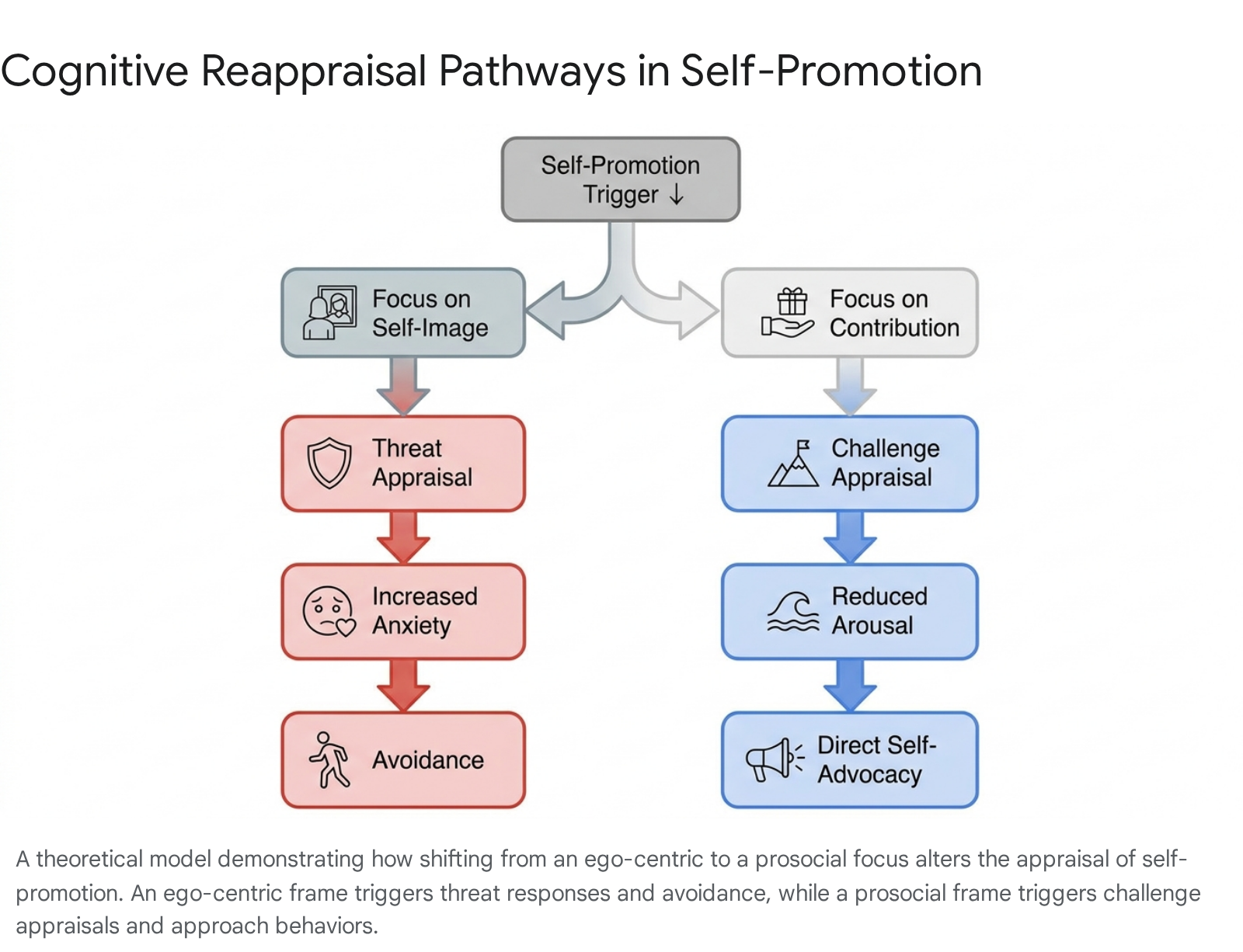
Prosocial reframing directly addresses these root causes of self-promotion discomfort by fundamentally altering the cognitive appraisal of the act. By defining the sharing of one's skills, accomplishments, or ideas as a method of contributing to a community or acting as a resource for others, the actor resolves the dual-motive conflict, satisfying both ego and empathy drives simultaneously 4614.
The Physiology of Challenge Versus Threat
When self-promotion is framed prosocially, the cognitive focus shifts from an ego-threat (anticipating social judgment) to a contribution-opportunity (anticipating service delivery). This process is a specialized form of cognitive reappraisal. Experimental research demonstrates that reappraising a stressful, evaluative situation as beneficial or purposeful alters both the psychological experience and the physiological expression of stress 515.
In clinical assessments during evaluative public speaking tasks, individuals instructed to explicitly reframe their stress arousal exhibited significantly less subjective shame and anxiety 5. Furthermore, independent raters observed a marked reduction in avoidant nonverbal signaling among those who reappraised their arousal. Physiologically, individuals who engaged in cognitive reframing exhibited increased levels of salivary alpha-amylase (sAA), a protein that indexes sympathetic activation 5. In this context, higher sAA levels, combined with positive cognitive appraisals, indicate a "challenge" state rather than a "threat" state. By extension, prosocial reframing of self-promotion transitions the individual from a threat-avoidance posture (driven by fear of social penalty) to a challenge-approach posture (driven by the motivation to be of service).
Resolving the Inequity Illusion
Prosocial framing acts as a psychological equity restoration technique 1. When an individual frames self-advocacy as a means of offering a reciprocal benefit to the audience, the perceived burden is neutralized. For instance, empirical research spanning multiple randomized controlled field experiments demonstrated that highlighting the prosocial benefits of reaching out to an advisor significantly lowered the advice-seeker's burden anxiety 1.
This threat-reduction effect proved especially potent in relational settings that typically amplify worries about inequity, such as interacting with unfamiliar individuals or those holding a higher relative status 1. By framing the interaction as mutually beneficial (e.g., providing the advisor with an opportunity to mentor, or offering a unique perspective that aids the higher-status individual), the self-promoter restores perceived equity, effectively bypassing the psychological blocks that prevent behavioral action.
Emotional and Behavioral Efficacy of Prosocial Appeals
Broader interventions examining prosocial behavior confirm that other-focused actions intrinsically reduce psychological distress. During the COVID-19 pandemic, researchers evaluated the efficacy of threatening versus prosocial public health messaging on a representative sample of 955 adults 2116. While both message types increased behavioral compliance (willingness to self-isolate), the efficacy of the prosocial message was uniquely dependent on the magnitude of positive emotional response evoked along both arousal and valence dimensions 2116.
Furthermore, a two-week intervention study comparing the mental health impacts of "other-kindness" (prosocial acts) versus "self-kindness" revealed distinct psychological pathways. Participants engaging in prosocial behavior experienced significant decreases in depression, anxiety, and loneliness, driven by increases in feelings of social connection 17. Conversely, the self-kindness group experienced decreases in depression but no significant differences in anxiety or loneliness 17. Because self-promotion is inherently an act of self-kindness (seeking personal advancement), infusing it with a prosocial frame allows the actor to access the anxiety-reducing and connection-building mechanisms of other-kindness.
Psychometric Measurement of Self-Promotion Discomfort
To assert that a shift in psychological discomfort can be measured requires robust psychometric frameworks. Researchers employ a combination of self-reported affective inventories, behavioral economic proxies, and neurophysiological markers to quantify the alleviation of self-promotion anxiety.
Clinical and Affective Anxiety Inventories
Several validated psychological scales are utilized to measure the baseline distress individuals feel regarding social evaluation, which directly maps onto the fear of self-promotion:
- The Social Avoidance and Distress Scale (SADS): A 28-item true/false self-report measure distinguishing between subjective distress (negative emotions in social settings) and the behavioral tendency to actively avoid social interactions 10. The SADS is specifically designed to measure behavioral and affective responses rather than purely cognitive fears, capturing the somatic discomfort experienced when speaking about oneself. Individuals scoring high on the SADS often exhibit lower self-esteem and an external locus of control 10.
- The Liebowitz Social Anxiety Scale (LSAS): Assesses the role of social anxiety across various situations, measuring both the intensity of the fear and the frequency of avoidance behaviors 18. This metric is highly relevant for measuring the discomfort of self-promotion in public speaking or authority-facing scenarios.
- The Social Self-Compassion Scale (SSCS): A domain-specific measure assessing how kindly individuals treat themselves following interpersonal adversities or social stressors (e.g., committing a social blunder during self-presentation) 1519. Higher scores on the SSCS correlate negatively with social anxiety and fear of negative evaluation, suggesting that trait self-compassion acts as a buffer during self-promotional tasks.
Behavioral and Economic Assessment Tools
While standard anxiety scales capture general distress, recent organizational economic research measures the discomfort of self-promotion through behavioral reluctance and its subsequent economic penalties. Exley and Kessler's (2022) foundational research established specific quantitative metrics to measure the "self-promotion gap" without relying solely on clinical anxiety scales 2620.
Their framework measures the exact point at which an individual downgrades their self-evaluation due to internal discomfort, despite holding objective knowledge of their high performance. By utilizing over 4,000 online participants and 10,000 school-aged youth, they established highly reliable economic proxies for self-promotion reluctance 2621.
| Psychometric Metric | Description and Implementation | Application to Self-Promotion |
|---|---|---|
| Continuous Agreement Scales | A 0 - 100 scale evaluating agreement with statements like "I performed well" or "I would succeed in a job requiring this skill" 26. | Measures objective recognition of skill against the subjective willingness to state that skill publicly. |
| Performance Bucket Metric | A 6-point Likert scale asking participants to categorize their performance using adjectives from "terrible" to "exceptional" 26. | Quantifies semantic modesty and the discomfort associated with using superlative language for oneself. |
| Financial Deservingness | Participants assign a monetary value (0 to 100 cents) they believe they deserve as a bonus for their objective performance 26. | Measures the direct economic suppression caused by the psychological discomfort of self-advocacy. |
| Hireability Translation | The percentage point increase in employer hiring likelihood per point increase on the candidate's self-evaluation scale 26. | Translates the psychological barrier of self-promotion into tangible labor market outcomes. |
When prosocial reframing interventions are applied within these economic paradigms, success is measured by the upward normalization of these scores, indicating a reduction in the psychological friction that suppresses accurate self-advocacy.
Neurophysiological and Biological Markers
Advancements in cultural neuroscience provide biological methodologies to measure the internal conflict of self-promotion. Electroencephalography (EEG) studies have isolated event-related potentials that correlate with self-enhancement motives. Specifically, the N170 component tracks the initial allocation of attentional resources to negative or positive trait processing, while the Late Positive Potential (LPP) amplitude correlates with the emotional intensity and motive strength of self-referent judgments 2223.
Additionally, as noted previously, the analysis of salivary alpha-amylase (sAA) provides a reliable neuroendocrine marker of sympathetic nervous system activation, distinguishing between a debilitating threat response (high anxiety) and an adaptive challenge response (facilitative arousal) during evaluative self-presentation 5.
Gender Dynamics in Self-Promotion
The psychological discomfort of self-promotion is not distributed equally across demographic groups. Gender plays a critical, heavily researched role in how self-promotion is experienced internally and penalized externally. Studies routinely demonstrate that women are up to five times less likely to self-promote than men, a disparity that persists even when there are no strategic incentives to inflate evaluations and when objective performance is identical 31243334.
Modesty Norms and the Backlash Effect
The reluctance of women to self-promote is largely driven by "backlash avoidance" 3536. According to social role theory, societal expectations prescribe communal traits for women (e.g., compassionate, empathetic, accommodating, yielding) while proscribing agentic traits (e.g., competitive, self-promoting, assertive, dominant) 325. When women violate these gendered modesty norms by engaging in straightforward, ego-centric self-promotion, they frequently encounter the "backlash effect" - severe social and economic sanctions for counterstereotypical behavior 23126.
Women who self-promote are often perceived by audiences as highly competent but socially deficient, unlikable, manipulative, or overly aggressive 314. This "uncommunal stereotype" severely limits their hireability, salary negotiation outcomes, and promotion prospects 325. Furthermore, evidence indicates that deviants from gender norms may even face deliberate sabotage from peers seeking to maintain cultural stereotypes 2. Consequently, the psychological discomfort women feel when talking about themselves is not an irrational manifestation of imposter syndrome; it is a highly accurate, adaptive anticipation of imminent social and professional penalties 35.
Communal Reframing as a Strategic Shield
Given the reality of the backlash effect, framing self-promotion as "being of service" serves a dual purpose for women: it eliminates the internal cognitive dissonance of violating modesty norms and simultaneously circumvents the external social penalty imposed by observers.
The theoretical mechanisms behind this were systematically tested in a study by Smith and Huntoon (2014) involving 123 college women tasked with writing a scholarship application essay 35362728. The researchers contrasted three potential causes for self-promotion discomfort: cognitive dissonance, stereotype threat, and backlash avoidance. They found that violating the modesty norm by boasting caused women to experience uncomfortable situational arousal, leading to lower motivation and poorer performance 28.
However, when women were provided with a misattribution source for their anxiety (a fake subliminal noise generator), their self-promotion performance and motivation improved significantly 28. More practically, when women were allowed to advocate on behalf of others - or frame their self-advocacy communally - their performance matched that of male counterparts. Because advocating for a shared goal aligns seamlessly with prescriptive communal stereotypes for women, it does not trigger the modesty norm violation 2728.
| Theoretical Mechanism of Discomfort | Premise of the Discomfort | Impact of Prosocial Reframing |
|---|---|---|
| Cognitive Dissonance | Discomfort arises from the conflict between internalized beliefs that one should be modest and the overt act of self-promoting 36. | Alleviates internal dissonance by redefining the act as a communal contribution rather than an ego-driven pursuit. |
| Stereotype Threat | Discomfort stems from the fear of confirming negative stereotypes about women in highly agentic, competitive roles 36. | Shifts the psychological domain from agentic to communal, removing the stereotype threat context entirely. |
| Backlash Avoidance | Discomfort is a rational fear of social and economic punishment (e.g., lower likability, sabotage) for violating prescriptive modesty norms 23536. | Bypasses the penalty; the audience perceives the actor as warm, giving, and collaborative rather than aggressive or dominant. |
Experimental Evidence on Modesty Constraint Removal
In experimental economic treatments where female participants were given a prosocial justification for self-promotion, behavioral willingness skyrocketed. For example, in a setting where self-promotion was inextricably linked to generating a charitable donation, female self-promotion rates increased tenfold, effectively eliminating the massive baseline gender gap observed in the control condition 24. The "being of service" frame allows women to project competence while maintaining the warmth required by societal expectations, thus neutralizing both internal anxiety and external threat.
Cross-Cultural Contexts and Self-Enhancement
The effectiveness and necessity of prosocial reframing are deeply influenced by macro-cultural contexts. The cognitive dissonance caused by self-promotion varies significantly depending on whether an individual operates within an individualist or a collectivist society, as the fundamental definition of the self changes across these environments.
The Universality Versus Specificity Debate
In individualistic, Western cultures (e.g., the United States, Canada, Australia), the independent self-construal is dominant. Cultural norms actively encourage self-reliance, uniqueness, and straightforward self-enhancement 293031. Individuals in these cultures frequently exhibit the "self-serving bias," overestimating their own contributions relative to their peers and experiencing less cognitive dissonance when claiming credit 3044.
Conversely, in collectivist cultures (e.g., Japan, Korea, China), the interdependent self-construal prevails. Modesty, self-effacement, and the subordination of personal goals to in-group harmony are strongly mandated 293132. In these contexts, straightforward self-promotion is often perceived as a disruptive, highly offensive violation of social cohesion.
A prominent debate within cultural psychology centers on whether the motive for self-enhancement is universal (pancultural) or culturally specific. Neurophysiological research utilizing EEG suggests that the underlying motive is indeed pancultural; measurements of the Late Positive Potential (LPP) demonstrate that individuals across all cultures exhibit similar physiological arousal when processing positive self-referent traits 2223. However, while the internal desire to self-enhance exists universally, the behavioral expression of that motive is heavily suppressed in Eastern cultures to preserve relational harmony and avoid social sanctions 222333.
Horizontal and Vertical Cultural Orientations
The application of prosocial reframing must account for nuances within these cultural paradigms, specifically the distinction between horizontal (valuing equality) and vertical (valuing hierarchy) orientations 2934.
| Cultural Orientation | Defining Characteristics | Interaction with Self-Promotion and Prosocial Framing |
|---|---|---|
| Horizontal Individualism | Emphasizes uniqueness and self-reliance, but within a framework of equality (e.g., Sweden, Denmark, Australia) 2934. | Straightforward self-promotion is accepted if it establishes capability, but ostentatious bragging violating equality is discouraged. |
| Vertical Individualism | Emphasizes competition, personal success, and social hierarchy (e.g., the United States) 2934. | Explicit self-promotion is highly expected, socially rewarded, and often necessary for advancement. |
| Horizontal Collectivism | Emphasizes sociability, empathy, and strict egalitarianism (e.g., the Israeli kibbutz) 293435. | Prosocial reframing is highly resonant. Self-promotion must strictly be framed as a communal contribution to be socially acceptable. |
| Vertical Collectivism | Emphasizes compliance with authority, deference, and in-group cohesion (e.g., Japan, India, Korea) 2934. | Individuals are motivated by duty to the hierarchy. Self-advocacy is heavily suppressed unless it elevates the status of the entire in-group. |
Collectivistic Obligations and Prosocial Behavior
In collectivist cultures, individuals hold more accurate impressions of their own behaviors compared to peers, and are deeply motivated by social responsibility and the embeddedness-autonomy dimension 3035. Therefore, a prosocial frame is not merely an optional anxiety-reduction tool; it is the only culturally sanctioned methodology for achieving visibility without severe penalty.
A Chinese employee, for instance, must frame their achievements as a victory for the collective team to avoid disrupting the interdependent harmony 443236. Thus, while prosocial reframing in individualist cultures serves primarily to reduce internal psychological discomfort (the "inequity illusion"), in collectivist cultures it is an essential mechanism for navigating rigid external sociological constraints.
Organizational Behavior and Digital Networking
The empirical findings regarding self-promotion discomfort and the efficacy of prosocial reframing translate directly into modern organizational behavior, negotiation strategies, and digital networking environments.
The Dual Concern Model in Interpersonal Conflict
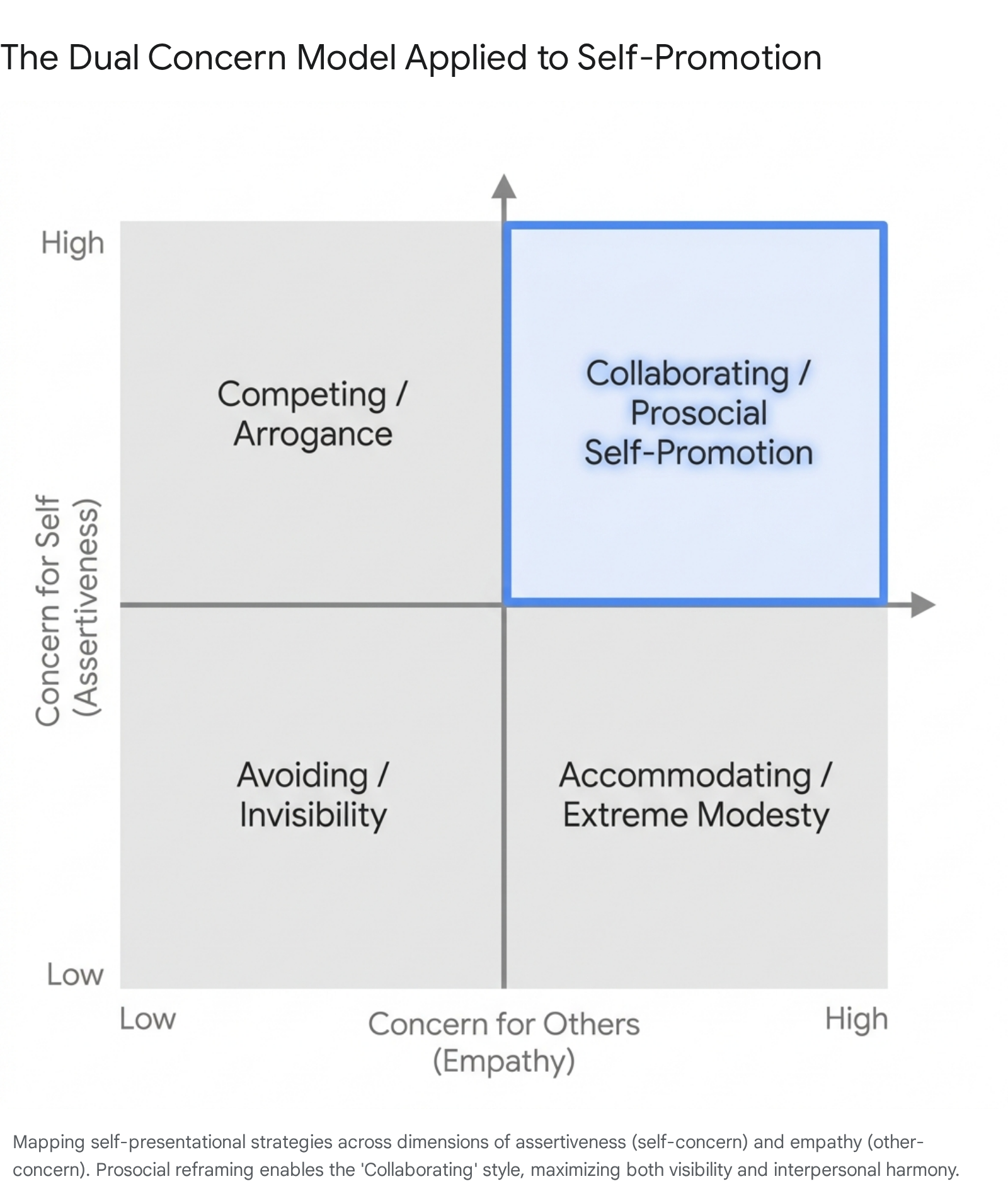
The Dual Concern Model, traditionally applied to negotiation and conflict resolution, posits that individual behavior in a conflict or bargaining scenario is dictated by the interaction of two distinct motivational axes: concern for self (assertiveness) and concern for others (empathy) 373852. This model provides a perfect organizational framework for understanding the psychology of self-promotion.
Within the Dual Concern Model, self-presentational strategies can be categorized into distinct behavioral styles: * Forcing / Contending (High Self, Low Other): This represents straightforward, ego-centric self-promotion. While it may effectively project competence, it sacrifices interpersonal relationships, ignores the audience's needs, and triggers internal burden anxiety for the actor. * Yielding / Accommodating (Low Self, High Other): This represents extreme modesty or self-effacement. While it is socially safe and preserves harmony, it results in professional invisibility, career stagnation, and suppressed economic outcomes. * Avoiding (Low Self, Low Other): A complete withdrawal from visibility, driven by paralyzing evaluation apprehension. * Problem-Solving / Collaborating (High Self, High Other): This represents prosocially reframed self-promotion. The individual aggressively advocates for their value (assertiveness) by explicitly connecting their unique skills and accomplishments to the specific needs of the team, organization, or audience (empathy) 37385253.
By adopting the collaborating orientation, individuals who typically shy away from visibility - due to high trait empathy, fear of backlash, or adherence to cultural modesty norms - can negotiate for themselves without triggering internal distress. The Dual Concern Model demonstrates that high empathy and high assertiveness are not mutually exclusive; they are synthesized perfectly through the "being of service" frame.
Artificial Intelligence and Skill Threat Reframing
The principles of prosocial reframing are increasingly relevant in modern digital ecosystems. On professional networking platforms like LinkedIn, the tension between self-promotion and audience perception remains acute. Job seekers constantly face decisions regarding how agentic versus communal their personal summaries should be, with women often defaulting to more communal language and emotional expressivity to proactively avoid the backlash effect 21.
Furthermore, as Generative AI alters the modern workplace, employees face unprecedented "skill threat" and job-displacement anxiety 54. The integration of GenAI in knowledge-sharing networks requires employees to self-promote their unique human insights to remain relevant in an environment where technical intelligence is rapidly commoditized. Research indicates that fostering a "growth mindset" and leveraging technical literacy can serve as critical threat-reduction mechanisms 54. When employees reframe their interaction with AI - not as a competition for competence requiring defensive self-promotion, but as a collaborative tool utilizing their human expertise to be of better service to the organization - their knowledge-sharing intentions increase, and psychological resistance to technological integration diminishes 54.
Conclusion
The empirical evidence spanning organizational psychology, cultural neuroscience, and behavioral economics confirms that framing self-promotion as "being of service" is a highly effective, objectively measurable strategy for reducing the psychological discomfort of self-advocacy. This prosocial reframing operates through the mechanism of cognitive reappraisal, successfully transitioning an individual's neurophysiological state from an anxious threat-avoidance posture to a facilitative challenge-approach posture. By systematically addressing the "inequity illusion" and alleviating burden anxiety, individuals can bypass the evolutionary dual-motive conflict that pits personal ambition against the human drive for social harmony.
Crucially, the efficacy of this cognitive shift is heavily mediated by gender and cultural orientation. For women navigating the treacherous landscape of prescriptive modesty norms, communal reframing is not merely a comfort mechanism; it is a vital, strategic shield against the well-documented backlash effect and subsequent economic penalties. Similarly, in collectivist cultures spanning both horizontal and vertical orientations, prosocial framing represents the primary mechanism allowing for individual visibility without disrupting interdependent social structures. Ultimately, aligning self-promotion with a genuine, authentic intent to serve others allows individuals to confidently articulate their value, fostering both personal career advancement and broader organizational collaboration.