
What Is a Go-to-Market Strategy
A go-to-market (GTM) strategy is a highly tactical, step-by-step action plan that dictates how a company will launch a new product, release a specific feature, or enter a new market. It aligns an organization's product value proposition with its target customer base through carefully defined pricing structures, distribution channels, and sales motions. Ultimately, a robust GTM strategy ensures that a business systematically acquires customers, validates market demand, and achieves a competitive advantage before depleting its operating capital.
The Distinction Between GTM, Marketing, and Business Plans
A frequent misstep among startup founders and corporate executives alike is treating a go-to-market strategy as synonymous with a generalized business plan or a long-term marketing strategy 1. While these operational frameworks inevitably overlap in practice, they serve distinct organizational purposes, operate on vastly different timelines, and seek to answer fundamentally different strategic questions 231.
A business plan serves as the overarching architectural document for the entire enterprise. It defines the company's long-term destination, detailing the overarching corporate mission, overall financial modeling, investor relations strategies, and long-term viability over a multi-year horizon 25. It is the map of the organization's ultimate destination.
A marketing strategy, conversely, represents a broader, continuous function focused on brand building. It governs the ongoing process of generating persistent demand, managing public relations, and maintaining market positioning across all product lines over a span of two to five years 23. If the business plan is the map, the marketing strategy represents the ongoing fuel that keeps the corporate engine running.
A go-to-market strategy is highly specific, narrow in scope, and strictly time-bound. It functions as the precise launch playbook for a singular initiative, such as rolling out a new software application, expanding a regional service into a new continent, or transitioning a legacy brick-and-mortar operation to an e-commerce model 236. GTM strategies typically operate on accelerated six- to eighteen-month timelines and demand rigorous cross-functional alignment between product engineering, sales, marketing, and customer success teams 32.
To clarify these operational boundaries, the following comparison highlights the core distinctions:
| Strategic Framework | Primary Organizational Purpose | Scope of Application | Typical Time Horizon | Core Components and Deliverables |
|---|---|---|---|---|
| Business Plan | Proves the financial and operational viability of the entire company to internal and external stakeholders. | The entire organization, encompassing all product lines and operational departments. | Long-term (3 to 5+ years). | Revenue projections, corporate structuring, investor pitches, broad competitive analysis 25. |
| Marketing Strategy | Builds sustained brand awareness, manages public perception, and generates continuous top-of-funnel demand. | The entire brand ecosystem, targeting the general market and broad consumer bases. | Medium-to-long-term (1 to 5 years). | Brand positioning, content calendars, SEO management, social media, overall advertising spend 23. |
| Go-to-Market Strategy | Outlines the exact, tactical steps required to successfully introduce a specific offering to a specific audience. | A single product launch, a new feature release, or a specific geographic market expansion. | Short-term and highly tactical (6 to 18 months). | Ideal Customer Profiles (ICPs), specific pricing mechanics, chosen sales motions, exact launch channels 32. |
The Imperative of Documented GTM Execution
Research published by Harvard Business School indicates that up to 95% of new products fail each year 23. While inferior product quality occasionally plays a role, a leading driver of commercial failure is the absence of a disciplined, data-driven strategy to bridge the gap between product development and consumer acquisition 2.
The technology sector is particularly vulnerable to the "build it and they will come" fallacy. Engineering teams frequently fall into the trap of spending months perfecting code, expanding database schemas, and adding complex features without ever validating whether the market actually requires those capabilities 9. When the eventual launch day arrives, the product is met with total silence because the underlying problem was never authenticated by real buyers 29.
A structured GTM strategy forces an organization to prioritize market realities over internal assumptions. By establishing shared objectives before tactical execution begins, a GTM plan prevents the common operational failure where marketing teams generate leads that sales teams cannot close, or where sales teams promise enterprise features that the product engineering team has not yet built 1. Data from global consulting firms demonstrates that companies operating with a documented, cross-functional GTM strategy are 33% more likely to achieve their revenue targets than those operating on ad-hoc assumptions 10.
Furthermore, disciplined GTM execution protects fundamental unit economics. In modern software-as-a-service (SaaS) and digital commerce, the ratio of Customer Lifetime Value (LTV) to Customer Acquisition Cost (CAC) is a paramount indicator of business health. A sustainable enterprise typically targets an LTV:CAC ratio of 3:1 or higher, alongside a CAC payback period of under twelve months 11. Without a highly targeted GTM strategy, companies inevitably waste marketing capital on broad, unqualified audiences, thereby driving up acquisition costs and destroying profitability 211.
The Four Interconnected Pillars of Market Entry
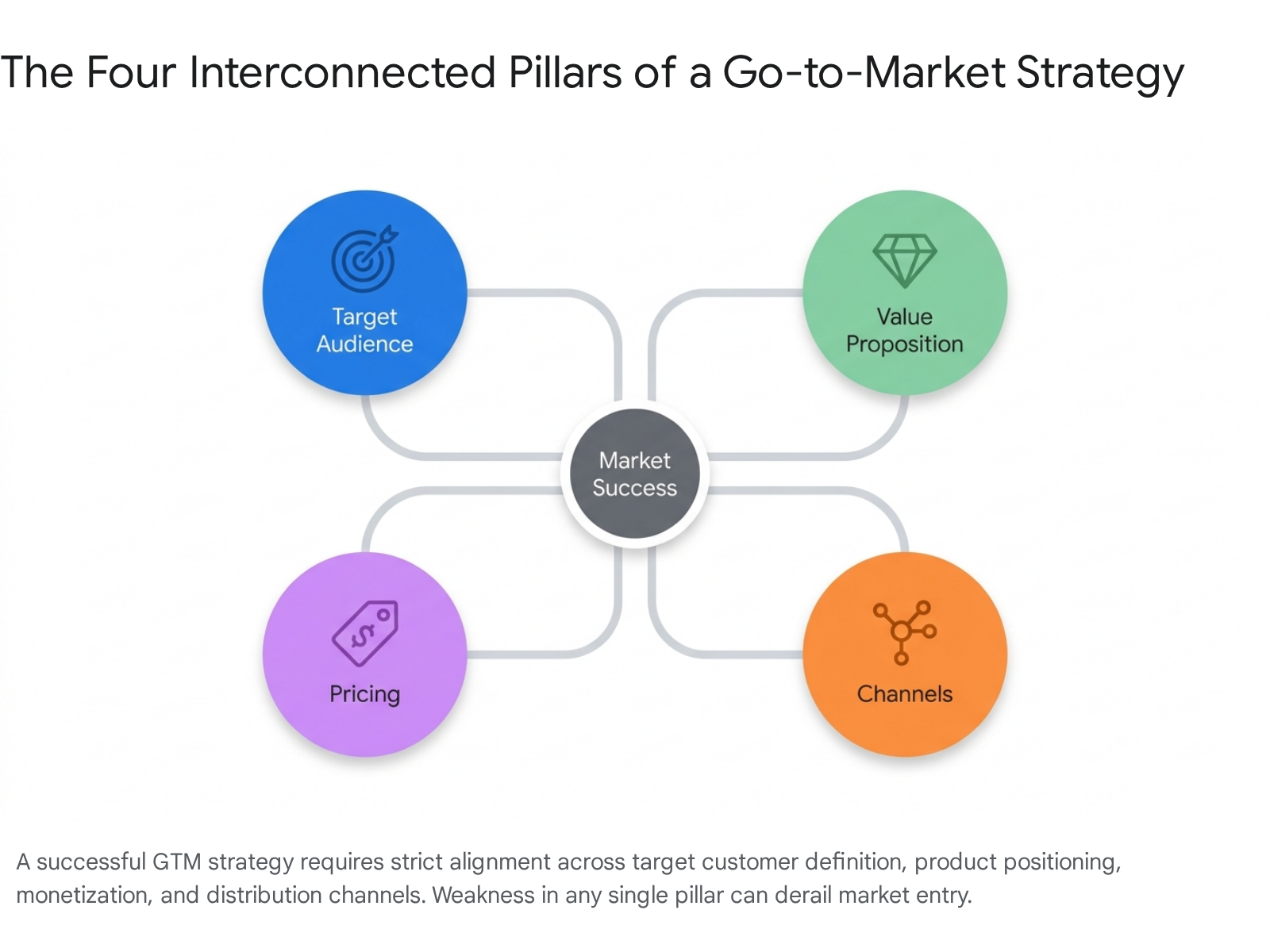
While precise frameworks vary depending on the industry and the complexity of the product, successful GTM execution generally relies on a deep understanding of four foundational pillars. These are widely referred to as the "4 Ps" of GTM strategy: Product, Price, Place, and Promotion 2.
Precision in the Ideal Customer Profile (ICP)
A robust GTM strategy must begin with surgical precision regarding who the product is actually built to serve. Broad demographic targeting dilutes marketing messaging and squanders advertising budgets 12. Consequently, organizations must define their Ideal Customer Profile (ICP). An ICP extends far beyond a generalized buyer persona; it is a highly specific description of the organizational characteristics, technological environments, and buying situations where the product creates the most immediate value and closes with the highest velocity 12.
For a B2B software company, an ICP definition requires analyzing firmographics, such as targeting companies with 50 to 200 employees operating in the financial technology sector. It also requires technographic data, such as targeting organizations that currently utilize specific legacy CRM systems 12. Conversely, for a consumer-facing entity, such as a local bakery transitioning to a national e-commerce model, the ICP might pivot from capturing local foot traffic to targeting regional event planners who require bulk digital ordering capabilities 13.
Value Proposition and Strategic Positioning
Once the target customer is meticulously defined, the GTM strategy must articulate a compelling value proposition. Customers do not purchase software features, application programming interfaces (APIs), or raw ingredients; they purchase solutions to pressing pain points. Strategic frameworks emphasize that buyers effectively "hire" a product or service to perform a specific job for them 4.
Positioning involves defining exactly how the product differs from existing market alternatives, which includes the pervasive alternative of the customer simply maintaining the status quo and doing nothing 12. Effective positioning requires translating technical capabilities into tangible, high-impact business outcomes. Rather than marketing a platform's "advanced data synchronization capabilities," the positioning should highlight the outcome: "eliminating fifteen hours of manual data entry for your sales team every week" 15.
Pricing and Packaging Architecture
Pricing represents a critical GTM lever that directly influences market penetration, perceived brand value, and overall financial viability. The strategy must dictate precisely how the product will be monetized 616. Common pricing models deployed in modern GTM strategies include several distinct approaches. Value-based pricing sets price points based on the perceived financial return or time savings generated for the customer, requiring deep research into customer willingness to pay 16. Competitor-based pricing positions the product at a premium, at strict parity, or at a discount relative to established market alternatives 16.
In the software sector, freemium models offer a core, functional version of the product entirely for free to drive rapid, frictionless user adoption, while restricting advanced, enterprise-grade features behind a paywall 56. Alternatively, usage-based pricing aligns costs directly with customer consumption, such as charging per gigabyte of data stored or per transaction successfully processed, ensuring the vendor's revenue scales directly with the customer's success 619.
Distribution and Channel Activation
The final foundational pillar addresses the physical and digital logistics of how the product will reach the intended buyer. This stage answers the "Place and Promotion" aspects of the strategy 2. Decision-makers must determine whether the product will be sold directly through an internal outbound sales team, distributed via third-party reselling partners, listed on major cloud marketplaces, or downloaded via a fully automated self-serve website 78.
Selecting the appropriate initial channels is a make-or-break decision for early-stage companies. Rather than attempting to conquer every available social media platform, search engine, and advertising network simultaneously, successful GTM execution typically involves concentrating resources on one or two high-performing channels. For instance, a B2B startup might pair founder-led outbound email campaigns for immediate pipeline generation with a targeted search engine optimization (SEO) strategy to build compounding, long-term organic growth 12.
Formulating Strategy: Insights from Harvard and McKinsey
Beyond the fundamental pillars, academic institutions and global consulting firms offer rigorous frameworks for developing GTM strategies. Harvard Business School outlines a structural approach emphasizing four critical questions that founders and executives must continuously answer.
The strategy must first precisely define the customer, demanding a deep understanding of demographics, pain points, and intrinsic motivations 4. Second, the strategy must identify the exact problem being solved, ensuring the product is positioned as a necessary solution rather than a supplementary luxury 4. Third, organizations must map the customer's buying journey to understand how prospects learn about new solutions, as the modern purchasing process is rarely linear and spans multiple omnichannel touchpoints 4. Finally, the framework demands a decision on the weighting of marketing versus sales: is the company primarily utilizing marketing to induce customers to buy independently, or is it relying on outbound sales representatives to proactively persuade prospects? 4.
McKinsey & Company advocates for a highly granular approach to GTM execution, explicitly warning against rigid, one-size-fits-all playbooks. According to their research, executives should "de-average" their view of markets, breaking them down into microsegments based on specific regional trends and future growth rates . A successful McKinsey-aligned GTM strategy relies heavily on dynamic resource reallocation, which involves rapidly shifting marketing budgets, sales talent, and management attention toward the specific microsegments that demonstrate the highest return on investment . Furthermore, McKinsey emphasizes tracking outcomes rather than inputs; a successful launch is measured by actual preorders and revenue yield, rather than the sheer volume of marketing collateral produced or the number of launch events hosted .
The Startup Playbook: Y Combinator's Pragmatic Approach
For early-stage technology startups, side hustlers, and independent creators, highly formalized corporate frameworks can sometimes induce operational paralysis. Y Combinator, the renowned startup accelerator responsible for funding entities like Airbnb, Stripe, and Dropbox, advocates for a highly pragmatic, speed-oriented GTM philosophy 239.
The cornerstone of the Y Combinator approach is the mandate to launch the product immediately. Founders are advised that launching a mediocre, unpolished product quickly is infinitely superior to building in isolation for months awaiting perfection 10. Releasing a minimum viable product (MVP) into the market is the only reliable mechanism for gathering authentic customer feedback and testing whether the product delivers a "quantum of utility" that overcomes its early flaws 10.
Once launched, Y Combinator strongly encourages founders to engage in activities that do not scale computationally. Rather than investing early capital into complex marketing automation software or expensive advertising campaigns, founders are instructed to acquire their first 10 to 100 customers through intense, manual effort 10. This philosophy is famously illustrated by the early days of Airbnb, where the founders manually traveled to properties to professionally photograph apartments, an entirely unscalable action that significantly boosted listing conversions and provided invaluable direct conversations with early users 10.
The accelerator also warns founders against premature scaling. Expanding a sales team or pouring capital into paid acquisition before achieving true product-market fit leads to rapid capital depletion 23. Furthermore, early-stage companies are advised to avoid long, heavily negotiated enterprise contracts with massive corporations, as these protracted sales cycles often distract the founding team and drain resources without guaranteeing sustained revenue 10. For a startup, identifying a small cohort of users who absolutely love the product is a far more effective GTM foundation than acquiring thousands of users who only feel indifferent about it 26.
B2B SaaS GTM Motions: Product-Led vs. Sales-Led
In the modern business-to-business (B2B) software landscape, a company's GTM strategy is heavily dictated by the primary mechanism it utilizes to acquire, activate, and expand its user base. This strategic divergence is typically framed as the choice between Sales-Led Growth (SLG) and Product-Led Growth (PLG).
The Mechanics of Sales-Led Growth (SLG)
In a traditional Sales-Led Growth model, human interaction serves as the primary engine for revenue generation 27. The organization utilizes marketing departments to generate top-of-funnel demand through whitepapers, industry webinars, and targeted advertising. These efforts produce Marketing Qualified Leads (MQLs), which are subsequently passed to Sales Development Representatives (SDRs). The SDRs qualify the prospects through discovery calls before passing them to Account Executives (AEs), who conduct highly personalized demonstrations, navigate complex security reviews, and negotiate final contracts 272811.
SLG strategies are absolutely essential for complex, highly customized enterprise software products that require significant technical implementation, legal scrutiny, and the alignment of massive, multi-stakeholder buying committees 1127. From a unit economics perspective, SLG models are generally only viable when the Annual Contract Value (ACV) of the software exceeds $25,000 11. Below this threshold, the high customer acquisition costs associated with maintaining an extensive human sales and marketing headcount outstrip the revenue generated, destroying the company's profit margins 1130.
The Rise of Product-Led Growth (PLG)
Product-Led Growth fundamentally inverses the traditional sales funnel. In a PLG strategy, the software product itself operates as the primary vehicle for customer acquisition, activation, and eventual expansion 1928. Instead of experiencing the product only after enduring a lengthy sales presentation, users discover the tool organically, sign up for a free trial or a freemium tier, and interact with the software immediately 630. Once the user experiences the core value of the tool - the crucial "aha!" moment - they input their credit card to unlock advanced features or remove usage limits, entirely bypassing human sales representatives 1930.
Pioneered by highly viral platforms such as Slack, Dropbox, Calendly, and Figma, PLG is profoundly effective for products that boast intuitive user interfaces, require minimal technical setup, and benefit from network effects or team-based virality 192831. Because expensive human intervention is removed from the initial transaction, PLG drastically reduces the Customer Acquisition Cost (CAC) by up to 80% 3032. This high-efficiency model allows software companies to profitably serve small and medium-sized businesses (SMBs), independent freelancers, and individual corporate contributors with an ACV of less than $10,000 1132.
To clearly illustrate the fundamental differences between these two primary SaaS GTM motions, consider the following comparison:
| Strategic Vector | Sales-Led Growth (SLG) | Product-Led Growth (PLG) |
|---|---|---|
| Primary Growth Engine | Human sales teams (SDRs, AEs, Account Managers) 1927. | The software product itself (self-serve onboarding, in-app upgrades) 1928. |
| Target Audience | Enterprise buyers, C-suite executives, procurement departments 2732. | End-users, individual contributors, small technical teams, SMBs 1932. |
| Optimal Price Point | High (ACV strictly > $25,000) 11. | Low to Medium (ACV strictly < $10,000) 11. |
| Customer Acquisition Cost | High (requires heavy investment in headcount, travel, and long sales cycles) 30. | Low (leverages organic virality, word-of-mouth, and automated conversion) 3032. |
| Sales Cycle Duration | Long (spanning months to years), involving high friction and negotiation 27. | Short (spanning minutes to days), characterized by frictionless adoption 2732. |
| Key Performance Metrics | Marketing Qualified Leads (MQLs), pipeline velocity, demo conversion rates 27. | Product Qualified Leads (PQLs), time-to-value, daily active usage 27. |
The Convergence: Hybrid GTM and Product-Led Sales (PLS)
While pure Product-Led Growth provides exceptional mechanics for rapid, low-cost user acquisition, it frequently struggles to capture maximum enterprise value. A self-serve, credit-card-driven checkout flow is rarely sufficient to close a complex, $100,000 corporate procurement deal that requires strict legal compliance and centralized IT approval. Conversely, traditional SLG companies struggle immensely to reach smaller businesses efficiently, as their heavy sales overhead makes small contracts unprofitable 273334.
Industry data reveals a precarious "broken zone" for companies with a median ACV between $10,000 and $50,000 34. In this tier, self-serve conversion rates plummet, yet the cost of deploying traditional sales representatives remains prohibitively high 34. Consequently, the dominant, most effective GTM motion for scaling B2B companies in 2026 is the hybrid model, frequently termed Product-Led Sales (PLS) 1134. McKinsey research emphasizes that high-performing companies executing effective hybrid PLS motions generate ten percentage points more in annual recurring revenue growth and achieve valuation ratios 50% higher than their purely sales-led counterparts .
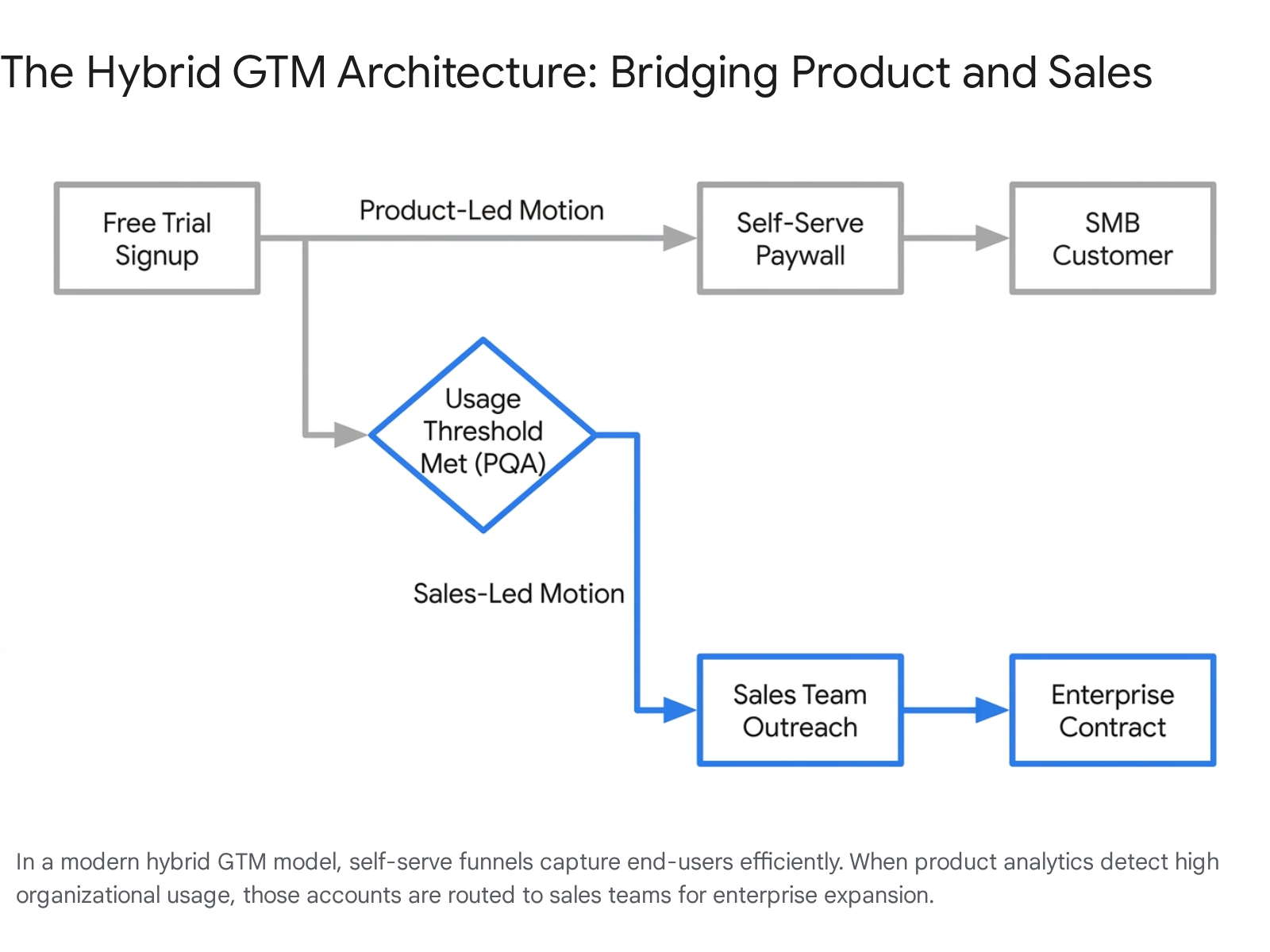
In a successful hybrid architecture, companies do not treat GTM as a sequential funnel where self-serve users are simply dumped into a sales queue. Instead, they operate two distinct tracks simultaneously in parallel 34. The PLG motion handles high-volume, bottom-up acquisition, bringing in thousands of free or low-tier individual users. Simultaneously, backend product analytics meticulously monitor this massive user base to identify "Product Qualified Accounts" (PQAs) 34.
A PQA trigger occurs when product usage signals high organizational intent - such as a single corporate domain where fifty different employees have individually signed up for free accounts, or when a small team rapidly hits their usage limits and requests Single Sign-On (SSO) integration 11634. The moment this algorithmic signal is detected, the human sales team steps in to execute a top-down motion, consolidating the scattered individual users into a lucrative, company-wide enterprise contract 113334.
Emerging Channels: Cloud Marketplaces and Co-Selling
Beyond traditional direct sales and organic inbound marketing, the GTM landscape is heavily influenced by the rise of Cloud GTM. Cloud GTM represents a highly structured approach that combines sales, marketing, and partnership efforts to list, transact, and co-sell software exclusively through massive cloud hyperscaler marketplaces, such as Amazon Web Services (AWS), Microsoft Azure, and Google Cloud Platform (GCP) 8.
Traditional GTM requires sales teams to create new budgets, establish new vendor records, and negotiate custom legal contracts from scratch for every single transaction 8. Cloud GTM bypasses these immense administrative bottlenecks by leveraging the buyer's existing, pre-committed cloud spend 8. Many large enterprises have multi-million dollar consumption commitments with cloud providers; by purchasing third-party software through the cloud marketplace, the enterprise can count that software purchase toward their mandatory cloud commitment 8.
This dynamic drastically accelerates deal velocity by utilizing standardized legal agreements and entirely bypassing redundant security reviews. Furthermore, it enables Independent Software Vendors (ISVs) to co-sell alongside the massive field sales teams employed by the hyperscalers themselves, unlocking a powerful new revenue channel 8.
| Operational Metric | Traditional Enterprise GTM | Cloud Marketplace GTM |
|---|---|---|
| Primary Sales Channel | Direct outbound sales, traditional resellers, standard marketing funnels 8. | Cloud hyperscaler marketplaces (AWS, Azure, GCP) 8. |
| Budget Acquisition | Requires securing net-new budget approvals for every procurement cycle 8. | Leverages the buyer's existing, pre-allocated cloud consumption commitments 8. |
| Security and Legal Review | Long, high-friction security audits and highly customized legal contract negotiations 8. | Zero or severely reduced security friction; utilizes standardized End User License Agreements (EULAs) 8. |
| Partnership Leverage | Isolated sales efforts reliant solely on internal headcount 8. | Cloud provider representatives actively co-sell the product to accelerate the deal cycle 8. |
Geographical and Cultural Nuances in GTM Execution
A catastrophic pitfall in global business expansion is treating diverse geographical regions as a monolithic market 3637. GTM strategies that achieve immense success in one domestic market frequently fail spectacularly in another due to deep-seated differences in cultural communication norms, regulatory frameworks, and technological adoption rates 37.
Privacy Regulations: North America vs. Europe
When expanding across the Atlantic, companies must fundamentally alter their digital distribution and marketing channels to comply with vastly different data privacy paradigms. The European Union operates under the General Data Protection Regulation (GDPR), a rigorous, privacy-first framework that strictly mandates explicit user consent (opt-in) before any personal data collection or sharing can occur 3912.
Consequently, GTM strategies in Europe cannot rely heavily on the aggressive third-party data scraping, automatic tracking, and assumed-consent marketing tactics that are deeply embedded in North American GTM playbooks. The United States lacks a unified federal data privacy law, relying instead on a highly fragmented patchwork of state-specific regulations 39. Laws such as the California Consumer Privacy Act (CCPA), the Virginia Consumer Data Protection Act (VCDPA), and the Colorado Privacy Act (CPA) generally operate on an "opt-out" model, allowing businesses greater initial leeway in consumer tracking compared to the European standard 3912.
Furthermore, the penalties for executing a non-compliant GTM strategy in these regions are severe. GDPR noncompliance can result in administrative fines of up to €20 million or 4% of a company's total worldwide annual turnover, whichever is higher 12. In contrast, CCPA violations carry civil penalties of $2,500 for unintentional violations and $7,500 for intentional violations per incident 12.
| Privacy Legislation | Jurisdiction | Consent Model | Primary Target | Regulatory Scope |
|---|---|---|---|---|
| GDPR | European Union | Strict Opt-in 12. | Any natural person within the EU 12. | Comprehensive; applies to any entity processing EU data, regardless of the company's global location 3912. |
| CCPA / CPRA | California, USA | Opt-out (Consent required only for minors under 16) 3912. | California residents 12. | Entities doing business in California meeting specific revenue or data volume thresholds 12. |
| VCDPA | Virginia, USA | Opt-out 12. | Virginia residents 12. | Entities conducting business in Virginia processing data of at least 100,000 consumers 12. |
| CPA | Colorado, USA | Opt-out 12. | Colorado residents 12. | Entities doing business in Colorado meeting specific data processing thresholds 12. |
Beyond legal compliance, fundamental buyer psychology differs drastically between regions. North American B2B buyers frequently favor bottom-up, self-service trials with high autonomy and rapid execution. In stark contrast, European enterprise buyers often expect a much more consultative, top-down approach, requiring extensive pre-sales support, relationship-building, and consensus-gathering before any commercial discussions occur 3741.
The Dominance of WhatsApp in Emerging Markets
In emerging economies spanning Latin America, India, and Southeast Asia, traditional North American GTM channels - such as long-form email marketing campaigns and standard web-based sales funnels - are highly ineffective 4243. The digital economy in these regions is fiercely mobile-first, and digital commerce operates predominantly through a single communication platform: WhatsApp 424445.
The market penetration of WhatsApp in these territories is staggering. The platform boasts over 3.3 billion active users globally, exchanging over 150 billion messages daily 45. In Brazil alone, roughly 147 million people actively use the application, representing a 99% installation rate across all active smartphones 44. In India, over 535 million users access the platform multiple times a day 42. Crucially for marketers, WhatsApp message open rates consistently hover near 98%, utterly eclipsing the 20% average open rates associated with traditional email marketing 4243.
Consequently, a winning GTM strategy in these markets leverages the WhatsApp Business API to execute full-funnel sales 13. Rather than directing traffic to a static landing page, modern companies run targeted social media advertisements that click directly into a WhatsApp chat interface. Here, multilingual AI-powered chatbots instantly engage the customer, display rich-media digital product catalogs, facilitate seamless payment processing, and provide automated post-purchase tracking updates - all without the user ever leaving the chat environment 42431347. Establishing highly curated "VIP WhatsApp Lists" for repeat buyers drives faster responses, intense brand loyalty, and higher conversion rates than any traditional CRM email campaign could achieve in these regions 43.
Artificial Intelligence Revolutionizing GTM Execution
The rapid integration of artificial intelligence is fundamentally rewiring how go-to-market strategies are developed, scaled, and executed. As the business landscape approaches 2026, AI is no longer viewed merely as a supplementary productivity tool; it has become the core operational engine driving GTM efficiency 4814.
Predictive Analytics and Hyper-Personalization
Historically, GTM teams relied on static customer segmentation models and manual analysis of historical sales data. Today, AI-powered predictive analytics tools evaluate massive, complex datasets of digital body language - such as website interactions, feature usage, and subtle engagement metrics - to accurately forecast future customer behavior 481450.
Platforms equipped with machine learning algorithms can automatically identify which free-tier users possess the highest probability of converting to paid accounts, predict the exact moment a customer is nearing a capacity limit and requires a sales intervention for an upgrade, and flag specific accounts that display behavioral indicators of imminent churn 2814. This technological capability allows marketing teams to deploy hyper-personalized content at unprecedented scale, shifting from generic, one-size-fits-all email blasts to highly dynamic messaging that is instantly tailored to an individual user's exact journey and feature preferences 54814.
The Shift to Agent-Led Growth (ALG)
Perhaps the most significant structural shift in SaaS GTM strategy is the rapid transition from pure Product-Led Growth to Agent-Led Growth (ALG) 30. In a traditional PLG model, the heavy burden of learning the software falls entirely on the user; they must navigate complex onboarding sequences, read through static documentation, and discover the product's value through trial and error 30.
Agent-led growth entirely reverses this dynamic. Autonomous AI agents and highly intelligent virtual assistants are now embedded directly into the software to "de-labor" the go-to-market process 3015. When a user signs up for a complex enterprise tool, they no longer have to struggle through setup menus or wait days for a human sales engineer to schedule an orientation demo. Instead, an autonomous AI agent proactively guides them through the setup, answers complex technical queries in real-time, and dynamically alters the user interface based on the customer's stated business goals 301516. Industry analysts from organizations like Winning by Design project that this AI-native approach will fundamentally alter or entirely replace up to 90% of traditional GTM sales roles by autonomously handling onboarding, upselling, and contract renewals 15.
The Solopreneur and Creator GTM Stack
For independent creators, side-hustlers, and solopreneurs, artificial intelligence has profoundly democratized GTM execution. Historically, executing a sophisticated, multi-channel product launch required significant capital to hire graphic designers, copywriters, SEO specialists, and data analysts 1754.
By 2025, a solo founder can execute an enterprise-grade GTM strategy utilizing a highly affordable, integrated AI technology stack. This technological leverage allows a single operator to punch far above their weight class, effectively simulating the output of a small agency 5455. A modern solopreneur GTM stack typically includes:
- Strategic Ideation and Research: Tools like ChatGPT and Perplexity AI act as strategic co-pilots, instantly summarizing market research, simulating buyer personas, and drafting initial product positioning and value propositions 17551819.
- Content Generation and Copywriting: Platforms such as Jasper AI are utilized to generate high-converting, SEO-optimized long-form blog posts, email marketing sequences, and targeted advertising copy, maintaining strict brand voice control 175419.
- Visual Design and Branding: Canva's AI Magic Studio empowers non-designers to instantly generate professional social media graphics, custom logos, and dynamic presentation decks without the need for expensive design software 175455.
- Search Engine Optimization (SEO): Tools like Surfer SEO provide real-time, AI-driven guidance on content structure, keyword density, and competitive ranking factors, ensuring the product reaches users actively searching for solutions 1755.
- Workflow Automation: Platforms such as Zapier automate the repetitive administrative tasks between different software tools, ensuring that leads captured on a website are instantly routed to a CRM and followed up with automated email sequences without any manual data entry 5520.
Common GTM Pitfalls and Execution Traps
Even with a flawless product and a massive total addressable market, poor GTM execution can rapidly sink a launch 359. By studying the most common points of strategic failure, organizations can proactively adjust their approaches to ensure sustainable growth.
Siloed Teams and Strategic Misalignment
A comprehensive GTM strategy spans the entire commercial operation of a business. When marketing, sales, product development, and customer success teams operate in rigid isolation, the strategy inevitably fractures 13. For example, marketing may create massive demand based on future features the product team hasn't fully finalized, leading the sales team to disappoint incoming prospects who realize the product cannot deliver on the marketed promises.
Research from the LinkedIn B2B Institute indicates that misalignment between brand building and demand generation is one of the most common causes of commercial failure 1. Data from global surveys reveals that over 84% of organizations experience severe GTM misalignment on a regular basis 41. To correct this critical vulnerability, leadership must establish shared, revenue-based KPIs rather than isolated vanity metrics, enforce strict service-level agreements (SLAs) between departments, and utilize unified CRM systems to ensure all teams operate from a single source of truth regarding the customer journey 13.
The Founder-Led Sales Trap
In the nascent stages of a startup, it is highly recommended that founders handle sales and customer acquisition directly. As advised by Y Combinator, engaging in actions that "don't scale" - such as manually onboarding the first 100 users or answering customer support tickets directly - provides invaluable, unfiltered feedback regarding actual market needs 72310.
However, many scaling businesses fail to transition away from this phase appropriately. They rely far too heavily on the founder's inherent charisma, deep technical knowledge, and personal industry connections rather than building a repeatable, systematized sales engine 36. Before a company hits critical revenue milestones (such as $5M ARR), it must meticulously codify the founder's tacit knowledge into strict GTM playbooks. This involves documenting the exact Ideal Customer Profile, creating objection-handling frameworks for common pushback, and establishing clear internal handoff protocols so that newly hired sales representatives can replicate the founder's success independently 36.
Running Concurrent GTM Motions Prematurely
The rapid speed of modern software development frequently tempts founders to launch multiple distinct features or target several disparate audience segments simultaneously. Accelerators and growth experts heavily advise against this scattershot approach 61.
Running parallel GTM hypotheses severely fragments market signals and burns through operational capital. If a massive, multi-front launch fails to gain traction, the team cannot accurately determine if the core product was flawed, the messaging was incorrect, or if the limited resources were simply spread too thin across too many channels 61. The most successful early-stage GTM strategies pick one distinct hypothesis, target one clear microsegment, and utilize one primary distribution channel, iterating relentlessly until absolute repeatability is proven before attempting to expand further 61.
GTM Beyond Technology: Application in Traditional Business
While the terminology surrounding GTM strategy is heavily concentrated in the software and technology sectors, the fundamental principles apply equally to traditional retail, food service, and local commerce.
Consider the trajectory of a major retail bakery chain like Gregg's in the United Kingdom. From its origins as a single store in the 1930s, the company scaled to over 2,500 locations by executing a highly disciplined GTM strategy based on a clear value proposition: delivering delicious, freshly baked, and affordable food 62. While their target market is exceptionally broad (an undifferentiated marketing strategy), their positioning remains fiercely competitive regarding price, service speed, and product quality, allowing them to sustain massive growth and navigate severe market disruptions like the global pandemic 62.
Similarly, for a hyper-local business, executing a modern GTM strategy often involves digital transformation. A case study of a local pastry shop, "Bakes and More," illustrates how transitioning from a reliance on local foot traffic to a dedicated e-commerce GTM strategy completely altered the business trajectory 13. By defining a new digital distribution channel, optimizing the website for mobile ordering, and utilizing social media not just for brand awareness but as a direct sales funnel, the bakery increased revenue by 35% in a single month and expanded its geographic reach far beyond its physical storefront 13. This demonstrates that regardless of whether a company is selling enterprise cloud software or custom wedding cakes, the rigorous application of GTM principles - defining the audience, clarifying the value, establishing the price, and optimizing the channel - remains the fundamental mechanism for commercial growth.
Bottom line
A go-to-market strategy serves as the critical, tactical bridge between engineering a great product and successfully commercializing it. By rigorously defining the ideal customer profile, establishing clear monetization models, and selecting highly specific channels for distribution, companies transition from merely hoping for market adoption to actively engineering it. As the commercial landscape evolves through 2026, organizations that effectively leverage hybrid product-led sales models, deeply integrate AI automation into their workflows, and respect profound regional market nuances will maintain a distinct competitive advantage. However, despite rapid technological advancements, the fundamental prerequisite of aligning undeniable product value with actual customer pain points remains entirely unchanged.