
Jobs to Be Done for go-to-market strategy and product positioning
Evolution of the Framework
The Jobs to Be Done (JTBD) framework originated as a theory of innovation designed to explain why customers adopt new products and technologies . Popularized by Harvard Business School professor Clayton Christensen, along with strategists like Anthony Ulwick and Bob Moesta, the theory posits a fundamental causal mechanism: consumers do not purchase products based on demographic attributes or broad categories; rather, they "hire" products to make progress in specific, situational circumstances 315. Historically, JTBD has been deployed primarily within research and development (R&D) and product management to inform feature prioritization and roadmap planning 67.
However, limiting the framework to product development leaves significant value unrealized in the commercialization phase. Increasingly, organizations are extending JTBD principles to their go-to-market (GTM) strategies 23. This expansion shifts the focus of marketing, sales, and revenue operations from selling a product's functional features to selling the specific outcomes and progress a customer seeks 54. Applying JTBD to GTM strategy involves adopting several core tenets: a job is stable over time, it is solution-agnostic, and success depends on making the job the primary unit of analysis rather than the customer or the product itself 6. By organizing GTM motions around these tenets, organizations can construct highly targeted channel strategies, resilient marketing narratives, and robust technical architectures capable of supporting outcome-driven growth.
Limitations of Traditional Market Segmentation
Traditional market segmentation relies predominantly on demographic data, psychographic profiles, and firmographic indicators 125. While these metrics provide a superficial understanding of who the customer is, they fail to illuminate the causal drivers behind purchasing decisions 46. A demographic profile detailing a target consumer's age, location, and job title does not explain why that consumer might abruptly abandon an established brand in favor of a disruptive alternative 37.
This reliance on demographic assumptions frequently results in the "Better Mousetrap" fallacy - the mistaken belief that a technically superior product will automatically capture market share 4. Without understanding the underlying struggle that prompts a purchase, product launches often fail to meet initial revenue targets because the accompanying GTM strategy misinterprets the market's actual demand 28. To rectify this, organizations are adopting "JTBD-infused personas." These hybrid models synthesize the precision of traditional demographic targeting (which remains necessary for media buying and ad placement) with the motivational clarity of job-based segmentation 67.
Table 1 highlights the fundamental differences between traditional demographic personas and JTBD-infused personas.
| Analytical Dimension | Traditional Demographic Persona | JTBD-Infused Persona | Strategic Implication |
|---|---|---|---|
| Primary Identifier | Age, income, job title, industry 57. | The core functional job and current struggle 56. | Moves focus from "who the buyer is" to "what they are trying to achieve." |
| Market Segmentation | Grouped by vertical or company size 26. | Grouped by job performance deficits and desired outcomes 26. | Reveals hidden market segments and non-traditional competitors. |
| Competitor Definition | Companies offering similar products 69. | Any solution currently hired to complete the job 918. | Expands competitive awareness (e.g., software competing with manual spreadsheets). |
| Application in GTM | Determines ad placement and channel selection 7. | Drives messaging architecture, sales talk tracks, and positioning 67. | Aligns narrative directly with customer motivation rather than product features. |
Job Dimensions in Product Positioning
A core principle of applying JTBD to product positioning is the recognition that customer jobs are rarely one-dimensional. To effectively position a product in a crowded market, go-to-market teams must deconstruct the customer's desired progress into three distinct but interconnected dimensions: functional, emotional, and social jobs 192010. Standard marketing efforts often fixate on the functional utility of a product, neglecting the reality that purchasing decisions are frequently driven by emotional and social aspirations 22.
The functional dimension represents the practical, objective task a customer needs to complete. Examples include automating a workflow, transporting goods, or satisfying hunger 5923. The emotional dimension reflects how the customer desires to feel (or avoid feeling) while executing the functional job. This involves internal psychological states, such as feeling secure, confident, or relieved of stress 2010. Finally, the social dimension encompasses how the customer wishes to be perceived by others - such as appearing professional to colleagues, seeming like a responsible parent, or projecting success to peers 191023.
When product positioning explicitly addresses all three dimensions, it elevates the brand above feature-level commoditization. For example, Clayton Christensen's foundational milkshake study revealed that morning commuters hired milkshakes not simply for sustenance (functional), but to relieve the boredom of a long drive (emotional) without creating a mess in the car 5822. Similarly, during the global shift to remote work, the videoconferencing software Zoom experienced a 354 percent increase in customer growth 8. While the functional job was to facilitate virtual meetings, the emotional job involved mitigating the isolation of remote work, and the social job centered on maintaining professional continuity in a dispersed environment 8.
Cross-Market Application of Job Dimensions
The weighting and interplay of functional, emotional, and social jobs vary significantly depending on the market context, particularly between Business-to-Business (B2B) and Business-to-Consumer (B2C) environments. Table 2 outlines how these dimensions inform multidimensional positioning across various sectors.
| Market Context | Product Example | Functional Job | Emotional Job | Social Job |
|---|---|---|---|---|
| B2B SaaS | Marketing Automation Platform | Automate repetitive email workflows and segment data 23. | Feel confident in decisions and reduce anxiety over human error 23. | Appear competent, data-driven, and capable of impressing the C-suite 23. |
| B2B Tech | Corporate Communication (e.g., Slack) | Streamline asynchronous team communication 11. | Feel in control of information flow; eliminate inbox stress 11. | Be perceived as a modern, agile, and collaborative team player 11. |
| B2C Tech | Fitness Tracking Wearable | Track heart rate, daily steps, and sleep metrics 23. | Feel motivated, disciplined, and proactive about longevity 23. | Project an image of health; share achievements with a peer group 23. |
| B2C Retail | Premium Suitcase | Transport belongings securely from origin to destination 12. | Reduce travel anxiety and feel organized during transit 12. | Look prepared, professional, and sophisticated to fellow travelers 12. |
By isolating these underlying dimensions, GTM teams can engineer sophisticated, layered messaging architectures. Functional jobs dictate baseline product requirements and inform search engine optimization (SEO) strategies, as users typically search for functional solutions. Conversely, emotional and social jobs must dictate the brand tone, overarching narrative, and creative imagery utilized in broader awareness campaigns 10.
Cultural Contexts in Job Dimensions
While the fundamental premise of JTBD - that individuals hire products to make progress - is globally robust, the specific expressions of social and emotional jobs exhibit extreme cultural variability 13. GTM strategies expanding into international markets frequently falter when they assume that the emotional and social circumstances surrounding a product are universally consistent.
This disparity is highly pronounced when comparing individualist cultures (e.g., the United States, Western Europe) with collectivist cultures (e.g., many Asian and African nations) 141516. In individualistic societies, social and emotional jobs are inherently tied to self-expression, personal achievement, and the amplification of a bounded, subjective self 1316. In these contexts, emotional norms often pressure individuals to maximize personal happiness and assert independence 15. Conversely, in collectivist cultures, emotional and social jobs are deeply grounded in social cohesion, interconnectedness, family duty, and assessments of relative social worth 131516. Emotion norms in these societies dictate that populations frequently prioritize relational harmony and group loyalty over individual standout performance 15.
Case Study: Mobile Money in Sub-Saharan Africa
The deployment of mobile money platforms, such as M-Pesa in Kenya and expanding fintech networks across Sub-Saharan Africa, demonstrates the necessity of adapting GTM strategies to culturally specific JTBD dimensions 1718. From a purely functional standpoint, the job of a mobile money platform is universally standard: to securely store value and transfer funds in regions with limited traditional banking infrastructure 1719.
However, the social and emotional jobs driving the widespread adoption of mobile money in these regions are heavily rooted in collectivist cultural norms. The platform is rarely "hired" purely for individual financial autonomy; instead, it is heavily utilized to support extended family networks, remit funds to rural villages, and fulfill deep-seated social obligations within the community 1718. A GTM strategy for an African fintech application that relies on individualistic messaging (e.g., "achieve your personal financial freedom") will structurally underperform compared to messaging that aligns with the collectivist job (e.g., "secure your family's future and support your community"). Furthermore, research indicates that post-consumption recommendations and referrals in these markets are strongly influenced by the technology's ability to integrate seamlessly into existing social ecosystems, highlighting how deeply intertwined functional reliability is with social trust and reputation 3320.
Cultural Institutions and Experiential Jobs
The cultural application of JTBD extends beyond technological products to experiential services and non-profit sectors. Cultural institutions, including museums, galleries, and theaters, are increasingly utilizing JTBD to redefine their GTM value propositions 21. Audiences do not hire a museum simply to view static artifacts; they hire the institution for specific emotional and social outcomes. An immersive museum visit may be hired as a mindful retreat from digital fatigue, while a community theater workshop might be hired to reclaim cultural identity, build confidence, or process collective grief 21. Recognizing that different demographic cohorts hire these institutions for divergent emotional progress allows cultural leaders to move beyond generalized participation metrics toward highly targeted, localized community engagement strategies 21.
The Four Forces of Progress in Market Dynamics
A critical extension of JTBD theory for go-to-market practitioners is the "Four Forces of Progress" model. This paradigm dictates that for a customer to adopt a new product or service, the forces driving them toward change must definitively outweigh the forces anchoring them to their current state 2223. Integrating these four psychological forces into GTM execution provides a strategic roadmap for demand generation, objection handling, and conversion.
The two forces that promote change and generate demand are: 1. Push of the Current Situation: The internal or external frustration, escalating costs, or inefficiencies associated with the status quo. If a customer does not feel sufficient push, they will not actively seek a new solution 22. 2. Pull of the New Solution: The magnetic appeal of a better future state and the specific benefits offered by the new product 23.
Conversely, the two forces that inhibit change and reduce demand are: 3. Anxiety: The fear of the unknown, implementation risks, or the potential for the new solution to fail. This manifests as "anxiety-in-choice" (fear of making the wrong purchasing decision) and "anxiety-in-use" (fear of complex implementation) 23. 4. Habit: The comfort of existing routines and the powerful inertia of a "good enough" status quo 22.
Aligning the Forces with the Go-to-Market Funnel
In a traditional GTM funnel, marketers focus on generating awareness of a brand and moving leads linearly toward a decision. In a JTBD-optimized GTM funnel, the overarching objective is to manipulate these four forces: amplifying push and pull while systematically neutralizing anxiety and habit 2224.
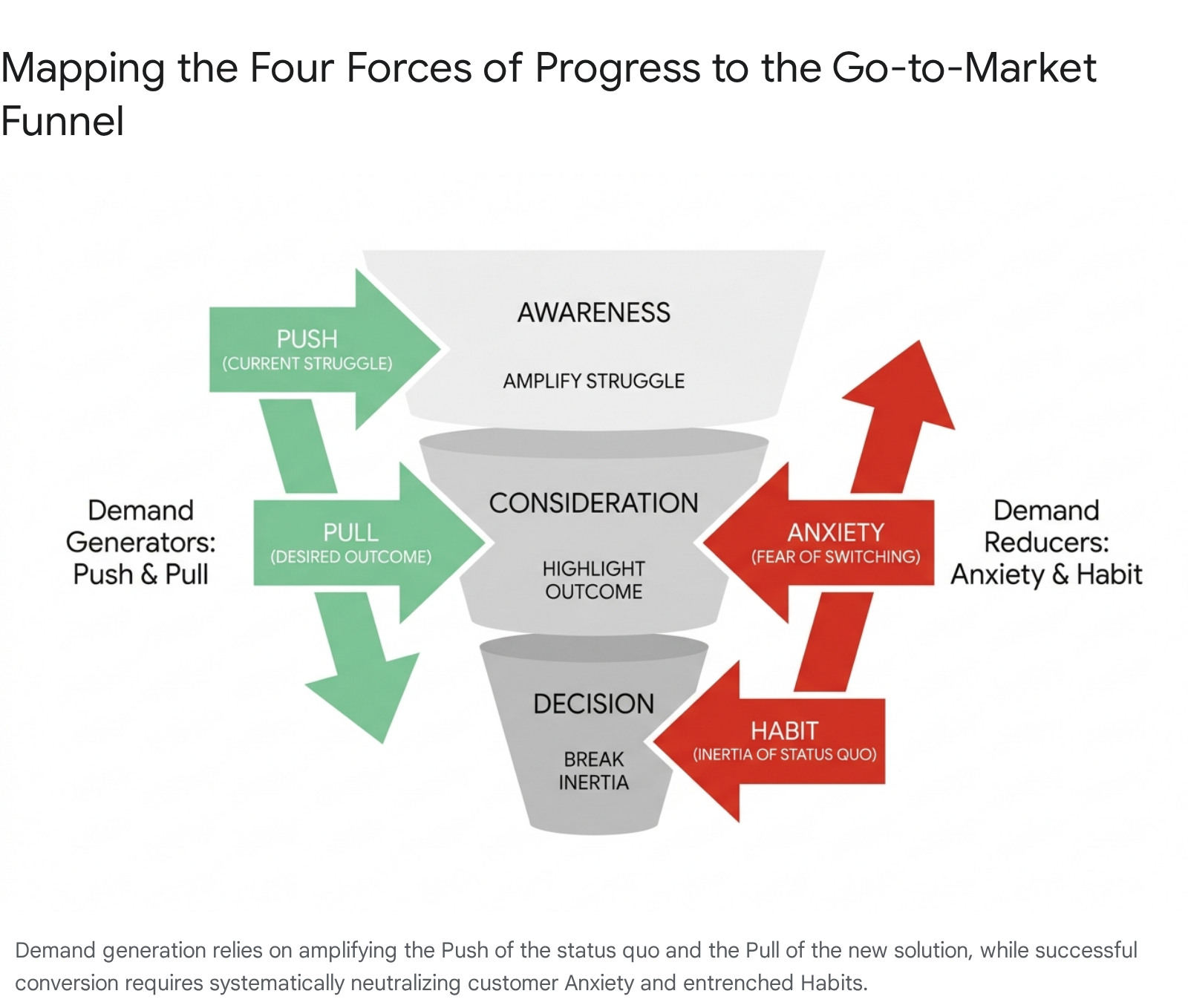
- Awareness Stage (Amplifying the Push): Top-of-funnel marketing should eschew heavy product promotion. Instead, it must mirror the customer's current struggle. By vividly highlighting the pain points, inefficiencies, or emotional frustrations of the status quo, the GTM strategy validates the customer's "push" factors 22.
- Consideration Stage (Establishing Pull and Mitigating Anxiety): As prospects move into the consideration phase, GTM messaging must articulate the "pull" by clearly demonstrating the desired progress and validating the outcome 23. Concurrently, this stage must proactively address anxiety. Content at this stage must deploy case studies, clear implementation roadmaps, social proof, and risk-reversal guarantees to lower perceived risk 23.
- Decision and Retention Stage (Overcoming Habit): At the bottom of the funnel, the primary competitor is rarely another vendor; it is the customer's entrenched habit . GTM strategies must emphasize the opportunity cost of inaction to dislodge inertia. Furthermore, post-sale onboarding must be heavily resourced to ensure the customer breaks their old routines, successfully integrates the new solution, and formally completes the job 2324.
GTM Channel Selection and Execution
The translation of JTBD insights into actionable market presence requires rigorous evaluation of GTM channels. Modern B2B buyers do not follow a linear path; thus, the most effective GTM strategies orchestrate multi-channel journeys grounded in audience insights 25. GTM leaders must assess established marketing channels across three primary lenses: channel fit, channel behavior, and channel controls 26.
Channel fit determines whether a medium naturally aligns with the customer's job context. For example, search engine marketing (SEM) is highly effective for capturing high-intent functional jobs where users actively seek solutions to immediate problems. Conversely, paid social media or programmatic display advertising is better suited for top-of-funnel awareness, where the goal is to trigger the "push" force by highlighting latent struggles to a passive audience 2527. GTM planners must match the deployment tier of a campaign to the strategic importance of the job, ensuring resources are not over-invested in low-priority feature launches that do not drive significant customer progress 28.
Designing Progress-Driven Marketing Messaging
When GTM teams adopt the JTBD framework, the structural composition of marketing copy, landing pages, and overarching brand narratives must undergo a fundamental transformation. Generic messaging engineered to capture an "average" demographic guarantees resonance with almost no one 4. Customers do not purchase products for their technical specifications; they hire them to execute a transformation from a struggling state to a desired state 491221.
Transitioning Copy from Features to Outcomes
Effective JTBD ad copy replaces feature lists with outcome statements. A useful structure for this is the APP (Agree, Promise, Preview) copywriting formula. The message must first establish agreement with the customer's current struggle (the push), promise a specific functional and emotional outcome (the pull), and then preview the product as the vehicle for that transition 44.
For example, a project management software company utilizing traditional messaging might lead with: "The most advanced Kanban boards and API integrations for enterprise teams." A JTBD-informed approach recognizes that the customer does not fundamentally care about API integrations; they care about regaining their time. The revised, progress-led message becomes: "Stop wasting 10 hours a week chasing updates. Finish your week on time" 4.
Table 3 contrasts feature-centric marketing messaging with JTBD-centric messaging across different product categories, highlighting the underlying forces addressed.
| Product Category | Traditional (Feature-Led) Messaging | JTBD (Progress-Led) Messaging | Primary Force Addressed |
|---|---|---|---|
| Project Management Software | "The most advanced Kanban boards and API integrations for enterprise teams." 4 | "Stop wasting 10 hours a week chasing updates. Finish your week on time." 4 | Push (Frustration with wasted time and administrative overhead). |
| GPS Dog Collar | "Features 10-mile range, Bluetooth 5.0, and a 14-day battery life." 27 | "Never experience the panic of a lost dog again. Find them instantly, even off-grid." 27 | Pull & Emotional Job (Relief from panic/anxiety regarding a pet). |
| Travel Suitcase | "Constructed with aerospace-grade polycarbonate and 360-degree spinner wheels." 12 | "Navigate crowded airports effortlessly and look impeccably prepared for your next meeting." 12 | Functional & Social Job (Efficiency and maintaining a professional appearance). |
Comparing JTBD to other messaging frameworks reveals its unique strength in insight generation. While frameworks like StoryBrand excel at narrative clarity and Challenger models excel at creating commercial tension, JTBD specifically provides the high-value insights necessary to map emotional arcs, dismantle the status quo, and segment audiences based on desired progress 45.
Transforming Sales Enablement and Scripting
In the sales domain, rigid, feature-heavy cold calling scripts are highly ineffective in modern B2B environments because they fail to address the buyer's unique context, leading to mechanized pitches that alienate prospects 4647. JTBD transforms sales enablement by converting scripts from robotic monologues into flexible, diagnostic talk tracks 46.
A JTBD-informed sales methodology equips Business Development Representatives (BDRs) and Account Executives to identify the specific circumstances driving the prospect to engage. Instead of a linear feature demonstration, the sales conversation becomes a diagnostic exercise designed to uncover the "Push" of the prospect's current solution and the specific "Pull" they desire 4648. When objections arise, sales teams are trained not to defend the product's technical specifications defensively, but to re-center the dialogue on how the solution uniquely mitigates the prospect's anxieties and facilitates their specific job 48.
Furthermore, JTBD allows sales teams to segment pipelines not by industry vertical or company size, but by the specific job the prospect is trying to execute. This ensures that discovery calls and product demos are hyper-personalized to the prospect's definition of progress, significantly shortening sales cycles, improving close rates, and systematically reducing customer acquisition costs (CAC) 48.
Market Research and Customer Insight Gathering
To power a JTBD-driven GTM strategy, the underlying market research methodologies must shift from preference-based surveys to outcome-driven investigations. Traditional market research often asks customers what features they want or how satisfied they are with current solutions, which frequently leads to status quo bias and false negatives regarding unmet needs 2950. Customers are notoriously poor at conceptualizing ideal future solutions in a vacuum 50.
To generate actionable JTBD data, researchers must conduct "Switch Interviews" - qualitative deep dives that investigate the exact moments and circumstances that caused a customer to abandon an old solution and hire a new one 4. Additionally, when conducting quantitative surveys, a common critical mistake is surveying solutions rather than surveying jobs 50. Survey items must be written as solution-independent outcomes that are measurable by their importance to the customer and the customer's current level of satisfaction. Failing to screen respondents for the specific situational context in which they execute the job will result in mixed data that obscures the true market signal 50.
Re-architecting CRM Systems for Job Metrics
A JTBD-driven GTM strategy cannot be effectively operationalized if the organization's technical infrastructure is incapable of capturing and tracking progress-based metrics. The primary technical hurdle lies in the foundational architecture of leading Customer Relationship Management (CRM) platforms, such as Salesforce and HubSpot. These systems are natively designed around demographic, firmographic, and relational data models 65152. They inherently track who the customer is (Contacts, Accounts) and what they are doing (Deals, Activities), but they are not structurally designed to track why they are buying or the progress they are attempting to make 65152.
To align sales, marketing, and customer success teams around JTBD, organizations must fundamentally re-architect their CRM data schema to capture struggle-based and progress-based data 654.
Structuring JTBD Data in Salesforce and HubSpot
HubSpot's architecture relies on standard "Hubs" and a relatively rigid, intuitive object framework (Contacts, Companies, Deals, Tickets), which excels in marketing attribution and ease of use for small-to-medium businesses but poses limitations for highly complex, non-standard enterprise data hierarchies 5152. Conversely, Salesforce utilizes a heavily metadata-driven architecture with a virtualized relational database, offering advanced customization through standard objects, custom objects, and complex relationship mapping (Master-Detail, Lookup) via its Schema Builder interface 52545530.
To integrate JTBD insights technically, organizations must utilize custom objects and field mapping to append job data to standard contact and account records 543132.
- Custom Object Creation: Rather than relying solely on the standard "Opportunity" object to track a sale, advanced revenue operations teams construct a custom "Customer Job" or "Job Map" object 183159. This custom object acts as a dedicated database table linked to the primary Account or Contact via a Lookup or Master-Detail relationship 54325960.
- Schema Mapping for the Four Forces: Custom fields within the Contact, Lead, or Custom Object must be mapped to capture the qualitative data gathered during discovery calls. Fields such as
Primary_Struggle__c(Push),Desired_Outcome__c(Pull), andCurrent_Workaround__c(Habit) move JTBD from a theoretical exercise to a quantifiable data point. These fields can then be used to trigger specific, highly personalized marketing automation workflows 54326162.
Integration and Bidirectional Sync Challenges
For organizations running a dual-platform stack - commonly utilizing HubSpot for top-of-funnel marketing and Salesforce for sales execution - maintaining a single source of truth for JTBD data requires meticulous data governance 33. Integrating the two systems frequently results in data synchronization errors due to differing underlying data models, field type mismatches, duplicate record creation, and conflicting workflow automation triggers 61623435.
When mapping a JTBD custom object or field from Salesforce to HubSpot, organizations face the risk of system lock-in and brittle event-driven sync architectures 66. If a marketing campaign in HubSpot is designed to trigger based on a change in a lead's JTBD_Status__c field in Salesforce, strict field ownership rules must be established to prevent loop conflicts. Typically, HubSpot owns top-of-funnel behavioral data and lead scoring, while Salesforce serves as the authoritative system of record for complex deal hierarchies and job outcome validation 33. Without strategic field mapping and reliable bidirectional database synchronization, the alignment between the marketing narrative and the sales execution fractures, rendering the GTM strategy technically inoperable 613366.
Table 4 illustrates the paradigm shift required in CRM data architecture to support a JTBD go-to-market strategy.
| CRM Component | Traditional Demographic Data Model | JTBD Progress-Based Data Model |
|---|---|---|
| Primary Segmentation | Industry vertical, Company revenue, Job title 26. | Core functional job, Current level of struggle, Desired outcome 26. |
| Opportunity Tracking | Stages based on internal sales processes (e.g., Discovery, Demo, Negotiation) 5255. | Stages aligned with the customer's Job Map and internal decision-making progress 218. |
| Lead Qualification | BANT (Budget, Authority, Need, Timeline) 46. | Assessment of the Four Forces (Intensity of Push/Pull vs. Friction of Habit/Anxiety) 46. |
| Technical Execution | Standard objects (Accounts, Contacts, Opportunities) 5152. | Custom Objects (Job_Map__c) and custom fields linked via Lookup relationships 543259. |
Aligning Organizational KPIs with Customer Outcomes
Ultimately, a GTM strategy is only as effective as the metrics used to evaluate its success. Traditional Key Performance Indicators (KPIs) predominantly focus on internal business outputs, such as lead volume, cost per acquisition, or sales efficiency metrics 67. However, achieving internal targets does not guarantee that the product is actually helping the customer make progress 67.
A JTBD-aligned organization must shift its measurement frameworks from internal outputs to external customer outcomes. This requires tracking metrics such as the Customer Effort Score (CES), which quantifies the difficulty a user faces when executing a specific step in their job map based on effort, speed, and accuracy 2. High CES scores indicate significant unmet needs and highlight priority segments for GTM investment 250. In the sales pipeline, organizations should track "Job-Aligned Pipeline Velocity" to measure how quickly prospects move through job understanding stages, and compare "Progress-Based Win Rates" to evaluate opportunities equipped with clear job context versus generic demographic qualifications 2. By tying these outcome metrics to service-level targets and making them visible in operational dashboards, organizations ensure that their GTM strategy remains tethered to the delivery of real customer value 50.