
What Is the Fractional Quantum Hall Effect
The fractional quantum Hall effect is an exotic quantum phase of matter that emerges when two-dimensional electrons, subjected to extreme cold and powerful magnetic fields, form a highly correlated, incompressible liquid. In this state, the strong repulsive forces between electrons cause them to act collectively, birthing emergent "quasiparticles" that carry exact fractions of an electron's fundamental charge and obey bizarre "anyonic" quantum statistics. This phenomenon completely upends classical physics, introducing new forms of topological order that technology companies are currently racing to harness as the foundation for fault-tolerant quantum computers.
The Classical to Quantum Transition
To understand the fractional quantum Hall effect (FQHE), one must first look at the classical phenomenon from which it stems. In 1879, American physicist Edwin Hall discovered that if an electric current is passed through a thin strip of conductive material while a magnetic field is applied perpendicular to the surface, the magnetic field exerts a Lorentz force on the flowing electrons 12. This force pushes the charge carriers to one side of the material, creating a measurable transverse voltage known as the Hall voltage 13. In the framework of classical physics, if one steadily increases the strength of the magnetic field, the resulting Hall resistance - defined as the transverse voltage divided by the longitudinal current - increases in a perfectly smooth, linear diagonal line 13.
Exactly a century later, in 1980, physicist Klaus von Klitzing chilled a two-dimensional electron gas (2DEG) - created at the interface of a silicon MOSFET - down to near absolute zero and subjected it to massive magnetic fields 345. He expected the Hall resistance to continue rising in a straight line. Instead, the resistance flattened out into discrete, stair-like steps or "plateaus" 46. These flat plateaus occurred at precise integer fractions of fundamental constants: the Planck constant ($h$) divided by the charge of an electron squared ($e^2$) 6. This discovery, which earned von Klitzing the 1985 Nobel Prize in Physics, became known as the Integer Quantum Hall Effect (IQHE) 36.
The IQHE is deeply remarkable for its precision - the resistance quantization is exact to one part in a billion, making it a universal standard for electrical resistance regardless of the specific material's geometry or impurities 367. However, the IQHE can be largely explained by the behavior of independent, non-interacting electrons. In a strong magnetic field, quantum mechanics dictates that the electrons' kinetic energy is quenched, forcing them into highly degenerate, discrete energy orbits called Landau levels 59. Random impurities and disorder in the material trap some of the electrons (localized states), which stabilizes the plateaus as the magnetic field changes 358.
The true shock to the physics community came just two years later, in 1982. Researchers Daniel Tsui, Horst Störmer, and Arthur Gossard utilized a significantly purer gallium arsenide (GaAs/AlGaAs) heterostructure, removing most of the disorder, and cooled it to extreme millikelvin temperatures 1359. They observed resistance plateaus not just at integers, but at precise rational fractions of the filling factor (the ratio of electrons to magnetic flux quanta), starting most prominently with $\nu = 1/3$ 13.
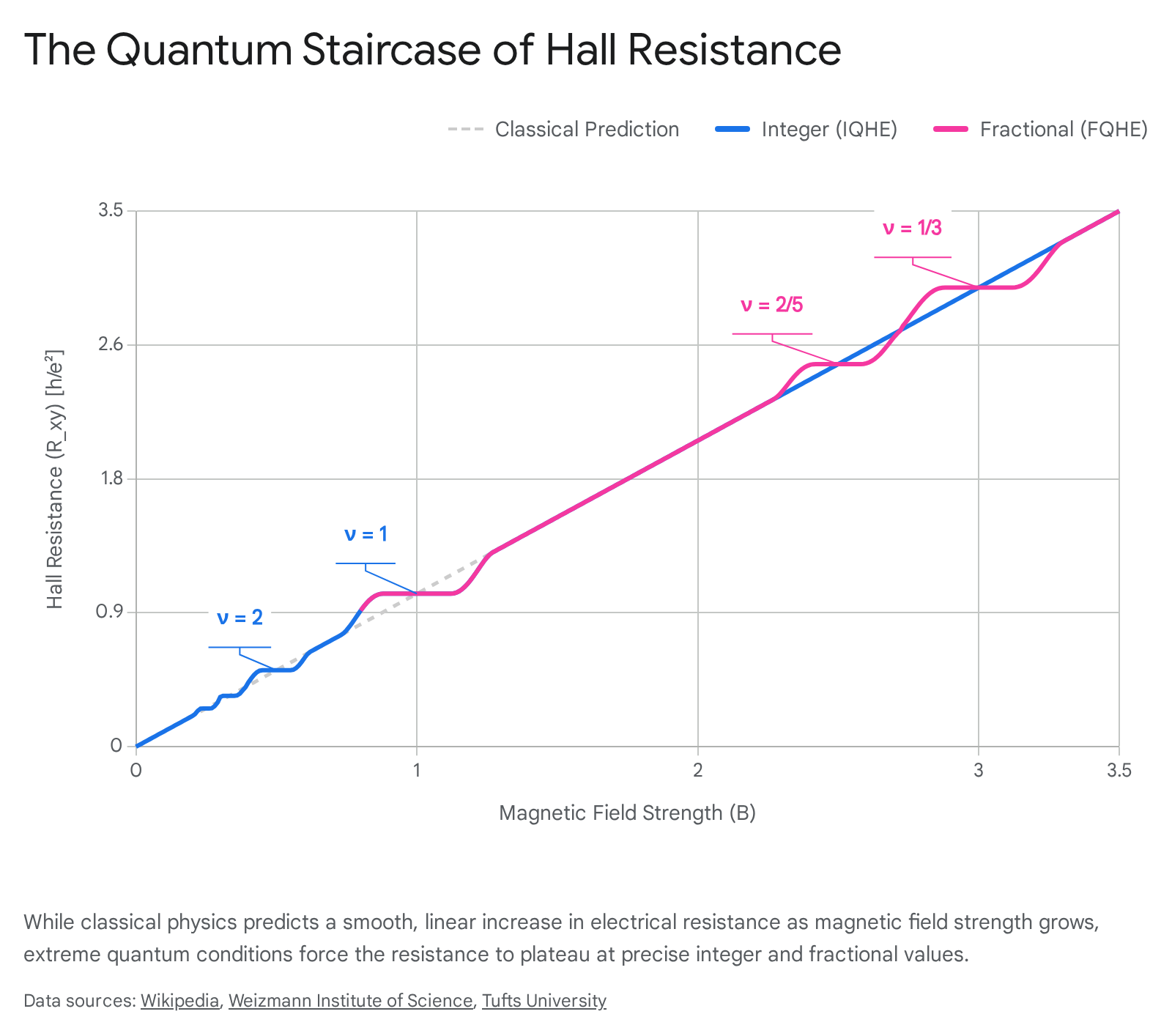
This fractional quantum Hall effect could not be explained by the single-particle physics of the IQHE. Because the kinetic energy of the electrons was entirely locked away by the intense magnetic field into the lowest Landau level, the previously negligible repulsive Coulomb force between the electrons became the dominant factor 81011. The electrons could no longer act independently; they were strongly interacting, fundamentally reorganizing into a bewitching new phase of matter 312.
The Recipe for Fractional Charges
When physicists state that the FQHE produces particles with a "fractional charge" - such as one-third ($e/3$) or one-fifth ($e/5$) the charge of an electron - it implies to the layperson that the indivisible electron has somehow been physically broken apart. This is a common misconception 1317.
The Illusion of Splitting the Electron
The fundamental electron remains entirely intact; it has not been shattered into quarks or smaller subatomic pieces 1318. Instead, the fractional charge is a property of a quasiparticle.
A quasiparticle is an emergent phenomenon arising from the collective, synchronized behavior of a massive crowd of interacting particles 1914. Consider the analogy of a traffic jam: a wave of densely packed cars can move backward down a highway at a specific speed, acting as a unified entity, even though the wave is entirely composed of individual cars moving forward. In condensed matter physics, when millions of electrons are trapped in a 2D plane under a massive magnetic field, their intense mutual repulsion forces them to organize into a rigid, highly choreographed liquid 1522.
If one introduces a single extra electron into this perfectly balanced quantum liquid, the system cannot comfortably accommodate it. To minimize the immense repulsive energy, the electron fluid dynamically rearranges itself, spreading the disruption out across the material. In the $\nu = 1/3$ state, the injection of a single electron creates three distinct "ripples" or topological defects in the fluid 1823. Each of these ripples moves independently through the 2D plane and carries exactly one-third of the fundamental electric charge.
For years, this concept remained highly theoretical. However, in 1997, two independent groups of physicists - one at the Weizmann Institute in Israel and one at the CEA laboratory in France - definitively proved the existence of fractional charges 91625. By measuring "shot noise" (the tiny, discrete electrical fluctuations in a current passing through a quantum point contact), they observed that the electrical current in these ultra-cold systems was genuinely being carried by granular entities with precisely $e/3$ and $e/5$ charge, rather than full electrons 161718.
The Dance of Electrons: Laughlin's Wavefunction
The theoretical breakthrough that explained how this collective liquid forms came in 1983 from physicist Robert Laughlin, who would later share the 1998 Nobel Prize for his work 9. The mathematics describing millions of mutually repelling electrons in a magnetic field are impossibly complex to solve directly. Instead of brute-forcing the Hamiltonian equation, Laughlin made a brilliant, educated guess at the mathematical formula - the "ansatz" many-body wavefunction - that describes the entire ground state of the system 28.
The Plasma Analogy and Topological Order
Laughlin's wavefunction was designed to reflect the physical reality that electrons desperately want to avoid each other. The formula utilizes a polynomial prefactor $\prod (z_i - z_j)^m$, where $z$ represents the complex coordinates of the electrons 101229. This structure forces the probability of two electrons being in the same place to drop to zero incredibly quickly (with a zero of order $m$) . Because electrons are fermions, they must obey the Pauli exclusion principle, requiring the overall wavefunction to be antisymmetric; thus, the exponent $m$ must be an odd integer (like 3, 5, or 7) 23. In essence, the electrons are locked in a relentless, synchronized dance where they constantly swirl counter-clockwise around one another but never touch, perfectly minimizing their repulsive Coulomb energy 2830.
To prove his math was stable, Laughlin mapped the probability distribution of his quantum equation onto a well-understood classical physics problem: the statistical mechanics of a two-dimensional classical plasma 1229. This "plasma analogy" proved that the electron density of the state remains entirely constant . The resulting liquid is highly incompressible; attempting to squeeze it introduces a steep energy cost, creating an "energy gap" separating the ground state from excited states 81028. This energy gap is exactly why the electrical resistance locks into flat, stable plateaus rather than varying smoothly - it takes a finite amount of energy to create the fractional quasiparticle excitations that carry current 8.
Crucially, the Laughlin state is not described by classical symmetries, like a liquid freezing into a solid crystal. Instead, it represents an entirely new phase of matter distinguished by topological order - a global organization that depends on the geometry of the system rather than local symmetry breaking 9.
| Feature | Classical Hall Effect | Integer Quantum Hall Effect (IQHE) | Fractional Quantum Hall Effect (FQHE) |
|---|---|---|---|
| Environment | Room temperature, standard magnetic fields | Low temperatures (~2-4 K), strong magnetic fields | Ultra-low temperatures (<1 K), massive magnetic fields |
| Material Quality | Standard 3D or 2D conductors | Requires 2D electron gas (2DEG); disorder is helpful | Requires ultra-pure 2DEG; disorder must be highly minimized |
| Resistance Profile | Smooth, continuous linear increase | Quantized steps at integer multiples of $e^2/h$ | Quantized steps at rational fractions (e.g., 1/3, 2/5) of $e^2/h$ |
| Primary Mechanism | Lorentz force pushing bulk electrons to one edge | Non-interacting electrons filling quantized Landau levels | Strongly interacting electrons forming an incompressible quantum liquid |
| Dominant Physics Paradigm | Classical Electromagnetism | Single-particle Quantum Mechanics | Many-body Quantum Mechanics & Topological Order |
Enter the Composite Fermion
While Laughlin's wavefunction perfectly explained the most prominent fractional state (the 1/3 fraction) and other odd-denominator fractions (1/5, 1/7), experiments kept revealing an expanding menagerie of increasingly complex fractions: 2/5, 3/7, 4/9, and so on 328. Attempting to build hierarchical wavefunctions for every new fraction was becoming mathematically unwieldy 9.
In 1989, theorist Jainendra K. Jain proposed a radical, elegant theoretical framework to unify the field: the "composite fermion" theory 919. Jain suggested that physicists should stop looking at the system merely as a collection of naked electrons. In a strong magnetic field, magnetic flux is quantized into discrete theoretical tubes, or "vortices" 20. Jain theorized that because the electrons are interacting so strongly to avoid each other, they capture these microscopic magnetic vortices, dynamically binding them to themselves 920.
Attaching Magnetic Flux
If an electron captures an even number of these magnetic flux quanta (most commonly two), it undergoes a topological transformation into a new, emergent quasiparticle known as a composite fermion 111920.
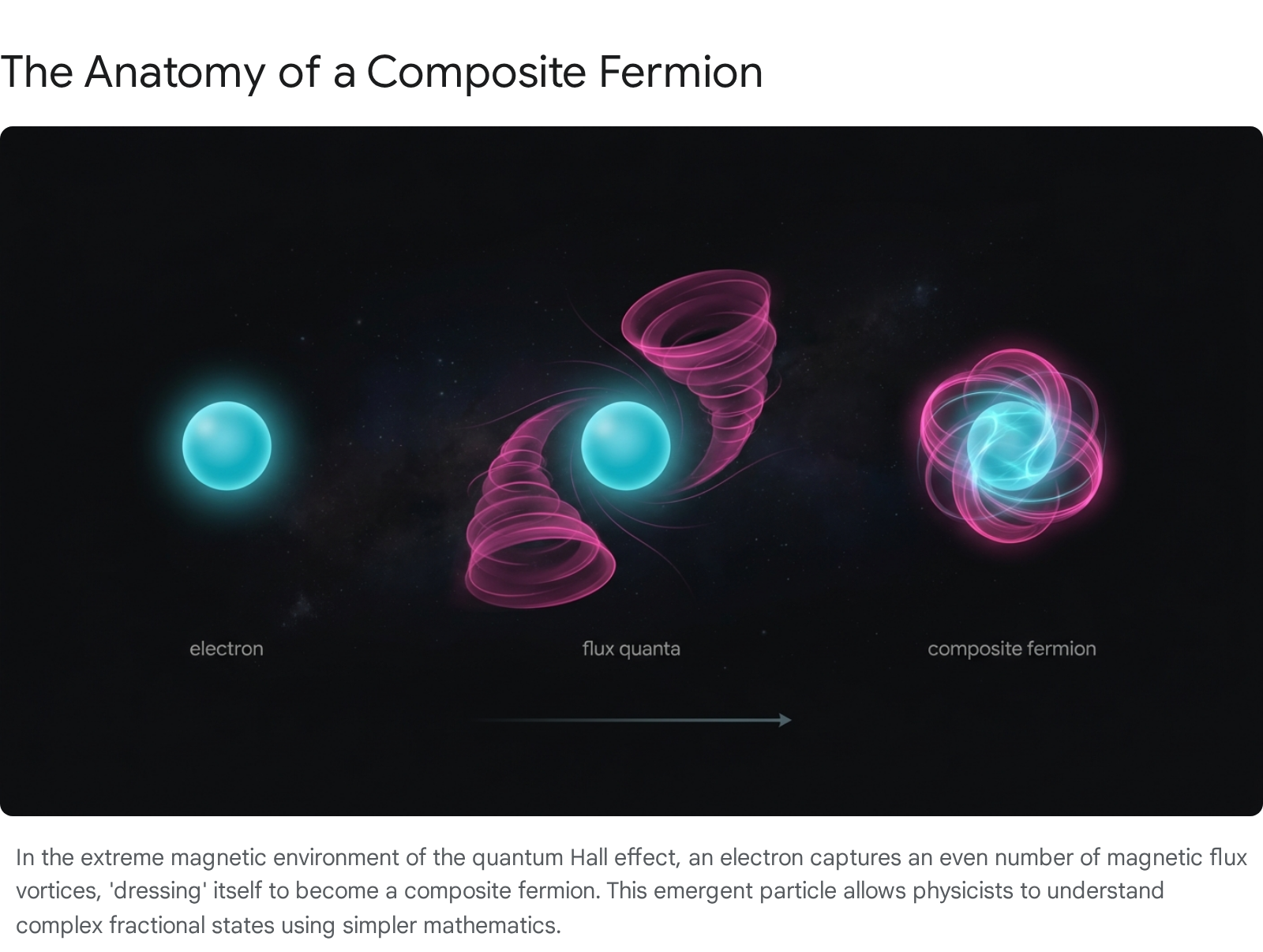
Why is this mathematical maneuver so powerful? Because the attached magnetic flux quanta effectively oppose and cancel out a large portion of the external magnetic field being applied to the laboratory sample 620. The newly formed composite fermions "feel" a vastly reduced, effective magnetic field ($B^*$) 333.
Under this composite fermion framework, the bewildering complexity of the Fractional Quantum Hall Effect vanishes into something highly familiar. The FQHE of strongly interacting electrons maps perfectly onto the simple Integer Quantum Hall Effect (IQHE) of weakly interacting composite fermions 39. For example, the messy $\nu = 1/3$ electron fraction is mathematically understood as composite fermions cleanly filling exactly one of their effective Landau levels (an integer of 1). The $\nu = 2/5$ fraction is simply composite fermions completely filling their second level 91121.
This theory successfully predicted the entire "Jain sequence" of fractional states given by the formula $\nu = n / (2pn \pm 1)$ (where $n$ and $p$ are integers), which were sequentially verified in experiments 61921. It also boldly predicted that at precisely half-filling ($\nu = 1/2$), the effective magnetic field $B^*$ would drop to exactly zero 1922. At this point, the composite fermions act as if there is no magnetic field at all, forming a standard, gapless Fermi liquid (a "Fermi sea") - a prediction spectacularly confirmed by subsequent measurements of their cyclotron orbits 1933.
Anyons and Fractional Statistics
Perhaps the most profound consequence of the fractional quantum Hall effect is that the quasiparticles it produces do not obey the fundamental quantum statistical laws that govern the rest of the universe.
Breaking the Boson-Fermion Dichotomy
A basic tenet of quantum mechanics is that every elementary or composite particle in our three-dimensional universe falls strictly into one of two categories: fermions or bosons 3623. Fermions (like electrons and protons) possess half-integer spin and strictly obey the Pauli exclusion principle, meaning no two can occupy the exact same quantum state 17. If you swap the positions of two identical fermions, their collective quantum wave function multiplies by a phase of $-1$. Bosons (like photons) have integer spin, happily clump together in the same state, and when swapped, their wave function multiplies by a phase of $+1$ 172123.
However, in the strictly two-dimensional flatland of a quantum Hall system, the rules of 3D geometry fail. If one quasiparticle loops around another in a 2D plane, the path it traces cannot be continuously shrunk to zero without physically crossing the other particle - a mathematical constraint tied to the fundamental topology of a punctured plane 17. Because of this topological restriction, when two identical FQHE quasiparticles swap places, the many-body wave function acquires a fractional geometric phase shift (e.g., $e^{i\theta}$) that is neither $+1$ nor $-1$ 172123.
Because their statistical phase can be any angle along a continuous spectrum between fermions and bosons, theoretical physicist Frank Wilczek aptly named these emergent particles "anyons" 936. For instance, exchanging two quasiparticles in the Laughlin 1/3 state results in an exact phase shift of $\pi/3$ (or 60 degrees) 17.
The Art of Quantum Braiding
If you take one anyon and physically move it in a loop around another anyon in the 2D plane, the global quantum state of the material records the event 1721. If one maps this movement over time, tracing the paths of the particles creates a three-dimensional spacetime diagram that looks mathematically identical to strands of braided hair. Hence, the process of exchanging anyons is known as "braiding" 221738.
For decades, anyonic braiding was purely a theoretical construct. But in a flurry of experimental breakthroughs between 2020 and 2026, physicists built highly specialized nanoscale devices called Fabry-Pérot interferometers to catch them in the act 3623. By sending ultra-dilute, one-dimensional edge currents of anyons around a central semiconductor cavity (sometimes wrapping around an artificially tuned "antidot"), researchers directly measured the interference patterns in the electrical current 232425.
These interferometry experiments directly observed the statistical phase slips caused by one anyon braiding around another, confirming the exact braiding phases of Abelian anyons at $\nu = 1/3$ and $\nu = 2/5$ 362426. In 2023, researchers even managed to observe this braiding entirely in the "time domain" by analyzing the autocorrelation of partitioned shot noise, bypassing the need for complex spatial interferometers 18.
The Quest for Topological Quantum Computers
The confirmation that anyons exist and can be braided has catalyzed a multi-billion-dollar race among tech giants (such as Microsoft, IBM, and Google) and academic institutions to build a fundamentally new architecture: the topological quantum computer 172743.
Standard quantum computers - which rely on trapped ions, neutral atoms, or superconducting transmon circuits - suffer immensely from a problem called "decoherence" 272845. Standard qubits are incredibly fragile; a stray photon, a trace of magnetic noise, or a slight temperature fluctuation easily destroys the quantum superposition 4546. Correcting these errors currently requires massive redundancies, with hundreds or thousands of "physical" qubits slaved together just to stabilize one useful "logical" qubit 4547.
Topological quantum computing attempts to solve this hardware frailty at the root level using anyons. In a topological system, quantum information is not encoded in the localized state of a single vulnerable particle, but rather in the global, topological properties of how anyons are braided around one another 2746. Because the information is stored non-locally, it is inherently immune to local environmental noise 222848. You can jostle the system with thermal noise, but as long as the perturbation doesn't physically force the anyons to cross paths and inadvertently "cut the braid," the quantum information survives perfectly intact 384648.
Abelian vs. Non-Abelian Anyons
However, not all anyons can run a computer. The anyons found at the $\nu = 1/3$ and $\nu = 2/5$ fractions are "Abelian." When they are braided, the system's wavefunction simply multiplies by a complex phase 23. While this proves fractional statistics, accumulating phase angles is mathematically insufficient to execute the complex logic gates required for universal quantum computation 2930.
To build a universal topological computer, physicists must utilize a much rarer, highly exotic variant: "non-Abelian" anyons 272851. Non-Abelian anyons exist in a highly degenerate ground state 172328. When you braid them, the system doesn't just acquire a phase; it undergoes a unitary matrix transformation, rotating the wavefunction into a completely new, orthogonal state 232829.
Crucially, in non-Abelian mathematics, the order of operations matters. Braiding particle A around B, and then taking that pair around C, results in a measurably different final state than braiding B and C first 1729. This non-commutative property allows specific braiding sequences to act directly as fault-tolerant quantum logic gates 3827.
| Feature | Ising Anyons (Majorana Zero Modes) | Fibonacci Anyons |
|---|---|---|
| Primary Physical Candidate | Topological superconductors, $\nu=5/2$ FQHE state | $\nu=12/5$ FQHE state |
| Mathematical Complexity | Simpler non-Abelian fusion rules | Complex "golden ratio" fusion rules |
| Computational Power | Generates limited Clifford gates; not universally complete | Dense operations; computationally universal by braiding alone |
| Implementation Hurdle | Requires non-topological steps (magic state distillation) for full logic | Exceedingly difficult to physically realize and stabilize in labs |
| Commercial Champion | Microsoft (Topoconductor / Majorana 1 chip) | Highly theoretical, academic research phase |
The Engineering Schism: Ising vs. Fibonacci
The race to engineer these non-Abelian qubits is currently split between two dominant theoretical models, balancing hardware viability against computational power 275131.
1. Ising Anyons (Majorana Zero Modes): The leading candidates for non-Abelian states are Majorana zero modes, which realize the "Ising" anyon model 4851. These are heavily pursued in certain engineered superconductor nanowires and are theorized to exist in the rare, even-denominator $\nu = 5/2$ FQHE state 12853. Tech giants, particularly Microsoft, have bet heavily on this route. In early 2025, Microsoft announced the "Majorana 1" processor, utilizing a novel "topoconductor" architecture to create 28 logical qubits based on Majorana particles, aiming for commercial viability by 2029 454732.
However, Ising anyons have a severe mathematical limitation: they are not computationally universal 485156. Braiding Majorana modes only allows for a restricted set of quantum operations known as the Clifford group (essentially 90-degree rotations on the Bloch sphere) 5156. To run complex, universal algorithms (like Shor's algorithm for breaking encryption), an Ising-based computer must utilize non-topological hacks, such as "magic state distillation," which reintroduces the very error-correction overhead that topological computing sought to avoid 485156.
2. Fibonacci Anyons: The holy grail of topological quantum computing lies in the Fibonacci anyon model, theorized to exist in the exceptionally fragile $\nu = 12/5$ FQHE state 285153. Fibonacci anyons possess a unique fusion rule linked to the golden ratio, and unlike Majorana modes, their braiding operations are mathematically dense 51. This means that braiding Fibonacci anyons alone can approximate any multi-qubit gate to arbitrary accuracy, making them fully universal for quantum computation without requiring any vulnerable, non-topological interventions 295157.
The tradeoff is profound physical difficulty. The physical realization of a Fibonacci anyon remains one of the most demanding challenges in experimental physics, requiring ultra-clean material quality, temperatures near absolute zero, and precise magnetic tuning that border on the impossible for scalable commercial manufacturing 51.
Recent Breakthroughs: Erasing the Magnetic Field
Historically, the absolute largest bottleneck to studying the fractional quantum Hall effect - and integrating anyonic properties into practical technology - was the requirement of a massive external magnetic field, often upwards of 10 Tesla (many times stronger than a hospital MRI machine) 131733.
The Moiré Magic of 2023 - 2026
Between late 2023 and 2026, a paradigm shift occurred that completely altered the trajectory of the field. Researchers at the University of Washington, MIT, and Shanghai Jiao Tong University observed the fractional effect without applying any external magnetic field 433.
This phenomenon, dubbed the Fractional Quantum Anomalous Hall Effect (FQAHE) or a "fractional Chern insulator," was achieved using engineered "moiré materials" 4333435. Researchers took atomically thin layers of van der Waals materials - such as the transition metal dichalcogenide molybdenum ditelluride (MoTe2) or pentalayer (five-layer) graphene layered with hexagonal boron nitride (hBN) - and stacked them at precise, slightly twisted angles 13153334.
This physical twist creates a synthetic "moiré superlattice" 3334. The geometry of this artificial lattice forces the electrons into narrow, topological "flat bands" where their kinetic energy plummets, making them incredibly slow and heavy 343536. Under these conditions, the electron interactions become immense. The system undergoes a spontaneous ferromagnetic transition, generating its own powerful, intrinsic orbital magnetism 3335.
The electrons effectively dress themselves in this intrinsic magnetic field, breaking apart into fractional charges just as they would under a massive external electromagnet 153337. By 2025 and 2026, these field-free moiré systems successfully demonstrated distinct fractional signatures and non-trivial anyonic topological order 343538. The researchers spearheading the graphene moiré discoveries were awarded the prestigious McMillan Award in late 2025, underscoring the magnitude of the breakthrough 37.
This development effectively untethers anyon research from the constraints of giant, expensive superconducting laboratory magnets. It provides an adjustable, highly tunable solid-state platform for generating and manipulating robust topological states, bringing the dream of scalable, fault-tolerant quantum devices much closer to engineering reality 333435.
Bottom line
The fractional quantum Hall effect reveals that under the extreme constraints of two dimensions and powerful magnetic forces, the simple repulsion between electrons births entirely new phases of matter. By reorganizing into an incompressible liquid, electrons give rise to composite fermions, fractional charges, and anyons - quasiparticles that remember their braided paths through space and time. While finding the elusive Fibonacci anyons remains an extraordinary challenge, recent leaps in zero-magnetic-field moiré materials and explicit experimental proofs of anyon braiding are rapidly pushing this phenomenon out of theoretical physics and into the race for fault-tolerant quantum computing.