
What Is the Default Mode Network and Why Does It Matter
The direct answer: The default mode network (DMN) is a vast, interconnected neuroanatomical system that exhibits highly synchronized activity when the human brain is not engaged in externally directed, goal-oriented tasks. It serves as the neurological infrastructure for internally oriented cognition - the engine responsible for mind-wandering, retrieving episodic memories, envisioning the future, and constructing a coherent sense of self. Far from being a passive background state, recent neuroscientific advancements reveal that the DMN is a computationally demanding, dynamic network that fundamentally governs emotional regulation, the genesis of highly original creative thoughts, and our capacity to navigate complex social environments.
Imagine waiting for a train. You have put your phone away, you have no immediate physical tasks to perform, and you are simply staring out at the tracks. To an outside observer, you are doing nothing. But inside your skull, a massive, energy-hungry neural superhighway has just powered up. You might suddenly remember an awkward conversation from five years ago, effortlessly picture what you will have for dinner tonight, and unexpectedly solve a problem that had been bothering you all week. This seamless transition from external perception to internal simulation is the default mode network in action.
For decades, the prevailing scientific consensus was that the brain essentially "powered down" when it was not actively engaged in a specific, cognitively demanding task. But in the late 1990s and early 2000s, positron emission tomography (PET) and functional magnetic resonance imaging (fMRI) breakthroughs revealed the exact opposite. When we stop focusing on the external world, specific areas of the brain light up with highly coordinated activity 12. Today, the DMN is recognized as one of the most critical networks in the human brain, deeply implicated in everything from the flexibility required for divergent thinking to the ruminative loops of clinical depression and the earliest physiological markers of Alzheimer's disease 334.
This comprehensive report explores the anatomy, functions, and recent paradigm-shifting discoveries surrounding the default mode network, translating cutting-edge 2024 - 2026 neurobiological research into practical takeaways for everyday cognitive health, creativity, and mindfulness.
Is the DMN just my brain's "screensaver"? (Debunking common misconceptions about brain rest)
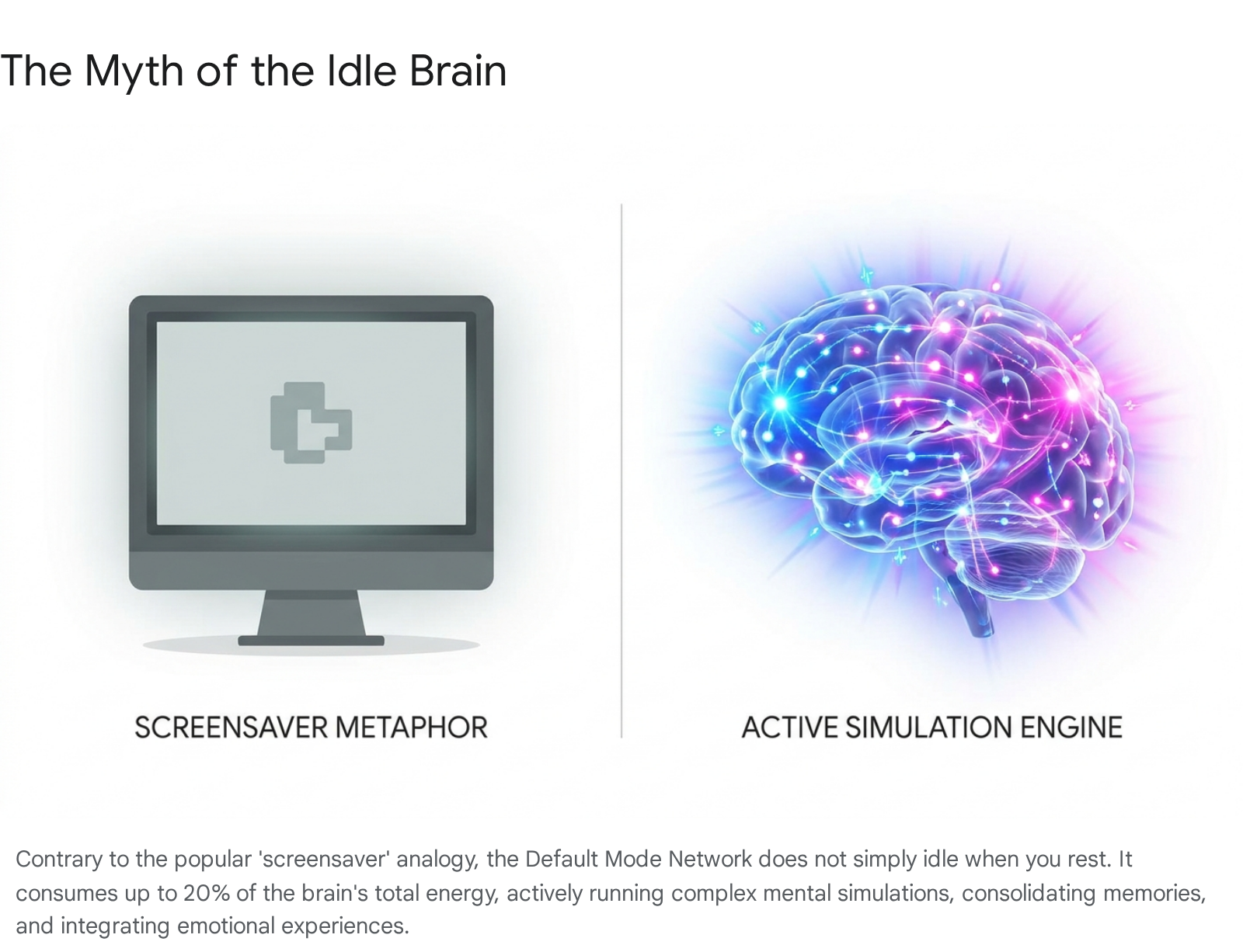
A popular analogy in both pop psychology and early neuroscience communication is that the default mode network functions as the brain's "screensaver" or a passive "background app." The logic seems intuitive: when you step away from your keyboard, the computer monitor switches to a default animation to prevent screen burn-in. Similarly, it is often said that when you stop actively thinking, your brain shifts to a low-power background mode to conserve resources.
Recent computational and metabolic research proves this analogy is deeply flawed, as it vastly underestimates the metabolic cost and the computational heavy lifting the brain performs at rest 65.
First, the brain at rest is remarkably expensive from a metabolic standpoint. The default mode network consumes roughly 20% of your brain's total energy even when you are ostensibly doing "nothing" 1. When examined through the lens of whole-brain energy mapping, the DMN's energy consumption accounts for a staggering 60% to 80% of the total energy utilized by the brain during resting states 6. A screensaver is designed to minimize wear; a background app is designed to sip battery life quietly. The DMN, by contrast, is a high-performance engine running at near-maximum capacity, drawing significant blood flow and oxygen to fuel its operations 57.
When the brain transitions from a state of rest to a highly demanding cognitive task requiring external focus (such as solving a complex mathematical equation or navigating a new environment), the overall energy consumption of the brain increases by a surprisingly marginal amount - often less than 5% 57. Furthermore, while primary sensory networks (like the visual and somatosensory networks) drop into highly efficient, low-energy states in the absence of external stimuli, higher-order cognitive networks like the DMN maintain exceptionally elevated energy levels 7. This suggests that the baseline state of the human brain is one of intense, continuous processing rather than dormancy.
So, what is the DMN doing with all that energy? It is running complex, continuous simulations. When your mind wanders, the DMN is actively consolidating memories, linking seemingly unrelated semantic concepts, processing complex emotional residue, and running predictive models of the future based on past experiences 110. It is the biological hardware that allows you to construct the "internal narrative" central to your sense of identity 8. Without this unstructured downtime, the brain struggles to integrate information. In fact, prolonged periods without DMN activation keep the brain stuck in an externally rigid "task mode," which is a primary neurological contributor to cognitive burnout 5.
Therefore, viewing the DMN as a passive background app is a fundamental misconception. Brain rest is not the absence of activity; it is a vital, active state of internal cognitive work 16.
Where is the DMN located, and what do its parts actually do?
The DMN is not a single, isolated lump of tissue; it cannot be removed like an appendix. It is a large-scale, widely distributed network composed of several distinct brain hubs that communicate synchronously across vast expanses of cerebral white matter 913.
Historically, mapping these regions required complex analyses of structural connectivity and task-evoked fMRI studies. Recent efforts, such as a 2025 study led by researchers at McGill University and Forschungszentrum Jülich, have mapped the cytoarchitecture of the DMN 13. By examining the micro-organization of neurons within the tissue, scientists have confirmed that the DMN is an evolutionarily advanced network. Comparative anatomy studies show that while rudimentary DMN homologues exist in rodents and macaques, the massive expansion of the frontotemporal subnetwork is an apomorphy (a derived evolutionary trait) unique to higher primates and humans, enabling complex social cognition and abstract time-travel 21415.
To move away from excessive cytoarchitectural jargon, the table below maps the primary structural hubs of the DMN into their everyday cognitive equivalents, illustrating how these distant anatomical regions collaborate to produce the human experience.
Translating Anatomical Regions to Everyday Cognitive Functions
| Anatomical Region | Location in the Brain | Everyday Cognitive Equivalent | What it Actually Does in Daily Life |
|---|---|---|---|
| Medial Prefrontal Cortex (mPFC) | Front of the brain, directly behind the forehead. | The "Me" Center | Regulates self-referential thinking, autobiographical planning, and emotional decision-making. It activates heavily when you think about your own traits, evaluate your personal emotional state, or make moral judgments about whether an action aligns with your personal values 81011. |
| Posterior Cingulate Cortex (PCC) | Deep in the midline of the brain, along the longitudinal fissure. | The Integrator / Time Traveler | Acts as the central communication hub linking various subsystems. The ventral (lower) part helps you retrieve autobiographical memories and mentally project into the future. The dorsal (upper) part manages involuntary awareness, blending internal memory with bottom-up attention to your immediate physical surroundings 811. |
| Precuneus | Medial parietal lobe (toward the upper back of the brain). | The Mind's Eye | Responsible for visual mental imagery, episodic memory consolidation, and complex spatial navigation. It allows you to vividly visualize a scene from your past or shift your mental perspective to literally "see" yourself as others might see you (transforming allocentric space to egocentric reference frames) 111213. |
| Angular Gyrus (AG) | Parietal lobe, near the back sides of the brain (junction of occipital, temporal, and parietal lobes). | The Meaning Maker | An interface for conveying and integrating cross-modal sensory information. It is heavily implicated in semantic processing, comprehending complex language (like deciphering a novel metaphor), understanding subtle social cues, and even spatial cognition tasks like discriminating left from right 8141516. |
| Medial Temporal Lobe (MTL) / Hippocampus | Deep inside the temporal lobes. | The Archive | Provides the raw materials - specific episodic memories, factual knowledge, and emotional associations from past experiences - that the rest of the cortical DMN uses to build mental simulations, narratives, and creative combinations 2815. |
Even within these broad regions, function is highly localized. For example, neuroanatomists subdivide the angular gyrus into distinct zones: Area PGs is more involved in shifting visuospatial attention and biological motion, whereas Area PGi activates specifically when listening to stories, processing human faces, or attempting to understand the mental states of others 23. The precuneus, often viewed homogenously, displays varying connectivity depending on the cognitive load, with its dorsal-anterior, dorsal-posterior, and ventral subdivisions connecting to vastly different motor and visual pathways 17.
How does the same network handle memories and present-moment perception? (The 2026 Senders/Receivers Discovery)
For nearly two decades, the DMN was strictly categorized as a "task-negative" network - a rigid label implying it only turned on when we were focused inward, and reliably turned off when we focused outward on external tasks 8. However, this label increasingly failed to explain why the DMN consistently activated during highly demanding tasks involving social perception, language comprehension, and environmental monitoring 818.
Groundbreaking research published in the Proceedings of the National Academy of Sciences (PNAS) in April 2026 by researchers from the Chinese Academy of Sciences Institute of Psychology fundamentally altered this understanding 1819.
By combining analyses of directional functional connectivity (which maps the direction of information flow rather than just synchronous firing), intrinsic network organization, and task-evoked brain activity across multiple independent datasets, the researchers discovered that the DMN is not a uniform blob of internal thought. Instead, the architecture reveals a highly differentiated system characterized by a "double dissociation." The network is organized into complementary subregions that act as either "senders" or "receivers" of information 1819:
- Receiver-like subregions are heavily biased toward incoming (afferent) signals. They exhibit robust connectivity with heteromodal association networks (which process external sensory data). Surprisingly, these receiver zones actually engage preferentially during external perception tasks, such as recognizing and evaluating human faces, processing ongoing language, or interpreting social dynamics in the immediate environment 1819.
- Sender-like subregions are biased toward outgoing (efferent) projections. They couple strongly with the body's distributed sensorimotor systems. These regions are preferentially engaged during perceptually decoupled tasks - using internal memories and past experiences to guide physical behavior, planning, and decision-making without immediate external cues 1819.
This 2026 discovery provides an elegant organizational framework that explains a long-standing paradox in cognitive neuroscience: how the same neurological network can allow us to effortlessly switch between remembering a past event (internal, memory-driven) and comprehending a complex social interaction happening right in front of us (external, perceptually grounded) 1820. The DMN is not just a resting network; it is the ultimate dynamic bridge between the outside world's sensory influx and our internal library of lived experiences.
How does the DMN work with the rest of my brain? (The Triple Network Model)
To understand why the DMN matters to human behavior, it is imperative to look beyond its borders. The brain operates as a highly integrated ecosystem. The DMN does not act alone; it is one of three massive, interconnected, and competing systems that dictate human cognition. This overarching framework, first proposed in 2011 and heavily refined by recent imaging studies, is known as the Triple Network Model 21223023.
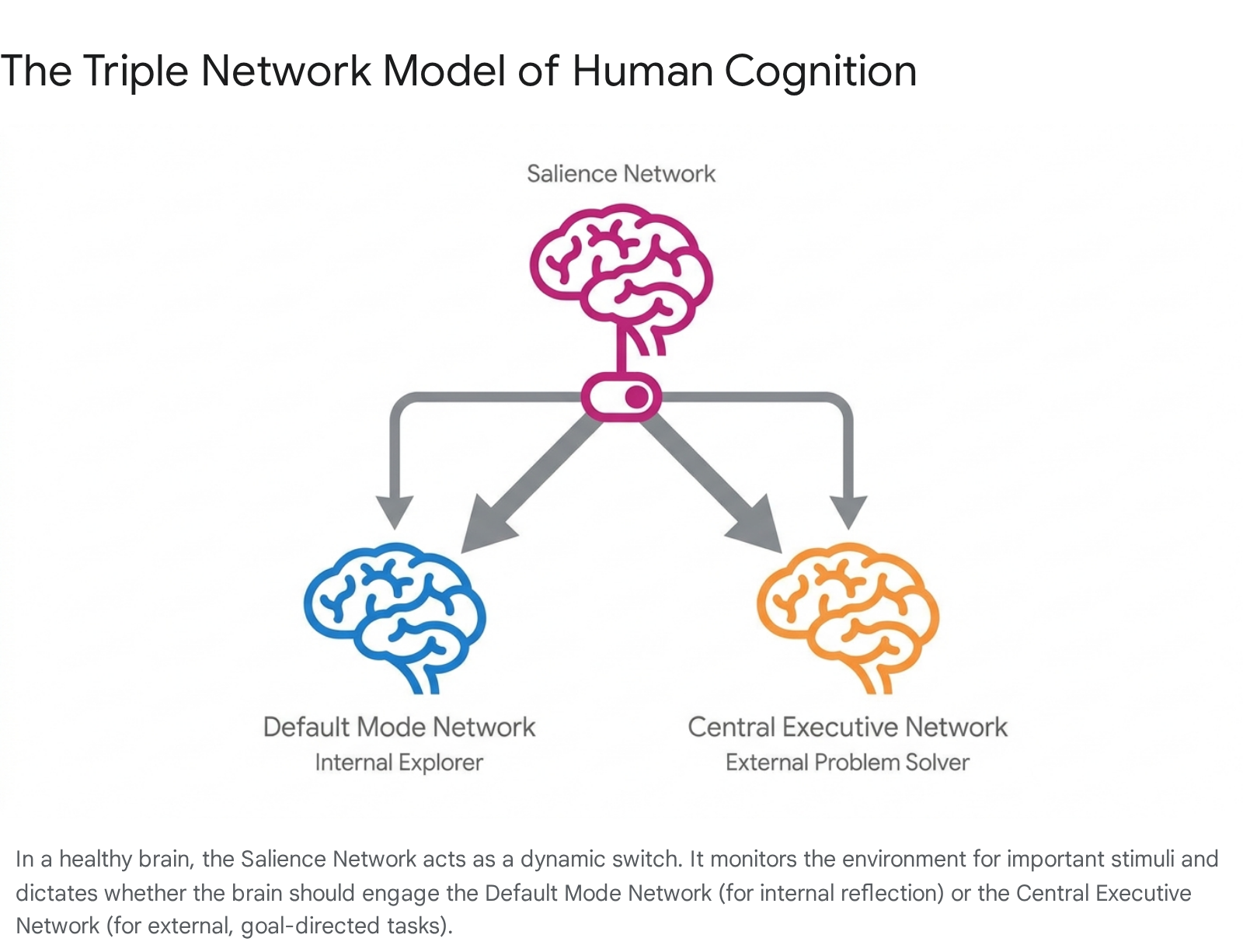
A helpful real-world analogy is to view your brain as a televised political debate. You have two main speakers who represent completely different, often opposing ways of interacting with the world, and you have a skilled moderator whose job is to ensure only one person speaks at a time to prevent a cacophony of mixed messages 24.
Comparing the Triple Networks
| Network | Role in the Brain | The Debate Analogy | Primary Brain Regions Involved |
|---|---|---|---|
| Default Mode Network (DMN) | The Internal Explorer: Active during rest, mind-wandering, introspection, episodic memory retrieval, and self-referential processing. | Speaker A: Focuses entirely on internal narratives, past experiences, and abstract future simulations. | mPFC, PCC, Precuneus, Angular Gyrus 823. |
| Central Executive Network (CEN) | The External Problem Solver: Active during cognitively demanding, goal-oriented tasks that require sustained external attention, working memory, and logical execution (e.g., solving a math equation or navigating heavy traffic). | Speaker B: Focuses entirely on the external world, logic, rigid execution, and immediate task-solving. | Dorsolateral Prefrontal Cortex (dlPFC), Posterior Parietal Cortex 3023. |
| Salience Network (SN) | The Switch / Moderator: Constantly monitors both the internal bloodstream and the external environment for important (salient) stimuli, deciding which of the other two networks needs to be active based on homeostatic and environmental demands. | The Moderator: Listens to both speakers, detects a sudden change in the room (a loud noise, a sharp pain, a sudden memory), and hands the microphone to the appropriate speaker. | Anterior Insula, Dorsal Anterior Cingulate Cortex (dACC), Amygdala 21222433. |
In a healthy brain, the DMN and the CEN operate in an anti-correlated fashion. When you are intensely focused on a spreadsheet or actively participating in a sport (CEN active), your daydreaming mechanisms (DMN) are suppressed. When you take a break, sit on a bench, and let your guard down, the CEN quiets down and the DMN powers up 3024.
The primary driver of this dynamic switching process is the Salience Network (SN), specifically a node known as the right anterior insula. It causally regulates these transitions 2122. When the Salience Network detects something critical - a physical threat, a sudden social reward, or even a highly salient internal memory - it acts as the neurobiological switch, suppressing the DMN and activating the CEN to respond appropriately to the stimulus 2224.
Recent analytical techniques, such as Co-Activation Pattern (CAP) analysis, have allowed researchers to track the "dwell time" (how long the brain stays in a specific network state) and transition probabilities between these networks. A 2024 study examining older adults from the Cambridge Center for Aging and Neuroscience found that the antagonism between these networks becomes fragile with age. Older adults spend less time in states where the DMN is suppressed and the CEN/SN are active, indicating that altered dynamic interactions between the Triple Networks are a primary driver of age-related cognitive decline 25.
Why does my mind get stuck in a loop? (Rumination, Pain, and Addiction)
Have you ever found yourself lying awake at 2:00 AM, replaying a perceived social failure over and over again, unable to snap out of the negative thought loop? This cognitive trap is known as rumination, characterized by a passive, repetitive focus on distressing thoughts. It is one of the primary behavioral hallmarks of major depressive disorder (MDD) and severe anxiety 263637.
Neuroscience has pinpointed exactly where rumination lives: a profoundly dysregulated Default Mode Network 31038.
In a healthy brain, mind-wandering is fluid and transient; it drifts from the past to the present to the future, making brief connections before moving on. But in individuals with depression or high anxiety, the DMN becomes "hyperconnected," rigid, and dominant over other networks 337. Specifically, researchers have identified abnormal connectivity between core DMN nodes and a specific emotion-processing area called the subgenual anterior cingulate cortex (sgACC). This hyperconnectivity acts like a stuck record, sustaining repetitive, self-referential negative thoughts and emotional distress 32638. The brain's "moderator" (the Salience Network) struggles to suppress the DMN, meaning the individual cannot easily shift their attention outward to the present moment or engage the CEN to break the cycle 137.
A fascinating 2023 machine-learning study published in the Journal of Affective Disorders demonstrated that resting-state fMRI (which relies on a completely passive subject) often fails to capture the true depth of depressive circuitry. Instead, by inducing a negative thinking state in MDD patients, researchers mapped the Negative Thinking Functional Connectivity (NTFC). They found that during actual rumination, the DMN couples abnormally with the visual cortex and the cerebellum. This aberrant coupling creates vivid, almost cinematic mental imagery of negative events that the patient cannot escape, allowing researchers to accurately predict an individual's trait rumination severity based purely on their neural connectivity patterns 36. Fortunately, time-varying functional connectivity (TVFC) analyses using Hidden Markov models reveal that treatments like Cognitive Behavioral Therapy (CBT) actively decrease DMN hyper-occupancy and normalize network transitions, directly correlating with a reduction in ruminative behavior 27.
The DMN's Role in Chronic Pain and Addiction
This hyperconnectivity issue extends far beyond psychological depression; it manifests physically in chronic pain conditions (such as chronic back pain or knee osteoarthritis). Extensive fMRI research reveals that living with constant pain physically alters the functional connectivity of the DMN 282930. In chronic pain patients, the medial prefrontal cortex (the "Me" Center) loses its normal connectivity with posterior DMN nodes and instead shows significantly increased, abnormal connectivity to the insula (the brain's pain and salience center), scaling in direct proportion to the intensity of the pain 2830.
Through this prolonged exposure, the brain reorganizes itself. Pain becomes a spontaneous, intrinsic part of the brain's default resting state, occurring even in the absence of external physical triggers or tissue damage 2930. The patient's default state of "self" becomes fundamentally interwoven with the perception of pain.
Furthermore, a highly revealing 2024 neuroimaging study mapped the neural networks of patients suffering from comorbid chronic back pain (CBP) and opioid use disorder (OUD). They found that in these patients, the DMN becomes deeply entangled with the mesocorticolimbic (MCL) system - the brain's core dopaminergic reward and addiction circuitry (including the nucleus accumbens and ventral tegmental area) 3144. The data indicates that opioid addiction and chronic pain manifest not as separate conditions, but as a combined, widespread neurological distortion within the default mode network, where pain signals and reward cravings become a unified, self-sustaining neural loop 3144.
Is a wandering mind the secret to creativity?
If a stuck DMN leads to toxic rumination, a flexible and dynamic DMN is the fountainhead of human creativity.
For years, behavioral psychologists observed that "Aha!" moments - those sudden bursts of insight - often happened when people were doing undemanding tasks like taking a shower, going for a walk, or staring at the ceiling 110. While functional MRI studies correlated DMN activity with creativity, correlation is not causation 323347. A pivotal 2024 study published in the prestigious journal Brain finally provided the causal evidence linking the DMN to highly original creative thinking 48343536.
Researchers from Baylor College of Medicine and the University of Utah utilized stereo-electroencephalography (stereo-EEG) on 13 human patients. This invasive but highly precise method involves placing high-resolution electrodes directly into the deep cortical surface of the brain, tracking neural oscillations in milliseconds. They had the patients perform two tasks: an "Alternate Uses Task" (a classic test of divergent thinking where a subject must generate highly original uses for an everyday object, like a brick) and a spontaneous mind-wandering task 44837.
They discovered two massive insights regarding the mechanics of creativity:
- The Spatiotemporal Dynamics of Idea Generation: The DMN initiates creative ideas. During the Alternate Uses Task, the DMN engaged heavily during the initial generation phase, scanning the brain's archive of episodic memories and semantic knowledge to forge novel connections. Only later does the Central Executive Network step in to evaluate if the bizarre idea generated by the DMN is actually physically useful 3235. Electrophysiologically, DMN activity during this creative state was characterized by a massive surge in high-frequency gamma band power (30 - 70 Hz) coupled with a drop in low-frequency theta band power (4 - 8 Hz), driven largely by the lateral regions of the network 44836.
- Causal Proof of Originality: To definitively prove the DMN was causing the creativity rather than just observing it, the researchers used mild direct cortical stimulation to temporarily disrupt specific DMN nodes while the patients performed the task. The result was striking: The patients could still generate the exact same number of ideas (their "fluency" was completely unaffected), but the ideas were suddenly boring, conventional, and highly predictable. Disrupting the DMN specifically killed the originality of the thoughts 447363738.
This research, supported by recent computational linguistic studies showing that analogy-related information is encoded directly within the fMRI activation patterns of the semantic network, highlights the necessity of downtime 39. When you step away from a demanding cognitive task, your DMN activates broader associations, linking seemingly unrelated semantic concepts that your task-focused brain previously filtered out as irrelevant 110. Your brain isn't slacking off when it wanders; it is actively forging the non-linear connections necessary for breakthrough innovation.
Can I intentionally rewire my default mode network? (Practical takeaways for mindfulness)
If a dysregulated DMN leads to depression and a flexible DMN sparks creativity, the ultimate question is: Can we consciously rewire our default mode network to optimize its function?
The neuroscientific consensus is a resounding yes. The most effective, non-pharmacological tool for this is mindfulness meditation. While mindfulness originated thousands of years ago as an ancient spiritual practice, it is now viewed by clinical neuroscientists as a rigorous form of neuroplastic brain training explicitly designed to strengthen the Triple Network switching mechanism 55.
Recent comprehensive meta-analyses (published between 2022 and 2024) of resting-state functional connectivity (rsFC) have demonstrated that interventions like Mindfulness-Based Stress Reduction (MBSR) and focused attention meditation physically and durably alter the DMN 5540574159.
When an experienced meditator sits down to practice focused breathing, their goal is not the impossible task of "emptying the mind." Instead, they are engaging in repetitive weightlifting for the brain's moderator - the Salience Network. When the DMN inevitably activates and the mind wanders to a past memory or future anxiety, the meditator notices it (SN activation), and gently redirects attention back to the breath (engaging the CEN).
This repeated practice causes profound structural and functional changes: * Reduced Overactivity: Regular focused meditation reduces DMN hyper-activity by 15% to 30% during rest, physically weakening the rigid intra-network connectivity that traps individuals in depressive rumination 1338. * Enhanced Cross-Network Connectivity: Paradoxically, while internal DMN chatter decreases, mindfulness actually increases the healthy cross-network connectivity between the DMN and the Salience Network. Meta-analytic voxel-based data shows significantly greater functional connectivity specifically between the left middle cingulate (a node of the SN) and the posterior cingulate cortex (the main hub of the DMN) following mindfulness training 415942. This enhanced neural wiring allows the brain to transition much more smoothly and flexibly between introspection and task-focused cognition without getting "stuck."
The Clinical Frontier: Mindfulness-Based Neurofeedback (mbNF)
In cutting-edge clinical settings, researchers are supercharging this process using Mindfulness-Based Neurofeedback (mbNF). In this 2024/2025 pilot approach, patients are placed in an fMRI machine or wear an EEG cap and are shown a screen with a visual indicator - such as a bar that turns red when their DMN (specifically the PCC) is highly active, and blue when it quiets down 61.
By receiving this real-time visual feedback of their own brain hemodynamics, patients learn exactly what it "feels" like internally to down-regulate their DMN. Studies show that mbNF can decrease the toxic connectivity between the sgACC and the medial prefrontal cortex by up to 35%, promoting immense emotional stability, reducing anxiety, and improving cognitive clarity with effects persisting for weeks after the sessions end 338. While some pilot studies on healthy adolescents show mixed results regarding psychological self-reporting, the physiological changes to resting-state PCC connectivity are robust and consistent 61.
Practical Takeaways for Everyday Life
You do not need a multi-million-dollar fMRI machine to optimize your default mode network. You can leverage these neurobiological findings today:
- Schedule "Niksen" (Intentional Doing Nothing): The Dutch concept of Niksen - doing absolutely nothing without a goal - is vital for brain health. Staring out a window, sitting on a park bench, or going for a walk without a podcast allows the DMN the necessary metabolic space to run incubation periods, consolidate memories, and generate creative insights 5. Interestingly, viewing images of natural environments, as opposed to urban environments, has been shown to rapidly increase functional connectivity between the medial DMN subsystem and attentional networks, facilitating rapid stress recovery and reducing state rumination 43.
- Recognize the "Wander" as the Actual Practice: If you try to meditate and find your mind wandering, do not get frustrated. The DMN will activate; it is biologically programmed to do so. The neurological benefit comes from the act of noticing the wandering and shifting back. Every time you perform this mental action, you strengthen the Salience Network's ability to act as a healthy, agile moderator 1.
- Break the Rumination Loop via External Load: If you feel stuck in an anxious, ruminative loop, your DMN is hyperconnected and dominant. You cannot "think" your way out of DMN rumination using more DMN activity. You must activate the Central Executive Network by engaging in a highly demanding external task - like a complex spatial puzzle, intense physical exercise, or a detailed, logical conversation - forcing the Salience Network to switch the active neural tracks and suppress the DMN 12437.
What are the clinical and technological frontiers of DMN research?
Beyond optimizing daily mental health and creativity, the Default Mode Network holds the key to the future of neurodegenerative disease diagnostics. The DMN is uniquely and tragically vulnerable to Alzheimer's disease; the toxic amyloid-beta plaques that characterize the disease often accumulate first within the highly metabolic core nodes of the DMN, specifically the posterior cingulate cortex and the precuneus, long before memory loss becomes apparent 9.
In a landmark 2024 study published in Nature Mental Health, researchers applied spectral dynamic causal modeling to resting-state fMRI data from a nested case-control group within the UK Biobank. They discovered that analyzing "effective connectivity" (the causal, directional flow of information between the regions of the DMN) could predict a future dementia diagnosis up to nine years before any clinical symptoms or gross structural brain changes appeared 363. The DMN dysconnectivity classifier achieved an impressive accuracy (AUC = 0.82), vastly outperforming traditional predictive models based solely on volumetric brain structure or simple functional connectivity 363. This suggests that DMN effective connectivity may serve as the ultimate early-warning biomarker, supporting the rational deployment of preventative dementia strategies.
Simultaneously, global consortiums, including collaborations between the RIKEN Center for Brain Science and the European Human Brain Project, are pushing the boundaries of intervention 44. In May 2026, a joint RIKEN and University of Tokyo team reported unprecedented success using an artificial gene designed to activate embryonic genes while suppressing aging genes in neural stem cells. In mouse models of Alzheimer's, injecting this artificial gene rejuvenated neurons and reduced amyloid-beta levels by half, restoring cognitive function and spatial memory - a process intrinsically tied to DMN health 45.
Furthermore, advancements in wide-field two-photon microscopy by RIKEN researchers in 2026 have allowed scientists to observe the DMN at the single-cell level. They mapped exactly how conscious states (wakefulness) differ from unconscious states (sleep and anesthesia), proving that loss of consciousness is characterized by extreme network segregation and the weakening of inter-subnetwork connections that normally facilitate the DMN's broad communication 46.
Bottom Line
The Default Mode Network is the most profound, complex, and metabolically expensive system in the human brain. It is categorically not a screensaver or a passive background app; it is the active, high-powered constructor of your internal reality, continuously weaving your past experiences, current emotional states, and future predictions into a cohesive sense of self. When dysregulated, its hyperconnectivity can trap us in the painful, rigid loops of clinical depression, anxiety, and chronic pain. But when properly managed - through intentional unstructured rest, mindfulness meditation, and cognitive flexibility - the DMN becomes the ultimate neurobiological engine for human creativity, empathy, and innovative problem-solving. Understanding and honoring the brain's biological imperative for unstructured, mind-wandering rest is no longer a luxury; it is a scientifically validated necessity for lifelong cognitive health.