
How Mind Wandering Sparks New Ideas in the Brain
When your mind wanders, the brain activates the Default Mode Network, a system responsible for spontaneous thought, memory retrieval, and imagination. By dynamically synchronizing this unconstrained "autopilot" state with the brain's executive control centers, you can connect distant concepts and evaluate them in real-time, resulting in the sudden breakthroughs we recognize as creativity.
The Discovery of the Brain's "Autopilot"
For decades, the prevailing assumption in neuroscience was that a brain at rest - one not actively engaged in a specific, external cognitive task - was essentially idle. Researchers likened the resting brain to a car engine in neutral, consuming baseline energy but not performing meaningful work. This assumption was overturned in 2001 when researcher Marcus Raichle made a counterintuitive discovery that fundamentally altered modern neuroscience: the brain possesses a massive, interconnected web of regions that reliably flare into action the exact moment external focus ceases 1.
This system became known as the Default Mode Network (DMN). It is the neurological infrastructure behind every daydream, passing thought, and mental drift.
The Anatomy of Internal Thought
The DMN is centered around specific regions of the cerebral cortex, most notably the medial prefrontal cortex (associated with thinking about oneself), the posterior cingulate cortex (involved in autobiographical memory and imagination), and the medial temporal lobes 234. Whenever an individual stares out a window, replays a conversation from the previous day, or envisions an upcoming vacation, the DMN is highly active 15.
The DMN serves essential cognitive functions that focused thinking simply cannot accomplish. It allows the stream of consciousness to continue when an individual is not processing external stimuli 5. It is responsible for memory consolidation, self-reflection, and mental simulation 16. Far from being a sign of a flawed attention span or a character deficit, the wandering mind constitutes the brain's true default mode of operation 56.
The Executive Control Network
Operating in stark contrast to the DMN is the Executive Control Network (ECN), occasionally referred to in literature as the Task-Positive Network (TPN) or the Frontoparietal Control Network (FPN). The ECN is the brain's goal-directed engine. When you are attempting to solve a complex mathematical equation, listening intently to a lecture, or navigating a busy intersection, the ECN is highly activated 278.
The ECN relies heavily on the dorsolateral prefrontal cortex and the posterior parietal cortex. These regions are responsible for higher-order cognitive functions such as planning, problem-solving, working memory, and attention regulation 24. Most importantly, the ECN acts as an inhibitory system, filtering out irrelevant internal thoughts and external distractions to keep the mind anchored to the present task 25.
The Autopilot and the Manual Override
To understand how the mind operates in daily life, cognitive psychologists frequently utilize an "autopilot" versus "manual override" analogy. The DMN functions as the brain's baseline autopilot, generating a continuous, low-effort stream of internally directed thoughts 5611. The ECN acts as the manual override, deliberately suppressing the DMN to direct cognitive resources toward the external environment 51112.
Under normal circumstances, these two networks operate in an anti-correlated manner. When the ECN turns on, the DMN turns off. If you are deeply immersed in a spreadsheet, your mind is decoupled from internal daydreaming. Conversely, if your attention slips from the spreadsheet to what you will eat for dinner, the ECN has decoupled, and the DMN has taken over 579.
According to the resource-control account of sustained attention, maintaining the manual override of the ECN is metabolically and cognitively expensive 5. Because the mind-wandering state is the true neurological default, there is a continuous, underlying bias for executive resources to be directed back toward mind wandering 5. As time on a task increases, executive resources are depleted. Eventually, executive control fails or decouples, leaving insufficient resources to sustain the primary task. The manual override slips, and the brain returns to its wandering autopilot 558.
The Neural Triad of Creative Thought
Historically, the strict anti-correlation between the DMN and ECN presented a paradox for creativity researchers. Creative thinking is not a single, isolated event; it is a dual-process mechanism. It requires both the spontaneous generation of highly original, novel ideas (idea generation) and the rigorous evaluation of those ideas to ensure they are functional, useful, and relevant to the problem at hand (idea evaluation) 379.
If the DMN generates spontaneous thoughts and the ECN narrows and controls thought, how does the brain accomplish both simultaneously?
Recent neuroimaging studies have revealed that highly creative individuals possess a unique neurological capability: they can simultaneously engage both networks 46910. During generative creative tasks - such as a divergent thinking exercise where participants are asked to list alternate uses for a common object like a brick - the brain does not simply shut down the ECN. Instead, the networks cooperate.
The Role of the Salience Network
This cooperation is orchestrated by a third system called the Salience Network (SN). The SN acts as a dynamic toggle switch, or a regulatory gateway, between the internally focused DMN and the externally focused ECN 6915.
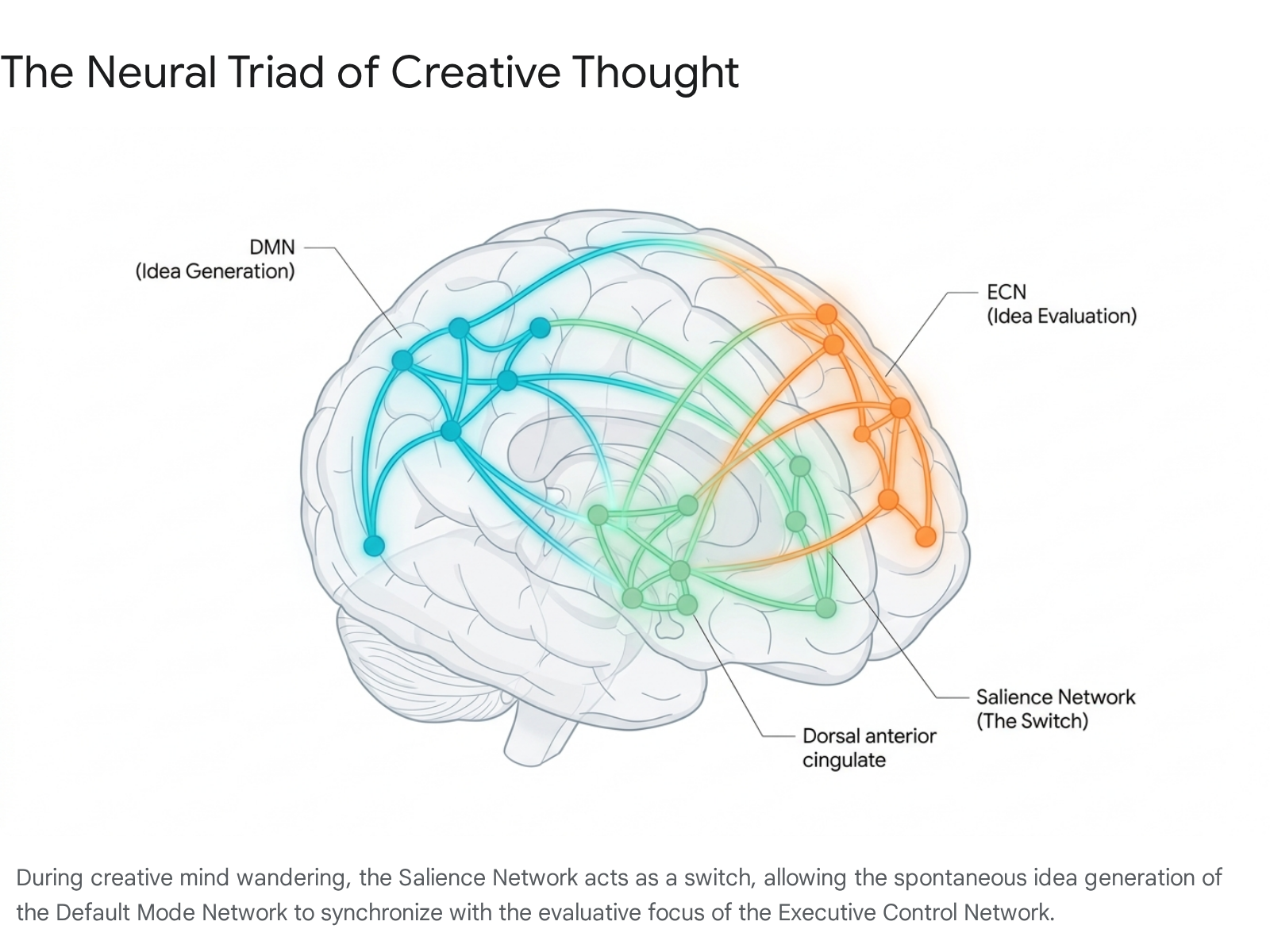
During creative mind wandering, the DMN generates a wealth of spontaneous, unconstrained associations. The Salience Network monitors this internal stream for novel, emotionally salient, or highly relevant features. When it detects a promising concept bubbling up from the DMN, the SN signals the ECN to step in 915. The ECN then evaluates the idea, shapes it, and aligns it with specific task constraints 715.
This synchronized integration explains why creative "flow states" feel simultaneously effortless and highly focused. When the DMN and ECN are coupled, internal conflict between spontaneity and focus is minimized. Spontaneous ideas flow readily (from the DMN) but are immediately harnessed and refined toward a specific goal (by the ECN) 7.
The "Edge of Chaos": Why Switching Frequency Dictates Creativity
While the ability to couple brain networks is a prerequisite for creativity, recent massive-scale research proves that the frequency of this switching is what ultimately separates highly creative individuals from the rest of the population.
In January 2025, Nature Communications Biology published the largest and most ethnically diverse neuroscience study on human creativity to date. Employing a meta-analytic network neuroscience approach, researchers analyzed resting-state fMRI scans and creative task performance from 2,433 participants across ten independent samples spanning Austria, Canada, China, Japan, and the United States 111712.
The researchers sought to understand how the dynamic switching between the segregation (working independently) and integration (working cooperatively) of the DMN and ECN predicted an individual's capacity for divergent thinking.
The Inverted-U Relationship
The study's primary finding was that creativity can be reliably predicted by the sheer number of switches a brain makes between the DMN and ECN. Highly creative individuals exhibit significantly higher switching frequencies - roughly 17.4% more network transitions than typical brains 1113.
However, this relationship is not linear; it follows an "inverted-U" trajectory. Optimal creative performance requires highly balanced brain network dynamics, existing on the neurological "edge of chaos" 111213.
- Too Little Switching (Rigidity): If the brain networks are heavily segregated and switch infrequently, thought patterns become locked into predictable, stereotypical routines. The brain cannot synthesize distant concepts, resulting in unoriginal, mundane ideas 1113.
- Too Much Switching (Chaos): If the brain networks switch too frantically, the mind becomes a chaotic storm of associations. The individual lacks the stability required for the Executive Control Network to evaluate an idea, refine it, or articulate it cohesively 1113.
- The Sweet Spot: The peak of the inverted-U represents a brain that transitions fluidly between broad, spontaneous ideation and sharp, evaluative focus. This balanced switching allows for both the birth of a novel idea and its subsequent execution 111713.
Fascinatingly, the researchers noted that this dynamic switching frequency showed absolutely zero correlation with general intelligence (IQ) 1113. Intelligence does not predict this specific neurological flexibility, indicating that creativity relies on an entirely distinct biological mechanism.
Lifespan Trajectories and Network Maturation
The brain's ability to seamlessly switch between these states changes as we age. Network connectivity and cognitive flexibility follow their own developmental inverted-U trajectories across the human lifespan 14.
During early development and young adulthood, connectivity within and between different brain networks increases, reaching peak efficiency in midlife 11415. At this peak, the frontoparietal control networks are highly adept at managing the shifting demands of the DMN and ECN, leading to optimal problem-solving and fluid cognition 1415. As individuals age, this dynamic integration slowly declines, and networks become more segregated 15. However, this shift is not entirely detrimental; older adults often exhibit different DMN activity patterns that confer advantages in emotional regulation, wisdom, and holistic sense-making, even as raw divergent thinking speed may slow 1.
The Science of "Shower Thoughts" and Incubation
The neurological requirement for balanced network switching perfectly explains one of the most universal human experiences: the "shower thought." Almost everyone has experienced a sudden burst of genius, a solved problem, or a recovered memory the exact moment they step into a warm shower, take a walk in the woods, or wash the dishes. In cognitive psychology, this phenomenon is known as the incubation effect 162317.
Under intense deadline pressure or when actively straining to solve a complex problem, the brain's cognitive load spikes. The Executive Control Network aggressively suppresses the DMN to maintain focus 231826. While this intense convergent thinking is excellent for executing routine tasks, it severely limits originality by forcing the brain down narrow, familiar, linear pathways 2326. If a problem requires an abstract or non-obvious solution, staring at a blank screen will only lead to an impasse.
Taking a break to engage in a routine, low-cognitive-load task allows the mind to enter an incubation period. Stepping into the shower occupies just enough of the brain's sensory and motor systems to prevent the ECN from actively obsessing over the primary problem, but it demands so little cognitive effort that the Default Mode Network is free to power up and wander 2317.
Biological Triggers of the Incubation Effect
The shower effect is driven by a convergence of environmental, psychological, and neurochemical factors that prime the brain for insight:
- Dopamine Activation: The soothing sensory experience of a warm shower - the temperature shift, the white noise of the water, the repetitive lathering - stimulates the parasympathetic nervous system (the "rest and digest" state) 1727. This relaxation drastically reduces stress and rumination, creating a safe physiological environment that triggers the release of dopamine. Dopamine is a critical neurotransmitter for insight; it widens associative networks in the brain and enhances cognitive flexibility, making it easier to connect disparate concepts 2327.
- Attentional Decoupling and Threshold Resetting: The Novelty-Seeking Model of incubation suggests that when you reach a mental impasse, the brain's decision threshold for what constitutes a "good idea" becomes biased toward previous, failed neural activity. Your brain literally gets stuck in a rut. Engaging in a completely different task forces "attentional decoupling." This break resets the novelty threshold, allowing spontaneous, previously suppressed ideas to emerge from the DMN without immediate rejection 19.
- Unconscious Associative Processing: While you are consciously thinking about the temperature of the water or humming a song, your brain does not simply delete the problem you were working on. Unconscious processing continues in the background 29. Freed from the rigid oversight of the ECN, the DMN begins conducting broad, undirected semantic searches through your memory, combining distant concepts that linear logic would have deemed irrelevant 202122.
| Factor | Mechanism of Action | Impact on Creativity |
|---|---|---|
| Warm Water / White Noise | Stimulates parasympathetic nervous system, lowering stress. | Reduces mental rigidity and anxiety-driven blocks 1727. |
| Dopamine Release | Neurochemical reward linked to relaxation. | Widens associative networks and enhances cognitive flexibility 2327. |
| Low-Load Task Engagement | Occupies basic sensory/motor function without taxing working memory. | Allows the DMN to activate and search distant memories uninhibited 2317. |
| Attentional Decoupling | Shifts focus entirely away from the source of the mental impasse. | Resets the brain's decision threshold, allowing novel ideas to surface 19. |
The Great Incubation Debate: Does Mind Wandering Always Help?
While the anecdotal evidence for "shower thoughts" is overwhelming, the exact scientific role that mind wandering plays in the incubation effect is highly debated. Does simply letting your mind wander guarantee a creative breakthrough?
Early benchmark studies suggested it did. A famous 2012 study by Baird et al. demonstrated that participants who engaged in an undemanding task (like a 0-back working memory test) exhibited higher levels of mind wandering and performed significantly better on subsequent creative tasks compared to those who engaged in demanding tasks (like a 2-back test) or took a resting break with no task at all 1623. This led to the widespread belief that allowing the mind to drift freely was the ultimate creativity hack.
However, replication efforts and newer studies from 2024 and 2025 have added vital nuance to this narrative, indicating that a wandering mind is not always a creative mind 3435.
The Prompt-Specific Benefit
A rigorous 2025 preregistered study tested whether different types of incubation breaks (0-back tasks, 2-back tasks, or mindfulness meditation) influenced creativity in a short-story writing task. Surprisingly, the researchers found no significant differences in creative improvement across the different incubation tasks 2024.
However, when they looked specifically at the amount of mind wandering that occurred during the break, a distinct pattern emerged. Greater mind wandering strongly predicted an increase in creative originality (measured by semantic distance and corroborated by AI evaluations) - but only for participants who returned to the exact same writing prompt they were working on before the break 2024.
For participants who were given a completely new prompt after their break, the amount of mind wandering they engaged in provided zero creative benefit 24.
This suggests that mind wandering is not a magic potion that generally enhances baseline creativity. Instead, its benefits are highly specific to the incubation of a previously established problem. The mind must first be primed with the puzzle; only then can the wandering DMN effectively search for the missing pieces 24. Furthermore, the study noted that explicitly and consciously trying to think about the story during the break did not yield the same benefits as undirected mind wandering, supporting the theory that undirected, unconscious associative processing is the true driver of the incubation effect 2024.
Not All Mental Drifting is Created Equal
The contradictory findings in creativity research often stem from a fundamental flaw: treating mind wandering as a single, uniform psychological construct. Mind wandering is incredibly heterogeneous 625. If an individual's mind drifts toward inventing a new recipe, that is highly creative. If their mind drifts toward replaying an embarrassing moment from a decade ago, that is a hindrance.
Freely Moving Mind Wandering (FMMW)
Modern cognitive science differentiates between types of thought dynamics. A 2024 study focused on a specific sub-type termed Freely Moving Mind Wandering (FMMW). FMMW is characterized by thoughts that proceed in a fluid, relatively unconstrained manner, skipping lightly from topic to topic without getting bogged down 23.
Using Hidden Markov Models to map rapid brain dynamics during resting-state fMRI scans, researchers identified a specific brain dynamic ("State 6") characterized by rigid internal connectivity within the DMN and ECN, but weak coupling between them 23. Participants who spent less time trapped in this rigid state exhibited higher levels of FMMW 23. Crucially, mediation analysis proved that high FMMW directly predicts superior performance in all three dimensions of creative divergent thinking: fluency (number of ideas), flexibility (variety of ideas), and originality (uniqueness) 23.
Intentional vs. Unintentional Mind Wandering
Another critical distinction is intentionality. Do you deliberately choose to zone out, or does your attention slip away against your will?
Neuroimaging combined with graph theory analysis reveals that while both types can benefit creativity, they rely on different neural topologies. Unintentional mind wandering shows greater involvement in prefrontal brain areas 26. Conversely, intentional mind wandering - where an individual consciously decides to step back and let their thoughts drift - is associated with stronger connectivity in the posterior regions of the Default Mode Network and the left temporal pole 2627.
Deliberate mind wandering appears to be a particularly potent tool for creative cognition. For example, a 2025 study examining the relationship between mindfulness and creativity found that non-reactivity to inner experiences (a core mindfulness trait) was positively associated with deliberate mind wandering, allowing individuals to observe their flowing thoughts without immediate judgment, thereby expanding their creative ideation 28.
The Fine Line Between Incubation and Rumination
When the Default Mode Network becomes hyperactive and fails to integrate with the regulatory functions of the Executive Control Network, mind wandering can turn toxic. This is known as guilty-dysphoric daydreaming, or rumination 25.
Rather than skipping playfully between novel concepts (FMMW), a ruminating mind gets trapped in obsessive, past-oriented, and highly critical thought loops. This actively consumes executive resources, causes mental fatigue, and is a hallmark neural signature of anxiety and depression 125. In these instances, the brain is not on the "edge of chaos" required for creativity; it is stuck in a rigid, negative groove.
ADHD: When Mind Wandering Becomes a Creative Asset
The complex relationship between mind wandering, executive control, and creativity is perhaps best illustrated by studying individuals with Attention Deficit Hyperactivity Disorder (ADHD).
ADHD is traditionally characterized as an executive function deficit. In a neurotypical brain, the Task-Positive Network (ECN) strongly suppresses the Default Mode Network during goal-directed tasks. In the ADHD brain, these two networks exhibit atypical connectivity. The inhibitory control mechanisms frequently fail to suppress the DMN, meaning that task-irrelevant, internal thoughts constantly hijack the individual's attention 2. This dysregulation, largely driven by abnormalities in dopamine transmission, leads to frequent, intense, and often disruptive episodes of mind wandering 2.
However, this exact neurological "deficit" provides a profound advantage in divergent thinking. A major 2025 study presented at the European College of Neuropsychopharmacology congress analyzed 750 participants across Europe and the UK to investigate the link between ADHD traits and creativity 29.
The researchers discovered that individuals with pronounced ADHD symptoms consistently scored higher on creative achievement tests 29. The mediating factor was mind wandering. Because their brains are highly predisposed to mental drift, they possess a wider associative net. More importantly, the study found that when individuals with ADHD engage in deliberate mind wandering - intentionally allowing their thoughts to drift rather than fighting the distraction - their creative output soared 29. By mindfully managing their neurological predisposition for mental drift, individuals with ADHD can leverage their atypical network connectivity as a distinct engine for innovation.
How Culture Shapes the Wandering Mind
The neural mechanisms that govern mind wandering and creativity are not universally hardwired at birth; they are deeply sculpted by the environments, values, and cultural practices in which a brain develops 34230.
Because the creative process is inherently dual-phased - requiring both the generation of ideas (DMN) and the evaluation and inhibition of those ideas (ECN) - cultural norms surrounding what constitutes a "good" idea can physically alter how these brain networks interact 3.
Individualism vs. Collectivism in the Brain
A groundbreaking series of cross-cultural neuroimaging studies compared the creative performance and brain activation of participants from Israel (a highly individualistic culture that rewards uniqueness and disruption) and South Korea (a collectivistic culture that heavily values traditionalism, usefulness, and social harmony) 3.
In behavioral tests utilizing the Alternate Uses Task (divergent thinking), Israeli participants consistently demonstrated significantly higher scores in fluency, flexibility, and originality compared to their South Korean counterparts 3. The researchers hypothesized that this was not due to a lack of creative potential, but rather a culturally ingrained difference in how ideas are evaluated and inhibited.
Functional MRI (fMRI) scans proved this hypothesis correct. During the generation of original ideas, participants from both cultures showed expected activation in the posterior cingulate cortex (PCC), confirming that the core Default Mode Network was functioning similarly to generate thoughts 3.
The divergence occurred in the brain's cognitive control centers: * Hyperactivity in Inhibition: South Korean participants exhibited significant "hyperactivity" in the Left Inferior Frontal Gyrus (L-IFG) compared to Israelis 3. The L-IFG is a crucial node in the brain's inhibitory control network. This hyperactivity strongly correlated with higher scores on cultural traditionalism and lower scores on originality 3. * Differing Network Coupling: In the highly creative Israeli cohort, the L-IFG was functionally coupled directly with the DMN (the PCC). This balanced connection facilitates a healthy screening process, allowing novel ideas to pass through and be refined. Conversely, in the South Korean cohort, the L-IFG was coupled with the pre-supplementary motor area (preSMA), a connection associated with intense, rigid behavioral inhibition 3.
The neuroscientific data suggests a profound conclusion: brains across different cultures possess the exact same underlying potential for spontaneous idea generation. However, in cultures where uniqueness is discouraged or harmony is prioritized, the brain's executive control networks aggressively evaluate and inhibit novel ideas before they can ever cross the threshold into conscious expression 3.
Rethinking Distraction: Practical Implications
The evolving neuroscience of mind wandering necessitates a paradigm shift in how we view distraction in both educational and professional settings.
For decades, the standard pedagogical model viewed mind wandering entirely through the lens of "executive failure" - a cognitive lapse that detracts from task performance, reduces reading comprehension, and leads to superficial learning 5. Modern frameworks, however, advocate for reframing mind wandering as a shift from external attention to inner engagement 45.
In qualitative studies of classroom environments, researchers found that students' mind wandering often involved adaptive forms of thought, such as planning future goals, exploring personal intentions, or incubating complex ideas related to the lesson itself 45. When a student momentarily zones out, they are not necessarily failing to learn; their Default Mode Network may be actively integrating the new material with their existing semantic memory 45. Educational models that rigidly enforce constant convergent focus actively suppress the neural networks required for creative synthesis 46.
Capturing the Ephemeral
Because mind wandering relies on unconstrained thought, the insights it produces are notoriously fragile. The moment the Executive Control Network is jolted back into dominance - by a phone notification, a loud noise, or the simple act of stepping out of the shower - the fragile connections formed by the DMN evaporate 47.
To leverage the brain's natural incubation cycles, experts suggest implementing low-friction capture systems. Installing a waterproof notepad in the shower, utilizing hands-free voice memos while driving, or carrying a pocket notebook on walks allows individuals to immediately offload the spontaneous ideas generated by the DMN before the ECN resumes control 2747. The goal is to capture the insight with minimal cognitive effort, parking it in an inbox to be consciously evaluated by the executive networks later 47.
Bottom line
Mind wandering is not a glitch in human attention, but a fundamental biological feature driven by the Default Mode Network. When this spontaneous mental drifting dynamically synchronizes with the brain's executive control systems - balancing on the neurological "edge of chaos" - it allows for the integration of distant concepts, resulting in the phenomenon we recognize as creativity. While the exact benefits of creative incubation depend heavily on the context and the type of thought dynamics involved, current evidence overwhelmingly indicates that a wandering mind - when guided deliberately and unburdened by heavy cognitive loads - is an essential engine for unlocking the brain's highest innovative potential.