
Neuroscience of creative thought and brain network dynamics
Introduction to the Cognitive Neuroscience of Creativity
Historically, the scientific pursuit to understand human creativity was constrained by the limitations of psychological observation and self-report metrics. For centuries, creativity was perceived as a mystical force, an elusive spark, or an impenetrable trait of genius that defied biological quantification. However, the integration of cognitive psychology with advanced neuroimaging technologies has catalyzed a paradigm shift. The contemporary cognitive neuroscience of creativity - spearheaded by the foundational work of researchers such as Rex Jung, Roger Beaty, and Mark Jung-Beeman - has transformed the study of innovation into a rigorous, empirical science 21.
The early work of Mark Jung-Beeman and colleagues provided some of the first neuroimaging evidence distinguishing sudden "Aha!" moments of insight from methodical, analytical problem-solving, mapping these epiphanies to high-frequency neural oscillations in the right hemisphere 236. Building upon this, Rex Jung advanced the understanding of structural brain metrics, demonstrating how transient hypofrontality and variations in cortical thickness across frontoparietal networks facilitate creative ideation 4. Most recently, Roger Beaty's pioneering network neuroscience approaches have revealed that individual differences in creative ability can be reliably predicted by the strength of functional connectivity between distinct, large-scale brain networks 185.
Recent advances, particularly the deluge of systematic reviews, Activation Likelihood Estimation (ALE) meta-analyses, and high-density electroencephalography (HD-EEG) studies published from 2023 to 2026, indicate a definitive move away from localization theories 3678. Creative thinking is not an isolated function localized in a specific anatomical structure, nor is it relegated to a single hemisphere. Instead, the current consensus dictates that creativity is the emergent product of dynamic, coordinated activity across large-scale functional brain networks. These networks continually reconfigure themselves in real-time to support the generation, evaluation, and expression of novel ideas 69.
This comprehensive report provides an exhaustive analysis of the neural mechanisms underlying creative thought. It systematically dismantles pervasive neuromyths, explores the intricate temporal dynamics of large-scale brain networks, maps these biological realities to traditional psychological frameworks, and critically examines the methodological limitations currently challenging the field. Furthermore, it broadens the neuroscientific lens beyond Western, Educated, Industrialized, Rich, and Democratic (WEIRD) populations to understand how distinct cultural paradigms shape the neural circuits responsible for human innovation.
Deconstructing Neuromyths: Structural Realities Over Simplifications
The popularization of neuroscience over the late twentieth century inadvertently spawned several pervasive "neuromyths" regarding creativity that continue to heavily influence education, corporate training, and public perception. Foremost among these are the right-brain versus left-brain dichotomy and the persistent belief in a singular, localized "creativity center" in the brain. Recent high-resolution neuroimaging meta-analyses and network connectivity studies definitively debunk these concepts, emphasizing instead the brain's highly integrated, pan-hemispheric nature 141011.
The Right-Brain vs. Left-Brain Paradigm
The concept that human beings are either "right-brained" - and therefore highly creative, artistic, and intuitive - or "left-brained" - predominantly logical, analytical, and mathematical - is a profound oversimplification derived from early split-brain research and pop-psychology interpretations 141218. While certain lower-level sensorimotor functions and basic language processing mechanisms exhibit lateralization, complex, higher-order cognitive functions like creativity categorically do not reside in a single hemisphere.
Modern functional magnetic resonance imaging (fMRI) and HD-EEG studies consistently demonstrate that creative ideation requires robust, synchronized interhemispheric communication. During divergent thinking tasks, both the left and right hemispheres exhibit intense, concurrent activation 1012. The generation of a creative metaphor or the resolution of an insight-based problem requires the right hemisphere's capacity for broad semantic associations coupled with the left hemisphere's precise linguistic, syntactic, and semantic control mechanisms 81314.
A recent study analyzing the functional connectivity of highly creative individuals revealed that their brains are defined by an exceptional capacity to integrate regions across both hemispheres simultaneously 11. Exceptionally creative visual artists and scientists - often referred to as "Big-C" creatives - exhibit more random connectivity at a global scale. This allows their brains to bypass traditional, highly trafficked neural hubs and make direct connections between distant cortical nodes, effectively debunking the myth that one isolated side of the brain acts as the sole engine for innovation 111522.
The Myth of the Single "Creativity Center"
A corollary to the hemispheric lateralization myth is the localization fallacy: the assumption that there is a specific "creativity center" or "God spot" within the brain that acts as the biological origin of all novel ideas 102324. Phrenological and early lesion-based approaches to neuroscience historically sought to map singular cognitive functions to discrete cortical patches. However, extensive Activation Likelihood Estimation (ALE) meta-analyses, which aggregate functional data across thousands of experimental foci, have established that creativity relies on a highly distributed neural architecture 8.
A massive 2025 ALE meta-analysis involving 787 experiments and over 10,000 foci conclusively demonstrated that creativity tasks do not uniquely engage new or dedicated brain regions 8. Instead, the brain regions implicated in creativity heavily overlap with the brain regions implicated in fundamental cognitive processes. This has given rise to the "Cognitive Cornerstones Hypothesis," which posits that creativity is not a functionally distinct process at all. Rather, it is the emergent product of general-purpose cognitive mechanisms, specifically semantic cognition, controlled episodic memory retrieval, and executive control 814. The prefrontal cortex, the hippocampus, the temporal lobes, and the posterior parietal regions communicate via complex white-matter tracts, blending previously stored memory architectures with goal-directed mental simulations 8810.
Large-Scale Brain Network Dynamics: The 2023+ Paradigm
The most significant breakthrough in the neuroscience of creativity over the past decade - solidified by comprehensive 2024 and 2025 systematic reviews - is the realization that creative thought is driven by the dynamic coupling and uncoupling of three primary large-scale brain networks: the Default Mode Network (DMN), the Executive Control Network (ECN), and the Salience Network (SN) 6916.
Historically, cognitive neuroscience operated under the assumption that the DMN and ECN were entirely anti-correlated. When an individual focused on a demanding external task (ECN activation), their internal, spontaneous thought processes (DMN activation) were suppressed to prevent distraction, and vice versa 1727. The biological hallmark of the highly creative brain, however, is the anomalous ability to co-activate and synchronize these typically opposing networks, an intricate dance guided by the precise mediation of the SN 1518.
The Default Mode Network (DMN): The Engine of Spontaneous Ideation
The DMN comprises the medial prefrontal cortex (mPFC), the posterior cingulate cortex (PCC), the precuneus, and the angular gyrus 1719. This network is inherently internally focused, activating heavily during mind-wandering, episodic future thinking, daydreaming, and the retrieval of autobiographical memories 1930.
In the context of the creative process, the DMN serves as both the foundational database and the generative engine. During the early stages of creative ideation, the DMN retrieves episodic memories and semantic knowledge, breaking these constructs apart and recombining them into novel configurations 9. The hippocampus and parahippocampal cortex within the DMN draw on spontaneous associations, operating without strict cognitive constraints 919. This unrestricted operational state allows for "remote associations" - the linking of concepts that have low semantic proximity in traditional memory structures 6914. Immersion in aesthetic experiences, listening to emotionally resonant music, or engaging in unstructured physical activities like walking heavily stimulate the DMN, setting the biological stage for spontaneous creative generation 6931.
The Executive Control Network (ECN): The Architect of Evaluation and Constraint
The ECN - anchored in the lateral prefrontal cortex, specifically the dorsolateral prefrontal cortex (dlPFC), and the posterior parietal cortex - is responsible for higher-order cognitive functions. These include working memory, attentional control, strategic planning, and prepotent response inhibition 11319.
If the DMN generates a chaotic multitude of novel combinations, the ECN acts as the critical evaluator and architect. While it is transiently suppressed during the initial generative phase, the ECN is aggressively up-regulated during the later stages of the creative process to apply goal-directed analytical processing 9. The ECN inhibits conventional, highly accessible, or habitual responses, which is a fundamental necessity for true originality 69. It evaluates the internally generated ideas surfacing from the DMN against the specific constraints of the problem at hand, ensuring that the creative output is not merely novel or bizarre, but also useful, logical, and contextually appropriate 69.
The Salience Network (SN): The Neural Switchboard
The SN is primarily situated in the dorsal anterior cingulate cortex (dACC) and the anterior insula (AI) 69. Its evolutionary function is to constantly monitor internal physiological states and external environments to identify behaviorally significant, salient stimuli 69.
During creative thinking, the SN acts as a dynamic neural switchboard. When the unconstrained DMN generates a novel association that holds high potential utility, the SN detects this internal "signal" amidst the background neural noise 918. Upon flagging this novel construct as highly salient, the SN initiates a rapid network transition. It signals the ECN to engage and apply top-down cognitive control to evaluate, refine, and implement the idea 159. This temporal connectivity, heavily mediated by the anterior insula, allows the creative brain to transition seamlessly from a state of unconstrained daydreaming to one of meticulous, focused evaluation 19.
Network Dynamics Overview
The following table synthesizes the distinct roles, neuroanatomical nodes, activation triggers, and interactions of these networks during the creative process, synthesizing the latest functional connectivity research 691931.
| Brain Network | Primary Cortical Nodes | Cognitive Functions in Creativity | Activation Triggers | Interaction Role & Network Dynamics |
|---|---|---|---|---|
| Default Mode Network (DMN) | Medial Prefrontal Cortex (mPFC), Posterior Cingulate Cortex (PCC), Precuneus, Angular Gyrus | Episodic memory retrieval, mental simulation, spontaneous divergent thinking, unconstrained associative thought. | Mind-wandering, aesthetic immersion, unstructured rest, removal of external cognitive demands, mild physical activity (e.g., walking). | Generative Engine: Supplies raw semantic and episodic material. Heavily suppressed during intensely constrained focal tasks, but uniquely co-activates with the ECN in highly creative individuals. |
| Executive Control Network (ECN) | Dorsolateral Prefrontal Cortex (dlPFC), Posterior Parietal Cortex | Working memory, goal maintenance, prepotent response inhibition, analytical evaluation, mental set-shifting. | Introduction of problem constraints, explicit instructions to evaluate, demand for utility and appropriateness, critical analysis phases. | Evaluative Architect: Down-regulated during early ideation to allow free association. Up-regulated by the SN to refine, constrain, and select the optimal creative product generated by the DMN. |
| Salience Network (SN) | Dorsal Anterior Cingulate Cortex (dACC), Anterior Insula (AI) | Bottom-up novelty detection, emotional salience monitoring, attention allocation, large-scale network switching. | Detection of a highly novel internal association, emotional resonance of a generated idea, sudden shifts in task demands. | Neural Switchboard: Flexibly modulates the coupling between the DMN and ECN. Detects the metaphorical "Aha!" moment and triggers the ECN to evaluate the DMN's generated content. |
Structural Mapping: Neural Correlates of Wallas's Stages of Creativity
In 1926, the pioneering psychologist Graham Wallas proposed a four-stage model of the creative process: Preparation, Incubation, Illumination, and Verification 20. For nearly a century, this psychological framework served purely as a conceptual architecture, reliant on introspection and self-report 2033. Today, the tools of modern cognitive neuroscience allow for a precise structural mapping of these subjective behavioral states directly to the temporal fluctuations in large-scale functional neural networks 63321.
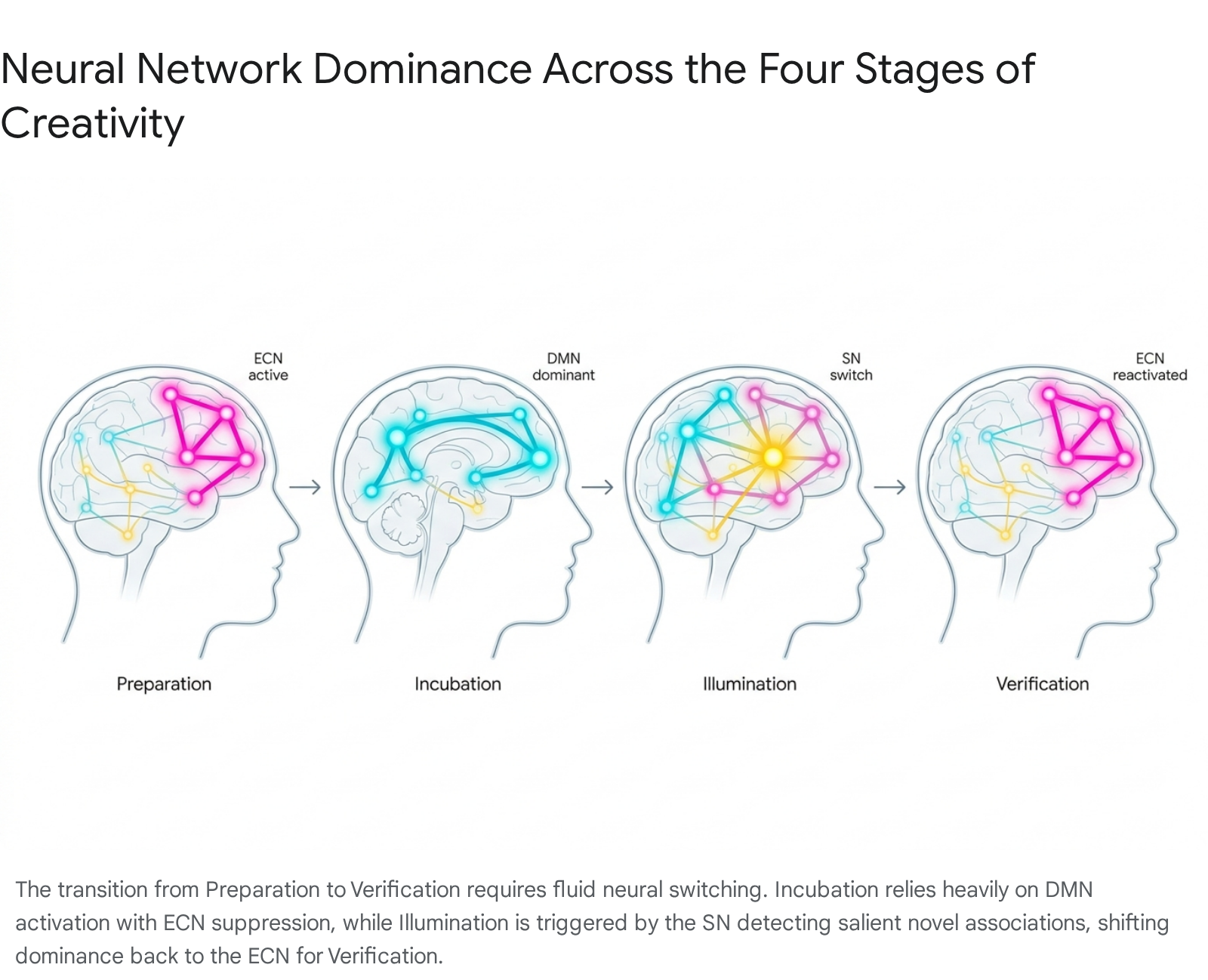
The Preparation stage is characterized by highly conscious, effortful work. The individual actively defines the parameters of the problem, gathers necessary data, and immerses themselves in the domain, building the cognitive raw materials necessary for later breakthroughs 3020. From a neurobiological perspective, this stage relies heavily on the Executive Control Network (ECN). The prefrontal cortex is continuously active, utilizing robust working memory capacity to hold complex problem parameters in mind, while language and sensory centers absorb semantic and episodic information 913. Neurologically, this phase is marked by high-frequency gamma and beta oscillations indicative of intense cognitive load, focused external attention, and active learning paradigms 16.
When direct effort yields no immediate solution, the creator naturally steps away from the problem, entering the Incubation stage. Wallas noted this as a period where voluntary conscious thought ceases, allowing unconscious cognitive processes to take over 3020. This deliberate detachment shifts the brain into a state dominated by the Default Mode Network (DMN) 30. During incubation, the rigorous constraints maintained by the ECN are relaxed. This phenomenon, often referred to as transient hypofrontality, involves a temporary down-regulation of the prefrontal cortex 91722. With the inhibitory guardrails of the ECN lowered, the DMN engages in the spontaneous, non-linear reshuffling of the material gathered during the Preparation stage, integrating previous experiences and forming distant semantic connections without conscious interference 930.
Illumination - often preceded by a fringe-of-consciousness phase that Wallas termed "Intimation" - is the sudden, intuitive realization of a solution 220. This phenomenological "Aha!" moment is neurobiologically driven by the Salience Network (SN). As the unconstrained DMN constructs a highly novel and potentially useful semantic bridge, the anterior insula detects the sudden salience of this internal stimulus 69. The SN then rapidly interrupts the DMN's quiet mind-wandering state. This transition is frequently accompanied by a sudden, measurable burst of high-frequency gamma-band EEG activity in the right temporal lobe (specifically the anterior superior temporal gyrus), structurally mapping the exact millisecond a participant experiences conscious insight 316.
In the final stage, Verification, the newly illuminated idea must be consciously evaluated against reality, mathematically proven, refined, or physically expressed 620. To achieve this, the SN facilitates a hard switch back to ECN dominance. The dorsolateral prefrontal cortex (dlPFC) is powerfully up-regulated to apply rigorous logic, deductive reasoning, and critical evaluation to the raw idea 69. Furthermore, if the creative endeavor requires physical expression - such as painting a canvas or performing a musical improvisation - the Sensorimotor Network (SMN) is concurrently recruited to facilitate high-level output. Across this final expression stage, the Reward System (RS) releases dopamine to sustain cognitive flexibility, maintain motivation, and reinforce the emotional resonance of the creative implementation 69.
Methodological Frontiers and Limitations
Despite massive advances in the structural and functional mapping of creative cognition, the neuroscience of creativity is fundamentally constrained by severe methodological and technical limitations. The dynamic, spontaneous, and highly individualistic nature of creative thought inherently resists the sterile, rigid protocols required by standard scientific measurement 222324.
The Spatial-Temporal Trade-off: fMRI vs. EEG
The dual necessities of tracking precisely where creativity happens in the brain and exactly when it happens present a persistent technological paradox for researchers 225. Functional Magnetic Resonance Imaging (fMRI) provides unparalleled spatial resolution, allowing neuroscientists to peer deeply into subcortical structures and identify precise node activations within the DMN and SN 225. However, fMRI does not measure electrical brain activity directly; it measures the Blood Oxygenation Level Dependent (BOLD) signal. This hemodynamic response is inherently sluggish, taking several seconds to unfold 225. Because insight generation, humor comprehension, and rapid network switching occur on a millisecond timescale, fMRI is temporally too slow to capture the immediate dynamics of an "Aha!" moment 225.
Conversely, High-Density Electroencephalography (HD-EEG) measures electrical activity directly through the scalp, offering superb temporal resolution at the millisecond level 32526. EEG excels at tracking the rapid shifts in alpha and gamma oscillations that indicate sudden insight, cognitive load changes, or shifts between convergent and divergent thinking states 22527. However, EEG suffers from poor spatial resolution due to skull attenuation and signal smearing. This makes it exceedingly difficult to pinpoint the origin of deeper brain sources, meaning conclusions regarding complex network interactions - like identifying specific nodes within the PCC or the insula - often remain indirect 22225. Consequently, future research heavily advocates for simultaneous, multimodal fMRI-EEG studies to bridge this gap, integrating the spatial precision of hemodynamics with the temporal exactitude of electrophysiology 22.
The Challenge of the Spontaneous Flow State
A secondary methodological crisis revolves around ecological validity and the measurement of "Flow." Flow is defined as an optimal psychological state characterized by complete task immersion, effortless attention, and peak creative output. Neurologically, it is uniquely characterized by synergistic DMN-ECN connectivity and the suppression of the amygdala, which allows for high focus with minimal anxiety 1722.
Capturing spontaneous flow in a laboratory setting presents a massive logistical hurdle. The sterile, claustrophobic, and noisy environment of an fMRI scanner is fundamentally antithetical to the natural conditions that foster spontaneous, uninhibited creativity 222324. Furthermore, true flow states cannot be easily induced on command through standardized tests. Many neuroimaging studies must rely on post-task subjective surveys to gauge flow, which complicates the ability to lock specific neural timestamps to the peak flow experience 1722.
Recent developments exploring the neurobiology of flow highlight the debate between the "Hyperfocused-Attention" theory and the "Expertise-Plus-Release" Theory 2228. A landmark 2024 EEG study from Drexel University examining jazz musicians provided strong support for the latter. The study revealed that extensive domain-specific expertise allows an individual to "let go" of conscious ECN control, automating performance while minimizing frontal lobe interference 2228. In these expert states, transient hypofrontality allows the brain to retrieve complex patterns implicitly. However, testing this theory requires highly specialized expert cohorts compared against novices. This introduces confounding variables related to generalized training versus acute creative states, making it difficult to separate the neural footprint of years of practice from the neural footprint of the immediate creative act itself 22.
The Global Creative Brain: Cross-Cultural Perspectives and Non-WEIRD Populations
A critical vulnerability in the neuroscience of creativity - and cognitive science broadly - is its historical over-reliance on WEIRD populations. Because human cognition is profoundly shaped by the sociocultural environment, generalizing findings from Western undergraduates to the entire global population introduces significant bias 729. Fortunately, research spanning 2023 to 2026 has actively broadened its geographical scope, utilizing the "Systems Model of Creativity" to explore the neurobiology of innovation in institutions across Latin America, Africa, and Asia 7304431.
Cultural Programming of Inhibitory Control
Recent cross-cultural neuroimaging studies have demonstrated that cultural paradigms fundamentally alter the cognitive strategies and neural circuits utilized during creative generation 42931. The psychological concepts of individualism and collectivism directly map onto distinct neural processing biases 2932.
A landmark fMRI study comparing Israeli (Western, individualistic) and South Korean (East Asian, collectivistic) participants on the Alternate Uses Task (AUT) yielded profound neuro-cultural insights. Behaviorally, Israeli participants generated a higher number of highly original, boundary-pushing ideas 4. Neurologically, South Korean participants exhibited significant hyperactivation of the left inferior frontal gyrus (L-IFG) during idea generation 4.
The L-IFG is a crucial neuroanatomical node for cognitive inhibitory control. In collectivist cultures, where social harmony, norm adherence, conformity, and group cohesion are prioritized over individual uniqueness, individuals apply a much stronger subconscious neural "filter" to their thoughts 431. Consequently, ideas generated by the DMN that deviate too far from established societal norms are actively neurologically inhibited by the L-IFG before they reach the threshold of conscious expression. Thus, while the underlying biological architecture of creativity (DMN-ECN-SN interaction) is universal, the thresholds for inhibition and the weighting of the executive control network are highly plastic, constantly calibrated by the individual's cultural environment 429.
Creativity and Brain Health in Latin America and Beyond
Significant contributions have also emerged from global consortia assessing diverse populations, including comprehensive initiatives led by the Latin American Brain Health Institute (BrainLat) and Trinity College Dublin. Published in Nature Communications in late 2025, a massive study examining over 1,400 participants across 13 countries reframed creativity from a purely psychological metric to a vital biological pathway for cognitive resilience 4733.
This globally diverse research demonstrated that long-term engagement in culturally resonant creative practices - such as Tango dancing, visual arts, and musical training - significantly enhanced the functional connectivity of vulnerable brain areas, including the hippocampus and parietal networks 4733. By utilizing an AI "brain clock" to measure biological versus chronological aging, researchers found that sustained creative engagement literally protected the brain against structural degradation, resulting in brains that appeared up to seven years "younger" chronologically 4733. These studies underscore the necessity of viewing creativity through an expansive, multicultural lens. They demonstrate that culturally integrated creative behaviors optimize neuroplasticity, enhance network communication, and mitigate cognitive decline across highly diverse populations and lifespans 4733.
Competing Views and Ongoing Debates in the Field
As the neuroscience of creativity matures as a distinct discipline, friction has inevitably emerged between differing methodological philosophies and conceptual frameworks. These debates center around what exactly constitutes measurable creativity and how the integration of modern technology impacts the neural plasticity of the human brain.
Standard Laboratory Metrics vs. Real-World Creativity
The most persistent debate in creativity research involves the fundamental friction between standard laboratory metrics and the measurement of real-world, spontaneous creative output 232434. The undisputed gold standard for assessing creativity in the fMRI scanner is the Divergent Thinking (DT) task, most notably the Alternate Uses Task (AUT), where participants generate novel uses for common objects within a strict time limit 3450.
Critics argue that the AUT is a highly artificial, short-duration task that predominantly measures ideational fluency and abstract associative capability 232434. While easy to quantify, generating alternative uses for a brick may not accurately translate to real-world "Big-C" creativity - such as designing a sustainable architectural structure, composing a symphony, or formulating a breakthrough scientific hypothesis 152334. Real-world creativity involves highly complex, ill-defined problems. It requires extended, multi-year periods of incubation, high-level convergent thinking (CT) to select the optimal solution, and immense emotional resilience to iterate upon failure 345035.
While recent 2025 studies demonstrate a strong positive correlation between divergent thinking scores and convergent thinking proficiency (such as performance on the Remote Associates Test), the leap from these structured puzzles to ecological, open-ended innovation remains a significant gap 143450. In response, researchers like Roger Beaty have begun utilizing novel tasks, such as scanning STEM majors while they generate original, scientifically plausible hypotheses, confirming that scientific creativity utilizes the same tripartite network dynamics (DMN, ECN, SN) as artistic divergent thinking 5.
The AI Dependency and Cognitive Atrophy Debate
A rapidly emerging and vital theoretical debate within the field concerns the impact of Artificial Intelligence (AI) and Generative Pre-trained Transformers (GPTs) on human neural plasticity and creative capacity.
Preliminary longitudinal observations and theoretical papers from 2024 and 2025 suggest a measurable decline in organic divergent thinking skills among young adults, correlating strongly with the widespread outsourcing of problem-solving to AI interfaces 52. Neurobiologically, creative thinking relies on the foundational principle of use-dependent neuroplasticity; the continuous, effortful engagement of the DMN and ECN strengthens the associative white-matter pathways required for complex problem-solving 3152.
If the crucial "Preparation" and "Incubation" stages of Wallas's model are continually bypassed by immediate algorithmic generation, there is a severe risk of "cognitive atrophy" in the specific neural tracts that facilitate human divergent leaps 52. Because AI systems largely mirror highly efficient convergent thinking - optimizing answers based on historical training data within defined parameters - over-reliance on these tools may weaken the human capacity to redefine problems and make unexpected associations outside of existing parameters 52. Balancing the undeniable utility of AI tools with the neurological necessity of effortful, unassisted ideation represents a critical, unresolved frontier for educational neuroscience and cognitive psychology 752.
Conclusions
The cognitive neuroscience of creativity has successfully transcended the simplistic binaries of right versus left hemispheres and abandoned the phrenological pursuit of isolated creative hubs. Creativity is now firmly understood as a supreme act of neural orchestration. The generation of a truly creative idea requires the spontaneous, unfettered memory retrieval of the Default Mode Network, the meticulous and logical constraints of the Executive Control Network, and the rapid, novelty-detecting mediation of the Salience Network.
By structurally mapping these biological realities onto Graham Wallas's century-old psychological stages, modern neuroscience has validated the necessary biological rhythm of human innovation: intense preparation, necessary rest and mind-wandering, the sudden electrophysiological flash of insight, and rigorous evaluation.
Looking forward, the field must confront its methodological limitations by embracing multimodal fMRI-EEG paradigms and shifting its focus toward ecological, real-world tasks that capture the authentic flow state. Most importantly, neuroscience must continue to de-center WEIRD populations, recognizing that the human brain's creative capacity is not forged in a biological vacuum, but is intimately sculpted by the cultural, geographical, and social environments in which it operates. Understanding these diverse neural landscapes will not only demystify the evolutionary origins of human genius but will provide scalable, biological pathways to enhance cognitive resilience and preserve the integrity of the creative mind in an increasingly automated world.