
What Is College Decision Day and How to Make Your Choice
College Decision Day, traditionally recognized as May 1, is the national deadline for admitted high school seniors to formally accept an offer of admission and secure their spot by submitting an enrollment deposit. Making the final choice requires families to look past the published "sticker price" to evaluate true net costs, compare institutional graduation rates, and establish a strategic backup plan if the student remains on a waitlist for their top-choice school.
What Actually Happens on May 1?
After months of submitting applications, writing essays, and waiting for decisions, May 1 serves as the crucial "National Candidates Reply Date" across the United States. By this date, students are expected to inform their chosen college or university of their intent to enroll and pay an enrollment deposit 12. This deposit typically ranges from $100 to $400, though it can climb as high as $1,000 at certain highly selective private institutions 345.
The deposit serves a critical administrative and psychological function for universities. Colleges face intense uncertainty regarding their "yield" - the percentage of admitted students who will actually show up to campus in the fall 36. Because universities cannot function effectively if classes are over-enrolled (straining housing, dining, and faculty resources) or under-enrolled (straining institutional budgets), the deposit acts as a reliable financial signal of a student's serious intent 37. In most instances, the money is ultimately credited toward the student's first-semester tuition 38.
For the student, submitting the deposit unlocks the entire next phase of the college transition. It allows incoming freshmen to register for orientation sessions, sign up for housing, choose meal plans, and begin selecting their fall classes 25. Until that money is submitted, the student's spot in the incoming class is merely theoretical.
Are Enrollment Deposits Refundable or Binding?
A common source of confusion for families is the legal and financial nature of the enrollment deposit. In the vast majority of cases, enrollment deposits are strictly non-refundable 45. If a student changes their mind after May 1, the college keeps the cash. This policy exists to discourage students from casually holding spots at multiple institutions, which would wreak havoc on a college's ability to accurately forecast its incoming class size 39.
However, while the deposit is non-refundable, it is entirely non-binding 58. Submitting a deposit does not legally obligate a student to attend that institution, nor does it make them responsible for paying the full year's tuition if they ultimately withdraw before classes begin 8. Students retain the right to change their minds over the summer, though doing so means forfeiting the initial deposit 410.
Why Is Decision Day Changing in 2026?
While May 1 has historically been the immovable standard in the college admissions calendar, the timeline has recently become remarkably fluid. Federal rollouts of updated Free Application for Federal Student Aid (FAFSA) formulas have resulted in technical glitches and significant processing delays over recent admission cycles 1112.
For the 2026-2027 academic year, legislative changes tied to the One Big Beautiful Bill Act (OBBBA) required the U.S. Department of Education to send FAFSA data to institutions in an entirely new format 1314. This resulted in universities across the country having to pause the loading of new FAFSA data until their software vendors could implement the necessary backend changes 14. Because students cannot be expected to make an informed, multi-thousand-dollar commitment without first seeing their financial aid packages, hundreds of colleges have temporarily extended their Decision Day deadlines to May 15 or even June 1 to accommodate these delays 1112.
Furthermore, a growing movement among elite institutions aims to permanently eliminate the enrollment deposit requirement altogether. The University of Pennsylvania, for example, recently ditched its $400 deposit requirement to remove financial barriers for low-income applicants, allowing students to wait until their first-term bill arrives before making any payments 15. Harvard and Yale have also eliminated enrollment advances 15.
Given this shifting landscape, students must meticulously check the specific admissions portal for each college they applied to, as deadlines for rolling admissions, extended FAFSA timelines, and special university programs can vary significantly from the traditional May 1 date 25.
How to Evaluate the True Cost of College
Concerns about college affordability dominate the national conversation, with many Americans viewing higher education as financially out of reach despite recognizing the long-term economic value of earning a degree 13. The most common mistake families make when comparing college acceptances is evaluating schools based on their published "sticker price."
The sticker price is the raw, unadjusted cost of tuition, room, and board before any financial aid is applied. In reality, the sticker price is highly negotiable and is rarely what a typical student actually pays 1617. The metric that matters is the net price: the total cost out-of-pocket after federal grants, institutional merit scholarships, and need-based aid are deducted 1617.
At public four-year institutions, the average net price hovers around $14,687 per year, while private nonprofits average roughly $24,308 16. Counterintuitively, highly selective private colleges with massive endowments can actually be far cheaper for low- and middle-income families than their local in-state public universities. Because these elite schools often have "no-loan" policies and meet 100% of a family's demonstrated financial need, a family earning under $75,000 may pay a mere fraction of the cost to attend an Ivy League school compared to a state college 161819.
How Income Brackets Change the Math
To understand the actual financial burden of private, nonprofit colleges, students must analyze outcomes based on their specific household income. Data aggregated from thousands of institutions reveals a consistent pattern of aggressive institutional need-based discounting 16. Assuming a student does not secure full-ride merit aid, the typical net price scales directly with household earnings.
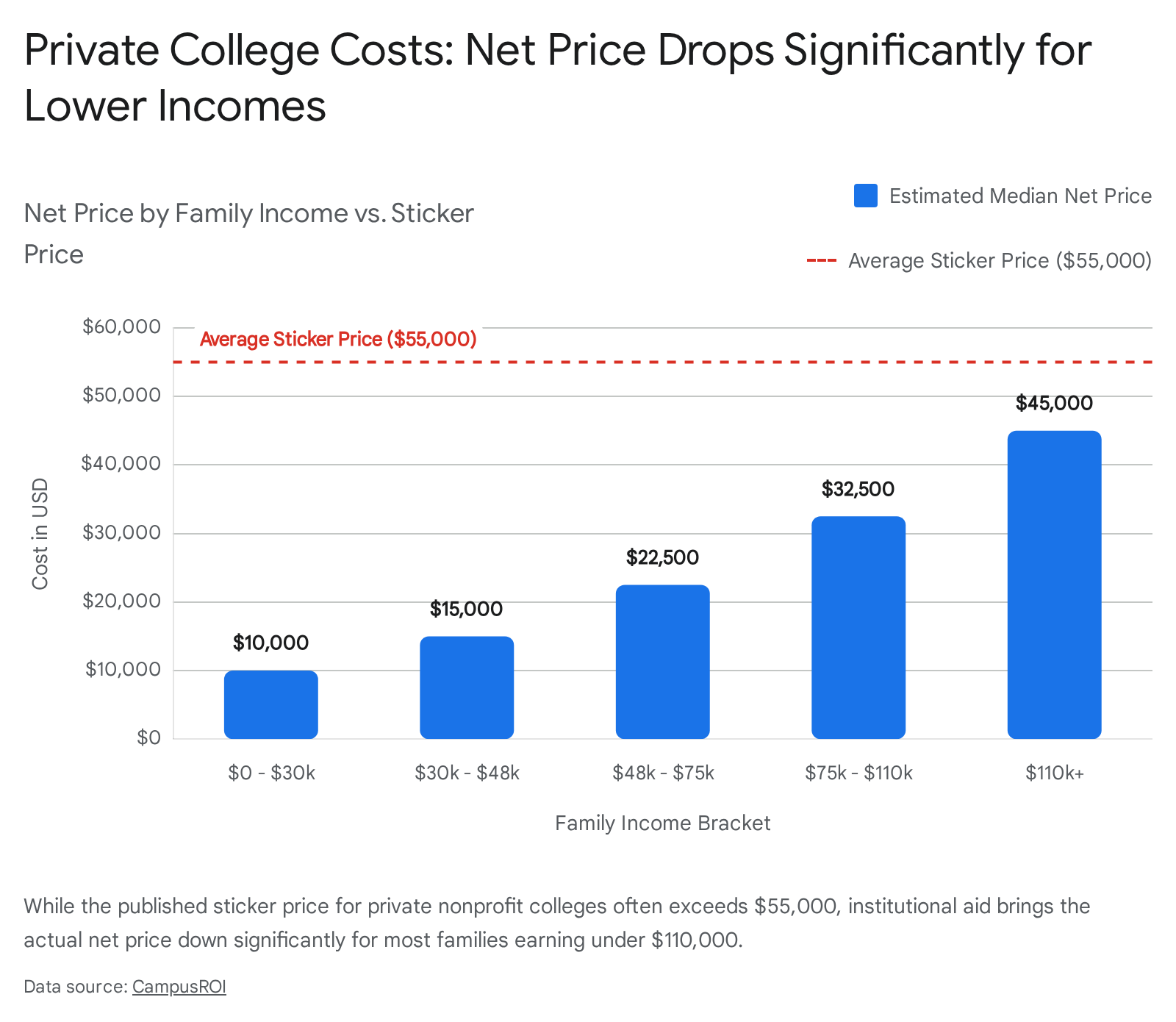
| Family Income Bracket | Typical Net Price (Private Nonprofit) |
|---|---|
| $0 - $30,000 | $5,000 - $15,000 / year |
| $30,001 - $48,000 | $10,000 - $20,000 / year |
| $48,001 - $75,000 | $15,000 - $30,000 / year |
| $75,001 - $110,000 | $25,000 - $40,000 / year |
| $110,001+ | $35,000 - $55,000 / year |
This discounting explains why a family earning $25,000 a year might pay less out-of-pocket to attend a highly selective private university than they would to attend an in-state public university 16. However, higher-income families must face a different reality. Many affluent families assume that selective private schools will offer generous merit aid to offset their massive sticker prices 19. In reality, the top fifty most selective universities in the country offer zero merit aid as a matter of policy, utilizing their financial resources strictly for need-based aid 19. For a family earning well over $110,000, attending a highly selective private college will almost certainly require paying the full sticker price.
The Merit Aid Reality Check
If a family's income is too high to qualify for need-based grants, but the cost of a private university remains daunting, the strategy must pivot to merit aid. However, merit aid is rarely awarded simply for being a good student; it is awarded strategically by universities to entice students who will raise the institutional profile 1920.
The "sweet spot" for merit aid occurs when a student applies to a college where they are a big fish in a relatively smaller pond. For example, if a student with excellent grades and test scores applies to a highly selective school where their profile merely matches the average applicant, they have roughly a 20% chance of admission and will receive zero merit aid 19. If that same student applies to a target school where their academic profile places them in the top 20% of the applicant pool, the college is highly likely to offer substantial merit scholarships - often ranging from $18,000 to $28,000 a year - to convince that high-achieving student to enroll 19. Over four years, choosing academic fit over raw prestige can result in a $160,000 difference in total cost 19.
The Hidden Costs That Ruin Budgets
When evaluating financial aid award letters, families must also calculate expenses that do not appear on the direct tuition bill. The published cost of attendance is a simplified figure, and real spending includes items that blow budgets in the first semester 1617. Beyond tuition and on-campus housing, the true cost of attendance includes an estimated $3,000 to $6,000 annually in indirect and hidden expenses 1617.
| Expense Category | Typical Annual Range | What to Know |
|---|---|---|
| Transportation | $1,000 - $3,500 | Getting to and from campus. Costs spike dramatically for out-of-state students flying home for holidays. |
| Personal Expenses | $1,500 - $3,000 | Laundry, toiletries, phone plans, winter clothing, and entertainment. |
| Health Insurance | $1,500 - $3,500 | Often mandatorily billed by the university unless the student explicitly proves they are covered by a parent's comparable plan. |
| Course Materials & Tech | $1,200 - $2,800 | Beyond textbooks, this includes required laptops, lab supplies, access codes, and specialized software licenses. |
| Hidden Student Fees | $500 - $2,000 | Mandatory campus activity, technology, athletic, and lab fees that are occasionally omitted from top-line tuition marketing figures. |
If a student's financial aid package only covers the officially published cost of attendance, the family will still face significant out-of-pocket costs to simply survive the academic year 1617.
What If You Cannot Afford the Enrollment Deposit?
For students facing severe financial hardship, an enrollment deposit of several hundred dollars can present a massive and immediate barrier to matriculation. While they may have secured a generous financial aid package that covers their tuition starting in September, finding $400 in liquid cash in late April is simply impossible for many low-income families 1521.
Recognizing this systemic friction point, the National Association for College Admission Counseling (NACAC) offers a universal Enrollment Deposit Fee Waiver program 2122. The program was explicitly crafted to address the financial micro-barriers that marginalized students face in the college admission process 22.
Students generally qualify to use the NACAC fee waiver form if they meet specific indicators of economic need. These indicators include eligibility for the Federal Pell Grant, participation in the federal Free or Reduced Price Lunch (FRPL) program, enrollment in state or local low-income programs like TRIO Upward Bound, or if the student's family receives public assistance 212324. Furthermore, students living in federally subsidized public housing, in foster care, or those experiencing homelessness automatically qualify 212324.
To utilize the waiver, a high school counselor, principal, or community-based organization representative must verify the student's eligibility, sign the official form, and submit it directly to the college's admissions office prior to the May 1 deadline 212223. Most universities will readily accept the form and either waive the deposit entirely or defer the payment until the student's federal financial aid is officially disbursed in the fall 821.
Navigating the Waitlist Purgatory
For thousands of students every spring, opening an admissions decision reveals neither an acceptance nor a rejection, but an invitation to join a waitlist. For students placed on a waitlist, Decision Day presents a profound logistical and emotional hurdle.
A waitlist notification does not mean the student was unqualified or that their collegiate dreams are over; rather, it indicates that the admissions committee found the applicant highly competitive but simply ran out of space in the initial incoming class 67. Waitlists exist precisely to protect institutional yield 625. Colleges cannot perfectly predict exactly how many accepted students will decide to enroll. If a college projects a 50% yield rate but only 45% of admitted students submit a deposit by May 1, the university will turn to the waitlist to fill the remaining empty beds and protect their tuition revenue 625.
Waitlist acceptance rates vary wildly by year and institution, ranging from 0% to 17% at highly selective schools 6. For example, in recent cycles, elite institutions like Yale have occasionally admitted zero students from the waitlist because their initial accepted cohort yielded perfectly, while other top-20 schools might admit dozens or even hundreds depending on the unpredictability of a given year 625. The higher a school's overall yield rate, the less likely a student is to get off the waitlist 7.
The Immediate Waitlist Action Plan
If a student hopes to turn a waitlist into an acceptance, passive waiting is highly ineffective. Admissions experts recommend a specific, strategic sequence of actions to maximize the odds of admission 26:
1. Accept the Waitlist Spot Immediately Waitlists are rarely automatic. Colleges require students to formally opt in. If a student wants to remain in contention, they must log into their admissions portal and confirm their interest as soon as possible. Failing to click this confirmation button is effectively interpreted by the college as declining the spot 2627.
2. Submit a Deposit Elsewhere by May 1 Because waitlist movement is incredibly unpredictable and never guaranteed, students must secure a backup option. A student must submit a formal enrollment deposit to a college where they were outright admitted prior to the May 1 deadline 627. Colleges fully expect waitlisted students to do this; it is standard practice and does not negatively impact a student's standing on the waitlist 67.
3. Write a Compelling Letter of Continued Interest (LOCI) Unless a college explicitly outlines in its instructions that it does not want any additional materials, the applicant should draft and email a Letter of Continued Interest (LOCI) by mid-April 2628. A strong LOCI should be roughly 500 words and lead with specific reasons why the school remains a perfect fit, referencing particular courses, professors, or research opportunities 26. The letter is also the appropriate venue to provide genuine updates on academic achievements, new leadership roles, or awards received since the original application was submitted in the winter 2628. Most importantly, if the school is genuinely the student's absolute first choice, the letter must clearly state: "If admitted, I will enroll." Admissions officers refer to this as a "first-choice declaration," and it matters immensely because it directly reduces their yield uncertainty; they know offering a spot to this student is a guaranteed enrollment 626.
4. Do Not Harass the Admissions Office While expressing continued interest is vital, knowing what to avoid is equally important. Students should not repeatedly call the admissions office throughout April to check their status. Admissions officers will not know the status of their waitlist until the second week of May at the earliest, after they have processed all the incoming May 1 deposits 2627. Repeated phone calls or emails are more likely to flag a student's name negatively as an administrative nuisance rather than secure them a spot 2627.
Is "Double Depositing" Allowed?
As students struggle to decide between multiple highly competitive offers, or attempt to leverage competing financial aid packages, some families consider a tactic known as "double depositing." This involves paying the non-refundable enrollment deposit at two different colleges simultaneously to secure a spot at both, essentially buying the student more time to make a decision over the summer 19.
According to the ethical guidelines established by the National Association for College Admission Counseling (NACAC), double depositing is highly unethical and universally condemned by admissions professionals 129. From an institutional perspective, the practice is deceitful. Students know they can only physically attend one college in the fall, so they are essentially lying to one institution when they signify their intent to enroll 1.
The broader impact of double depositing falls on other applicants. A student holding two deposits is artificially taking up a spot in an incoming class that could go to another student currently languishing on a waitlist 19. If the practice becomes widespread, colleges find they cannot predict the size of their incoming class with any accuracy, forcing them to take defensive actions like enlarging their waitlists in future years or increasing the non-refundable deposit amounts, which penalizes all future applicants 1.
If colleges discover a student has double deposited - which they frequently do by cross-referencing final enrollment lists through the National Student Clearinghouse, reviewing final transcript requests from high schools, or checking the Common App database - they reserve the right to immediately rescind both offers of admission, leaving the student with no college to attend in the fall 1630. High school counselors are also professionally obligated to report double depositing if they become aware of it 29.
The Single Waitlist Exception
There is only one scenario in which the NACAC guidelines consider holding deposits at two institutions to be ethically acceptable: when a student is admitted off a waitlist after May 1 1927.
In this specific case, the timeline forces a temporary overlap. The student has already correctly submitted an enrollment deposit to their backup school by the May 1 deadline. In late May, their top-choice school calls and offers them a spot from the waitlist. The student is allowed to accept the new waitlist offer and submit a deposit to the new school. However, immediately after securing the new spot, the student must contact the admissions office of their original backup school in writing to formally withdraw their enrollment 6927. The student will forfeit their initial deposit, but the withdrawal allows the backup school to quickly offer that newly opened seat to someone on their own waitlist 927.
Ivy League vs. State Flagship Universities
A persistent dilemma for many high-achieving students on Decision Day is choosing between a prestigious Ivy League institution and a top-tier public flagship university. The premise that Ivy League schools are universally "better" than state universities is one of the most persistent myths in higher education; dozens of public flagship universities rank among the best in the world, produce massive research output, and launch equally impressive careers 31.
However, the statistical reality of Ivy League admissions has never been more competitive. For recent admission cycles, every one of the eight Ivy League schools posted overall acceptance rates below 7%, with some dropping below 4% 3233. Furthermore, these institutions rely heavily on binding Early Decision (ED) rounds to secure their classes. Early Decision rates typically run two to four times higher than Regular Decision rates, meaning a massive portion of the freshman class is locked in before the spring even begins 3233. For a student weighing options in May, gaining admission to an Ivy through the Regular Decision bloodbath is an extraordinary statistical anomaly.
| Institution | Regular Decision Pool Context | Selectivity Trend |
|---|---|---|
| Harvard University | Overall acceptance rates hover near 3.19%, with regular decision rates falling closer to 2.3% 33. | Exceptional selectivity; nearly perfect yield rates limit waitlist movement 67. |
| Columbia University | Overall acceptance rates around 3.7% 3233. | Urban campus carries significantly higher daily living costs beyond standard room and board 32. |
| Yale University | Overall acceptance rates below 4.5% 33. | Yield protection is highly efficient; historically has admitted zero students from waitlists in certain years 25. |
| Cornell University | Historically the most accessible Ivy, but still rejects over 93% of applicants 1832. | Broader range of undergraduate academic programs than other Ivies 18. |
When choosing between an Ivy and a state school, families must rigorously analyze the return on investment (ROI). If an Ivy League school offers a generous need-based financial aid package that rivals the cost of in-state tuition, the prestige and networking opportunities make it a highly logical choice 1831. However, if a family must take on $200,000 in private debt to fund the Ivy League sticker price, attending the honors program at a state flagship university for a fraction of the cost is often the far superior economic decision.
The Data of Success: Graduation and Retention Rates
When a student holds multiple acceptances, evaluating the options requires moving beyond campus aesthetics or brand prestige. The data clearly proves that while earning a degree yields a 60% earning premium over a high school diploma, the economic payoff is heavily dependent on where a student enrolls, what they study, and whether they actually finish 2.
A college's six-year graduation rate is widely considered the single most reliable metric for assessing institutional quality and student support 353. The national average six-year graduation rate for first-time, full-time students at four-year institutions is roughly 62.2% 37. This means nearly four in ten students who start a bachelor's degree do not finish within six years.
However, this national average masks a massive disparity based on institutional selectivity and sector 374.
| Institution Type | Average 6-Year Graduation Rate | Context |
|---|---|---|
| Private Nonprofit (4-Year) | ~76% | Highly selective institutions within this category often boast graduation rates exceeding 95% 3940. |
| Public (4-Year) | ~71% | Rates vary wildly by state funding; top state flagships perform exceptionally well, while regional public schools may struggle 3740. |
| Private For-Profit (4-Year) | ~36% | Consistently the lowest-performing sector, even when adjusting for the non-traditional demographic profile of their student body 3740. |
Graduation rates naturally track with admission selectivity. Highly selective colleges (those accepting fewer than 25% of applicants) generally boast graduation rates approaching or exceeding 90% because they are admitting students who already possess strong academic preparation 3439. For instance, elite private schools like Harvard and Stanford routinely graduate 95% to 98% of their cohorts 3541. Conversely, institutions with open enrollment policies often see graduation rates drop below 40% 354.
To get a true sense of a college's effectiveness, educational researchers increasingly use "value-added" measures 42. These statistical models adjust raw graduation rates to account for the incoming class's demographic and academic background. A value-added analysis attempts to show how well an institution supports the students it actually has, rather than simply rewarding elite colleges for admitting wealthy, high-scoring students who were statistically likely to graduate regardless of where they enrolled 42. When researching a college, a student should look closely at how the school graduates students from their specific demographic or socioeconomic background, as the overall top-line rate may not reflect their likely experience 37.
Students should also check a college's freshman retention rate, which measures the percentage of first-year students who return to the institution for their sophomore year. A high retention rate typically translates to a high graduation rate down the line 35. A retention rate below 70% is a severe warning sign; it indicates that a massive portion of the freshman class is encountering insurmountable financial, academic, or cultural barriers early in their college experience and deciding to drop out or transfer 439.
Higher graduation rates ultimately lower the total cost of college. Taking six years to finish a traditional four-year degree requires two additional years of tuition, fees, and living expenses, and represents two years of lost professional wages in the workforce 37.
Frameworks for Making Your Final Choice
The process of selecting a college is deeply personal, requiring students to synthesize complex financial data, academic goals, and emotional instincts 3043. The sheer volume of variables involved often leads to decision paralysis. To strip the emotion out of the final choice and evaluate options objectively, admissions experts recommend utilizing structured decision-making frameworks.
Building a Weighted Decision Matrix
A decision matrix is a structural tool - often utilized in engineering and business - that helps individuals make objective choices based on personalized criteria rather than personal bias 4445.
To build a matrix, a student lists their top college options across the columns of a spreadsheet. Down the left-hand rows, they list the specific criteria that matter most to them 4446. Crucially, not all criteria are equal, so each factor is assigned a weight based on its importance (e.g., a weight of 3 for critical factors, a weight of 1 for minor preferences).
Key criteria to evaluate often include: * Academic Fit & Major Match: Are specific concentrations available within the intended major? Are classes taught by professors or graduate assistants? 46548 * True Net Financial Cost: What is the total projected out-of-pocket cost and estimated debt load upon graduation? 46549 * Campus Culture & Geography: Is the environment urban or rural? What is the distance from home, and how does the climate affect quality of life? 548 * Career Outcomes: What are the job placement statistics and average early-career earnings for graduates of specific programs? 248
The student then scores each college on a scale of 1 to 10 for every criterion. The score is multiplied by the weight, and the totals are tallied at the bottom 4446. For a more comparative approach, a student can use a Pugh Matrix, which involves selecting one college as the "baseline" and scoring the other options simply as "better," "worse," or "the same" across every metric 45. The matrix rarely spits out a perfect, undeniable answer, but the act of organizing the research forces a student to articulate exactly why they prefer one school over another.
Overcoming Decision Fatigue
The college application cycle requires months of sustained high-stakes choices, frequently leading to a psychological phenomenon known as "decision fatigue" 50. When forced to constantly evaluate unfamiliar variables - from essay topics to complex financial aid documents - students can lose mental and emotional clarity, resulting in brain fog, confusion, and the inability to focus 50.
Decision exhaustion causes every subsequent choice to be less effective. To combat this, counselors recommend that students prioritize making their most critical analytical decisions (such as comparing financial aid spreadsheets) early in the morning when their cognitive resources are fresh, leaving smaller, less consequential tasks for the afternoon 50. Furthermore, once a final decision is made, students must actively avoid rehashing the choice or second-guessing the matrix, as lingering over alternative timelines only fuels anxiety 50.
The "Coin Flip" Gut Check
When a student has completed their decision matrix, spoken with counselors, toured the campuses, and still remains utterly paralyzed between two equally matched colleges in late April, psychologists and critical thinking specialists suggest a simple gut-check exercise: the coin flip 5051.
The student assigns College A to heads and College B to tails, and flips the coin. The value of this exercise is absolutely not in blindly obeying the physical outcome of the toss 5152. Rather, the value lies in monitoring the immediate, visceral emotional reaction that occurs while the coin is in the air, or in the split second the result is revealed. If the coin lands on College A and the student feels a sudden, sharp flash of disappointment or relief, their subconscious has effectively bypassed the analytical brain fog to clarify which school is their true preference 505152. As seasoned admissions counselors advise students struggling with a final dual-admit scenario: "See how the coin flip makes you feel, and go with your gut" 52.
Bottom line
College Decision Day marks the definitive transition from high school applicant to committed undergraduate. A successful decision requires students to aggressively ignore the published sticker price in favor of calculating their true net out-of-pocket costs, utilizing weighted matrices to objectively evaluate institutional graduation rates, and identifying schools that offer a realistic return on investment. Ultimately, while securing a guaranteed spot by the May 1 deadline is non-negotiable, students lingering on waitlists should comfortably deposit at their backup school, knowing the ethical frameworks allow them to pivot later if their absolute first choice eventually extends an offer.