
What Is a BS/MD Program and How Competitive Is It
A BS/MD program is a highly specialized academic track that grants ambitious high school students conditional admission to medical school in conjunction with their undergraduate degree. These programs are exponentially more competitive than traditional undergraduate or medical school admissions - often harboring acceptance rates below three percent - and require candidates to possess flawless academic records, significant clinical experience, and unwavering commitment to a medical career by age seventeen.
The Architecture of Combined Medical Programs
A Bachelor of Science/Doctor of Medicine (BS/MD) program, which occasionally takes the form of a BA/MD program, allows a student to secure their undergraduate and medical degrees along a single, continuous educational pathway 12. Rather than entering college as a traditional pre-medical student and braving the notoriously volatile medical school application process during their junior or senior year, students apply to these combined programs during their final year of high school. If accepted, they secure a provisional seat in the affiliated medical school before ever stepping foot on a college campus 34.
The primary appeal of a BS/MD program is the alleviation of traditional pre-medical anxiety. Provided the student meets specific maintenance criteria during their undergraduate years, their transition into the partnered medical school is contractually guaranteed 121.
However, the architecture of these combined medical programs is not monolithic. They vary significantly in duration, academic structure, and intensity. Generally, institutions offer these programs in three distinct chronological formats.
The Standard Pathway: Eight-Year Programs
The most common structure mirrors the traditional educational timeline: four years of undergraduate study followed immediately by four years of medical school, commonly referred to as a 4+4 model 67. Elite institutions offering this format include Brown University's Program in Liberal Medical Education (PLME), Case Western Reserve University's Pre-Professional Scholars Program (PPSP), and the University of Rochester's Rochester Early Medical Scholars (REMS) program 282.
The eight-year route provides the most traditional collegiate experience. Because the curriculum is not hyper-accelerated, students possess the flexibility to study abroad, pursue double majors in the humanities, or engage deeply in campus leadership roles 10. For many students, this path offers the optimal balance: the psychological security of a guaranteed medical school seat without sacrificing the intellectual exploration and personal development inherent to a typical four-year undergraduate education.
The Accelerated Pace: Seven-Year Programs
Seven-year programs compress the undergraduate curriculum into just three years, creating a 3+4 educational model 7. Prominent examples include the Penn State Accelerated Premedical-Medical Program (which partners with the Sidney Kimmel Medical College at Thomas Jefferson University), The George Washington University BA/MD program, and the Florida International University Herbert Wertheim College of Medicine accelerated pathway 16211.
To graduate a full year early, students enrolled in seven-year tracks frequently enter college with a substantial portfolio of Advanced Placement (AP) or International Baccalaureate (IB) credits. Furthermore, they are routinely required to take intensive summer courses to satisfy both their undergraduate graduation requirements and their medical school prerequisites 612. While this track saves a full year of undergraduate tuition and allows students to begin earning an attending physician's salary earlier, it demands rigorous time management and severely limits opportunities for non-science electives.
The Ultra-Fast Track: Six-Year Programs
The rarest and most demanding iteration is the six-year program, which squeezes a bachelor's degree into a mere two years prior to four years of medical school (2+4). The University of Missouri-Kansas City (UMKC) BA/MD program and the Howard University BS/MD program are notable examples of this ultra-fast track 6213.
In these highly accelerated pipelines, students operate on a year-round schedule. Mandatory summer semesters are the norm, and clinical exposure often begins within the first few weeks of the freshman year through integrated docent teams 6. While the financial advantages of eliminating two full years of undergraduate tuition and living expenses are immense, the six-year route requires a level of emotional maturity, academic stamina, and stress tolerance that few teenagers possess. There is virtually no room for academic exploration outside of the biological sciences, and the risk of academic burnout is profoundly magnified 10.
Analyzing the Extreme Competitiveness of BS/MD Admissions
To classify BS/MD programs as simply "competitive" is an understatement; they are arguably the most selective academic programs in the United States, frequently exhibiting acceptance rates far lower than those of elite Ivy League undergraduate colleges 14.
The Statistical Reality of Acceptance Rates
The traditional route to medical school is already a daunting crucible. In 2024, the average acceptance rate for traditional applicants to allopathic (MD) medical schools via the American Medical College Application Service (AMCAS) was roughly 44.58%, up slightly from previous years due to increased seat availability 15. In stark contrast, the most highly coveted BS/MD programs accept a microscopic fraction of their applicant pools 1617.
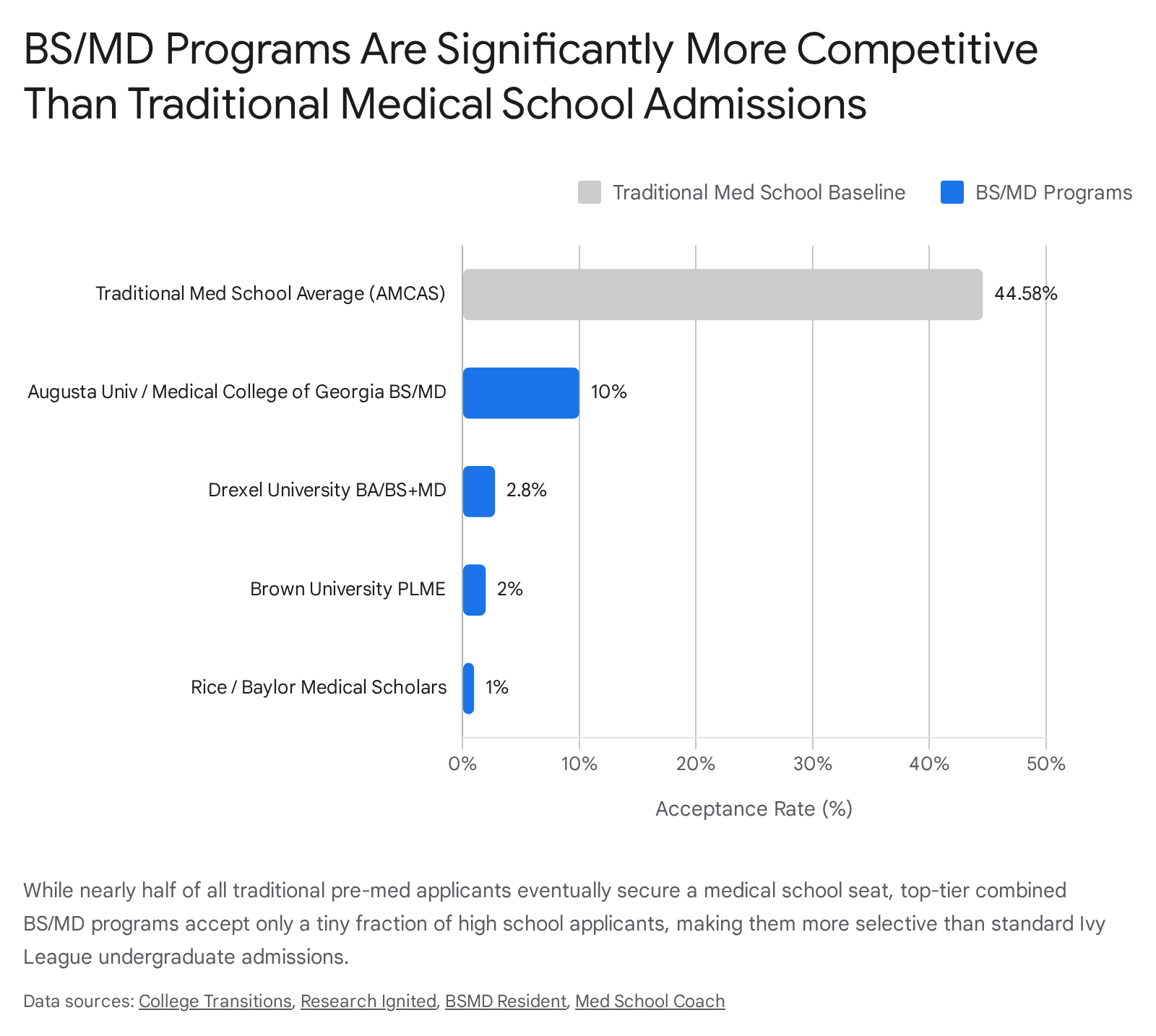
The selectivity of these programs can generally be categorized into four tiers based on recent admissions data 17:
- Ultra-Selective (Under 5% Acceptance): This tier includes programs like Brown University's PLME (averaging 2% to 3.6% acceptance), Northwestern University's HPME (historically around 2%), and the Baylor College of Medicine programs (often below 1%) 81718. These programs routinely receive upwards of 4,000 applications for a cohort of 50 to 80 students 1819.
- Highly Selective (5% to 10% Acceptance): Programs such as Case Western Reserve University's PPSP, Boston University, and The George Washington University fall into this category. They are slightly more accessible than the ultra-selective tier but still reject more than 90% of applicants 817.
- Competitive (10% to 20% Acceptance): State-affiliated programs or newer direct medical tracks, such as those at Drexel University or Augusta University's Medical College of Georgia, often operate in this range. They remain incredibly rigorous but have larger cohort sizes or specific geographic preferences that alter their statistical dynamics 1718.
- More Accessible (Over 20% Acceptance): This tier primarily consists of newer regional programs, heavily restricted in-state pipelines, or combined Bachelor of Science/Doctor of Osteopathic Medicine (BS/DO) options that serve as feeder systems for specific medical institutions 17.
Academic Benchmarks: The Cost of Entry
Because medical school admissions committees are essentially betting on the future physiological and academic success of a high school senior, their preliminary screening algorithms are ruthless. An applicant cannot simply be considered "intelligent"; their academic profile must be nearly flawless to survive the initial culling.
Most established BS/MD programs expect a nearly unblemished high school transcript, with a minimum unweighted GPA of 3.9 out of 4.0 38. Some programs set explicit mathematical floors that cannot be circumvented. For instance, Nova Southeastern University's Dual Admission program requires a minimum 4.0 GPA to even submit an application, while the SUNY Upstate Medical University pipeline mandates a minimum 90% average (or a 3.50 GPA), explicitly stating that they will not round up under any circumstances 113. Furthermore, students must demonstrate mastery of the most rigorous course load available at their high school, frequently maxing out on Advanced Placement or International Baccalaureate courses, particularly in the hard sciences (Chemistry, Biology, Physics) and advanced Calculus 414.
Standardized testing thresholds are equally stringent. Following a brief period of pandemic-era test-optional policies, the majority of programs have aggressively reinstated their SAT and ACT requirements. The competitive benchmark for viable applicants generally starts at a 1500 on the SAT or a 34 on the ACT 34. At Boston University's highly regarded 7-year program, the average SAT score for accepted students is 1530 18. Even state programs demand elite testing profiles; Penn State's Accelerated Premedical-Medical program recently reinstated a strict minimum of 1470 on the SAT or 32 on the ACT just to be considered, though admitted students typically average closer to a 1570 SAT and a 36 ACT 2122.
With the College Board discontinuing SAT Subject Tests, admissions officers have recalibrated their evaluation metrics. Instead of relying on a single SAT Subject Test in Biology or Chemistry, committees now heavily scrutinize AP test scores, longitudinal performance in diverse science electives, and the depth of STEM-related extracurriculars to gauge subject mastery 23.
Extracurricular and Clinical Prerequisites
Perfect grades and test scores are merely the price of admission to ensure an application is read. What truly differentiates accepted students from the thousands of rejected valedictorians is a highly cultivated extracurricular profile.
Admissions committees look for definitive, documented proof that the applicant understands the unglamorous realities of a medical career. This cannot be achieved by simply stating a desire to "help people" in a personal statement 16. Successful applicants typically possess hundreds of hours of clinical volunteering or direct physician shadowing, proving they are comfortable in high-stress healthcare environments 424.
Furthermore, sustained involvement in high-level scientific research is heavily favored. Programs want to see students who have spent multiple years engaged in laboratory work, often culminating in co-authored academic publications, poster presentations at regional scientific conferences, or participation in prestigious, highly selective summer STEM enrichment programs 4816.
Ultimately, the committees are evaluating an applicant's maturity, clinical empathy, and resilience 4. Because they are bypassing the standard AMCAS application process, high school seniors must draft essays addressing complex ethical dilemmas and their fundamental motivations for practicing medicine with the same level of specificity and conviction expected of a twenty-two-year-old college senior 3.
Navigating the Interview Process
If an applicant survives the academic and extracurricular screening, they are invited to interview. During the COVID-19 pandemic, nearly all BS/MD programs pivoted to virtual interviews. However, recent admissions cycles have seen a definitive return to mandatory in-person interviews 1925. Programs such as Nova Southeastern University and the New Jersey Institute of Technology now require candidates to travel to their campuses, a trend that is expected to become the industry standard once again as programs seek to evaluate interpersonal skills in a physical setting 19.
The format of these interviews is also evolving. While many programs rely on traditional panel interviews, a growing cohort of medical schools utilizes the Multiple Mini Interview (MMI) format 1925. The MMI requires students to rotate through a series of short, timed stations where they must respond to complex ethical dilemmas, role-play with actors in clinical scenarios, or demonstrate collaborative problem-solving skills 25. Programs at Drexel University, Union College, Virginia Commonwealth University, and recently Hofstra University all utilize the MMI to test a high school student's on-the-spot critical thinking and ethical reasoning 1925.
The Conditional Nature of BS/MD Acceptance
A pervasive misconception surrounding direct medical programs is that an acceptance letter in high school allows a student to coast through their undergraduate years. In reality, the acceptance into the medical school portion of the program is strictly conditional.
To retain their reserved seat, BS/MD students must hit precise, non-negotiable academic and behavioral benchmarks during their undergraduate tenure.
Undergraduate Maintenance Requirements
This universally involves maintaining a high minimum Grade Point Average. While the exact threshold varies by institution, students are typically required to hold between a 3.5 and 3.8 cumulative GPA, alongside a similarly high science-specific GPA 326. If an undergraduate student in an accelerated seven-year program struggles with organic chemistry or physics, their medical school seat is immediately jeopardized 3.
Furthermore, students must maintain a pristine disciplinary record, adhere to strict academic integrity policies, and often continue to fulfill mandatory community service and clinical volunteer hours. For example, students in the Adelphi University/SUNY Upstate program must log and track specific clinical hours throughout their undergraduate career to prove ongoing commitment to the field 3.
The MCAT Dilemma
The most variable and stressful maintenance condition is the Medical College Admission Test (MCAT). Approximately forty percent of BS/MD programs waive the MCAT requirement entirely, a feature that significantly reduces undergraduate stress 213. Elite legacy programs like Brown's PLME and the University of Rochester's REMS are famous for not requiring their cohorts to sit for the exam 214.
However, the majority of programs do require the MCAT, utilizing it in one of two ways. Some use it as a basic competency formality, requiring a relatively low baseline score (such as the University of Houston's requirement of a 500) to ensure the student can handle standardized testing 26. Others use it as a rigorous hurdle that mimics the traditional admissions process. The University of South Florida, for instance, requires its BS/MD students to score a highly competitive 516 26.
Programs frequently adjust these requirements based on institutional priorities. Case Western Reserve University's Pre-Professional Scholars Program, historically known for waiving the MCAT, recently shocked the admissions landscape by quietly instituting a mandate that its students must achieve a 511 minimum score, with no individual subsection dipping below 124 2122.
If a student fails to meet their program's specific GPA or MCAT benchmarks, their conditional medical school acceptance is permanently revoked. They are usually permitted to finish their bachelor's degree at the host undergraduate institution, but they must subsequently enter the traditional, highly saturated medical school applicant pool if they intend to salvage their medical career 328.
The "Binding" Rule: To Apply Out or Not
One of the most consequential strategic factors a family must consider is whether a specific BS/MD program is binding or non-binding regarding medical school matriculation.
Imagine a scenario where a brilliantly talented student attends a mid-tier state university for their BS/MD program. By their junior year, they realize they have accumulated a 4.0 GPA, co-authored multiple publications, and scored a 520 on the MCAT. They now possess the credentials to realistically gain admission to a top-tier medical school like Harvard, Johns Hopkins, or Stanford.
In non-binding programs, students are explicitly allowed to "apply out." This means they can apply to other medical schools through the standard AMCAS portal while retaining their guaranteed seat at their home institution as a safety net 2930. The University of Pittsburgh's Guaranteed Admissions Program (GAP), Virginia Commonwealth University's GMED, the University of Rochester's REMS, and Florida Atlantic University's dual-degree program all maintain non-binding policies 30. This offers unparalleled flexibility for students who wish to pursue highly competitive surgical specialties where the prestige of the medical school dictates residency placement 29.
Conversely, binding programs strictly prohibit their students from exploring the open market. If a student enrolled in a binding program - such as Hofstra University's 4+4 program or the Adelphi/SUNY Upstate pipeline - applies to a different medical school, they immediately and irrevocably forfeit their guaranteed seat 330. This architecture forces students into a difficult position: they must either accept the medical school they committed to at age seventeen or completely abandon their guaranteed safety net to gamble against the broader applicant pool 29. Generally, all accelerated six-year and seven-year programs, as well as programs that entirely waive the MCAT, enforce strict binding contracts 29.
Comparing BS/MD With the Traditional Pre-Med Pathway
Deciding between a direct medical pipeline and the traditional pre-medical route requires a deep analysis of a student's maturity, financial situation, and career certainty. The decision is not merely about prestige; it is about choosing the correct psychological and educational framework.
| Feature | Combined BS/MD Program | Traditional Pre-Med Pathway |
|---|---|---|
| Application Timing | Senior year of high school. | Junior or senior year of college (or after gap years). |
| Acceptance Rates | Ultra-selective (<1% to 10% average). | Highly competitive (~44% overall AMCAS rate). |
| Program Duration | 6 to 8 years continuous. | 8+ years (frequently longer due to the rising necessity of gap years). |
| MCAT Requirement | Often waived or requires a lower benchmark score. | Mandatory; high scores are the primary filter for admissions. |
| Psychological Stress | One highly intense cycle in high school; undergraduate years are less pressured. | Continuous anxiety maintaining GPA, followed by an exhausting 12-month AMCAS application cycle. |
| Academic Flexibility | Rigid. Locked into one undergraduate institution and its specific partner medical school. | Maximum flexibility. Students can change majors, transfer colleges, or pivot away from medicine entirely. |
| Collegiate Experience | Often accelerated, requiring summer coursework. May miss out on traditional undergraduate milestones. | Standard four-year experience. Ample time for study abroad, diverse non-science electives, and personal growth. |
| Application Costs | Normal undergraduate application fees. | Extremely high (MCAT prep, travel, primary/secondary fees often exceeding $5,000). |
The Flexibility Factor
The traditional pre-medical route grants students the luxury of time and exploration. Traditional students can spend their freshman year taking diverse electives, discovering a passion for medical anthropology or bioethics, and studying abroad in Europe - activities that are exceedingly difficult to fit into an accelerated BS/MD curriculum 1. More importantly, the traditional route allows a student to change their mind. If an eighteen-year-old realizes that they hate organic chemistry and would rather pursue software engineering or health policy, they can pivot their major with relatively little friction 24.
For a BS/MD student, this pivot represents an existential crisis. Enrolling in a combined program means committing to a specific school's geographic location, campus culture, and medical curriculum for up to eight years 3. If the environment turns out to be a poor fit, the options for changing course without derailing one's entire medical timeline are severely limited 3.
Financial Implications and Opportunity Costs
The financial calculus of a BS/MD program is complex, involving both immense savings and substantial opportunity costs.
By bypassing the traditional AMCAS application cycle, BS/MD students save significant capital. Applying to medical school is extraordinarily expensive; traditional students routinely spend between $5,000 and $15,000 on MCAT preparation courses, primary application fees, secondary application fees (often applying to upwards of 25 schools), and travel for interviews 431. Furthermore, by accelerating their education in six- or seven-year programs, students save between $80,000 and $120,000 in undergraduate tuition and living expenses 31. More importantly, they enter the workforce as an attending physician one to two years earlier, vastly increasing their lifetime earning potential and allowing them to aggressively tackle any accumulated debt 5.
However, traditional undergraduate applicants often have access to generous merit scholarships or massive institutional financial aid packages at top-tier universities. Because BS/MD programs recognize they are offering an incredibly coveted asset - a guaranteed medical school seat - they rarely offer significant financial aid or merit scholarships specific to the combined program itself 6. Therefore, a family might find themselves forced to choose between accepting a full-ride merit scholarship at an excellent state university on a traditional pre-med track, versus paying full out-of-pocket tuition for a prestigious, private BS/MD program 6. When making this decision, financial analysts recommend mapping out the total eight-year cost, factoring in the lost wages of potential gap years required by the traditional route 5.
The Shifting Landscape of Direct Medical Admissions (2024 - 2026)
The direct medical admissions ecosystem is highly volatile. Institutional priorities shift frequently, resulting in programs modifying their requirements, merging with new partners, or shutting down entirely. Recent admissions cycles have seen several major structural shifts that dramatically impact how applicants must strategize.
High-Profile Program Closures and Restructuring
Several highly prestigious institutions have recently abandoned the direct medical model. Northwestern University's famous Honors Program in Medical Education (HPME), Boston University, and the Rice University/Baylor program have all permanently shuttered their high-school direct-entry pipelines in recent years 225.
Most notably, the State University of New York (SUNY) Upstate Medical University radically restructured its Upstate Accelerated Scholars (UAS) program. Between 2023 and 2024, SUNY Upstate abruptly severed its BS/MD partnerships with nearly a dozen regional feeder colleges, including Adelphi University, Purchase College, the Rochester Institute of Technology, and the University at Albany 253435. In late 2024, they announced a consolidated, sole partnership with Syracuse University 367. This move effectively centralized their BS/MD pipeline, wiping out multiple entry points and making the remaining Syracuse track intensely competitive.
As high school BS/MD programs close, many universities are transitioning their resources toward Early Assurance Programs (EAPs). Temple University, for example, recently shifted its model away from high school admissions 21. Under their new EAP model, students apply to the medical school during their sophomore or junior year of college 421. This provides the medical school with a massive advantage: rather than evaluating a high schooler's potential, they can evaluate two years of proven, rigorous college-level scientific performance before committing a medical school seat 4.
New Openings and Evolving Models
Despite the closures, the landscape is not entirely shrinking. DePaul University in Chicago recently launched a new eight-year BS/MD program in partnership with the Rosalind Franklin University of Medicine and Science, requiring a 3.8 unweighted GPA and a 1350 SAT for consideration 21. Nova Southeastern University, which historically operated a combined osteopathic (BS/DO) program, recently opened a new allopathic BS/MD track, though it is hyper-selective, accepting only five students per year 25. Indiana University-Indianapolis has also begun accepting students into a newly formed direct pathway 25.
The Post-Pandemic Return to Standardized Testing
During the height of the COVID-19 pandemic, massive disruptions to testing infrastructure forced nearly all BS/MD programs to adopt temporary test-optional policies 233839. While a select few - such as Brown, the University of Rochester, and the University of Arizona - have maintained this stance, the vast majority of BS/MD programs have aggressively reinstated their SAT and ACT mandates 21.
Admissions committees ultimately concluded that without standardized test scores, evaluating the extreme academic rigor required for early medical admission was simply too difficult 39. Even at programs that technically remain test-optional, elite admissions consultants strongly advise applicants to submit a top-tier score. Empirical data from recent cycles shows that students who submit strong test scores are admitted at significantly higher rates than their test-optional peers, as the scores provide a standardized baseline of scientific and mathematical competency 38.
The Surging Popularity of BS/DO Programs
As allopathic (MD) combined programs become mathematically impossible for many highly qualified students, interest in combined Bachelor of Science/Doctor of Osteopathic Medicine (BS/DO) programs is surging exponentially 2122.
Historically, some high-achieving pre-medical students were hesitant to pursue the DO route due to structural concerns regarding residency match rates and access to highly competitive surgical specialties. However, this dynamic shifted fundamentally following the recent merger of MD and DO residency accreditation under the Accreditation Council for Graduate Medical Education (ACGME). Today, graduates of both allopathic and osteopathic medical schools apply to the exact same residency programs using the same matching algorithm 2122.
This merger has dramatically improved outcomes for osteopathic students. In 2024, DO seniors matched at a rate of 92.6%, an all-time high. Furthermore, osteopathic graduates are increasingly matching into notoriously competitive, historically MD-dominated specialties such as orthopedic surgery, anesthesiology, and neurology 2122. Consequently, high school applicants who previously only applied to BS/MD programs are now enthusiastically adding BS/DO tracks to their college lists, transforming programs that were once considered "fallbacks" into premier, highly competitive destinations 2225.
Do Accelerated Pre-Med Students Make Competent Physicians?
A persistent and valid criticism of BS/MD programs - particularly those that waive the MCAT or compress four years of undergraduate biology and chemistry into three years - is that they might produce less capable medical students. Detractors argue that skipping the MCAT and bypassing the brutal academic crucible of the traditional pre-med track removes a vital vetting mechanism, potentially weeding out the resilience required for clinical medical training 12.
However, longitudinal academic data suggests these concerns are unfounded. A comprehensive study published in the peer-reviewed journal Academic Medicine analyzed 2,583 students entering Northwestern University's Feinberg School of Medicine over a fourteen-year period. The researchers compared the performance of students originating from the school's accelerated, MCAT-waived HPME program against traditional medical students who fought their way through the standard AMCAS application cycle 8.
The educational outcomes were virtually indistinguishable. Accelerated BS/MD students scored an average of 231.7 on the critical USMLE Step 1 licensing exam and 236.8 on Step 2, compared to traditional students who scored 233.0 and 237.7, respectively - a statistically insignificant margin 8. Furthermore, the accelerated cohort demonstrated a slightly higher overall graduation completion rate (97.2% versus 95.8%) and were selected for the prestigious Alpha Omega Alpha (AOA) national honor society at nearly identical rates (16.9% versus 16.7%) 8.
These findings indicate that the rigorous high school screening process utilized by BS/MD admissions committees is highly predictive of future medical school success. For this specific, highly vetted population, the traditional pre-medical gauntlet and the MCAT itself appear functionally unnecessary to produce competent, successful physicians 8.
The Hidden Crisis: Burnout and Mental Health in Combined Programs
While the objective academic and career outcomes of BS/MD programs are undeniably strong, the psychological toll of locking into a high-stakes medical career at age seventeen is severe. Medical education is universally recognized as stressful, but students in accelerated pre-medical pipelines face unique, compounded pressures that are currently causing alarm among academic medical educators 419.
A recent extensive survey of pre-med and medical students revealed a terrifying reality regarding the mental health pipeline: a staggering 86% of respondents reported experiencing symptoms of stress or burnout (quantified as feeling exhausted "often," "sometimes," or "almost always") within the past year 43. Even more concerning, 76% of those surveyed admitted that this burnout had caused them to actively consider delaying their education, taking a leave of absence, or abandoning the medical path entirely 43.
The causes of this burnout crisis in combined and accelerated programs are multifaceted:
- The Firehose of Academic Compression: In six-year and seven-year programs, students must absorb the same massive volume of organic chemistry, cellular biology, and systemic physiology as their traditional peers, but in significantly less time 10. This academic compression necessitates relentless studying, leading to chronic sleep deprivation, cognitive exhaustion, and an inability to process information deeply rather than just rote memorizing it 1011.
- Social Isolation and the Loss of Youth: While traditional college freshmen are exploring different academic majors, joining social organizations, and experiencing the formative growth of early adulthood, BS/MD students are often sequestered in the library or fulfilling mandatory clinical rotations 110. This inability to participate fully in normal young adult milestones fosters deep resentment, social isolation, and professional cynicism 1046.
- The Trap of Early Commitment: A traditional pre-med student who struggles mightily in organic chemistry can easily pivot their major to business, engineering, or education. A BS/MD student who realizes at age nineteen that they no longer desire a career in medicine faces a profound existential crisis. They have anchored their entire collegiate identity - and frequently their family's immense expectations - on a singular decision made while they were still in high school 2443. Unwinding that decision feels impossible to many students.
Disproportionate Impact on First-Generation and Minority Students
This burnout crisis is particularly acute among first-generation college students (FGCS) and underrepresented minorities (URM) in healthcare programs.
Recent research published in the Physical Therapy & Rehabilitation Journal by faculty at the University of Washington highlighted the systemic vulnerabilities of these populations. The survey of over 600 graduate health profession students indicated that FGCS were 50% more likely to experience clinical exhaustion compared to their peers whose parents attended college 1213.
Furthermore, first-generation students were three times more likely to report severe family-induced stress, and 74% more likely to suffer from acute financial stress 13. The profound pressure to succeed and elevate one's family socioeconomically, combined with the sheer, unyielding academic volume of a combined medical program, creates a volatile psychological environment long before the student even begins their formal clinical rotations as a physician 1213. Medical educators are increasingly calling for structural reforms, including expanded mental health access and less rigid timeline expectations, to prevent burning out the future healthcare workforce before they even reach the hospital floor 4112.
A Geographical Overview of the BS/MD Landscape
To understand the breadth of options available, it is helpful to look at the geographical distribution of established combined medical programs across the United States. While programs frequently open and close, the following table represents a cross-section of highly regarded, stable BS/MD programs as of the 2025 - 2026 admissions cycle, demonstrating the variety of timelines and MCAT requirements across different states.
| State | University Program | Partner Medical School | Duration | MCAT Requirement |
|---|---|---|---|---|
| Alabama | University of Alabama at Birmingham (EMSAP) | Heersink School of Medicine | 8 years | Required (Target 506+) 226 |
| California | California Northstate University BS/MD | California Northstate University | 8 years | Required (511 minimum) 226 |
| Florida | Florida Atlantic University (FAU BS/MD) | Schmidt College of Medicine | 7-8 years | Required (Target 510) 226 |
| Florida | University of South Florida (USF BS/MD) | Morsani College of Medicine | 7 years | Required (Strict 516) 226 |
| New York | University of Rochester (REMS) | UR School of Medicine and Dentistry | 8 years | Waived 226 |
| New York | Syracuse University / SUNY Upstate | SUNY Upstate Medical University | 7-8 years | Waived 27 |
| Ohio | Case Western Reserve University (PPSP) | CWRU School of Medicine | 8 years | Required (Strict 511) 221 |
| Pennsylvania | Drexel University BS/MD | Drexel College of Medicine | 8 years | Required (511-513 target) 226 |
| Pennsylvania | Penn State / Sidney Kimmel (PMM) | Thomas Jefferson University | 7 years | Required (Target 508) 7226 |
| Rhode Island | Brown University (PLME) | Warren Alpert Medical School | 8 years | Waived 22 |
| Texas | Baylor University BS/MD | Baylor College of Medicine | 8 years | Required (Target 508) 226 |
| Washington D.C. | George Washington University BA/MD | GWU School of Medicine | 7 years | Waived 6226 |
Note: Requirements change frequently. Applicants must verify specific MCAT thresholds and application deadlines with individual university admissions offices.
Bottom line
A BS/MD program is the ultimate high-risk, high-reward proposition for an academically gifted high school senior. For the rare student who is unequivocally certain they want to dedicate their life to medicine, possesses flawless academic credentials, and values a streamlined, guaranteed path over collegiate exploration, it is an unparalleled opportunity that eliminates the brutal anxiety of traditional medical school admissions. However, families must understand that this path is not a shortcut; it demands immense sacrifice, carries a severe risk of early-career burnout, and requires an adolescent to lock into a decade-long professional commitment before most of their peers have even declared an undergraduate major. As the admissions landscape continues to evolve - with shifting MCAT rules, program closures, and the rise of BS/DO alternatives - applicants must prioritize long-term psychological fit and institutional flexibility over mere prestige.